Dr SAZI DLAMINI
In memory of Abbey Duze Mahlobo and The Malopoets
‘I only play my compositions’ Duze Mahlobo
On 5 May of this year I was jolted by a call from Fika Mahlobo – who had never called me before – informing me that his second eldest brother Abbey Duze Mahlobo (1953-2026) had passed away in the early hours of the morning. The self-taught guitar master from Durban’s KwaMashu township was also pianist, electric bassist, mbira-player and pennywhistle flautist. As Duze Mahlobo’s friend and musical admirer for nearly four decades and also being hugely indebted to his guitar influence, I’m left with a sense of unresolvable and irreplaceable loss.
Like most of us who knew Duze and were aware of his periodic health challenges due to an enlarged prostate gland, I had been fooled by his characteristically wily stubborn self, his resilient humour, and his undimmed vision of a future crowned by a triumphant stage appearance – of performing and recording music… together …someday.
Duze Mahlobo was born in 1953 in Lamontville, Durban’s oldest township built 16km south of the city to house middle-class and black African workers. Since its founding in 1934, Lamontville township has garnered an illustrious and pioneering history of cosmopolitan cultural achievements in the fields of music, education, sports, apartheid resistance politics, beauty, fashion and crime. The second born of ten siblings Duze grew up in Lamontville, where he was introduced to jazz-inspired tap-dancing by his father, Mr Ndabenhle Mahlobo, who was himself tap-dancer and pianist. Both his parents were active participants and organisers in the vibrant ballroom and tap-dance social culture in Durban where the senior Mahlobo had beed a tap-dancer with The Airport Shots, one of many among Durban-based variety entertainment troupes since the 1940s. He later founded and trained his own group The Streamliners who until the early 1960s, were performing tap-dance to live jazz, ballroom dance music and, as he recalled, “anything else that you could sing, anything that was rhythmic”. When the family relocated to KwaMashu township 20km northwest of Durban in 1962, Duze was introduced to the guitar by his musical friends.
In 1997 I had come to interview Duze Mahlobo at his parents’ home in KwaMashu, K Section when his father candidly joined us in conversation, confessing a much regrettable lapse of memory…
Duze: I was taught by my father at a very young age, who insisted that I dance in my unwieldy school ‘bovver boots’ while he danced in his steel-capped shoes. My ‘bovver’ shoes were then affixed with shoemaker’s metal tabs under the toes and heels because of my eagerness to achieve the same ‘clicky’ sound as my father’s. Only now do I realise the teaching method he was applying. At the time I did not know any better. He was trying to train me to control and discipline my feet as I was very impulsive then… which I still am today!
Mr Mahlobo: … He had large feet and could not do this… [demonstrates a ‘toe-heel’ tap, approximating a ‘double quaver’ rhythmic figure]. Now then, he would not have been able to execute a movement such as… [taps a rapid ‘quintuplet’ rhythmic figure using both feet].
Duze: That’s what he was trying to control and because I was floundering, I had to start with an uncapped pair of boots. At the time I thought he was short-changing me as ‘his’ shoes gave a nice ‘click, click, click’ sound.
Mr Mahlobo: It’s not ‘them’!
Duze: Of course, I didn’t understand then and it used to upset me really bad. Still, being a child, I had to do it and in the process of trying I earned myself a nickname, Ququdu[1]‘qu-qu-du’ – a Zulu ideophone, an onomatopoeic term deriving from a triplet rhythmic figure, in this case a sound by especially ‘boot-clad’ feet stepping on a hard surface., due to the sound I always managed to elicit from stiff boots. As time went by, my father started to include me in concerts in Lamontville and other places I cannot remember…where I would ‘ququdu’ away, performing tap-dance.
Mr Mahlobo: …and the Zulu “isicathulo”…the gumboot. I used to teach them that as well.
Duze: Of course, gumboot-dancing. Over and above that, there was a piano at home, I used to listen and watch my father play. He used to play that too, even although it was not his main pursuit. I would often try to imitate him…that’s how I started to play the piano. When we moved house to come to KwaMashu, the piano was sold as it was too heavy to move around.
Listening to this exchange between father and son, I realised the special relationship they shared. This was a kind of relaxed familiarity that was commonly missing in day to day parent-child communication in particularly Christianised black families. The combined censorial countenance of church and school had succeeded in supplanting the naturally uninhibited relationships between traditional family members of different ages and gender. Invariably in most such families even human anatomical parts had to be renamed to replace their indigenous terms of reference that Christian sensibilities had come to consider as barbaric.
I have known the situation of unemployable offspring among township families to be the cause of intolerable stress and deep resentment between family members, especially in instances where the family members depend solely on an elderly parent’s meagre pension for survival. I wondered if Duze’s father, as a result of his own experiences as a performer, had come to understand his artistic son’s frustrations better. I was very curious about the type of music Mr Mahlobo and his troupes were performing and tap-dancing to in the late 1940s and the early 1950s.
Mr Mahlobo: ‘At that time, it was jazz… but wait a minute… it was anything really… anything that was rhythmic’.
Sazi: So then, your initial experiences on stage were as a tap-dancer…but tell me, how did you become an instrumentalist?
Duze: I was not playing any instrument then. I was very young, about eight years old when I was tap-dancing. I fell in love with an instrument that my family owned at home. I was crazy about the piano, and I used to play on our acoustic upright whenever I could. When the family left Lamontville to come here, I decided to learn another instrument. We did not bring the piano over here… we could not carry it, so I tried the guitar… in the 1960s. When we arrived here in 1963, I decided to learn another instrument. I chose the guitar, which I carried on playing, even though I really had no idea what I should be doing.
The first time I encountered Duze Mahlobo performing was in a concert of the Malopoets featuring two guitarists (the other guitarist being Sam Shabalala). Headquartered in Durban, Malopoets included musicians Pat Sefolosha (lead vocalist, percussion, alto saxophone and pennywhistle flute), Madoda Bruce Sosibo (drums), Pat Mokoka (electric bass), and Sam Shabalala (guitar) together with student activists, writers and poets Ben Langa, Mafika Mbuli, Eugene Skeef and others. The concert was inside the chapel hall at Amanzimtoti Zulu Training School – previously Adams College – where I was a matric student in 1979.
The Malopoets were formed as a result of a merger between Afrika and Third Generation, two bands from Mamelodi (Pretoria) and KwaMashu (Durban) townships respectively. Afrika was led by the flautist Abie Cindi of the ground-breaking Malombo Jazzmen trio that was completed by guitarist Philip Tabane and meropa drummer Julian Bahula. The Third Generation was a KwaMashu band that Duze Mahlobo and drummer Madoda Bruce Sosibo had first played in together professionally on stage, prior to their forming Malopoets.
Duze Mahlobo’s passing is lamented by all who associated him with the radical impulse of the Malopoets’ engagement with pan-African and black conscious orientations in their performances of music, poetry, black historical narratives and visual arts. Less than a year after Steve Biko’s assassination The Malopoets’ launched from within the township’s cultural atmosphere that was still reverberating with 1976 Soweto youth revolt. Their blossoming from a heavily politically-charged black sociocultural milieu signalled unambiguously to the music’s assumed agency of articulating African spiritual roots to a renewed wave of black popular resistance to apartheid.
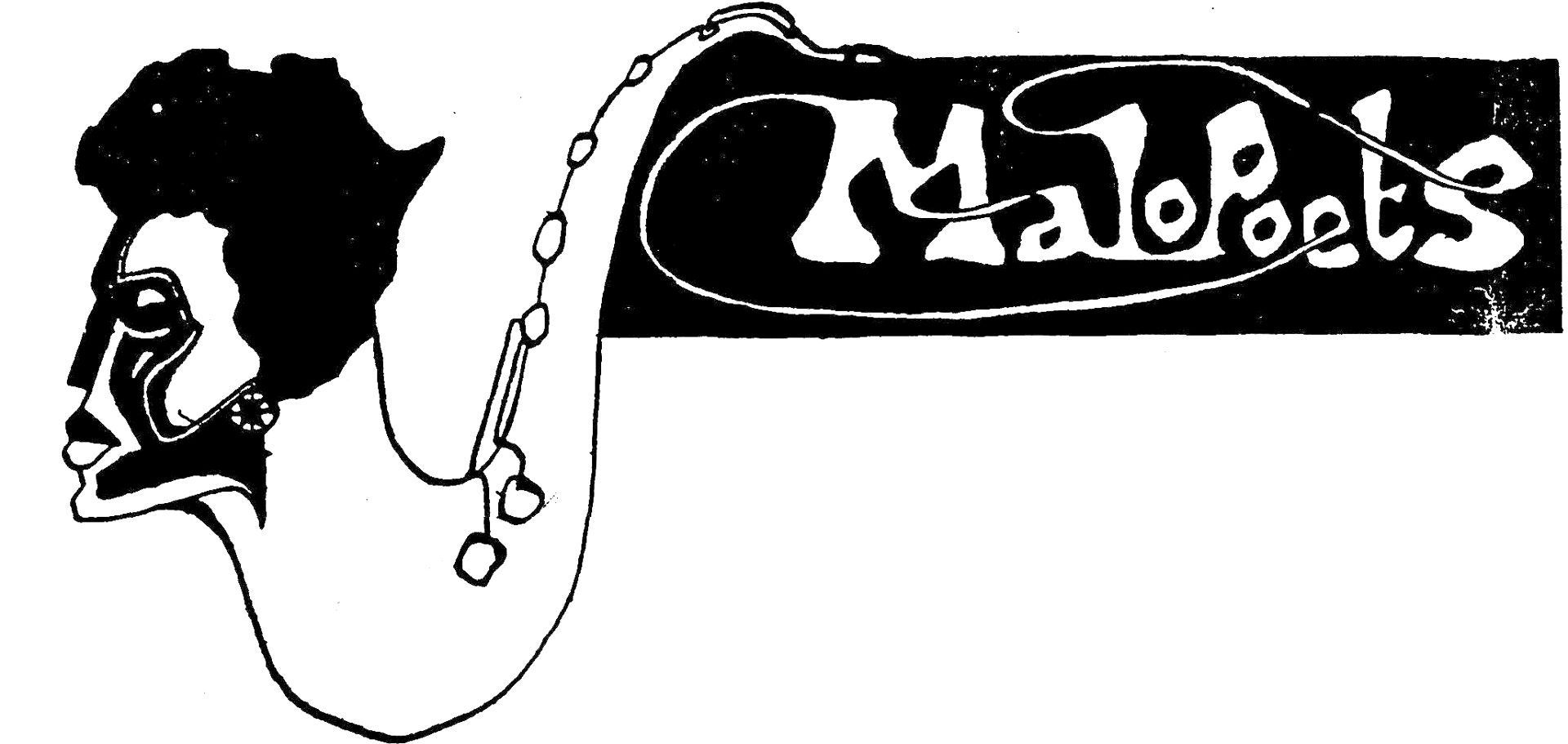
(On the 17th of July 1967 John Coltrane passed from before our closed eyes with the heavy weight of song. On the 17th of July 1978 the souls of Malopoets were totally imbued with the energizing spirit of this bard of sound. For this timely birth we have the unity of life to humbly thank.) In the next issue, Malopoet ”Mafika P. Mbuli’s poem, ‘In Memoriam: Speak Like A Child’ will appear.
In the temporal margin of night and light
In the spatial flight between birth and death we await our souls
Who am I
Who am I Standing amid
the harmattan’s disarray
Who am I
the elephant-skinned drum echoing the dawn of creation
Who am I
the memories in songs of supple maidens
balancing embellished calabashes on their plaited heads
Who am I
with ivory beads in my eyes straining under the kingly weight of the child of human time
Yet in my bearing
my mirth is echoed in universal thunder
Who am I
whose tears of timeless wails
have quenched the world’s lustful thirst whose sweat anoints
the stone and steel of her every tower
Who am I …
Strung taut between my zenith and the weaning earth-mother what plaintive melody
I carve into the mysterious night
Attend warily my mahogany silence embracing the drum
the oracular quivering to the dance of shades
With my tempered blood-surge the dismembered horn
must cry the cow to life
Hear my portentous timbre for I am the Gwababa perched on a wrinkled twig of the mortar tree
singing dissonant sonnets above the raucous glee
I am the midnight sough the light of day
is the unfolding of my song
My son is the sigh of Gods Listen high and low
for my voice is far-reaching
Life of perpetual separation – Group Areas, Migrant Labour, Race
Classification etc., Keeps us apart all the time.
And each time I crawl to my kraal,
I feel, in the deep recesses of my soul, The agonies of happiness
The sores eternally festering in the heat of my passion.
I long for the blanket of darkness To crawl out of my pained heart
To reach out for the sourness of joy
Yet knowing that the dark night is a refuge Protecting me from the pain of unfulfilled promises.
In the deep recesses of my heart, Countless hours of pain and hurt,
Fill the cavities left by fleeting tenderness.
Across the dividing line
Let me live earnestly, love painlessly Balm the scalds on my burnt body
To live to love,
Painlessly.
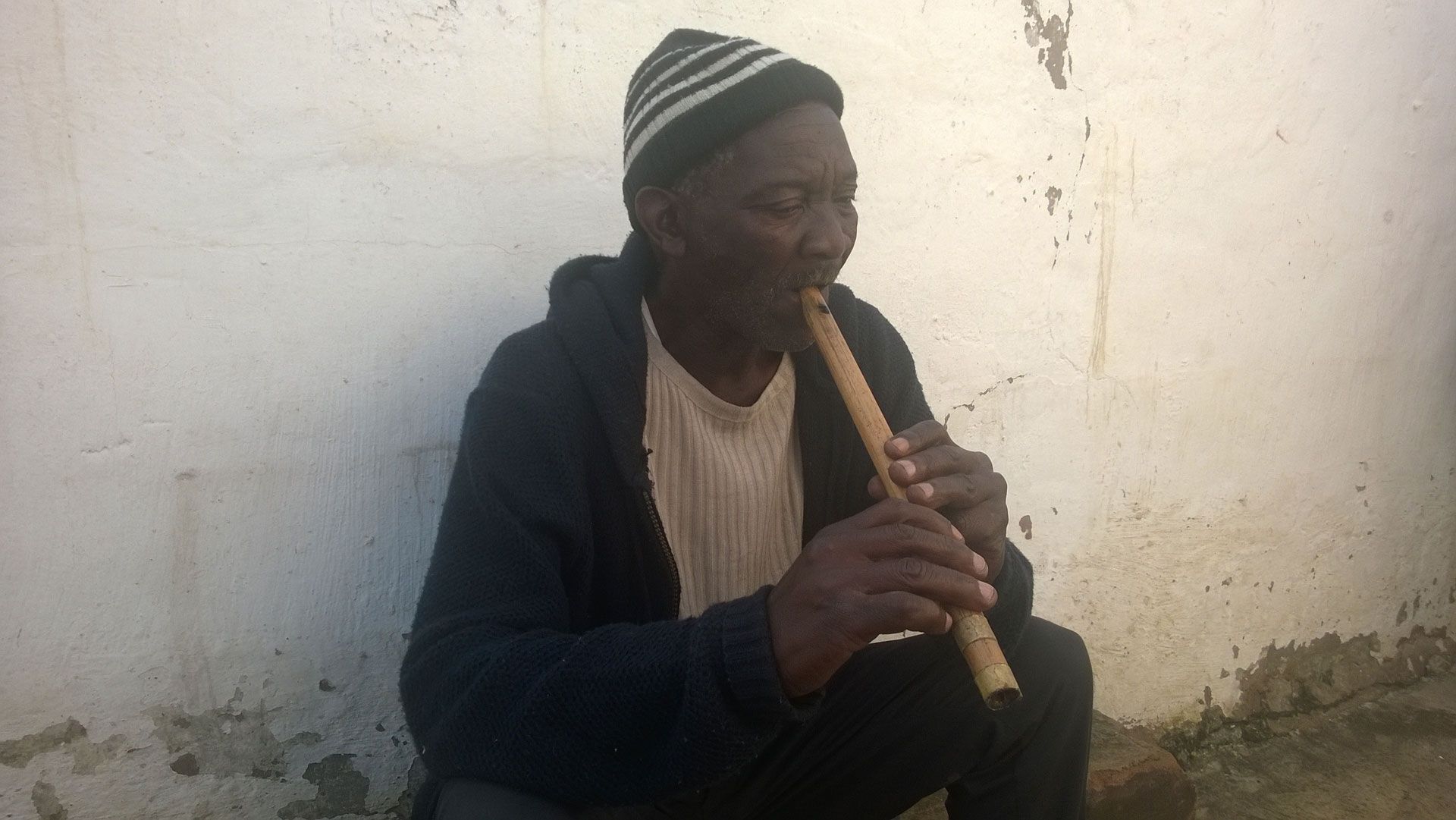
I am distressed not so much by the rite of Duze Mahlobo’s mortal passing as by his shadowed passage as a musical artist, and the residual ignorance by both the South African jazz appreciating, practitioner public, culture and heritage, promoter and performance media world. A master tape recording of what would have been The Malopoets’ debut album, the iconic but short-lived multi-disciplinary resistance art ensemble of which Duze Mahlobo was principal co-founder, ‘disappeared’ when it was confiscated and apparently destroyed by apartheid security police. The group managed to record only one other album, Malopoets-Fire [1982] CCP Record Co. MINC (L) 1031.
Echoing the defiant wave of black power consciousness and the cultural mobilisation of popular resistance against apartheid in the turbulent wake of the 1976, the founding of Malopoets in early 1978, mere months following the death of Steven Bantu Biko, was accompanied by the founders’ declaration of black diasporic and pan-African solidarity:
‘THANKS TO ALL THE WOMEN IN AFRICA WHO ARE EXPECTING. THROUGH THEM THE FUTURE LEADERS OF THIS DARK CONTINENT WILL BE BORN’
The great musician John Coltrane died on 17th July, 1967. Eleven years later, to the day, THE MALOPOETS were born. The group searches in their music for an authentic, indigenous African sound. As the name suggests (MALOPO – Sotho for Spirits, POETS – interpreters of the spiritual language), they pledged themselves to the enunciation of the wisdom of the Spirits that are hovering over us all the time and of which we are consciously aware’ (Pat Sefolosha 1979).
The album was radical in its rootedness in potent indigenous African concepts of spiritual and material symbolism. Compositions titled Exikwembu [It’s God], Call of the Spirits; and Meropa Badimo [Drums of the Spirits] invoked African spiritual symbols and affirmative ritual practices, birthright, gendered rites of passage, African solidarity, celebration of African self-hood and shared African cultural histories. Bearing titles such as Bamakweru [Brothers and Sisters], Mem’ Afrika [I The African], Regomotse [We’re Silent, We’re Not Speaking], Thabi [Happiness, Marriage], and Maboko [Celebration], the album’s songs texts resonated with a coeval rekindling of black political and cultural consciousness in South Africa. It is undoubtably the contentiousness of such issues during South Africa’s apartheid era, that led to the ‘disappearance’ of the master tapes of the album before it was commercially released.
For a collective like Malopoets whose music, poetry and visual art overtly espoused discursive resistance against apartheid’s obliteration of black bodies and minds, financially rewarding engagements were ruled out. Their overtly radical black-conscious and pan-Africanist political leanings ruled commercial success out. The late Ellinor Herman who was the Malopoets’ managing member later recalled the prevailing conditions at the time,
‘… we couldn’t play in white clubs, that’s where we could have made the money. As far as I remember we only played at the beginning in one white venue in the yacht harbour…there was that fish and lobster restaurant…but then we had to apply to Pretoria for a special permit. That must have been around 1977, 1978.’
The white liberal university, colleges and cultural events of the besieged anti-apartheid movement provided the few outlets Malopoets could popularise their music and its message among a sympathetic, youthful and politically sensitized audience. Needless to say, the band members and their associates came under the harsh radar of the South African police’s Security Branch. On a harsh personal level Duze Mahlobo daily risked arrest because he was romantically involved with a Jewish woman. On tour with Malopoets he expended much time hiding from security police in attics and hotel room closets until he was able to cross the border into Zimbabwe. The ensemble’s fugitive existence under surveillance by apartheid police effectively cemented a permanent break-up of the original formation, and the exiling of its musicians to different locations in southern Africa and western Europe.
It was around 1981 when Duze left South Africa with his wife to live in Zimbabwe in a move that virtually dissipated the Malopoets. Eluded by success in the country of their birth, the remaining band members soon left South Africa to seek better opportunity abroad. When the band later regrouped in Paris for a recording, their music had decidedly lost its vital edge of apartheid-defying earthiness and conceptual integrity of resistance that had sustained the band during the challenging South African phase of its existence. Duze Mahlobo, who was not involved in this reunion did not mince his words in his dismay about the band’s debut album in exile,
‘That was “cheapline”… the sense of South African roots was alienated … they also killed the sound by including an electronic keyboard’ (Duze Mahlobo).
Mahlobo was referring to the band’s Paris produced album, entitled Malopoets [CCP Record Co.1984]. The overseas production had lost sight of the cultural symbolism imbued in the band’s image within South Africa. The producers had chosen, for the album sleeve, to pose the band in front of a museum collection of Central and West African indigenous spiritual artefacts including fertility dolls, carved totems and masks.
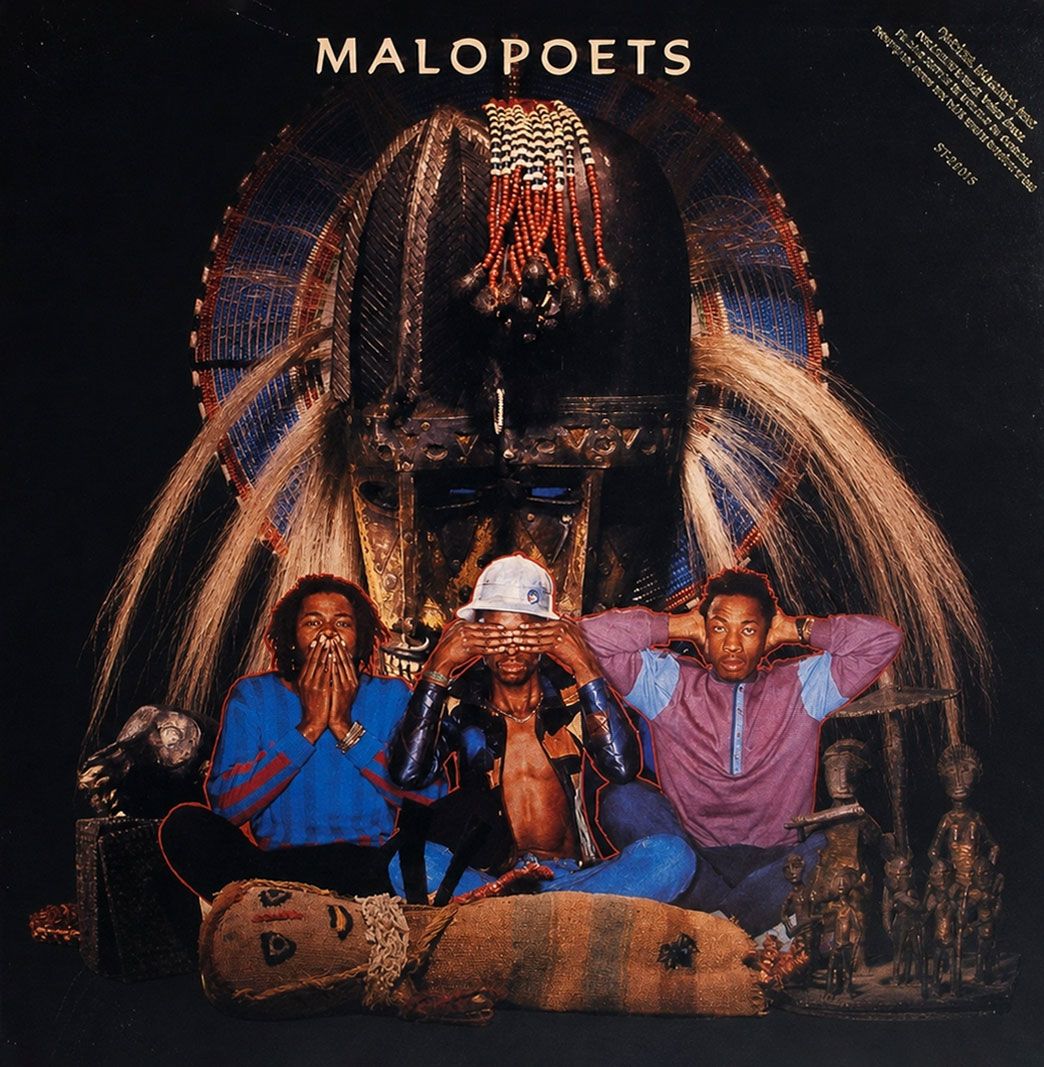
The contradictions were further compounded by the band members’ appearance in ‘designer’ jeans, processed leatherware, sports sweaters and ‘American basketball’ sneakers. The band’s stage attire during their South African phase had consisted of pan-African dashiki caftans, beads, sandal footwear and often unclad torsos. In his criticism, Duze felt strongly that a group comprising culturally emancipated Nguni, Tswana, Shangaan, Pedi and Sotho youth would have been more respectable donning local beads, hairstyles and even hide materials such as shields.
Duze Mahlobo was ever reluctant to discuss freely his experiences during his time in exile, a period which clearly represents personal struggles that left him disillusioned and musically alienated.
Duze: Yes, my brother. That is how things turned out…You amaze me by asking me about painful issues… (At this point Duze starts to tune his guitar)
Sazi: …So… from there onwards, what directions did your musical development take?
Duze: I was very much frustrated by the band …working with a large band frustrated me a lot, but it also made me grow to be able to incorporate much more. Much more is now possible – I have been afforded a larger scope. In this way it also helped me because I had never dreamt that I would be able to play solo guitar. For three years I worked very hard, playing alone without public performance and studying at the same time. I had to develop a solo repertoire – I was living in Zimbabwe at the time.
Sazi: Where were you studying…What was the name of the school?
Duze: …Nongoma…I think that was the name – because it was in Bulawayo.
Sazi: …those are Nguni names…
Duze: Yes, they are of Zulu origins…it was Nongoma Training College. It was not called a music college. If I remember correctly the teacher’s name was[2]Dumisani Maraire – the late ethnomusicologist and music professor.…. I once saw him in a local television programme on his visit to this country. He was travelling with his ensemble. He used to teach marimba and mbira. I keep forgetting what his surname was.
Sazi: Did the college have a music department?
Duze: Yes, and they used to deal solely with mbira and marimba – and that is where I learnt these instruments …marimba, mbira and also umakhweyana bow. I had been introduced to the latter instrument while I was still in Johannesburg – by the mineworkers. In Pretoria too, rural migrant workers possessed a fuller knowledge of traditional instruments. We used to visit them in the compounds – and they had come to trust us because we showed them respect. That is where I came across this knowledge.
Sazi: Did you then leave for Europe immediately after Zimbabwe?
Duze: Yes. It was becoming very complicated to return – one could not cross the borders back and forth easily. I opted to go (West) Germany, where I could not be recognised. While I was not happy to do this, I still had no choice.
Sazi: Did you regroup as MALOPOETS when you were abroad?
Duze: No… never.
Sazi: Who did you perform with then while you were in exile?
Duze: Bheki Mseleku, Steve Neil… an African American bassist and former husband to singer Busi Mhlongo, percussionist Dumisani Mabaso who is based in Germany… also with Reiner – a German, on bass. I am just counting the people I performed with, and not in any order. I also played with Thebe Lipere… the percussionist, Eugene Skeef, an Italian tenor saxophonist, Julio and his brother, Steve, who played drums. We were only performing my music.
Sazi: Where can one get hold of that music?
Duze: It was lost.
While living in London, Duze was briefly involved with an innovative group of open-minded and experimental musicians who went under the name Loose Tubes and included brothers Steve and Julian Arguelles on drums and saxophone respectively. Among their repertoires were included Duze Mahlobo’s original guitar compositions, which he arranged for two saxophones, drums and guitar.
From the time of his return to South Africa in 1989 until his death, Duze Mahlobo had difficulty working with established musical performance outlet and commercial institutions of music production and their representatives, including market-oriented promoters of South African township music. Over the years, Mahlobo’s initial disillusionment grew steadily, culminating in a frustrated impatience and alienation. Duze once observed during our conversation nearly a decade after his return from exile,
‘The location is a concentration camp. It was designed for the population, the “so-called black man, so that he could not escape. In every township, if you remember well, there are only two exits. Some, like Lamontville and Chesterville are cul-de-sacs…one and the same…the entrance and the exit. Ya…it is a concentration camp. No one possessing a mind capable of beauty could have built the location...could design the location as it exists’.
The depressing sense of the township’s location however did not successfully suffocate his uniquely individual, jazz-influenced guitar style and his resisting impulse as a historical grounding of township musical performance traditions. May his dreams and prayers for love, beauty and peace be yet fulfilled for us the living.
Cover photo on the top of this page of Duze Mahlobo is by Hugh Mdlalose.
Mem’ Afrika (I The African), Malopoets’ iconic signature song performed live in concert at the University of Zululand in 1979.
Duze Mahlobo’s [untitled] composition which he arranged for the London band Loose Tubes.
Duze Mahlobo demonstrating an improvisational single line guitar approach.
Duze Mahlobo’s guitar composition in the tuning E A D g b e.
A short guitar passage demonstrating the tuning E A D g a e.
Duze Mahlobo’s guitar composition in the tuning E A D g a e with a Zulu guitar maskandi influenced introduction.
Duze Mahlobo’s guitar composition in the tuning C A D g c e.
Duze Mahlobo’s guitar interpretation of the Zulu maskand
A guitar and drum duo performance by Duze Mahlobo and Madoda Bruce Sosibo at a music festival at the University of Natal in 1990.
| 1. | ↑ | ‘qu-qu-du’ – a Zulu ideophone, an onomatopoeic term deriving from a triplet rhythmic figure, in this case a sound by especially ‘boot-clad’ feet stepping on a hard surface. |
| 2. | ↑ | Dumisani Maraire – the late ethnomusicologist and music professor. |