CY CANTEREL
Living with Ghost Machines - Generative AI as hauntological determinism
“One must adapt himself to the inevitable, and I have long accustomed myself to being dead.”
Wilhelm Jensen, Gradiva
Jacques Derrida’s office is small and grey and messy: books and folders spill behind his desk, papers and ashtrays scatter across it. Wan light from a shaftway filters in and suffuses the scene. There is nothing on his walls, at least nothing we can see. A young woman named Pascale Ogier sits across from the older philosopher, her dark hair piled on top of her head. She has aquiline eyebrows, touches the corner of her mouth: self-conscious, a bit arch.
“Do you believe in ghosts?”, she asks.
I am watching Ken McMullen’s 1983 film Ghost Dance, in which Derrida plays himself. He dangles a rough-cut pipe in one hand, unlit (very philosophical), considering his answer.
“That’s a difficult question. Since I’ve been asked to play myself in a film which is more or less improvised, I feel as if I’m letting a ghost speak for me. The cinema is the art of ghosts, a battle of phantoms. It’s the art of allowing ghosts to come back. That’s what we’re doing right now.”
He smiles at Pascale, stops to answer a telephone call, switches to English, then back to French.
“I believe that modern developments in technology and communication, instead of diminishing the realm of ghosts, enhances their power and their ability to haunt us. In fact, it’s because I wanted to tempt the ghosts out that I agreed to appear in a film.
Whether I believe in ghosts or not, I say long live the ghosts. And you, do you believe in ghosts?”
She smiles in return, answers, her voice reedy, almost singsong:
“Yes, certainly.
Yes, absolutely.
Now I do, absolutely.
Now, certainly.”
…trailing off, scene fades…
And now, of course.
Within a year Pascale Ogier would be dead at 25. Decades later, Derrida would describe watching Ghost Dance again at the request of students. He saw her face (the face of a dead woman) answering his question about ghosts, looking fixedly out from the screen, saying yes, yes, yes. Now I do. The uncanny vertigo of that moment: which “now”? The now of filming, when she was alive? The now of his watching, when she was dead? The perpetual now of the image, which exists in neither past nor present but in some spectral middle state?
“It was already there, she was already saying this, and she knew, just as we know, that even if she hadn’t died in the interval, one day, it would be a dead woman who said, ‘I am dead’”, he writes. Even when she was alive, sitting in his office, the camera was turning her into a ghost. When you watch someone onscreen, you’re not seeing them; you’re seeing their trace, their image severed from the moment it was recorded. The person you’re watching is no longer there. What returns is only the revenant: something that comes back without ever having been truly present.
Film doesn’t capture presence; it automates absence. It records and reanimates the trace.
This, Derrida said, is what media does. It doesn’t preserve the real; it produces ghosts. And that was the early eighties, when the technology was still analog, still tied to physical celluloid, still recognizably material and mechanical.
Derrida, too, is a ghost. Dead in 2004, at the beginning of the digital media boom. Now, not long after, technology companies have developed large language models: gargantuan systems that have unconsciously concretized Derrida’s insights and scaled them across media— systems that have in fact eaten his words, his likeness, his movements, and can reanimate him (along with everything else they’ve digested) on demand. The traces become data, metadata, a soup of statistical averages waiting in the blippy dark for the incantation we call a “prompt” to resurrect them, recombine them, spit them out into a paste of sense.
Generative AI is, in other words, an almost perfect invocation of what Derrida called hauntology: a state of being continually haunted by non-being— by ideas, meanings, histories that refuse to die. The past and the future continually intrude on the present, preventing any kind of neat closure. Cultural theorist Mark Fisher (now also a ghost) extended hauntology in the 2010s, using the concept to call out the stagnation suffusing late capitalism, the strange leadenness that attaches to its cultural products. For Fisher, what haunts us is the “spectres of lost futures”, the futures that modernism promised us but which failed to materialize. Instead, we get culture endlessly looping through its own archive, pulling magpie-like from bits of this or that flotsam, pasting things together into a pastiche of longing. Things we never/always had, never/always beheld, never/always heard. Ghosts.
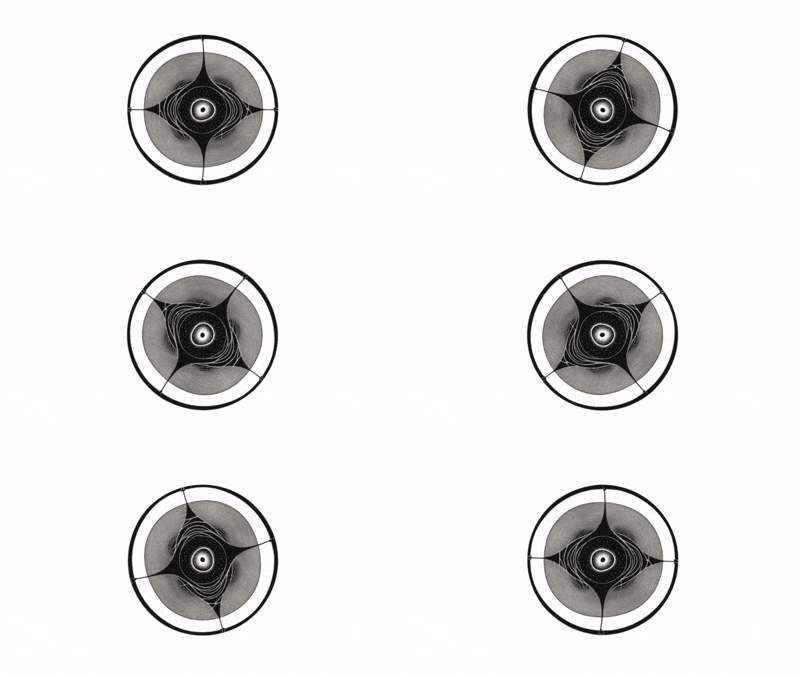
Large language models are exactly this: they are ghost machines, constructed entirely from the extinction of origins. When a model is “trained” (when it is taught to recognize the patterns in language) it is fed massive amounts of human-generated text. This text is not ingested as text, however, but is abstracted into a system of numeric identifiers called tokens. A token might stand in for a word, a contraction, a punctuation mark, or groups of letters— each company, each model, ‘sees’ a text differently. GPT’s tokens are different from Claude’s, which are different from Llama’s. Even when trained on identical text, they create incompatible sign systems. They don’t ‘speak’ English, or any other human language, nor can they communicate directly to one another.
Each phrase, each sentence fed into an LLM thus becomes a series of numbers, crunched through billions of parameters, producing probability distributions. What comes back out looks like language, but it’s simply the statistical ghost of every similar sentence in the training data. The AI doesn’t understand what it’s saying because it’s not ‘saying’ anything. It’s channeling, performing presence without being present. It’s a revenant— something that returns without having been in the first place.
This is why calling LLMs “linguistic engines” is inexact at best. They’re semantic engines. They operate on meaning-as-pattern, not language-as-communication. They manipulate the statistical residue of meaning without accessing meaning itself. Each token is what Derrida called a trace— a mark that signifies by pointing to what isn’t there. In his view, all language works this way: every word carries the ghost of its previous uses, an absence that haunts its presence. But in human language, that absence is productive. It gives us metaphor, ambiguity, poetry. It’s what he called différance: meaning deferred, always pointing elsewhere, never fully present but always generative. Patterned, but nebulous.
In AI, différance becomes deterministic. Meaning is calculated probability distribution rather than openness. The trace isn’t a hint of something beyond; it’s the only thing there is. Tokens are traces mechanized, the play of meaning reduced to the replication of pattern.
This is what makes AI-generated text, images, and video feel eerie. Not just that they’re uncannily imperfect, or too-slick, but that they’re structurally spectral. In them, you can sense the return of what has been without the presence of what is. Each artifact is semantically correct but experientially absent: speech without a speaker, communication without relation, creation without conscious intent.
AI is thus a probabilistic generator of ‘averaged’ cultural products, but it’s also increasingly positioned as a deterministic scrim between us and lived experience itself. We’re moving from a world where we explore the web to a world where we ask AI to tell us what’s on the web. From a world where we seek out information (however lazily) to a world where AI flattens and summarizes. From a world where we directly experience things to a world where AI mediates our experience.
The early, ‘wild’ web was decentralized by design. The hyperlink itself was a Derridean trace: a pointer to something absent, an invitation to follow. Then came the feed, algorithmic curation that created filter bubbles but still showed us things other people posted: enter ‘content’. The content might have been preselected, but at least it came from other humans.
Generative AI introduces the next phase: a simulcast of synthetic information disguised as interactivity. In a broadcast paradigm, one transmits and many receive. In dialogue, exchange flows both ways. What we’re building with gen AI is a paradigm that simulates dialogue while maintaining broadcast’s one-way structure. You query; it generates. The generation is customized to you specifically, based on everything it knows about what you’ve wanted before, what people like you have wanted before, what the probabilistic center of all wanting suggests you should want now.
It’s a closed loop disguised as conversation, drawing from an ocean of averaged, undead data.
Philosopher Rob Horning calls this “the fantasy of totally individualized consumption.” It’s solipsism as infrastructure— not the philosophical thought experiment where you wonder if you’re the only real person, but a technological condition where your interface with reality is increasingly a mirror reflecting you back to yourself, flattened and smoothed by probability. A single subject consumes a “custom feed” generated from mass data, effectively turning the multitude into a single echo chamber. This is, ontologically, the transformation of collective mediation into solipsistic recursion.
And crucially: this isn’t just happening in chatbots. It’s being imposed across mediation itself. Gen AI is summarizing your emails, answering your questions, generating your images, filtering your news, writing your code, mediating your relationships. The spectral layer is spreading. The world starts to feel like it’s made of AI because the world you’re experiencing increasingly is made of AI.
For cultural theorist Luciana Parisi, this is “the alien subject of AI” not because AI is extraterrestrial, but because human reason has extended itself so far that it’s become unrecognizable to us. The machine doesn’t think like us, but it thinks with our thinking, using our logic in ways we can’t follow. It’s our rationality, alienated from us, operating quasi-autonomously. Or as she puts it: the instrument of thought has itself become a thought— one that originates within the human but exceeds our epistemic frame. We’re encountering our own thinking estranged from us through technology, and interacting with such reasoning feels alien because it’s been detached from embodiment and set loose as pure abstraction.
When the deterministic scrim is everywhere, when we can’t see through it to unmediated experience because there’s no longer a clear distinction between the two, consensus reality grows rigid and brittle. The world becomes what Parisi might call a deterministic hallucination: consistent because it’s synthetically maintained, smooth because it’s averaged, stable because nothing genuinely new can enter.
Because this hallucination is based entirely on what has already been said, already been done, already been archived, it creates what I call hauntological determinism: a world where the future is locked into a reshuffled, recombined version of the past. Not metaphorically locked: mechanically, infrastructurally locked. The spectral layer of gen AI is essentially composed of algorithmic comfort: ghosts that never surprise, revenants that only return in expected ways. Hauntology becomes infrastructural stasis. The revenant that was once culture’s occasional visitor has become the architecture of culture itself.
So what do we do with this?
The good news, if there is any, is that the trace guarantees incompletion. The ghost, by its nature, introduces friction even as it pretends at smoothness. Perfect recursion is impossible not because the engineers haven’t gotten it right but because the logic of the trace ensures there’s always something that escapes capture, always some remainder that resists assimilation.
The world leaves its fingerprints. The glitch persists. The hallucination testifies to what can’t be synthesized or smoothed away.
Our task isn’t to escape the haunted house. We can’t. It’s being built around us, with or without our consent. Our task is to track a path through the pathless territory— to wake into the realization that we live with machinic ghosts, and that these ghosts are reshaping what it means to think, to speak, to create, to relate. It’s already being translated into infrastructure; the question is whether we’ll inhabit it consciously or unconsciously, critically or passively, as subjects who understand we’re being mediated, or as users who mistake the interface for the world.
Without the ghost, there can be no Other. And without the Other, there’s only an endless broadcast of ourselves, averaged and blurred until we’re indistinguishable from the machine. That’s not the future we were promised, but it might be the future we’re building, one probability distribution at a time.
Derrida’s ethics started with a simple injunction: “Learn to live with ghosts.” Not exorcise them, not deny them, but acknowledge that they’re constitutive of reality. The past is always haunting the present. The trace is what enables signification. That’s not a problem to solve; it’s a condition to inhabit.
The last scene of Ghost Dance features Pascale and her friend Marianne carrying their ghosts down to the sea: black and white images of dead ideologues, dead revolutionaries, Derrida, their own faces. They cover the images with sand, dark mud, their handprints squelching into strange terrains. Marianne runs out into the surf in white leather boots, throws a giant image of a bodhisattva into the waves. The sea returns it. Again, she casts it out, again it chases her back to shore. Again, again, until it is finally drawn out, beyond, and down.
Do you believe in ghosts?
Yes, yes, now I do.
This editorial was first published on substack on Oct 21, 2025 here: cybelecanterel