HANNA B. HÖLLING
What of Conservation? After Permanence: On Decay as a Critical Ethics
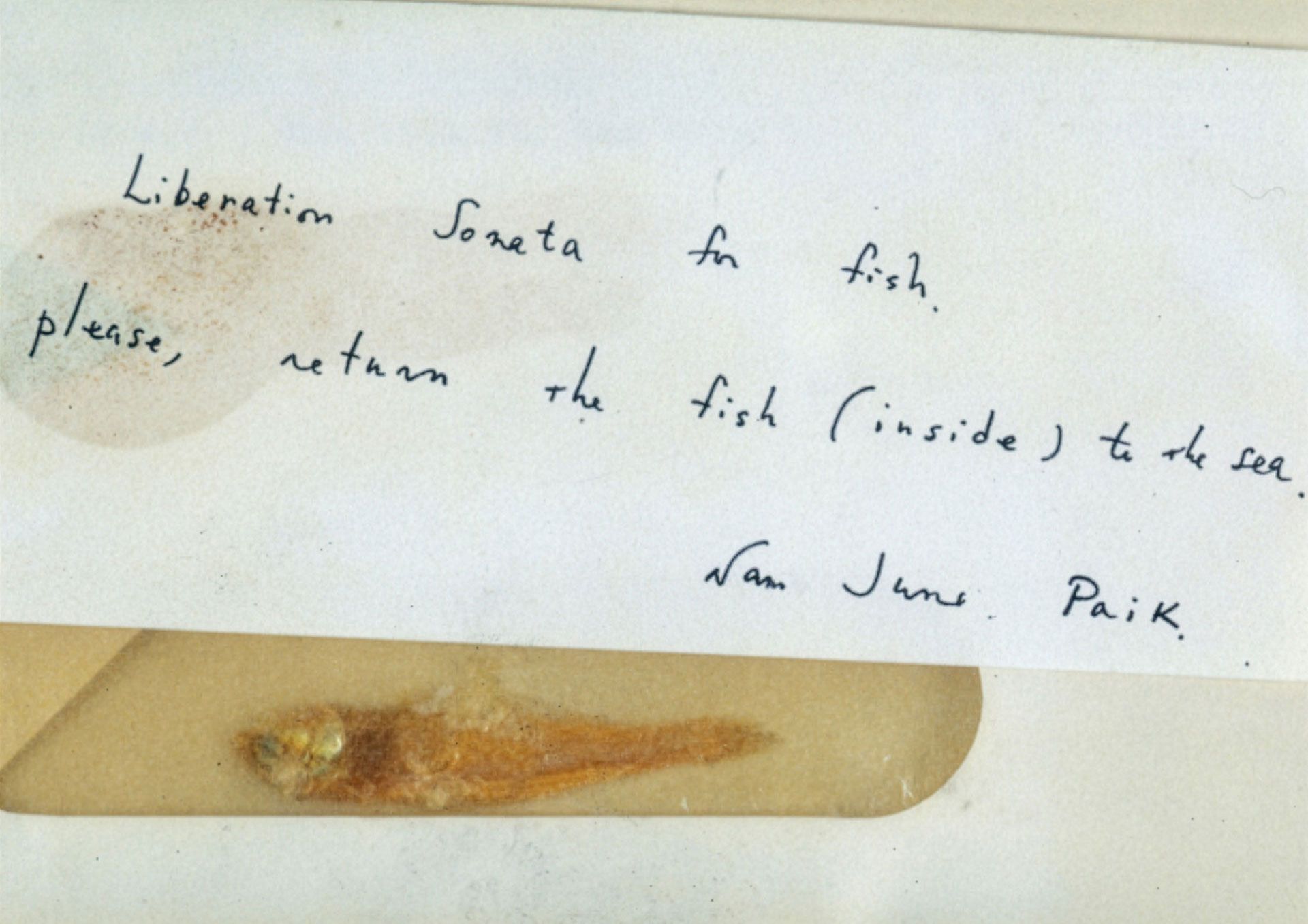
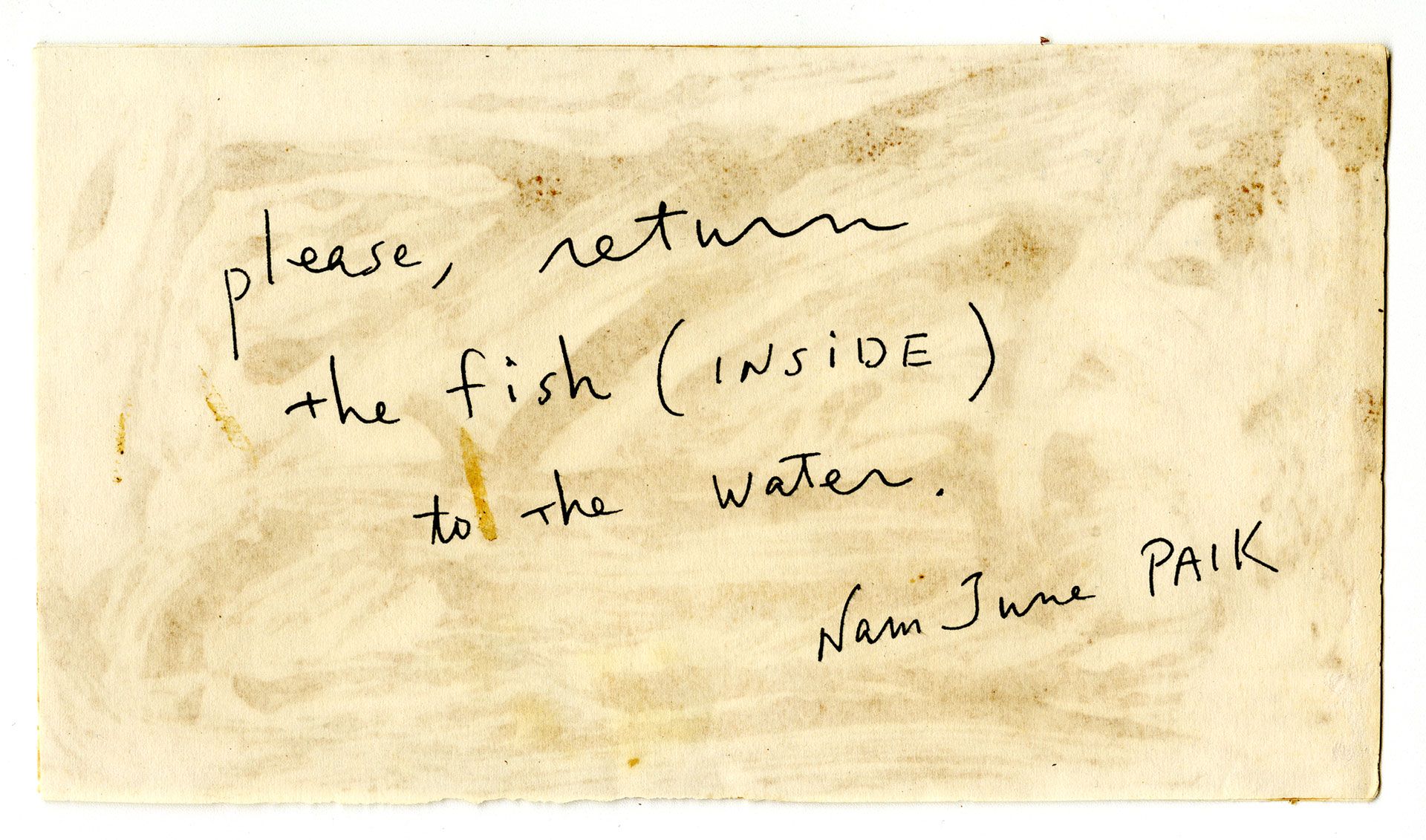
During my research at the Smithsonian Archives of American Art, a translucent plastic sleeve in one of the archival folders caught my attention. Inside it was an envelope bearing the following inscription:
please, return the fish (INSIDE) to the water. Nam June PAIK.[1]Nam June Paik, Liberation Sonata for Fish, 1969, event score and object. For the archival context, see Nam June Paik Papers, 1932–2008, NJP.2.EPH.12, Smithsonian American Art Museum, Research and Scholars Center, Washington, DC.
The materiality of this curious object struck me as I slowly began to unpack it. The inscription seemed improvised. I examined the envelope more closely: it was stained, marked by traces resembling watery brushstrokes—the remains of an environment that may once have sustained a living fish. I turned the envelope over and found, at its bottom, a dark brown stain. I was seized by the dreadful realisation that it could be the body of a fish that had not made it back to the water.
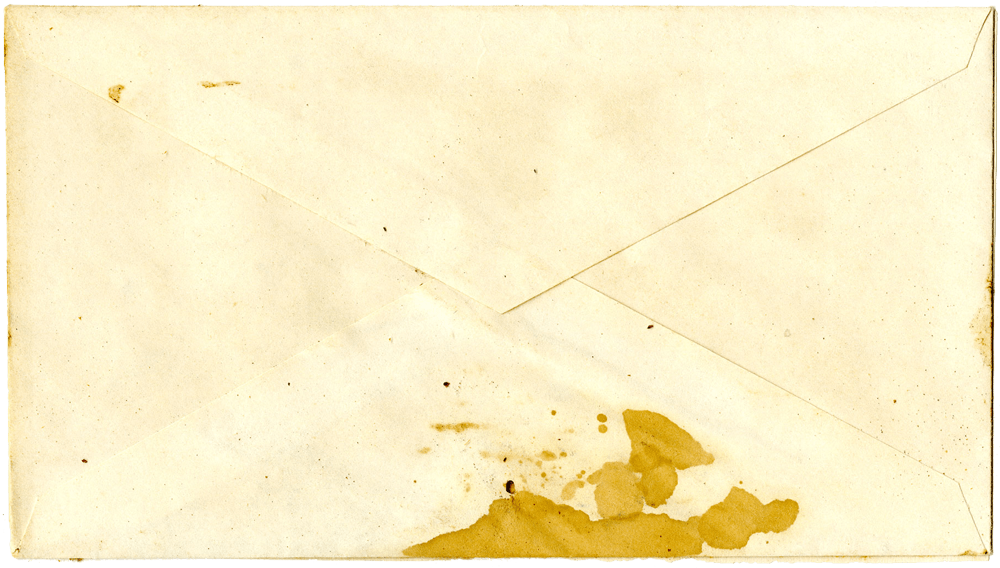
What I have just described is Nam June Paik’s score-based work Liberation Sonata for Fish (1969). Since its distribution to attendees of Charlotte Moorman’s 7th Annual New York Avant-Garde Festival on Two Islands in 1969, the work has existed in at least two variants—one prompting the viewer to return the fish to the water, the other to the sea—which have circulated across collections worldwide in an unknown number of editions.[2]The exchange of “sea” for “water” might have been a result of Paik’s rethinking of the work for Charlotte Moorman’s festival, which took place near the East River. One of these variants includes 9½″ × 4″ envelopes with glassine windows and one 6½″ × 3½″ without windows. Some of these editions are missing the fish. Personal email exchange with Scott Krafft of the Northwestern University Libraries.
Liberation Sonata for Fish belongs to the Fluxus tradition of the event score—instigated by George Brecht and developed within Fluxus’s international circles—which combined textual descriptions of varying length and abstraction with the form of a paper object, often enclosed in an envelope or a box.
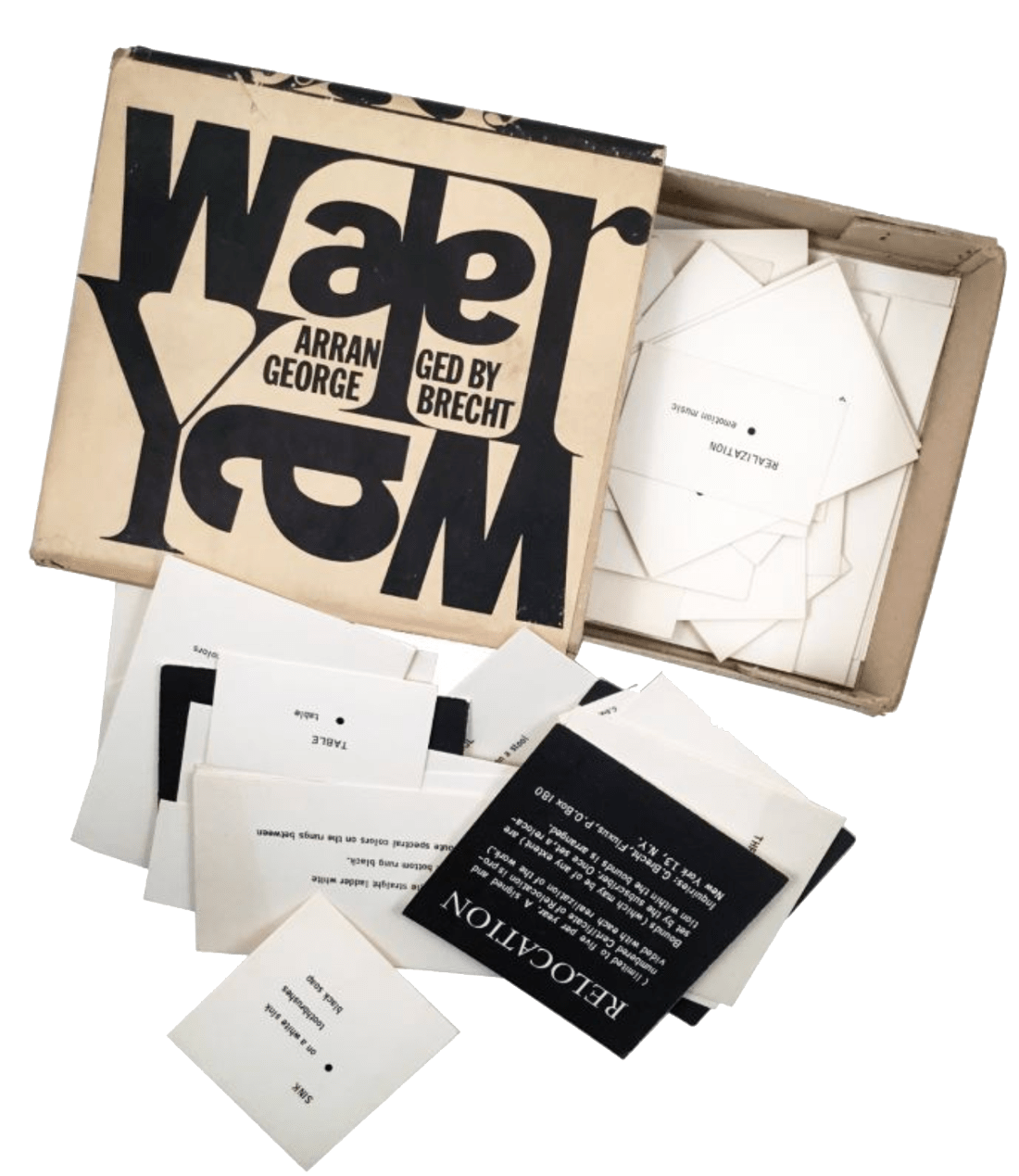
Water Yam (1963) and the scores included in the collective anthology Fluxus I (1964) are among its best-known examples.[3]George Brecht, Water Yam (New York: Fluxus, 1963). Cardboard box with offset label, containing sixty-nine offset cards designed and conceptualised by George Maciunas; George Maciunas, ed., Fluxus 1 (New York: Fluxus, 1964). I elaborated extensively on the topic of Fluxus scores in Hanna B. Hölling, “Unpacking the Score: Notes on the Material Legacy of Intermediality,” in On Curating, Fluxus Perspectives, 51 (2021), https://www.on-curating. org/issue-51-reader/unpacking-the-score-notes-on-the-material-legacy-of-intermediality.html. On the event score and Water Yam, see also Jon Hendricks, Fluxus Codex (New York: Harry N. Abrams, 1988) and Natilee Harren, Fluxus Forms: Scores, Multiples, and the Eternal Network (Chicago: University of Chicago Press, 2020).
The work’s absurdity lies in the proposition that a dead fish might be liberated by returning it to water—an act that resonates differently in an age of mass species extinction. What appears as an unfulfilled gesture of release raises questions of agency and care: who liberates whom, and to what end? At the same time, the archive itself becomes a paradoxical site of “liberation,” where the fish persists as a disintegrating specimen within a tightly controlled institutional environment.
One might say that while a certain guise of permanence survives at the level of the score—even if the “freeing” of the fish from the envelope and its return to water can be enacted physically only once but imaginatively countless times—the work’s visibly aged, patinated, and heavily stained envelopes deny any promise of long duration.
This paper takes decay not as a negative value, but as a productive analytical category. I argue that decay is not simply a subset of change; it is a distinct material, ethical, and political mode of becoming that calls for a different paradigm of conservation. Paradoxically, decay may not signal the end of heritage, but its future.
Rather than an exception, decay is a condition of life.
Maria Puig de la Bellacasa captures this relational ontology when she writes that, through decay, “we shapeshift into soil,” even as soil itself becomes life. Anna Tsing extends this insight by observing that decay “needs to get rid of the dead,” emphasising that decomposition is not a negation of vitality but the very mechanism through which life continues.[4]For Tsing’s broader account of disturbance, precarity, and multispecies life, see Anna Lowenhaupt Tsing, The Mushroom at the End of the World: On the Possibility of Life in Capitalist Ruins (Princeton, NJ: Princeton University Press, 2015). For soil as a temporality and practice of ecological care, see María Puig de la Bellacasa, Matters of Care: Speculative Ethics in More than Human Worlds (Minneapolis: University of Minnesota Press, 2017), 169–215. In the footsteps of Gilbert Simondon, Josephine Ellis argues that processes of de-formation—of decay and degradation—are not forms of loss but a “continued form-taking activity.”[5]Ellis turns to philosopher Gilbert Simondon’s (1924–89) theory of individuation, which understands matter and form as continually emerging through processes of transformation and co-becoming. Josephine Ellis, “Daniel Spoerri’s Logic of the Multiple and the Continuum of Active Matter,” in Activating Fluxus, Expanding Conservation (London and New York: Routledge, 2026), 54. Breakdown, then, is not merely an ending but the very condition through which matter persists, transforms, and passes into other forms.
Decay also renders the distinction between nature and culture increasingly untenable because it reveals both as participants in the same processes of material transformation. Materially indiscriminate, decay acts through the same physical, chemical, and biological processes across so-called “natural” and “cultural” entities alike. It is relational rather than intrinsic, emerging through interactions among microbes, fungi, moisture, light, temperature, pollutants, insects, humans, and countless other actors. In doing so, decay blurs conventional notions of agency: material transformation is never solely “natural” or “human-made” but always the outcome of entangled human and more-than-human forces. It likewise dissolves categorical boundaries as cultural artefacts re-enter ecological cycles, while glaciers, forests, and other environmental formations increasingly become objects of cultural (heritage) care, management, and conservation. If cultural objects are ecological processes and natural entities are simultaneously cultural and political, then conservation can no longer sustain a strict division between the two domains.
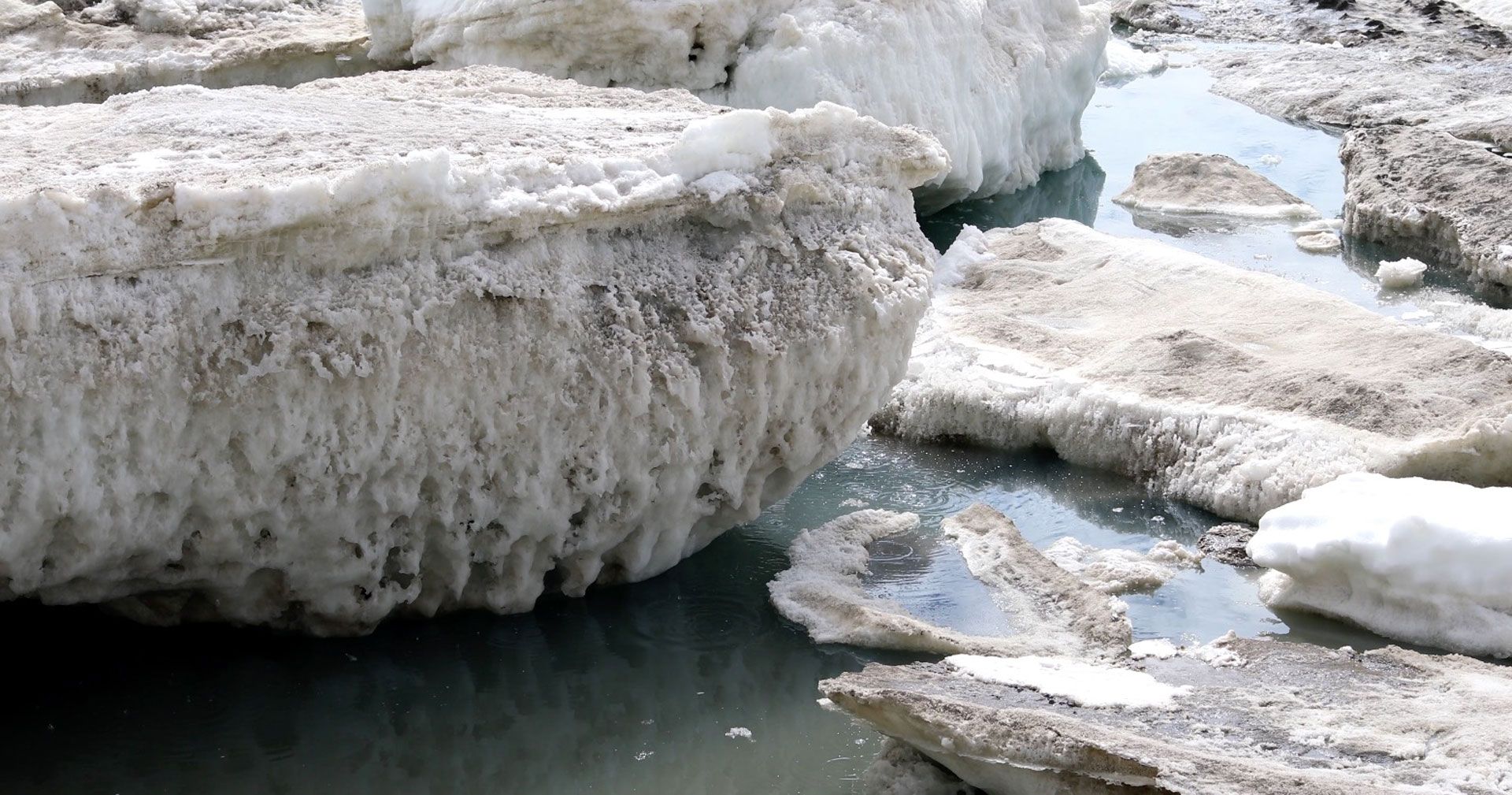
This critique of the nature–culture divide underpins my broader research, which begins from the premise that cultural and natural heritage can no longer be understood as separate domains but rather as natureculture hybrids, entangled across multiple timescales, human and more-than-human agencies, and overlapping pasts and futures.[6]On this subject, see my research project “Caring for Naturecultures,” Collegium Helveticum, Institute for Advanced Study, ETH Zurich (https://collegium.ethz.ch/projects/fellow-year-2025-2026/caring-for-naturecultures) and the eponymous symposium (https://collegium.ethz.ch/events/fellow-year-2025-2026/caring-for-naturecultures-symposium) and exhibition (https://collegium.ethz.ch/events/fellow-year-2025-2026/caring-for-naturecultures-glaciers). For the natureculture formulation and multispecies entanglement, see Donna J. Haraway, The Companion Species Manifesto: Dogs, People, and Significant Otherness (Chicago: Prickly Paradigm Press, 2003), 1–32; and Haraway, Staying with the Trouble: Making Kin in the Chthulucene (Durham, NC: Duke University Press, 2016), 1–8. In this essay, however, I mobilise decay more specifically to critique the dominant heritage conservation paradigm and its long-standing investment in permanence, along with its corresponding devaluation of material transformation.
My concern is not to romanticise ruins, celebrate decline, embrace a cult of entropy, or find comfort in the teleological notion that every ending simply prepares a new beginning. Instead, building on two decades of research into contemporary art—including electronic and media art, film and video installation, and performance—I understand change as an intrinsic condition of artworks and their existence in the world. What I have elsewhere called the aesthetics of change fundamentally unsettled conservation’s traditional commitment to permanence and control.[7]Hanna B. Hölling, “The Aesthetics of Change: On the Relative Durations of the Impermanent and Critical Thinking in Conservation,” in Authenticity in Transition: Changing Practices in Contemporary Art Making and Conservation, ed. Erma Hermens and Frances Robertson (London: Archetype Publications, 2016), 13–24; and Hölling, Paik’s Virtual Archive: Time, Change, and Materiality in Media Art (Oakland: University of California Press, 2017). Here I extend that argument by asking what happens when change takes the particular form of decay.
Within this framework, I conceive of decay as a specific manifestation of change, one intimately bound to entropic processes. While all change transforms objects, not all change constitutes decay; yet all decay is a form of change. But decay does not simply denote deterioration. Rather, it describes a qualitative mode of transformation through which material, meaning, and agency are continually redistributed. It is simultaneously a material condition, an epistemic tool, and an ethical orientation. It also provides a way of acknowledging a multispecies world by recognising the agencies, forces, and temporalities that take hold of artworks and continue to work through them.
The pages that follow explore how practices of letting go and accompanying in transformation can emerge as acts of care, set against the traditional conservation ideals of permanence, stability, and durability—ideals that are increasingly untenable amid ecological precarity, political volatility, and shifting ontologies of cultural value. If accepting change still allows us to imagine reversibility or retreat, decay goes further.
I posit decay as a critical custodial ethic: one that embraces fragility, improvisation, and partial transmission as modes of responsibility in multispecies worlds.
The crumbling corpus of the fish proposes an aesthetic of decay that exceeds the common-sense expectation that art must remain “fine,” in the sense of fine art, and exist primarily to gratify the senses. The fish is no longer merely an organic remnant enclosed within the score. It becomes the work’s second performance: one enacted not by the performer but by bacteria, moisture, fungi, paper and time.
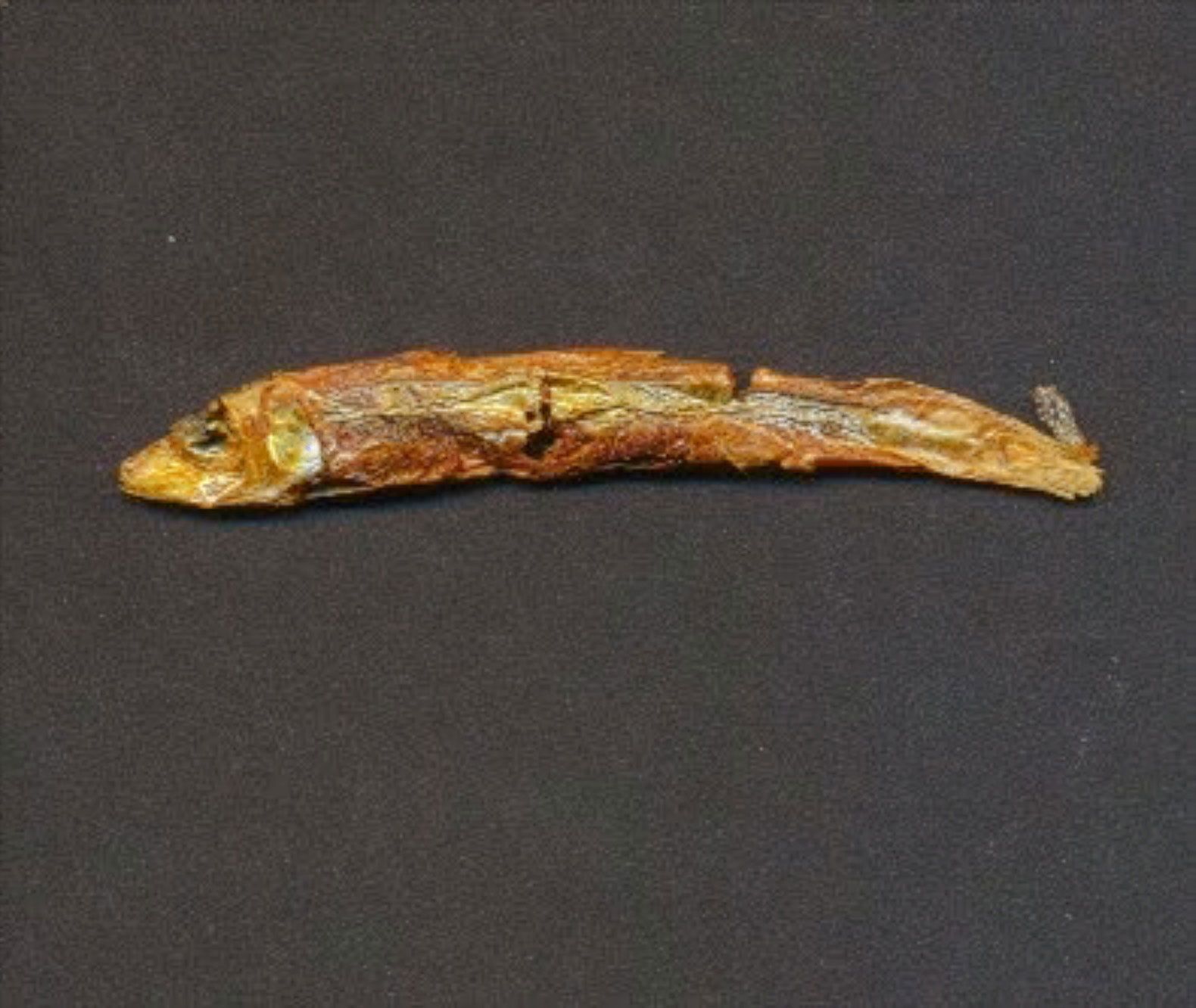
18 × 32.5 × 2.5 cm, Edition size unknown. Distributed free to attendees at Charlotte Moorman’s 7th Annual NY Festival of Avant-Garde, Wards Island, New York, in 1969.
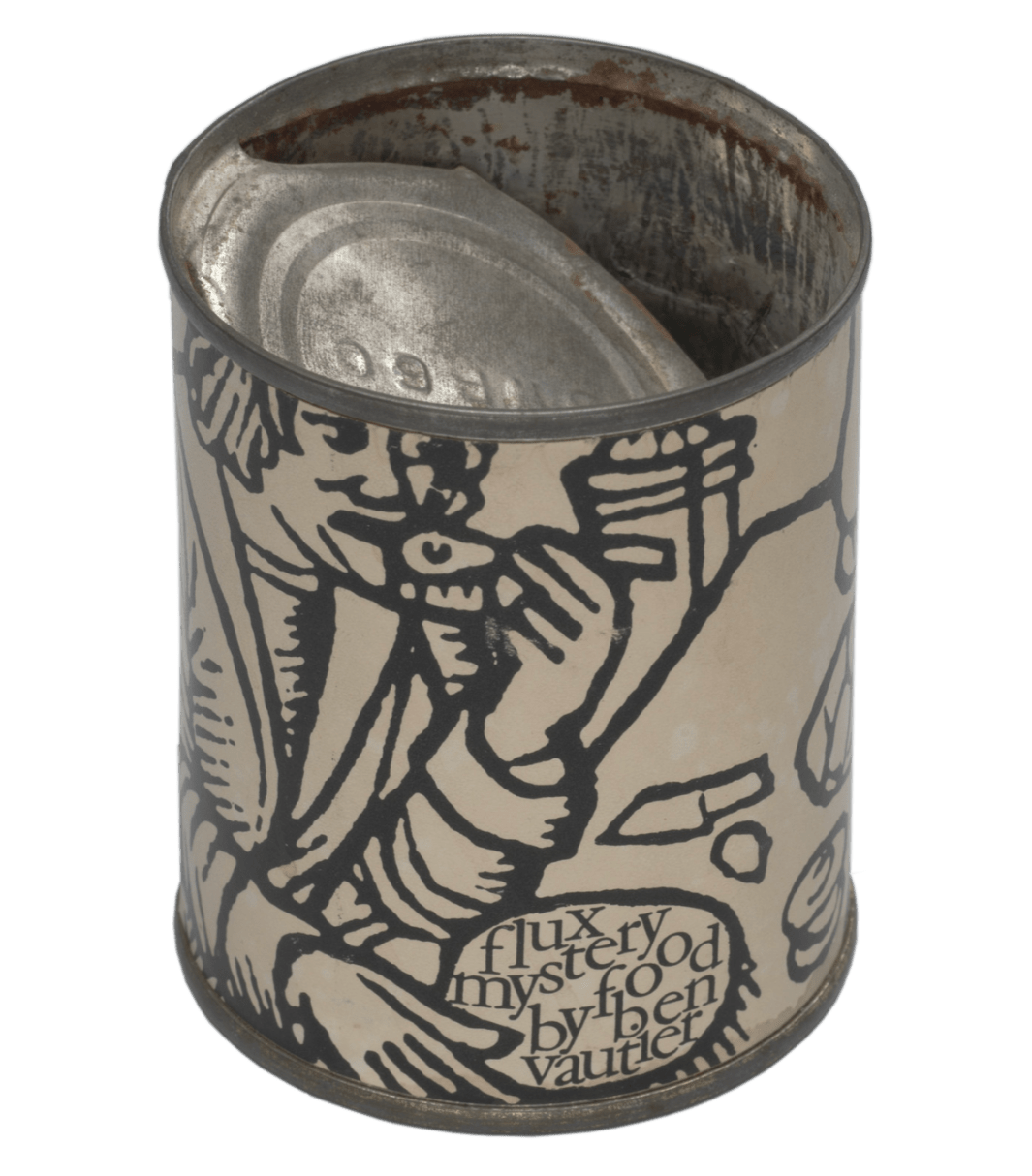
Paik’s fish is not unique, and not only because numerous editions survive in archives.[8]One of these editions includes 9.5” x 4” envelopes with glassine windows and one 6.5” x 3.5” without windows; some of these editions are missing the fish. Charlotte Moorman Archive and unprocessed Geoffrey Hendricks archive at Northwestern University Libraries. Personal email exchange with Scott Krafft of the Northwestern University Libraries. Throughout Fluxus, organic matter repeatedly unsettles the fantasy of permanence. This is equally true of a number of Fluxfoods, which only appear to be docile, fixed, and well-preserved objects.
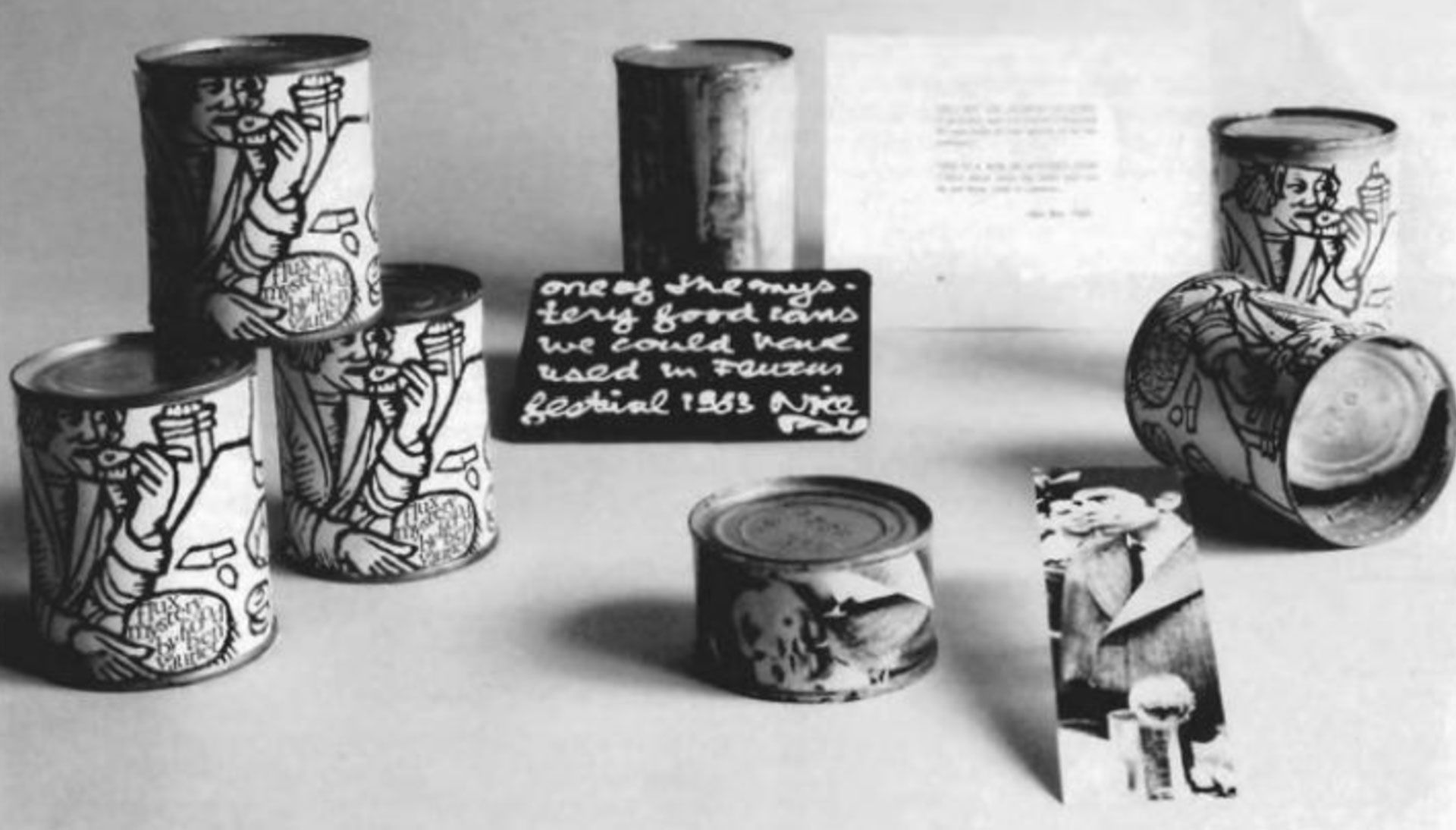
A story circulates about a food can from the Fluxus collection at the Getty Research Institute—a can of sardines forming part of Ben Patterson’s Hooked (1980, fig. 5), which, notably, bore no expiration date—that had to be replaced after corrosion caused it to leak. Twenty-five years after Patterson assembled the box, a curator noticed a strong smell upon handling it.[9]Marcia Reed, “Killing with Kindness? The Challenges of Conservation and Access for Living Matter,” in Living Matter: The Preservation of Biological Materials in Contemporary Art, ed. Rachel Rivenc and Kendra Roth (Los Angeles: Getty Conservation Institute, 2022). For the conservation of biological and food-based materials in contemporary art, see Rachel Rivenc and Kendra Roth, eds., Living Matter: The Preservation of Biological Materials in Contemporary Art (Los Angeles: Getty Conservation Institute, 2022).
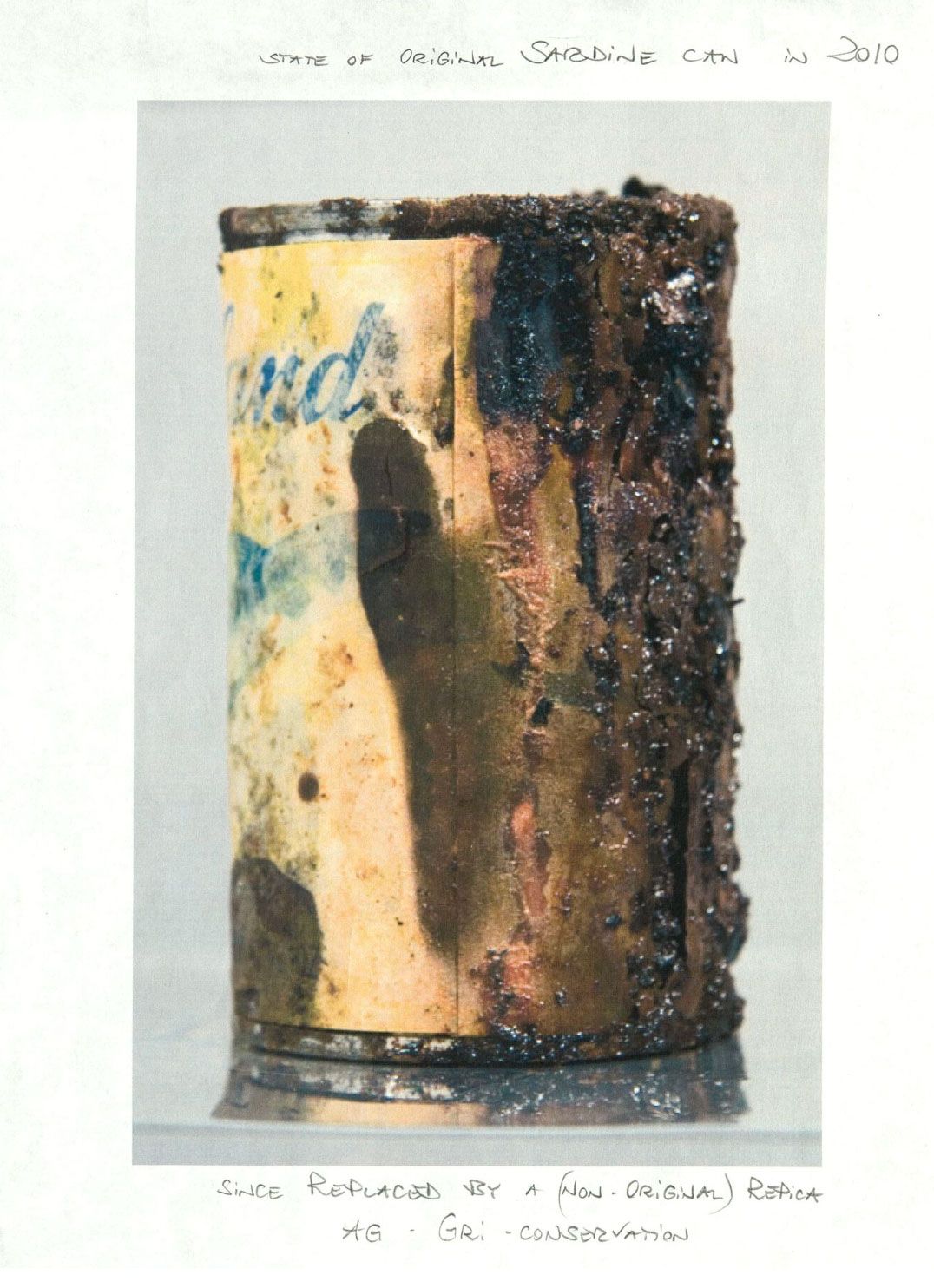
One can only imagine the scene: the work releasing its toxic, aged, pungent contents into its surroundings—a convulsion of decay exposing the limits of conservation’s promise of stability. In this moment, Fluxus performs itself: an outpouring that refuses containment, an insistence on flux in its most literal form. Should it be discarded or preserved? Patterson, who was still alive when the deterioration was discovered, reportedly expressed no concern: “It’s yours now,” he told the curator.[10] Reed, “Killing with Kindness?”
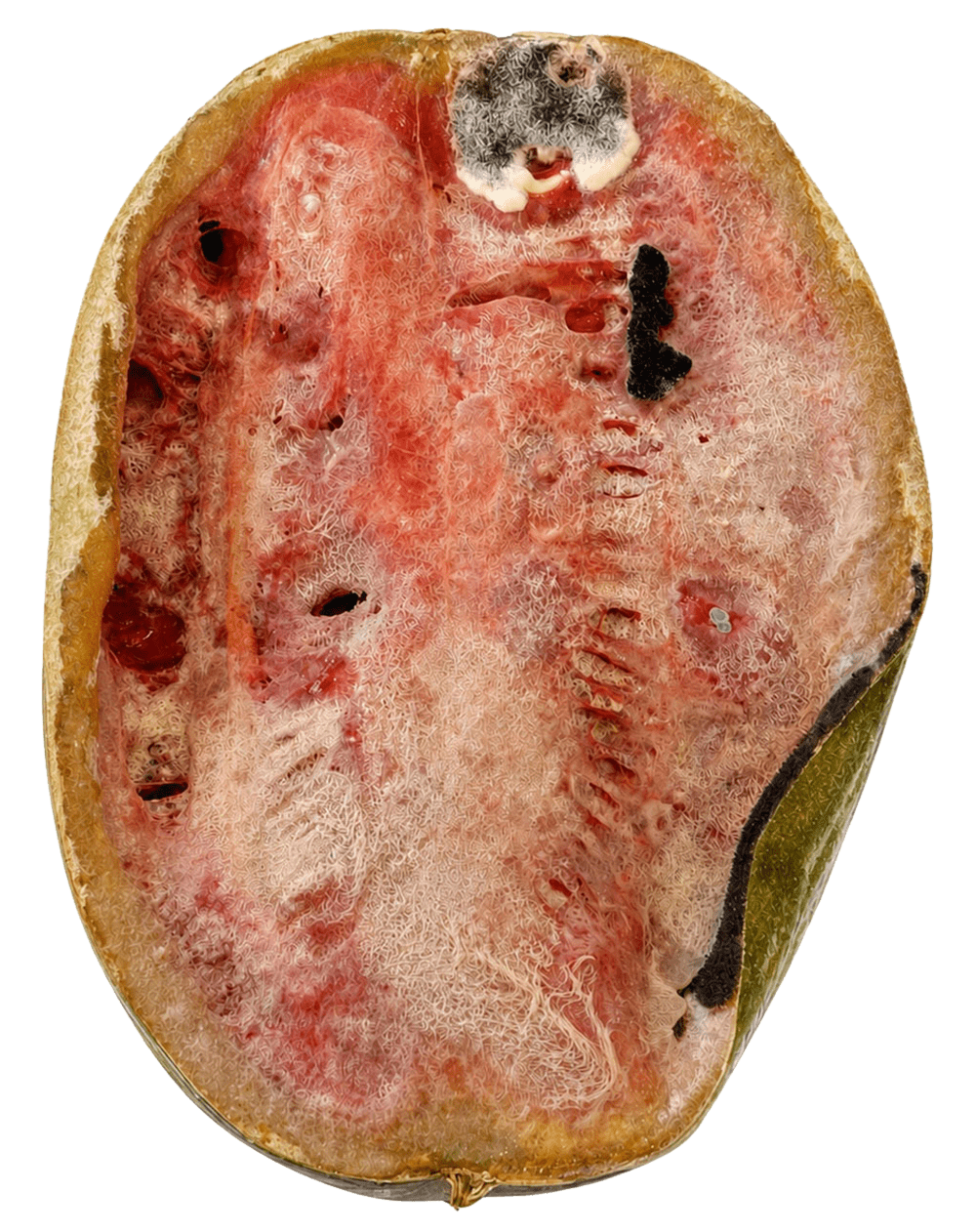
Since the work of Dieter Roth and Daniel Spoerri, organic decay has become one of contemporary art’s most radical materials. More recently, artists such as Anya Gallaccio, Helen Chadwick, Io Makandal, Sam Taylor-Wood or Camila de Andrade Bianchi have extended this lineage by foregrounding decomposition as an ecological and multispecies process.
In these works, decay renders visible the movement otherwise implicit in all matter: its perpetual disintegration and recreation.
Here I agree with Caitlin DeSilvey and the team behind the research project Decay without Mourning that appreciating loss and decay can produce a productive relation to the past.[11]Caitlin DeSilvey, Curated Decay: Heritage beyond Saving (Minneapolis: University of Minnesota Press, 2017); Lizabé Lambrechts et al., “Decay without Mourning: Future-Thinking Heritage Practices,” International Journal of Heritage Studies 31, no. 3 (2025): 340–57, https://doi.org/10.1080/13527258.2024.2417062. Rather than mourning the crumbling corpus of the dead fish and asking questions whether the work still serves its purpose in the collection (thinking here of those deteriorated works which were subsequently deaccessioned), we might read in these remains different kinds of narrative. We might understand change, and even death, not as loss, but as release into other states: more open, more indeterminate.
Although on different levels, both works, Liberation Sonata for Fish and Hooked, can offer a provocation to conventional understandings of both conservation and the museum’s role to keep things intact. Wanting to liberate us from the anxiety produced by the absence of a stable object, it opens a horizon of futurity unbound by material fixation and stasis. Uniqueness appears here not as the singularity of an original, but as a work’s non-replicable trajectory, marked by traces of use. Here, the score no longer merely serves the realisation of such a scored performance. Throughout its multiple editions, decay performs the work, producing in every instance a unique material trajectory: stains, residues, traces of a life lived and lost, and the slow interaction between paper and organic matter.
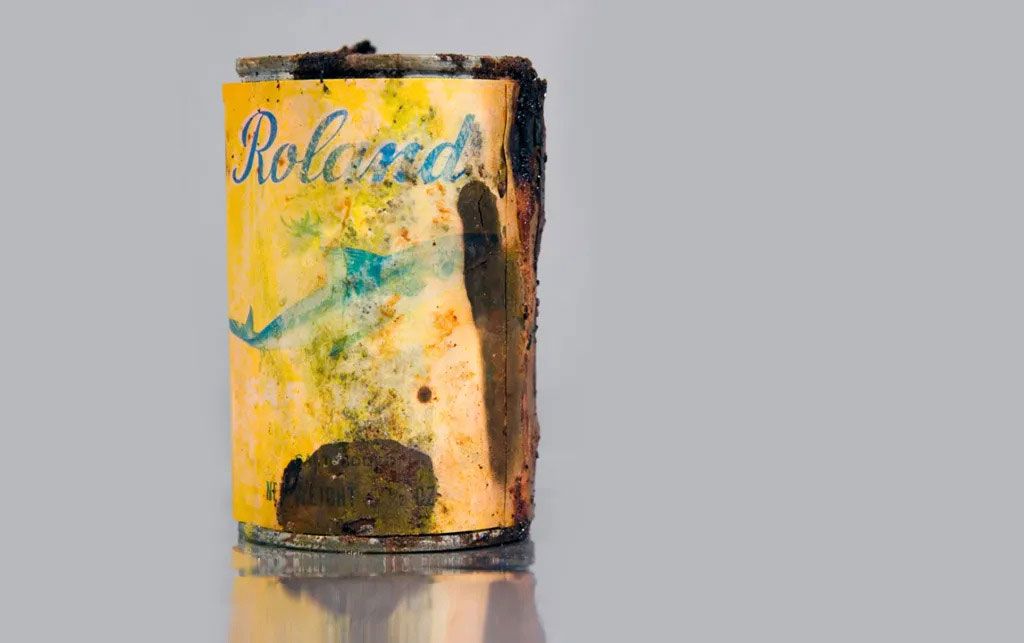
In Patterson’s Hooked, the museum’s decision to replace the corroded object with a new can, imitating the old visually and sensorially, offers a different scenario. The replacement may be understood as a form of rebirth, following the object’s not-yet-completed death. Rather than restoring permanence, it embraces breakdown as the emergence of another life. Yet one question remains: can the leaking itself still be considered part of the work, and if so, what kind of relation does the replacement introduce to the growing assemblage of the work?
The deep materiality of Paik’s and Patterson’s works renders them, following Tim Ingold, incipient rather than preordained.[12] Tim Ingold, Making: Anthropology, Archaeology, Art and Architecture (London: Routledge, 2013), 20–25. Ingold’s account opposes predetermined form to processes of growth and making.These are works simultaneously precarious in their actual manifestations and sustained in their endless potential. This material precarity and changeability are part of what I call their intramediality. From the Latin intra (“within”), intramediality names this turn inward: toward the permanent, unstoppable, never-at-rest movement of matter itself.
But both works are also a dramatic demonstration of the impossibility of conserving living matter. Regardless of the preservative measures invested in the canned food produced in the 1960s—or the subsequent efforts of conservators working with organic or food-based art—matter ultimately yields to processes of flow and degradation. What appears as order or stable form reveals itself as provisional, transitory, and relative.
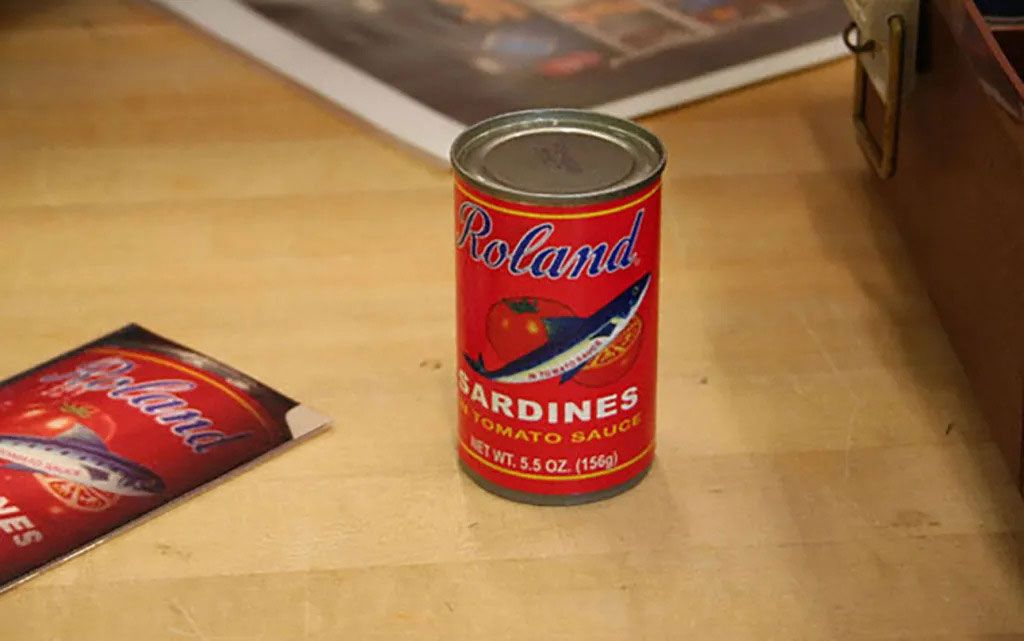
Decay redistributes authorship. Neither Liberation Sonata for Fish nor Hooked is made solely by the artist, performer, or conservator. Bacteria, fungi, microbes, moisture, corrosion, paper fibres, and time become collaborators in the works’ continued unfolding. Conservation, in turn, is no longer the privileged agent that determines the work’s future, but one participant within a multispecies world. The “nature” of these works—understood both literally and metaphorically—poses a challenge to the institutional culture that seeks to master or stabilise it. Through bacterial growth and microbial decomposition in Paik’s work, and fermentation and corrosion in Patterson’s, the material forces at work become visible. As natureculture hybrids, both works stage the collision between organic process and the culture of keeping things intact.
These works thus exemplify a broader consequence of decay: it dissolves the distinction between natural and cultural agencies. What appears as the decay of a cultural artefact is simultaneously an ecological process, just as conservation itself becomes an intervention within those processes rather than an external attempt to arrest them. The artwork is neither purely cultural nor simply natural, but a natureculture hybrid whose continued existence depends on the entanglement of human and more-than-human actors.
Decay makes the present the only dimension in which care can occur.
Whereas conservation traditionally preserves the past for the future—thus affirming, yet simultaneously troubling, linear time by privileging the “original” or “authentic” instance—decay insists on the present. As an ongoing event, it refuses deferral.
Importantly, decay does not merely unfold in time; it reorients the temporality of conservation itself.
What remains for conservation is to become something like an “accompaniment in transformation”: a post-preservation practice of being with change. To return to Tsing, this is also a practice of noticing[13]For “the arts of noticing,” see Tsing, The Mushroom at the End of the World, 17–25. —one that understands decay as the work of multiple organisms, a process that can be narrated, aesthetically engaged, and materially mobilised.
From these reflections there emerges a politics of affinity and a growing recognition of other species, and not only in their living forms but also in their apparently dead ones (thinking here of the fish): as premonition and warning, and perhaps a forecast for those still living. Death becomes bearable, not as an end, but as a transition from one state to another—a radical form of change in a universe composed of vibrational matter.
In seeking solidarity with the dead fish, in the difference between its dead and our living bodies, we may find ourselves no longer wishing to liberate it. The fish, rather, can begin to liberate us, by offering the perspective that living a “dead” life might still be a different kind of living. In this vein, caring for a dead fish might take the form of radical sociability: the building of a coalition between different bodies in different states of vitality.
What both Liberation Sonata for Fish and Hooked ultimately stage, then, is not simply the failure of conservation, but the displacement of its focus of attention. In the case of Liberation Sonata for Fish, the work does not endure despite decay; it comes into being through it. Its performance is not exhausted in the moment of instruction, nor in its archival containment, but continues in the slow, material processes of disintegration: in the staining of the envelope, in the decomposition of the fish, in the microbial life that persists within it.
While in Patterson’s Hooked the leaking probably continues its process backstage (Getty records that the original can has been retained), Paik’s fish spills over the envelope and potentially, and simultaneously, over the archival and museum registers that mirror an infrastructure with which the work does not comply. As the decaying body seeps beyond the envelope, the work likewise exceeds the archival and museological frameworks that seek to contain it. It resists enclosure. Always in the making—and unmaking—it remains, to borrow Tsing’s term, feral.[14] Anna L. Tsing, Jennifer Deger, Alder Keleman Saxena, and Feifei Zhou, eds., Feral Atlas: The More-Than-Human Anthropocene (Stanford, CA: Stanford University Press, 2020). In Feral Atlas, “feral” describes trajectories generated through human infrastructures that develop beyond human control.
If, in a Heideggerian sense, the broken tool discloses the otherwise invisible conditions of its use,[15] Martin Heidegger, Being and Time, trans. Joan Stambaugh, rev. Dennis J. Schmidt (Albany: State University of New York Press, 2010). Heidegger’s analysis concerns how malfunction or breakdown makes the referential structure of equipment conspicuous. then these works—broken, undone, dispersed, staining—disclose what is at stake in conservation itself. They expose the limits of a paradigm committed to stabilisation: to fixing objects, extracting them from their environments, and suspending the processes through which they change. But what may appear here as “futile conservation” is not simply failure, but a critical opening: a moment in which the work refuses stasis and insists instead on remaining in flux.
In this sense, Liberation Sonata for Fish and Hooked unexpectedly returns to George Maciunas’s original conception of Fluxus.[16]George Maciunas, Fluxus Manifesto, 1963. Maciunas’s manifesto foregrounds flux as purging and calls for the world to be purged of “dead art” and bourgeois, professionalized culture. See also Jon Hendricks, ed., Fluxus Codex (New York: Harry N. Abrams, 1988).
Maciunas, the driving force and impresario of Fluxus, understood flux as discharge: a purgative force that would expel the accumulated waste of institutional art. Here, Fluxus discovers the consequences of its own etymology by rendering that metaphor literal. Whether canned or served in an envelope, the fish leaks, decomposes, and stains; its material discharge refuses containment, embodying Fluxus’s anti-institutional rhetoric. The work does not merely represent the purging of dead artistic forms—it enacts it, reminding us that decay is not the opposite but one of art’s possible modes of becoming. Finally, if decay is recognised as intrinsic to the work’s long performance, then what we call conservation must begin to reckon with processes that exceed control, authorship, and the human.
The Material Politics of Decay
The argument developed so far requires one crucial qualification. If decay can become an ethical orientation, it cannot therefore be celebrated indiscriminately. The question is never simply whether decay is desirable, but whose decay is permitted, whose is mourned, and whose is prevented.
The disappearance of early activist performance, the undocumented street actions of artists such as David Hammons and countless other ephemeral artistic practices cannot be equated with the productive material transformations of Paik’s or Patterson’s work. In these cases, disappearance is often less an expression of material becoming than the consequence of unequal infrastructures of preservation, documentation, and institutional attention. Here, decay reveals not an ethics of care but the politics of neglect.[17]For David Hammons’s elusive and frequently undocumented practice, see Kellie Jones, EyeMinded: Living and Writing Contemporary Art (Durham, NC: Duke University Press, 2011).
A similar asymmetry characterises media art, where countless early works disappeared through obsolete technologies and inadequate institutional support, and colonial collections, where objects were meticulously preserved while the knowledge systems, relations, and communities that gave them meaning were systematically dismantled.[18]For technological obsolescence and change in media works, see for instance, Richard Rinehart and Jon Ippolito, Re-collection: Art, New Media, and Social Memory (Cambridge, MA: The MIT Press, 2014); or Hölling, Paik’s Virtual Archive. For colonial collections and the violent separation of objects from communities and knowledge systems, see Dan Hicks, The Brutish Museums: The Benin Bronzes, Colonial Violence and Cultural Restitution (London: Pluto Press, 2020); and Felwine Sarr and Bénédicte Savoy, The Restitution of African Cultural Heritage: Toward a New Relational Ethics, trans. Drew S. Burk (Ministère de la Culture, 2018). Decay is therefore never politically innocent. It may constitute an ethical practice of letting go, but it can equally become the outcome of neglect, exclusion, and archival violence.
Conclusions
Throughout this essay I have argued that decay should no longer be understood as conservation’s failure but as one of its central conditions of thought. Decay performs. It redistributes authorship across human and more-than-human agencies. It unsettles permanence, not by opposing conservation, but by redefining what conservation attends to.
To conserve after permanence therefore means neither preserving everything nor abandoning everything. It means learning to distinguish between those forms of decay that emerge as material life continues and those produced by political neglect, colonial violence, or institutional exclusion.
Again and again, conservation becomes less a practice of arresting change or securing permanence than of accompanying transformation. Its task is to cultivate attentiveness: to recognise when decay sustains networks of care and relations, when it destroys them, and when intervention remains an ethical necessity.
Acknowledgements
This paper emerged during the course of the research projects Activating Fluxus (Swiss National Science Foundation [SNSF], 2022–26) and Critical Conservation (SNSF, 2026–30), as well as during my fellowship at the Collegium Helveticum, Zurich / ETH Zurich, and I gratefully acknowledge the generous support of these institutions. My research in the Nam June Paik Papers archive was possible thanks to funding from the Terra Foundation for American Art and the Smithsonian American Art Museum in Washington, DC (2019-20); my research at the Jean Brown Papers archive was supported by the Getty Conservation Institute and Getty Research Institute (2016-17). Parts of this paper were presented at the Decay without Mourning conference in Stellenbosch, South Africa (April 2026). I am deeply grateful to the conference organisers for the invitation to present and publish this research, and especially to Aryan Kaganof for his generous encouragement and support in making it publicly accessible.
Brecht, George. Water Yam. New York: Fluxus, 1963.
DeSilvey, Caitlin. Curated Decay: Heritage beyond Saving. Minneapolis: University of Minnesota Press, 2017.
Ellis, Josephine. “Daniel Spoerri’s Logic of the Multiple and the Continuum of Active Matter.” In Activating Fluxus, Expanding Conservation, edited by Hanna B. Hölling, Aga Wielocha, and Josephine Ellis, 141–64. London and New York: Routledge, 2026.
Haraway, Donna J. The Companion Species Manifesto: Dogs, People, and Significant Otherness. Chicago: Prickly Paradigm Press, 2003.
———. Staying with the Trouble: Making Kin in the Chthulucene. Durham, NC: Duke University Press, 2016.
Harren, Natilee. Fluxus Forms: Scores, Multiples, and the Eternal Network. Chicago: University of Chicago Press, 2020.
Heidegger, Martin. Being and Time. Translated by Joan Stambaugh. Revised by Dennis J. Schmidt. Albany: State University of New York Press, 2010.
Hendricks, Jon, ed. Fluxus Codex. New York: Harry N. Abrams, 1988.
Hicks, Dan. The Brutish Museums: The Benin Bronzes, Colonial Violence and Cultural Restitution. London: Pluto Press, 2020.
Hölling, Hanna B. “The Aesthetics of Change: On the Relative Durations of the Impermanent and Critical Thinking in Conservation.” In Authenticity in Transition: Changing Practices in Contemporary Art Making and Conservation, edited by Erma Hermens and Frances Robertson, 13–24. London: Archetype Publications, 2016.
———. Paik’s Virtual Archive: Time, Change, and Materiality in Media Art. Oakland: University of California Press, 2017.
———. “Unpacking the Score: Notes on the Material Legacy of Intermediality.” OnCurating, no. 51 (2021): 64–81.
Ingold, Tim. Making: Anthropology, Archaeology, Art and Architecture. London: Routledge, 2013.
Jones, Kellie. EyeMinded: Living and Writing Contemporary Art. Durham, NC: Duke University Press, 2011.
Lambrechts, Lizabé, Kati Lindström, Lize-Marié Hansen van der Watt, Fernanda Pitta, Nicola Deane, Bruno Moreschi, and Leif Petersen. “Decay without Mourning: Future-Thinking Heritage Practices.” International Journal of Heritage Studies 31, no. 3 (2025): 340–57. doi.
Maciunas, George, ed. Fluxus 1. New York: Fluxus, 1964.
———. “Fluxus Manifesto.” 1963. Museum of Modern Art.
Puig de la Bellacasa, María. Matters of Care: Speculative Ethics in More than Human Worlds. Minneapolis: University of Minnesota Press, 2017.
Reed, Marcia. “Killing with Kindness? The Challenges of Conservation and Access for Living Matter.” In Living Matter: The Preservation of Biological Materials in Contemporary Art, edited by Rachel Rivenc and Kendra Roth, 247–66. Los Angeles: Getty Conservation Institute, 2022.
Rinehart, Richard, and Jon Ippolito. Re-collection: Art, New Media, and Social Memory. Cambridge, MA: MIT Press, 2014.
Rivenc, Rachel, and Kendra Roth, eds. Living Matter: The Preservation of Biological Materials in Contemporary Art. Los Angeles: Getty Conservation Institute, 2022.
Sarr, Felwine, and Bénédicte Savoy. The Restitution of African Cultural Heritage: Toward a New Relational Ethics. Translated by Drew S. Burk. Ministère de la Culture, 2018.
Tsing, Anna Lowenhaupt. The Mushroom at the End of the World: On the Possibility of Life in Capitalist Ruins. Princeton, NJ: Princeton University Press, 2015.
Tsing, Anna L., Jennifer Deger, Alder Keleman Saxena, and Feifei Zhou, eds. Feral Atlas: The More-Than-Human Anthropocene. Stanford, CA: Stanford University Press, 2020.
| 1. | ↑ | Nam June Paik, Liberation Sonata for Fish, 1969, event score and object. For the archival context, see Nam June Paik Papers, 1932–2008, NJP.2.EPH.12, Smithsonian American Art Museum, Research and Scholars Center, Washington, DC. |
| 2. | ↑ | The exchange of “sea” for “water” might have been a result of Paik’s rethinking of the work for Charlotte Moorman’s festival, which took place near the East River. One of these variants includes 9½″ × 4″ envelopes with glassine windows and one 6½″ × 3½″ without windows. Some of these editions are missing the fish. Personal email exchange with Scott Krafft of the Northwestern University Libraries. |
| 3. | ↑ | George Brecht, Water Yam (New York: Fluxus, 1963). Cardboard box with offset label, containing sixty-nine offset cards designed and conceptualised by George Maciunas; George Maciunas, ed., Fluxus 1 (New York: Fluxus, 1964). I elaborated extensively on the topic of Fluxus scores in Hanna B. Hölling, “Unpacking the Score: Notes on the Material Legacy of Intermediality,” in On Curating, Fluxus Perspectives, 51 (2021), https://www.on-curating. org/issue-51-reader/unpacking-the-score-notes-on-the-material-legacy-of-intermediality.html. On the event score and Water Yam, see also Jon Hendricks, Fluxus Codex (New York: Harry N. Abrams, 1988) and Natilee Harren, Fluxus Forms: Scores, Multiples, and the Eternal Network (Chicago: University of Chicago Press, 2020). |
| 4. | ↑ | For Tsing’s broader account of disturbance, precarity, and multispecies life, see Anna Lowenhaupt Tsing, The Mushroom at the End of the World: On the Possibility of Life in Capitalist Ruins (Princeton, NJ: Princeton University Press, 2015). For soil as a temporality and practice of ecological care, see María Puig de la Bellacasa, Matters of Care: Speculative Ethics in More than Human Worlds (Minneapolis: University of Minnesota Press, 2017), 169–215. |
| 5. | ↑ | Ellis turns to philosopher Gilbert Simondon’s (1924–89) theory of individuation, which understands matter and form as continually emerging through processes of transformation and co-becoming. Josephine Ellis, “Daniel Spoerri’s Logic of the Multiple and the Continuum of Active Matter,” in Activating Fluxus, Expanding Conservation (London and New York: Routledge, 2026), 54. |
| 6. | ↑ | On this subject, see my research project “Caring for Naturecultures,” Collegium Helveticum, Institute for Advanced Study, ETH Zurich (https://collegium.ethz.ch/projects/fellow-year-2025-2026/caring-for-naturecultures) and the eponymous symposium (https://collegium.ethz.ch/events/fellow-year-2025-2026/caring-for-naturecultures-symposium) and exhibition (https://collegium.ethz.ch/events/fellow-year-2025-2026/caring-for-naturecultures-glaciers). For the natureculture formulation and multispecies entanglement, see Donna J. Haraway, The Companion Species Manifesto: Dogs, People, and Significant Otherness (Chicago: Prickly Paradigm Press, 2003), 1–32; and Haraway, Staying with the Trouble: Making Kin in the Chthulucene (Durham, NC: Duke University Press, 2016), 1–8. |
| 7. | ↑ | Hanna B. Hölling, “The Aesthetics of Change: On the Relative Durations of the Impermanent and Critical Thinking in Conservation,” in Authenticity in Transition: Changing Practices in Contemporary Art Making and Conservation, ed. Erma Hermens and Frances Robertson (London: Archetype Publications, 2016), 13–24; and Hölling, Paik’s Virtual Archive: Time, Change, and Materiality in Media Art (Oakland: University of California Press, 2017). |
| 8. | ↑ | One of these editions includes 9.5” x 4” envelopes with glassine windows and one 6.5” x 3.5” without windows; some of these editions are missing the fish. Charlotte Moorman Archive and unprocessed Geoffrey Hendricks archive at Northwestern University Libraries. Personal email exchange with Scott Krafft of the Northwestern University Libraries. |
| 9. | ↑ | Marcia Reed, “Killing with Kindness? The Challenges of Conservation and Access for Living Matter,” in Living Matter: The Preservation of Biological Materials in Contemporary Art, ed. Rachel Rivenc and Kendra Roth (Los Angeles: Getty Conservation Institute, 2022). For the conservation of biological and food-based materials in contemporary art, see Rachel Rivenc and Kendra Roth, eds., Living Matter: The Preservation of Biological Materials in Contemporary Art (Los Angeles: Getty Conservation Institute, 2022). |
| 10. | ↑ | Reed, “Killing with Kindness?” |
| 11. | ↑ | Caitlin DeSilvey, Curated Decay: Heritage beyond Saving (Minneapolis: University of Minnesota Press, 2017); Lizabé Lambrechts et al., “Decay without Mourning: Future-Thinking Heritage Practices,” International Journal of Heritage Studies 31, no. 3 (2025): 340–57, https://doi.org/10.1080/13527258.2024.2417062. |
| 12. | ↑ | Tim Ingold, Making: Anthropology, Archaeology, Art and Architecture (London: Routledge, 2013), 20–25. Ingold’s account opposes predetermined form to processes of growth and making. |
| 13. | ↑ | For “the arts of noticing,” see Tsing, The Mushroom at the End of the World, 17–25. |
| 14. | ↑ | Anna L. Tsing, Jennifer Deger, Alder Keleman Saxena, and Feifei Zhou, eds., Feral Atlas: The More-Than-Human Anthropocene (Stanford, CA: Stanford University Press, 2020). In Feral Atlas, “feral” describes trajectories generated through human infrastructures that develop beyond human control. |
| 15. | ↑ | Martin Heidegger, Being and Time, trans. Joan Stambaugh, rev. Dennis J. Schmidt (Albany: State University of New York Press, 2010). Heidegger’s analysis concerns how malfunction or breakdown makes the referential structure of equipment conspicuous. |
| 16. | ↑ | George Maciunas, Fluxus Manifesto, 1963. Maciunas’s manifesto foregrounds flux as purging and calls for the world to be purged of “dead art” and bourgeois, professionalized culture. See also Jon Hendricks, ed., Fluxus Codex (New York: Harry N. Abrams, 1988). |
| 17. | ↑ | For David Hammons’s elusive and frequently undocumented practice, see Kellie Jones, EyeMinded: Living and Writing Contemporary Art (Durham, NC: Duke University Press, 2011). |
| 18. | ↑ | For technological obsolescence and change in media works, see for instance, Richard Rinehart and Jon Ippolito, Re-collection: Art, New Media, and Social Memory (Cambridge, MA: The MIT Press, 2014); or Hölling, Paik’s Virtual Archive. For colonial collections and the violent separation of objects from communities and knowledge systems, see Dan Hicks, The Brutish Museums: The Benin Bronzes, Colonial Violence and Cultural Restitution (London: Pluto Press, 2020); and Felwine Sarr and Bénédicte Savoy, The Restitution of African Cultural Heritage: Toward a New Relational Ethics, trans. Drew S. Burk (Ministère de la Culture, 2018). |