SOPHIA OLIVIA SANAN
De-centring White Histori(city)
Just over two years ago I was offered a post-doctoral fellowship at the Centre for the Study of the Afterlife of Violence and the Reparative Quest (AVReQ), a teaching and research centre at Stellenbosch University. Part of my plan to re-engage with this town, where I had received my high school education, my primary degree and my first few years of formal employment; was an ambition to work with the permanent collection of the Stellenbosch University Museum as a catalyst for conversations about racial inequality, privilege, taste, culture and power. As I embarked on my personal, social and intellectual re-engagement with this university town after more than a decade of deliberate distance, I began to stall the intended project. I prioritised teaching, speaking opportunities, participating in AVReQ’s dynamic public seminar program, re-reading Frantz Fanon with my colleagues. Really, I was engaging everything but the museum collection.
I realised that this reticence was partially feeding off an enormous PhD hangover, the fieldwork for which had ensconced me in colonial, apartheid and white liberal discourses imprinted in the Iziko South African National Gallery archives. My PhD had left me in more doubt than ever about the possibilities of decolonising museums, given their intractable entanglement with legacies of colonialism and neoliberalism. After grappling with this question for years, deep in museum basements; I emerged into the sunlight with a slightly different set of preoccupations. I emerged with more curiosity about the financial, ideological and political systems and interests that invest in museums, and the broader, evolving and dynamic psycho-social ecology in which museums exist – either by the skin of their teeth or flourishing through new modalities. From a pre-occupation with what we can learn from museums and their holdings, my post-doctoral question had shifted to something like this:
if museums are one (tainted) format of recording / exploring / exhibiting / creating historical narratives, what are other less nourished and underinvested mechanisms of holding collective space for our many past(s)?
My reticence to engage the museum collections also fed off a persistent sense that South African cultural discourse doesn’t need more of a focus on implicit or explicit projects of white-self-making, after all these centuries of the undue dominance of whiteness. Critiques of whiteness can become a wily way of re-centring whiteness in critical discourse,[1]There is relevant criticism that the journals of ‘settler colonial studies’ and much of what has come from white liberal humanities scholarship in South Africa is filled with tacit justifications of white economic dominance and sustained white social privilege in post-apartheid South Africa (Milazzo, 2022; Park, 2021; Fung, 2022). just like decolonising museums can become the rubric under which museological authority and ownership protocols are maintained beneath surface changes. And yet, Stellenbosch’s whiteness needs to be critiqued, historicised and challenged. This is not because it is an anomaly in post-apartheid South Africa, but because it presents an example of what sociologist Neil Roos has diagnosed as “specific iterations of what it means to be white, that serve to paralyze the capacity of whites to participate in post-apartheid public life where white racial privilege is no longer ingrained in the structure and very DNA of the state” (2024: 12).
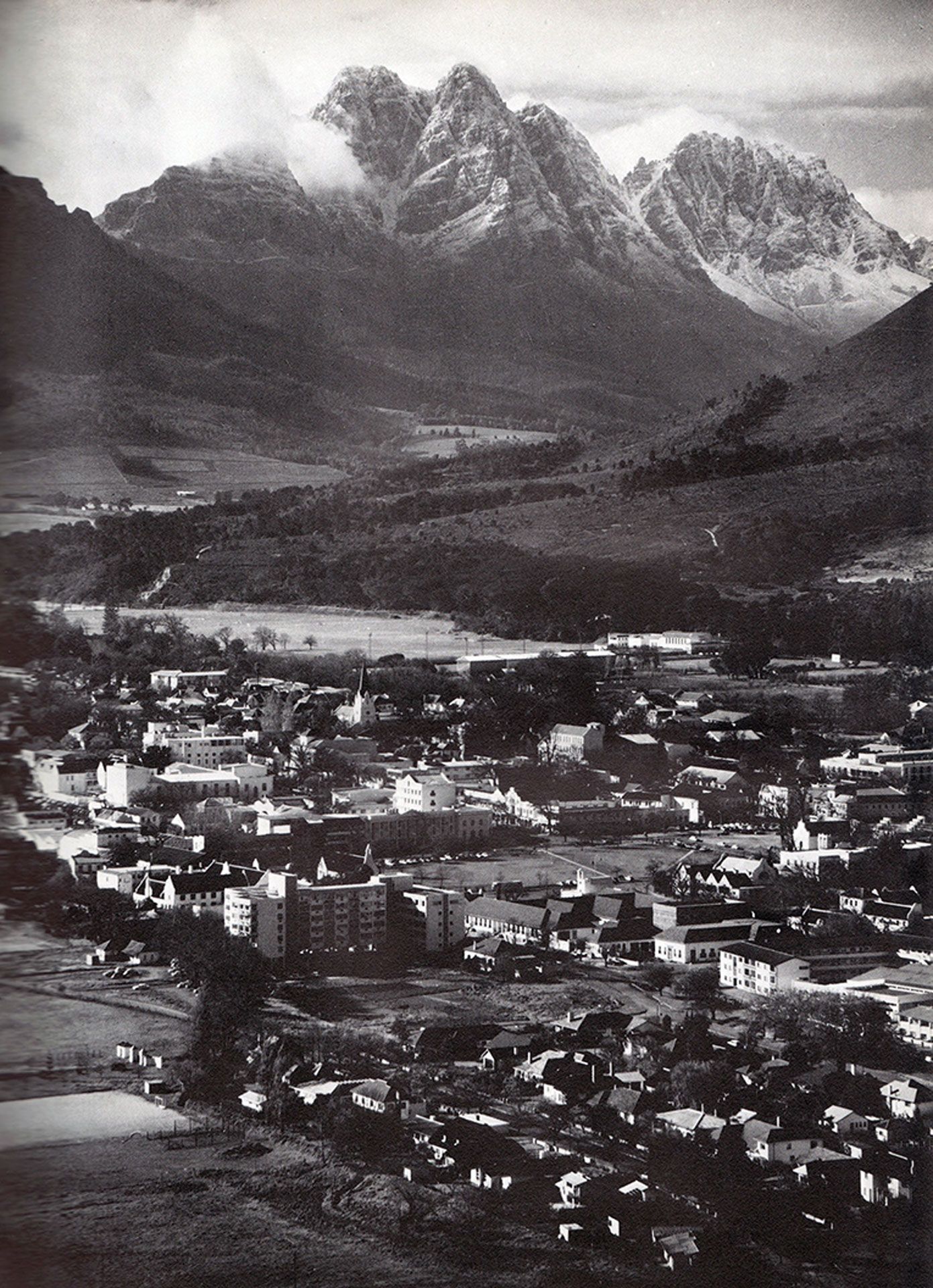
The iterations of whiteness on display in Stellenbosch remain a barrier to the development of an inclusive and more equal South Africa, this is why their operative mechanisms should be identified, questioned and reformulated. If we place this whiteness in a broader context in which the USA’s secretary of state gives a speech about renewing and reviving the project of colonial expansion, Western world dominance and proud white supremacy to a standing ovation by European leaders, we might infer that certain expressions of whiteness remain a pertinent and dangerous problem globally. James Baldwin’s bold injunction about the terrifying hollowness of ‘white leadership’, made over four decades ago, resonates in the Trumpian chaos of our present.
I look back at my seminar notes from my first few months back in Stellenbosch after more than a decade of completely avoiding the town, I notice repetitive questions: ‘how will whiteness be dismantled in South Africa? What will it take to disinvest whiteness? A common humanity depends upon whiteness becoming less white’. In this town, whiteness is hyper-present, visible and yet slippery to pin down.
How is it that one can look at whiteness, but it seems to evade the consequence of being seen?
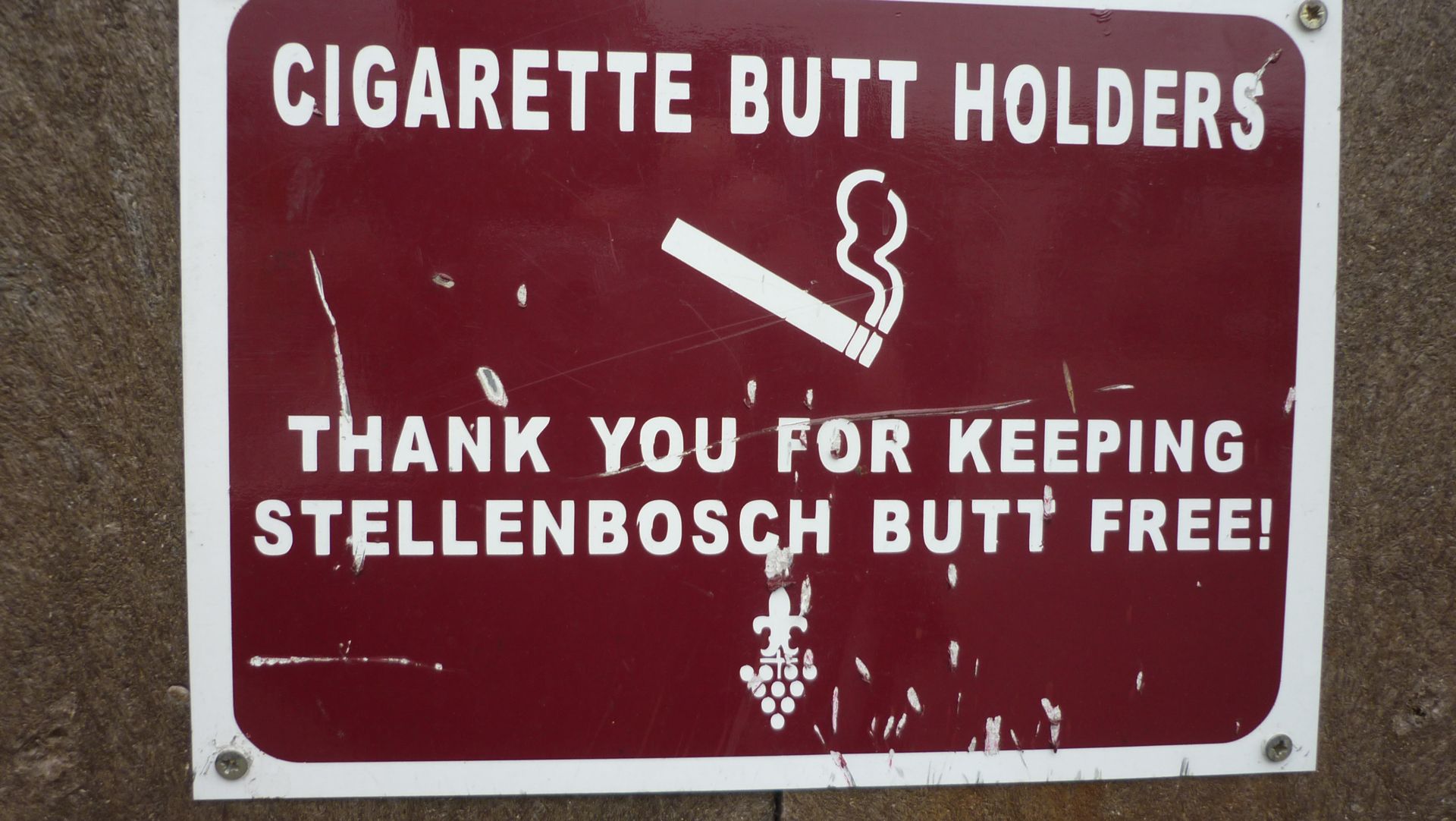
Sigmund Freud said that when you have a problem that doesn’t seem immanently solvable, rub it against another problem – it is easier after all to break one nut with two in one’s’ palm rather than one.[2]“In scientific research it is often advantageous, if the solution of one problem presents difficulties, to add to it a second problem; just as it is easier to crack two nuts together instead of separately. Thus, we are confronted not only with the problem: How can painful and terrifying dreams be the fulfilments of wishes? but we may add to this a second problem which arises from the foregoing discussion of the general problem of the dream: Why do not the dreams that show an indifferent content, and yet turn out to be wish-fulfilments, reveal their meaning without disguise?” (Sigmund Freud, Chapter 4, Distortion of Dreams in Interpretation of Dreams, 1899) I decide to rub these two problems together. Whiteness and museums. Rubbing against each-other in my palm. I stand at the threshold of the Stellenbosch University Museum, in order to look again at an exhibition that I have been tasked to write about for a colleague’s edited volume. I turn my head in all directions to take in the town’s Municipal Centre, the edges of its mini-banking district, a scattering of expensive cafes, vintage clothing and high-end bicycle equipment shops, and realise that together they compose an intentional visual harmony between past and present. The museum is surrounded by large, lush oak trees which line the busy streets in the centre of the town. In this part of the town, generous shade and discrete canal systems developed by Dutch settlers, as well as the immaculately maintained white-washed walls, seem to contribute to a crucial heat differential, offering business people, academics, tourists and resourced students a few degrees of cooling in the annually increasing summer heat. The maintenance and conservation of certain buildings, flora and spatial planning features in conjunction with the careful corporate management of logos, gold and maroon colour schemes and sign-boards creates a visual continuity between the Stellenbosch founded by the Dutch colonial administration and the Stellenbosch currently dominated by a wealthy Afrikaner business elite of South Africa.
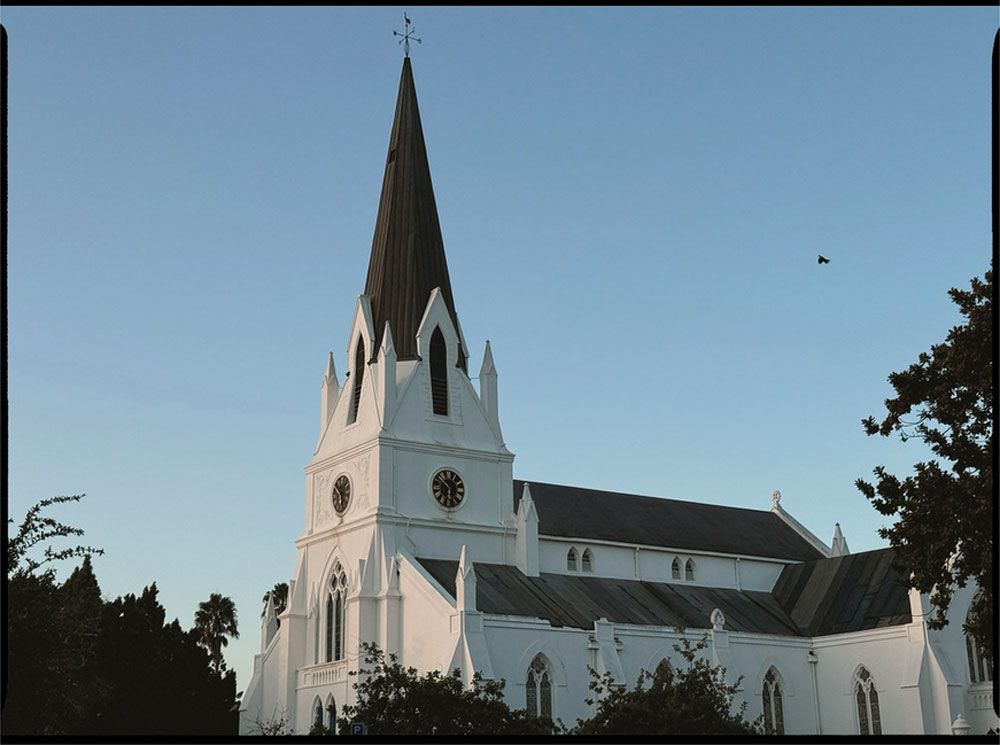
The proclaimed centre of Stellenbosch itself might be thought of as a curatorial space, in which museums are one of many spaces that assert a dominant mode of sight. The gaze implied in the normative visual and spatial language of the museum is conspicuously present both in and outside Stellenbosch’s many museums.
The interweaving of tourism, heritage preservation and wealth (a global phenomenon) reproduces the conception that this rarefied part of the town (cooler, cleaner, greener, wealthier) is the historical part of the town. The symbolic embedding of the notion of historicity in the privileged, exclusive and wealthy centre of a town characterised by extreme racial inequality does three things. First, it naturalises and celebrates the continuum of a dominant, wealthy and mostly white social class from the era of settler colonialism to the present. Second, it marginalises (and in rare cases can even co-opt) counter narratives, spaces, activities, communities that might contest or complicate this historicity. Third,
this implicit notion of historicity becomes the bedrock for the production of contemporary articulations of taste, beauty and desire in a way that shapes future possibilities of the town.
Today, private white wealth and white land-ownership still shapes the town of Stellenbosch materially and culturally. While this is a fundamental problem in itself in post-apartheid South Africa, since the town is also the home of a public university, it carries an explicit mandate to participate in the continued project of undoing the legacies of apartheid. The inadequate and corporatized expression of this mandate creates a dissonance in the town between overt discourses and performances of racial diversity and the covert protection of white racial privilege. In the last decade, there have been extensive visual redress investments by Stellenbosch University as a way to demonstrate ‘institutional transformation’.
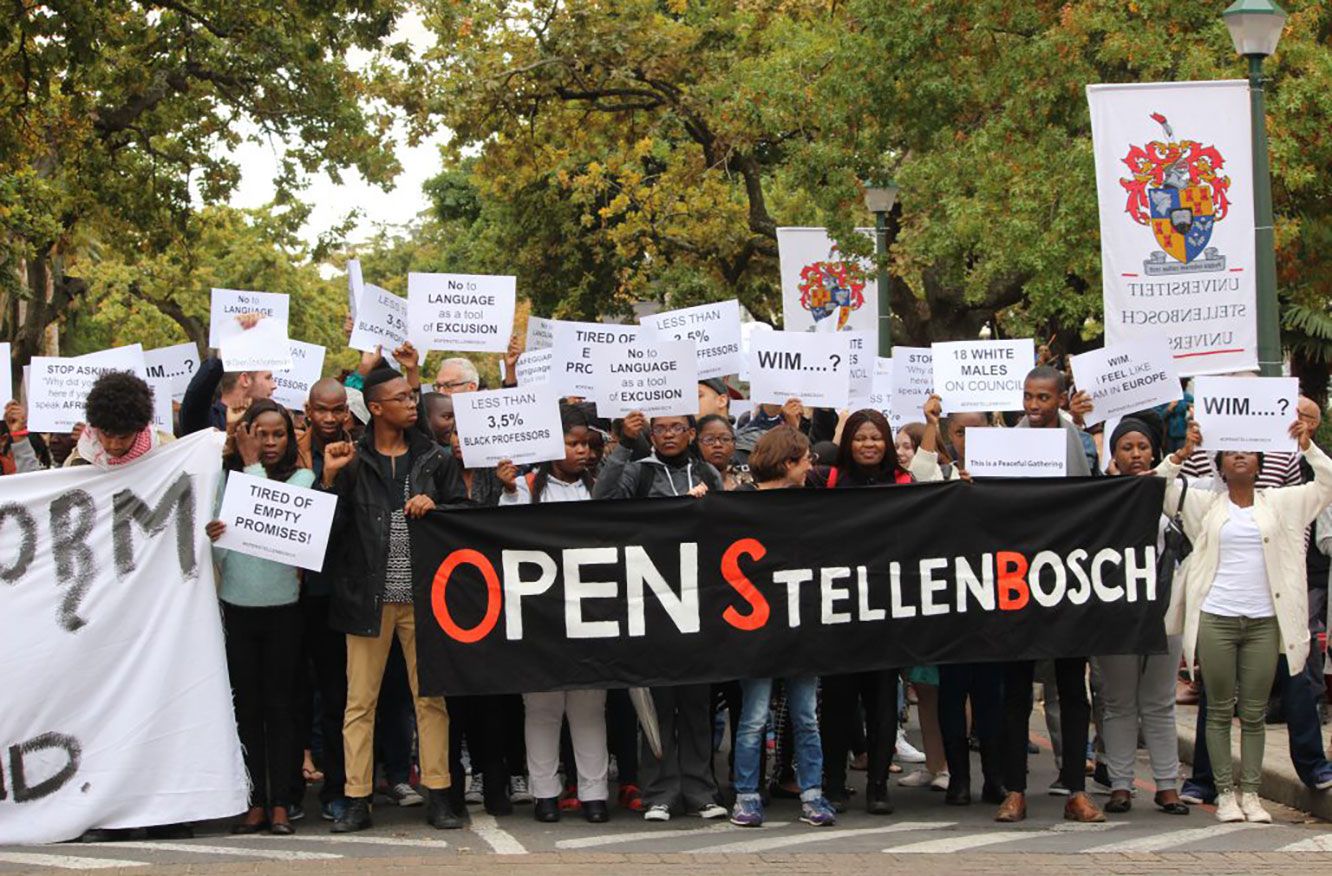
Projects have included significant building name changes, visual interventions on the campus and aggressive on and off-line marketing campaigns featuring a younger generation of racial diversity and harmony. The student body of 2026 is no longer majority white. And yet, there is a lived sense that whiteness (as a material imprint, aesthetic regime, psychic force, political presence) retains dominance in this town and on the campus. This often leads to experiences of profound violence, alienation and dissociation for black, brown and diversely racialised bodies who navigate the space professionally, culturally and socially. From my perspective as an insider and outsider of the town (white but not Afrikaans, worker but not resident), and as scholar of museology and cultural studies, the dissonance I describe manifests not only in what we see in the town, but by how we are conditioned to see (in) the town.
How we are conditioned to see, as people who work, or live in this town is not only a problem of socio-economic and cultural dominance, but a problem of stifling alternate aesthetic and political imaginations. While the town carries notoriety as the intellectual birthplace of apartheid, this notoriety superficially obscures the town’s longer role as a key node in the slave economy of the Cape. It is precisely this longer story of settler coloniality which plays a key role in the construction of a whitened historicity that in turns shapes visions of the town’s future.
For visual theorist Nicholas Mirzoeff, ‘white sight’ is “a colonial technology that creates a visible white reality.” This “reality” is real only insofar as it conforms to the desire of the colonist. When it does not, violence returns matters to the colonist’s desired condition. “White” here is a hierarchical relation, not (just) a measure of skin tone. In the slave law that regulated the plantation, “whiter” persons had dominion over the enslaved” (2025: 36). Technically, Mirzoeff identifies the surveillant gaze as the primary mechanism of white sight, a type of detached observation which requires distance in order to facilitate control (primarily of movement and bodies). It is not difficult to map this insight onto the wealthy town centre in which the museum sits, and onto the implicit ‘look, don’t touch’ protocols of the museum itself. The notion of ‘white sight’ helps to raise to the forefront the racialised history of the management of bodies in this town: the invisible interpellative message to select bodies that they should move and not linger, walk rather than sit, see and not touch, listen and not speak. These imperatives, which carry a racial and class bias, turn the wealthy town centre itself into a type of museum.
Mirzoeff’s observations follow a tradition of theorists of visuality like Susan Sontag and John Berger who urge us to give weight to what is hidden, what is unseen, in the process of seeing. In thinking about absences, and unseeing what is in plain sight, I think of this painting below, as an illustration of the way white site bleeds across media in Stellenbosch.
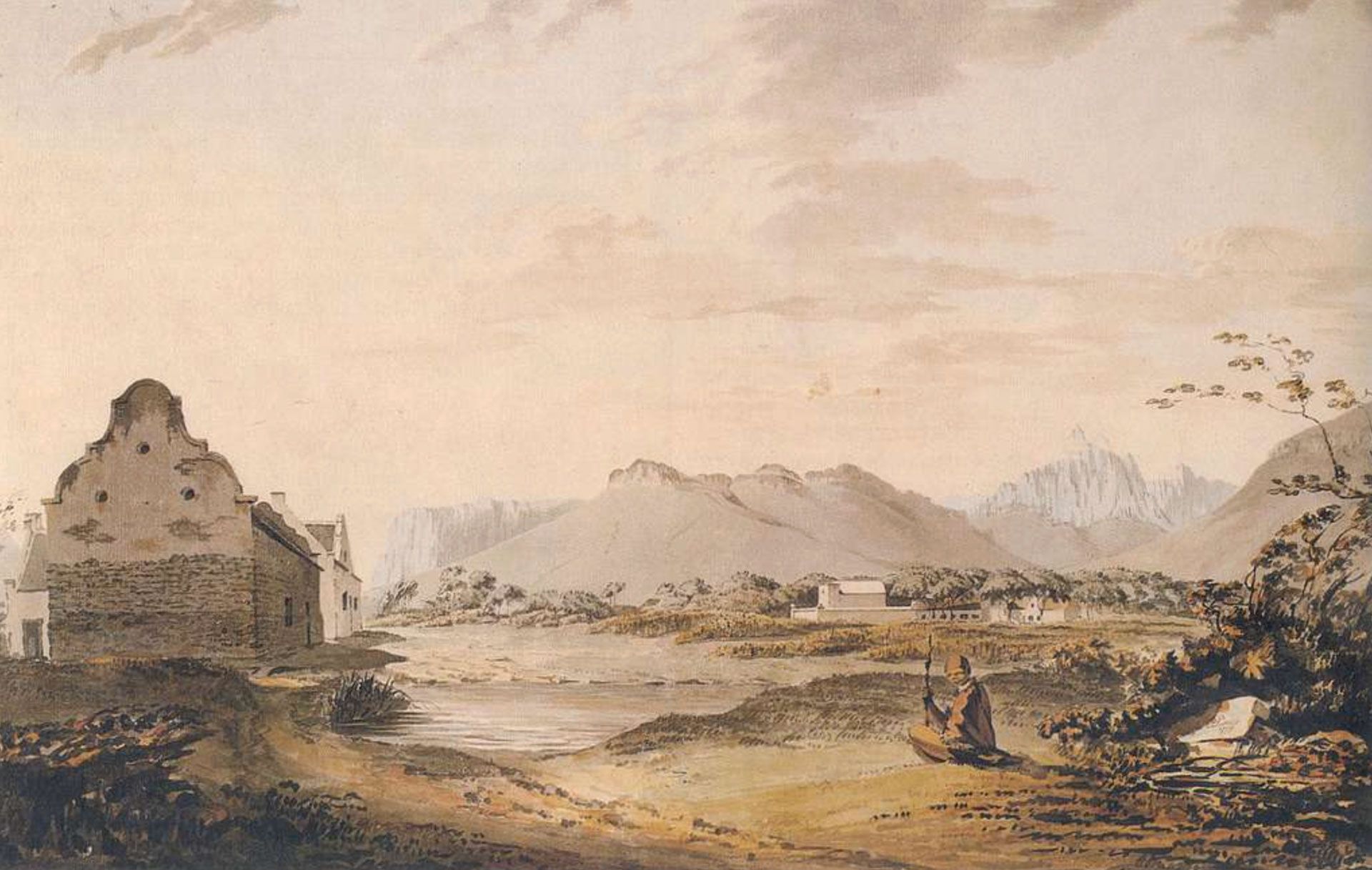
I first saw the work in relation to an historical recovery project by the artist Charles Palm, who looked at the history of the armory building visible in the center right of the painting. The armory, which stands empty in a field in the town center to this day, was provided by Cape Colonial officials to arm Simon van der Stel’s burgeoning settlement against the local indigenous population. My introduction to this image, was a way of seeing that linked the featured arms cache with the man in the foreground, who seems to be carrying a stick or staff, and is draped in clothing that identifies him potentially as an indigenous person rather than a settler. The artist’s reading of the work centred indigenous presence, settler violence, dispossession and theft.
Searching for this image online brought me to the website of ‘The Old Townhouse’, a habilitated Cape Dutch ‘heritage’ house which offers accommodation, fine dining, and tourism services. The painting heads an ‘historical’ overview section in a tab titled ‘Unveiling the Storied Past of Stellenbosch’. In this section of their website, the Townhouse compels the reader (and potential customer) to “(e)mbark on a journey through time as we delve into the rich tapestry of Stellenbosch’s past, where colonial charm, academic excellence, cultural diversity, and winemaking prowess intertwine”.
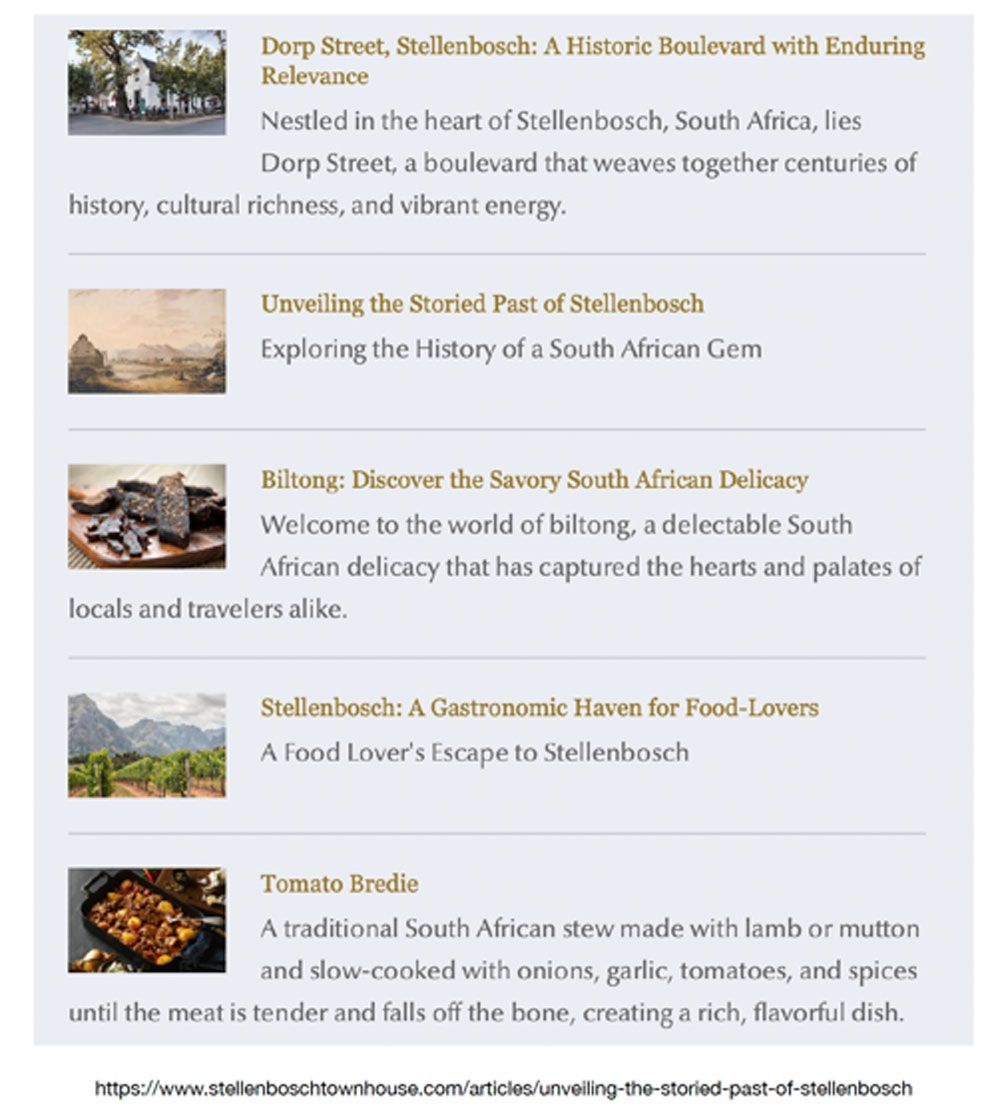
The Townhouse website goes further, to urge the reader to “(s)tep back in time to the late 17th century when Dutch settlers, led by Simon van der Stel, established their roots in the fertile Eerste River Valley. From humble beginnings, the settlement evolved into the picturesque town we know today as Stellenbosch. Walking through its streets, you’ll be enchanted by the well-preserved Cape Dutch architecture, characterized by gabled roofs, whitewashed walls, and thatched roofs. Each building whispers tales of exploration and colonization, transporting you to an era of bygone charm.”[3] Tellingly, at the time of writing the website has been replaced with an updated overview of luxury heritage accommodation offerings presented through a less historicised and more neutral capitalist aesthetic.
This reading sees neither the indigenous man sitting in the foreground nor the implication of violence and dispossession of the arms cache. The rudimentary casting of ‘Stellenbosch history’ unsurprisingly makes no reference to the well known by now, (but infrequently acknowledged) fact that Simon van der Stel was not a so-called “white”, he was what would later be called a “coloured”. Through this website, we are interpellated into a way of seeing this painting, the painting in turn becomes our lens for seeing the historic buildings in the urban center. This way of seeing conceals any signs of the violence (physical, psychic, social, spatial, environmental) or the ambiguities that underlie the construction of racial categories that sustain the contemporary racialised inequality that characterises the town, and co-opts the seer into this unseeing.
This form of sanitized settler colonial nostalgia references the colonial past in a way that hides histories of racial violence in plain sight. While there are official municipal policies that shape the aesthetic of the town centre, the paucity of alternative aesthetics and interpretations of heritage that deviate from the standard settler nostalgia indicate processes of self-censorship and coercion characteristic of a state of hegemony. This aesthetic ripples outward far beyond the Cape Winelands, and is re-inscribed as the condition of good taste. The ‘vernacular’ forms of white settler culture: wine farms, English oak trees, Cape Dutch architecture, ‘heritage’ cuisine; operate as the fertile soil for the growth of global signifiers of whiteness: fine dining, artisanal bakeries, luxury coffee, brightly coloured European crockery sets, linen outfits, expensive cars, neutral toned yoga-wear etc. These practices of elite consumption are coded with whiteness, but also on offer to anyone who can afford them. They entice a year-round stream of eager European consumers.
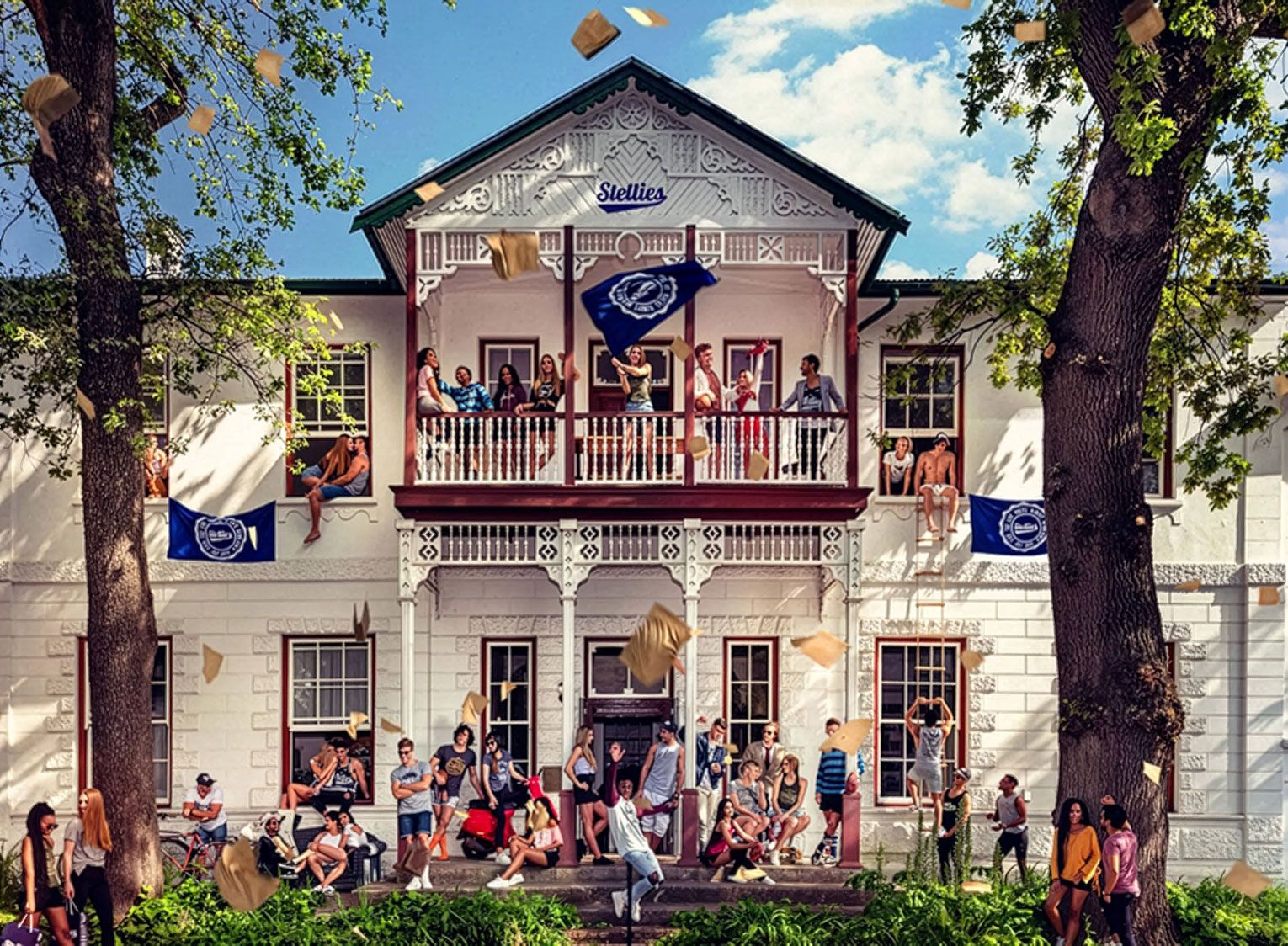
The exclusionary imagination of history that shapes the built environment and the commercial and cultural life of the town is not unique to Stellenbosch, and can be observed in various iterations from Pretoria to Prince Albert. Although I am an outsider to the white Afrikaans community dominant in the town, I am a white South African and have been informally inculcated through my lifetime in the implicit signifiers, tastes and cultural behaviours of white privilege that are so visible in Stellenbosch.
An easy outrage (and personally a self-conscious cringe) can be elicited by the various official, private and commercial examples of settler-colonial aesthetics in the oak-lined town (see Duane Jethro‘s astute observations about what was until a few years ago called the Schoon de Companje). However, as Wamui Mbao points out, Stellenbosch today is more Abercrombie and Fitch (or perhaps also Old School) than AWB.
This is the more insidious point that we miss when we caricature or mythologise white settler nostalgia.
White racial privilege is protected through a production of heritage and taste that seamlessly weaves settler colonial aesthetics with the multi-racial visual language of contemporary capitalism. This sleight of hand effaces questions of whiteness, making a whitened history stand in for a neutral all-encompassing ‘history’. This is also why the town is often experienced as inexplicably comfortable and accommodating for bodies racialised as white. This elusive and shape-shifting whitening also makes pragmatic discussion about race, class, identity, history and experience feel slippery and difficult. In the effort to describe, see, critique whiteness in Stellenbosch, I am haunted by the risk of mythologising it, of presenting it as monolithic, uniform and inevitable. My hope is that the focus on the curatorial construction of white-life makes evident that whiteness is re-inserted and re-invested in purposeful ways that appear naturalised.
Scholar Andre Keet (2014) points out that the inaccurate fantasy of picturesque whiteness in Stellenbosch is also sustained by practices that ‘expunge the ‘living black’ from the present’. In this essay, I have traced how public constructions of history shape the built environment, bleed into the language of commerce and create imaginative limits for our societies in the present, both by what they include and by what they exclude. It is significant, for example, that the battle of Andringa street in 1940 carries no imprint or memorialisation in Stellenbosch’s ‘historic centre’ where residents, visitors and above all consumers are inculcated into their informal historic education of the town.
The battle of Andringa Street took place over the weekend of 27 and 28 July 1940, when Stellenbosch University students were implicated in physical violence, intimidation and destruction of property against coloured inhabitants of Die Vlakte. Die Vlakte was a mixed neighbourhood in what is now a central part of the University Campus. More than 20 years later, on 25 September 1964, Die Vlakte was declared a white group area in terms of the Group Areas Act of 1950. In the subsequent years, 3700 coloured inhabitants, six schools, four churches, a mosque, a cinema and ten businesses were affected by the forced removals. This relatively recent, violent and traumatic history which completely reshaped the town bears no visible imprint on the town centre of the present and evidences the relative nascency and purposefulness of the whitening of the town centre and the construction of a whitened past and present. While the University has invested in projects that seek to engage the history of Die Vlakte, there is a tendency for such interventions to have limited presence beyond the campus.
I remain curious about how the language of commerce, capitalism and spatial planning that creates shared spaces in the town could be shifted through investments in powerful historical counter-narratives and re-centred perspectives, given the key role that historicisation plays in creating shared imaginations. With conscious investments, memory cultures and heritage practices that centre a different set of historical accounts (such as Hilton Biscombe’s study), could flourish into projects that take on different modalities, and that shape the built environment, beyond museum displays and instructive interventions on the university campus. Stellenbosch is not destined to only and always incubate exclusionary forms of privileged whiteness. Could you imagine sustained cultural and social interventions in Stellenbosch like the participatory and community led District Six Museum in Cape Town which continues to contest whitened versions of the city’s history? We need to think about what prevents this from happening.

A recent study indicates that the English Cape oak trees, planted by the settlers in the 1600 and 1700s after indigenous trees were depleted as a timber source, are infested with borer beetles and are slated to die in the next five years. The municipality has an extensive plan to replace them with Turkish oaks.
The revelation of invisible rot raises questions about the enormous cost of the myth of whiteness, and the endless investments in its facades.
No doubt the town will come up with the finances to protect the historic beauty of the CBD and wealthy white suburban neighbourhoods like Mostertsdrift. Meanwhile the Stellenbosch neighborhoods of Kayamandi, Idas Valley and Cloetesville, because of their purposeful historical and present marginalization, will likely not receive the same investments and will remain vulnerable to impending climate related suffering – floods, fires, droughts, denuding of remaining trees etc. White supremacy continues to inform the development of Stellenbosch, it has done so for hundreds of years. The powerful marriage of a whitened past and a capitalist future sustains the myth that things have always been a certain way and that they cannot change. Can the exposure of the fragility of this myth embolden us to look again at the weak spot revealed between the story of the town’s past and its potential future? This moment of rot and collapse could also be a rupture in which a different set of agencies, of contingencies are placed on the historical stage. This is not only an argument for the ‘inclusion’ of the histories of slavery and other forms of racial violence within the existing visual matrix, but rather for an investment in a new visual matrix, a decentring of white historicity. I hope that new saplings, new cultural projects, investments in diverse historical narratives, might create different historical centers of the future.
| 1. | ↑ | There is relevant criticism that the journals of ‘settler colonial studies’ and much of what has come from white liberal humanities scholarship in South Africa is filled with tacit justifications of white economic dominance and sustained white social privilege in post-apartheid South Africa (Milazzo, 2022; Park, 2021; Fung, 2022). |
| 2. | ↑ | “In scientific research it is often advantageous, if the solution of one problem presents difficulties, to add to it a second problem; just as it is easier to crack two nuts together instead of separately. Thus, we are confronted not only with the problem: How can painful and terrifying dreams be the fulfilments of wishes? but we may add to this a second problem which arises from the foregoing discussion of the general problem of the dream: Why do not the dreams that show an indifferent content, and yet turn out to be wish-fulfilments, reveal their meaning without disguise?” (Sigmund Freud, Chapter 4, Distortion of Dreams in Interpretation of Dreams, 1899) |
| 3. | ↑ | Tellingly, at the time of writing the website has been replaced with an updated overview of luxury heritage accommodation offerings presented through a less historicised and more neutral capitalist aesthetic. |