SEAN O’TOOLE
Gnossienne
Deep into the twilight of the Gutenberg era, when doom scrolling has replaced cashier-avoidant browsing at a local newsagent or bookstore, the plucky endurance of independent publishing, particularly artsy publishing in printed format, is both quaint and curious as a phenomenon. Community building, an unromantic but core business function of little magazines, is now, as an activity, more URL than IRL. “Like and subscribe,” goes the mantra, which anyway was a truism during the Darwinian age of print – a now-faltering enterprise that for centuries provided the mulch for the Anthropocene. And yet, here we are, long after print’s Chernobyl moment, regarding its half-life.
Now into its second edition, publisher-editor Jess Sutherland’s Gnossienne project slots into a foolhardy tradition / resilient legacy (take your pick) of little magazines. I prefer the designation “little magazine” to the fustier descriptor “literary journal” in writing about Gnossienne, even if, as captions and statements deep into this magazine suggest, it is the word “journal” that is nearer Sutherland’s idea for the publication. What’s in a name, right? I prefer “little magazine”, not only for the fact that it is more capacious and objectively descriptive of the species, but also because it doesn’t sell short the ambitions of this gorgeously visual publication, which just happens to be little (15.5 x 22cm).
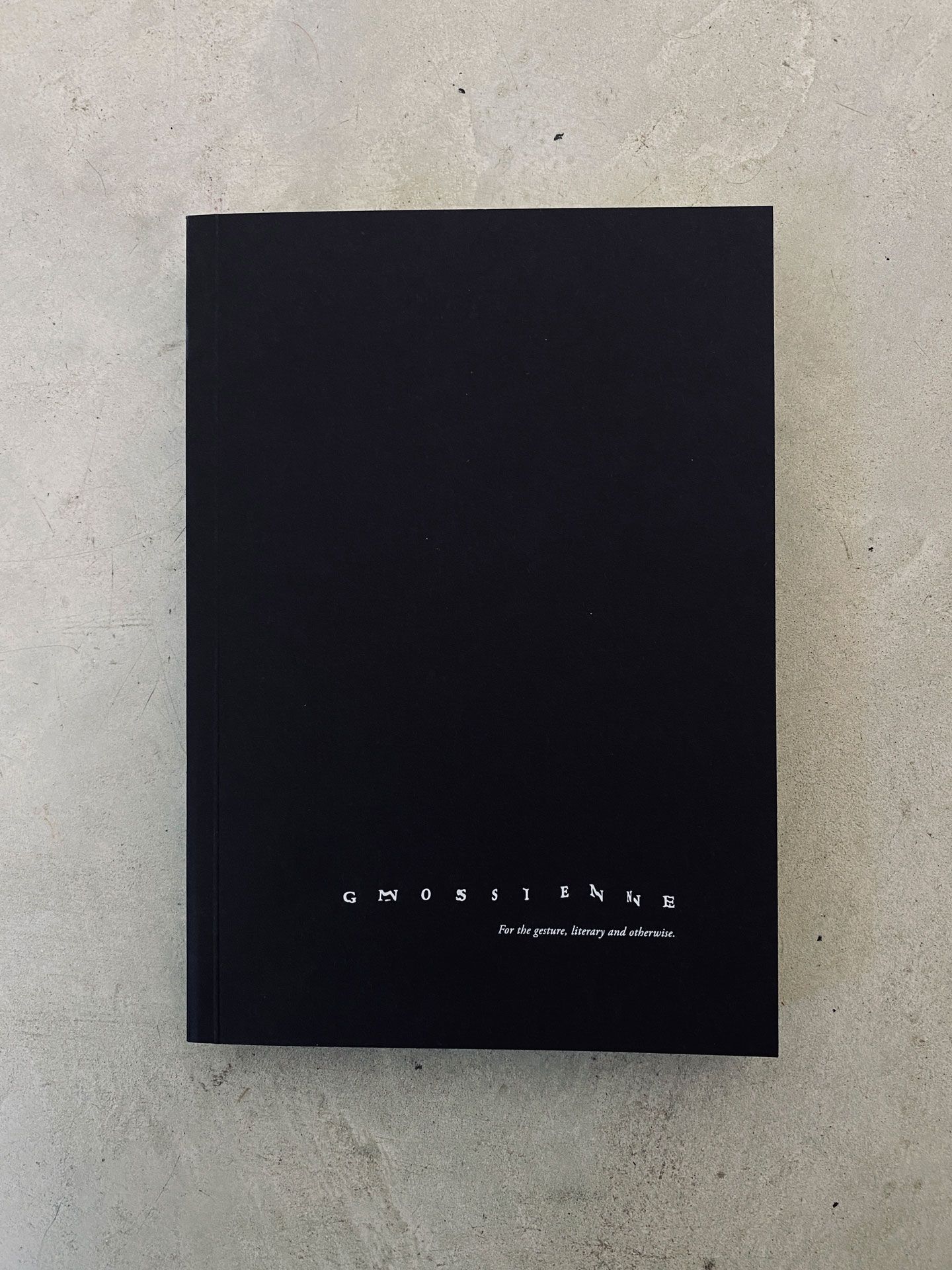
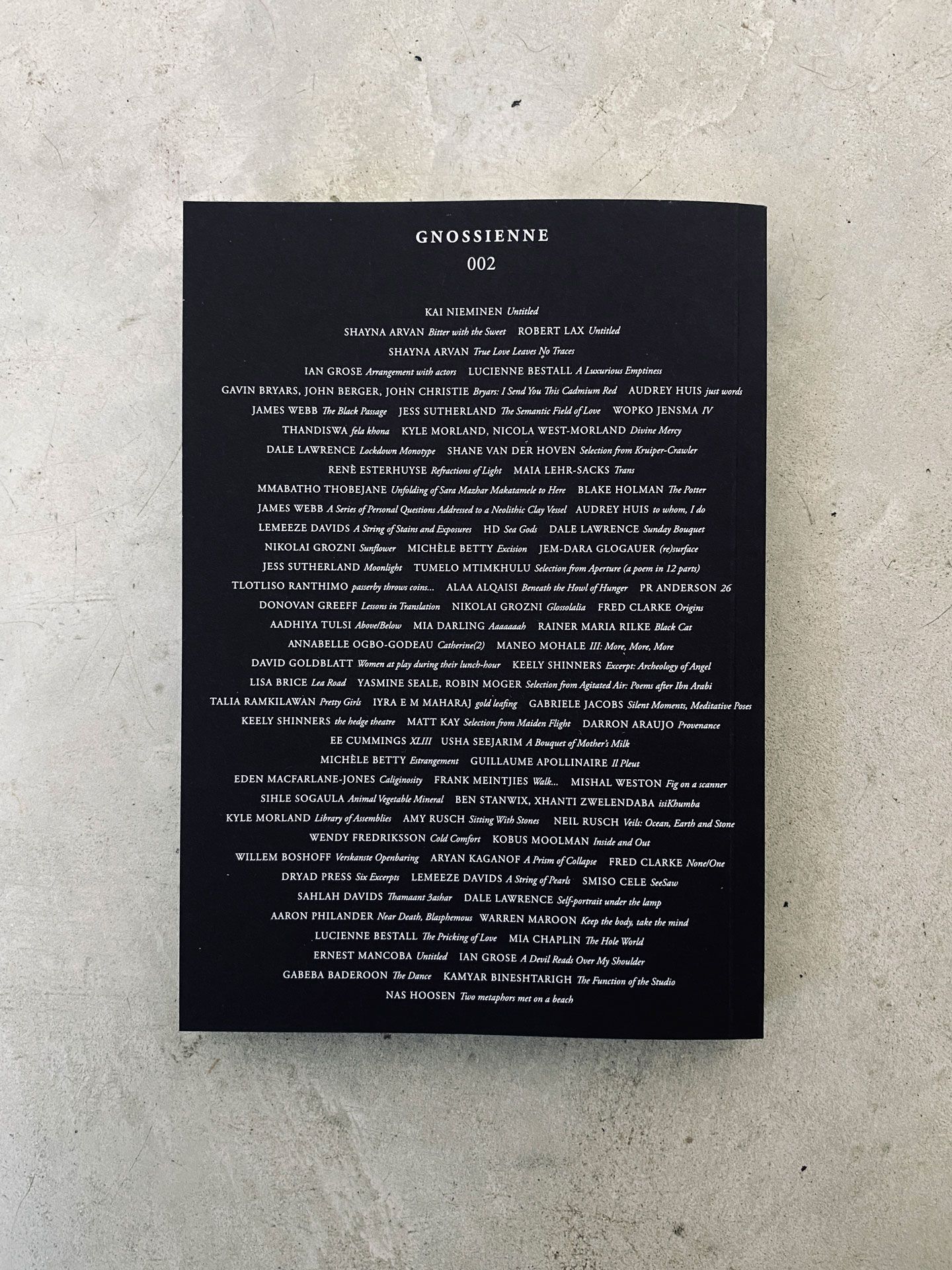
Yes Gnossienne includes essays, short fiction and poetry (notably by Wopko Jensma, a stalwart of South Africa’s small, literary-inclined presses of the 1970s), but it is equally stocked with visual experiences. Working with art advisors Khanya Mashabela and Daniel Malan, Sutherland’s 260-page salon features generous reproductions of paintings by Shayna Arvan, Lisa Brice and Ernest Mancoba, also sculptures by Smiso Cele, Sahlah Davids and Warren Maroon, as well as word art by Willem Boshoff, Dale Lawrence and Tumelo Mtimkhulu – all in black and white.
There are even long-form essays devoted to single art works by James Webb and Maia Lehr-Sacks. Webb’s recent, literary-infused art practice is represented here by his questions addressed to a Neolithic clay vessel from the Upper Yellow River region. “Who formed you?” reads a lone sentence. Printed opposite, another question: “What were you told when you were drawn from the mud?” Similarly, Lehr-Sacks is given a generous allocation of printed real estate, her folded paper sculpture Trans (2025), made to the dimensions of the magazine, depicted transforming across ten pages.
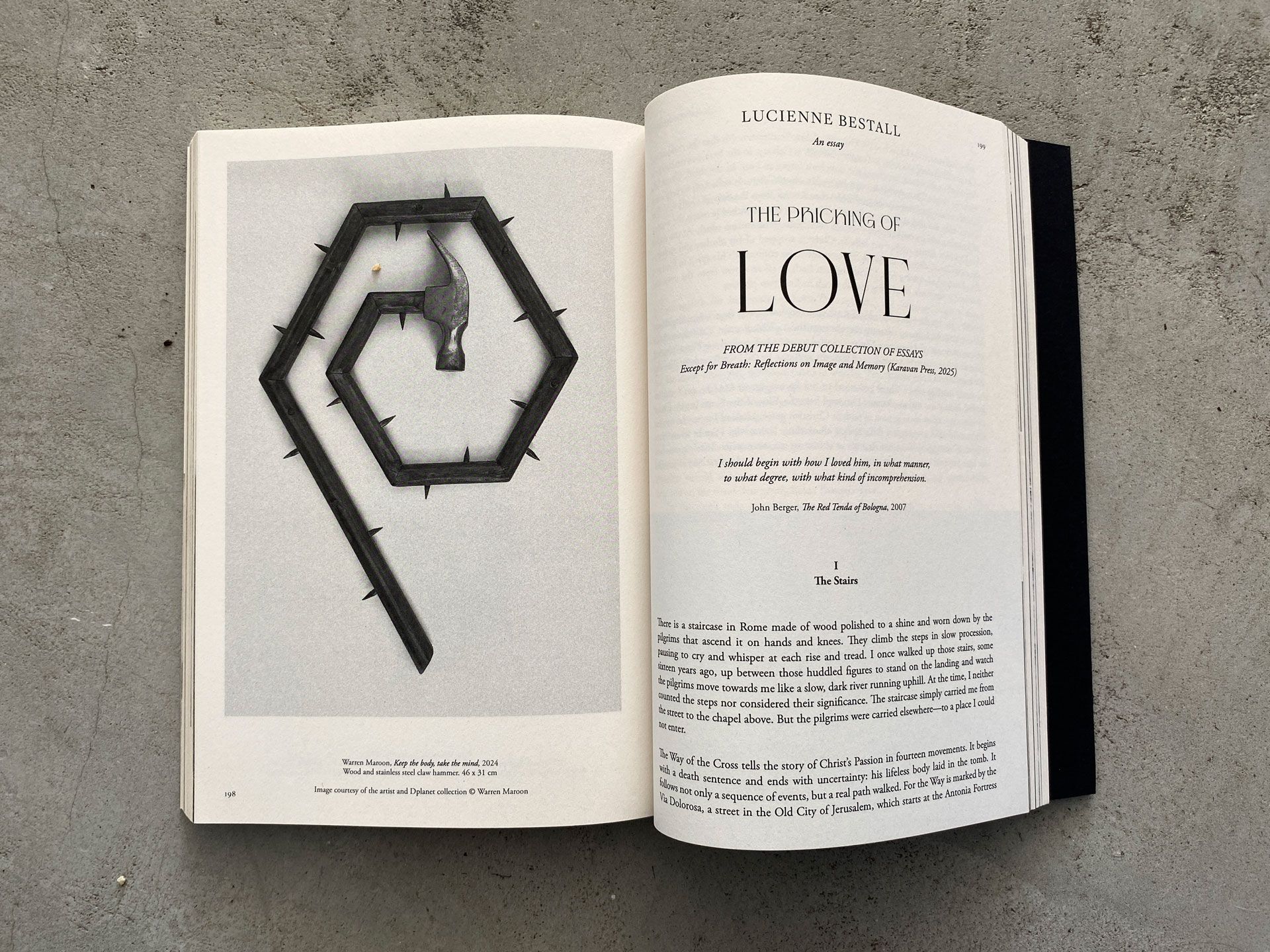
Gnossienne’s affections for art run deep. There is an interview with the luminous critic and essayist Lucienne Bestall, whose essay “The Pricking of Love” from her debut book Excerpt for Breath (2025) is reprinted later into the publication. “Whenever I find myself knocking up against language, I think of Wittgenstein’s sentiment: ‘the inexpressible is expressed in the expressible’,” Bestall states in an illuminating interview.
“Language becomes something to gesture with. It’s the finger that points …”
Also excerpted is a poem and passage from a novel, both from forthcoming titles by the engaging art critic Keely Shinners, whose role of vocalist in the punk band Ugly Baby has added to her list of vocational diversions. These prospective excerpts are matched by retrospective loans: Jensma’s concrete poem “IV” originally appeared in his 1977 collection I Must Show You My Clippings, while Rainer Maria Rilke’s poem “Black Cat” was written in the European summer of 1908 (not 1907 as is stated). Sihle Sogaula’s seductively recondite short essay “Animal Vegetable Mineral” is another borrowing. It originally accompanied – rather than elucidated, as is the prosaic demand of gallery texts – a 2025 exhibition of the same name by collaborating artists Ben Stanwix and Xhanti Zwelendaba at Reservoir Projects in Cape Town.
There are also original texts, some magical, like Lemeeze Davids’ poem-like essay in six parts, “A String of Stains and Exposures”, in which she proposes that there is a sunken Phoenician galley buried in the Cape Flats. “The shipwreck is said to lie/ under a Pinelands cricket field.” True? I rushed to Google to find out, a sure sign the author had me engaged. But it is the borrowings that intrigue, at least momentarily. They hint at the blurry meaning of the nouns “editor” and “curator” in the wake of the supposed horizontality of the internet and corporate-owned instantaneity of the socials, Pinterest especially.
“An editor should be neutral but not a neuter,” wrote Transition editor Rajat Neogy in Kampala in 1968. It is durable advice, even in 2026, when the expectations of a literary editor are that they must not only be bookish but neurally connected. Sutherland is just that. During a 2025 residency at A4 Arts Foundation in Cape Town, while working on this edition of Gnossienne, Sutherland showed me a black-and-white photocopy of Sahlah Davids’ Thamaant 3ashar (2020), a found wooden chair with padded seating festooned with red-tipped boutonniere pins illustrated in this issue. The image, she said, had been purloined from my Instagram. I, the reviewer in waiting, was being watched.

A perennial accusation levelled at little magazines is bias: they are no more than self-reinforcing clubs. It is not an unreasonable charge. Terry Eagleton persuasively and prismatically made this charge the subject of a book, The Function of Criticism (1984). Be it Ophir or Izwi, New Contrast or Chimurenga, the Voorslag of Roy Campbell and William Plomer or The Johannesburg Review of Books of Lidudumalingani and Koleka Putuma, the history of little magazines in South Africa is one of camaraderie and companionability, but also cliquishness and, yes, dogged clannishness. Refreshingly or naively – again, take your pick – Sutherland doesn’t buy into this charge. In an interview with Kamyar Bineshtarigh, a limber Iranian artist long resident in Cape Town, she likens his recent exhibition of glue works, large relief transfers made from the studio walls of various artists in Cape Town and Johannesburg, to her ambitions with Gnossienne.
“The show seems to visually describe an arts community, giving the audience a lay of the land – albeit fleeting and specific,” she observes of Bineshtarigh’s works from his exhibition Group Show (2025) at Cape Town’s Southern Guild. “I love this because it’s how I see this journal. Producing Gnossienne feels like lightly attaching a web across people and between fields, making apparent a creative ecology of practitioners who know each other and who acknowledge each other’s practices.” This interdependence, she adds, bolsters a scene. Words solidify as an actuality, a perishable thing: a scene. Later into the interview, Sutherland self-reflexively says of Bineshtarigh’s exhibition, “It feels like a survey of working artists suspended in the connective tissues of a particular moment in time.”
Reading all this, some 230 pages into the magazine, I wondered why Sutherland hadn’t said this earlier, in her editor’s note. As introductions go, the editor’s note is, charitably put, esoteric. (A useful hint: the publication derives its name from French composer and occultist Erik Satie’s inspiring modal piano compositions from the early 1890s.)
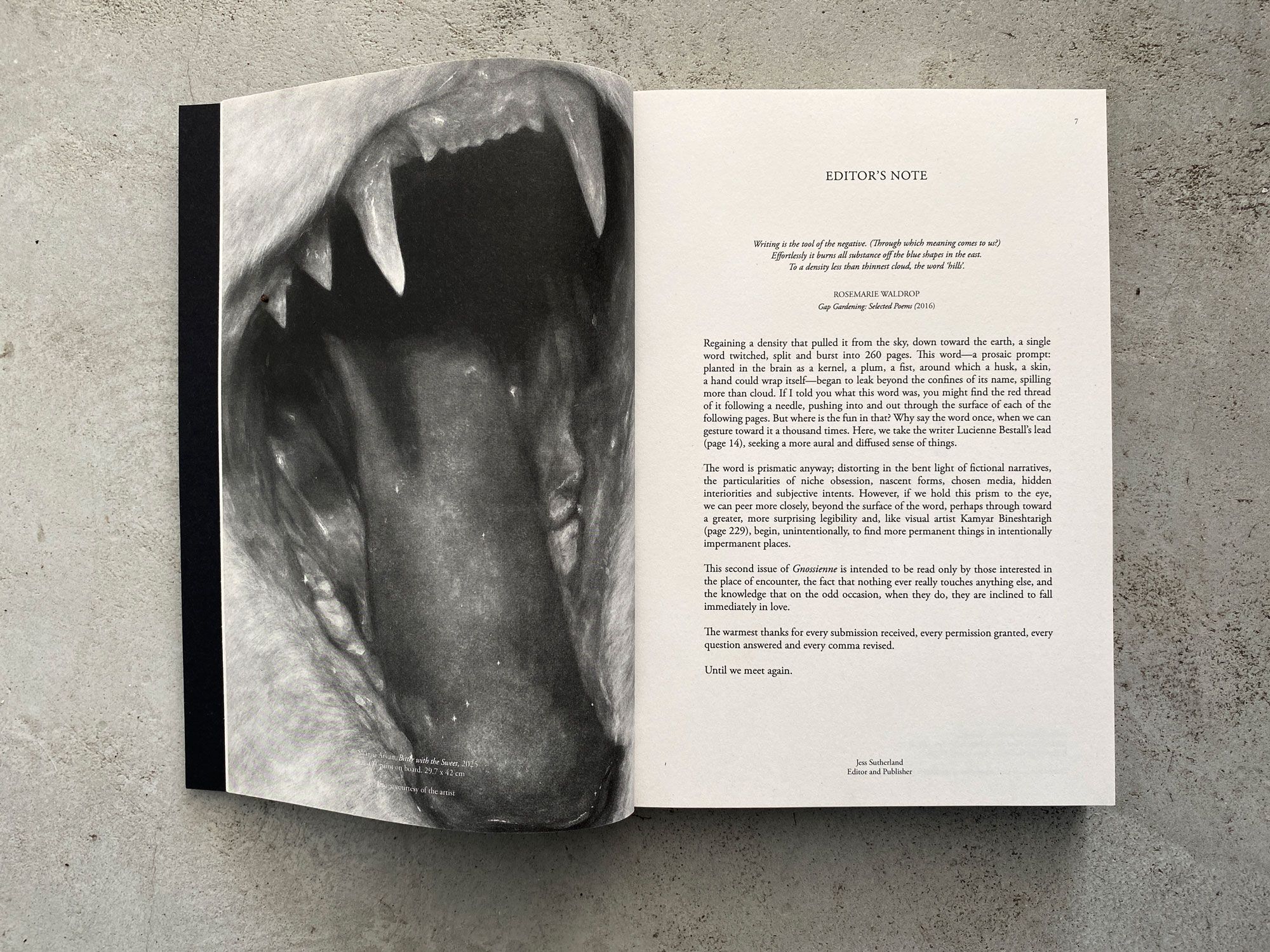
Paired with a reproduction of Arvan’s winning painting of a cat ’s mouth in full yawn, all teeth and mysterious depth, some sense of mission is suggested in the third paragraph: “This second issue of Gnossienne is intended to be read only by those interested in the place of encounter, the fact that nothing ever really touches anything else, and the knowledge that on the odd occasion, when they do, they are inclined to fall immediately in love.” Um, yes, I guess.
A standalone note floated above the colophon better locates the ambitions and objectives of Gnossienne. The unsigned note begins by detailing the mating rituals of male riflebirds, a bird-of-paradise species native to eastern Australia and New Guinea, in particular its habit of creating a dark arc of feathers under its chin and exposing its open mouth. “Gnossienne likens this extended moment of seduction to the courtship display of a text, which is also, always, hoping to seduce its reader with its own golden mouth,” the note reads. “In this we find a view on how one might begin a relationship with literature, by allowing themselves to be the object of desire.”
This is either a throwaway remark that the editors (or Sutherland) may come to regret, or the rough draft for a more full-throated defence of the romantic or impressionist tradition of literary publishing and art criticism, one that has prospered – haters notwithstanding – since Baudelaire and his great interpreter, Walter Benjamin. Bestall discusses Benjamin and his disciple, John Berger, a radical who was also a romantic, but she is broadly interested in the limitations of language, as well as its medicinal qualities, not its capacities to indict.
If there is an ideological undertow to Gnossienne, it is not allied to Mark Fisher’s influential analysis of futility and economic precarity in Capitalist Realism: Is There No Alternative? (2009), nor is it motivated by the impulses informing Marc Fischer’s zine Why Self-Publish under Facism? (“To attack and humiliate Neo-Nazis and use publications to grow an atmosphere of hostility to their bullshit,” the Chicago author proposes). Not that.
Bineshtarigh’s politics, which are unambiguously pro-Palestine and against the Shiite clerical establishment ruling Iran, are not canvased. David’s wonderful meditation on “watery entanglement” does briefly pause on the social: the use of purple dye by security police to stain anti-apartheid protestors in 1989, but it is in the pursuit of a durable metaphor: “It’s about being encased/ in the fluids of the world”.
Gnossienne‘s lack of an explicit politics is either refreshing or, as the dogmatists and ideologues like to say, a revealing lacuna.
When is preference a fault? And, more to the point of this writing, is criticism of any use when it refuses to look at and respond to what is visible and palpable? A passage from Sogaula’s essay was, for me, instructive about the experience of reading Gnossienne: “… sometimes, what returns is not meaning./ Just texture./ Just a glitch./ A murmur./ A story told sideways.” For some, this compendium of textural murmurs and colourless pictures might not be enough as a creative response to the awfulness of now. For me, right now, during this pandemic of scrolling, I’m okay with looking imperfectly sideways at a scene, my scene, and recognising in this archaeological fragment not only its possibilities and limits, but its shy frequencies and legitimate claims to posterity.