LINDA KOPITZ
“Who’s buried here?” #Gravetok between Archives and Aesthetics
INTRODUCTION
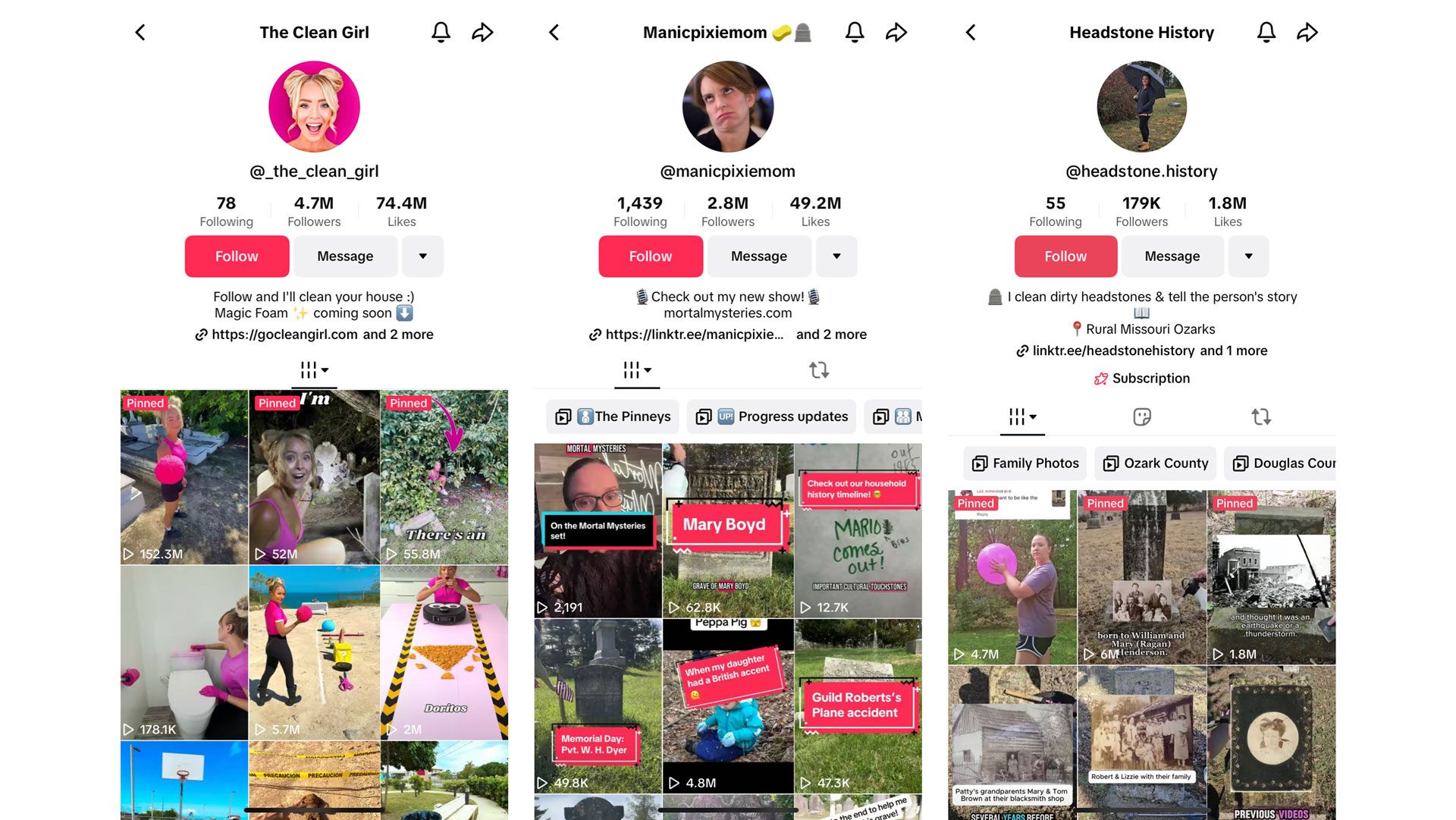
“Who’s buried here? Let’s clean this grave and find out!” With this voice-over begins one of the most successful videos of TikToker @_the_clean_girl (2024). Within the video’s next minute, the seemingly abandoned grave – and the name of the buried – is uncovered through the manual labor of scrubbing, washing and shining with an extensive range of fluorescent cleaning liquids and tools.
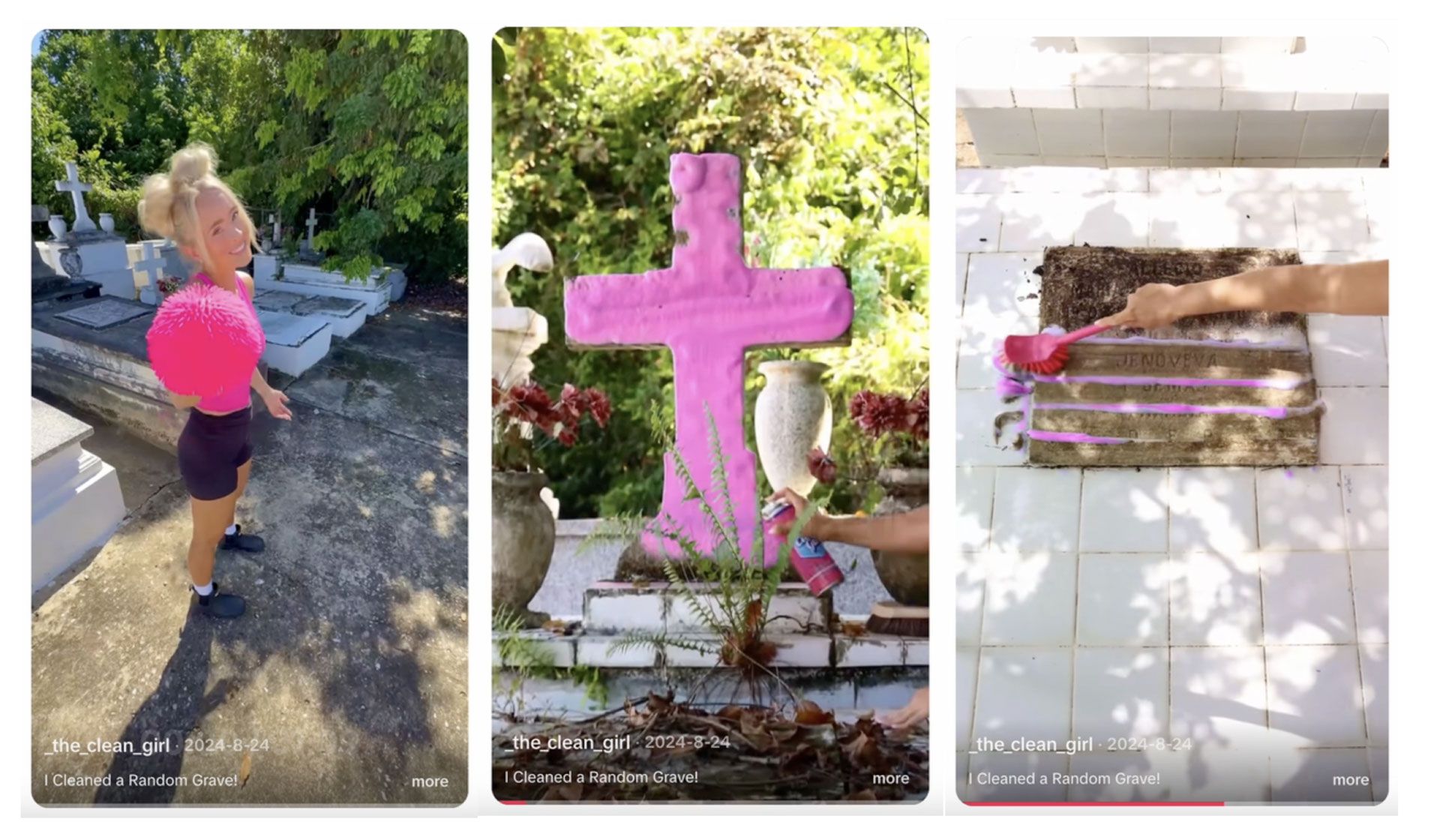
Positioned as documenting ‘meaningful transformations’, this example forms part of an emerging genre of social media posts that is both applauded and criticised for its particular, mediated form of memory work. This particular video has been viewed more than 152 million times on the social media platform – and is part of more than 24.000 #Gravetok videos at the time of writing.
While some of the videos function as what we could call ‘supernatural tracings’ and some as an excursion into the life (and death) of the buried, this contribution focuses on a striking subsection: Videos documenting the cleaning and revealing of abandoned graves. Or rather: seemingly abandoned graves. The question of when a grave is being cared for, has not been abandoned, is a fairly contentious one – and also comes back throughout these social media videos and their comments. Predominantly featuring young women cleaning and narrating, as well as commenting, #Gravetok not only points to gendered discussions of care labor but also challenges what forms and practices of care are acceptable – particularly as it comes to caring for both the dead and decaying infrastructures.
DEATH AND MEDIA: Contextualizing #Gravetok within Infrastructures of Death
The entanglement between technologies, and particularly media technologies, and death is not necessarily new: For instance, one of the first widespread uses of the medium of photography was preserving images of the deceased. This historical form of post-mortem photography can be linked to contemporary practices where images of the deceased are not only kept, archived, individually remembered but also shared on dedicated memorial websites and social media – which now also features embedded technological solutions on how to ‘memorialize’ online presences. See, for instance, the official help page of Facebook on how to memorialize your own page. Stefania Rasile has argued that in doing so, “social networks connect the living and the dead, the material world with the immaterial world” (Rasile 2024, 43). While there is expansive research on changing forms of mourning online, I will try to bring these forms of mediations back into the urban space – to then think about digital space again.
In many regards, at least in Western culture, the cemetery, as it has developed over the past centuries, still remains the most common form of burial, and the most central site of memorialization. The catholic church, to this day, does not permit the scattering of ashes – and advises against anonymous burial. Only in extraordinary circumstances are ashes allowed to be conserved in private, domestic residences – where they then also fall under the respective national health and burial codes. Similarly, a wide range of European countries have specific regulations that, generally, tend to center the cemetery as the preferred, if not only, place of burial. At the same time, as Sam Holleran reminds us, the cemetery is not just a space, but one that is also very much “the product of social imaginaries, including idealised notions of landscape, memory and storytelling” (2024, 41).
It is within this physical context, and within an increasingly mediated everyday life, that I am thinking about how digital infrastructures and digital media are “expanding the commemoration experience” (Rasile 2024, 43; cf. Arnold et al. 2017) – for instance through the inclusion of QR codes on gravemarkers, usually leading to memorial websites and digital tributes to the deceased. Beyond these small changes – that also function as a continuation of earlier phases of media histories, for example through the inclusion of photographs on gravemarkers – in many ways, cemeteries as ‘space’ are not changing in themselves, but are being layered with technologies and technological practices as memorialisation also becomes digitalized. To explore this further, this contribution narrows in on videos posted by three content creators on the social media platform TikTok: @_the_clean_girl, @headstone.history and @manicpixiemom.
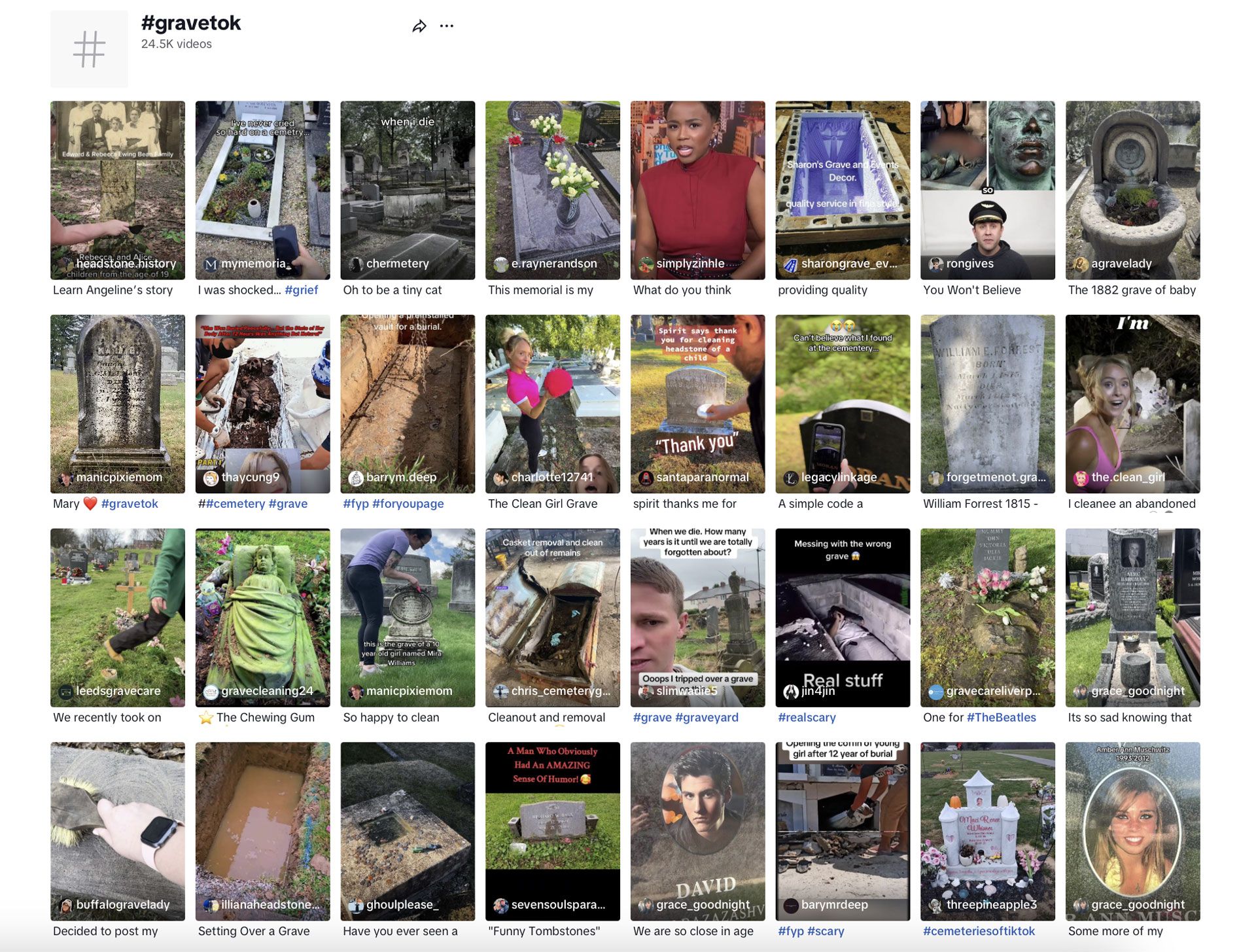
Their respective most popular gravecleaning videos and the comments posted underneath them function as a starting point to trace how ideas of memory, heritage and labor in relation to deathcare are both embedded and challenged in contemporary discourses. With their specific attention to making the cleaning of graves visible, #Gravetok videos connect to what Hannah Gould and Sam Holleran call the “complexities of seeing and unseeing, exposure and concealment in contemporary death rituals” (2024, 539). And, notably, they bring underlying assumptions about decay, of bodies and spaces, histories and infrastructures, to the forefront.
#MEMORY: Gendered Care and the Cemetery as Archive
Understanding the cemetery as a public site, and yet one that is only rarely mediated, highlights the intersections between urban and digital spaces – and the role of social media in discovering, uncovering and recovering everyday memories of ‘forgotten’ lives and ‘decaying’ infrastructures. Epitaphs, the inscriptions in headstones, are considered “one of the oldest forms of writing in the built environment” (Holleran 2024, 43) – and one that underlines the linkage between personhood, memory and name, both in life and in death. Referred to as “‘necronominalism’, this is “a phenomenon that persists to the present day: the deceased are remembered through their names, which identify the remains of a body and its memory, relating them to one another” (Rasile 2024, 39).
In the #Gravetok videos, cleaning and uncovering the name becomes interwoven with uncovering the life histories of the deceased. On the one hand, both the TikTokers themselves and the comments underline this as a form of memory work, particularly for forgotten histories of women and children of the past, while on the other hand also negotiating their own fear of being forgotten in the future. One of the most notable lines in the comments is the comparison drawn between the lives of the commentators and the grave, pointing out shared names, shared familiar histories as well as shared health experiences. In addition to these still more abstract comparisons and connections, some comments center on hoping that somebody will do this for their own grave, someday. This positions #Gravetok at the tension between the temporalities of cemeteries and the temporalities of social media as (fragile) archives – and the larger question of what remains over time. The notion that, as Sam Holleran puts it, “cemeteries are ‘archives in stone’ that must be protected at all costs” (2024, 41) versus the idea that “the easy accessibility, dissemination, and consumption of digital information presents a paradox: the rise of memory is inevitably accompanied by the rise of forgetting” (Rasile 2024, 43; cf. Huyssen, 2000).
The decision of which graves to clean in the first place and the popularity of the cleaning videos in turn point to gendered dimensions: In a local newspaper article on the work of @manicpixiemom, the journalist notes that she “is interested in the stories of everyday people. Of women, especially, whose lives went intentionally unremembered. And of children, whose stones she can find easily, because they’re usually small” (van Dine 2021).
Here, the gendered histories of cleaning, of deathcare and of archival efforts intersect.
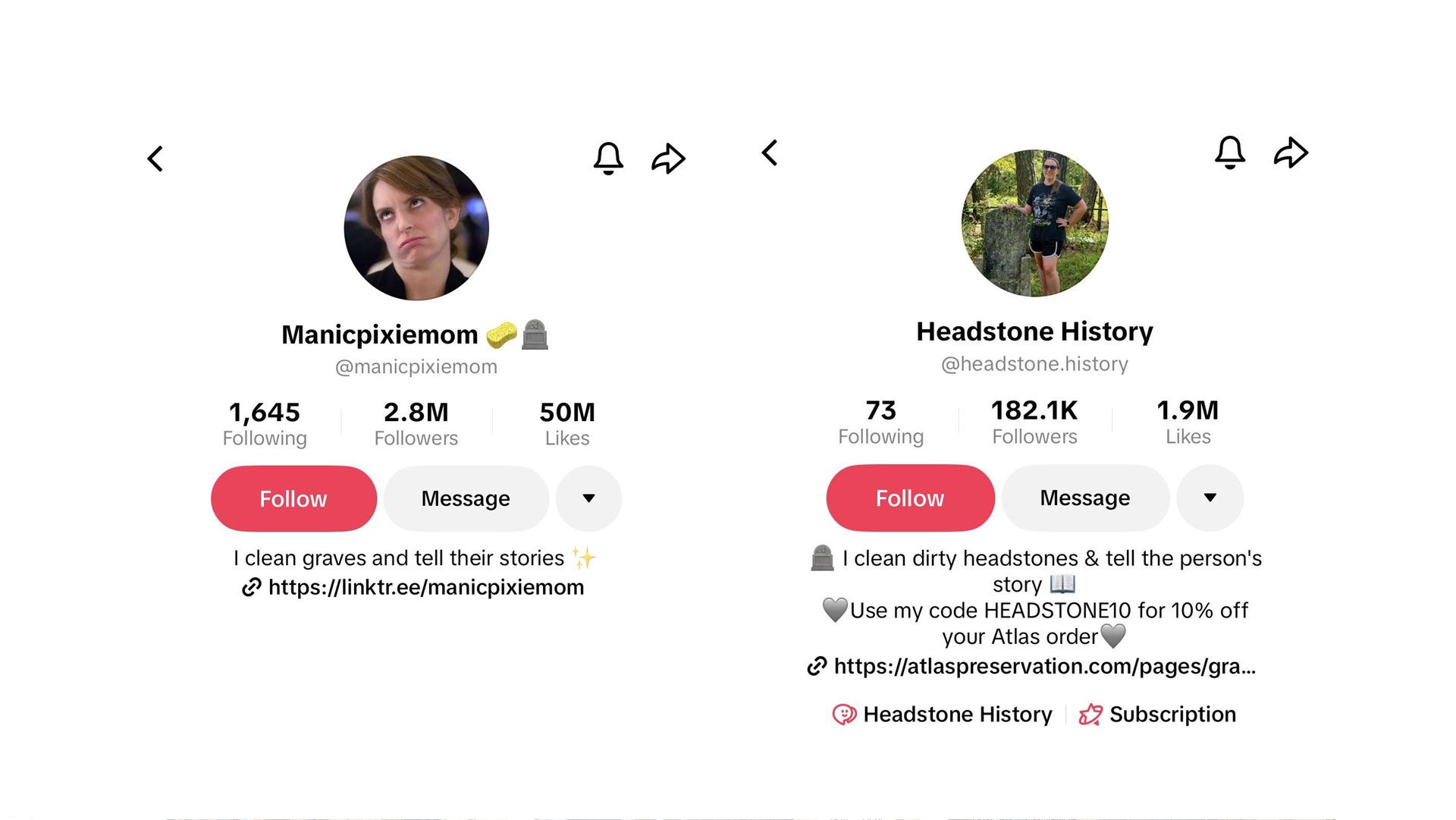
Who is doing the labour, and who is remembered for it. @headstone.history features the post text “Grace Elizabeth “Gracie” (Henderson) Johnson’s Headstone Cleaning & Story”, while @manicpixiemom simply describes the video with “Josie <3”.
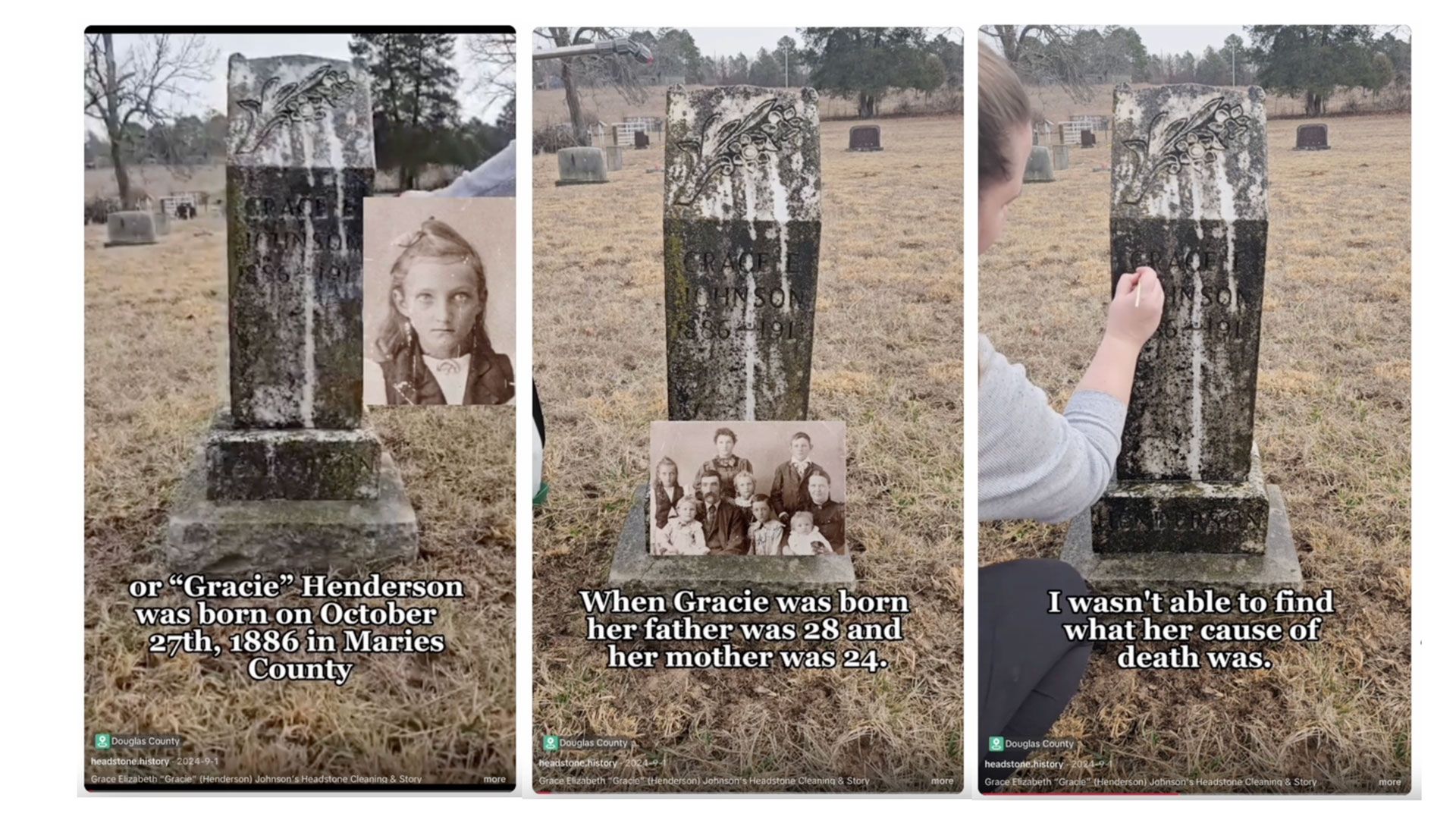
Both the restoration of the headstone and the revelation of the life history of the buried person are central elements to these TikToks, and are interwoven both visually and through the narration. In doing so, and in a close relation to earlier forms of post-mortem photography as frequently the only visual trace of the deceased, #Gravetok can also be understood as an archival effort to reconstruct the lives of people that are not only forgotten in the physical space but also rarely featured in historical documentation. Raymond Firth describes graves, and inscribed gravestones, as creating a “place for the periodic assemblage of kin… a rallying point for members of a group, a focus for their solidarity” (2005, xix).
In and through the #Gravetok videos, this assemblage of kin becomes extended as a larger feminist project against the forgotten histories of women, both in the past and in the present. Pushing this even further, Sam Holleran suggests that while gravestones as “works of vernacular sculpture come from the past, they speak to future public” (2024, 53). This also connects to an understanding of archiving as a form of power, and the gendered dimension of caring for graves as a form of caring for memory.
#HERITAGE: The cemetery as space and caring ‘done wrong’
This research is positioned at the intersection between changing burial and memorial practices and processes of mediatization – which brings me to the second discursive line in the comments: Heritage. Heritage in this context not only refers to the cemetery as a site of heritage, of architectural fragility, but also to the inherited, established ways of behaving in cemeteries. Within this theme, the specific spatiality of the cemetery returns – and raises questions of how the cemetery as a space comes with expectations of deathcare ‘done right’. And, notably, ‘done wrong’.
One of the recurring lines in the comments is about respect: Telling the life history with respect and cleaning ‘respectfully’. This comes, for instance, with dressing appropriately, speaking in a not too high-pitched voice in the videos – or even better not speaking at all – and following the established, historical, manual conventions of gravecleaning. One of the counterexamples, as pointed out by the comments: Similar to the narrative logic of her other videos, @_the_clean_girl chooses which grave to clean through a randomized draw – tossing a ball.The comments comparing her ‘disrespectful’ cleaning to the ‘respectful’ cleanings done by @headstone.history and @manicpixiemom are amongst the most liked comments underneath the videos as well, highlighting a continuous comparison between the TikTokers and their forms of care.
What Emma Casey and Jo Littler, in their discussion of so-called cleanfluencers, highlight as the gendered (re)construction and (re)imagination of cleaning as “pleasurable, affective and meaningful” (2022, 493) also resonates in both the TikTokers’ narration of the work and the comments praising the meaningfulness of this work and the respectfulness of their practice. “I clean dirty headstones 🪦 & tell the person’s story 📖 “ reads the description of @headstone.history’s account. It is in this ‘telling of a story’ that the responses to the different creators seem to differ: The act of cleaning itself is not an acceptable, appropriate form of gravecare by itself – beyond questions of how graves are meant to be cleaned.
Cleaning wrong, caring wrong, in this regard, seems to be worse than not cleaning at all, not caring at all.
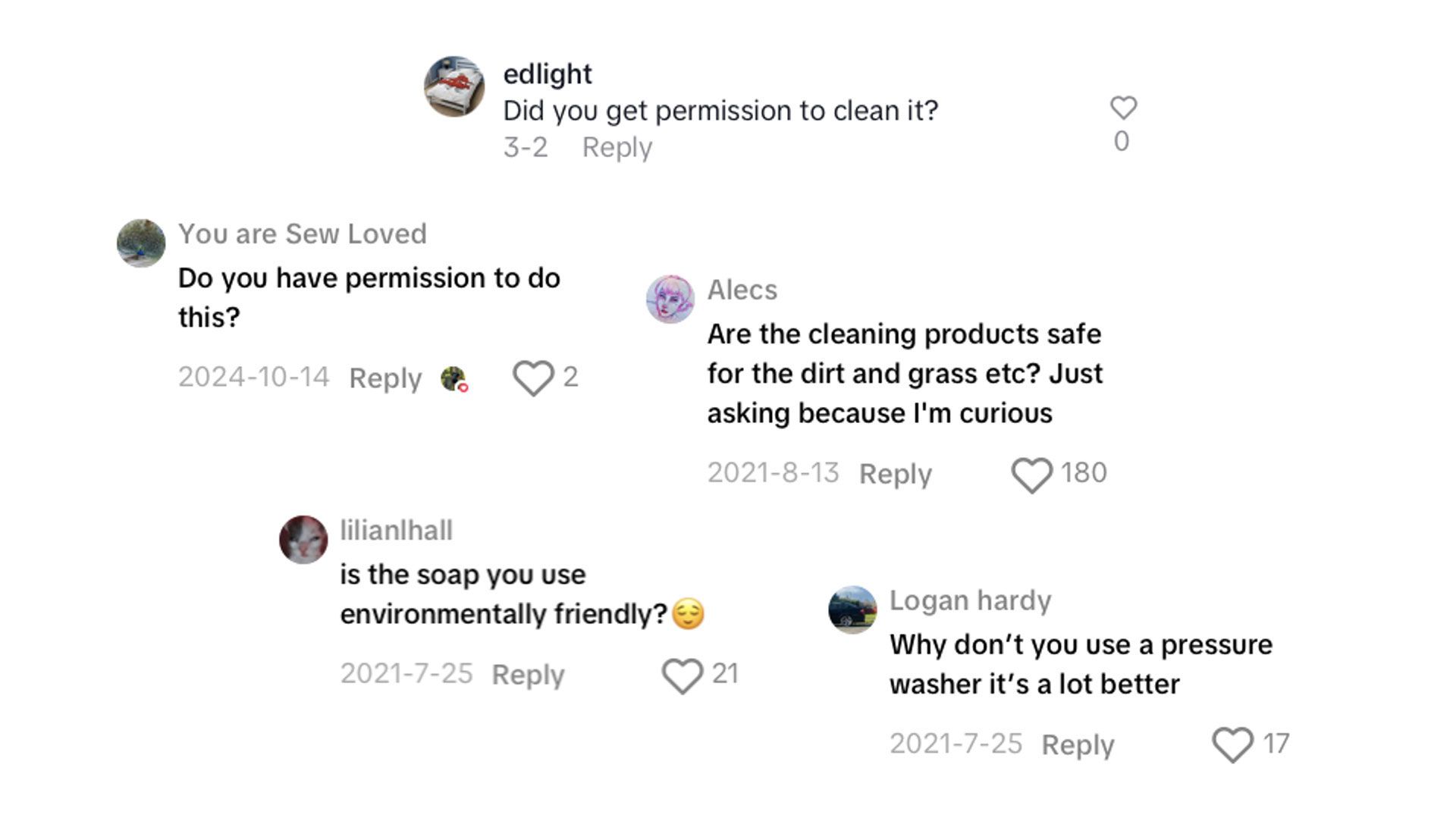
And, of course, it should be noted that there is an entire science to this process of cleaning – in a ‘respectful’ way. This respect, in some regards, both applies to the buried and their stories – but also to the headstones themselves. @manicpixiemom, for instance, underlines the carefulness of her process which includes soft brushes and plastic putty scrapers as well as biological D2 solution, a non-hazardous and biodegradable cleaner designed to preserve historic structures and stones. And yet, there are a staggering number of comments that do not necessarily ask how to also clean graves but rather ‘double-check’ whether the work done by the women doing the cleaning corresponds to expectations of proper care: Whether the TikTokers have actually checked in with the respective cemetery managers, whether they actually received prior approval for their cleaning by the relatives of the deceased, whether the cleaning solutions used are actually appropriate for the type of historical materials used for the grave, and whether they actually acted in a respectful way towards both the grave as spatial site and the buried as human being.
Here, we should zoom out to the cemetery as a shared space and public infrastructure as well: Cemeteries come with a code of conduct – and yet, they have also been, and increasingly become, public space. This points to a tension with the changing roles of cemeteries as well. For instance, cemeteries are increasingly also factored in as parts of urban green infrastructures, and are also increasingly becoming recreational spaces – for activities ranging from walking and jogging to picnicking. This connects to an understanding of cemeteries as liminal spaces:
Cemeteries’ liminality lies not only in their spatial character but also in their ability to accommodate complex meanings, different from other urban spaces (Grabalov and Nordh 2021, 83).
Within this context, there remains a lingering question: Whether, maybe, gravesites should actually carry the residues of time, should actually be left undisturbed once living mourners have stopped ‘taking care’ of a gravesite. Across all #Gravetok videos, there is a line of comments that disapproves of the cleaning in general – independent on how or with what cleaning supplies it is done – as an intervention in the historical character of cemeteries.
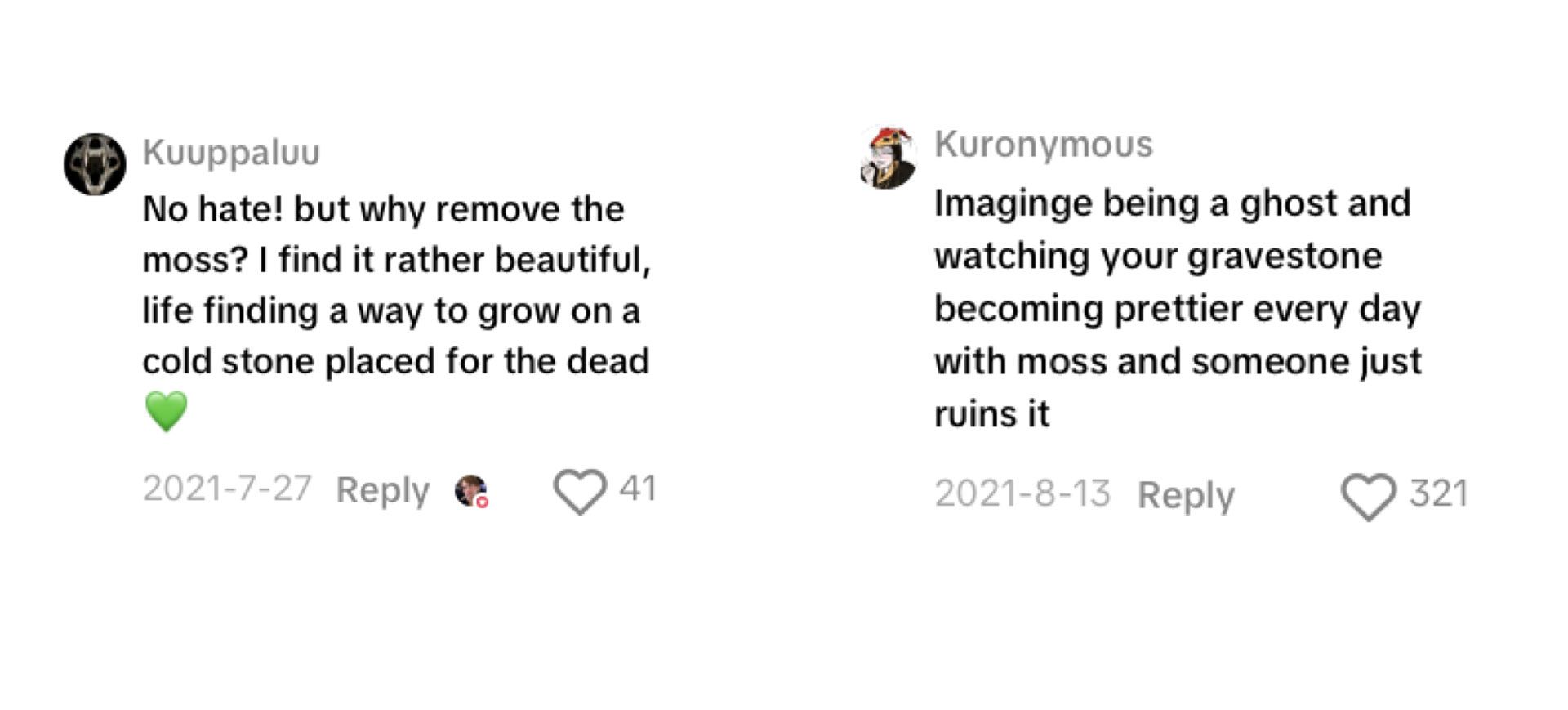
Imagine being a ghost and watching your gravestone become prettier every day with moss and someone just ruins it, as one of the comments reads. Somewhat surprisingly, this corresponds to psychological research into the ‘nature’ of nature experiences in the urban, that frequently highlight cemeteries, and particularly historical cemeteries, as sites of peace, calm and contemplation in hectic urban centers. The #Gravetok videos, for these commentators, take away the ‘historical background’ of the overgrown, aestheticized, gravesite and place the life of the deceased back into the foreground. Through this labour, cemeteries appear to morph from sites of urban leisure back to sites of urban mourning and memorialization.
#LABOUR: Caring work and influencer labour
What Stefania Rasile calls the “commercialization of memory” (2024, 45) here intersects with questions of influencer labour: One of the key markers of @_the_clean_girl’s perceived disrespect in and to the cemetery is not just the practice of cleaning but also the presumed intention behind it: Monetization of influencer labour. Here, there are two lines to be teased apart: The first is the TikToks in themselves. With 3.7, 6 and 152.7 million views for the TikToks respectively at the time of writing, these videos have reached a wide audience and amassed a notable number of comments – and, in turn, digital visibility for their creators. However, even if these three content creators are part of TikTok’s Creator Rewards Program, the remuneration is not extensive: Per 1.000 views, TikTokers receive between 40 cents and 1 US Dollar. What becomes more lucrative, however, is the second line of monetization: the layering of multiple potential income streams, with the highly visible and popular TikToks of the gravestone cleaning functioning as an entry into different forms of monetization beyond the logic of the platform. In the heavily criticized case of @the_clean_girl, there is, indeed, a specific range of cleaning supplies – used in the videos, and available to you at just $19.99, shipping excluded.
While not as explicitly criticized in the comments, it should be pointed out that the other two TikTokers are also expanding their content beyond TikTok, with the links in their profile leading to Youtube channels, podcasts and public appearances. For instance, @manicpixiemom’s cleaning of Josie’s headstone is not only the focus of the TikTok video – viewed 3.7 million times and commented on 1313 times – but also features as one of the episodes on her podcast Mortal Mysteries – which in turn taps into remunerations via Youtube, Spotify and other platforms. As another part of the linked resources, @manipixiemom offers ‘Manic Pixie Mom’s Guide to Gravecleaning’:
Welcome to the world of cleaning historic gravestones! Below is a guide to the methods I use for cleaning historic graves. Note: For equipment, I am sharing links from Atlas Preservation. In the interest of full disclosure, I have a promo code with Atlas (PIXIE), but I was buying supplies from them long before we began working together.
The offering of promotional codes – and the emphasis on the products having been used before and beyond the influencer’s social media presence – corresponds to established norms in the influencer sphere.
While I do not wish to coin the term ‘gravefluencer’ here, it is striking how despite the attention to and emphasis on memory and heritage, gravecleaning videos nonetheless become part of a larger system of influencer labour and the monetization of care, explicitly or implicitly. In doing so, there is another parallel to be drawn to what has been criticized as the commercialization of deathcare more generally – as much as its refeminization. If “history is a moving image” (Hughes-Warrington, Nelson and Treacey 2024, 4), #Gravetok videos arguably contribute to a (re)writing of forgotten histories – and, in their digitality, also function as an archival effort. At the same time, even the videos explicitly highlighting the labour that has gone into both cleaning and, maybe more importantly, retrieving information about the graves and their forgotten inhabitants usually end with a final ‘before and after’ shot of the grave, influencer-style.
Conclusion
Expanding from a historical understanding of cemeteries as ”a place for mourning, as a city in miniature, as an expression of idealised nature, and as an open-air archive that catalogues the names of the dead and, indeed, inscribes them on the landscape” (Holleran 2024, 42), #Gravetok highlights the contemporary negotiation of what types of space cemeteries are, and what practices are acceptable within and for them. In the #Gravetok videos, the temporalities of cemeteries and the temporalities of social media intersect. In some ways, both the cemetery and social media function as an archive – but one that is simultaneously stable and fragile.
The cemetery through its stones and permanence, which is still fragile as stone crumbles, decays, is overgrown. As these stones are mediated, captured, shared on social media – both in their crumbling, decaying, overgrown states and their restored, clean ones – TikTok in turn takes on an archival function, an archive of the archive, so to speak. And yet, this digital archive is equally fragile, ‘threatened’ by accounts being deleted, feeds refreshed, platforms disabled. Even beyond that, the gravecleaning videos discussed here point us to the complexities of deathcare within changing and increasingly diversifying memorialisation practices (Grabalov and Nord 2021, 86; cf. Grabalov and Nord 2020). Along the three discursive lines of #memory, #heritage and #labour, different dimensions of care intersect:
Caring for forgotten and gendered histories,
caring for the cemetery as a public infrastructure and
caring about likes and views.
In this tension between archival and aesthetic efforts, #Gravetok points to the complexities of navigating media, death and decay – and whatever might happen after.
Arnold, Michael, Martin Gibbs, Tamara Kohn, James Meese, and Bjorn Nansen. 2017. Death and Digital Media. 1st ed. Routledge. doi.
Casey, Emma, and Jo Littler. 2022. “Mrs Hinch, the Rise of the Cleanfluencer and the Neoliberal Refashioning of Housework: Scouring Away the Crisis?” The Sociological Review (Keele) (London, England) 70 (3): 489–505. doi.
Firth, Raymond. 2005. “Foreword: The Body in the Sacred Garden.” In The Secret Cemetery, by Doris Francis, Leonie Kellaher, and Georgina Neophytou. Taylor & Francis Group.
Gould, Hannah, and Samuel Holleran. 2024. “Concealment and Care in Deathcare During COVID.” Anthropological Quarterly 97 (3): 539–56. doi.
Grabalov, Pavel, and Helena Nordh. 2020. “‘Philosophical Park’: Cemeteries in the Scandinavian Urban Context.” Sociální Studia / Social Studies 17 (1): 33–54. doi.
Grabalov, Pavel, and Helena Nordh. 2021. “The Future of Urban Cemeteries as Public Spaces: Insights from Oslo and Copenhagen.” Planning Theory & Practice 23 (1): 81–98. doi.
Holleran, Samuel. 2024. “Library of Stone: Cemeteries, Storytelling, and the Preservation of Urban Infrastructures of Death and Mourning.” FOOTPRINT 18 (1): 1. doi.
Hughes-Warrington, Marnie, Kim Nelson, and Mia E. M. E. M. Treacey, eds. 2024. The Routledge Companion to History and the Moving Image. 1st ed. Routledge Companions Series. Taylor & Francis Group.
Rasile, Stefania. 2024. “El Cementerio y La Memoria Colectiva Digital.” ARQ (Santiago), no. 118 (December): 36–45. doi.
van Dine, Anne. 2021. “‘I Don’t Believe In An Afterlife’: Why This TikTok-Famous Vermonter Cleans Graves.” Vermont Public, September 13. vermontpublic.
“The contemporary cemetery is not a prototypical use of land, like the burial ground, but a shared space that is the product of social imaginaries, including idealised notions of landscape, memory and storytelling”.
(Sam Holleran 2024, 41)
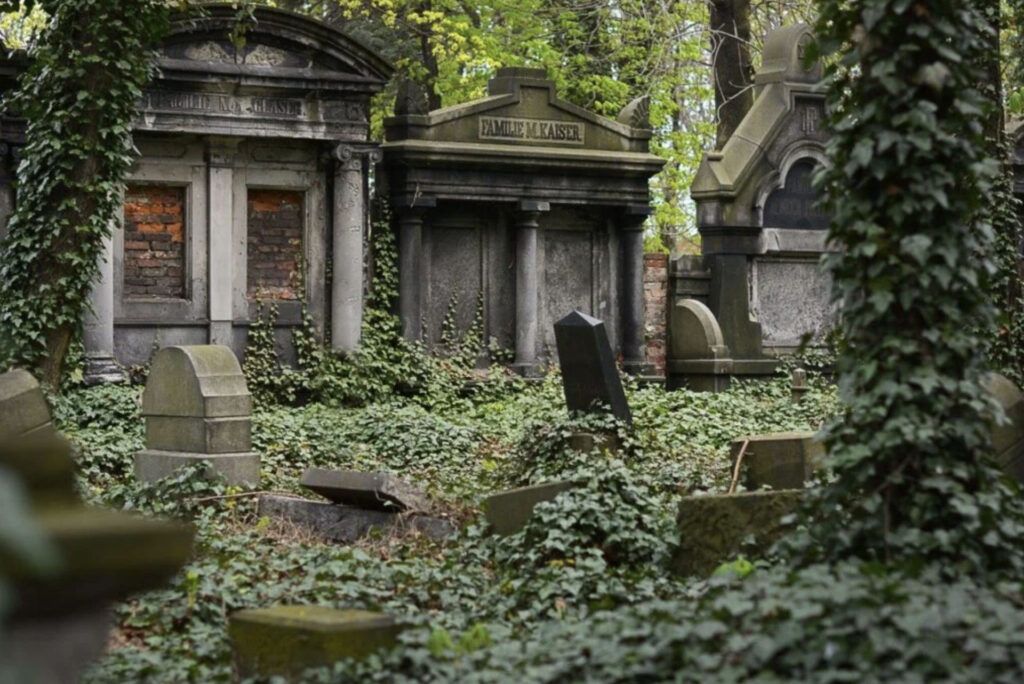
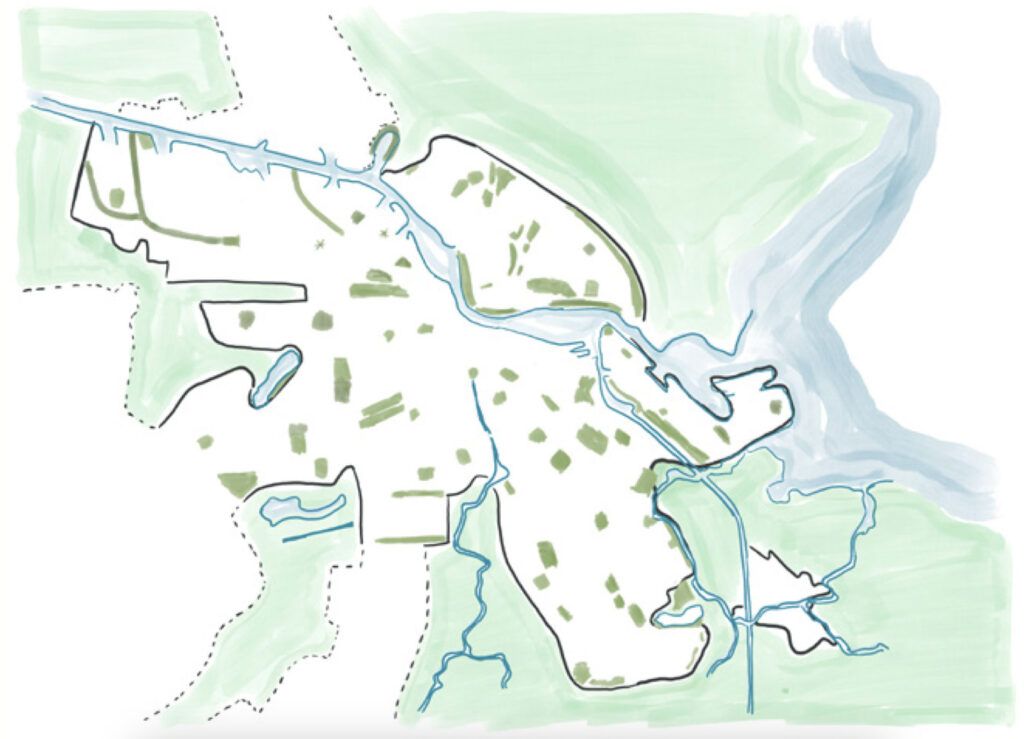
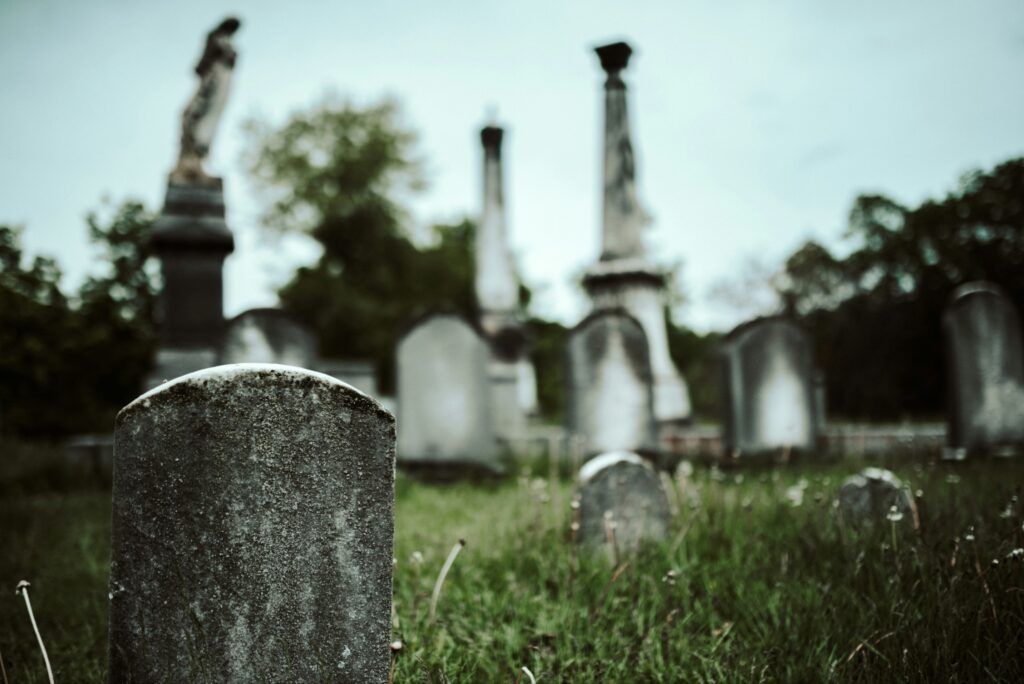
#Gravetok highlights the intersections between urban and digital spaces – and the role of social media in discovering, uncovering and recovering everyday memories of ‘forgotten’ lives and ‘decaying’ infrastructures.
“complexities of seeing and unseeing, exposure and concealment in contemporary death rituals”.
(Gould and Holleran 2024, 539)
Raymond Firth describes graves, and inscribed gravestones, as creating a “place for the periodic assemblage of kin… a rallying point for members of a group, a focus for their solidarity” (2005, xix). In and through the #Gravetok videos, this assemblage of kin becomes extended as a larger feminist project against the forgotten histories of women, both in the past and in the present.
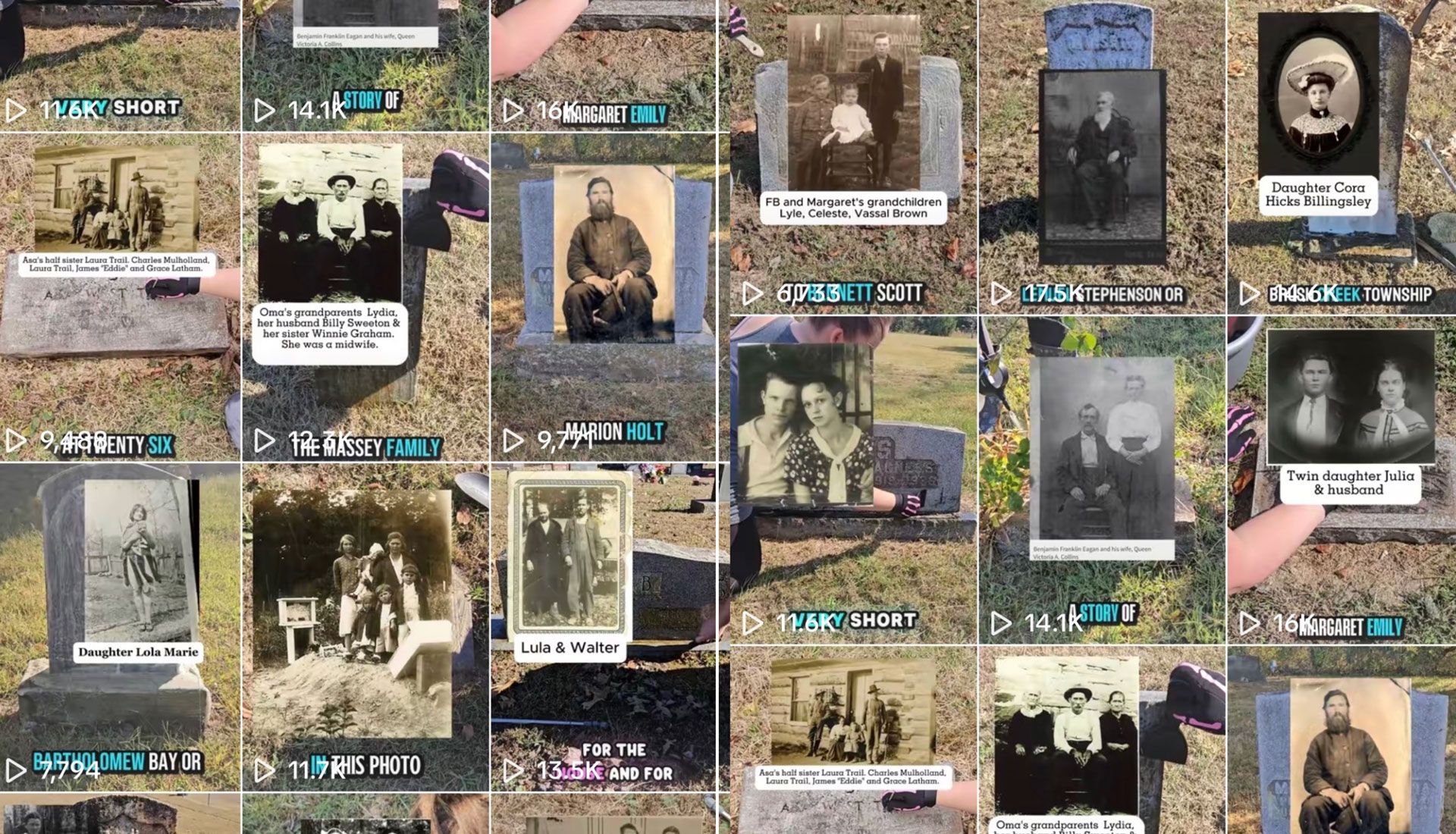
#Gravetok points to the tension between the temporalities of cemeteries and the temporalities of social media – and the larger question of what remains over time – and how both can function as a (fragile) archive.

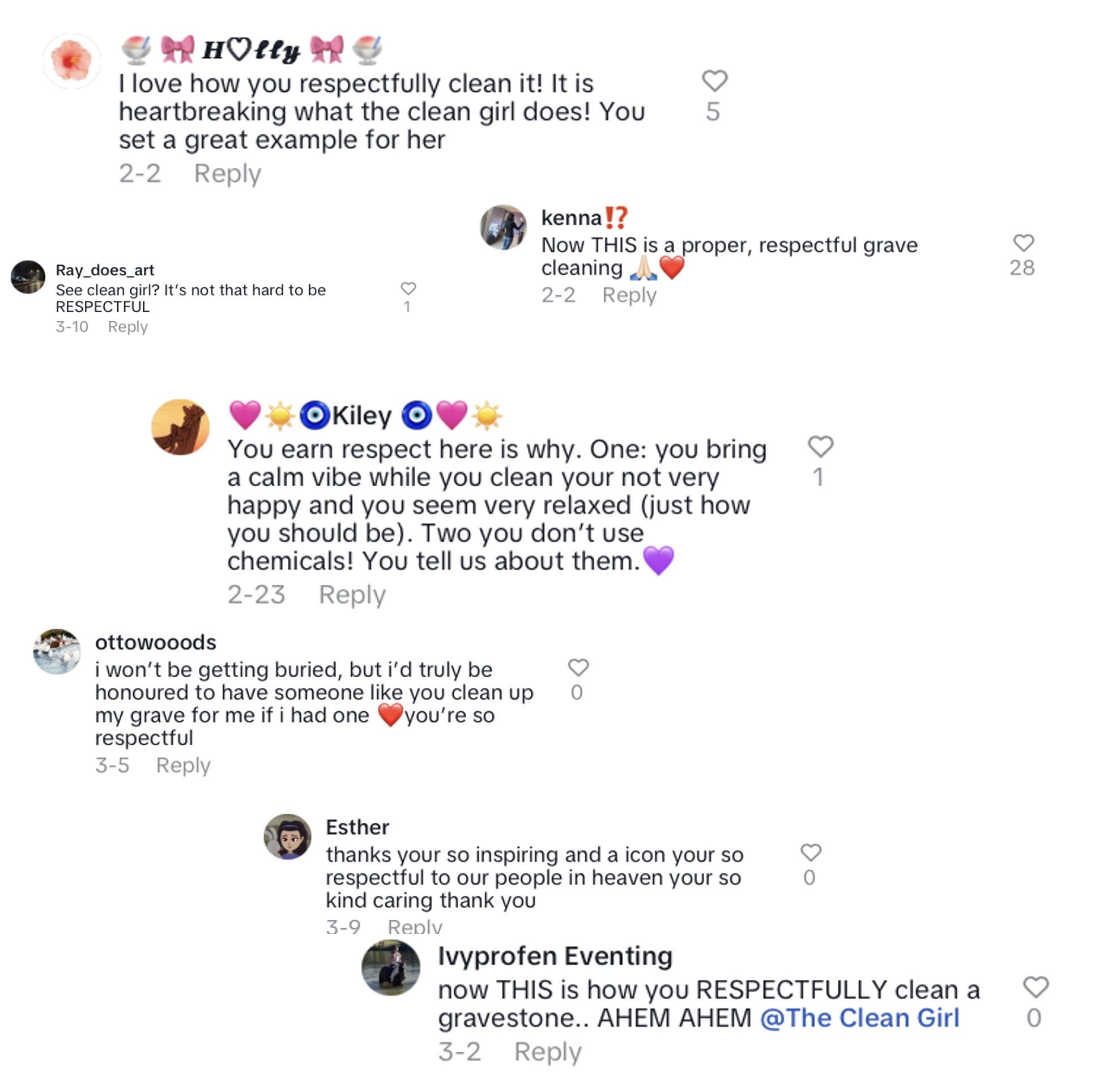
What Jo Littler and Emma Casey, in their discussion of cleanfluencers, highlight as the gendered (re)construction and (re)imagination of cleaning as “pleasurable, affective and meaningful” (2022, 493) also resonates in both the TikTokers’ narration and the comments praising the meaningfulness of this work and the respectfulness of their practice.
Thank you! Linda Kopitz l.kopitz@vu.nl