NICOLA DEANE
Endling by Dominique Edwards & Nicola Deane
[1]The term ‘endling’ was proposed by Robert Webster and Bruce Erickson (1996:386) in a letter to the editors of Nature, stating “a need for a word in taxonomy, and in medical genealogical, scientific, biological and other literature, that does not occur in the English or any other language … to designate the last person, animal or other species in his/her/its lineage.” Webster, R. & Erickson, B. (1996). ‘The last word?’ Nature Vol. 380: 386. doi
Dominique Edwards and I were given the task to generate an artwork for the research project, Decay Without Mourning: Future Thinking Practices, supervised by Lizabé Lambrechts, the archivist responsible for the transfer of the Hidden Years Music Archive that was donated by David Marks to Stellenbosch University in 2013. The materials we were invited to respond to were the ruined remains of the institutionalisation of this persona l collection – considered obsolete, too damaged or too dangerous to keep – including rusted staples and paperclips, hole- and mould-ridden papers, warped tapes and defaced negatives.
Decayed detritus like this falls outside the celebrated values within typical cultural heritage collecting and preserving practices, so although these compromised materials were considered too broken to save, Lambrechts felt they were too charged to throw away. She gathered and stored them in what she referred to as “the decay archive” – a parallel archive of ruined fragments – anarchival artefacts with potential, to be studied and reflected on through artistic research.
These outcast objects, usually regarded as failures of preservation, were treated through an alternative lens, as active participants in the heritage process, inscribing their own histories of vulnerability, survival and transformation. In this light, they may shift one’s sense of what heritage is, not a static collection of intact objects, but a dynamic ecology of ongoing processes. As Tim Ingold argues, “the properties of materials, regarded as constituents of an environment, cannot be identified as fixed, essential attributes of things, but are processual and relational” (2011:30).
In this collaborative work a strange body emerges from an even stranger container. Referred to interchangeably as creature/critter, sculpture, artefact and mobile archive, Endling (2024) becomes not only a material object but a conceptual pivot through which multiple subject threads converge: memory, echo, cultural-liminal rituals, environmental ruination, co-creation, co-affection, glitch, decay, and sonic reanimation. As a sculptural form embedded in a mobile crate-like structure, the object is designed to emit sound triggered by movement and presence, which resonates literally and symbolically. Within this resonance is staged an encounter with the plangent echo of archival loss as signal for ecological mourning.
[Endling] is itself unmoving,
Only the cause and end of movement,
Timeless, and undesiring
Except in the aspect of time
Caught in the form of limitation
Between un-being and being.
T.S. Eliot, ‘Burnt Norton,’ in Four Quartets (1943)
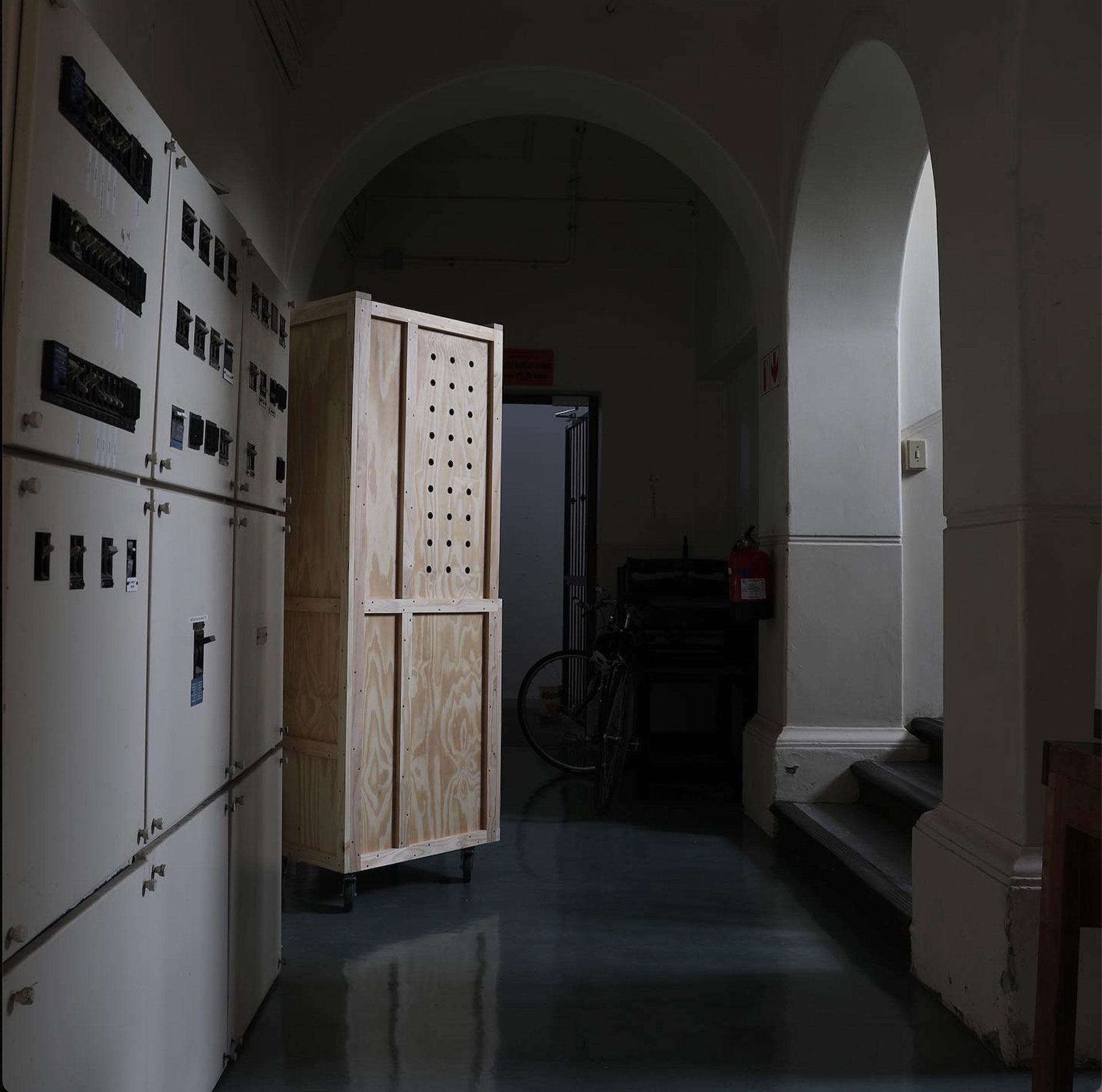
A sense of something being ‘alive’ was important to us right from the start. We wanted to reach into the vastness of the archive, this dense collection of song and find something that spoke to the throat, something that sat in the chest. We engaged in a process that involved material exploration and hours of conversation for almost a year before the work came to us – something other than human.[2]Dominque Edwards interviewed by Jess Sutherland on the collaborative artwork: Endling (2024) by Edwards and Deane, in GNOSSIENNE (2025).
In our attempt to represent the “vibrant matter” from the hidden recesses of the archive that actively transforms its contents across time, erasing some layers of information as it builds other kinds, of the anarchival sort, we first conceived of making something that made a noise, that could pulse or breathe, perhaps gaining its own momentum through the entropy of other material. Our intention for the piece evolved into finding form for the formless, something to embody an intangible artefact from the archive derived from decayed tapes. This body, we felt very strongly, was from an unknown elsewhere…
Through working with a music archive named Hidden – by focusing on its visual and sonic decay elements that evoke other, less recognisable worlds than one would expect from the ordered and secured conventional archive – we were prompted to seek inspiration for our sculptural piece from the natural world, namely the Cango caves in Oudtshoorn, a heritage site that has also been transformed (and endangered), but by the excess of human interference since its discovery in 1780.[3]Caused by the intense tourist engagements with the site across time, from its first tour conducted in 1891 to its use as a concert hall (the first chamber that can seat 2000 people), that endangered the cave’s unique ecosystem. From the early 1800s visitors would pilfer artefacts from the site, leading to the first Caves Regulation in South Africa in 1820, which banned the collection of souvenirs and fined acts of vandalisation. Available: cango-caves This extended focus fostered a relational space of thinking around natural and cultural heritage since both are in trouble and entangled, “with our human imprint now penetrating deep into global ecologies and geologies, the distinction between nature and culture – and natural and cultural heritage – is an artefact of a world we no longer inhabit” (DeSilvey, 2020:289).
The cave as a “living archive” is continuously being transformed across time through the accrual of mineral deposits carried by the unceasing seepage of water from the outside into its deep, hidden and resonant chambers, building a natural museum of wonder. Our field trip to the Cango caves involved experiencing the restricted-access chambers of the cave through the “adventure tour” that included a twisted climb up the “Devil’s chimney,” and what approximated a birthing experience, sliding headfirst through the “Devil’s post-box,” to view the extensive range of stalactites and stalagmites that we captured in photographs to inform our studio work.
Our embodied experience of the caves, our envelopment within a geological wonder, was translated to our handling of composite material in the studio to slowly build our “decay artefact” based on ruined residuals of the Hidden Years Music Archive. Harriet Hawkins’ account of “creative encounters” with cave sites as stimulants for the environmental imagination, reflects on “the material and deep time intimacies and sensualities of human bodies with/in millenia-old rocky bodies” to explore how the underground, “far from offering a site of separation of nature/culture, as it did in the 19th century, is in fact a renewed site for their engagement and intersection” (Hawkins, 2006:6).
And if many times I paint caves it’s because they are my submersion into the earth, dark but clouded with clarity, and I, nature’s blood—extravagant and dangerous caves, Earth’s talisman, where stalactites, fossils, and stones come together and where creatures crazy through their own evil nature seek refuge. Caves are my hell. Caves, dreamlike always with their mists, memory or longing? Frightening, frightening, esoteric, greenish with the ooze of time (Lispector, 1973:11).
As our studio work evolved our ideas regarding our audio engagement with the decay archive transformed. We selected a range of the most degraded sounds of the magnetic tapes, some of which had suffered sticky-shed syndrome[4]The chemical breakdown of the adhesive binder in older magnetic analogue tapes. Caused by moisture absorption, the adhesive becomes soft and gummy, sticking to playback heads and shredding the magnetic coating when played. Common symptoms include high pitched squealing, stuttering, gummy residue, and unwinding resistance. and were quite unpleasant to listen to. Our aim was to “compost” these samples, creating a dense sonic palimpsest to visually determine our edits from, in order to distil a “decay melody” for polyphonic overtone singing. The result of this sonic ruin experiment was put through AnthemScore software to produce a music score (pictured below), but we ended up choosing a single sound event from the decayed tapes instead – a seven second sample – to represent the “voice” for our form.
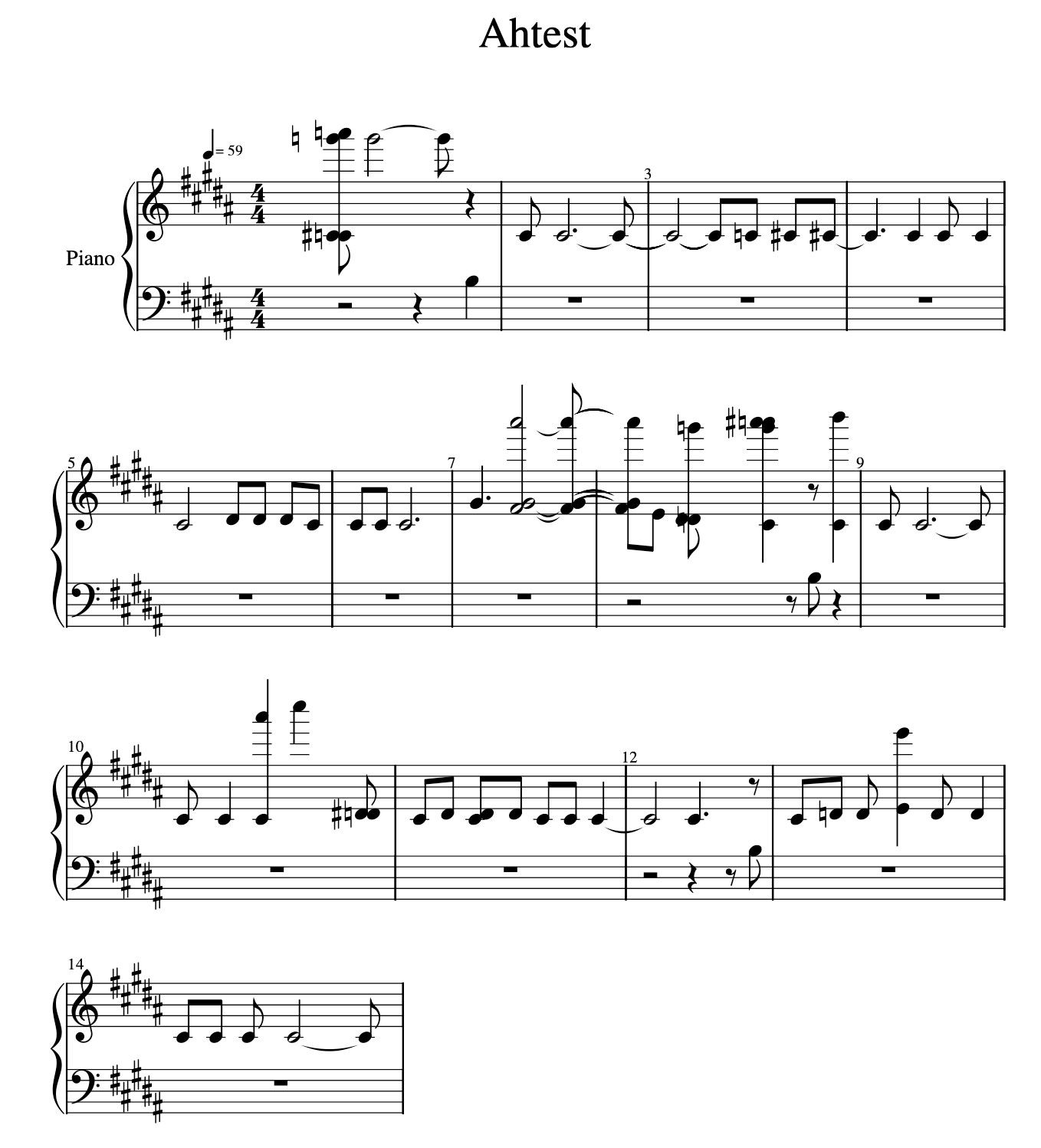
Although we did not pursue this line of inquiry, we hummed a line of the melody repeatedly during our public procession with the work on the Stellenbosch University Campus in 2025. The final work we produced comprised: Paper, cold glue, paint, flocking, pine shutter ply, pine slats, screws, bolts, hinges, wheels, and interactive sound system (2000 x 42 x 65cm). The title came to us at the very end of the process, before being wrapped and transported to the site of its first public appearance.
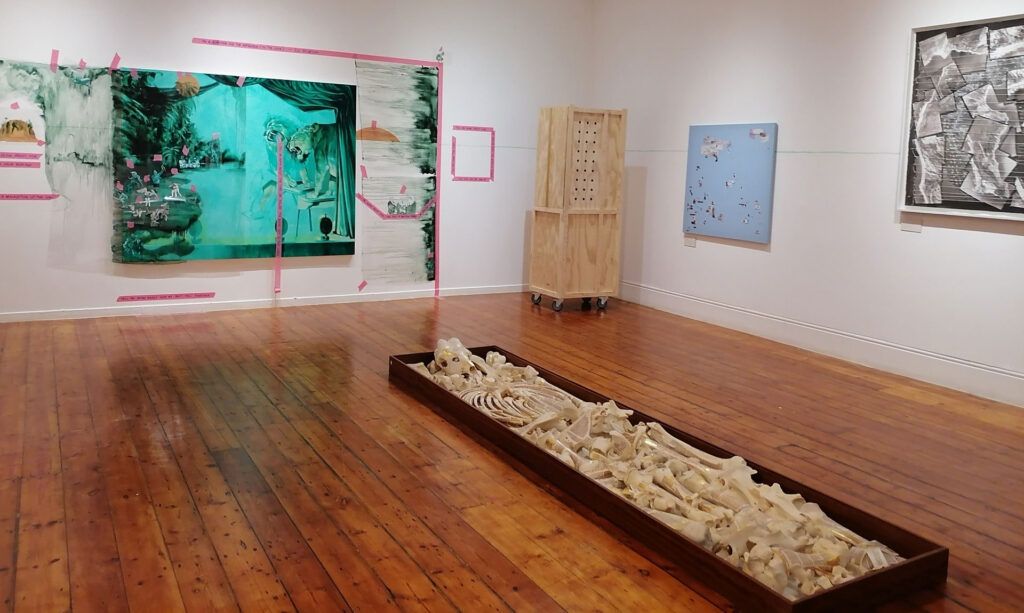
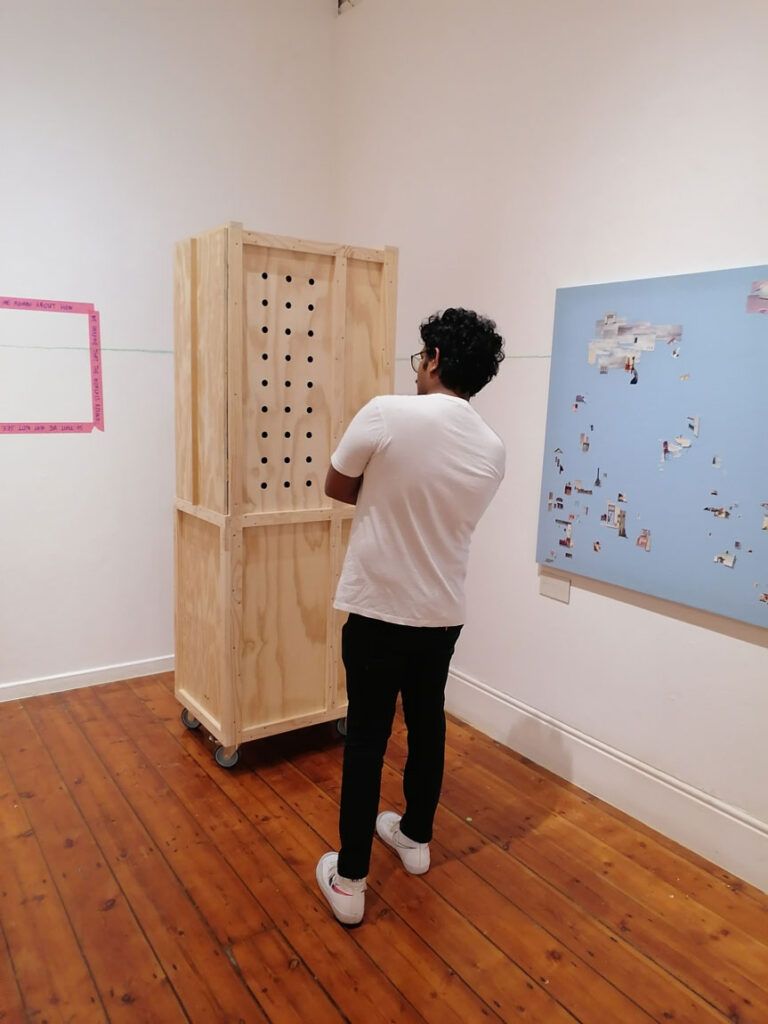
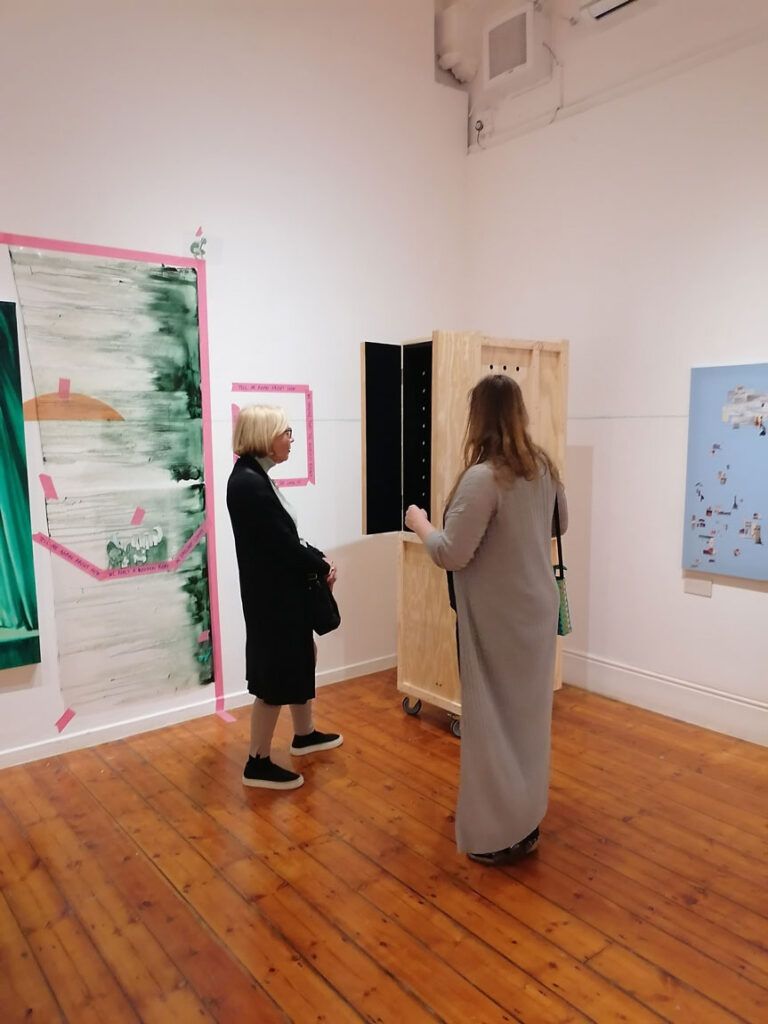
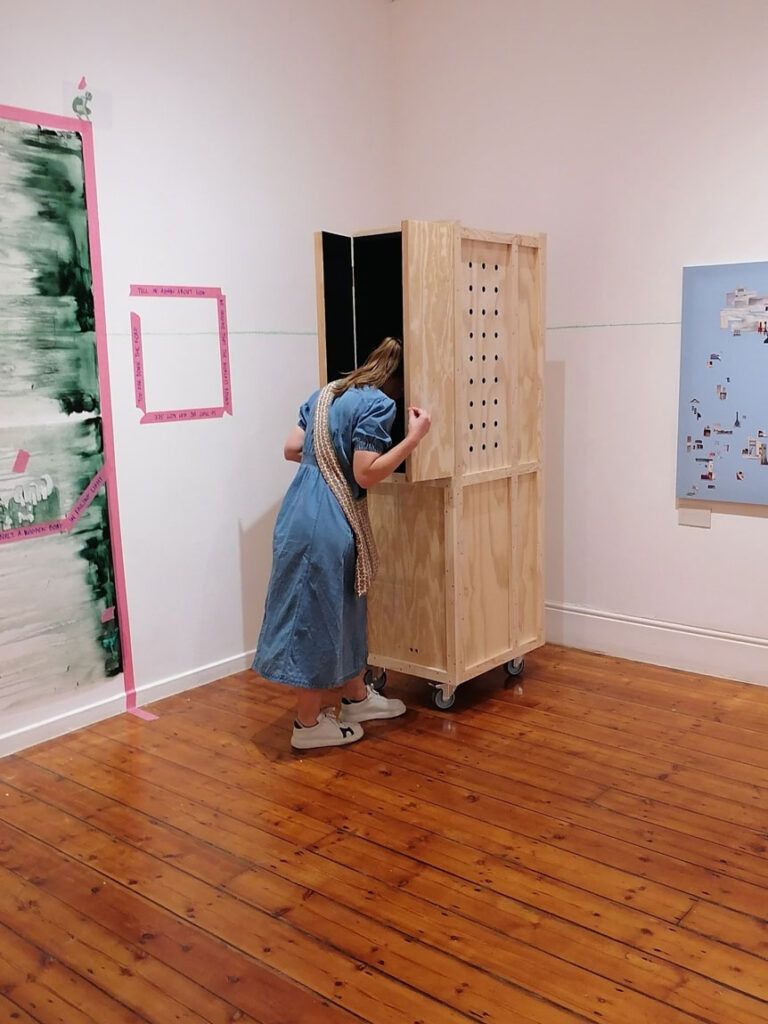
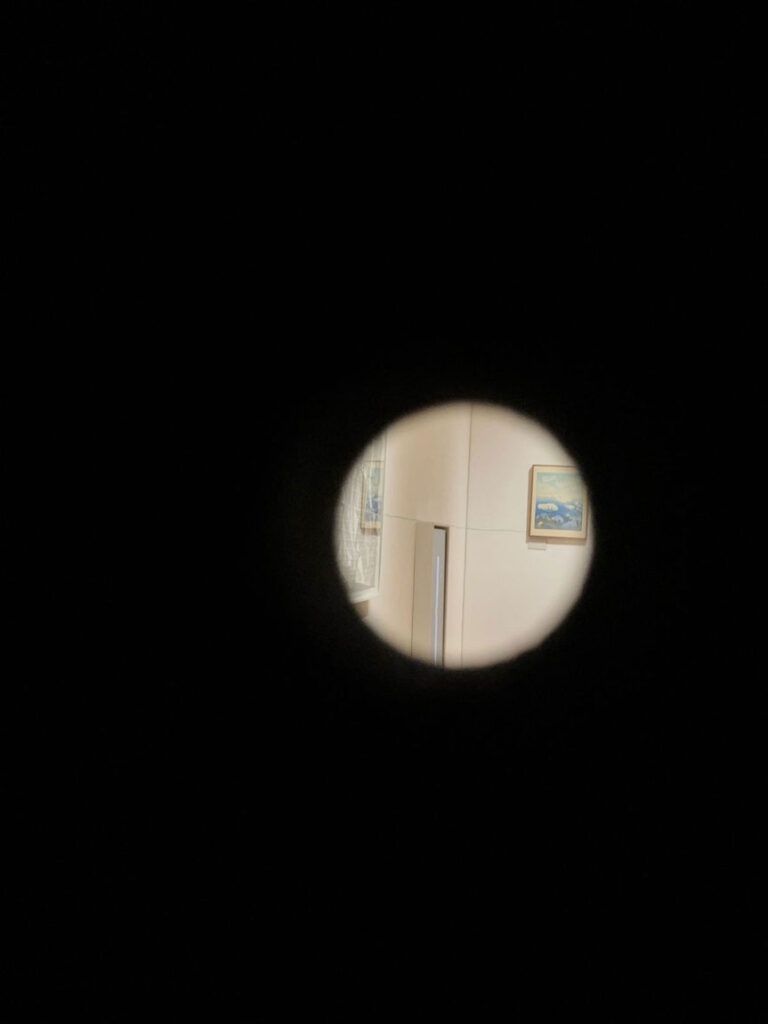
The first public presentation of Endling (2024) was within the group exhibition, Vital Signs: The environment, loss & sustainability held at the Michaelis Gallery in Cape Town (17 September – 17 October 2024).
The awful sonic signal that Endling emits as soon as it is approached by the audience – Endling’s ‘speech’ – is irreducible to intelligible units. Endling, this black flocked tongue-in-the-box extended in a scream, thus embodies a semiotic wound. Speech here is decomposed into a collapse of language implicated as semiosonic decay (Kaganof 2025).[5]Review of Endling (2024) by Aryan Kaganof, 24 June 2025. Available: kinoki. (Accessed: 1 July 2025) Decaymentation as poetics.
The above response to the work at the exhibition, analysing it in semiotic terms and relating it to Antonin Artaud’s drive to “break through language to touch life” (1958:13) – considering the wounded tongue as a channel of sonorous material in cries, incantations, and vibrations – inspired me to revisit theoretical interests stowed within the archive of my own practice. Let me now consider the branched paths of theory since being detached from the process of making, to follow this analysis of the artwork: An incongruous relic entombed in a box that cries in glitches suggests invocation rather than communication.
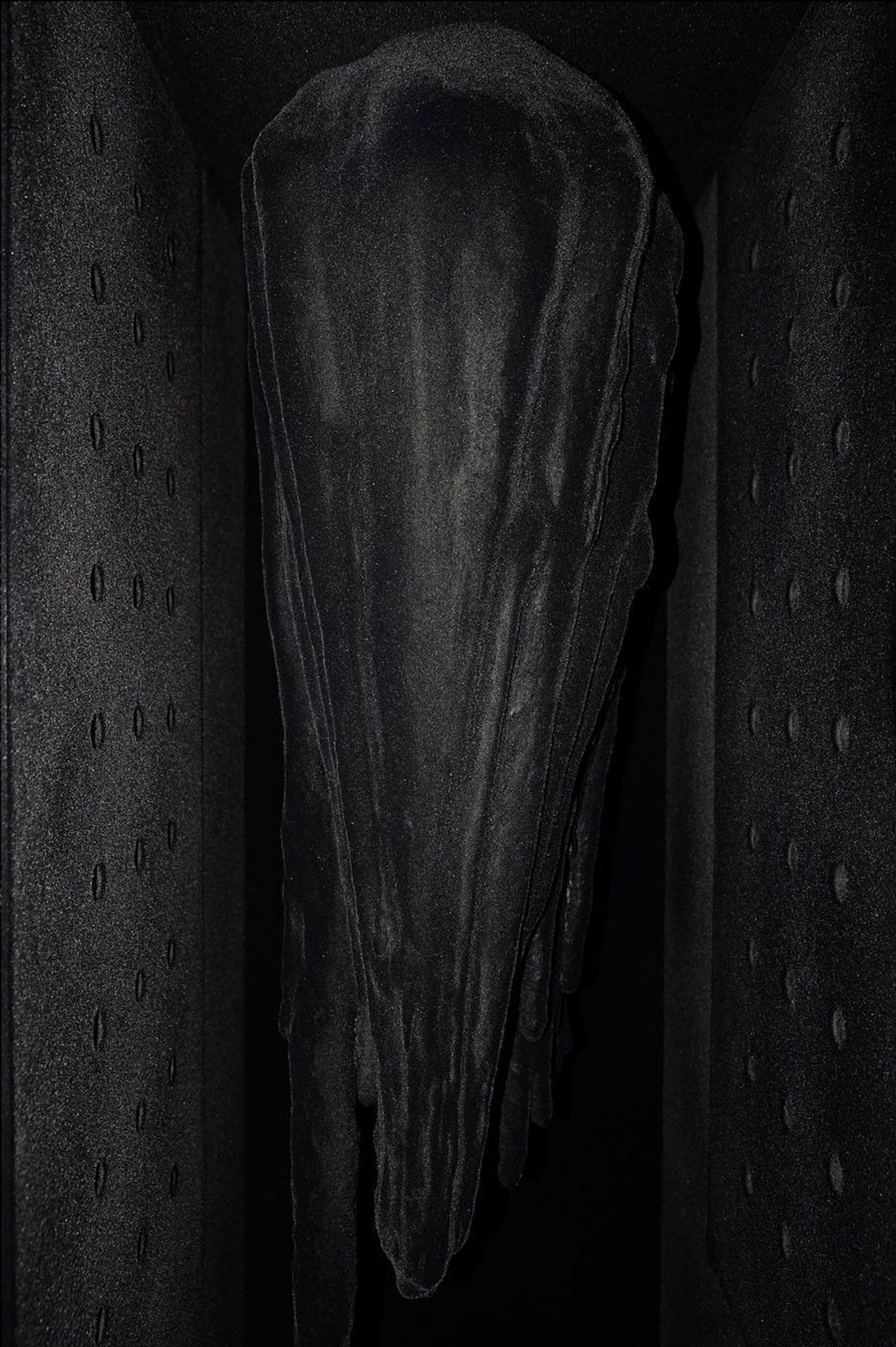 Endling, interior. Photo: Dominique Edwards.
Endling leaks affect by stutter/cackle/convulsion, like an eruption of the semiotic chora[6]Kristeva defines as a pre-symbolic, maternal space of rhythm and drive that precedes and undergirds structured language bound by logic, grammar and social law. The chora is fluid, corporeal, and resistant to signification. Endling invokes the chora’s unstable energies, tied to both the maternal body and the abjection of meaning. that resists the symbolic order. According to Kristeva: “the chora, as rupture and articulations (rhythm), precedes evidence, verisimilitude, spatiality, and temporality” (1984:26). Does Endling thereby stage a return to the chora – a pre-symbolic space of pulsation and instinct, where language is felt in the gut[7]Another way in and around this is directly related to the gut. The form and structure of this organ, connected to our intuition, that instinctive impulse so directly connected to feeling – whether something that draws one to write or sing a song, or that compels people to obsessively collect, horde etc. or do anything for that matter… that structure is so fundamental to all life on earth, those microbial forces that co-habit our bodies, and that we also find in these really simple but ancient life forms around mould/fungi/algae and other phenomenal single cell organisms, these connections are quite strong, enticing and ancient (Edwards’ notes to Deane, 2024). before it ever takes shape in the mouth? Speech breaks down into affective discharge, a sonic rupture, Endling’s obscure call becomes a perverse echo of Kristeva’s chora – haunting its container, a sarcophagus of lost meaning. Within it, phonemes collapse and pulsate, producing a rhythm of information undone.
The sculptural interface of Endling performs a transduction. It takes a minor sonic remnant from the degraded dimensions of an archive – once arbitrary noise or forgotten affect, this sample becomes looped upon detection of bodily proximity, thus turned into a rhythmic, spatial, and temporal event. The decay is not erased but codified into repetition, like a skipping record or haunted refrain. What was dissipating is made to pulse again as a kind of residual persistence. The loop doesn’t resolve but lingers in space, highlighting the unfinishedness of the past. Endling converts the fragmentary entropy of sonic heritage – those decaying, degraded elements – into rhythmic structures activated by embodied presence, thus reconfiguring loss into ongoing, recursive temporal experience.
Trickster Logics and the Ludic Archive: Procession, Play, and the Perverse Echo
The trickster incarnates in every culture the oxymoronic imagination at play, literally ‘fooling around’ to discover new paradigms and even new logics (Pelton 1980:272).
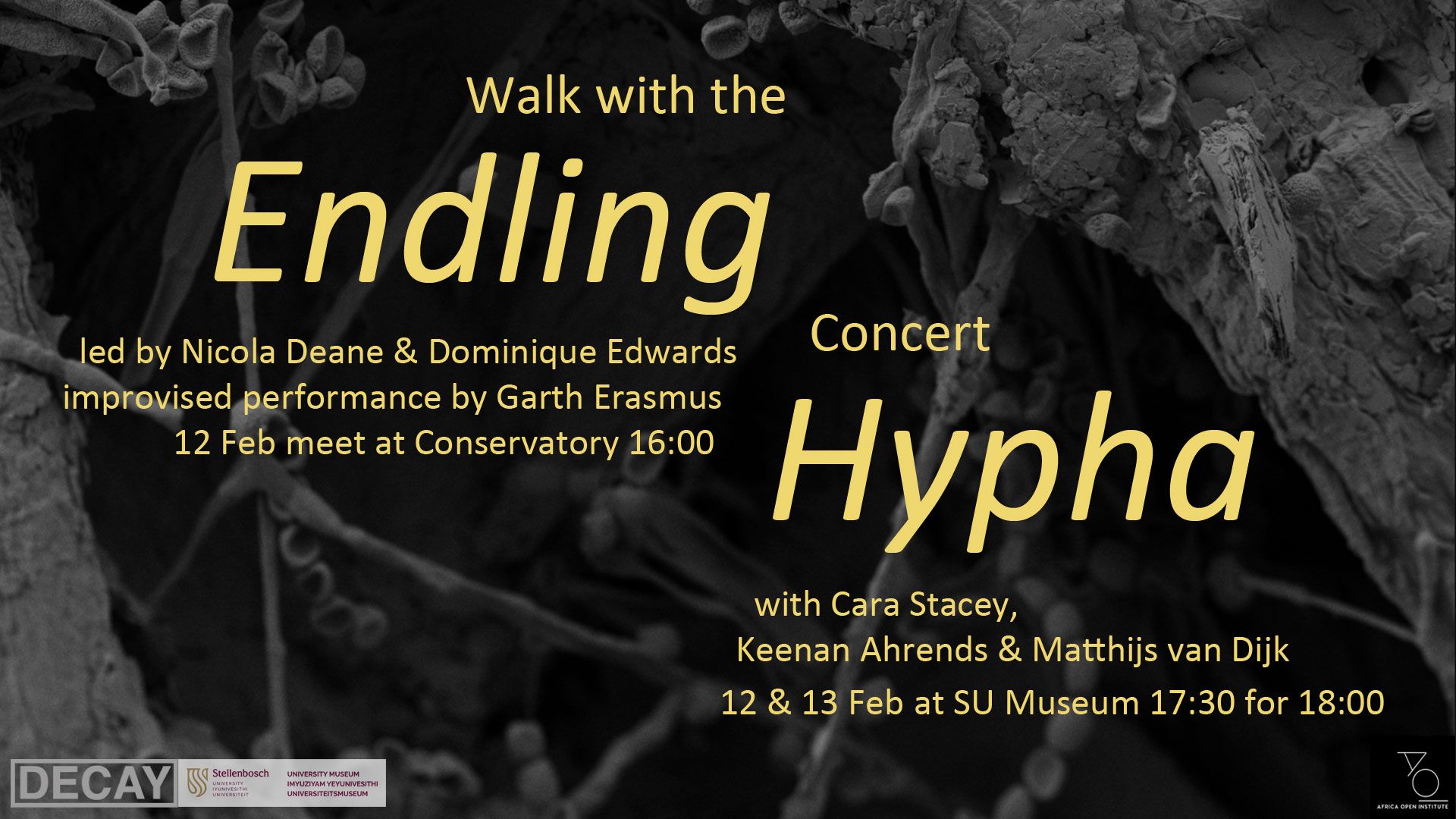
The next presentation of the work, as a form of public intervention, took place on the 12 February 2025 as an invitation to: Walk with the Endling. With the rising of the Dassie moon,[8]The Dassie Moon is the full moon that falls in February that was named (by the Centre for Astronomical Heritage in South Africa) after the rock hyrax native to Africa, as an alternative to the Northern Hemisphere’s Snow Moon. In San mythology the dassie represents the wife of the shape-shifting trickster god |Kaggen who is most often represented as a praying mantis. Edwards and I led a small procession as a meditation on time, loss and collective presence, with an improvised performance by Garth Erasmus on his handmade instrument accompanying the triggered sonic ruptures of Endling (2024) and our humming of the melody derived from decayed tapes of the archive. We walked from the storage rooms of the Hidden Years Music Archive, as the site that called Endling into being, to the atrium of the Stellenbosch University Museum, where the concert titled Hypha[9]A set of compositions by Cara Stacey that responded to the same decaying materials of the archive. was performed.
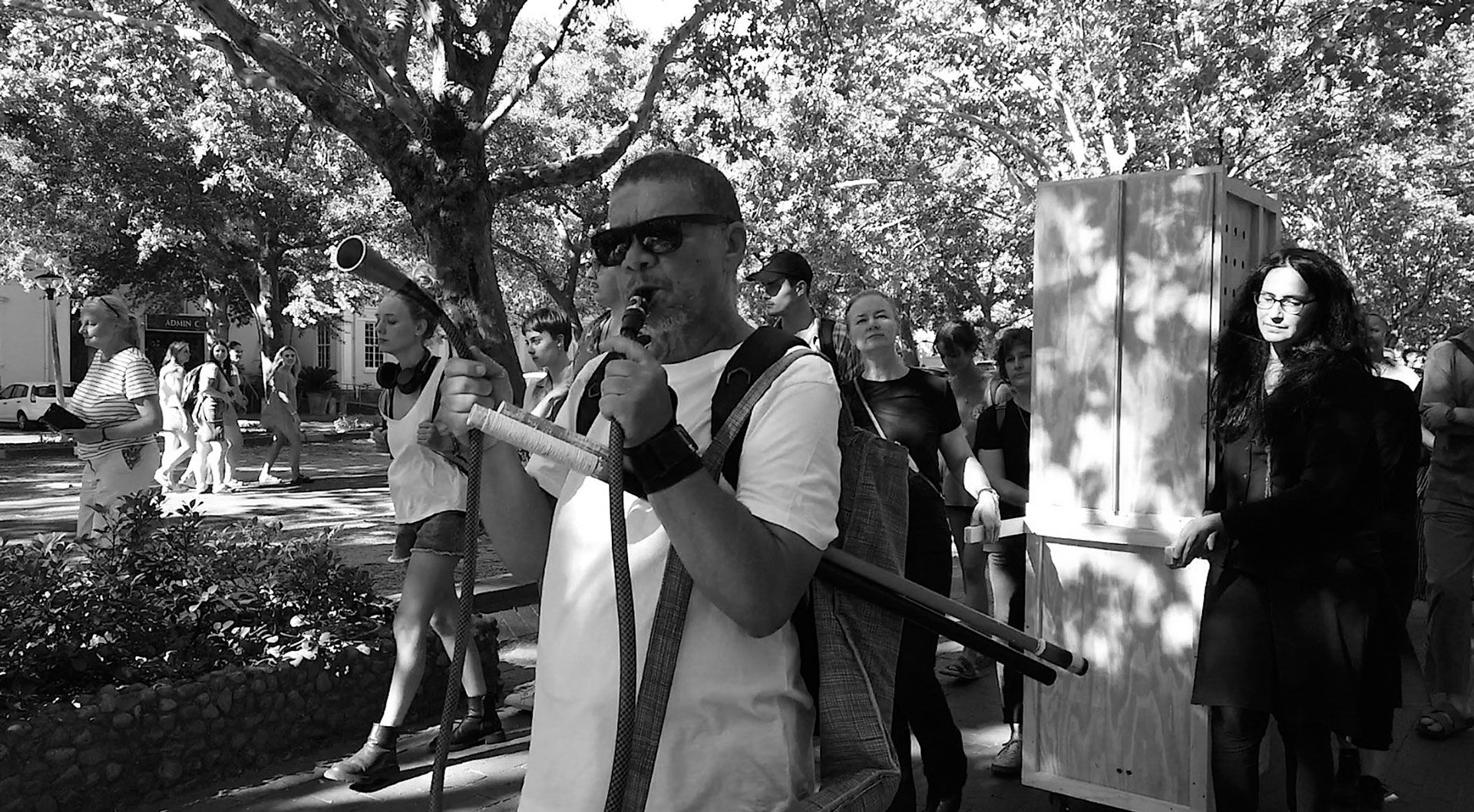
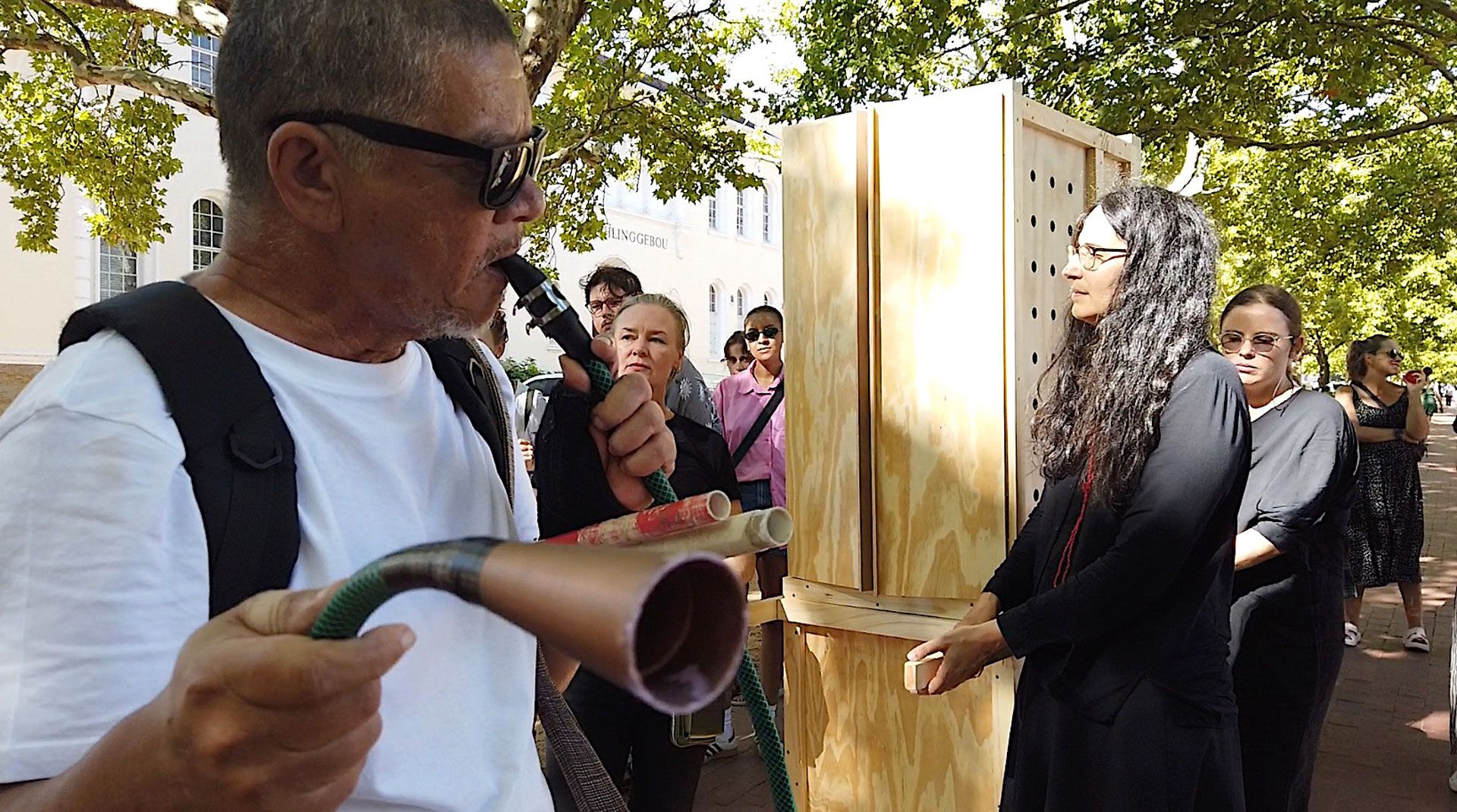
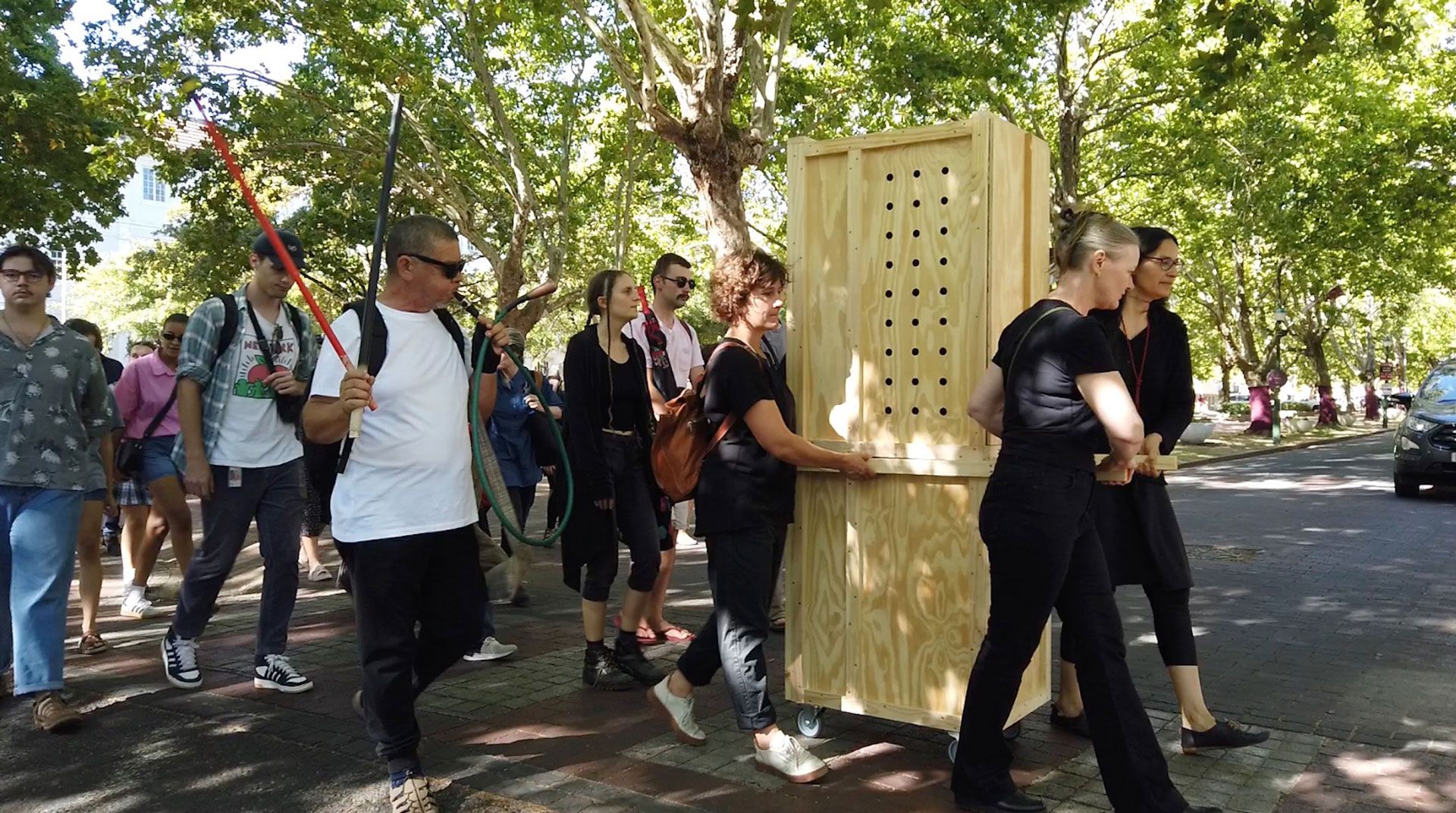
Lambrechts introduced the artwork and project context to those gathered to do the walk, before inviting them to accompany us in humming the ‘decay lullaby’ en route, she says:
Like crumbling paper and forgotten voices, Endling stands at the edge of time a bridge between memory and absence. In walking beside it, we acknowledge its existence, and we offer solidarity against oblivion. Endling is not solely a marker of finality or endings but is also a herald of beginnings connecting what was, what is, and what may come to be. This is more than a walk; it is an act of defiance against forgetting.
Artistic research, I would like to argue, potentiates access to different ontologies in mediating varied modes of engagement with an object or subject as it reconfigures the conditions of perception. For example, the heightened perceptual state of enchantment as an altered mode of attention, may allow access to another state of being where the world feels charged with meaning, agency and relational presence, even for those who do not inhabit that space normally. Accordingly, artistic research may create temporary thresholds for alternative encounters and exchanges across diverse ontological registers. The artwork or performance thus enables a “liminoid”[10]What anthropologist Victor Turner identified – in industrialised society’s reception of cultural phenomena – as correspondent to the liminal phases of the rites of passage rituals of tribal societies, that provide the necessary channels for suspending or transcending the mundane: “today’s liminoid is yesterday’s liminal” (1977:46). experience for its spectators.
If Endling proposes an archive, it is not one built on order and preservation, but on transgression, play, movement and renewal. The practice of wheeling the sculpture through different spaces, each encounter triggered by audience proximity, movement and ritual revealing, does not evoke the solemn stillness of institutional archives, but rather a playful disruption.
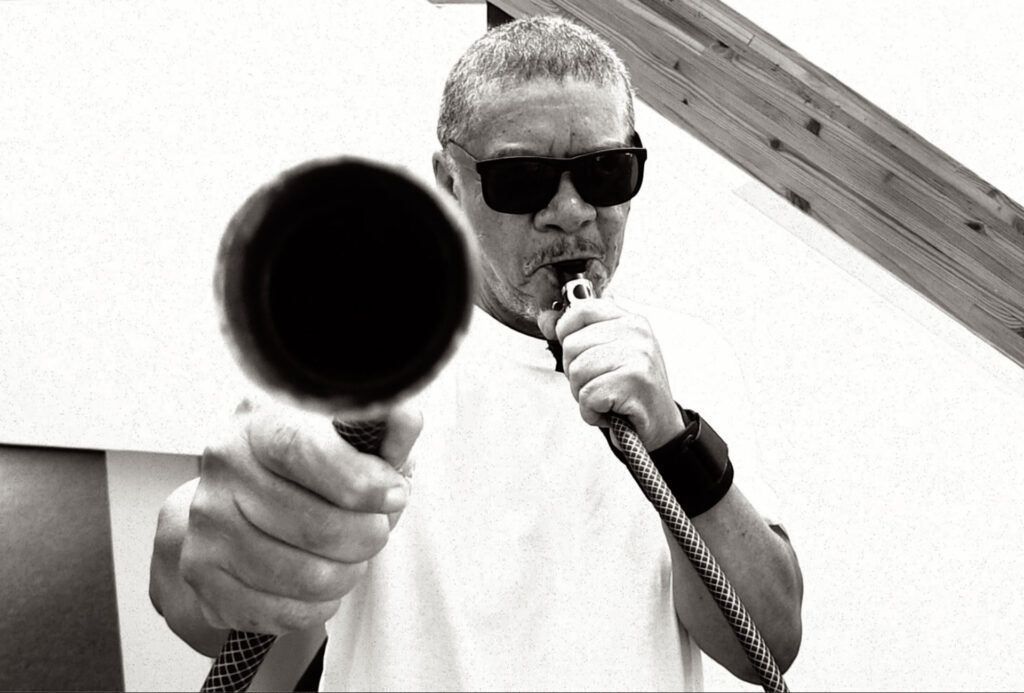
Here, the figure of the trickster brings into focus Endling‘s ludic logic. In the context of Mikhail Bakhtin’s analysis of folk humour, the trickster is aligned with the carnivalesque: an inversion of norms, the breakdown of hierarchies, the grotesque body that laughs at power. He describes the carnival as “the true feast of time, the feast of becoming, change, and renewal,” and that this carnival experience, “opposed to all that was ready-made and completed, to all pretense at immutability, sought a dynamic expression; it demanded ever changing, playful, undefined forms” (1984:10-11).
Endling, with its ambiguous form and necro-sonic utterances, operates as a kind of posthuman trickster-archive, resisting legibility and stability. Like the Trickster, Endling disrupts stable meaning: it is at once a funerary object and an active/activated presence. It harbours decay yet activates sonic vibration, it holds memory yet resists containment. Its responsive sound loop triggered by bodily presence becomes a threshold mechanism, to reveal, unsettle and reconsider. It is not a passive container of the past, but a disruptive code-bearer, entangling entropy, rhythm and memory into new affective circuits.
This playful perversity recalls Johan Huizinga’s Homo Ludens, as he notes, “the terrors of childhood, open-hearted gaiety, mystic fantasy and sacred awe are all inextricably entangled in this strange business of masks and disguises” (1955:13). He goes on to assert that in play “we may move below the level of the serious, as the child does; but we can also move above it – in the realm of the beautiful and the sacred” (1955:19). Endling engages its audience through a gamified logic of proximity, response, and uncertainty. The artefactual crate may or may not react as the cackle-call may or may not be triggered. The artwork calls for an open-ended, ludic engagement with participants. It is part oracle, part machine, part prank.
The ludic openness of Endling is also political: a resistance to the professionalisation and bureaucratisation of artistic labour at universities that promotes efficiency, predictability and instrumental outcomes.
Claire Bishop considers it essential to think of art “not as part of a seamless continuum with contemporary labour, but as offering a specific space of experience where those norms are suspended and put to pleasure in perverse ways” (2012:238). Rather than reproducing prevailing social logics, the artwork prompts a liminoid condition in which the dominant assumptions become temporarily inoperative. Within the Decay without Mourning context, this suspension extends to the preservationist imperatives that govern archival practice. The artwork establishes a threshold through which deterioration, instability and material decomposition cease to signify failure and emerge instead as generative, relational and affective processes.
Gloria Anzaldúa’s (1987) theorisation of borderlands is useful in thinking of Endling as a threshold entity. Its body – tongue, crate, sound – is a mestiza archive,[11]The archive as dynamic process: The “mestiza archive” is not a fixed collection of texts or artifacts, but rather a way of engaging with history and identity that is constantly evolving and being reinterpreted. formed at the crossings of gender, ecology, memory, and decay. Its voice cracks and stutters, speaking from in-between: between mourning and meaning, between scream and silence.
In many ways, the trickster logics of Endling return us to the principles of improvisation and embodied knowledge. Its gesture is circular, looping, stuck in a feedback system that insists on repetition as method. Through its travelling form, Endling destabilises the assumptions of static meaning, linear time, and fixed identity. If Endling has a language, it is one spoken from the ruins.
Endling, a wake (2025) is a video essay documenting the procession and temporary placement of Endling within the context of the Stellenbosch University Museum. It was screened at the Decay Without Mourning: Future-thinking Heritage Practices conference at the Stellenbosch Institute for Advanced Study on 16 April 2026.
Conclusion: Towards a Compost Archive
Cultural remembering proceeds not through reflection on a static memorial remnant but through a process that slowly pulls the remnant into other ecologies and expressions of value, accommodating simultaneous resonances of death and rebirth, loss and renewal (DeSilvey, 2017:35-36).
Artistic research through practice-led experimentation with light-sensitive photographic processes, microbial traces, obsolete materials, corroded fragments and sonic ruins, considers decay as a speculative medium (Gineprini, 2025) – one that prompts the archive to exceed its own taxonomies and to speak (other codes) through its margins. Within these fragile thresholds where preservation yields to transformation, decay insists that every ending already carries within it the pattern of another beginning, and continuous becoming. In her “postpreservation” discussion on collaborating with entropy to curate deeper relations to cultural memory, DeSilvey (2017:142) directs us to some poignant lines of T.S. Eliot’s “Little Gidding” (1948:58):
What we call the beginning is often the end
And to make an end is to make a beginning.
The end is where we start from.
This artistic research bears a post-archival, or composting-logic that embraces decay as a generative aesthetic and methodological condition through which new relations between matter, memory and perception may emerge. While the lumen prints activate the latent agencies of deteriorating and expired materials, Endling translates sonic entropy into embodied, rhythmic encounter. Together they propose a rethinking of the archive as a composting ecology in which images, sounds, materials and bodies remain in continual processes of transformation, instead of a stable repository of fixed histories. Through decay, procession, play and care, the work cultivates forms of attention that resist the preservationist impulse to fix content and meaning. Instead, it invites viewers into a liminoid encounter with matter in which decomposition becomes a condition of relation rather than loss.
This work characterises part two of Deane’s postdoctoral research for the project, part one resides in the gallery section and can be accessed here.
Acknowledgements | This work was supported by the Riksbankens Jubileumsfond [GI21-0001].
Anzaldúa, G. (1987). Borderlands/La Frontera: The New Mestiza. San Francisco: Aunt Lute Books.
Artaud, A. (1958). The Theatre and Its Double. (Trans.) Mary Caroline Richards. New York: Grove Press.
Bakhtin, M. (1984). Rabelais and His World. Translated by Hélène Iswolsky. Bloomington: Indiana University Press.
Bishop, C. (2012). Artificial Hells: Participatory Art and the Politics of Spectatorship. London & New York: Verso.
Boym, S. (2001). The Future of Nostalgia. New York: Basic Books.
Deane, N. (2025). Ending, a wake. [Video essay]. Black-and-white with sound (16:09).
DeSilvey, C. (2020). Ruderal Heritage. In Harrison, R. & Sterling, C. (eds.) Deterritorializing the Future: Heritage of and after the Anthropocene. London: Open Humanities Press.
DeSilvey, C. (2017). Curated Decay: Heritage Beyond Saving. Minneapolis: University of Minnesota Press.
Eliot, T.S. (1943). Four Quartets. New York: Harcourt, Brace & Co.
Gineprini, L. (2025) Speculative aesthetics and archaeology of the future: discarded objects as media of the future. In Journal of Aesthetics & Culture, 17(1). doi: 10.1080/20004214.2025.2567101.
Harrison, R. & Sterling, C. (eds.). (2020). Deterritorializing the Future: Heritage of and after the Anthropocene. London: Open Humanities Press.
Hawkins, H. (2019). Underground imaginations, environmental crisis and subterranean cultural geographies. In Cultural Geographies Vol. 27(1) 3-21. doi
Huizinga, J. (1955). Homo Ludens: A Study of the Play-Element in Culture. Boston: Beacon Press.
Ingold, T. (2011). Being alive: Essays on movement, knowledge and description. London & New York: Routledge.
Kinoki, T. (2025). Interviews: Position spaces__Aryan Kaganof. In Kinoki. Available: kinoki (Accessed: 27 May 2026).
Kristeva, J. (1984). Revolution in Poetic Language. (Trans.) Margaret Waller. New York: Columbia University Press.
Lispector, C. (1973/2012). Água Viva/The Stream of Life. (Trans.) Elizabeth Lowe & Earl Fitz. New York: Minneapolis: University of Minnesota Press.
Moore, S.F. & Myerhoff, B.G. (eds.). (1977). Secular Ritual. Assen: Van Gorcum.
Muller, S. (2019). Broken Music. In herri #02. Cape Town: herri Publishing.
Negarestani, R. (2008). Cyclonopedia: Complicity with Anonymous Materials. Melbourne: re.press.
Pelton, R.D. (1980). The trickster in West Africa: a study of mythic irony and sacred delight. Berkeley, CA: University of California Press.
Senekal, J. (2025). The Archive Project: Endling. [HD Video]. Black-and-white with sound (01:35).
Sutherland, J. (2025). GNOSSIENNE, issue one, a daydream, mainly literature. Cape Town: Gnossienne Press.
Turner, V. (1977). Variations on a Theme of Liminality. In Moore, S.F. & Myerhoff, B.G. (eds.) Secular Ritual. Assen: Van Gorcum.
Wittgenstein, L. (1958). Philosophical Investigations (2nd edn). Trans. G.E.M. Anscombe. Oxford: Basil Blackwell.
| 1. | ↑ | The term ‘endling’ was proposed by Robert Webster and Bruce Erickson (1996:386) in a letter to the editors of Nature, stating “a need for a word in taxonomy, and in medical genealogical, scientific, biological and other literature, that does not occur in the English or any other language … to designate the last person, animal or other species in his/her/its lineage.” Webster, R. & Erickson, B. (1996). ‘The last word?’ Nature Vol. 380: 386. doi |
| 2. | ↑ | Dominque Edwards interviewed by Jess Sutherland on the collaborative artwork: Endling (2024) by Edwards and Deane, in GNOSSIENNE (2025). |
| 3. | ↑ | Caused by the intense tourist engagements with the site across time, from its first tour conducted in 1891 to its use as a concert hall (the first chamber that can seat 2000 people), that endangered the cave’s unique ecosystem. From the early 1800s visitors would pilfer artefacts from the site, leading to the first Caves Regulation in South Africa in 1820, which banned the collection of souvenirs and fined acts of vandalisation. Available: cango-caves |
| 4. | ↑ | The chemical breakdown of the adhesive binder in older magnetic analogue tapes. Caused by moisture absorption, the adhesive becomes soft and gummy, sticking to playback heads and shredding the magnetic coating when played. Common symptoms include high pitched squealing, stuttering, gummy residue, and unwinding resistance. |
| 5. | ↑ | Review of Endling (2024) by Aryan Kaganof, 24 June 2025. Available: kinoki. (Accessed: 1 July 2025) Decaymentation as poetics. |
| 6. | ↑ | Kristeva defines as a pre-symbolic, maternal space of rhythm and drive that precedes and undergirds structured language bound by logic, grammar and social law. The chora is fluid, corporeal, and resistant to signification. Endling invokes the chora’s unstable energies, tied to both the maternal body and the abjection of meaning. |
| 7. | ↑ | Another way in and around this is directly related to the gut. The form and structure of this organ, connected to our intuition, that instinctive impulse so directly connected to feeling – whether something that draws one to write or sing a song, or that compels people to obsessively collect, horde etc. or do anything for that matter… that structure is so fundamental to all life on earth, those microbial forces that co-habit our bodies, and that we also find in these really simple but ancient life forms around mould/fungi/algae and other phenomenal single cell organisms, these connections are quite strong, enticing and ancient (Edwards’ notes to Deane, 2024). |
| 8. | ↑ | The Dassie Moon is the full moon that falls in February that was named (by the Centre for Astronomical Heritage in South Africa) after the rock hyrax native to Africa, as an alternative to the Northern Hemisphere’s Snow Moon. In San mythology the dassie represents the wife of the shape-shifting trickster god |Kaggen who is most often represented as a praying mantis. |
| 9. | ↑ | A set of compositions by Cara Stacey that responded to the same decaying materials of the archive. |
| 10. | ↑ | What anthropologist Victor Turner identified – in industrialised society’s reception of cultural phenomena – as correspondent to the liminal phases of the rites of passage rituals of tribal societies, that provide the necessary channels for suspending or transcending the mundane: “today’s liminoid is yesterday’s liminal” (1977:46). |
| 11. | ↑ | The archive as dynamic process: The “mestiza archive” is not a fixed collection of texts or artifacts, but rather a way of engaging with history and identity that is constantly evolving and being reinterpreted. |