JURGEN MEEKEL
Palinopsia
This article is a republication, in whole, of the author’s Master’s thesis, Palinopsia: Images at their Ends: A Practice-Based Study in Traces, Temporality and Image Dissipation, Using Glow-in-the-Dark Laser Technology as a Medium for Contemporary Art, submitted to and approved by the University of the Witwatersrand in 2018 in fulfilment of the requirements for the degree of Master of Fine Arts, and awarded with distinction.
It should also be noted that the thesis was originally presented as an interactive PDF with embedded sound and video files. However, due to the discontinuation of Adobe Flash on 31 December 2020, much of the interactive functionality of the original PDF has since dissipated (decayed).
This document is a hyper-textual mixture of personal notes, web and hyperlinks, colours, spaces, graphs, tables, quotes, short poems, citations, images, sounds, videos, disputes, doubts, hopes, references, presumptions, invitations, memories, lyrics etc. Sometimes, the sections are inserted without following a clear rigour and other times the format is more concrete.
The way the document evolved is a direct consequence of the way I have worked on the whole of the project: collecting, mapping, imagining and assembling. During this process I was trying not to ask myself too many questions, such as, why would I insert a certain note in my draft document. But I trusted my intuition that certain inclusions would become clear as I would move further into the finalisation of the document. A process, that is not straightforward, nor is it ever ending. As a scrapbook, it describes just a moment in the process of making of a work and that does not necessarily need a finite result.
For this thesis, I started by writing directly into my MA proposal document, but after consulting with my supervisor we both agreed and concluded that my loose note/scrapbook document had advanced much more than this updated proposal and provided more to work from. To a certain degree, I retained that structure, so in parts, it might read as a cut-up document. For the reader, there is no need to start on page 1 and end with page 63, paging through it will attract the reader to some content and possibly step over others. An invitation to a kind of ‘rhizomatic’ browsing. Deleuze and Guattari, A Thousand Plateaus, 1980
Some parts will link to sections of content that I will project in the MAFA exhibition which forms the practical component of this Masters, some immediately play visuals and soundscapes. I decided to keep the movies and images as small as possible in file size, to reduce the overall file-size of the interactive PDF, and not to put too much strain on the viewer’s workstation. Generally, the images will start playing on page load, but I have included a controller (on mouse rollover) to stop, play or seek the sounds and visuals.
Framing this research, I have been exploring the abstract phenomenon of chronological (Chronos) and psychological time (Kairos) in my creative output titled: ‘Palinopsia/seeing again’ as one of the main concepts that connect the theory to the praxis. How it defies, opens, confuses and produces choices. Time is a property that is impossible to really comprehend. In this work, I worked with time as a ‘physical’, essential element. An inevitable condition of the production of this work was, that I could perform and play with the materials (laser) for only two days, mainly due to the cost of the equipment, which made the process feel like being a painter without the paint. The work only evolved by imagining the work. This has brought many questions that I in some instances could answer, but mostly remained questions which consented to acquiescence.
Citing St. Augustine (354 – 430AD): ‘What is time? If no one asks me, I know what it is; but if someone asks and I’m off to explain, I no longer know what it is. The Art of Time – Jean-Louis Servan Schreiber (1988)
To an extent, the research and practical work have been conceptually influenced by the loss of both my mother and mother-in-law. They both passed away during the time that this research developed. As a consequence, the reader will find biographical references to the passing of life in relation to the passing of time.
The Inception of ‘Palinopsia’
The origin of the interest in this project is in part inspired by important childhood memories of my aunt Maria ‘s glow in the dark bedside table statues. My aunt, prior to her death in 2011, resided in the religious conservative south of Holland. She had, during her life, collected twelve or fifteen fairly large phosphorescent plastic Virgin Mary figurines of various sizes that were residing under glass domes. …Not surprisingly her name was Maria.
When I was about five years old, I was staying with my aunt as my parents were on holiday with my siblings who were a few years older. One night, I remember not being able to sleep as I had a delirious flu. My aunt suggested I sleep in her bed and I snuggled up next to her in her large wooden bed. As she turned off the light, the whole room was suddenly covered in a green glow.
Years later, in 1993, I remembered this fantastical experience, when I was conceptualising a work for an exhibition in the South of France, where I made my first work with phosphorescent material. The work was presented in an old stone quarry and was titled: ‘Bienvenue au combatants de la dernière heures’ (Welcome to the fighters of the last hours) – at Lacoste, France.
On the next page, you can see an image of a photo-flash device with a once-per-minute-flash-timer and the installation piece that would activate the phosphorescent illumination, which would then dissipate in ± 1 minute.
The idea to work with the phosphorescent pigment and light re-emerged yet again in 2013, and after some tests with a slide projector onto a phosphorescent pigment prepared surface, I started thinking about the possibilities of image projection onto glow-in-the-dark.
Palinopsia/seeing again 2018
A brief summary of the work:
The installation piece, ‘Palinopsia / seeing again’, is a projection of monochromatic images with a nearly invisible UV laser on a large fully covered glow-in-the-dark prepared canvas. The visual elements appear line-by-line and continue to persist for some time. The projection surface records the image until the image dissipates. After some time, a new image can be projected, creating a new layered assemblage. The notion of the present and past, trace and decay, and the impossibility to observe time are central concepts in the work. Underscoring soundscapes create a dialogue with the projected images, echoing these temporal properties.
Registrations (4K) of the work
Snapchat, is an example of a ‘temporal’ mobile app where the image disappears in 10 sec. The current iteration of this application is being revised. The dissipating element has been restored to a functionality that now allows saving. Obviously, impermanence (not being able to keep) is not a great marketing tool and decreases the ability to monetise.
Kaya Yurieff, 2017
Time and Space
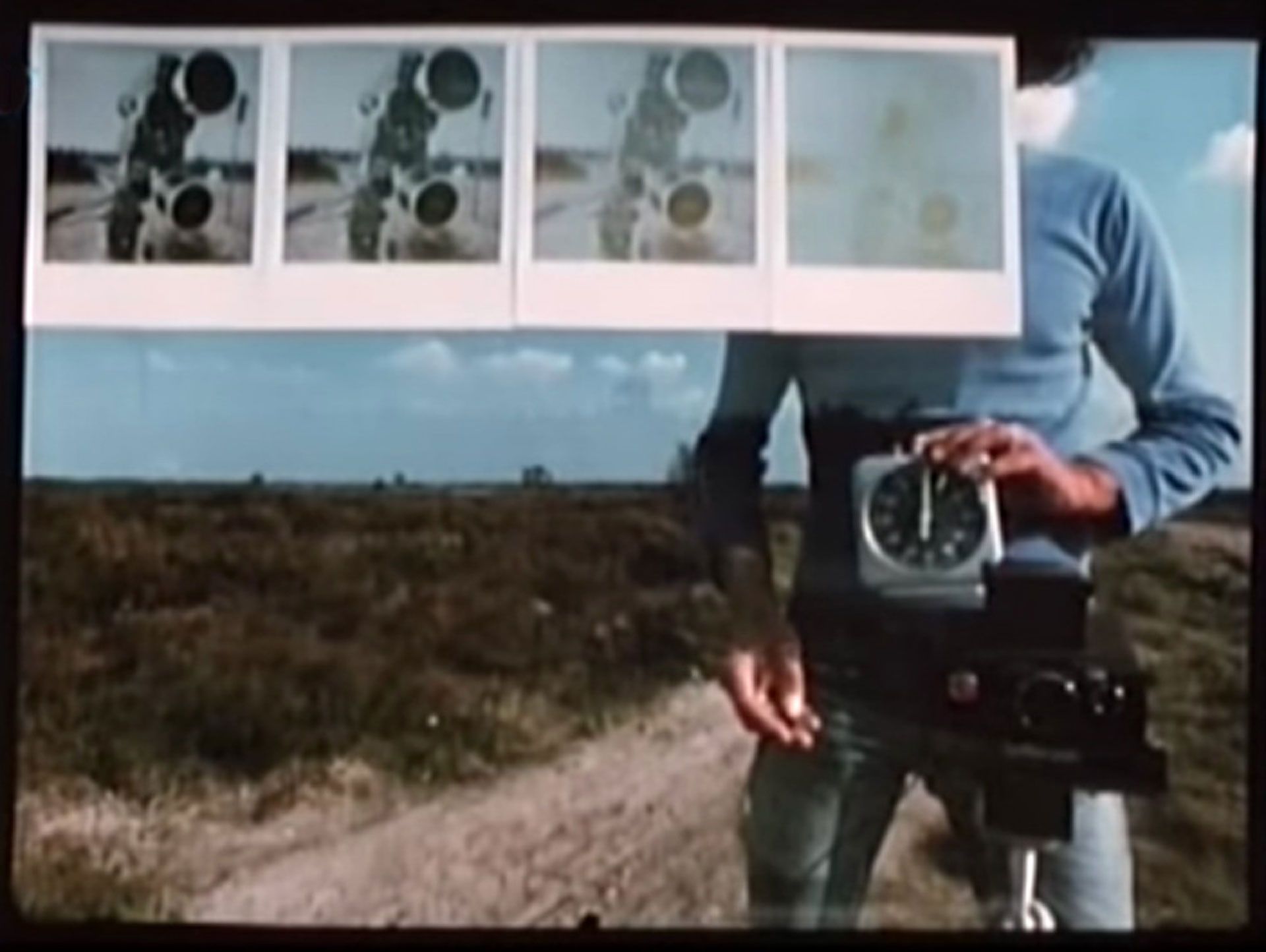
Dutch experimental artist – animator – filmmaker Paul de Nooijer worked with Polaroids. There is an interesting dissimilitude between the technologies in the glow in the dark work and Polaroid
photography.
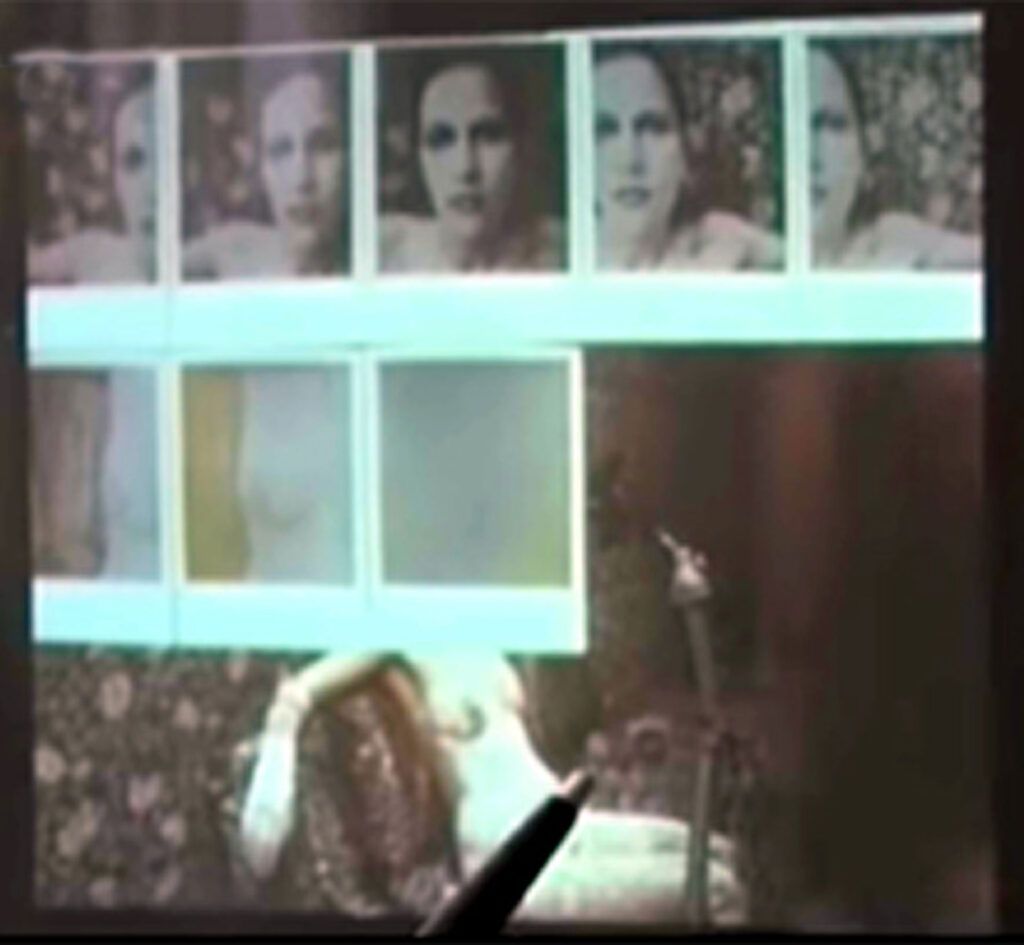
Polaroids, the image slowly comes up > accumulation
Palinopsia, the image slowly depletes > dissipation
Het Laatste Kunstje (het uur van de Wolf), VPRO, 2010
Time = transformation = change
Through time transformations are made, nothing stands still
a plastered wall changing colour
a wet floor
paint drying
blushing…
cooking a sauce; gets thicker and changes colour
flowers blooming / dying
transformations through time
Palinopsia, the image slowly depletes > dissipation
Time is a language we cannot speak nor understand
J.Meekel, 2018
The Regiment of Time
Stil de Tijd, een pleidooi voor een langzame toekomst.
Silent – the Time, Joke J. Hermsen, 2009 / ‘in praise of a slow future’ (my own translation from Dutch).
Joke J. Hermsen (1961) is a Dutch writer/philosopher who has been writing about the subject of time and how we spend our time. In this discourse, she opposes the regime of the clock. Where once, time and the passing of time was a natural every day mechanism. You get in and out of bed following the sun. Since the industrial revolution this has completely changed, we have become slaves of time.
Opposing the regime of the clock.
Scholae = School
Joke Hermsen > leisure – rest – free time.
Plato pleaded for rest, he argued that it was the most important condition for ‘thinking’. Our word ‘school’ originates from the Greek ‘scholae’ which means ‘rest’ or ‘leisure’. Because only in rest you are able to think according to the ancient Greeks.
In old English ‘scolere’ (student), derived from the Medieval Latin word ‘scholaris’, noun use of late Latin ‘scholaris’ (of a school), and the Latin ‘schola’. In Greek ‘scholastes’ means ‘one who lives at ease’. The English schoolmaster and lexicographer, Fowler, points out that in British English it typically has been restricted to those who attend a school on a scholarship.
In consequence, it is peculiar that the current acquired distorted interpretation of the original meaning of the word ‘school’ as rest and leisure, has lost its meaning in our current pedagogy and it has not been adopted in learning institutions. The initial meaning of school is contradictory to how we see the mechanisms of knowledge acquisition now. Apart from some countries, like Finland, increased time to play and a reduced amount of homework for school children had been introduced some time ago.
Another modern time contradiction: ‘the more machines have been invented in the last century to save time, the busier we are getting. And we are moving faster than ever from A to B using very fast modes of transportation like cars and trains, but we have less time to stay somewhere.’ (Stil de Tijd, J. Hermsen, 2009) She adds: ‘Our current deadlock could be described as; As we need more rest and need less, the economy demands acceleration.’
Time is classified as Chronos (calculable time) and Kairos (proper or opportune time for action). Krishnamurti (1895-1986) referred to the latter as psychological time.
In ‘Palinopsia’, the passing of clock-time chronologically drives the inevitable dilapidation but the interpretation of the Kairos-time in ‘Palinopsia’ allows pondering and contemplation. With Kairos time, time is only measurable as a duration that one feels. With this Kairos or opportune time, one takes as long as one wants. Parrallel meanings of Chronos / Kairos as Chronos = quantitative and Kairos = qualitative. This in some way also relates to the persistence of vision in film and the persistence of the material in photography to which I will elaborate on in a later chapter where I position ‘Palinopsia’ between Cinema and Photography.
In her book, Hermsen also makes reference to the musical composition Canto Ostinato (1979) – by Simeon ten Holt (1923-2012). A 2011 performance by 4 pianists in Eindhoven. The piece has an undecided duration, the length depends on the way the musicians like to perform the work, based on repetition.
Hermsen frequently quotes the French philosopher Henri Bergson (1859-1941). Philosophy and Physics need to work together to uncover the mystery of time (Hermsen, 40). Following this idea, he gave lectures on time and relativity with Albert Einstein.
The now (present) is important, we know everything fades in the end. – Seeing again…
The previously quoted philosopher Henri Bergson:
‘My memory is there, which conveys something of the past into the present. My mental state, as it advances on the road of time, is continually swelling with the duration which it accumulates: it goes on increasing-rolling upon itself, as a snowball on the snow.’
Henri Bergson.[1]“The Evolution of Life — Mechanism and Teleology”, Chapter 1 in Creative Evolution, translated by Arthur Mitchell, Ph.D. New York: Henry Holt and Company (1911): 1 – 97.
To illustrate this movement of the past into the present, Bergson described this as:
‘…it may just as well be compared to a continual rolling up, like that of a thread on a ball, for our past follows us, it swells incessantly with the present that it picks up on its way; and consciousness means memory.’[2]Essay, An Introduction to Metaphysics – H. Bergson, 1903, pp3.
Until my 16th birthday I had to go to church, there was no choice in the matter. I guess to some degree I could be grateful to my Catholic upbringing as in church I really learned what boredom was about. The long tedious sermon made me want to conquer boredom. There was no escape from it, there were only solutions to just deal with it. Time was made tangible, endless and initially unbearable through the lengthy rituals. But it is where you imagine the world in a different way.
The impermanence of the glow-in-the-dark laser projection work holds the middle between photography and film. It is not indefinitely like a photo and for keeping, but it also does not disappear ‘in the blink of an eye’ (Murch, 1992) like cinema. This middle, liminal position, not being one nor the other, is where glow-in-the-dark projection of ‘Palinopsia’ is situated. To further clarify the positioning of this argument, I make reference to the work and inventions of Etienne-Jules Marey, who with Eadvaerd Muybridge was a pioneer in Photography and generating the earliest images in motion > Motion picture.
…the Queen jumped up and bawled out,
"He's murdering the time! Off with his head!
…Alice sighed wearily.
`I think you might do something better with the time,' she said, `than
waste it in asking riddles that have no answers.'
Alice in Wonderland, Lewis Caroll
The work of Etienne-Jules Marey (1830-1904)
Etienne-Jules Marey was an inventor whose methods of recording movement revolutionized our way of visualizing time and motion. Best remembered for his chronophotography, Marey constructed a single-camera system that led the way to cinematography. ‘Picturing Time, the first complete survey of Marey’s work’, investigates the far- reaching effects of Marey’s inventions on stream-of-consciousness literature, psychoanalysis, Bergsonian philosophy, and the art of cubists and futurists.
Etienne-Jules Marey was not overly interested in the creation of movement (synthesis). Marey was mostly interested in the analysis of motion. Breaking down real-life motion in individual frames to investigate human and animal movement and learning from it. However, the two photographers have many commonalities, one could say that Marey > Analysis vs Muybridge > Synthesis. Analysing motion (learning about human movement) instead of synthesising motion which brings it together. Marey’s studies of movement were also used to make production processes more efficient.
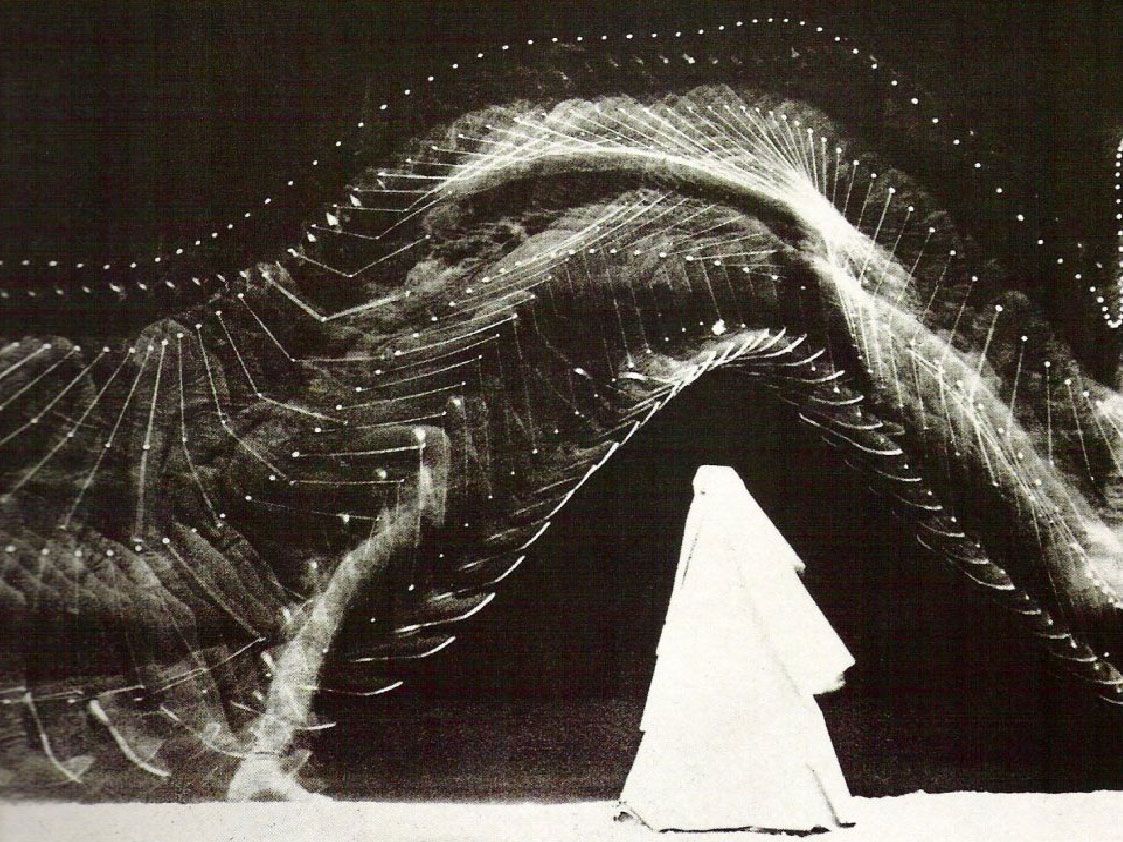
The technique that was used to create these studies was a type of long-exposure, time-exposure, or slow-shutter photography that can reveal the movement in a work process. Comparing this to glow-in-the-dark laser projection you could say that in this work photosensitive emulsion records an image that will become permanent after the developing process. In ‘Palinopsia’ the phosphorescent paint behaves like the photographic emulsion, however, it does not persist, it fades away.
Cyclegraphs & Chronocyclegraphs.
A cyclegraphs is a photograph showing movement depicted as a continuous pattern of light. It is made by exposing a still film or plate for the period of the cycle of the activity being analysed. Electric light bulbs are attached to the hands, arms or feet of the subject, whose work is being analysed. The technique was first used in 1890 by Marey to study the movements of athletes and later developed by Gilbreth in the study of work. A technique, that increases human productivity but imposes the ‘regiment of time.’ Hermsen J. 2009
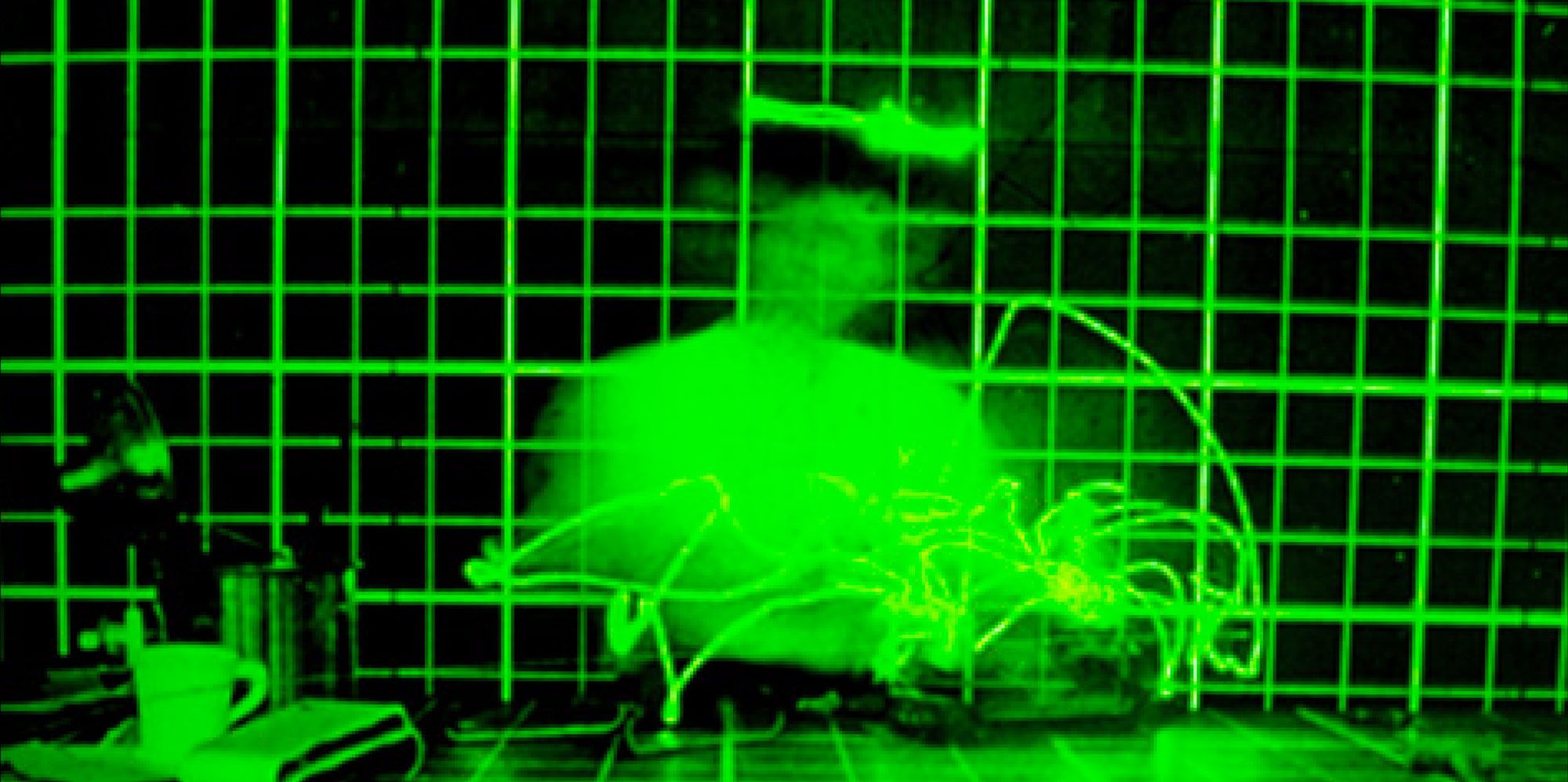
Palinopsia – seeing again
Palinopsia is known as ‘a visual disturbance defined as the persistence or recurrence of a visual image after the stimulus has been removed’.
Both the visual and sonic experiences are ephemeral; one cannot touch or keep it. They only exist in the moment. And therefore they engage more with memory. This is one of the reasons why I have chosen ‘Palinopsia/seeing again’ as a title, as it implies contemplation after the stimulus. But the images can be overwritten. The palimpsestic nature interests and drives me to further the exploration of this medium. It attacts because it cannot be kept. The title also resonates towards John Berger’s – Ways of Seeing (1972), where he reitterates the importance of understanding that a projected or printed images is not the object or person but a reproduction of the object or person.
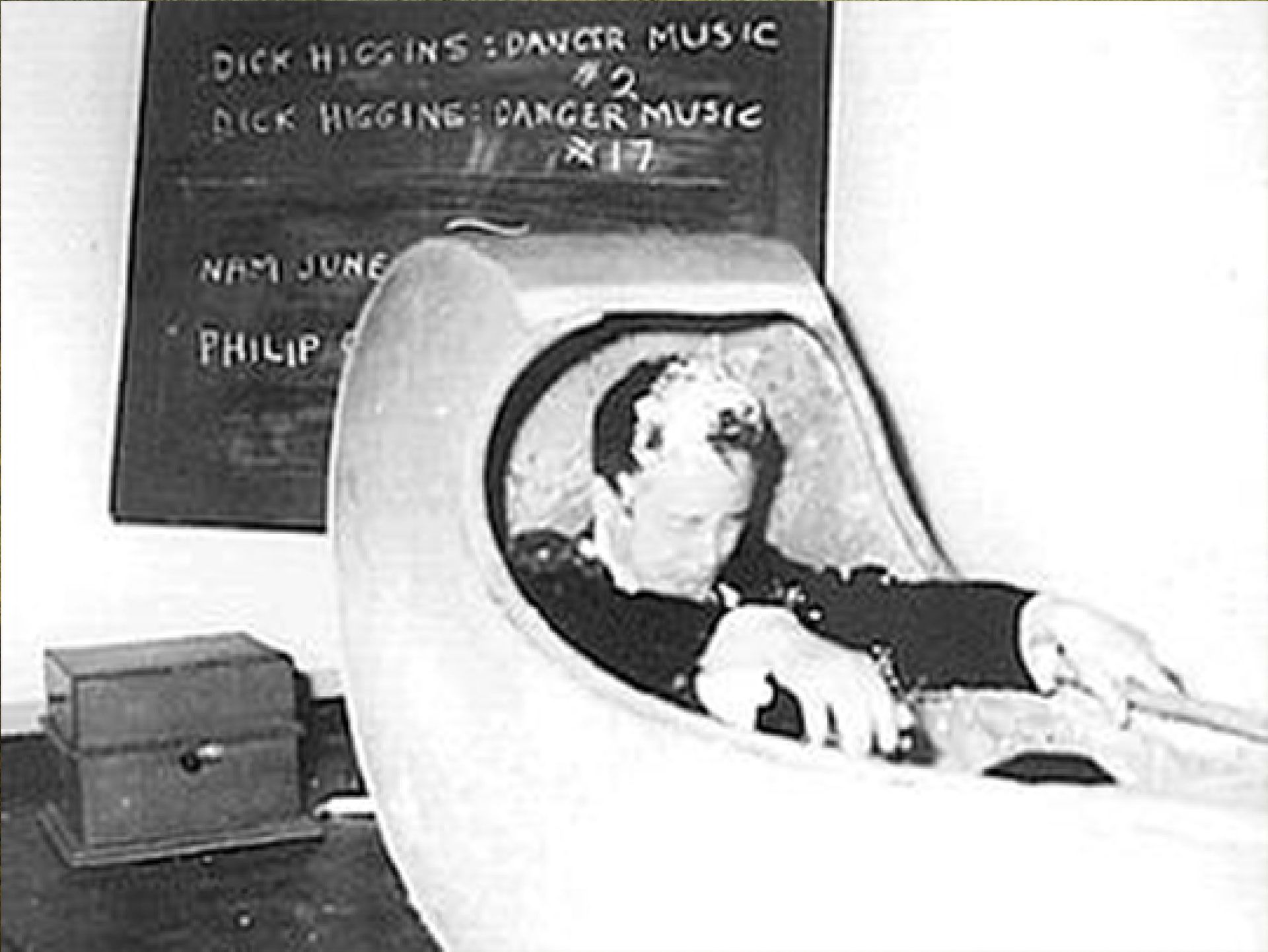
The following is included as an inspirational study of two works by Nam June Paik as a reference for possible inclusion of performative action into ‘Palinopsia’.
Nam June Paik
«Simple» 1961
Karlheinz Stockhausen invited Paik to make a 7-minute appearance in the performances of his piece ‘Originale’ (‘Originals’), which was first presented in Cologne on 26 October 1961. Paik varied his music action from performance to performance, but ‘Simple’ and ‘Zen for Head’ were basic elements which Paik later presented outside the scope of ‘Originale’, for instance in 1962 at the festival ‘Fluxus Festspiele neuester Musik’, Wiesbaden (photo). Paik’s instructions for ‘Simple’ read: ‘1. throw peas into auditorium, 2. smear shaving cream on body, 3. put rice in the shaving cream, 4. slowly unwind a roll of paper, 5. go into a pool of water, 6. come back and play some piano with baby’s dummy in mouth.’ Stockhausen recalled the additional deployment of tapes with Paik’s ‘typical acoustic montage of women’s screams, radio news broadcasts, noises made by children, scraps of classical music, electronic sounds’.
Rudolf Frieling medienkunstnetz
Nam June Paik
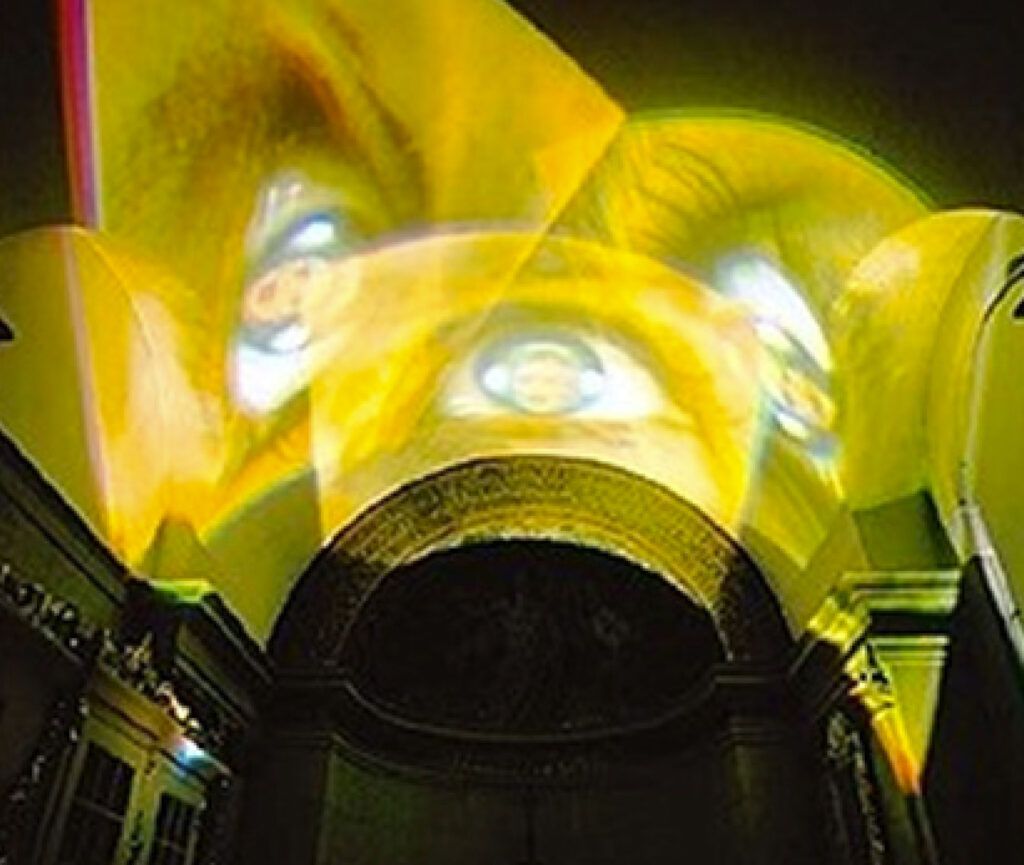
«Baroque Laser» 1995
Two years after the «Sistine Chapel» at the Venice Biennial, Nam June Paik chooses to decorate with electronic images the choir of a baroque church near Münster in Germany. In collaboration with Horst Baumann, he uses tautened gauze to experiment with laser as a new projection technique for video and expands the installation by means of video projection onto the vaulted roof. The basic images come from Paik’s ‘Merce on Merce’, his video homage to the dancer Merce Cunningham.
The sculptural quality of laser projection, and its manoeuvrability via mirrors, enable an apparently free and kaleidoscopic orchestration of the space. The inclusion of a closed-circuit image of a candle, and 17th- and 18th-century flute music, transform the installation into a Gesamtkunstwerk in the baroque sense, with architecture, painting, sculpture and music making up an ideal ensemble.
Rudolf Frieling medienkunstnetz
Memory of Paris
Up to my 40th, I must have driven past and around Paris, on the périphérie about 15 times. Hitchhiking or just driving with family and friends from the Netherlands to the South of France or Spain. As a result, I had never really visited Paris. I had no memory of the inner city even though I did end up there hitchhiking once or twice and stayed there for a few hours until I got a new lift. Two years ago I stayed in Paris for 5 days. It now still feels I have never really visited the city.
That memory of the unknown inner Paris, a city that I never visited, remained.
A glow in the dark projection is a certificate of an absent presence’, – a has-been-, -a what-was- and therefore connotes to memory and loss as we can only remember what it might have been, a trace of what it once was, a mark. It does, however, offer the viewer a short timeframe for a contemplative confrontation with the projected subject.
Due to the set duration of the image dissipation, the spectator will only physically engage with the image for that set amount of time. I believe this obstruction of fetishising the image could be used as a narrative device. The image only lingers in memory after the image has ceased to exist. The viewer will, therefore, make the conscious decisions of what to remember, which produces a selective interaction informed by the will of the viewer. The oeuvre of the artist Christian Boltanski deals with a large extent with memory, time and death.
In one of his interviews he mentions that he when he was collecting and compiling his piles of clothes, he did not immediately connect this to the framework of Holocaust that the piece got connected to further along in the work process. This absence of immediate rationality and what motivates some artists in their art practice connects to the way that I like to work. In the next pages, I will elaborate on that.
It’s always tea time…
Alice in Wonderland,
Alice in Wonderland, Lewis Caroll
Joint images into a mesmerising sequence like a cloud time-lapse seem to excite us as a consequence of their unusual time base. This film-time influences me – but adds the ‘straight-jacket’ to the experience of time. Roland Barthes says in Camera Lucida – reflections on photography: ‘Do I add the images in movies? I don’t think so; I don’t have time: in front of the screen I’m not free to shut my eyes; otherwise, opening them again, I would not discover the same image, I am constrained to the continuous voracity; a host of other qualities, but not pensiveness whence the interest, for me, of the photogram.’[5]Barthes Roland, Camera Lucida Reflections on Photography, 1980, pp55.
But why…?
Without thinking too much in this process of reflection, you in some way have to astrally project yourself and look down into one-self to create an objective image and describe your artwork in the making, or after the making with some objectivity. In some cases, you give reference to an artwork that already exists. Boltanski, who believes that most artworks have been made before, said that artworks just appear in different forms at different times. In that sense, the work of Baselitz has similarities to that of Bill Viola.
Art-production often comes with a huge challenge as you actually do not always know why you are doing anything in any particular way. Art-making is a doubtful practice. Not in a manner of whether it is legal or acceptable to the masses, but in a sense of dithering. Having fluctuating ideas and thoughts about a work is an elementary part of the work and its process. There is no assurance that anything that one does, will in any way be meaningful in the end. And for me, that is the whole point of making art. Not knowing…
When you already know what you are doing and you’re convinced that something will emerge that is worthwhile, then why do it at all. I leave doubt to where it belongs; in the realm of all uncertainties, we engage with. Using doubt as the driving force and fuelling the artistic adventure. Using the figuring out of a puzzle as a metaphor for the process of art making; we have a 10,000 piece puzzle, for argument’s sake, we can say that the difficulty level is intermediate to advanced, it obviously must have a fair amount of blue sky. One happily moves the puzzle pieces around on the table, but they never seem to match. You try to keep courageous and trust that at some point you will find the connecting pieces. This develops in all kind of stages of hair pulling, panicking and flushes of cold sweat until suddenly the moment will come where the puzzle pieces seem to implode together. There is an inexpressible satisfaction in this process.
There is, however, the risk that a work will fail and that it just doesn’t materialise like it was imagined. No problem, an art piece that has failed more than often offers the inception of a new art piece. Citing my art school lecturer Jos Houweling (1943-) from an article in the Dutch NRC newspaper where he quotes Wim T. Schippers: ‘I just do something, that is the essence of art.’
Jos Houweling: ‘You should not try and make anything new by phrasing big words and presenting extensive plans. Not searching, but finding, that is the secret. My best collages are often based on semi-conscious mistakes. A head that I made too big by accident. I cherish and value mistakes.’ (nrc.nl)
The ‘Palinopsia’ project went through many iterations without knowing where it would end and I am intending to continue to do so. Also considering that my MAFA exhibition was the second time I could work with the material. The first time was only for five hours, in which I also engaged with the audience who were interested and asked many questions about the work and unusual technique. Working on ‘Palinopsia’ has been both nerve-wracking and pleasurable. Strange things happen when you work on an art piece without actually being able to work with the actual material. Everything has to just happen in your head.
Two days before my Masters exhibition, I became more at ease with the project and its current iteration. There was no more time left to make big changes. I was imagining that maybe that is how it feels when you know that you are soon going to die. An acquiescence with the condition of being; abiding all stress. This way of submission to a fixed situation is sort of calming and pleasant and can give surprising insights.
Etymology
The word Palinopsia translates to ‘seeing again’ (Greek: Palin for “again” and opsia for “seeing”). So, ‘Palinopsia/seeing again is a repeat in itself which resonates with the work. This title choice has also a resonance to the work for two other reasons:
1) A literal explanation is, that the image is projected and therefore is ‘seen’,whereafter the image fades away and allows for re-projection ‘again’. But ‘seeing again’ can also be explained as observing carefully; taking time; seeing something to allow an inquiry. Seeing it again but in a different light.
2) The positioning of this new media artwork is centrally located between photography and film and challenges to SEE this ‘new’ art form AGAIN in a contemporary light using present-day reproduction technologies as the referent. Flooded and overfed with images, whether in motion or not, we’ve changed in the way in which we perceive image reproduction. The Internet and particularly the social media and the photo sharing applications like ‘Instagram’ (my predictive text made this into Instant Gram), Pinterest, YouTube, and Google are the web-based downpours of an endless assortment of audiovisual media. The avalanche of information seems to dilute what used to be inspiring and intriguing. Perhaps, ‘Palinopsia’ tries to test me on what I really find important.
Cinema and Photography
Like film, the glow-in-the-dark image deterioration cannot be stopped, it fails to linger. After the excitement the exposed image dies out within a certain amount of emission time and therefore, situating it next to photography, it can be seen as a ‘glitch’ due to the inability to remain visible and as a consequence it cannot be permanently kept, where ‘keeping a photo’ according to C, Metz, 1985 is the fetish principal of photography. However, this way of projecting does hold the prospect of re-projection within a short window of time, something that, one can arguably say, photography falls short of. A photograph is a permanent depiction of a moment in time …dead still.
Using Barthes’s reflection on photography: ‘Every photograph is a certificate of presence’, does not apply to glow in the dark projection, It could be re-phrased as ‘Every glow in the dark projection is a certificate of an absent presence’, a has-been, a what-was, and therefore has an association to memory and loss as we can only remember what it might have been, a trace of what it once was, a mark of consolidation. Maybe that repetitive absence reiterates our mortality. It does, however, offer the viewer a short timeframe for a contemplative confrontation with the projected subject. Due to the inevitable duration of the dissipation of the image, the spectator will only physically engage for a distinct amount of time. I believe this hindrance of fetishising the image has its merits.
The image only lingers in memory of the image. The viewer makes the decisions of what to remember which is a selective interaction process fed by his or her own will. Then again, in contrast to cinema, it does fetishise the image as it lingers for 10.000 times longer than the duration of the film frame.
Bergson writes: “perception is master of space in the exact measure in which action is master of time.”![6]Matter and Memory, H. Bergson, pp 23.
It has been argued by filmmakers like Godard, Truffaut, and Rohmer that cinema did not make any change after its conception by the Lumiéres brothers in 1896. Their answer to that was to overhaul the conventions of shooting and editing. This manifested itself in the ‘Nouvelle Vague’ the French New Wave (1958 – late 1960’s).
Film works on the basis of the persistence of vision, our brain is deceived in seeing real action and movement and even though being projected on a 2-dimensional white surface while sitting in a black box, we engage into narratives that are often subjective and mimic real life. Situating glow-in-the-dark laser projection between cinema and photography, one could argue that glow-in-the-dark projection, has in a cinematic sense the benefit of the re-projection that cinematic frame by frame projection has, but also encompasses the static undisturbed stillness of photography.
Like I quoted earlier in the page before, Barthes states that film does not allow the receiver to let their mind wander off. He further argues that the photograph has the ability to resonate in the observer’s mind. Barthes names it ‘the punctum’ which is revealed only after-the-fact when the photograph is no longer in front of him and he thinks back on it. … ‘ultimately, he says, or at the limit in order to see a photograph well, it’s best to look away or close your eyes.’ (Barthes, 55). This describes a wonderful contradiction. Do you have to close your eyes to see better?
In the online article: educationmuseum by Strawberry (2013), studium and punctum are described in a way that time was initially framed by St. Augustine (354-430AD):
’What is time? If no one asks me, I know what it is, but if someone asks and I must explain, I no longer know what it is.
The Art of Time – Jean-Louis Servan Schreiber (1988)
The delivery of studium and punctum Barthes describes is in a way similar to the decryption of time that is quoted by Schreiber. Both refer to the necessity of an absence in order to fully comprehend. Citing the online article: ‘The punctum turns into the studium when expressed in language.’ It seems to be an impossible mission as punctum is life-giving and studium more denotive.’ Strawberry, 2013. The sublime insight referred to as ‘punctum’ evaporates when it is put into words. Categorising and describing art by using language, enables us to understand it, and to give clear meaning.
If this is not achieved with some level of nuance, it might as well not have been made.
Semiotically, ‘Palinopsia’ as a work reads like a contradiction. The visual side of the work presents itself very slowly, invisibly glaring up and then fading out, inviting contemplation as time passing is a central property. It can be read like an incredibly slow subtitle. Or as the last pages of the fantastic novel that you just don’t want to finish. Reading between the lines. On the other hand the work has an association to laser-shows, entertainment for the masses, alien poison and perhaps life living in the fast lane.
[Work-Money-Party]
In 'Palinopsia' the rudiments of the previous image physically linger on and create a palimpsestic visual presence that relates directly to the immediate past, but the gentle fading reminds us of the unavoidable mortality and our vulnerability.
Other artists working with laser on glow in the dark
I only found few references to artists also working with this medium, An example of this is the work ‘uv laser fade out test 0‘ from Daito Manabe (Japan), he used a laser projector on glow-in-the-dark projecting a halftone image captured by a webcam in 2010 described in the web article by Thibodeau, J. 2011. This work also projects greyscale images over time but used a very different velocity than ‘Palinopsia’. Learning from his work one can see that the laser moves much quicker, which is inherent to entertainment lasers and thus minimising any risk of of eye and skin damage to the audience that a slow-moving laser would have done. The show laser projection software application named ‘Pangolin’ does not allow the user to the laser write slower than a certain velocity. Those show-lasers move so fast that they create an illusion, much like cinema, of the persistence of vision. Therefore ‘Palinopsia’ can only be performed when the beam is out of reach from the spectators.
Daito Manabe, added short pauses in order to let the shadow areas dissipate in relation to the mid-tones and highlights. I presume the type of phosphorescent pigment in the paint is also different than the one that used in ‘Palinopsia’. In these kinds of technologies, every year improvements are made to the emission coefficients and the amount of light that is needed to excite the phosphorescent particles. Comparing Palinopsia to Manabe’s work the light emission seems to be less either by a less powerful laser, the seemingly faster projection speed or a different amount of excitement of the pigment itself.
The pauses (moments of non-projection) allow an interesting iteration, where the projected work can be seen without the visual interference of the laser, which slightly overexposes certain areas of our view of the work. In my evaluation of the MA exhibition performance, I have added this is one of the elements that can improve the observation experience. As when the laser is paused an unobstructed view of the light emission become visible.

The artist: a snail invents the wheel and goes through a cultural evolution to finally get back to its origin In this work, the laser is positioned inside a glow-in-the-dark painted cylinder and moves around its own axis projecting a trailing animation on the surface.
The democratisation or dictatorship of the Visual
Hito Steyerl states in ‘The Wretched of the Screen’ (2012), chapter: ‘in Defense of the Poor image pp.42, that the poor image operates against the fetish of high resolution. She presents this argument in relation to highly compressed and small resolution images. Video work using glow in the dark laser projection is not an example of the production of high definition visuals. Similar to low res web-video it is in that sense modest in its representation, where the content is more important than the high quality and precise depiction of the image.
A good example of this quality (content) over quantity (pixel count) principle is, for instance, the poor quality CNN recording of a man stopping a Chinese tank in Tiananmen Square in 1989.
Glow-in-the-dark projection is dim, monochromatic, has an ultra-slow frame-rate of circa 1 frame per 180 seconds or less and it can not persist for longer than 10 minutes. It therefore, democratises the visual, presenting itself without the obsessive compulsion to be dragged along with the unstoppable train of the possibly deceivable technological improvements in screen technology and applications. Citing Steyerl: ‘ contemplation into distraction.’ The ‘Palinopsia’ screen has to be seen in its dim presence as a dissipating after-fact, as long as it lasts. Metz’s fetish principle of keeping or the Pinterest like obsessive-compulsive hoarding of images is challenged. Deriving this from Steyerl one could say: ‘Distraction into contemplation.’
The liberation of the single image fitted into an art-form in which the image is presented allowing inspection and deliberation. On the other, hand one could argue that showing an image for eight minutes is hard to be seen as an act of free and voluntary consumption, in fact, it can also easily be interpreted as a dictatorial observational imposition on spectatorship.
It forces the viewer into slowly observing and digesting.
To appease this notion of visual force-feeding, the additional soundscape will bring a layer that will hopefully enrich the viewing experience to create a more meditative production method of the visual foie gras.
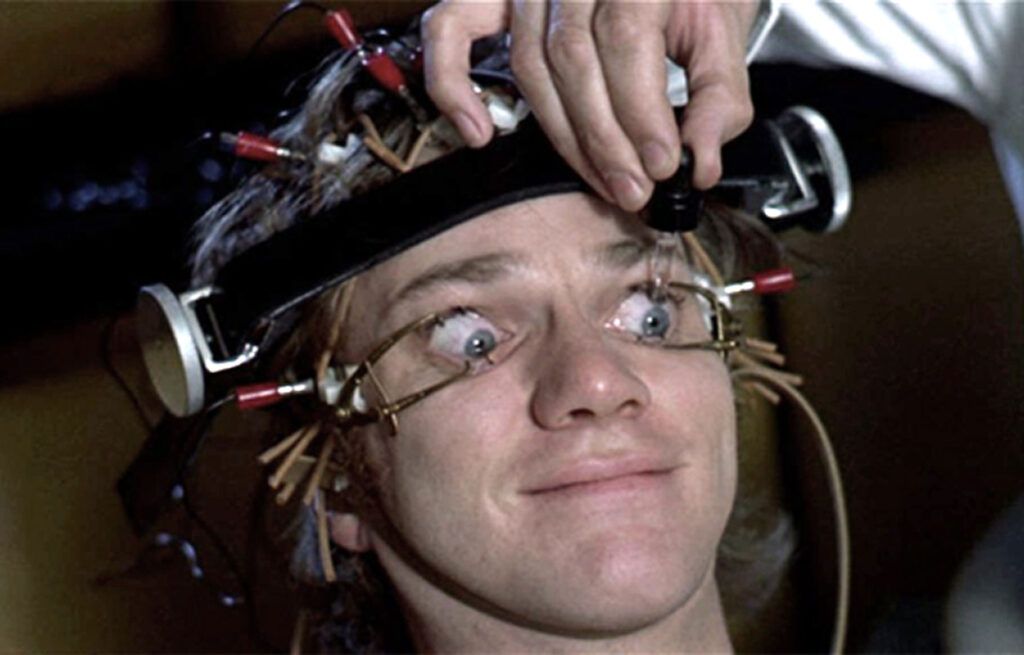
Hito Steyerl opens her chapter with: ‘The poor image is a copy in motion. Its quality is bad, its resolution substandard. As it accelerates, it deteriorates. It is a ghost of an image, a preview, a thumbnail, an errant idea, an itinerant image distributed for free, squeezed through slow digital connections, compressed, reproduced, ripped, remixed, as well as copied and pasted into other channels of distribution. The poor image is a rag or a rip.’
in defense of the poor image (2009).
However this perhaps pertains more to the quality of the image, it does speak about the acceleration and deterioration of the poor image creating a ghost, something which is inclusive in ‘Palinopsia’. And this ghosting or after imaging also connects to something Jonathan Crary, voiced: ‘Let the observer look steadfastly on a small coloured object and let it be taken away after a time while his eyes remain unmoved; the spectrum of another colour will then be visible on the white plane . . . it arises from an image which now belongs to the eye’. Carry, J. 1988, 4.
In ‘Palinopsia’ the projected images persist as intentional after-images, and the temporary ‘recording’ of these images on the exited screen act like if the images are belonging to the screen. When observing a bright magenta shape for a while, when then closing one’s eyes a similar shaped green shape retains.

Nijmegen is a purple volcanic landscape. Time, presence, wasteland, future, existence. Everything is finite, terminates, limited
The joy of Danger and contradictions
Mesmerising green ambiguity, captivating: what isn’t … & what is there.
Binaries: my dear aunt Maria / an evil-green radioactive glow. The green glow associates with radioactivity, indicating a potentially hazardous situation, but then it also has religious undertones.
…Go on a religious pilgrimage and you might come back with some green glowing object to spiritualise with.
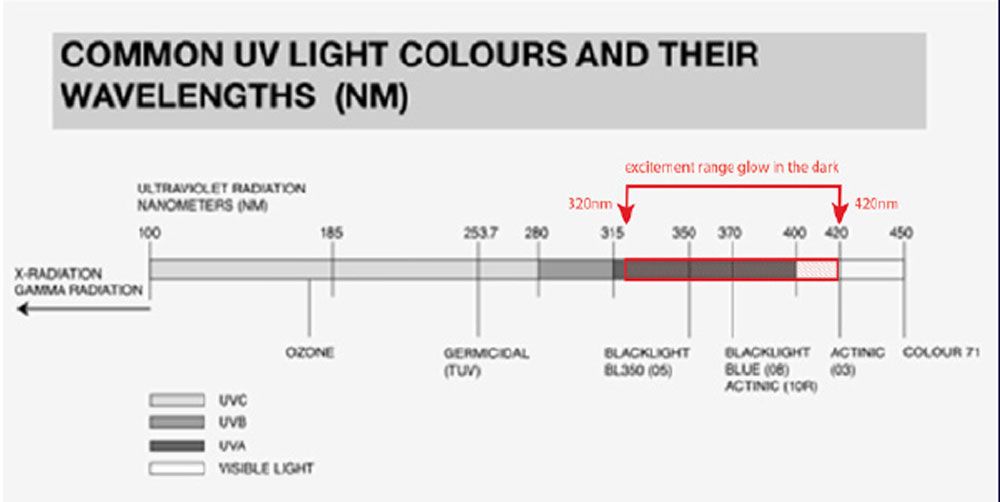
Danger has been a continuous element in my work. Often danger and paradoxical materials and properties of physics make ideas come to life; tiny ‘big bangs’. Out of interest into the sublime, extreme and the excessive. I enjoy working with semi-dangerous materials that have found their acceptance in everyday life. The over-the-counter household stuff that managed to get hallmarked. The slow-moving laser in itself is a hazardous device as it could inflict damage to the eyes and skin. When using UV light as a projection source the light frequency can also be a possible hazard. Therefore audiences have to be kept out of direct contact. Which is not such a problem, one just has to be aware of it.
UV-A – Longwave UV, also known as “blacklight”, the major type of UV in sunlight, responsible for skin tanning, generally not harmful, used in medicine to treat certain skin disorders.
UV-B – A small, but dangerous part of sunlight. Most solar UV-B is absorbed by the diminishing atmospheric ozone layer. Prolonged exposure is responsible for some type of skin cancer, skin aging, and cataracts (clouding of the lens of the eye).
UV-C – Also known as “shortwave” UV, includes germicidal (253.7nm wavelength) UV used for air disinfection. Unintentional overexposure causes transient redness and eye irritation, but does NOT cause skin cancer or cataracts.
I used to have a UV light in my studio which had my interest because of the awkward purple quality of the light. It was interesting to illuminate my work-in-progress installation pieces. UV light can cause skin cancer so I did not do that too often.
Related art installation work: Jurgen Meekel
Another example of my interest in working with relatively dangerous materials is two of my pressure cooker projects: Soup-fountain (1993) and Day-soup (1994). It is worth noting that both projects were conceived and produced about 10 years before pressure cookers were becoming severe and terrible weapons of destruction in terrorist attacks.
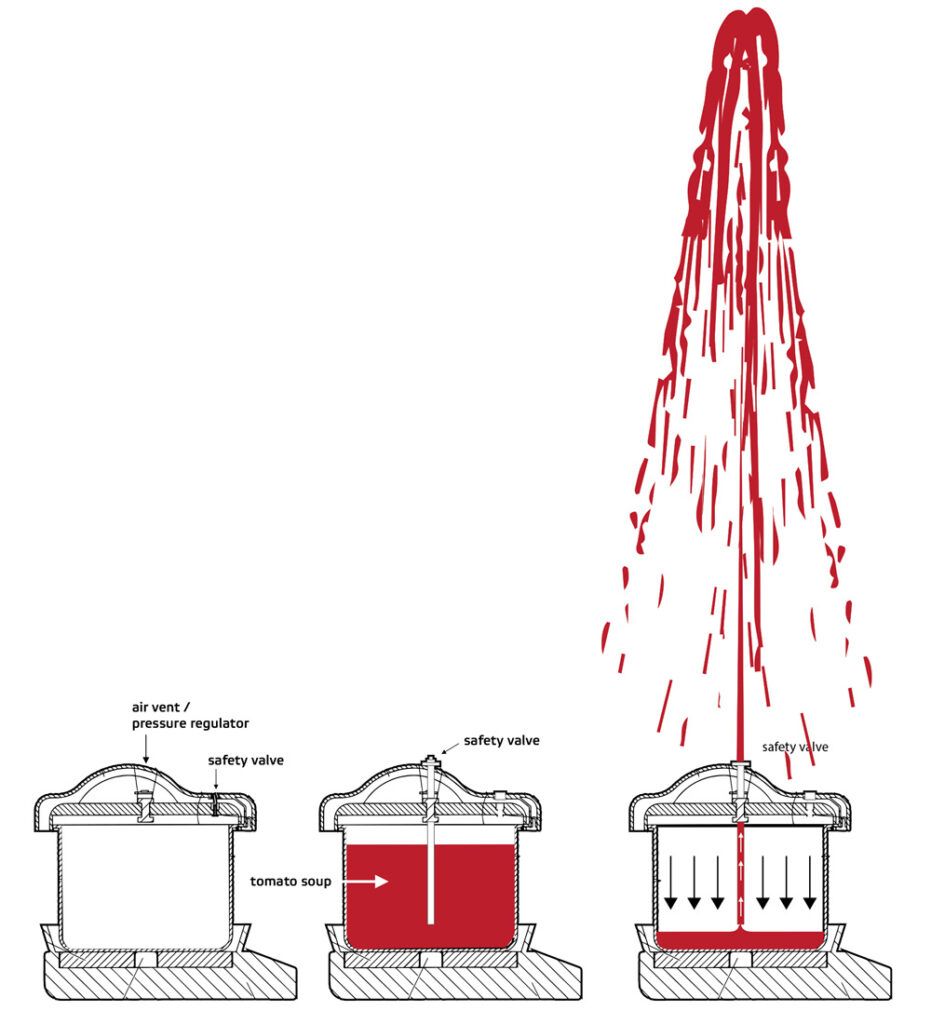
Soup-fountain – 1993, gallery DAAR, Amsterdam
A performance/installation piece that pre-dated and to some degree tested the larger installation Soup of the Day (1994). Soup-fountain comprised of a pressure cooker placed on a small table in a gallery and was heated by a small camping gas burner. The pressure cooker was hacked and manipulated as follows:
The original safety valve that generally is positioned on the side of the lid was moved to the middle/top of the lid and welded into a connection with an alluminium pipe that is reached nearly to the bottom of the pan. The pan was filled with approximately 3/4 of tomato soup and brought to the boil. Once the pressure was getting too high, the safety valve popped, and the soup instantly escaped the pan through the pipe producing a fountain of red soup that covered most of the ceiling and walls of the small gallery. It was wonderful how much faith and trust the audience had when I performed this action.
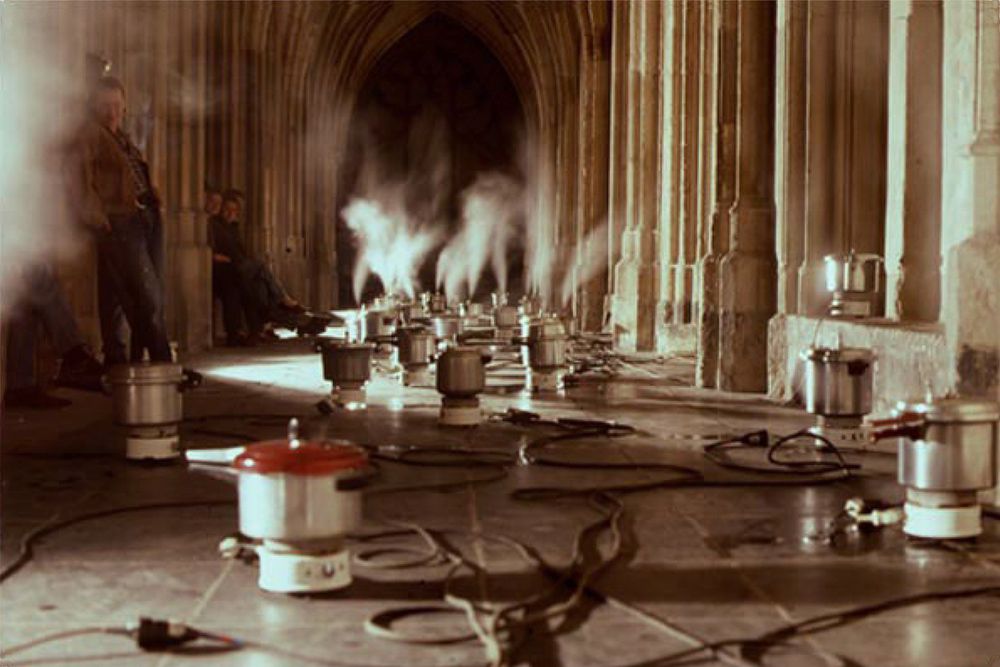
Soup of the Day – 1994, Theatre a/d Werff festival, Utrecht
A performance/installation work comprising of 40 working pressure cookers in a gothic monastery garden in the city of Utrecht.
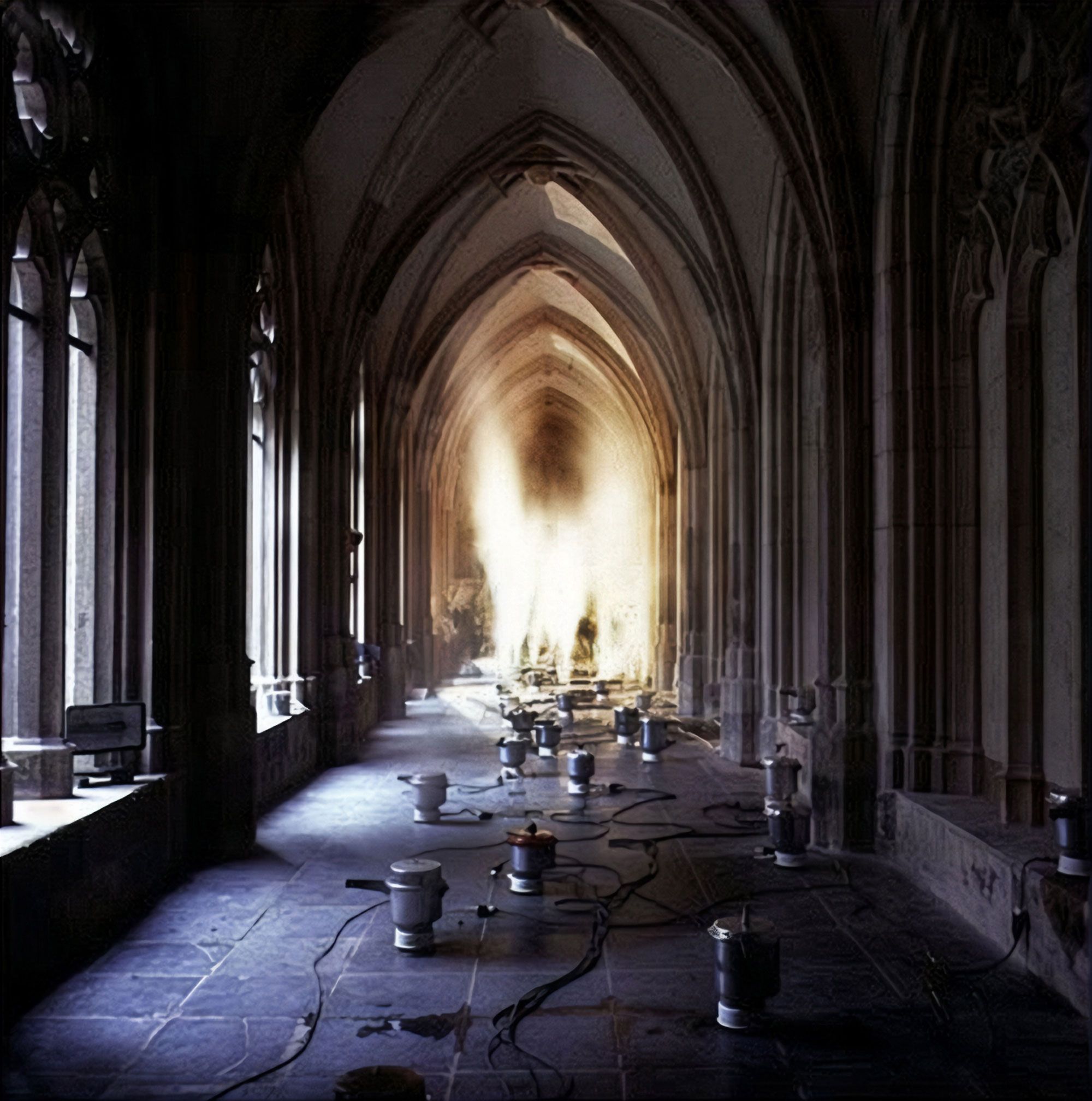
For one day I made a watery soup in the pressure cookers using the herbs that were growing in the central garden area of the square monastery passage. All the pressure cookers were placed on individual 800 W electric cooker plates. The cacophony of smells, humidity, visual and sound was speaking to all five senses.
Another re-occurring element in my work is my interest in how we observe works in galleries, museums or public art. The following work was made to challenge the observational abilities of gallery visitors.
Living and working as an exhibiting artist in Amsterdam in the 90s, I found myself not always interrogating and observing artworks as the maker had intended. I presumed that other spectators of art shows did not always fully engage in art in a similar way, so I decided to make a work addressing that.
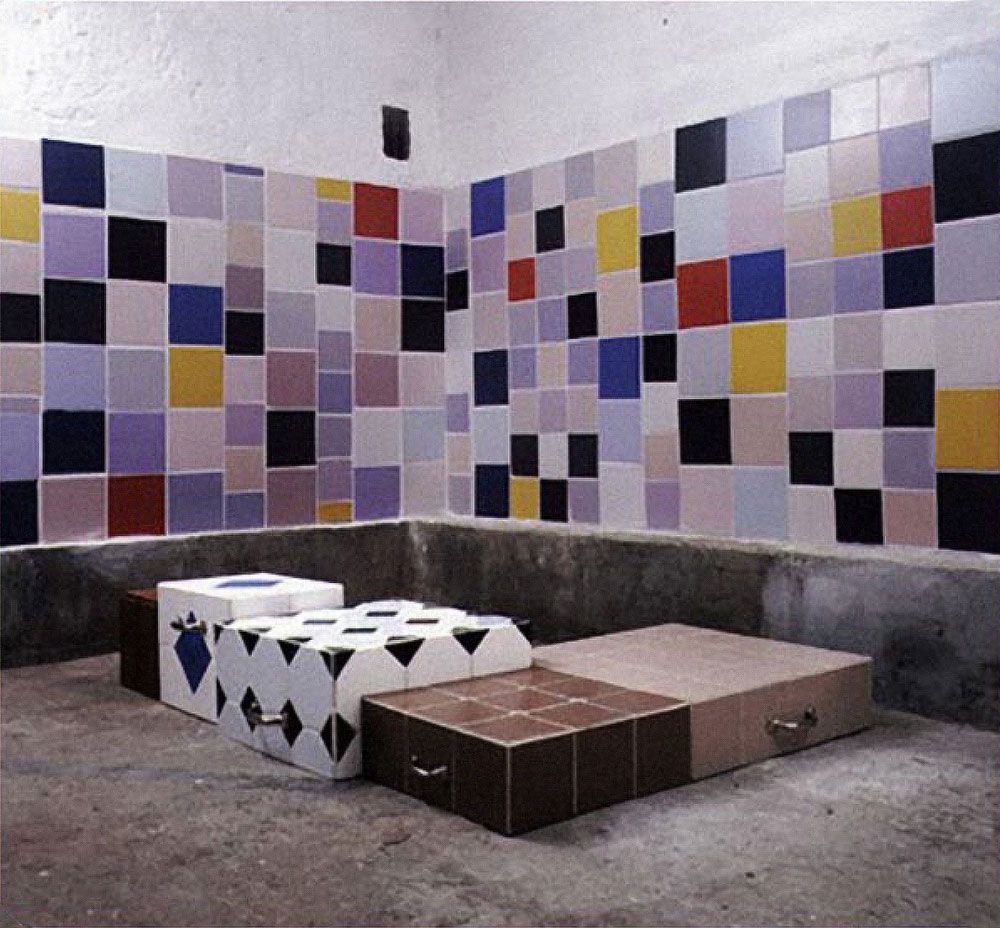
Un-tiled, 1996, gallery DAAR – a work about observation.
This work consisted of 5 wooden cubes, that were covered with tiles, in a fully tiled environment. The blocks, resembling an awkward 1-2-3 podium were fitted with small handles. These handles were kept in place by screws. Six of these screws were then again individually connected to small electric mirror ball motors that were housed inside the cubes and slowly rotated about six times per minute. Watching the work at a glance one would not pick up the rotational movement of the individual screws. But staring at the work for a while one could clearly pick up the subtle tilting of the handles caused by the rotating screws.
Decay
Degradation – entropy (gradual decline into disorder) disorder as in failure, failure to persist.
The French philosopher Simone Weil said: ‘All the tragedies that we can imagine can just be reduced to one: ‘The Passage of Time’.
One can argue whether death and decay are real tragedies? Acquiescence to the inevitability of the passing of time, resulting in letting time go, to be dissolved in time, is what we are prone to do. There should be a reluctance in this impermanence. Maybe, when we would think about the inevitability of dying every day of our lives, we wouldn’t have any drive to get up in the morning do our work, filing our taxes and getting the children to school. In that sense you could say that we live in constant denial, fooling ourselves. What is the purpose of it all? Nobody knows, and everybody consolidates to this abstract idea.
Death and Memory to life
“And there are never really endings, happy or otherwise. Things keep going on, they overlap and blur, your story is part of your sister’s story is part of many other stories, and there is no telling where any of them may lead.”
Erin Morgenstern, The Night Circus, 2011.
Perhaps the way to visualise time-passing in a longer frame of time is the aging of children, a partner and then also oneself. In the short period of one and a half year, I lost both my mother and my mother-in-law. To a certain degree, the artwork will be autobiographical. Also, in 2010 the wonderful and inspirational sculptor Ans Hey died, whom I assisted in sculpting for many years and who was also the mother of a very good friend. Linking a section of the project to all of their death’s and eventually, my own death, when it comes, became a clearer choice when these remarkable women died. In that sense, the work will also be an homage to them, to their incredible significance to my life and the life of friends and family.
Death’s relationship to the temporality in ‘Palinopsia’; the images and sounds are continuously dying and forming, in a relatively short cycle of life. The aspiration not to linger is a characteristic that compliments the property of decay and expiration, which makes a connection to another significant link that Christian Metz makes; the kinship of Photography and Death and how it appropriates the vanishing moment of when she or he was, and as a social practice to keep photographs in memory of loved ones who are no longer alive.
An important artist that Metz refers to is Christian Boltanski, who in his photographic installations explores life, death, and memory, blurring the boundaries between truth and fiction. Boltanski says in an interview: ‘Les vies possibles de Christian Boltanski – PARTE 2’ (The possible lives of Christian Boltanski)
“Photo’s are always linked to the idea of death. You preserve a moment, but as soon the photo is taken, the moment is over. You can display all someone’s objects you like – they won’t disappear – but they will only be images of objects.”
Thinking of this statement Boltanski made, John Berger’s discourse on image reproduction came to mind and also a personal memory.
In 1986, I was in Barcelona for two and a half months.
I had taken my stills camera, but only took very few photos, maybe only 3 or 4. I discouraged myself from taking photo’s to really experience this historically intriguing and fascinating city. In a way, I was not allowing myself to be seduced to search maniacally for clever and nice shots, which was easy to do. Barcelona is an amazing conglomerate of wonderful architecture, art and of course the people that live in Barcelona. It seemed like a treacherous idea, to only leave the true experience of the city to a few weeks after my return back home to the Netherlands, where I would review the photo’s in a slide projector, contact sheet or prints. I allowed the experiences to be my own personal encounters without being shared with family or friends that would then join me in the viewing of ‘Jurgen’s Barcelona slide presentation’. I was convinced that storing the experience as a hard copy and fetishising (Metz, 1985) the experience, would weaken my lived intimate adventure.
‘Palinopsia’ reveals images that are present for a while in display of stillness – death, and perhaps are preserved for a short-lived moment. But when they disappear they give life back. Knowing that these experiences are not lasting, allows more engagement for me.
A few more quotes retrieved from the subtitles in the Les vies possibles de Christian Boltanski – PARTE 2’ video:
~ ‘I don’t think art progresses, it follows a course we just use different words to ask the same old questions. The questions always remain the same.’
~ ‘I came to art in the 1970’s and used the language of my time, which was installations, sound, film, and video. That painting is another way to ask the same questions and I don’t see a break between Bill Viola and Baselitz. They have two modes of expression but the same questions are asked.’
~ ‘The more you try to show your memory of someone, the more you pinpoint their absence. As soon as you preserve something, you kill it. I think that’s why photos are always linked to the idea of death. You preserve a moment, but as soon as the photo is taken the moment is over. You can display all of someone’s objects, they will not disappear – but they will only be images of objects.’
~ ‘Life is destruction and wear and tear. The object always evokes the absent human.’
The large quantities of photographs and more specifically the large mountains of clothes of people in some of Boltanski’s work refer to the non-specific choices of people. His people; they have no name. For Boltanski this points directly to Shoah. Roland Barthes’s, Camera Lucida (1980) is partly a meditation on photographs of his mother as a young woman. He writes, looking at these images, much later after her death. He pointedly never re-presents or re-prints the images of his mother as he is convinced that they will not have the same meaning for anyone else. Barthes says: “Every photograph is a certificate of presence.”[7]Barthes, Camera Lucida pp87. Even though the photograph is a confirmation of our presence, the fixed stillness of a single still image also reminds us of the finite reality of our existence.
Documentary photographer Dorothea Lange (1895-1965), has been quoted: ‘Photography takes an instant out of time, altering life by holding it still’ which support both Metz and Barthes’s theories that there is an intrinsic power to capture a single moment. In my opinion, it holds the essence of the intriguing property that photography can hold time still and allows for boundless contemplation as time has become stationary.
“The visual arts have always existed within a certain preserve; originally this preserve was magical or sacred. But it was also physical: it was the place, the cave, the building, in which, or for which, the work was made.”
Ways of Seeing, Berger, J. 1972.
John Berger suggests that ‘duplication of images severs art from its past, thereby destroying the authority works of art once had’. Berger, J. 1972. With this argument in mind one could argue that the projection of the image on a glow-in-the-dark surface respects this authority as the duplicate image is projected, but soon fails to persist and only continues to exist as a reminiscence of the image in the spectator’s mind.
Photography
The conceptual implications of the dying image are pivotal in ‘Palinopsia’ and formed the nucleus of my investigation. The work has a dependency on the temporal, non-persistence or fading of the image. Analysing non-persistence of the image projection as they relate to: memory – trace – erasure – ephemerality – image retention – rupture – error – ambiguity – loss – compassion – melancholy – erosion – palimpsest.
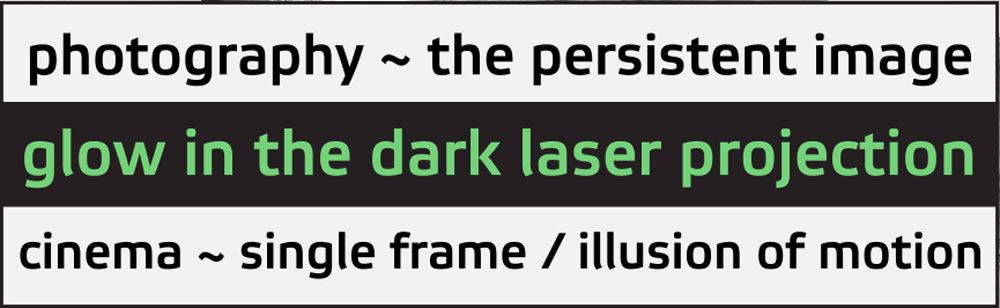
The work that I will make under the ‘Palinopsia’ umbrella will be impermanent, ephemeral, volatile and evaporate quickly. Ephemerality connotes to transience, moving from one state into another. Transitioning. In this way ‘Palinopsia’ positions itself between photography (permanent, durable or fixed) and film or cinema (short-lived, fluid, impressionistic). This relation can be schematised as follows:
The articles Photography and Fetish, Christian Metz (October journal, MIT Press, Vol 34, 1985, pp 81-90) and Camera Lucida (1980) link clearly to this glow-in-the-dark projection concept.
Metz establishes some critical differences between photography and film where he states that in Difference 1: …’the photographic lexis has no fixed duration (= temporal size): it depends, rather, on the spectator, who is the master of the look, whereas the timing of the cinematic lexis is determined in advance by the filmmaker.’ In that respect Peter Wollen in “Fire and Ice,” Photographies, 4 (1984) points out; ‘on the one side, “a free rewriting time” (photography); on the other, “an imposed reading time’ (cinema). Glow-in-the-dark laser projection has a fixed duration that is dictated by the light emission time of the medium. The medium imposes the reading time until the next image emerges, or the image maker decides on the over-layering the image with a new image to result in a new composite. A palimpsestic process. In addition, (Metz, 1985) states that the ‘Fetish of Photography’ lies within the ability to stop time and to hold on to the single image, something that is not possible in that way in the continuous form of film or video.
Metz continues:
Difference 2: ‘the social positioning of both art forms. However more ambiguous, he mentioned that photographs are considered by society as artworks, presented in exhibitions and albums accompanied by learned commentary, where movies are watched as entertainment on TV.’
This is debatable and maybe out of context. Both can undoubtedly be classified as higher art forms, but they are also image (re)production devices to be used in advertising, snap shooting, scientific knowledge production and so on. Glow-in-the-dark laser projections can live on walls in a city as a site-specific art form or for advertising and in exhibitions. The only physical necessary condition is the absence of too much ambient light.
Difference 3: ‘the mode of the production itself, the principal of the taking.’ After all, he says, ‘film is only a series of photographs. But more precisely, a series with supplementary components that get exploited by the narrative, more importantly than the link of each image with its referent. Photography remains closer to the pure index, stubbornly pointing to the print of what was, but no longer is. Movement and plurality in film both imply time, as opposed to the timelessness in photography, which is comparable to the timelessness of the unconscious and of memory.’
In Glow-in-the-dark laser projection, one could imagine a narrative to develop; it uses related or unrelated sequences of stills but at the very slow pace of one image per 3 min or less. The onscreen display would lack the thrusting excitement of film, nor the inert infinite stillness of the photograph, but using this slow forward push could be used in more contemplative utterances. Especially where the unstoppable instrument of time, reiterating timelessness, are part of the conceptual idiom of the work.
The last Difference 4, lays within the auditory sphere, which is totally absent in photography. He says: ‘Cinema adds phonic sound (spoken word), non-phonic sound (sound effects, noises etc.) and musical sound.’ One of the properties of sound is that there is a time-based expansion, a development in time, whereas single images only construct themselves in space. In this respect, the addition of sound in glow-in-the-dark projection could make the positioning of the work even more centrally located between photography and film. The addition of sound will be a useful layer that could add a new layer of significance to the project.
Metz points out that there are also clear similarities, that they are both prints of real objects, prints left on a special surface by a combination of light and chemical action. Metz (1985), 82. This differs completely in glow-in-the-dark laser projection as it has neither the ability nor the desire to retain the image. The work is dependent on the expiration. However, Jarryd Bekker (engineer-collaborator in ‘Palinopsia’) mentioned, and is experimenting with this technique, that there would be a way to retain the image that is projected by the laser if one would use the process of cyanotype or blueprint. A sequence of images can also be projected on the blueprint paper and then when developed, a persistent image would be obtained.
Cinema
The moving image – the persistence of vision occurs at 16 to 18 frames per second. In his book: Sculpting In Time, Andrei Tarkovsky (1986, pp113) identifies time in cinema as:
‘The dominant, all-powerful factor of the film image is rhythm, expressing the course of time within the frame. The actual passage of time is also made clear in the characters’ behaviour, the visual treatment, and the sound—but these are all accompanying features, the absence of which, theoretically, would in no way affect the existence of the film. One cannot conceive of a cinematic work with no sense of time passing through the shot, but one can easily imagine a film with no actors, music, decor or even editing.’
Pigment and applications
Phosphorescent pigments come in various ranges of luminosity and endurance that makes them uniquely suitable for distinct applications. There are pigments that have the ability to absorb light during daytime and then for a long time during the night light up to discharge their light. There are also pigments that emit light for a far shorter duration but are more luminous.
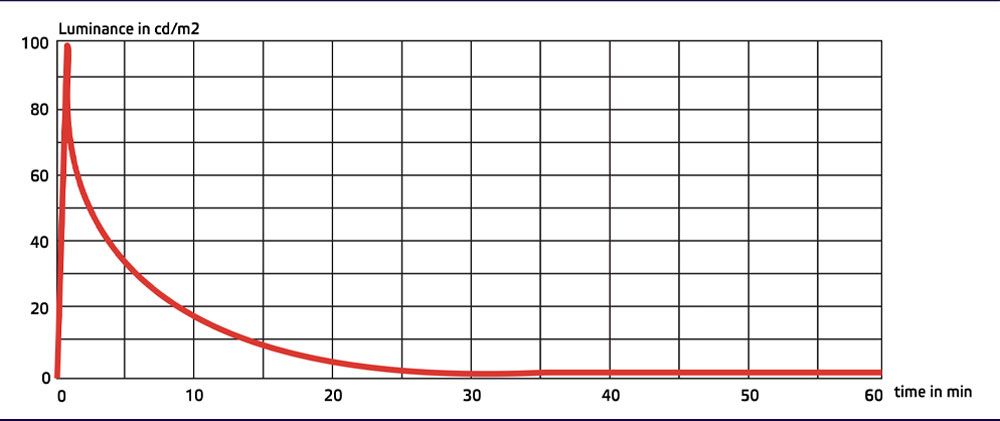
The graph, as shown above, shows a very quick decay in the first few minutes. After that, its slopes gradually down to a very low luminance at 15-25 minutes. Luminescence is measured in cd/m2 which stands for candela per square meter. The gradually sloping curve is a common characteristic of afterglow luminance of the currently fabricated glow-in-the-dark pigment.
In my work: Biénvenue au combatants de la dernière heures (welcome to the fighters of the last hours) – Lacoste, France – 1993, as displayed on page 5 of this document, I experienced the duration of incandescence to have a different emission property. Nearly 25 year years ago, the afterglow only lasted for a minute, which perfectly suited that work as there the cycle of 1 x per minute suited the decay properties. The audience came into the completely dark quarry chamber where they were surprised by a photoflash. After which they experienced an after image in the form of broomsticks with glow-in-the-dark painted doughnut-shaped pieces made of plaster of Paris. As the glow emission diminished the viewer’s ability to see in the dark improved until the flashlight was triggered again resulting in their temporary blindness where after one minute it all repeated.
Pigment characteristics
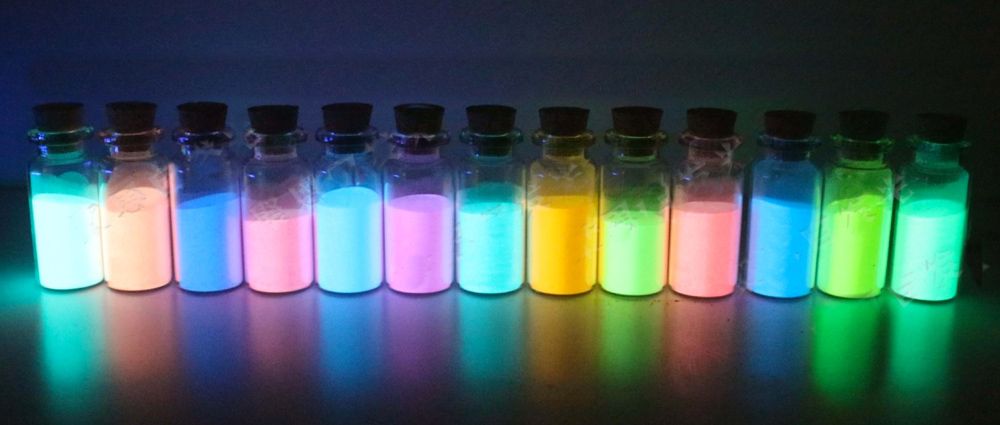
There are various colours of the pigments in a range of red, green and blue.
Glow-in-the-dark applications
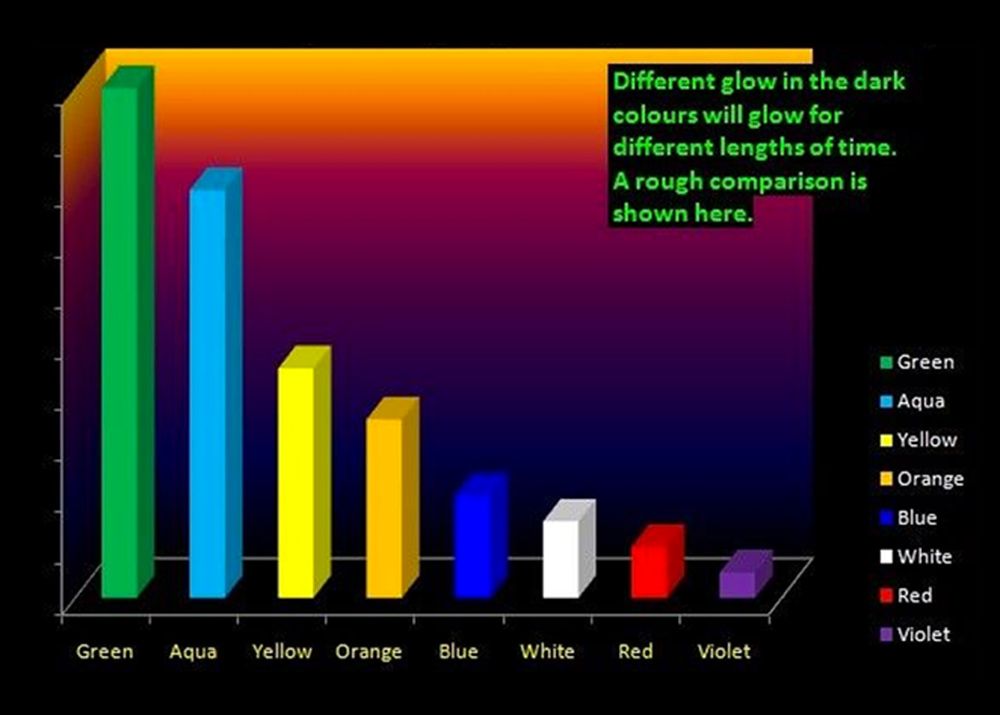
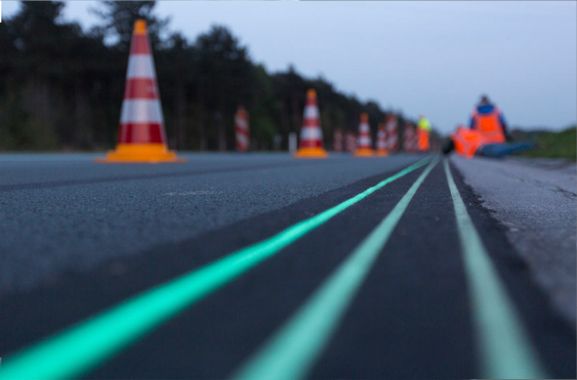
This graph shows the different coloured pigments and the time they emit light. It clearly shows that the green phosphorescent pigment has the slowest decay. What the graph does not show is the luminance of the individual colours. After testing the green pigment also has the most luminous appearance. This research informed the choice of materials in ‘Palinopsia’. Commercially glow-in-the-dark is used to reduce the frightening darkness in children’s bedrooms. In the Netherlands glow-in- the-dark pigment is used on Smart highways to enhance road safety.
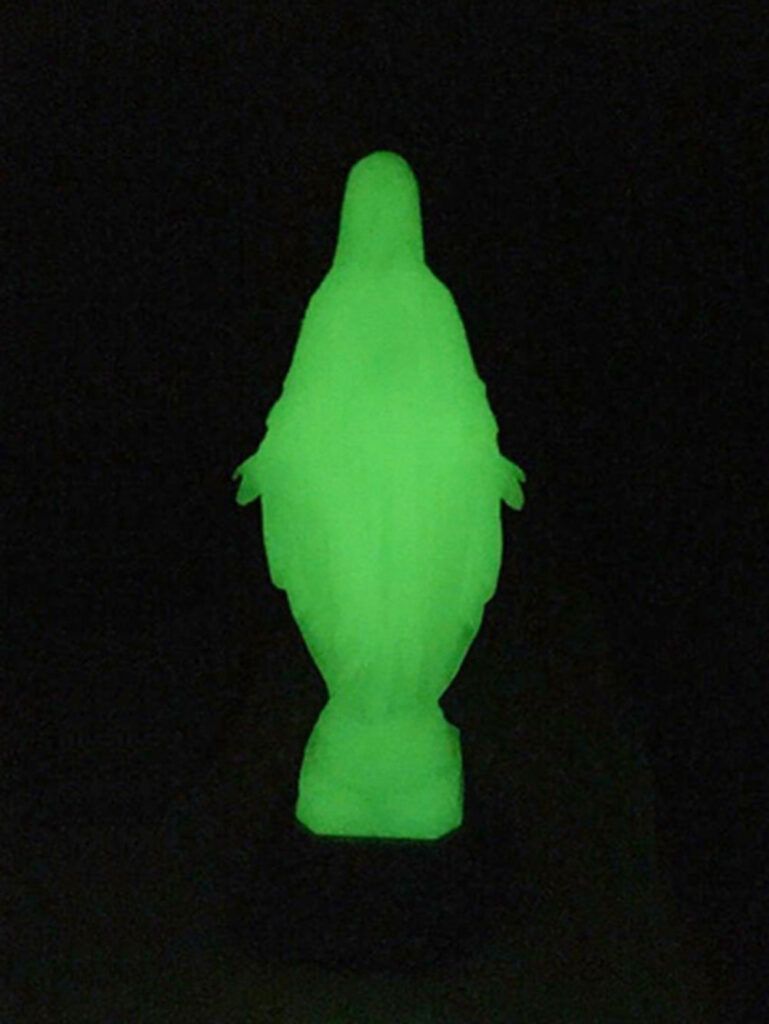
As with the Maria statues of my aunt Maria, the pigment can also be engineered to bind to a plastic polymer where it has similar properties to the painted application.
Apart from an application to enhance enchanted religious experiences, the phosphorescent pigment is also employed in far less mystical applications. Nevertheless, I can state that applying phosphorescence in any way always has a level of incantation. Glow-in-the-dark strips on the side of a stairway for instance, functioning as a low-location safety guidance systems, can also display a mesmerising Tron-like visual experience. Tron (2010)
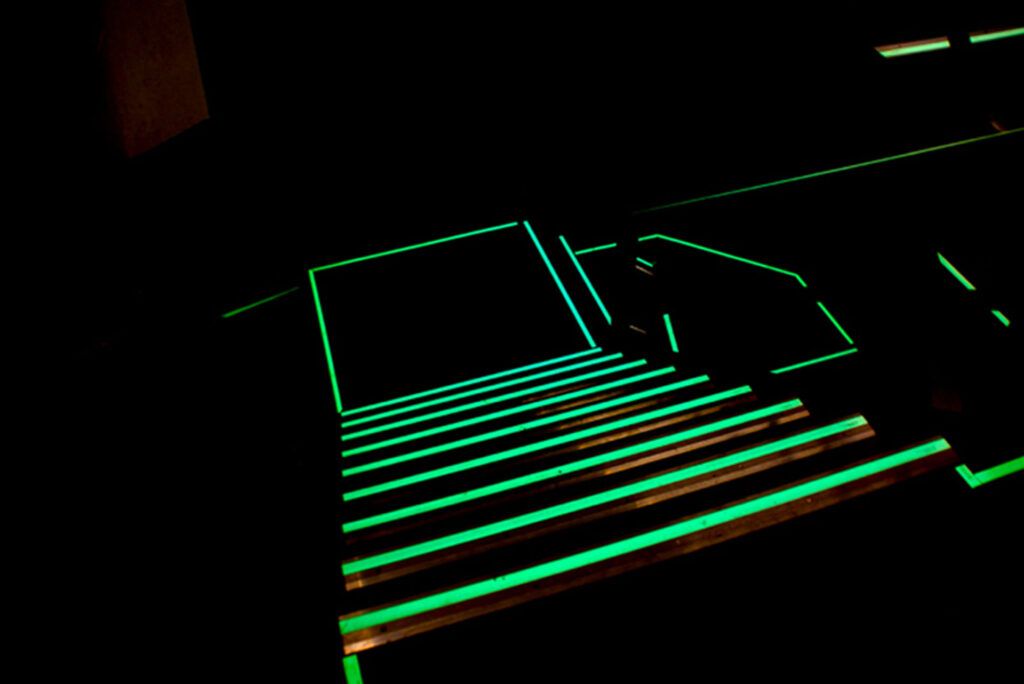
The futuristic aesthetic property of the material has resulted in applications in fashion and since a long time, it has been used in the entertainment industry to liven up rave parties and games.
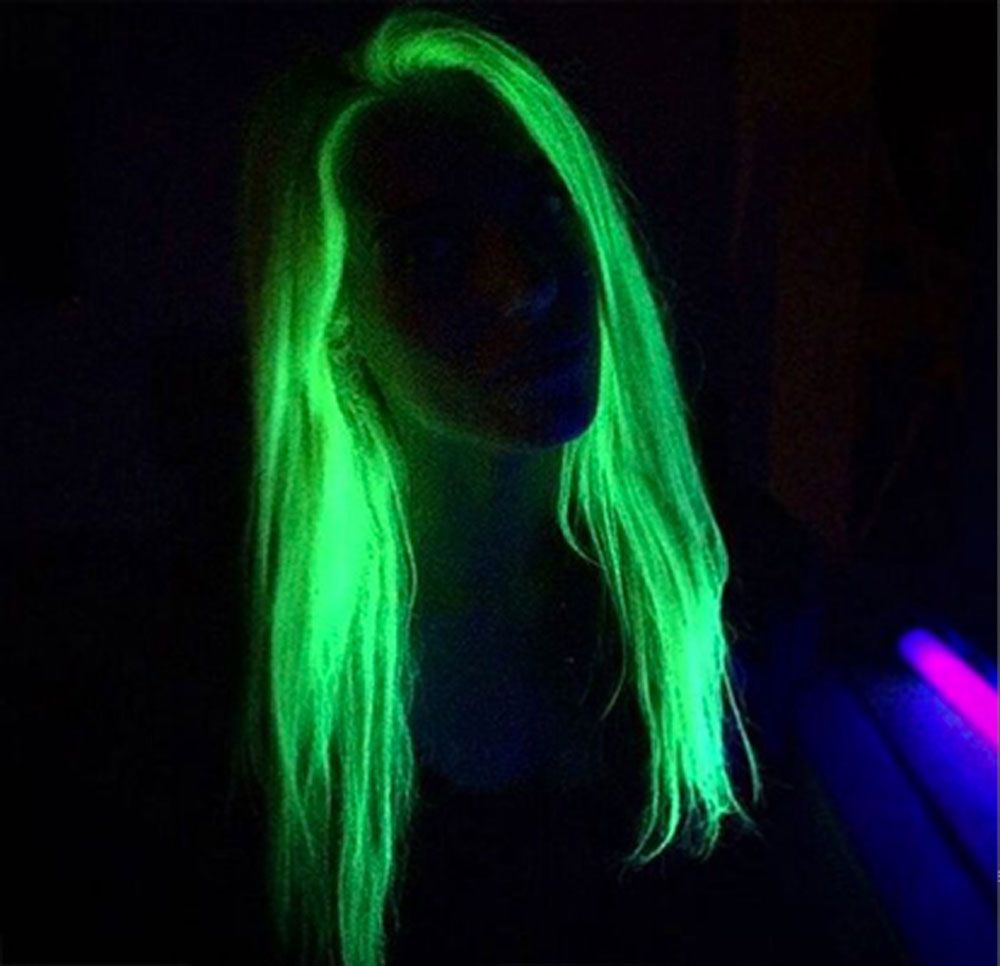
It has been applied to colour hair. It has become obvious that since the usage of radioactive radium in diving watches and alarm clocks much has changed in the composition of the phosphorescent materials. In 1993 I was still warned to not inhale or touch the material.
Bioluminescence: living light
The origin of our enchanted fascination with glow in the dark lies to some degree in the occurrence of bioluminescence in nature. The attraction or repellency of the spellbinding green light in both animal and plant life has great significance and consequences in nature. According to Tim Kahlke ad Kate D. L. Umbers: ‘Bioluminescence is the emission of light by an organism as a result of a biochemical reaction. Even though the effect is the same; in contrast to fluorescence and phosphorescence, bioluminescent reactions do not require the initial absorption of sunlight or other electromagnetic radiation by a molecule or pigment to emit light. Bioluminescent systems produce light through the oxygenation of a substrate, generically called luciferin (lat. Lucifer, the light-bringer), and an enzyme, luciferase.'[8]Current Biology, Volume 26, Issue 8, 25 April 2016, Pages R313-R314. sciencedirect
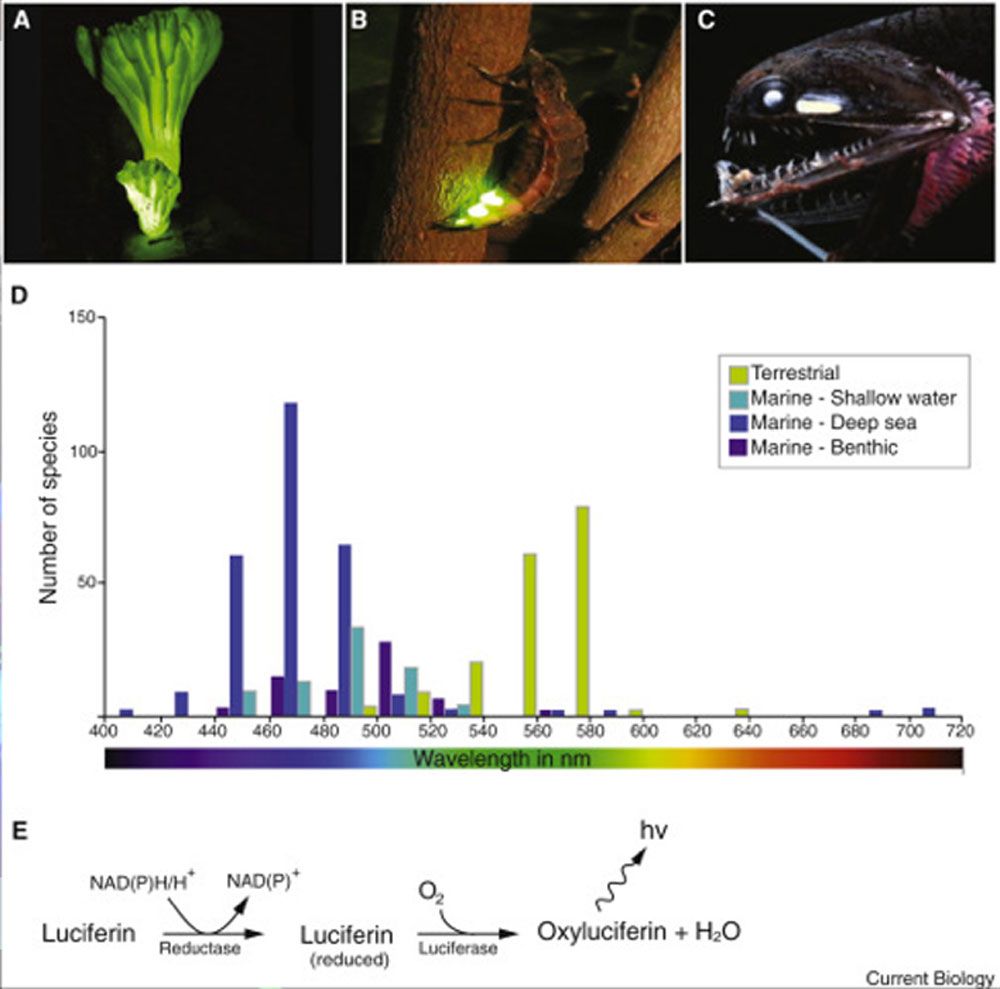
Procreation
The emission of light by living organisms has various purposes. It could function to attract other organisms for the objective of mating as described in: Courtship, Mating, and Organisation of the Pronotum in the Glowspot Cockroach Lucihormetica verrucosa (Brunner von Wattenwyl, 1865) (Blattodea: Blaberidae)
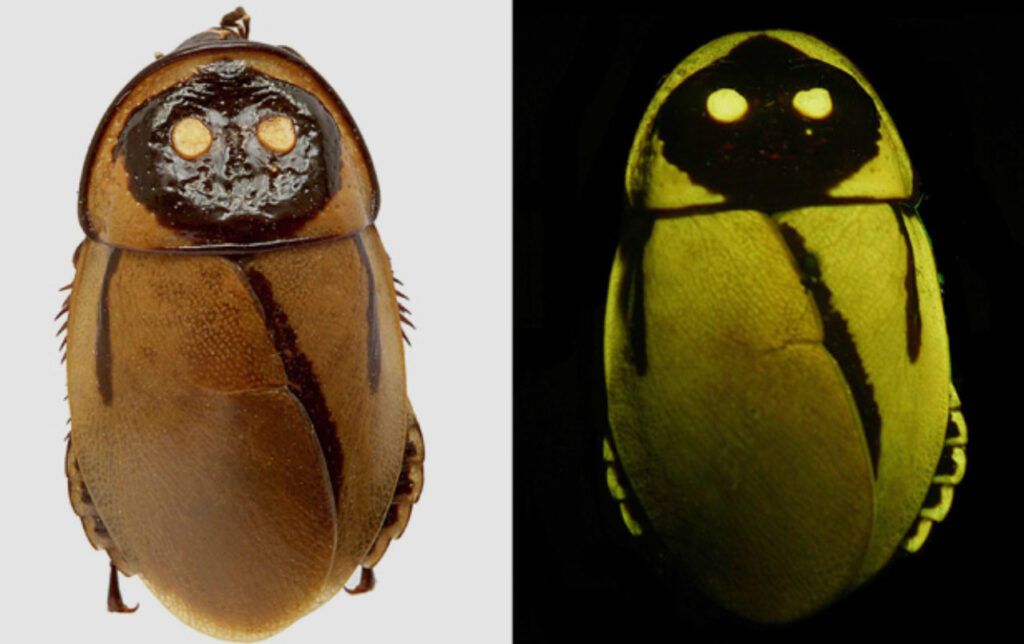
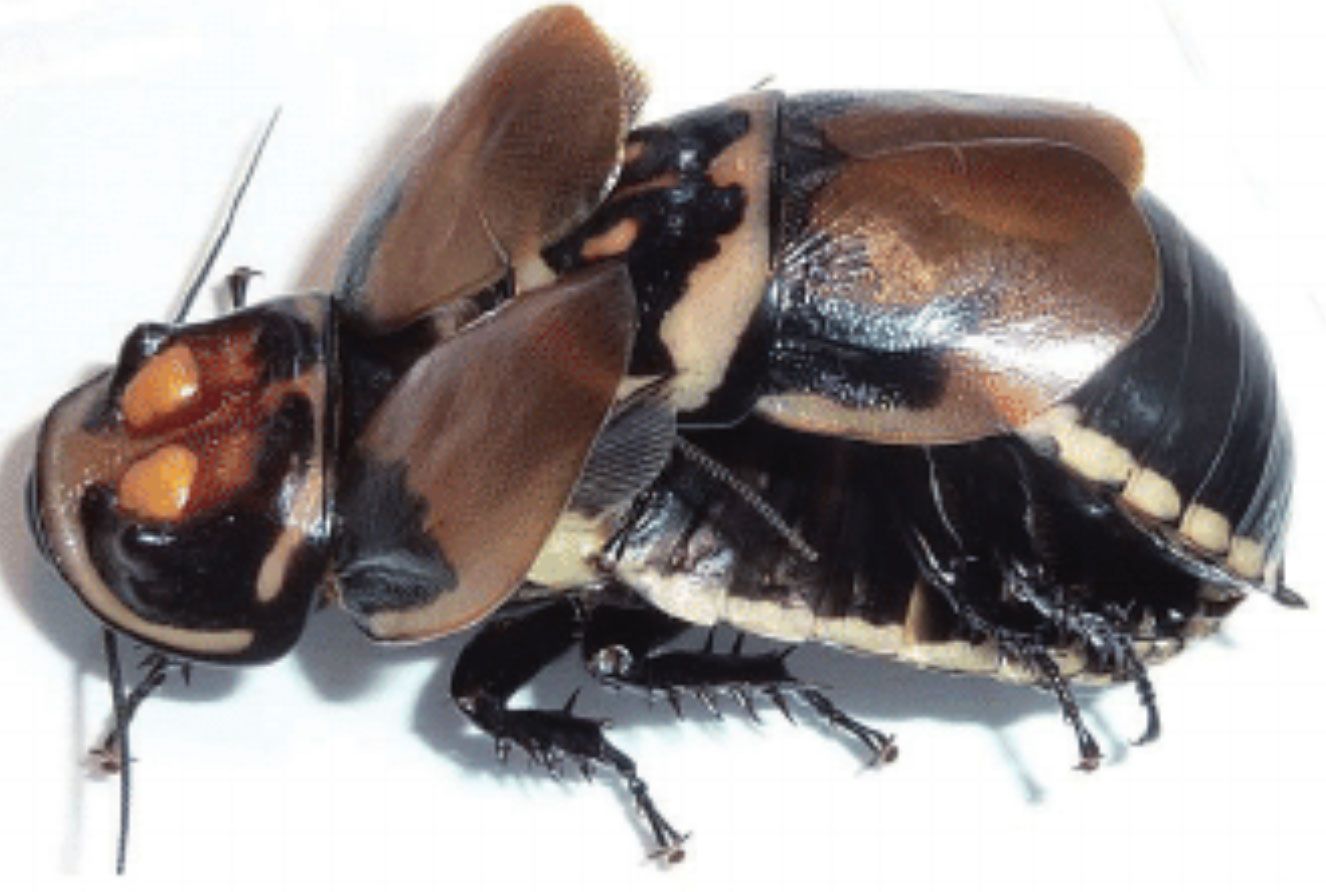
Camouflage
As counter illumination or camouflage as seen with the Firefly squid. When seen from below by a predator, the bioluminescence helps to match the squid’s brightness and colour to the sea surface above.
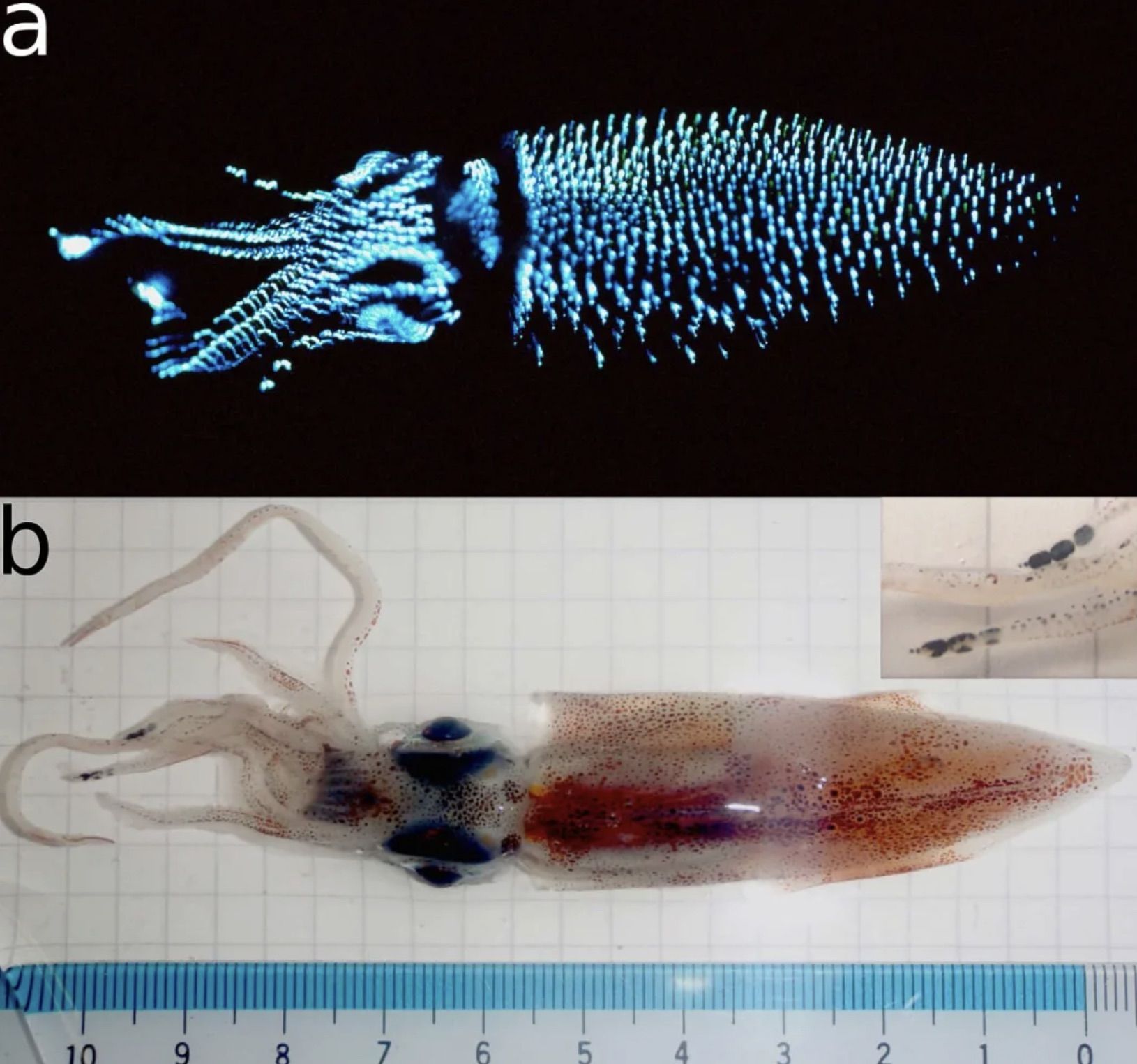
Defence
In case of the railroad worms, their light emissions are believed to be a warning-signal as an unpalatability to their nocturnal predators.
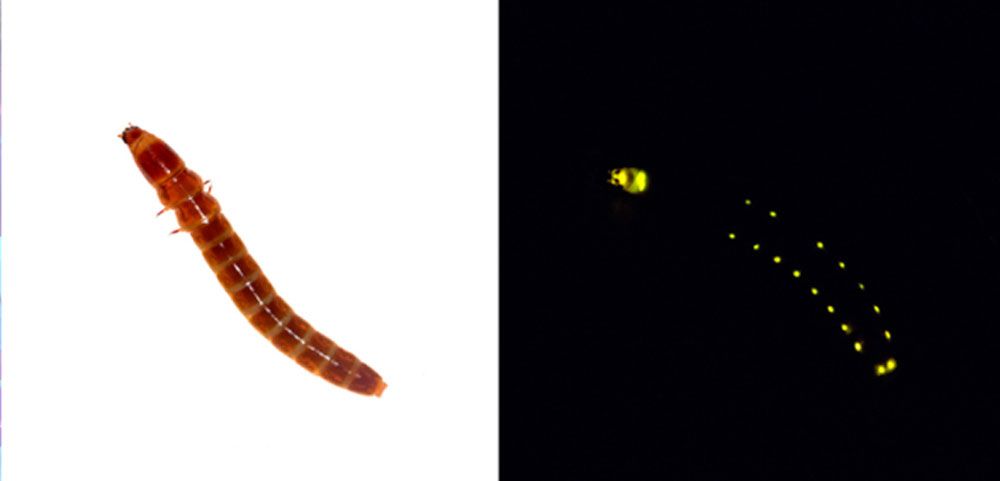
Warning
Various species of animals display warning signs when they encounter their natural enemies. Latia Neritoides (bioluminescent limpet)
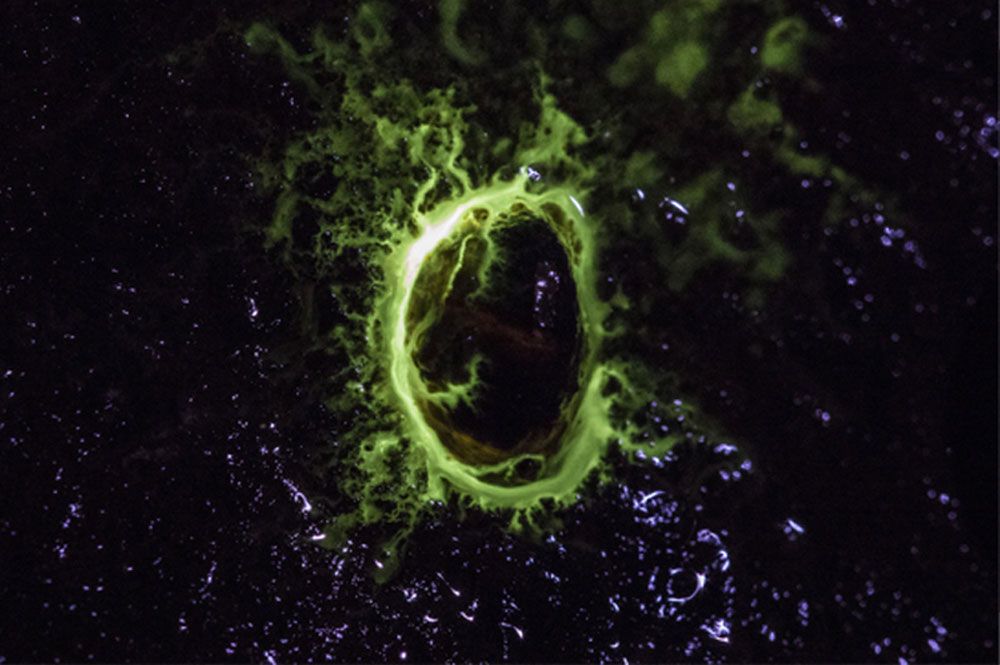
Communication and Mimicry
A range of bacteria communicates via secretion of light producing molecules to communicate that their genes for light production when cell density, measured by the concentration of the secreted molecules, is high. Certain deep-sea fish make use of aggressive mimicry to attack their prey.
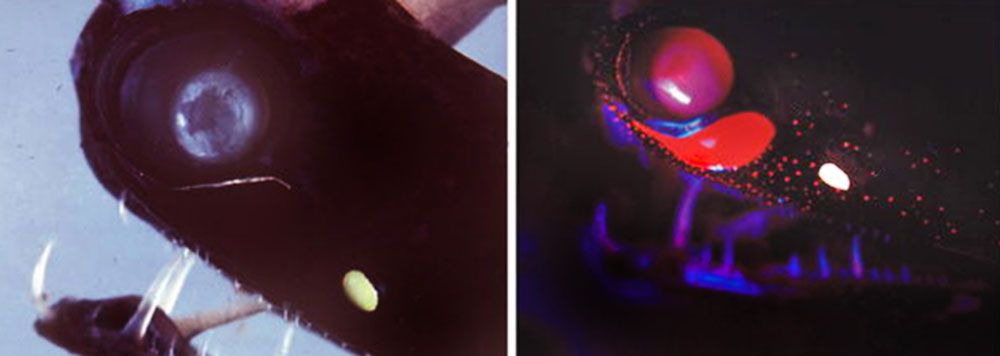
Illumination
The barbeled dragon fish (Malacosteus niger) is one of the few animals that emits a red glow instead of the more common emittance of a blue or green glow in order to see red-pigmented prey, which is normally invisible in the deep ocean environment where red light has been filtered out by the water column.
Much like in nature, we as humans are sometimes attracted but mostly repelled by dark ambiguities.
Commercial and environmental applications
The French startup ‘Glowee’ founded by designer Sandra Rey is trying to harness the power of bioluminescence the create bioluminescent lighting that could save electricity to, for example, illuminate cities at night. In an article in Wired Magazine she says: “Many marine organisms have the ability to create light without electricity,”. “Jellyfish, squid…even algae.” To get that natural resource out of the ocean, Rey’s Paris-based startup Glowee makes lights filled with genetically modified bio-luminescent bacteria. Now, the Glowee initiator wants their soft green glow to illuminate city streets. “Nature is a perfectly clean factory,” she says. “We could change the way we consume and lower light pollution.”
Each bioluminescent bulb is a transparent shell containing a combination of nutrients and oxygen: this supports E.coli bacteria, which Glowee’s 15-person team alters genetically, inserting bioluminescent genes found in a Hawaiian bobtail squid. “We make the light more intense by coding their DNA,” explains Rey.[9]Wired magazine April 2017 glowee
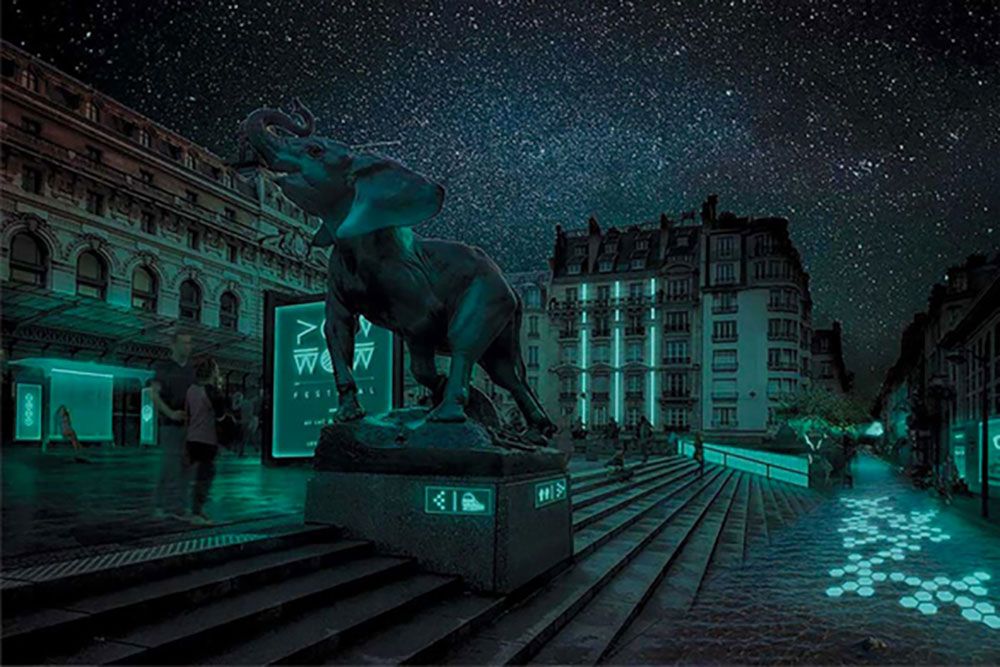
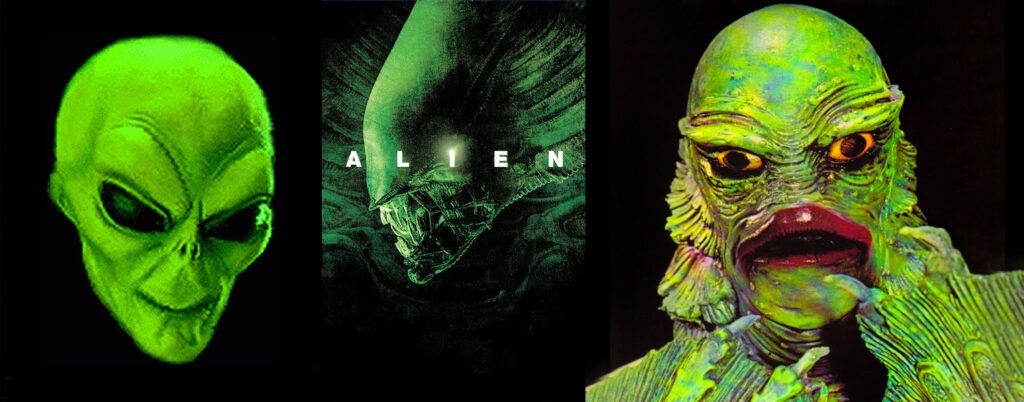
Perhaps our attraction to glow-in-the-dark and the ambiguous green glow is also connected to our wish to explore the boundaries of the universe, the galaxies themselves surely have a visual relationship to the green ambiguity of glow in the dark. For example, aliens are often portrayed as green glowing entities.
HOW?
Intuitively, and due to the untried nature of the medium, I am confident that the various developments and iterations of working with laser on glow-in-the-dark surfaces can be explored for a number of years.
In what follows, I will explain the process in detail on how the research into the new medium evolved from straightforward video projection to laser projection onto a glow-in-the-dark prepared surface. The projection method is distance independent, there could be focus on a nearby object, but also on the faraway object. So, one is not confined to projecting on a flat surface, and could possibly project on three-dimensional objects in a space, as long as the surface is more or less parallel to the laser. Otherwise, slanted projections with a lower phosphorescent excitement would occur. I will explain this in the next paragraph.
From video to Laser
Amsterdam, 2015
In Amsterdam, I worked in the lab space of BeamSystems, and in particular with my friend Jozef Hey who owns a company that specialises in audiovisual equipment and works predominantly with artists to create and facilitate art-installations. I was able to work at BeamSystems and use their lab space during my sabbatical period in 2015. I could use their high-end Panasonic video laser projector. This projector had nothing to do with laser, it was just a high-end video projector that uses a lamp that has a very long lifespan. I was able to test the pigment and after-glow characteristics like image detail, resolution, luminosity and persistence of the projected image. My initial idea was to work with video projectors of 5000 ANSI-lumen and higher. And I found out, that it is possible to project images with a strong video projector, but there are a substantial disadvantages working with a video projector as opposed to working with laser:
1 The light intensity of laser projection is much higher. This means it takes less time to excite the phosphorescent pigment.
2 A laser beam is far more focused, and it is practically indifferent to stay in sharp focus over the projection distance. Unlike a video projector, which has a specific resolution, intensity and dimensions depending on the lens and the distance. The video projected light has a much larger fall-off then a laser projector. The widening of the laser beam projection is approximately +1 mm per 5 meters of increased projection distance. And it is possible to reduce this divergence of the laser beam by using optics.
3 With laser the image is written line by line or randomly pixel by pixel with small dots until the image is complete. With video, the image is fully projected at once, which takes away the surprise of what the image will become.
4 With the right UV colour frequency of the laser beam, you can hide the actual light (laser) beam that is thrown on the projection surface. Like this it seems that the light is emerging directly from the screen. This was a particular comment I received during their Fak’ ugesi event. In the first instance, some of the audience did not understand how the image was produced.
5 A laser projector uses a relatively small amount of
energy, the laser beam itself is 2000 Milliwatts (2W) or less, and for the rest, the galvo-scanner mirrors need to be powered. This in itself is a huge advantage as this would enable the device to be solar- powered as it only needs approximately 100 Watts. An outdoor laser covering a large glow-in-the-dark painted wall might need to be a bit more powerful, but even then the running power consumption is relatively very low.
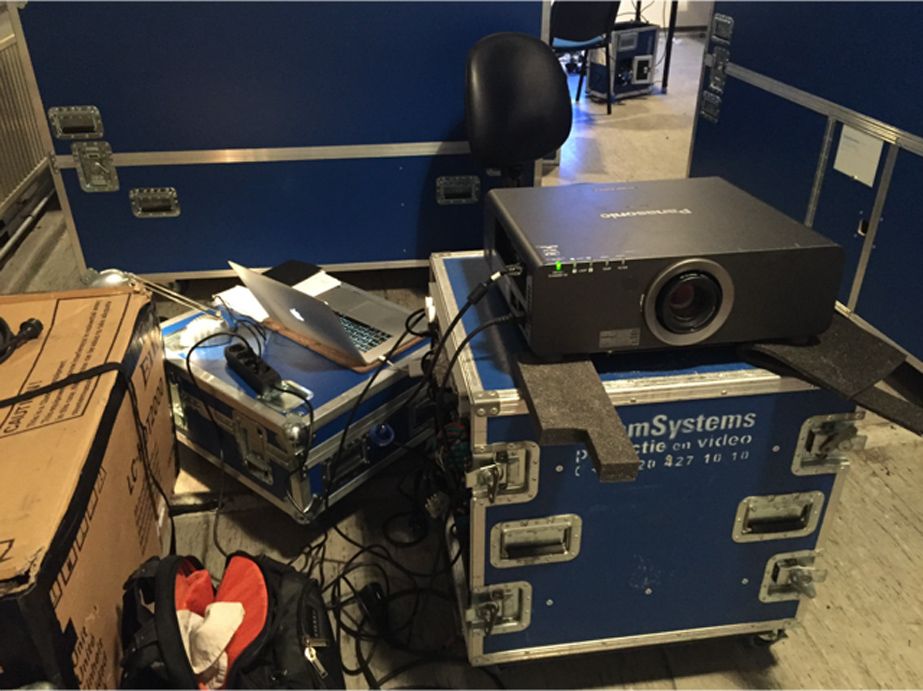
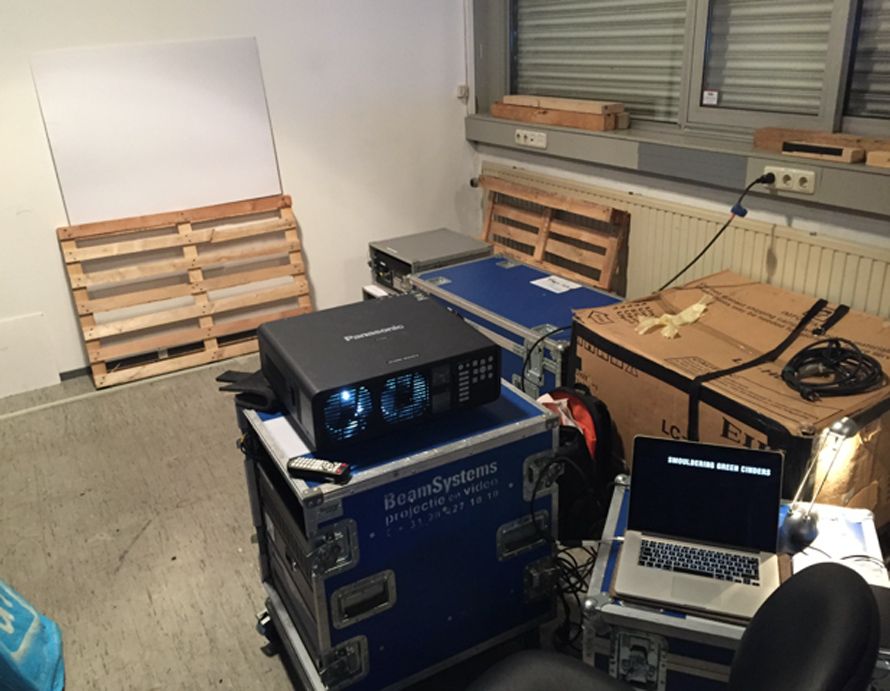
As a result of this low power consumption, one of the ideas that came to mind is to make self-contained laser projectors on glow-in-the-dark surfaces. This could be used for artistic utterances but also commercial purposes like advertising.
The two conditions for the projection to be successful are that the projected surface has to be in a dark area with visibility for an audience and where the light pollution is as little as possible and the projection beams have to be fully out of reach from human eye and skin contact and even if the beam is terminated on an opposite wall. There are aviation regulations to be taken into consideration. The process of trying out the video projector at the BeamSystems gave a better idea how to continue with the project. The tests gave a good indication what worked and what did not work.
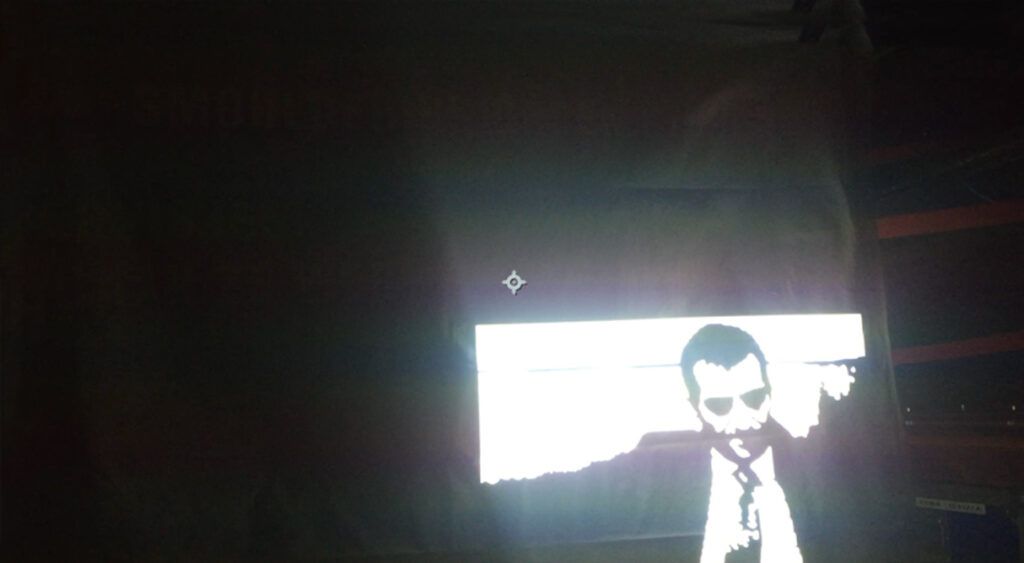
During my field trip to Amsterdam, I decided to continue with laser as a light source. I tried various colours of laser light on a small prepared surface that was fully painted with phosphorescent paint. Both green and red laser did not excite the phosphorescent paint at all. White light was exciting the material which was an indication that another light frequency was exiting the pigment. Projection-test on YouTube
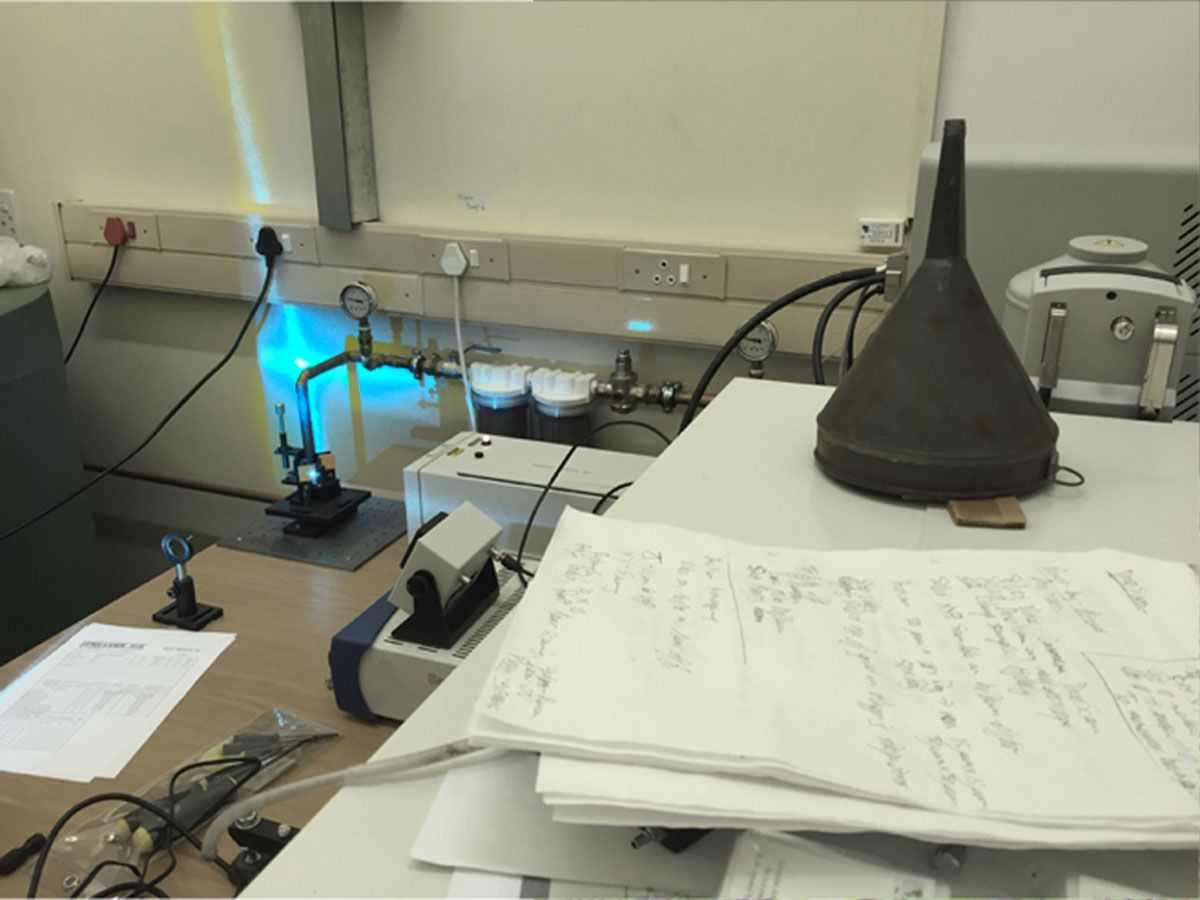
Wits Physics Department: Prof. Rudolph Erasmus
Coming back from Holland I contacted Prof. Rudolph Erasmus, who after my decision to work with laser, kindly assisted me with testing the ideal light frequency to excite the phosphorescent material I had. The department’s argon (gas) laser was able to change the colour temperature with small increments. Here it became clear that a blue-ish violet light frequency had the best results. Laser is an acronym that Stands for Light Amplification by Stimulated Emission of Radiation and was invented by Theodore Harold Maiman in 1960.
Glow in the dark painted surfaces emit light through the following processes. For the excitement of the phosphorescent pigment, one needs the light to be of a specific colour temperature or one can use white light (the additive combination of all visible light frequencies that are representative for human perception). The green glow-in-the-dark coloured pigment, that is most common and has the most intense excitement, absorbs light optimally when excited by light in the blue to violet spectrum (400nm – 500nm). The ideal and central wavelength or central spectral bandwidth is the ideal colour to excite the phosphorescent material. We discovered for this specific type of paint. That would be around 405nm.
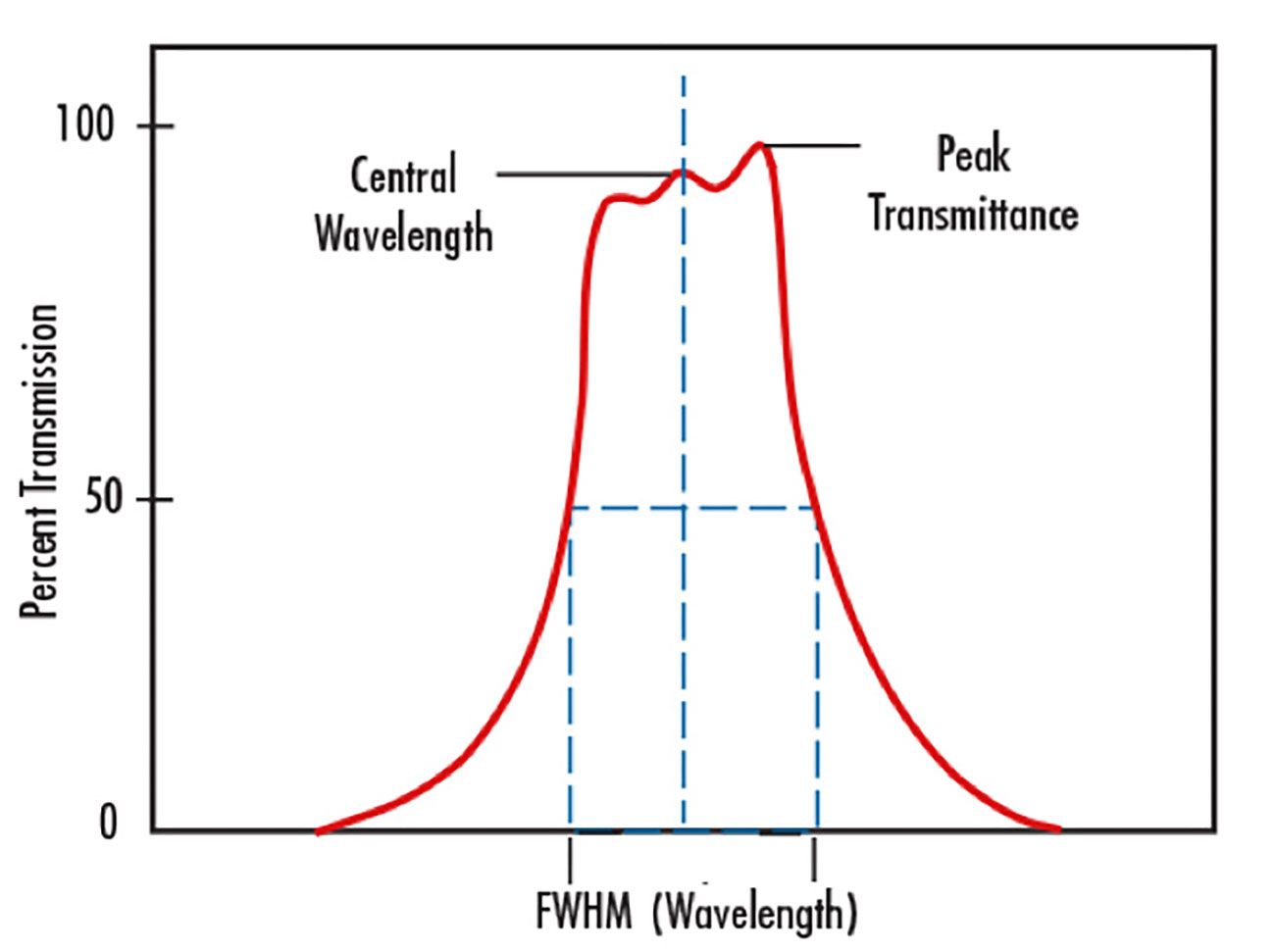
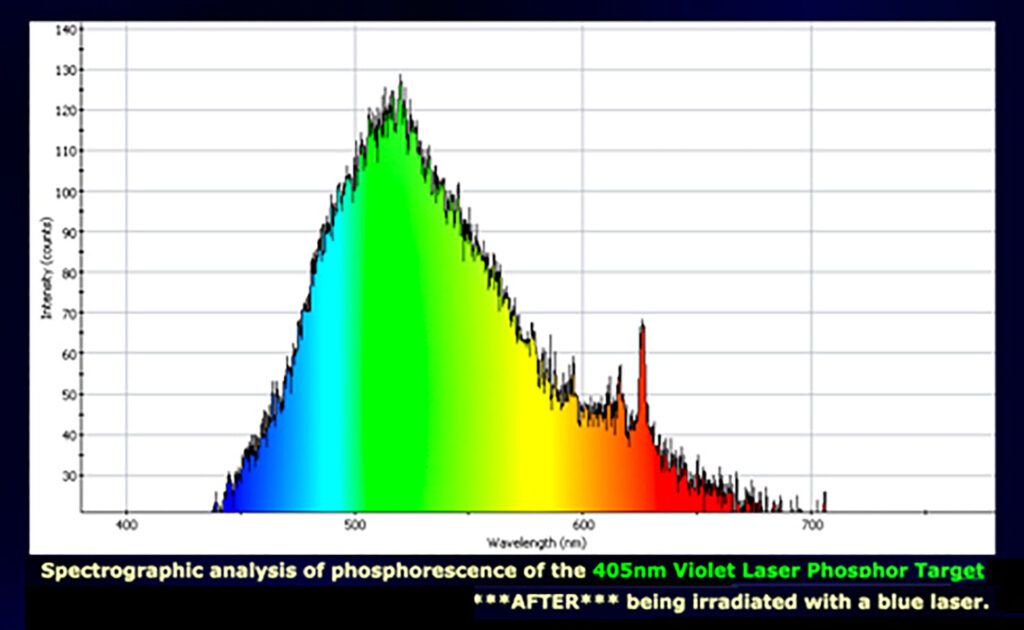
Spectrograph of green GITD (Glow in the dark) material after it’s been irradiated with blue laser light. The graph underneath is somewhat misleading is it doesn’t depict the ideal wavelength for optimal excitation and emission.
BushveldLabs Engineers
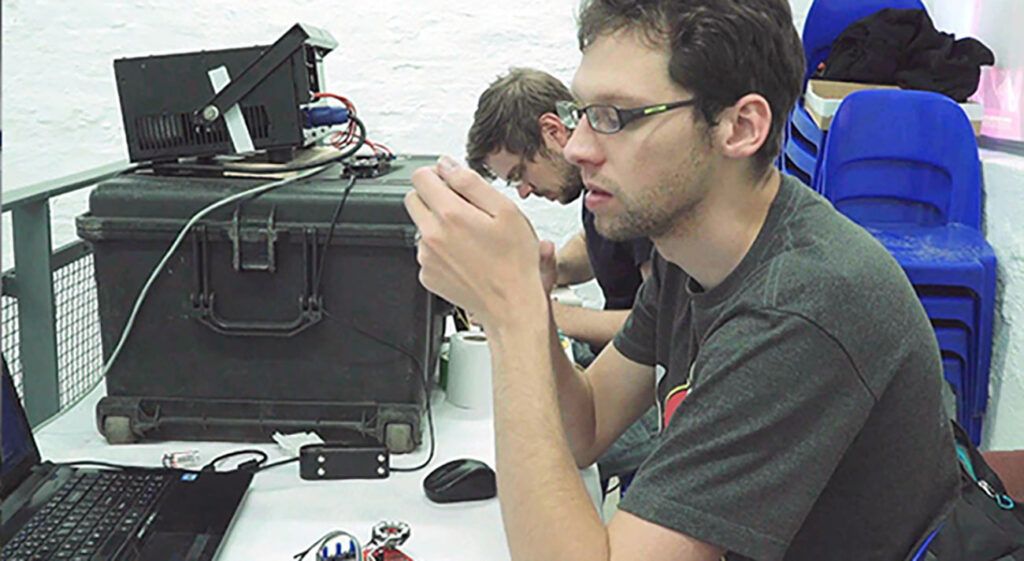
Being advised by colleagues from digital arts at Wits University, I was suggested to contact BushveldLabs engineers, Daniel de Kock and Jarryd Bekker (Wits alumni). They specialise in electronic software and hardware engineering and a huge bonus was that they had experience with lasers. Throughout the research process, they have been absolutely instrumental in collaborating, thinking through, advising and assisting not only in the direct science and limitations that involves this complicated technique but also considering the creative options one has to work with. Without them, this project would have been very different. They generously invested numerous hours in programming and building the hardware. After our initial conversations, we soon discovered that the project required some funding as the materials to build the hardware can be costly. The initial idea was to build our own laser projector. But it soon became clear that at this stage this was very difficult and expensive to get all the materials together for the device.
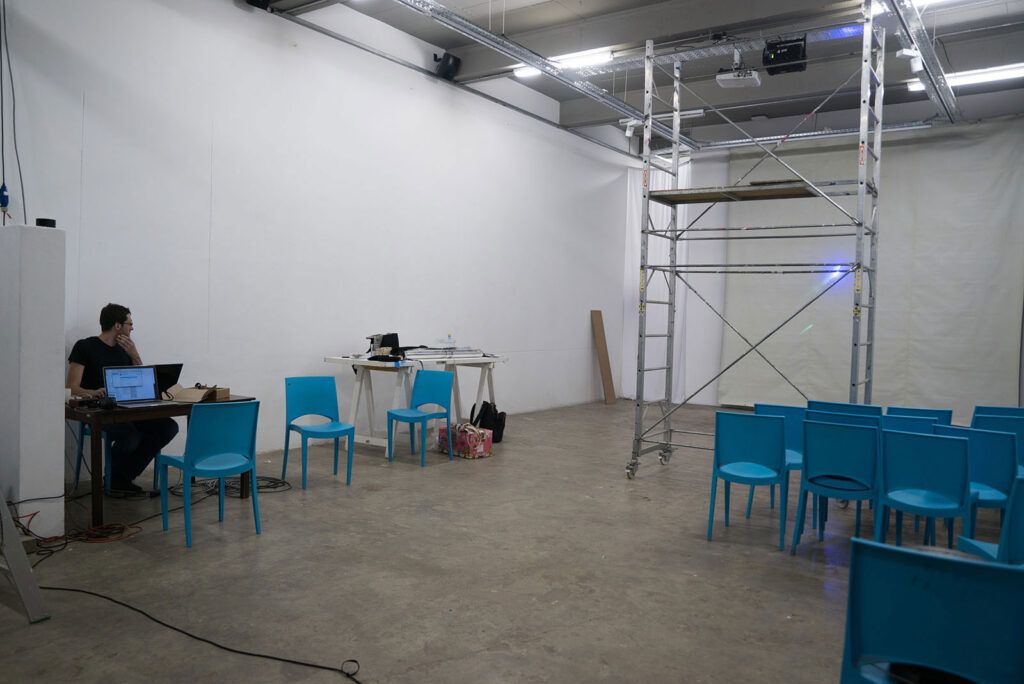
Amsterdam light Festival proposal submission 2016
In order to get funding to do more research and continue the more in-depth work, thought and development of glow-in-the-dark projection I submitted a proposal to the Amsterdam Light Festival in 2016. The theme in 2016 was ‘a view on Amsterdam.’ The proposal was well received and I made it into the final round of applicants. Unfortunately, according to the organisers, the work was not chosen in the final round, due to a difficulty in placing the work. There were limited available locations that would have the necessary spatial characteristics the work needed and would consider the audiences ultimate safety of not being in contact with a high powered laser.
Underneath the final proposal:
THE VISITOR EXPERIENCE
The visitor will be entertained by the magical, near -spiritual glowing green light that radiates from the projected surfaces. Randomly positioned texts and images appear on the house shaped planes to allow the previously projected images to die out. An image texture also now and then covers the surface fully and the randomised combinations of text and images will entice a poetic changing layered meaning that raises contemplation. Included in the concept is an interactive layer, where the audience can directly interact with the work by uploading text, which is however moderated.
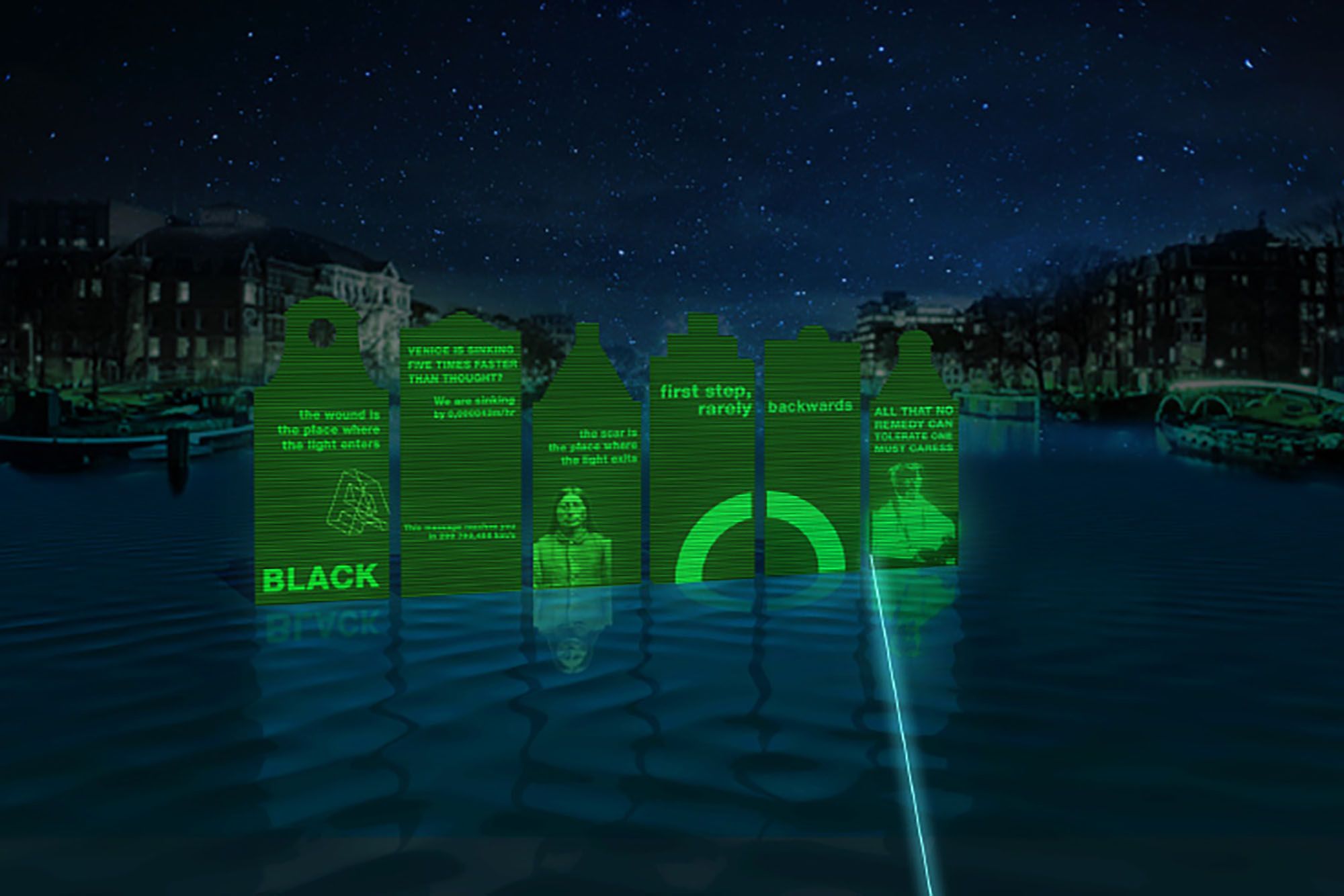
ANSWER TO THE BRIEF, … WATERCOLOURS
Amsterdam is a very fast growing metropole and expanding like many major cities on the planet. With its long history is and physical beauty we need to take care of it. With significant text and images that encourage the audience to interpret freely, I will incite humorous connotations next to more serious nuances, calling for taking care of the city and its heritage. I also want to combine Amsterdam humour that the ‘Amsterdammer’ is well known for with serious aspects of where we are heading with the increase of world population and rising water levels that are becoming a serious threat for countries with a shoreline. I will show portraits of the important historical figures that have made the city the way it is. I would preferably place the work in the water to illustrate the danger of the rising water. And the benefits of the water reflection.
THE TECHNICAL PRINCIPLE
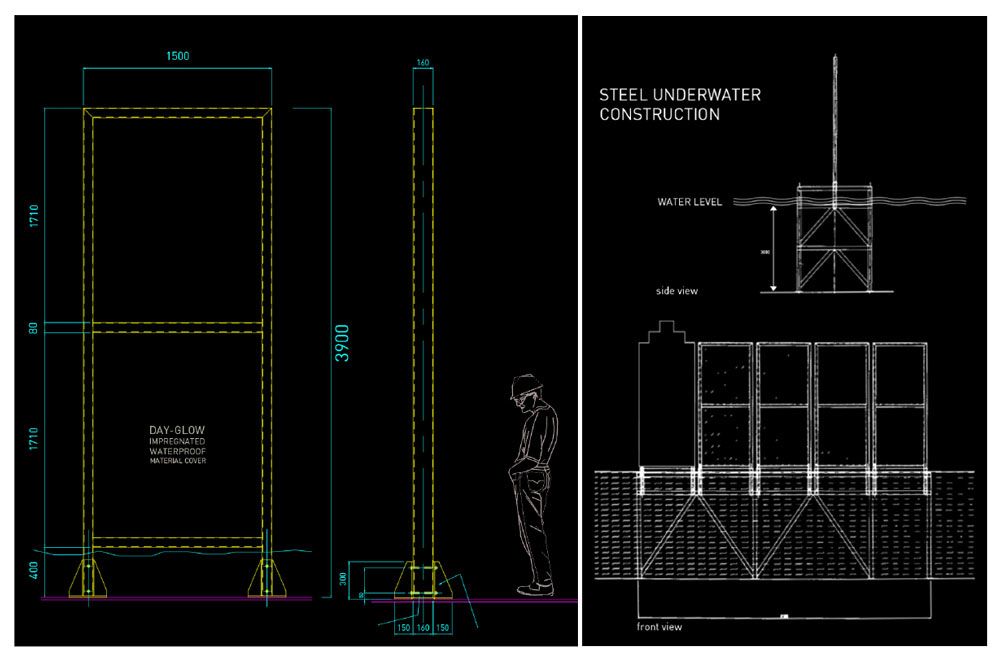
The laser projector and panels are both to be positioned on a sturdy base, 3-meter max. to avoid movement and therefore misalignment of the mapped projection. The day-glow pigment in the paint is specifically sourced to have the maximum excitement in luminance and a minimum duration afterglow to reduce the time for re-projection. With structural engineer James Gardener from Demcotech, we decided to place the work on a submerged steel box structure to ensure stability. The individual frame construction is out of square steel tubing on which the pop riveted projection canvas is mounted.The canvas is an impregnated/painted closed fabric to prohibit light leakage. The custom built laser has a high-end galvo-driven by open source (Processing) software that will allow variable speeds, mapping (OpenGL) onto the panels. Images can overlap, however, this is never accidental, the visual elements are assigned to a grid structure where they are categorised into groups of aspect ratios. To ensure the audience eye and skin safety, a webcam and software can shutter-off the laser when something obstructs the beam. Audience interaction is achieved through an integrated smart app that allows moderated messages to appear real-time on the panels.
Fak’ugesi – 1st iteration
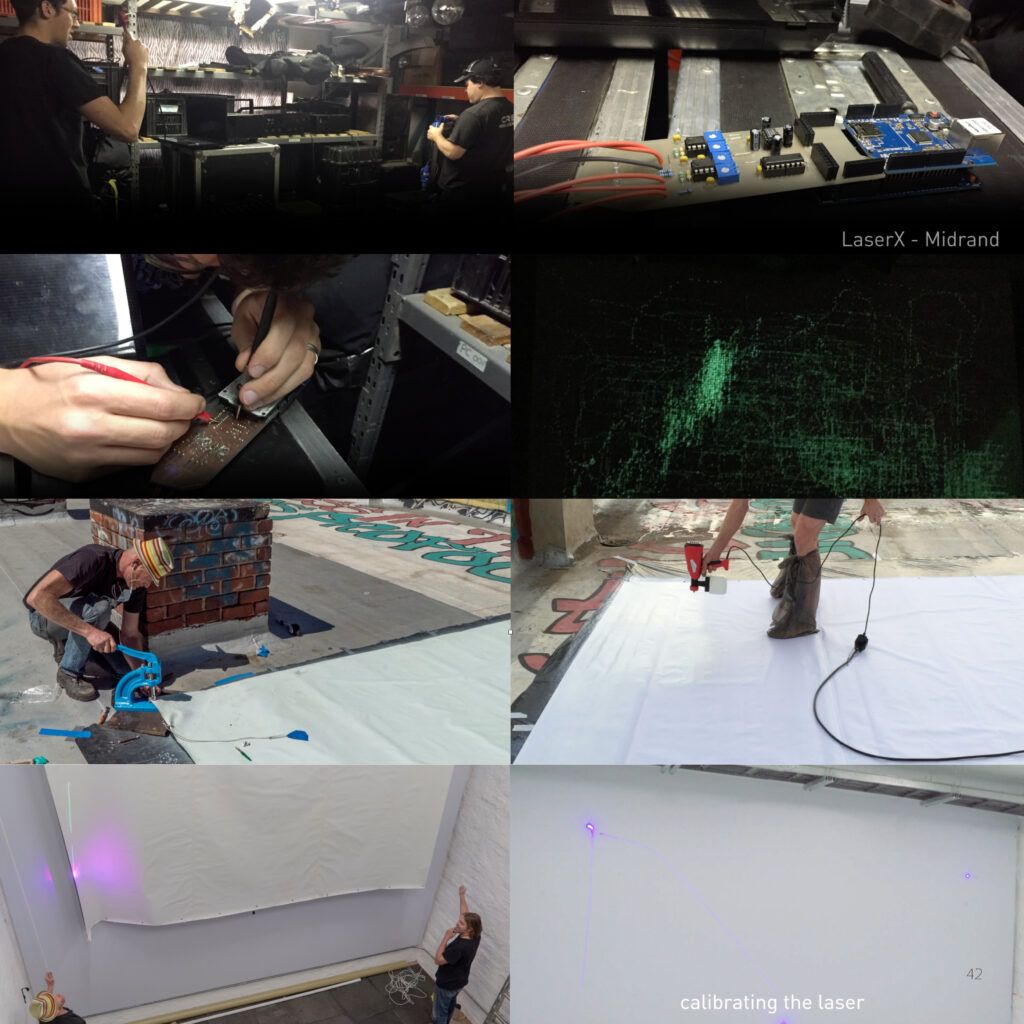
In August 2016, I submitted the work in progress to Tegan Bristow as a work that would run for a one night at the Alight Block Party, which was the last night event/party of the Fak’ugesi Digital Arts festival. The available budget enabled me with valued assistance of Ben Law-Viljoen to fabricate the screen which was a made of seam-welded banner material of 4.10m.x 4.10m and covered it with approximately 5 liters of glow-in-the-dark paint. The paint was applied with a spray gun to ensure an even application of the paint. In this first iteration of the work, I had my first five hours of play time with the laser and the screen. The next time I would be able to use the equipment would be in 2018. I rented the laser projector, that generally is used for laser shows in the entertainment and event industry from the company Laser-X in Midrand, Johannesburg. Troy Bently, the owner of the company, allowed us to test their laser, with the DAC (Digital to Analogue Converter) on a small testing canvas at their facility.
The results were fantastic the afterglow light emission was incredibly intense.
At the Fak’ugesi venue the calibration of the laser was necessary to set out the space to project on. The laser position is defined by the X-Y coordinates that are measured from the top left downwards on the canvas.
This image reveals an example of layering of a glow-in-the-dark projection. Some image elements are nearly faded, and the recently projected elements are still bright. This superimposed spatial layering of the images being supported by their fading is a crucial part of the concept within ‘Palinopsia’.
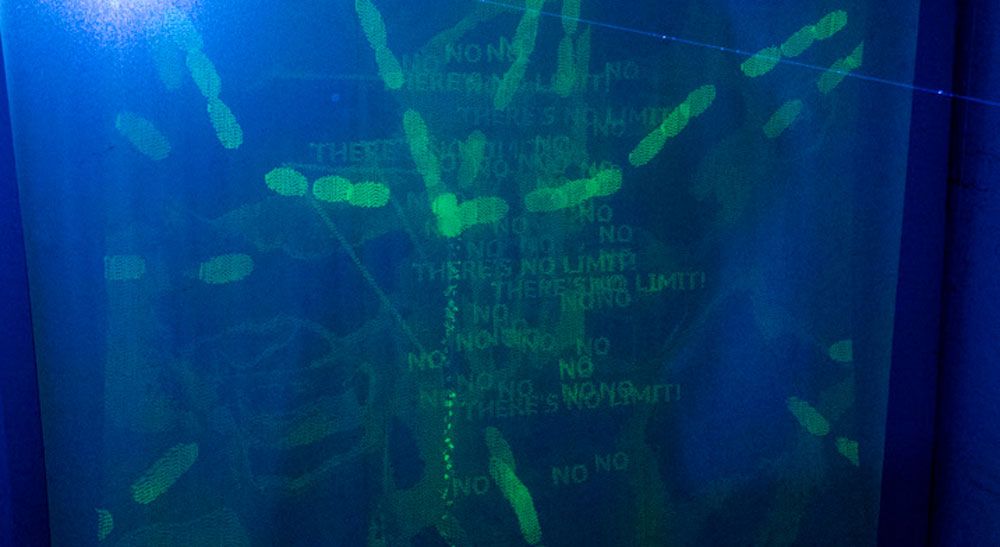
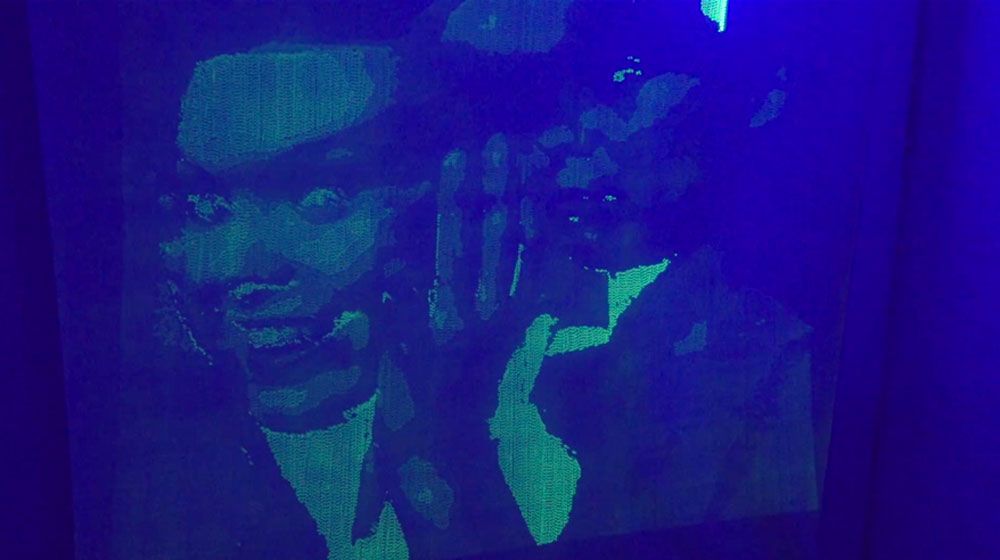
The projected image might convey a certain meaning, but as soon as a new image is being overlaid on the fading one, new meanings emerge out of the combination of images until that image fades and so on. This technique finds its origin in collage, montage, and graphic design.For example in Robert Rauschenberg picture disc.
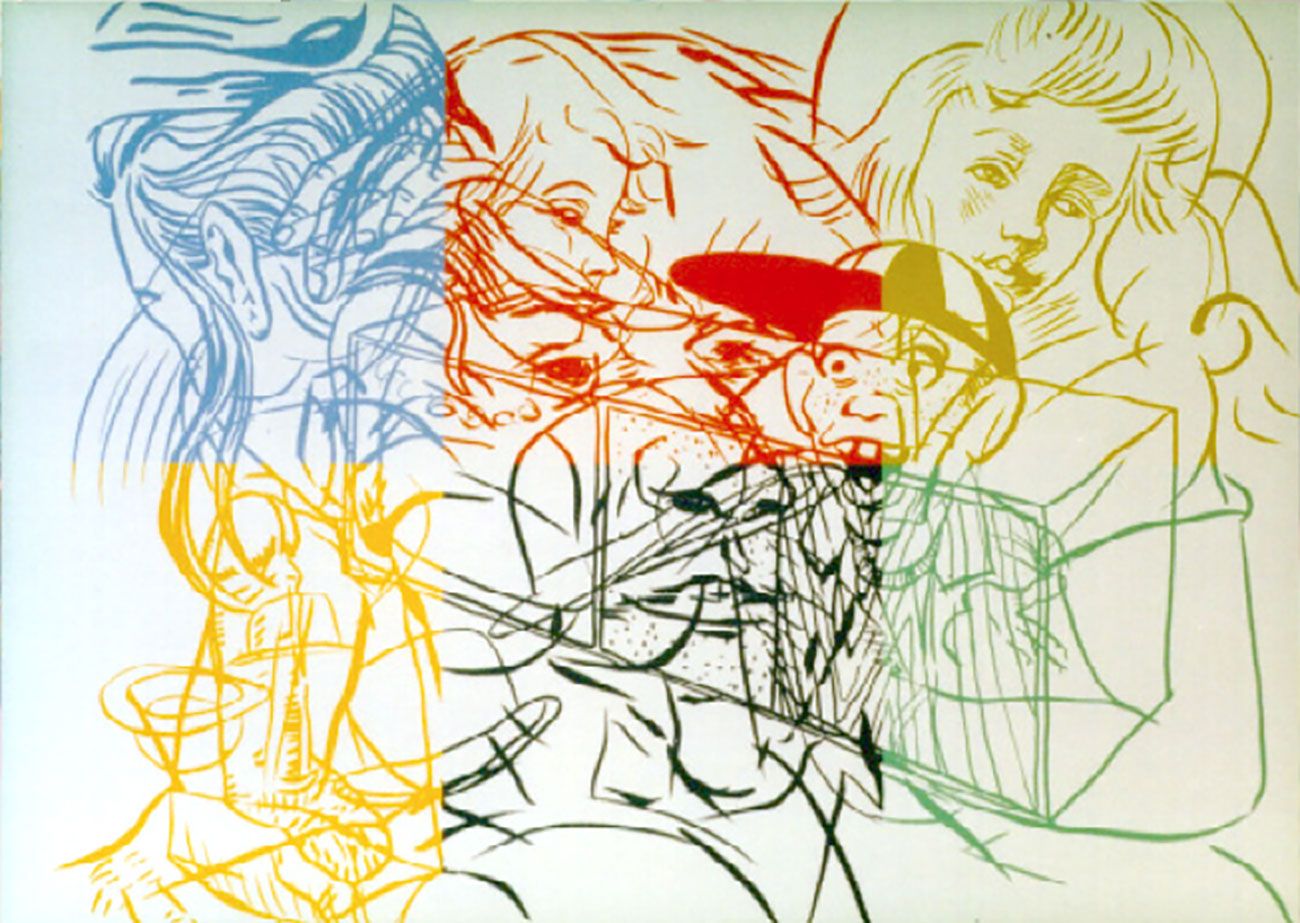
Amongst many others artists pop-art artist Robert Rauschenberg (1925-2008) and neo-expressionist painter David Salle (1952 – ) work with this technique.
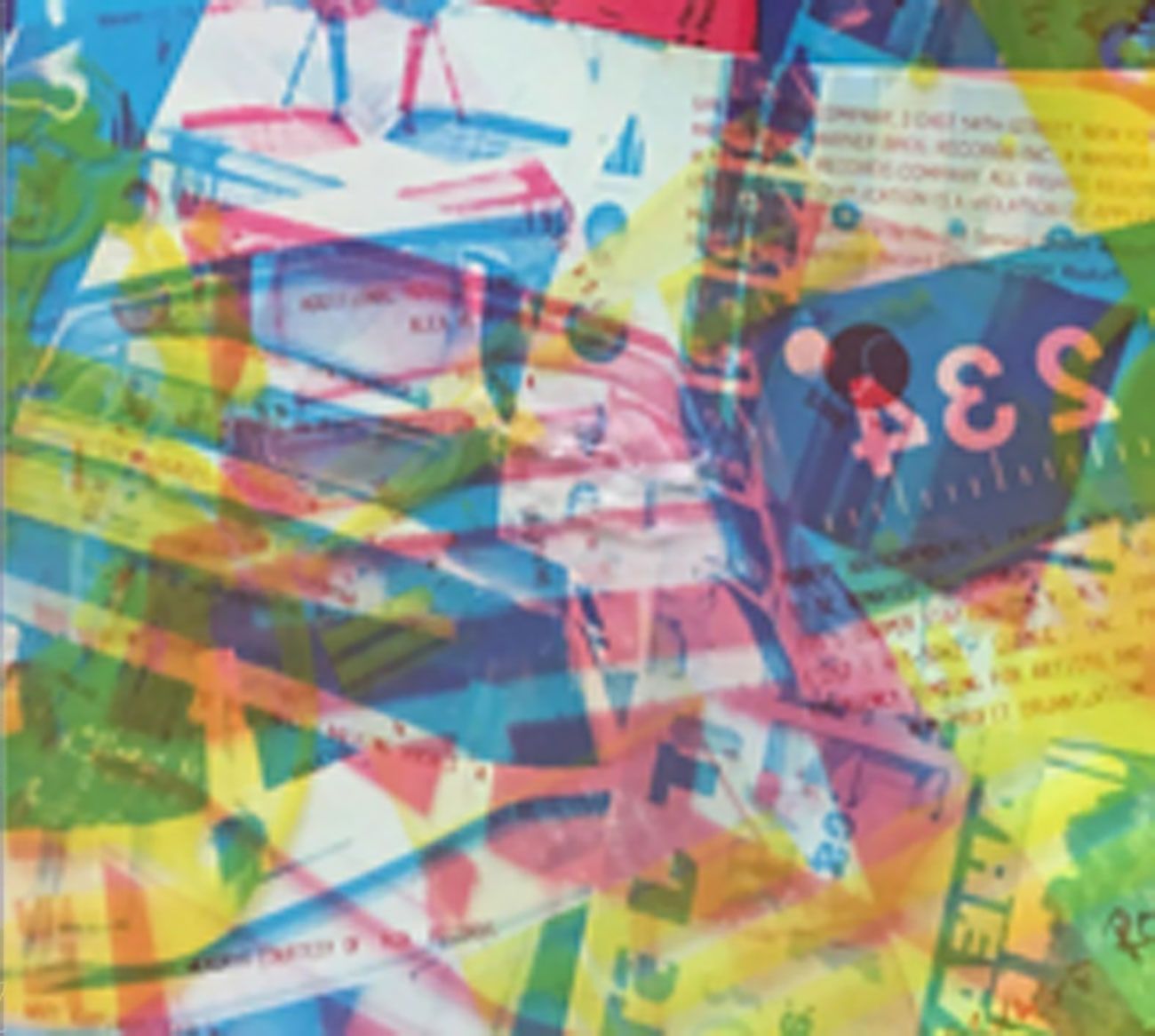
This transparent record sleeve comprises out of three layers of monochrome printed acetate circles. Collages of images are printed in three of the four printing colours: magenta, cyan and yellow. By rotating the individual acetate circles one can try to get a complete full-colour image, which purposefully never works. This is a layering technique that is quite common in the visual arts.
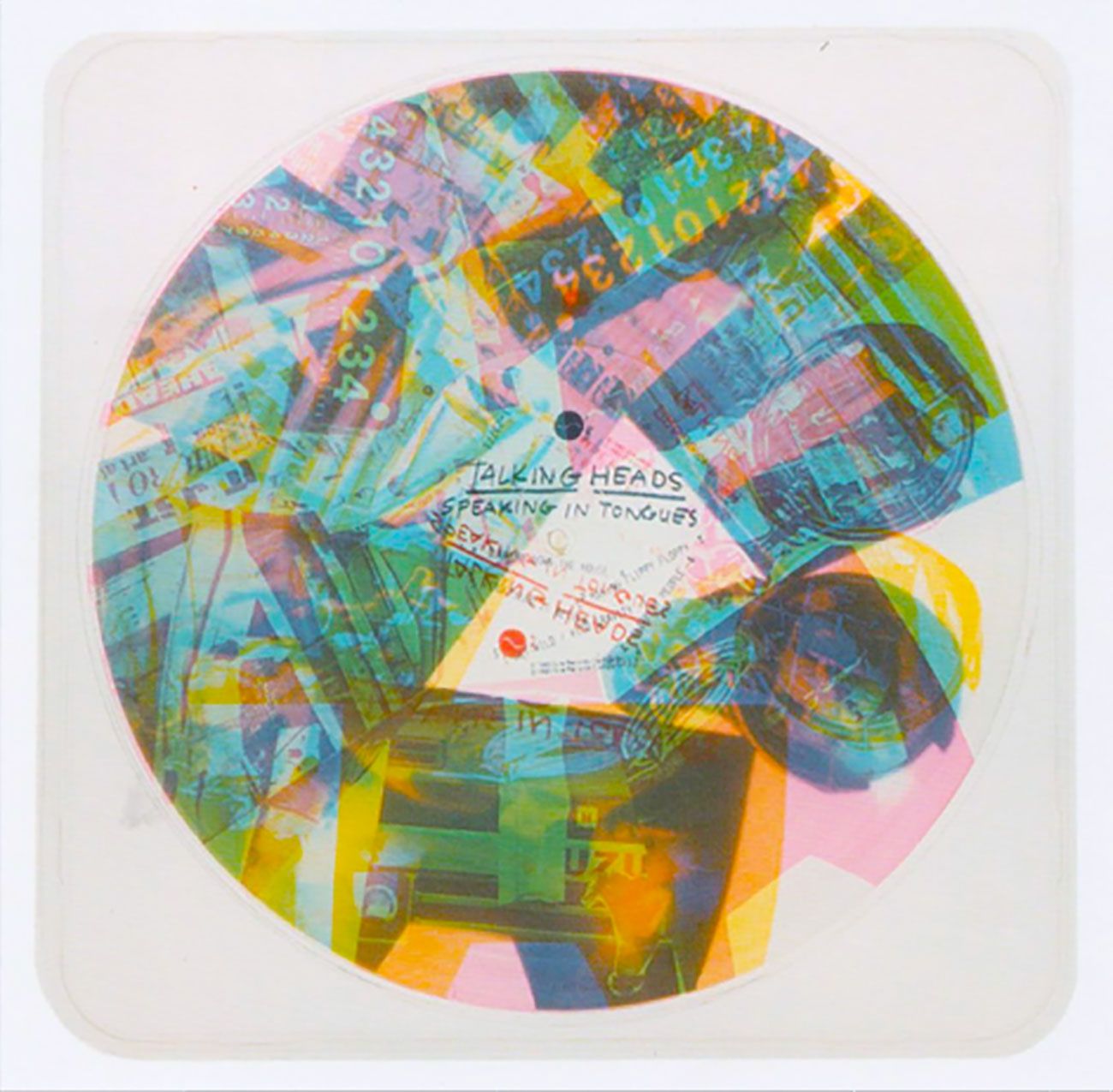
Robert Rauschenberg picture disc and detail of the Talking Heads album ‘Speaking-in-Tongues’ (1983).
Salle’s paintings and prints comprise what appear to be randomly positioned images or images placed on top of one other with, what he said himself, purposely clumsy techniques.
DLP video projector hack
After ‘The Alight’ event at ‘Fak’ugesi’ it became clear that the technique was successful, but I needed to find a way to affordably work with the equipment. The cost involved with renting is high and would not be sustainable if I would perform this piece multiple times. At this stage buying a laser projector was also not an option. Daniel de Kock opted that we could try to convert a DLP video projector into a projector that could be a strong emitter of UV light. In order to experiment with this, I was given a faulty DLP projector from the Digital Arts department at Wits.
The advantages of the hacked video projector would have been substantial as the experimentation with glow-in-the-dark and the projection would become much simpler. I would be able to just project images directly from a laptop in a studio set-up.
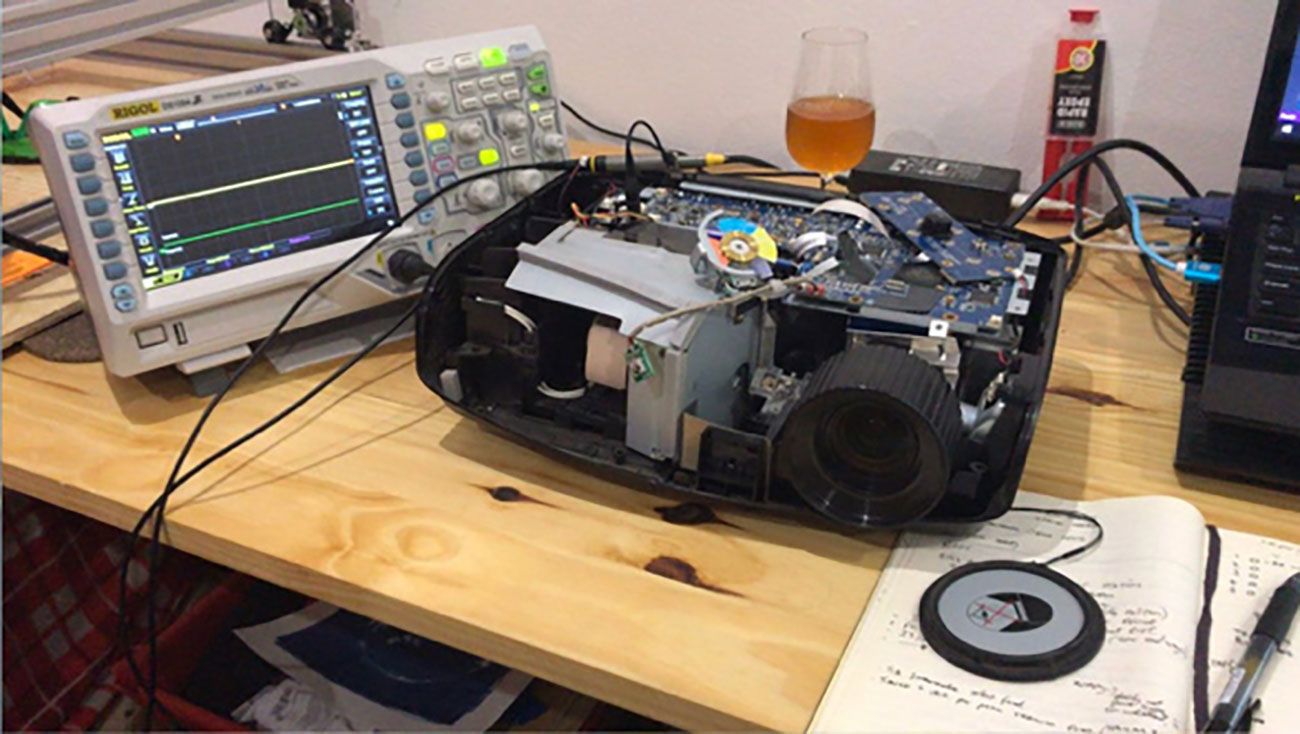
Daniel dismantled the device and moved the colour wheel out of the way, whereafter he made an attempt to hack the projector to become a UV-passing-only projector. This unfortunately failed as the heat of the projector lamp was melting the UV passing glass (Woods glass). This Woods glass (top right) was very difficult to find unless one wanted to order it for ± R 300/1000. And at that point, we still had no idea this would work. It took us 3 months to find the glass to conclude the experiment.
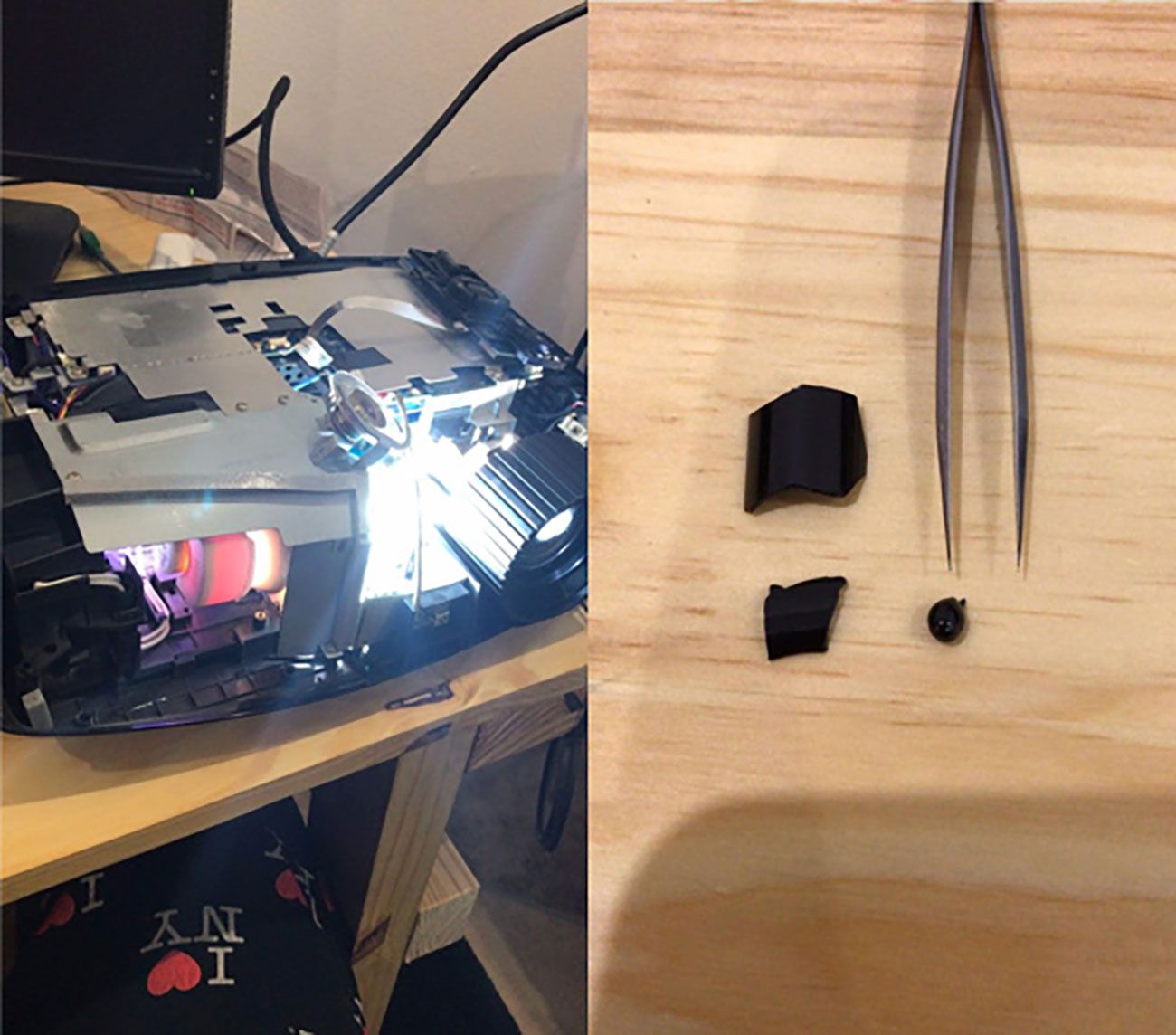
We also needed two computers to operate. One computer to process the images using the ‘ Processing 3’ coding application. And another computer connected to the DAC (digital to analog converter) via Ethernet, which is used to drive the laser-galvo scanners (img. underneath)which are a combination of little motors and mirrors to allow the laser beam to be redirected in order to reach x and y coordinates on the screen.
Currently, the system layout has changed from using two computers with the use of Ethernet connectivity to communicate to the laser controller to one computer using a serial port connection via USB. Which makes it much easier to operate.
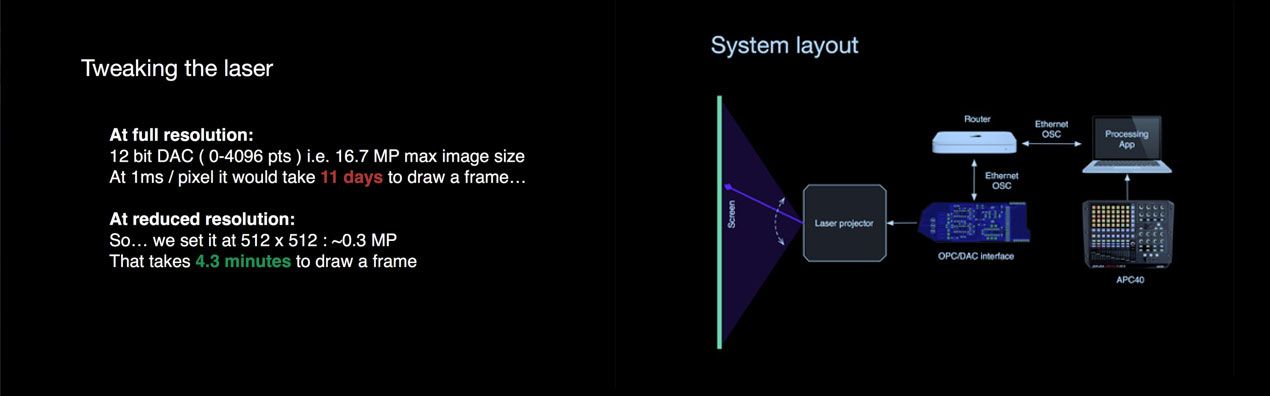
The laser has the ability to project a high-resolution image of 4096 x 4096 points (16.7 million points). This does not work for GITD projection as drawing a full white (green) frame (as the above illustration indicates) takes 11 days to complete. Considering the luminosity depletes in 7/8 minutes, the resolution needs to be far smaller. That is why we have chosen to reduce the resolution to 512 x 512 pixels which amount to ± 260.000 points which take 4.3 minutes to be drawn for a full white screen. The visuals need to be prepared and rendered as GIF’s.
‘Time appears when it is felt, beyond events, as the weight of truth’.
Andrei Tarkovsky, Sculpting in time
Digital to Analog Converter
This is the circuit board that converts the digital computer signal into an analogue signal that the laser is able to understand. The above system-layout is not completely up-to-date. As mentioned the system has changed to a one computer operation.

Programming
Underneath a section of the programming in the Processing 3.3.6 App that was involved in calling up the images and sending the to be projected X and Y coordinates via USB to the DAC. Working on this level with the hardware and software was new to me and thanks to Daniel and Jarryd’s relentless inputs this was made possible. Through the whole process of developing the projection technique, I gained a fair amount of literacy in the field. Which at least makes it possible to ask the right questions. The hardware manufacturing and coding are however too specialist to perform myself.
Image and sound
Predominantly, the visuals are chosen because they have a relationship with time, death, decay and memory.
E.g. the image of the blast of an atomic bomb explosion taken at 0.025 seconds after detonation. The effect of the bomb is obviously horribly devastating. How the massive explosion grows shows an appealing attractiveness and visually reminds of the smallest deep- sea plankton as seen under a microscope. At the end of this document, I have included 10 draft sections that I intend to work with. There are images I will use as layers of radio towers/antennas. Those images are spiky and consist of just lines. Mixing these images and the different textures will create new assemblages with a new layered meaning, which sometimes have a clear meaning and in other instances more abstract and increasingly open to interpretation.
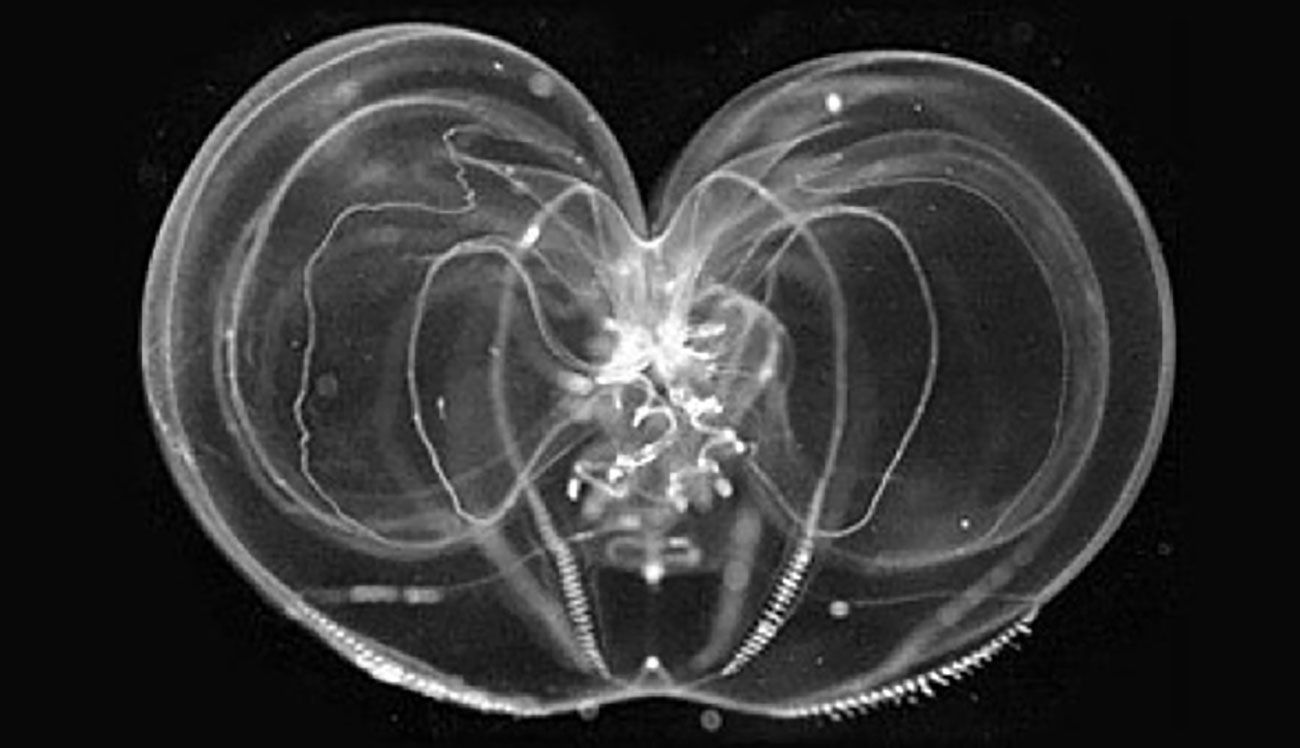
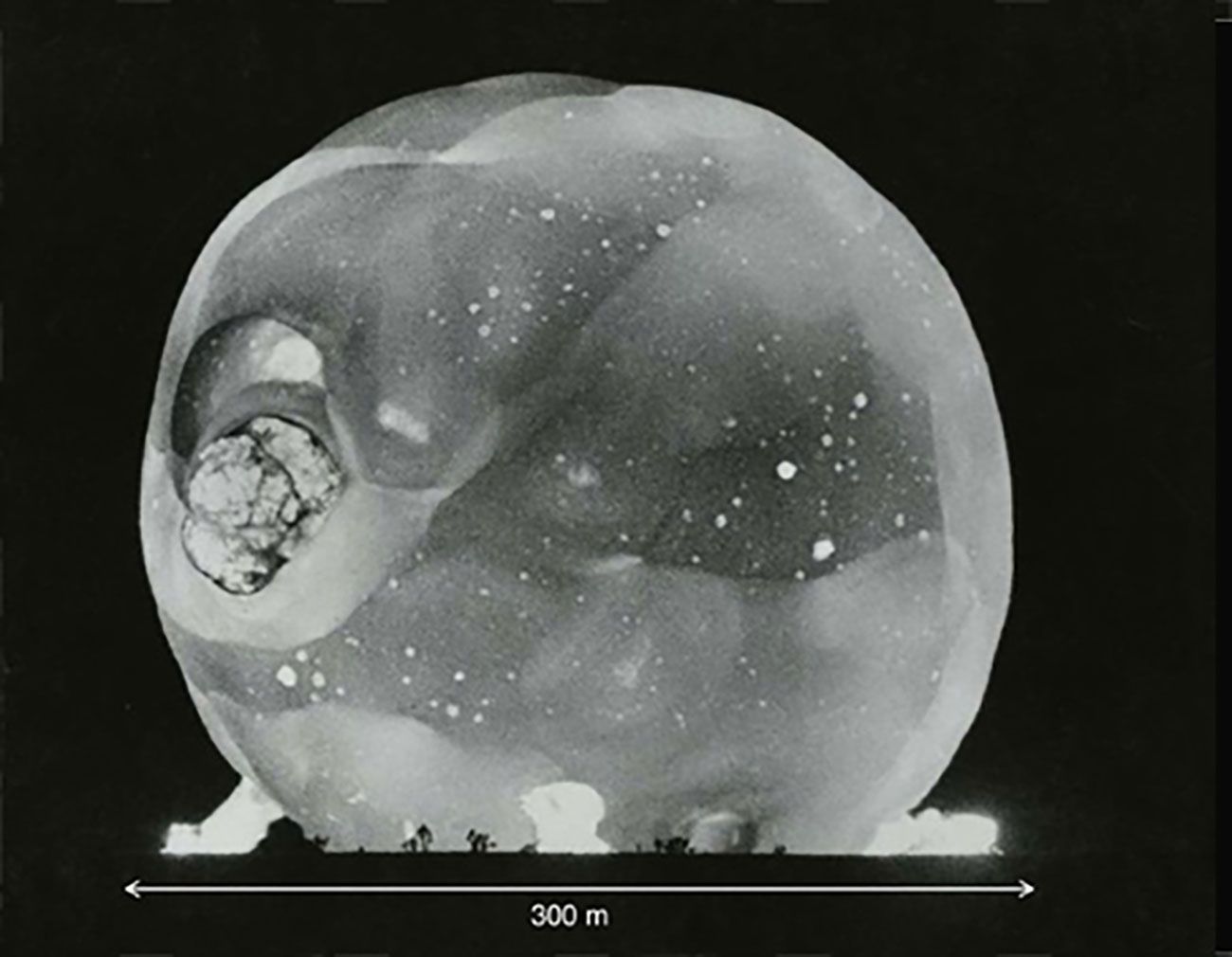
Perhaps the antennas when layered over the death masks become like ancestral antlers to reach out to the living. Since I was not able to experiment much with the materials, the exhibition and what the layering could accomplish, was surprising to me too. Through careful timing of these selections of images, I intend to go from section to section. And plan the transitions between the 10 sections, which I reduced to 3 section for the MAFA show.
Preparation of the images
The visuals are all prepared and saved in Adobe photoshop There is a distinction between two types of images;
1. Monochromatic bitmap images that I saved as GIF’s.
2. Monochromatic halftone images that through a workflow process of greyscale tone selection, filling with white and saving as individual GIF’s.
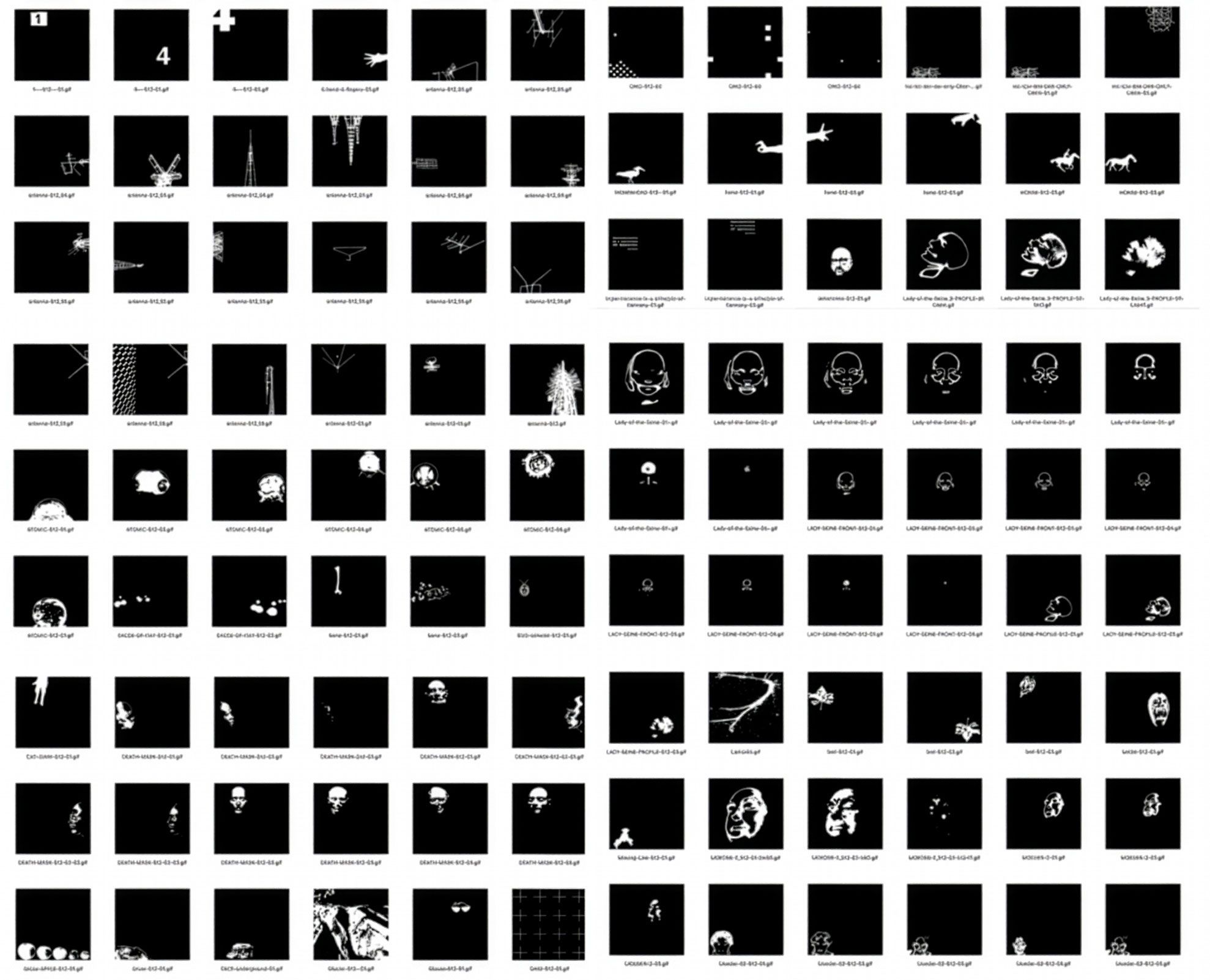
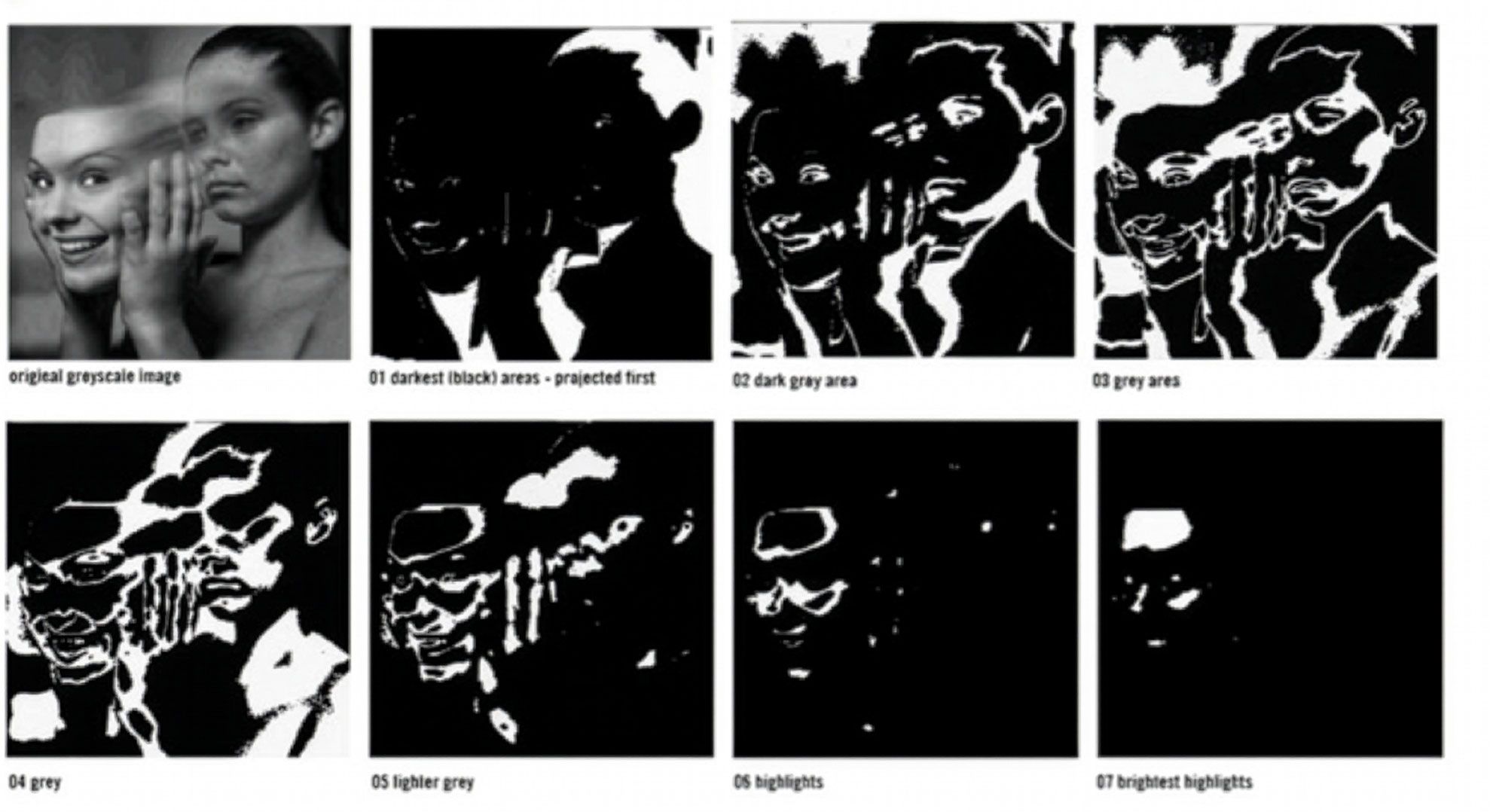
`If you knew Time as well as I do,' said the Hatter, `
you wouldn't talk about wasting it. It's him.'
`I don't know what you mean,' said Alice.
`Of course you don't!' the Hatter said, tossing his head contemptuously.
`I dare say you never even spoke to Time!'
`Perhaps not,' Alice cautiously replied:
`but I know I have to beat time when I learn music.’
SOUND
The addition of soundscapes and musical parts will further support the central concept of time in ‘Palinopsia’. At the ‘Alight’ event this I feel this was missing. Music and sound depend on decay and impermanence. It evaporates as it is being heard. This ephemeral characteristic makes sound an excellent companion for a glow in the dark projection work (playing with time).
Depending on the musical type, decay as it pertains to music is described as:
‘Envelope, in musical sound, the attack, sustain, and decay of a sound. Attack transients consist of changes occurring before the sound reaches its steady-state intensity. Sustain refers to the steady state of a sound at its maximum intensity, and decay is the rate at which it fades to silence. In the context of electronically synthesised sound, the term decay is sometimes used to refer to a drop in intensity that may occur between the attack and the sustain phase, and in such cases, the time it takes for the sound to fade to silence is called the release.… Every musical instrument has its characteristic attack, sustain, and decay pattern.’
One of the sources for the soundscapes.
I recorded tone frequencies from 1 – 20154 Hz
played > forward + reversed = mix
played >1 – 20154Hz + 20154 – 1Hz = mix
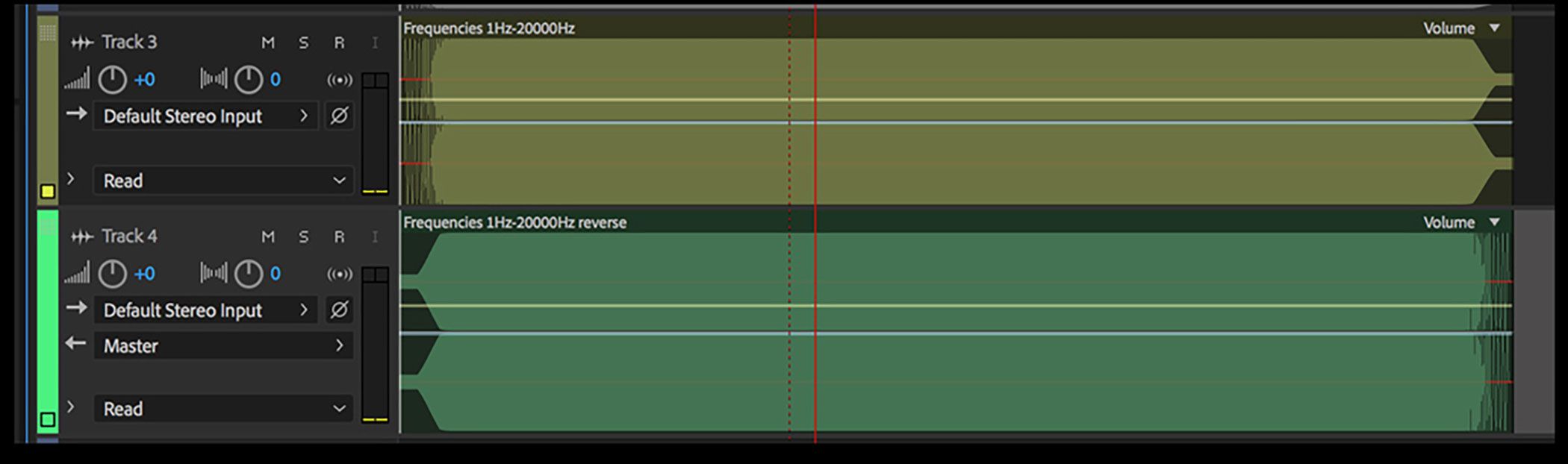
In the beginning, you will hear nothing, low and very high frequencies cannot be heard. Audible frequencies range from 36 – 17000 Hz depending on what animal is listening. The displacement of the pendulum (fig. 1) has a similar decay or release of energy and can also be compared to a sound-envelope (fig. 2) or a glow-in-the-dark paint light emission curve after being excited (fig. 3).
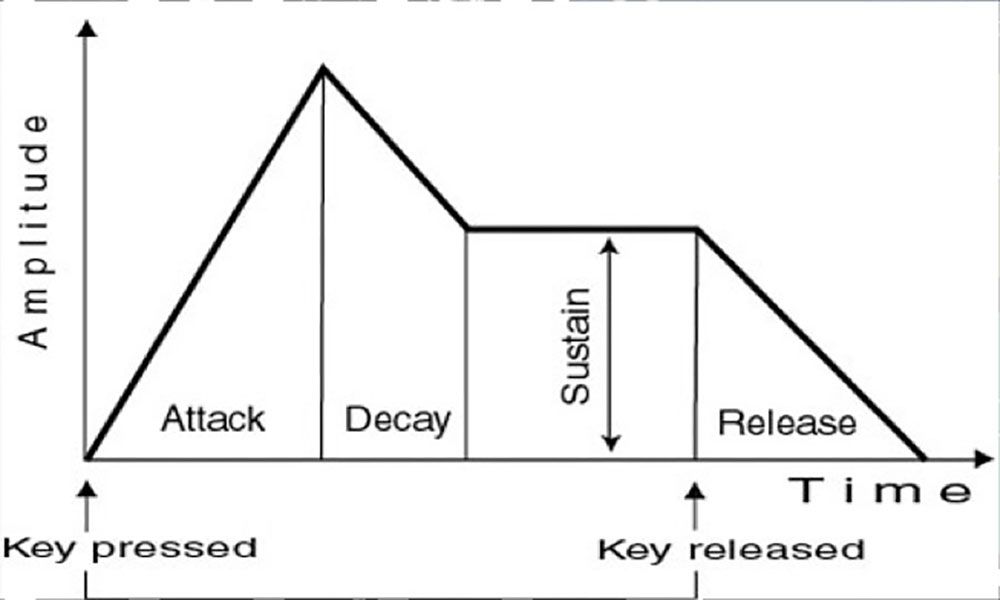
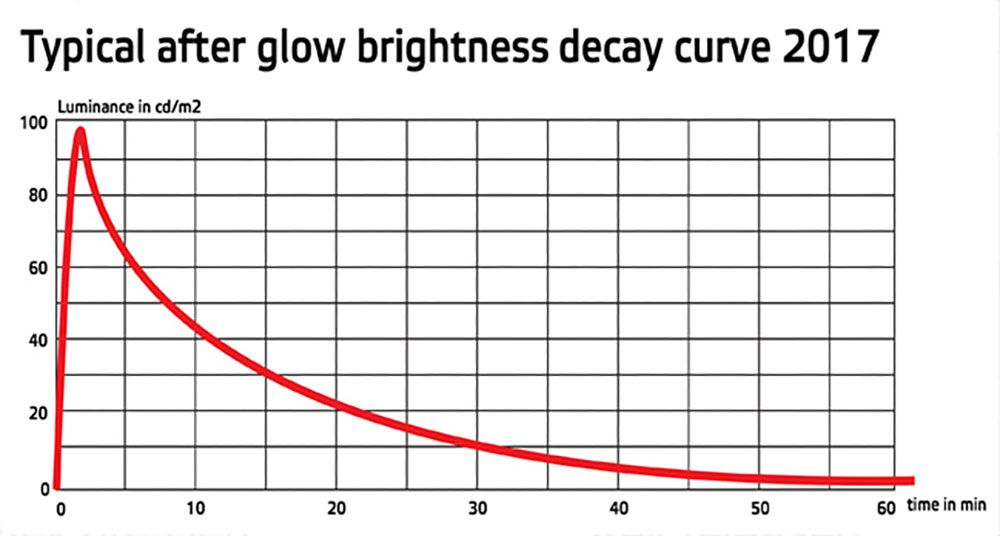
The previous paragraph identifies one type of decay. In acoustically generated music, decay is characterised as the rate in which a note fades to silence, and in the generation of electronic sound, the decay is placed between the attack and sustain phase and here final fading out phase is referred to as release. The Attack-Decay-Sustain-Release (ADSR) envelope.
The nomenclature in this instance decay and release, are semantically significant attributions to the aspects of fading-out, or the death of the sonic experience. Decay describes and expresses a certain moment after death that is easily brought in relation to ‘rotting’, whereas release connotes to a more positive episode, where release brings solace and consolation. Linguistically ‘release’ inhibits a kind of freedom.
My perception of this release is an essential link to the work ‘Palinopsia’ since the work both in a visual and auditory sense embraces ‘letting-go’. Perhaps this is a consequence of the assurance that our inevitable death is the one and only absolute certainty we have in life, which through my personal experience has become a vivid part of my present life, through the passing of loved ones and all the living things that I experienced and ceased to exist at some point.
Maybe in that sense, the work personally contributes like a gateway to deal with those losses and commemorates their lives. An homage and a memento mori.
In the classical conventional musical approach, temporal overlapping of disappearing notes create harmonies and/or dissonance(s). As previous, musical notes linger, new notes are played. And silence, or not playing for a moment, puts emphasis on last played notes or could announce a new segment.
The antithesis of this would be a note that carries on with the same amplitude and pitch for a very long time, and this would surely deviate from the more usual musical construction and appreciation. In ‘Palinopsia’, I combine silence, very long-standing tones, sound recordings and unconventional sound making methods with the traditional musical techniques to counterpoint the traditional approach and put an emphasis on time as an undefinable unit which can only be grasped by an intuition of the imagination to‘la durée’ – (Bergson), the duration and continuous time experience.
In (The New Aspects of Time: Its Continuity and Novelties, M. Capek, 1991 pp 22,23) Capek quotes Bergson:
Bergson’s snowball analogy form page 11 strikingly pertains to music which in itself is a continuum of the past into the present. In this sense, I can add that music keeps on forming itself as it keeps the musical bars that have just passed, in a time related enclosed memory.
Bergson also applies this statement in relation to psychology, stating:
“My mental state, as its advances on the road of time, is continuously swelling with the duration it accumulates: it goes on increasing – rolling upon itself, as the snowball on the snow. The difference between the present moment and the be immediately previous one just consists in the memory of the immediately past moment which makes the present moment richer in respect to the past one. Obviously, novelty and retention of the past are two aspects of the single dynamic fact – the progress of time. Only when these two aspects become conceptualised do they appear as mutually exclusive and contradictory.”
These theories of Bergson’s have been one the important inspirational frameworks in both a visual and auditory sense to produce the content and concepts for this work ‘Palinopsia’.
For the exhibition, I used 37 soundtracks varied in length from 15 seconds to 90 minutes. They were live-mixed on a computer-based DJ application and were all custom-made for the ‘Palinopsia’ project. Now and again, I used recorded radio. For example a short phrase by Robert Fripp. And I used the Russian UVB Ghost radio station which was a suggestion made by Jill Richards.
Jill Richards
Apart from the collaborations with the engineers, I have been intensively collaborating with pianist Jill Richards who specialises in new music. The soundtracks for ‘the Point of Order’ show were partially recorded at Jill’s house. Apart from the physical recording work we have done, we spent many hours talking about time in relation to sound and the visual work. Her passionate contributions have been very important up to this stage and as you will see in the following proposal, we are planning a more inclusive collaboration in the near future, to further develop these intrinsic connections between sound/music and glow-in-the-dark laser projection.
Performance 2018
A future plan is to make a six-hour performance where people can walk in and out. How this will physically work needs to be researched further. There can be various ways of showing the work. As a public intervention, indoor or outdoor, as a performance, as a pre-recorded installation piece in an art house on a loop, as a workshop, etc… The Point of order installation will not take six hours, nor will it have live performing musician. There will be pre-recorded sounds playing out over two speakers. The soundscapes are mixed to the specific duration that suits the length each section.
Future plans & Curating
Here the proposal for ISEA2018 (International Symposium for Electronic Art) for June / July 2018 that I made with Jill Richards. We have made another proposal for an ‘Only Once’ at the Centre of the Less Good Idea in Maboneng for possibly May – June.
ISEA proposal submission – PALINOPSIA / seeing again
Palinopsia-(seeing again) is a laser projection work on a Glow-in-the-Dark (GITD) surface that is made in collaboration with Jill Richards & BushveldLabs engineers Daniel de Kock and Jarryd Bekker. The 1st try out and première of this digital artwork was shown the ‘Alight block party’ on 1 Sept 2016 in Johannesburg as part of the Fak’ugesi festival. – Please have a look at the 3 min registration.
With a purplish-blue UV laser as a projection source and using fully covered painted phosphorescent canvas as the projection surface, I project after-glowing images that appear line by line (much like a fax or inkjet printer). In this way, the projection canvas records the image. The projected image/text elements will diminish in luminosity over time. New elements will be projected as the older ones fade.
When projecting with lasers onto a glow-in-the-dark surface the image will leave a clear green trace and remains visible for some time. After that, one can re-project over the remaining image to create a visual layering. In the YouTube link above you will also see an example of projecting a halftone image by just projecting different highlights of the image over time. The way temporality and perseverance leave a finite mark or trace of the projected image positions glow-in-the-dark laser projection between cinema and photography.
THE PERFORMANCE
For this latest iteration of ‘Palinopsia’ I am collaborating with Jill Richards for the addition of music and sound to the work. Similarly to G-I-T-D projection, music operates on the bases of time. Therefor we have chosen for existing contemporary musical pieces, self-composed pieces and pre-produced soundscapes from various audio recordings that have a relationship with temporality and decay. There will be 5 sections of each 10 / 20 minutes. I have included 10 sections in the current idea, but some will fall away or be combined in other sections. The individual sections are different ways to engage and play with the medium, wherein some parts the improvised and premeditated music and sounds propel the projection and vice-versa in other parts.
Like this, an audience will also be able to distinguish the difference between the sound and the visual approaches. There will be overlapping transitions to collect the sections… in visual and audio depending on the dissipation of the images and timing of the soundscapes. It takes around 8 minutes for an image to fully dissipate and we will also use sounds that linger.
Placement of laser / speakers / audience / screen / piano
For the work, I’m busy developing a laser projector it is easy connectable to a laptop. For the first iteration I rented a powerful show-laser that is generally used in the entertainment industry. A digital to analog converter (DAC) translated the digital signal to the analog laser projector. I currently have one phosphorescent screen of 4 x 4 m. The work requires a high space to avoid eye contact with the laser. The laser needs to be mounted on a minimum height of 3 1/2 meters. Distance to the screen is variable. The content underneath is still being developed, but the basis is there. An important condition for the work is that the venue needs to be dark and quiet.
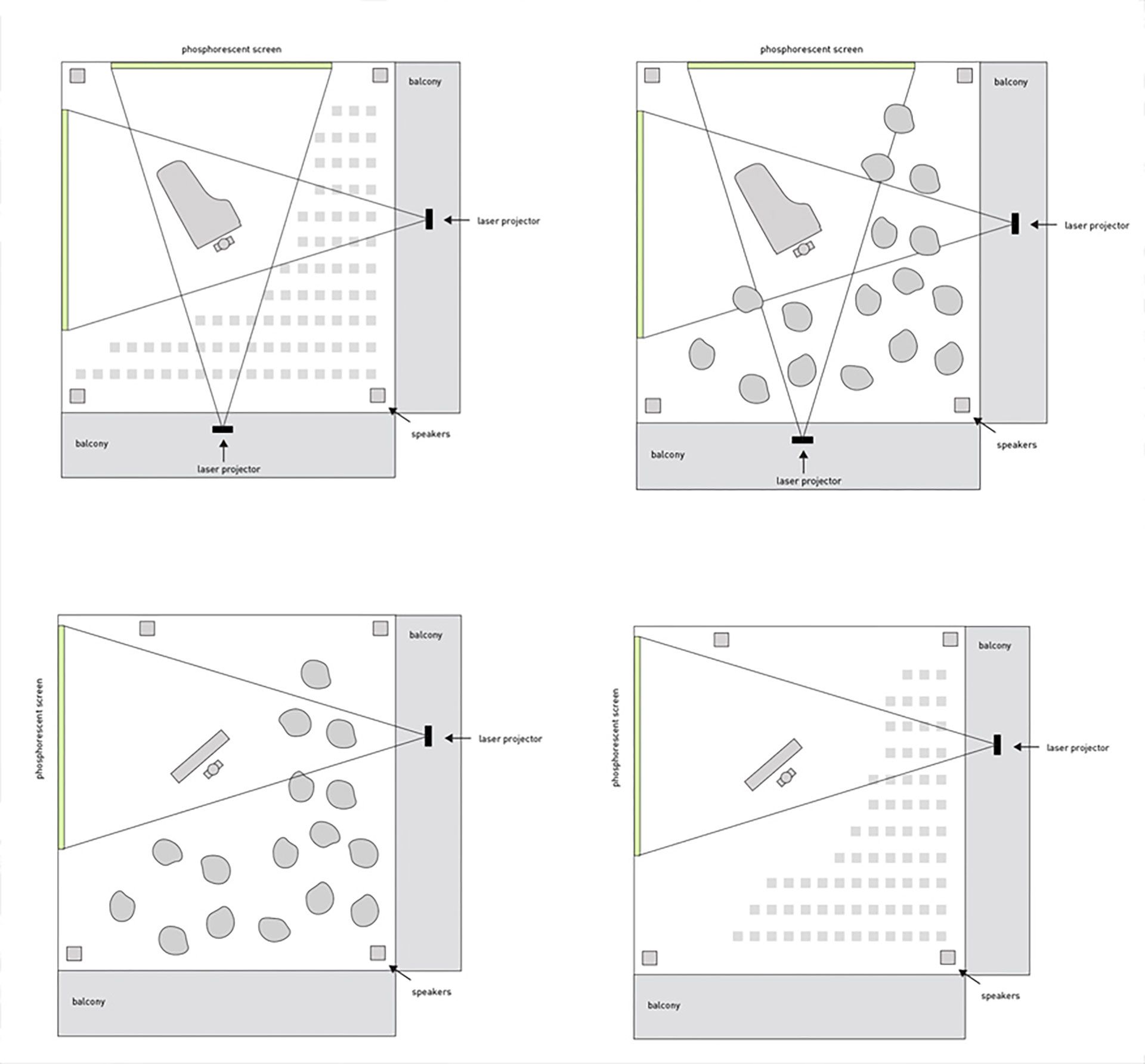
Minimal set-up: one projector, one screens, 5.1 speakers and a grand piano
10 SECTIONS (under construction)
The exhibition space needs to be open and spacious. It will be a one-time event with an unknown duration the undefined length links to the concept.
1_ Fragments and omissions
Sounds and gaps. Using a pre-recorded and cut up soundscape filled in by the piano performance by Jill Richards.
A section of my MA-FA proposal is displayed in Morse code.
…. .. … / .-. . … . .- .-. -.-. …. / .- .. — … / – — / . -..- .–. .-.. — .-. . / – …. . / .. — .–. .- -.-. – / — ..-. / – .. — . / .–. .-. — .— . -.-. – .. -. –. / — -. – — / –. .-.. — .– -….- .. -. ….- – …. . -….- -.. .- .-. -.- / … ..- .-. ..-. .- -.-. . … / -.–.- .-. . ..-. . .-. .-. . -.. / – — / .- … / –. .. – -.. / .. -. / – …. .. … / .–. .-. — .–. — … .- .-.. -.–.- / ..- … .. -. –. / .- / .-.. .- … . .-. / .-.. .. –. …. – / … — ..- .-. -.-. . .-.-.- / .. / .– .- -. – / – — / . -..- .–. .-.. — .-. . / …. — .– / – …. . / .–. …. — … .–. …. — .-. . … -.-. . -. – / .–. .. –. — . -. – / .. -. / –. .-.. — .– -….- .. -. -….- – …. . -….- -.. .- .-. -.- / … ..- .-. ..-. .- -.-. . … / .-. . -.-. — .-. -.. … / .-.. .. –. …. – / ..-. .-. — — / .- / — — -. — -.-. …. .-. — — .- – .. -.-. / .–. .-. — .— . -.-. – .. — -. / … — ..- .-. -.-. . –..– / .- -. -.. / .-.. . .- …- . … / .- / …- .. … .. -… .-.. . / — .- .-. -.- / ..-. — .-. / .- / -.-. . .-. – .- .. -. / .- — — ..- -. – / — ..- … . .-. . / .- ..-. – . .-. / – …. . / — .- .-. -.- / -.. .. … … .. .–. .- – . … / .- -. -.. / .-.. . .- …- . … / … .–. .- -.-. . / ..-. — .-. / — …- . .-. / .–. .-. — .— . -.-. – .. — -. / — .-. / .-. . -….- .–. .-. — .— . -.-. – .. — -. .-.-.- / . -..- .–. .-.. — .-. .. -. –. / – …. . / – …. . — .-. -.– / — ..-. / – .-. .- -.-. . –..– / — . — — .-. -.– –..– / – . — .–. — .-. .- .-.. .. – -.– / .- -. -.. / .. — .- –. . / -.. .. … … .. .–. .- – .. — -. / .– …. .. -.-. …. / .– .. .-.. .-.. / ..-. — .-. — / – …. . / -… .- … .. … / — ..-. / – …. . / .– — .-. -.- / -.-. — -. -.-. . .–. – ..- .- .-.. .-.. -.– .-.-.- / .- -.. -.. .. – .. — -. .- .-.. .-.. -.– –..– / .. / .– .. .-.. .-.. / .-. . … . .- .-. -.-. …. / – …. . / ..- -. – .-. .. . -.. / .–. — … … .. -… .. .-.. .. – .. . … / – — / .–. .-. — .— . -.-. – / ..-. ..- .-.. .-.. / -.-. — .-.. — ..- .-. / -.–.- .-. –. -… -.–.- / –. .-.. — .– -….- .. -. -….- – …. . -….- -.. .- .-. -.- / .. — .- –. . … .-.-.- / .. — .–. — .-. – .- -. – / –.- ..- . … – .. — -. … / – …. .- – / .. / .– .. .-.. .-.. / . -..- .–. .-.. — .-. . / .. -. -.-. .-.. ..- -.. . —… / .– …. .- – / .- .-. . / – …. . / .. -.. . .- .-.. / -.-. — -. -.. .. – .. — -. … / .– .. – …. / .-. . –. .- .-. -.. … / – — / -.-. — .-.. — ..- .-. / – . — .–. . .-. .- – ..- .-. . –..– / .–. .. –. — . -. – / . -..- -.-. .. – . — . -. – –..– / .-.. .. –. …. – / . — .. … … .. — -. / .- -. -.. / .–. . .-. … .. … – . -. -.-. . / – — / ..-. .- -.-. .. .-.. .. – .- – . / – …. . / .–. .-. — -.. ..- -.-. – .. — -. / — ..-. / .- / -.. .. –. .. – .- .-.. / .- .-. – .– — .-. -.- ..–.. / …. — .– / -.-. .- -. / .. / ..- … . / – . — .–. — .-. .- .-.. .. – -.– / – — / .–. — … .. – .. — -. / –. .-.. — .– -….- .. -. -….- – …. . -….- -.. .- .-. -.- / .–. .-. — .— . -.-. – .. — -. / .. -. / .-. . .-.. .- – .. — -. / – — / – . — .–. — .-. .- .-. .. .-.. -.– / .. -. / ..-. .. .-.. — / .- -. -.. / .–. …. — – — –. .-. .- .–. …. -.– ..–.. / – …. . / .–. .-. .- -.-. – .. -.-. . / -… .- … . -.. / — ..- – -.-. — — . / — ..-. / – …. .. … / .-. . … . .- .-. -.-. …. / .. … / – .. – .-.. . -.. / .–. .- .-.. .. -. — .–. … .. .- .-.-.- / ..- -. -.. . .-. / – …. . / ..- — -… .-. . .-.. .-.. .- / — ..-. / .–. .- .-.. .. -. — .–. … .. .- –..– / .. / .– .. .-.. .-.. / .- .–. .–. .-.. -.– / – …. . / -.-. — .-.. .-.. . -.-. – . -.. / – . -.-. …. -. .. -.-. .- .-.. / – …. . — .-. -.– / .. -. / .- / -. ..- — -… . .-. / — ..-. / .–. .-. — .— . -.-. – .. — -. / -… .- … . -.. / .- .-. – / .– — .-. -.- … / – — / .- .-. – .. … – .. -.-. .- .-.. .-.. -.– / -.-. …. .- .-.. .-.. . -. –. . / – …. . / -… — ..- -. -.. .- .-. .. . … / — ..-. / – …. .. … / -. . .– / — . -.. .. ..- — .-.-.-
2_ Chaos
Double rod pendulum, off-sync metronome, discontinuous, playing fullness, disruption, panic attack. Graphic music scores projection, and live and pre-recorded soundscape + feedback improvisation from Jill Richards.
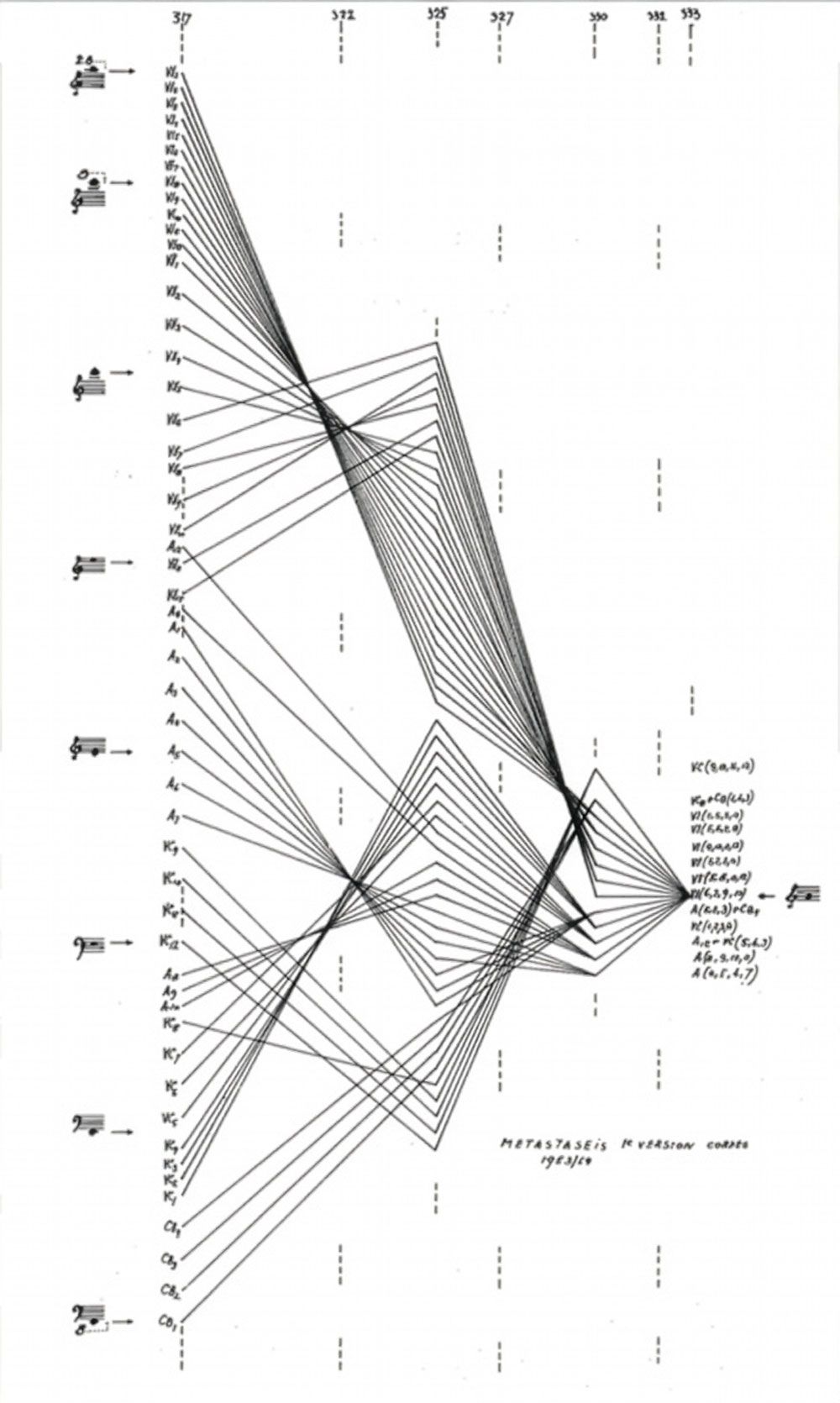
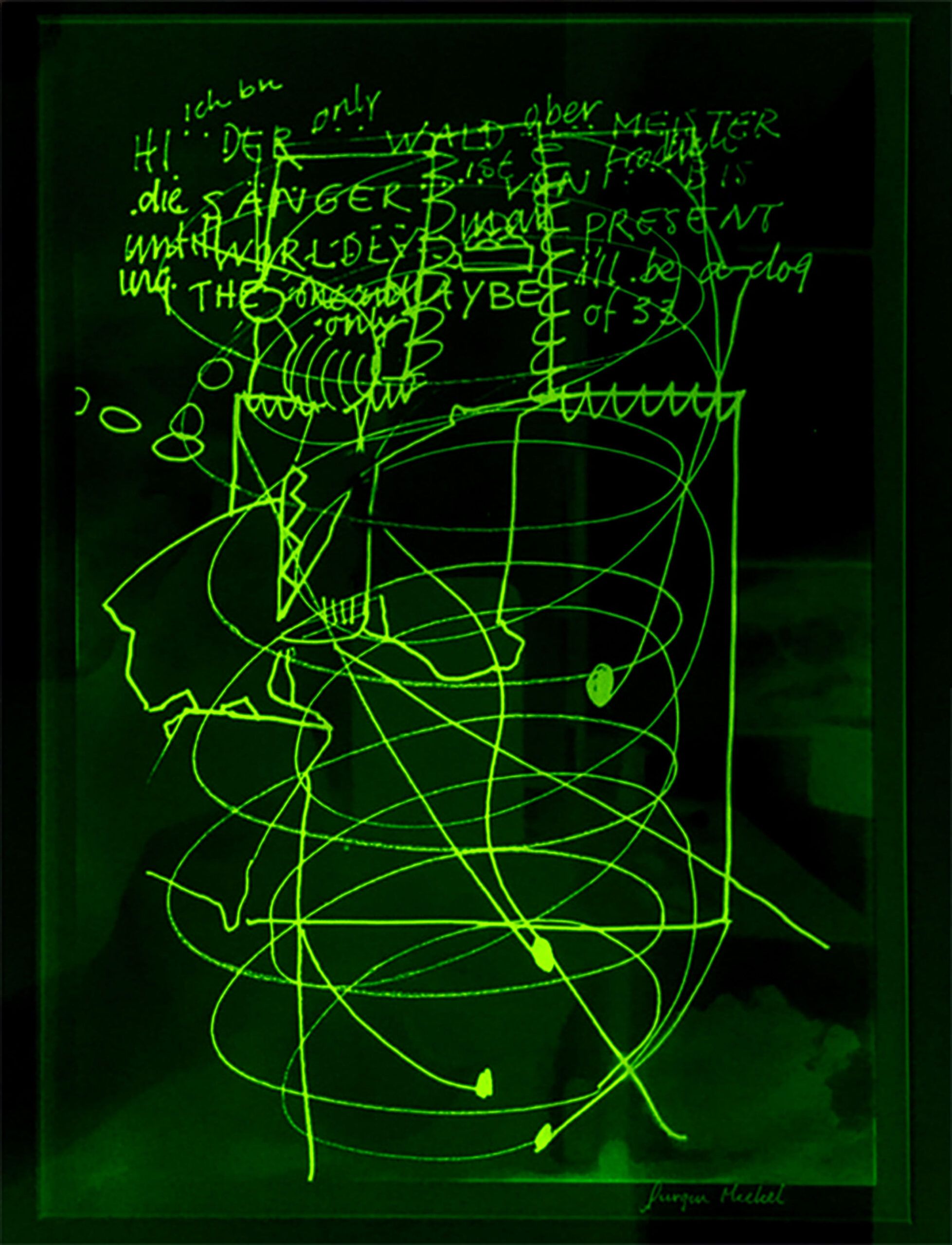
3_ Palinacousis (hearing again)
Noise pollution, high-pitch bomb-blast after effect, das ständige wiederholen der Kürze Melodiephrasen (the constant repetition of the short melody phrases) Long resonating notes/ melodies that repeat themselves over themselves.
Repetitive phrases:
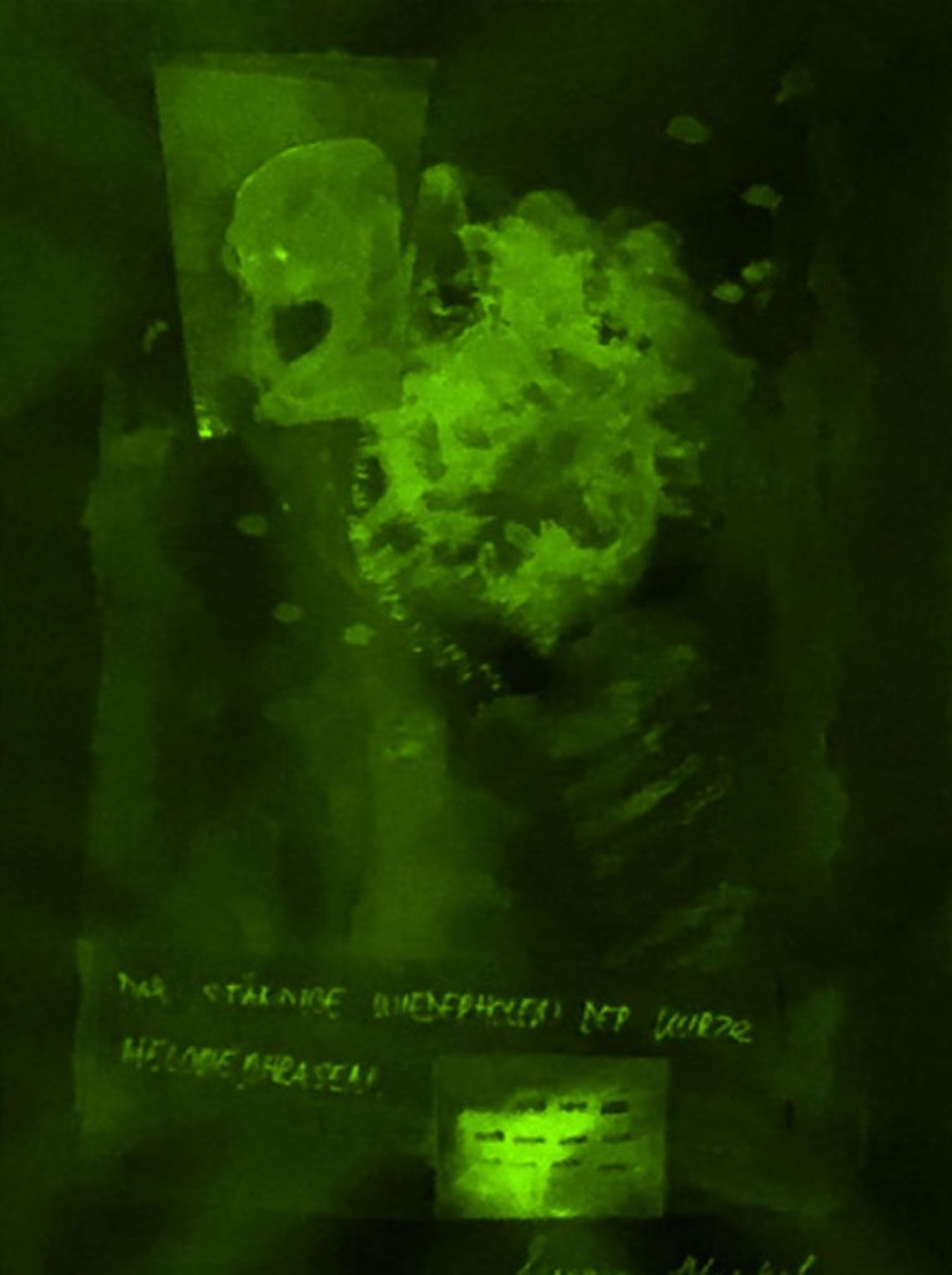
4_ Death
memory – live – death masks – ageing – whispers – in shadows – faces
Memento mori.
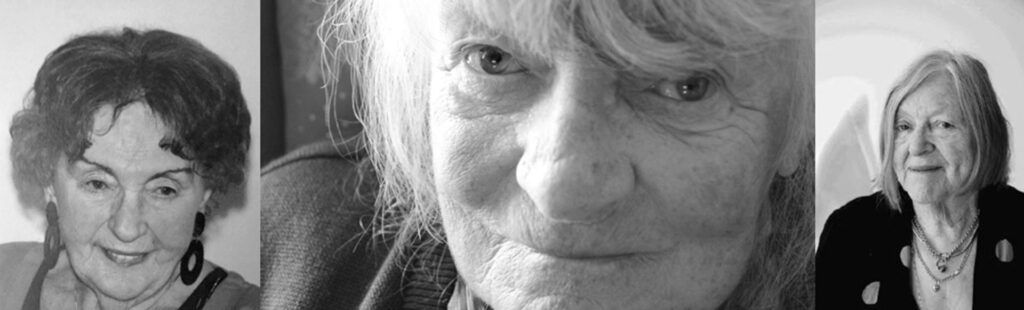
dilapidation - decay - memory - trace - erasure
epheeral - image retention - rupture - resonance - error
ambiguity - loss - poor - nostalgia - erosion - palimpsest
evanescent - passing - transient - fleeting - volatile
dilapidation - depletion - running out - impermanence volatile evaporate - transient - transitory -
temporary short-lived short-term - ephemeral - impermanent - brief short momentary - fleeting -
flying - evanescent - passing
fugitive - fading - mutable - unstable.
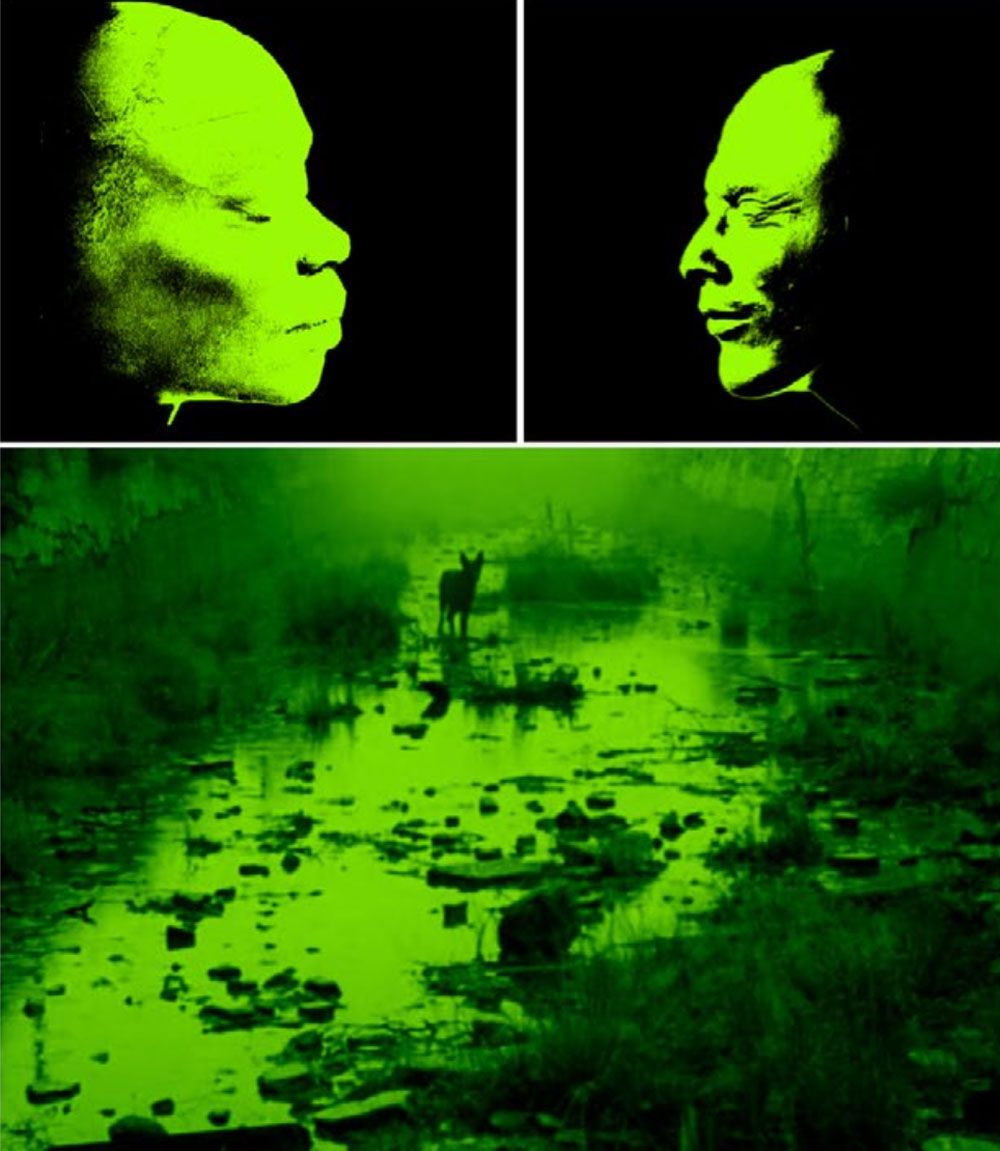
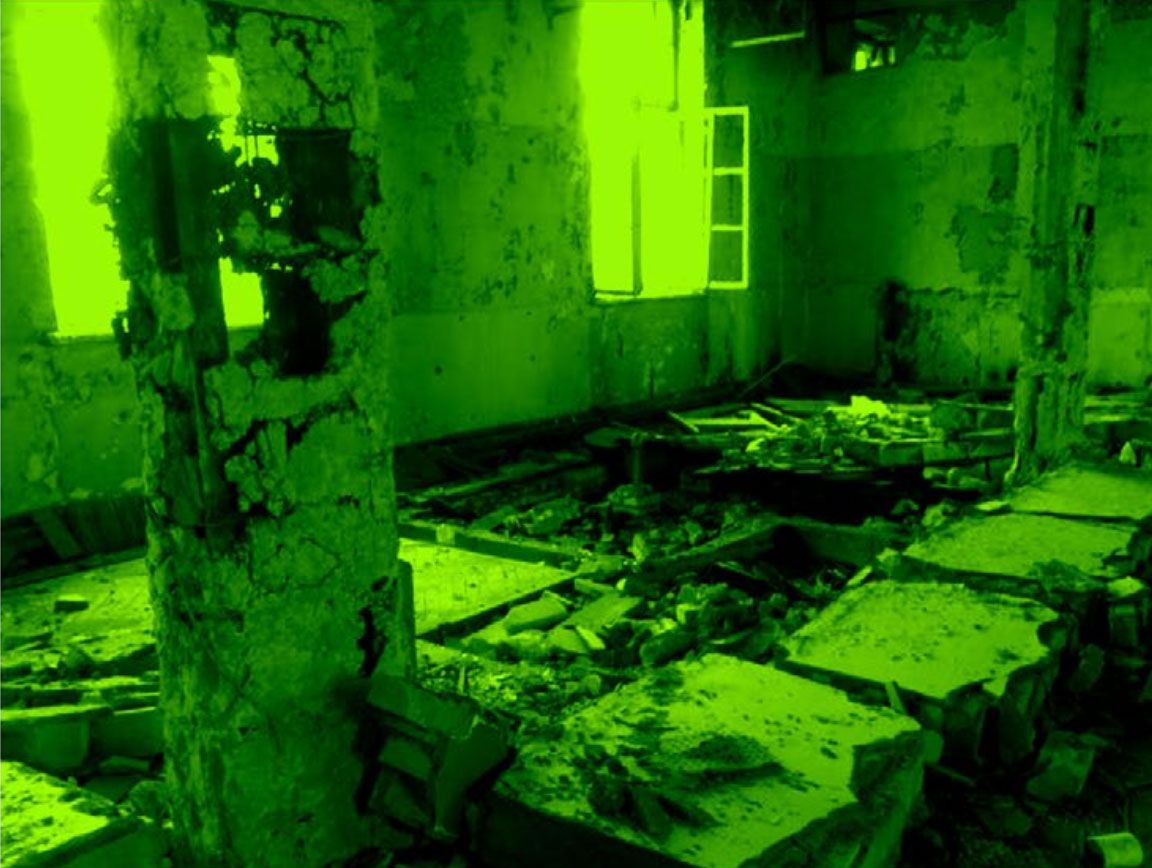
5_Silence and edges
Elusive, liminal, ephemeral, evanescent, palimpsest, transient, ineffable, wind, mountain, wind.
6_ Trapped in Time
We need more rest and need less stuff, and yet the economy needs continuous acceleration.
J. Hermsen. 2009
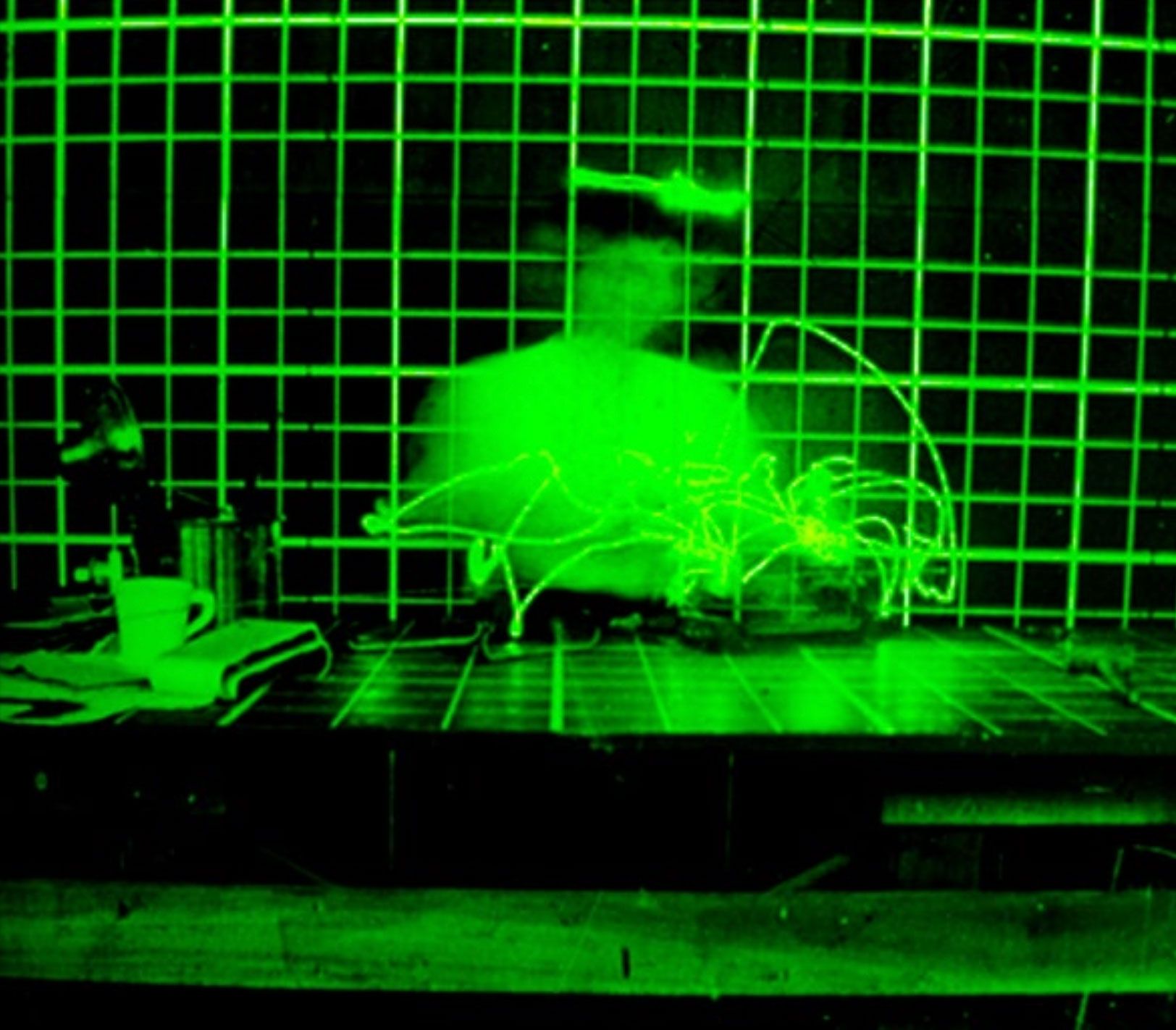
Étienne-Jules Marey, (1830- 1904), a contemporary of Eadwaeard Muybridge. Utilising Marey’ s pioneering work Frank and Lillian Gilbreth developed and sold motion studies to the early industrialists in order to make factory work processes more efficient.
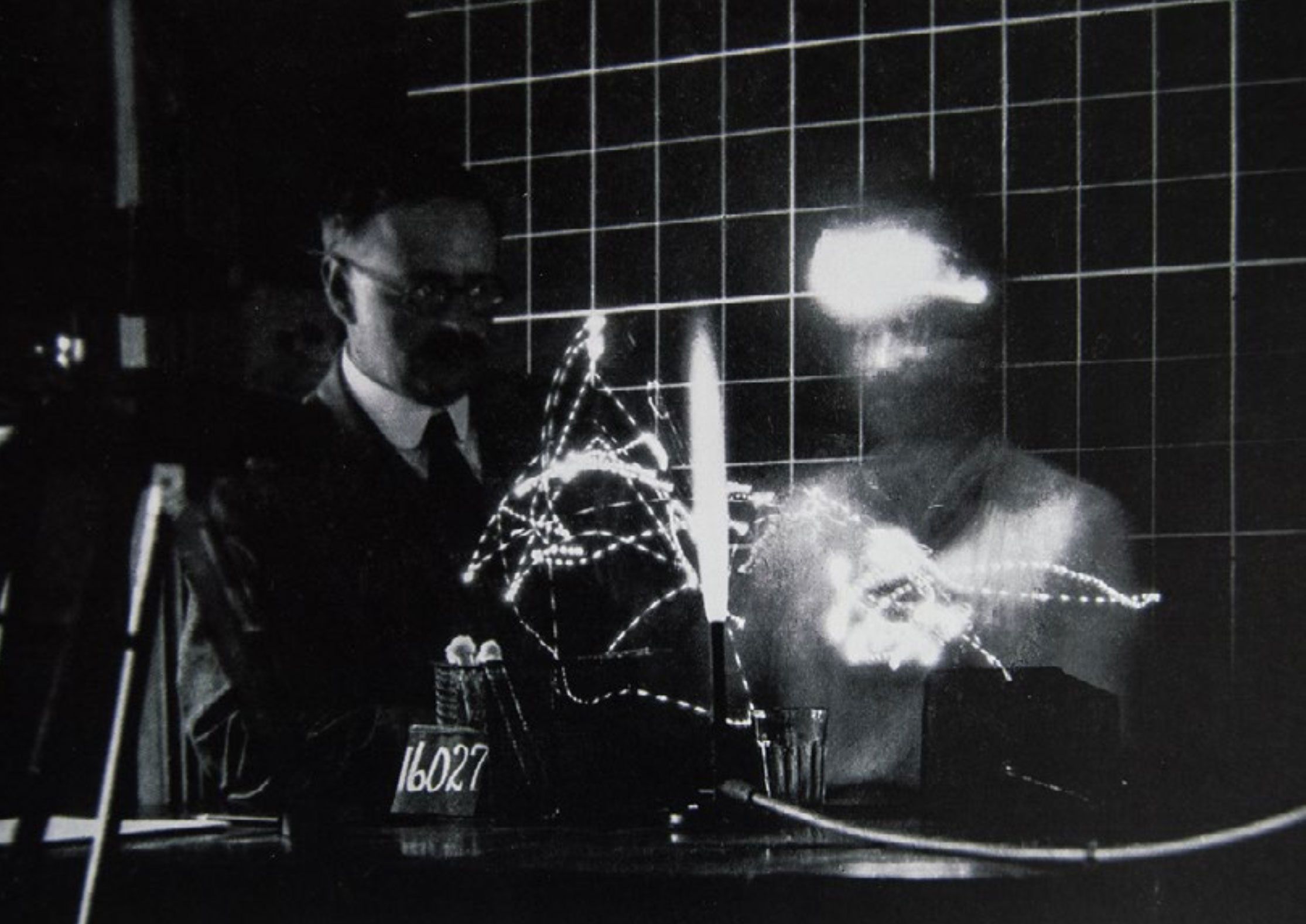
‘There is no waste of any kind in the world that equals the waste from needless, ill-directed and ineffective motions, and their resulting unnecessary fatigue’ Frank Gilbreth
\\
Duration (Durée) and Simultaneity, H. Bergson (1922)
This philosophical text deals with the theme of time. A central contention is that science and philosophy alike systematically misrepresent the nature of time. Bergson suggests that the traditional association between the model of space and time is incoherent. Unlike space, time is not measurable by objective standards. This contention is tried out against the major movement in physics of the day – relativity (Einstein). Tracing the development of the theory from special to general relativity, Bergson finds that a fundamental requirement of the theory is an impossibility – the assumption that the experiences of two observers moving at different speeds within two different physical systems might be thought of as simultaneous. This is to ignore the limits of possible experience.
7_ Losing time
Every day we lose time:
waiting for the water to boil – the toaster to pop – the shower to get to temperature – the eggs to cook – the waiting line at the bank – a web page to load.
8_ Impermanence is a principle of harmony
value = a range of approaches to understanding how, why, and to what degree people value things.
History of Economic Theory and Method, Ekelund 6th ed 2017 ‘Palinopsia’ exists for a short amount of time, does this add or reduce the value of the work? Living on in the memory might increased value opposed to an object being visible all the time. A principle of myth, an ambiguous and debatable truth.
Note value = the relative duration of a musical note ‘Palinopsia’ exists for a short amount of time.
Does this increase or reduce the value of the work? As opposed to an object being visible all the time, an artwork living on in memory might increase value. `A principle of myth, an ambiguous and debatable truth.
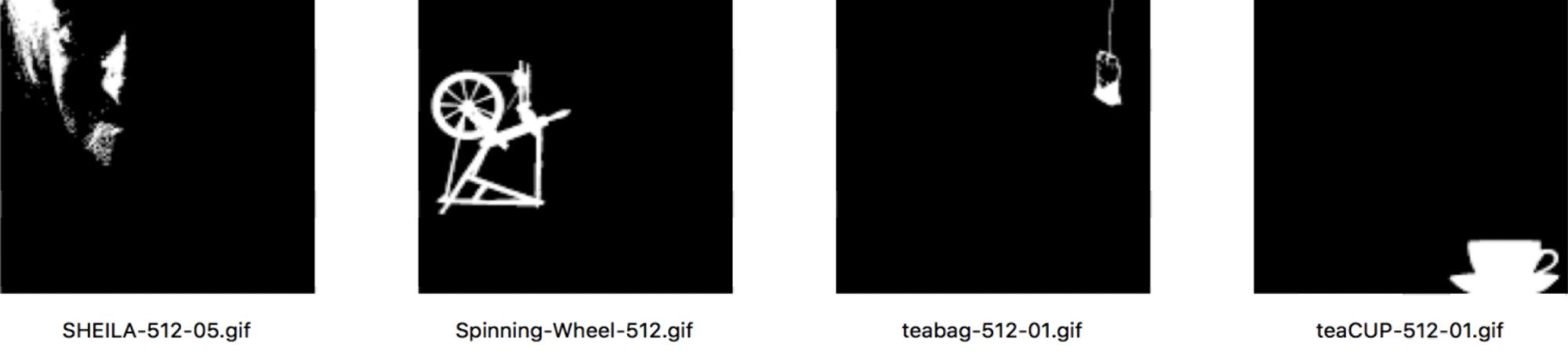
Note value = the relative duration of a musical note.
9_ Counterpoints
Agreeable opposites – antibioses versus symbioses. A combination of two or more independent melodies into a single harmonic texture in which each retains its linear character. In ‘Counterpoints’ the visual and sound elements will oppose and/or align to create harmony.
10_ the Value of Loss
The last projected image will be a full bright image by a photo-flashlight that will be triggered by the pianist. The canvas will be fully excited and therefore luminous. Leaving the space in a green glow.
This will make it easy to exit the space, and has reference to the initial idea: my aunt’s glowing Maria statues.
. . .
some points of consideration
For the manipulation of the images, I will devise an automated script that would instantly allow images to be converted and ready for glow-in-the-dark laser projection. This will definitely work for the single layer GIF images. The greyscale images will need to be produced manually.
More defined variation in the image content with regard to the images of faces in combination with graphics like antennas, morse code, horses, drawings, and texts were randomly plotted. This was something I enjoyed since the result of the combination of images could be quite unexpected. Apart form many compliments, a compliment and remark were made that in some cases the layered screen build up reminded the spectator of a Basquiat painting. There were also mentions of the possibility if some images could be saved and printed. Jarryd Bekker mentioned earlier in 2016, that this is possible when projecting on blueprint paper or a cyanotype that can be developed after being exposed to the laser. This would then create a print of the projected visual. And live drawing on the canvas with a Wacom tablet could be an option. This could create an interesting layer of live interaction. Behind the canvas, I placed 4 blue LED tubes to bring the canvas of the wall. This was subtle but worked very well. Perhaps a LED light string would be easier to install. A very important consideration is to allow the laser light to go off now and again. Even though the laser at work and its movements are mesmerising to look at. It does over time tire one’s eyes.
Not much, but sometimes you do want to look away. Turning the laser off and witnessing the dissipation without the distraction of the blue light was something we only saw once we shut down the laser. This pause will add another layer to the experience. After having experienced the projection medium twice now, and understanding more of the possibilities that this medium brings, I would like to produce a more extensive library of images that particularly suit and narrate certain sections of the piece, without losing the more random playfulness of the Point of Order performance. I also intend to be shooting image material specifically for each individual section. It will give the work more agency and distinct relationships can be created with the live piano performance and soundscapes.
Creating new soundscapes with Jill Richards that particularly go well with the individual sections. Together with Jill Richards we are continuing to make new soundscapes that are specifically related to the concept of time. The live piano performance will allow emphasis on silent sections in the work. In future iterations, I would like to try and find a venue where some form of silence is achievable. The current noises during the performance came from, a little buzz in the speakers, which could be related to earthing problems and the mechanical noises of the galvos or scanners (tiny mirrors that reflect the lights into the different directions on the screen) in the laser. This latter could be reduced with acoustic insulation.
Build my own laser specifically for the work. A new controllable laser would cost between 20.000 and 30.000 rands, but it has become clear that a new laser is not necessary. For the purpose of glow-in-the-dark projection, I don’t need a high-quality laser. In fact, a low-quality device would do, since to the galvos do not need to run at a very high speed like they would in an entertainment laser show. I would also only need one colour, instead of the RGB type lasers that are more expensive. The laser can be fitted with a laser that has the optimal light frequency (with the centre bandwidth of around 405 nm) which excites the pigments best. And it obviously will give me the chance to fully explore the medium with my collaborators and experiment.
There is a specialised eye-wear available to block out certain harmful frequencies when using lasers on an industrial scale. One idea is to give the performers a pair of these glasses. Or hand-out these glasses for the duration of the performance to the audience. It would, however, alter the experience because the current moving lights would be invisible. I would like to work with the medium on a site-specific level. Also, open-air performances on a glow-in-the-dark prepared wall have been part of the ideas from the beginning of working with this material.
On a more personal note, the journey of producing the physical work and interrogating and framing my work for this Masters of Fine Arts has been a process that I, to some degree, have been craving for since my childhood days. That was when I started to become aware of my interest in creating and thinking about producing art. The un-comparable joy and satisfaction that comes with the making of an art-work have motivated me to continue, but it also posed some questions.
Having lived as an artist in Amsterdam for most of my life, in quite a regulated society (especially in the 80’s and 90’s), there was an abundance of money and opportunities that were made available to explore one’s artistic aspirations. Also, the available funding for art-education, art-houses, museums and galleries seemed to be limitless and were an amazing resource for an aspiring artist.
A huge privilege, for many of people around the world without these benefits. Producing works of art (mostly installation works), 4 to 6 exhibitions a year for over 12 years, I have certainly benefitted from this privilege.
This brought up various introspective questions pertaining to the overall purpose of art-making, and how it could exist in a world where, for the equivalent of the honorarium of one artist in an art-show, possibly whole families could be fed. This brought some doubt whether a certain artistic idea is worth pursuing and if it is worthwhile putting it into the world. What is the real purpose of making a work? Does it need to exist? But, …should there be a reason? How does art-making relate to these global inequalities? Does art need to be considering politics at all…, and be empathetic, or can it just be an utterance of the artist’s mind in a moment? Does art need to articulate a positioning, and if it does not disclose a statement, does that make it weak? These are some of the questions I have been asking myself throughout my artistic career.
Maybe this can be seen as not really relevant with regard to the work that I have made for this MA. But for me, it does have relevance, as this long process of creating the work and producing the theory, has made me think differently about my own art practice. Perhaps this work is the most mature of the works I made so far. Instead of the previously mentioned, six exhibitions a year, it enabled me to work on something for a longer time, allowing for more interrogation and exploration of a certain idea. So, in that respect, this masters has been incredibly valuable. I do not think that I have all the answers to my introspections as I posed in the previous paragraph, but it surely got me thinking.
This process of making and writing has been an insecure process, full of doubt, where nothing was easy nor straightforward, a challenge I now understand is essential to pursue in a Post-Graduate project. Over a period of three years, I have spent months pondering, wondering and scrutinising over ideas. Constantly pursuing the various technical challenges that the project brought me, it has given me important insights into the different methods and forms of knowledge production and it also added numerous new questions.
Conceptually, the work evolved substantially throughout this period, from when I found this new and basically untried technique, until the exhibition and evaluation period. At first, I initially had real difficulty to work with glow-in-the-dark laser projection as a medium of expression. Painting with time (producing the visuals) requires such a different way of thinking which is nearly entirely time-based. As the thesis describes, time is an impossible trait to ascertain, and working with time as the main component, was very different to what I knew and often felt uncomfortable. It was hard to conceptualise a work that would in its specificity resonate mostly within the realm of these concepts of time and decay. Until I, very unfortunately, lost both my mother and my mother-in-law in a short space of time, and suddenly the medium became a very personal and investigational device which explored and linked temporality directly to the mortality that I had experienced from so close-by. My initial subconscious intrigue for the medium at that point clearly materialised.
The process has been difficult and sometimes doubtful. Sometimes, I wondered why I had chosen such a technical undertaking, where I was quite dependent on the knowledge of others. In retrospect, this was incredibly fascinating, and at this juncture, it gives me fresh new insights that inspire me to carry on working with this medium. There is also still a lot to be investigated theoretically, especially the not yet fully explored link of the image-temporality with the fundamental temporality of sound. Technically, there are still functionalities that can be improved or made more efficient in order to bring the technical aspects closer to the conceptual ones. Like for instance a more intuitive graphic-user-interface, or the programming of the inclusion of pauses in the projection sequences.
Finally, the most enthralling part was to see how the release of an image in conjunction or disjunction with the release of a note/tone could create a meaningful narrative and inviting contemplation. Seeing the audience during the performance at the gallery, being spiritually and meditatively (from the audience feedback) moved and involved for a very long time, has been an amazing reward for all the hard work that the collaborators and myself invested in this great project
Andrei Tarkovsky, Sculpting In Time, 1986, pp113
Barthes Roland, Camera Lucida – reflections on photography, 1980, pp55, pp87
Bekker Jarryd, Illustration ‘Palinopsia, hardware system layout’ 2017
Berger J, Ways of Seeing, 1972
Bergson Henri, “The Evolution of Life — Mechanism and Teleology”, Chapter 1 in Creative Evolution, translated by Arthur Mitchell, Ph.D. New York: Henry Holt and Company (1911): 1-97
Bergson Henri, Duration (Durée) and Simultaneity, 1922
Bergson Henri, Essay, An Introduction to Metaphysics, 1903, pp3
Bergson Henri, Matter and Memory (French: Matière et mémoire), 1896, pp23
Bock Pauline, online article: wired
Boltanski Christian, interview, Les vies possibles de Christian Boltanski – PARTE 2, youtube
Braun Marta, Picturing Time: The Work of Etienne-Jules Marey (1992) pp343
Carroll Lewis, Alice in Wonderland, 1865
Crary Jonathan, Techniques of the Observer, 1988, pp4
Current Biology, Volume 26, Issue 8, 25 April 2016, R313-R314 sciencedirect
De Kock Daniel, Projector Hack, 2017
Deleuze and Guattari, A Thousand Plateaus, 1980
Ekelund & Herbert, History of Economic Theory and Method, 6th ed, 2017
etymonline, 2018
Frieling Rudolf, medien kunst netz medienkunstnetz
Gardiner James, Technical drawing, Demcotech, 2016
Hermsen Joke J, Stil de Tijd- een pleidooi voor een langzame toekomst, 2009, Uitgeverij de Arbeiderspers, Amsterdam
Het Laatste Kunstje (Het uur van de Wolf), VPRO, 2010 youtube.com
Krishnamurti, quote, jkrishnamurti
Kubrick Stanley, A Clockwork Orange, 1971
Lange Dorothea (1895-1965), quoted, source unknown
Meekel Jurgen, artist impression, Amsterdam Light Festival submission, 2016
Meekel Jurgen, Das ständige wiederholen der Kürze Melodiephrasen, drawing on paper, 1999
Meekel Jurgen, Hi Ich bin… , drawing on paper, 1999
Meekel Jurgen, illustration top view installation, 2017
Meekel Jurgen, illustration, Soup fountain (installation), DAAR, Amsterdam, 1993
Meekel Jurgen, overview how the shadows, mid-tones and highlights are separated, original img. source unknown
Meekel Jurgen, photo, Beam Systems, 2015
Meekel Jurgen, photo, Daniel at Palinopsia exhibition, the Point of Order gallery, 2018
Meekel Jurgen, photo, Daniel de Kock and Jarryd Bekker, Alight, Fak’ugesi 2016
Meekel Jurgen, photo, Soup of the Day (installation), Theatre aan de Werff festival, Utrecht, 1994
Meekel Jurgen, photo, Un-tiled (installation), DAAR, Amsterdam, 1996
Meekel Jurgen, photo, Wits Physics dept, 2015
Meekel Jurgen, section of the visual score used in the exhibition
Meekel Jurgen, various photos, Daniel de Kock at LaserX, Ben Law-Viljoen at Wits Fine Arts, 2016
Meekel Jurgen, video link youtube
Meekel Jurgen, video stills, Alight event, Fak’ugesi, 2016
Meekel Jurgen, video, youtube
Meekel Jurgen, video: projection test Laser X, Midrand, 2016
Meekel, Abigail, photo, Sheila Rolfes, 2016
Meekel, Jurgen, Making Faces, still from Time-lapse, 2017
Metz Christian, Journal article, Photography and Fetish, October Vol. 34 (Autumn, 1985), pp81-90
Morgenstern Erin, The Night Circus (novel), 2011
Phillip Artus, philippartus, 2012
Ribbens Arjen, news article, De truc is: niet nadenken, 2018, nrc.nl
Richards Jill & Meekel Jurgen, video: live piano improvisations cut up, 2018
Saladini Emanuela, Essay, The Art of telling History: Christian Boltanski, pp6, Departamento de Historia del Arte Universidad de Santiago de Compostela
Signer Roman, quote, source unknown
St. Augustine (354-430AD), cited in Schreiber, Jean-Louis Servan, The Art of Time, 1988
Steyerl Hito, journal article, In Defense of the Poor Image, 2009
Strawberry, online article, educationmuseum, 2013
Talking Heads, Once in a Lifetime (lyrics), 1981, video: youtube
ten Holt Simeon (1923-2012), Canto Ostinato (1979) performed by Elizabeth Bergmann, Marcel Bergmann, Sandra van Veen and Jeroen van Veen, 2011, Eindhoven youtube
Thibodeau J, hackaday, 2011
Unknown, photo Ans Hey
Unknown, photo Fien Meekel
Unknown, photo, Robert Rauschenberg picture disc and detail of the Talking Heads album ‘Speaking-in-Tongues’ (1983)
Unknown, photo, David Salle, The Fourth Since I Came Up, 1980
Unknown, Sound: Russian UVB-76 Buzzer radio station
von Wattenwyl Brunner, article: Courtship, Mating, and Organisation of the Pronotum in the Glowspot Cockroach Lucihormetica verrucosa (Blattodea: Blaberidae) researchgate
Weil Simone, quote, source unknown
Xenakis Iannis, Metastaseis (1953-54), mesures 317-333: graphic score, Musique. Architecture, Tournai, Casterman, 1976
Yurieff Kaya, online article, 2017
Online Sources
Animation source: imgur
Book summary, Internet Archive: Duration_and_Simultaneity
Online link, Morse code translator: morsecode.world
Thanks to
Zen Marie, Jill Richards, Daniel de Kock, Jarryd Bekker, Wits Fine Arts, Wits School of the Arts, Christo Doherty, Angus Davidson, Wits Digital Arts, Wits Film & TV, Wits School of Physics_Prof. Rudolph Erasmus, Tegan Bristow_Fak’ugesi, Uno de Waal_Between 10 and 5, Ronell Henning_Carst & Walker, James Gardiner_Demcotech, Jozef Hey_Beam Systems, Ben Law-Viljoen, Godfrey Mahlangu, Andrea Rolfes, Neville Reed, Goran Music_Visual Impact, ISEA, Eliot, Abigail and Claire Meekel.
| 1. | ↑ | “The Evolution of Life — Mechanism and Teleology”, Chapter 1 in Creative Evolution, translated by Arthur Mitchell, Ph.D. New York: Henry Holt and Company (1911): 1 – 97. |
| 2. | ↑ | Essay, An Introduction to Metaphysics – H. Bergson, 1903, pp3. |
| 3. | ↑ | The Work of Etienne-Jules Marey (1992) pp 343 |
| 4. | ↑ | imgur.com |
| 5. | ↑ | Barthes Roland, Camera Lucida Reflections on Photography, 1980, pp55. |
| 6. | ↑ | Matter and Memory, H. Bergson, pp 23. |
| 7. | ↑ | Barthes, Camera Lucida pp87. |
| 8. | ↑ | Current Biology, Volume 26, Issue 8, 25 April 2016, Pages R313-R314. sciencedirect |
| 9. | ↑ | Wired magazine April 2017 glowee |