REZA NEGARESTANI
Undercover Softness: An Introduction to the Architecture and Politics of Decay
[1]This essay was extensively developed from a seminar originally given at The Centre for Cultural Studies, Goldsmiths, University of London, in May 2007. Whilst the arguments and analyses are different, the fundaments are still the same. I could not have written this essay without engaging commentaries provided by Robin Mackay, Ray Brassier, Eugene Thacker, Nick Land, Mark Fisher, Eyal Weizman, Susan Schuppli, and Luciana Parisi, who chaired the seminar.
Amongst philosophers and theologians of the Middle Ages, few did not make at least a tangential remark on a particular or general aspect of decay and putrefaction. Whether in the context of theological quandaries concerning the world of beings or in the context of philosophy and the science of the age, mediaeval thinkers touched on putrefaction as a problem too intimate with the world of beings or the explicatio of the universe to be brushed aside on emotional or rational grounds. Yet even among this rot-frenzy of the Middle Ages, there are only a handful of passages that directly focus on the implications of omnipresent problems which decay and putrefaction give birth to. One such passage can be found among the pile of proto-scientific works on impetus theory ascribed to the German theologian and mathematician Henry of Langenstein, also known as Henry of Hesse the Elder.
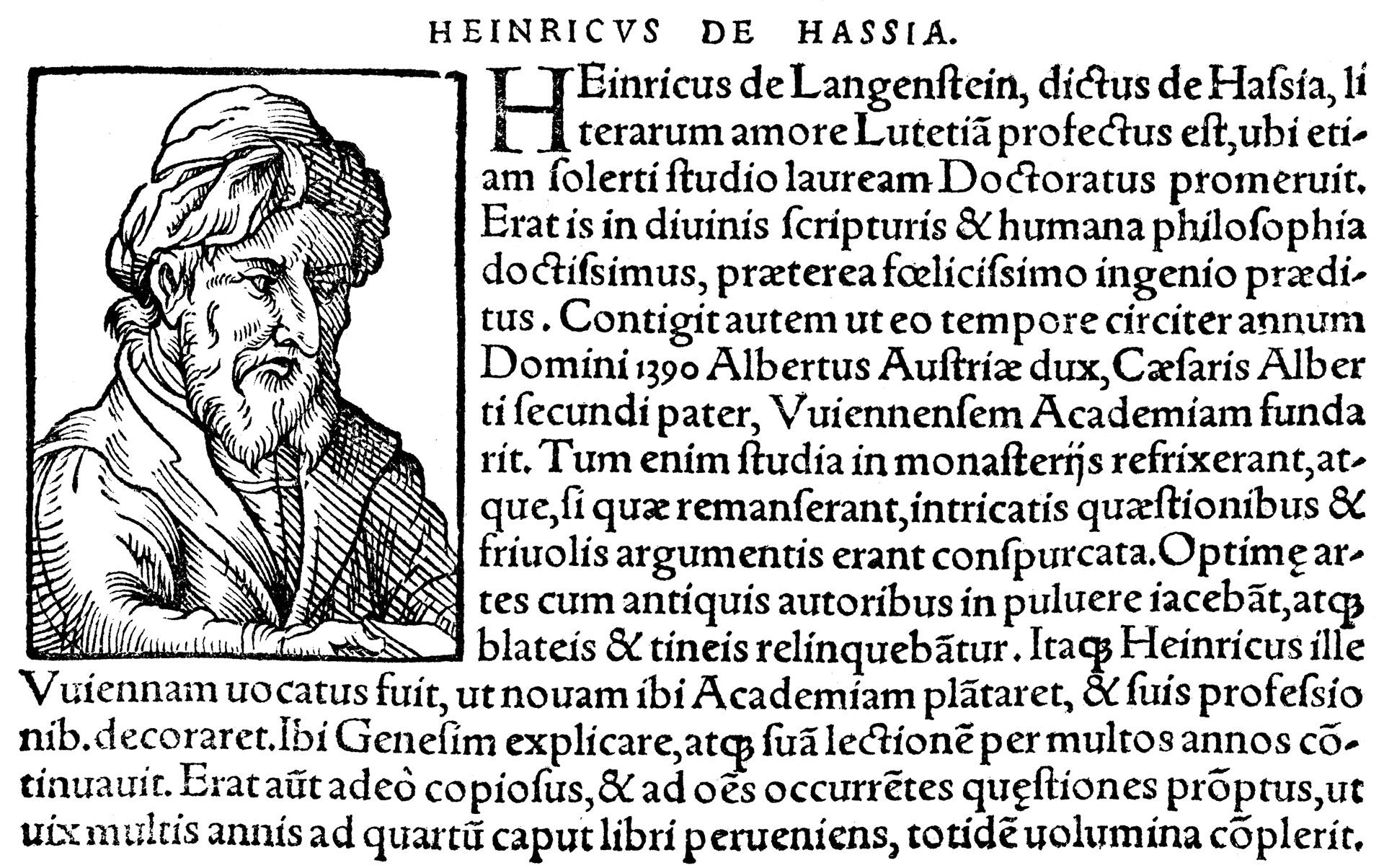
Henry poses a ludicrously bizarre yet metaphysically troubling question regarding the possibility of the generation of one species from the putrefying corpse of another species: that of whether a fox can spontaneously be generated from a dog’s carcass. Even more grotesquely unsettling is Henry’s strong suspicion that it is not clear whether all men are of the same species or not, and so too with dogs and horses; [since] corpses which had been of the same species when living might differ in species from one another when corrupted.[2]L. Thorndike, A History of Magic and Experimental Science, Vol III (New York: Columbia University Press, 1934), 485. 380 For Henry of Langenstein, putrefaction creates a differential productive field in which natural evolution is transmogrified into a sinisterly putrid inter-species production line. The so-called beloved creatures of God, in this corrupt scenario, are so unfortunate that they might be the festering fruits of rotten dead worlds and corpses. It is not only that forms of different species can overlap in decay, but that, according to Henry of Hesse, following the scholastic polymath Nicole Oresme and his theory of qualities or accidental forms, in putrefaction one species can uniformly or difformly deform in such a way that it gradually assumes the latitude of forms associated with other species. These deformities can progress to such an extent that one species might engender an entirely new species, an unheard-of thing, a universe whose reality can only be speculated upon. The gradational movements of decay – its vermicular liquidation across all latitudes and longitudes thus create fields of differential deformity wherein the rotting corpse of one species or formal category interpolates between all other known species. In other words, gradients of decay or the blurring movements of rot calculate latitudes and longitudes peculiar to other species by interpolating other forms between them. These interpolated forms are in fact derivatives of the initial form of the decaying species, putrid or thawing forms which are derived as the process of decay differentiates or gradually subtracts from a formation or structural framework. This is suggestive of an affect without the positivity of affirmation – a becoming devoid of desire but driven forward solely by the creeping power of thawing forms and their differentiation across the latitudes of forms already taken by other bodies and entities. In this sense, we can say that in putrefaction the universe is calculated; yet even more importantly, the universe that is sensed or speculated, whether as an idea or a materialized form, is the calculus of an infinite rot – this is the belated epigraph from which we shall begin our investigation into the architecture, mathesis and politics of decay:
The world has its origin in putrefaction.[3] This remark is associated with the Friulian miller Domenico Scandella, also known as Menocchio, who was declared a heresiarch by the Inquisition and burnt at the stake. See C. Ginzburg, The Cheese and the Worms: The Cosmos of a Sixteenth-Century Miller (London: Routledge & Kegan Paul Lid, 1980), xi.
THE CORPSE OF WORLD POLITICS
The whole world is full of corpses.[4]From Sweet Movie (1974) written and directed by Dusan Makavejev.
If political systems are constituted of formations – both in the realm of ideas and in concrete structures – then, like living species, they also are subject to the troubling deformities brought about by the process of decay. In fact, Henry of Langenstein’s formula of decay as a weird interpolating or extrapolating differential dynamism calculating the entire universe through the putrefying gradations of a corpse finds its most refined expression in politics and on socio-political grounds. The power of differential interpolation or weird affective dynamism lends the idea of localized or isolated decay a universal twist. What is rotting is indistinguishable from the wholesome remainder: not only can the decaying part generate the healthy parts through differentiating into their forms and ideas, the healthy parts themselves may indeed be the gradients of a decaying part. That is to say, in decay the origin qua the ideal shrinks more and more toward nothing and becomes unrecognisable, whilst the idea is spewed forth from the differential subtraction of the ideal. To put it differently, in putrefaction, it is not the decaying formation that is derived from an idea, but the idea that is differentially or gradationally formed through putrefaction. The idea, accordingly, is a deteriorating husk belatedly formed over an infinitely shrunken ideal. It is in this sense that the most proper form of a political formation – its idea – can be the product of a process of decay feeding simultaneously on the unidentifiable corpse of the ideals of that system along with the putridly amalgamated forms of other decaying systems.
The process of decay constructs the idea only as a byproduct of the differential regurgitation of a shriveling body which is in the process of becoming less and less, without ever finding the relief of complete annihilation. This is to say, once again, that the troubling aspect of decay has to do more with its dynamism or gradation than with its inherently defiling nature: The most proper form of a formation such as a political system is not enveloped, as an origin or a priori ideal core; it is rather unfolded as a form which is differentiated a posteriori from the putrefaction of that formation or political system. The ideas of the wholesomeness and decaying (whether in regard to design, function, economy or ideas) of socio-political formations, accordingly, are posited as the latter products of a putrefying system. Yet this is not where the scenario of rot ends. Decay does not result in an equivocation between putrid and wholesome; it rather constructs both ideas as its gradationally proper forms, so that what is considered wholesome can in fact be seen as a rotten derivative of an initial construction that has limitropically diminished. The reverse of this scenario is not only possible but is even more prevalent: through putrefaction, the system or construction can assume forms and ideas associated with those systems or constructions which have whether rightly or wrongly been assumed wholesome.
The obvious, yet gullible, objection is that such an investigation of the politics of decay is not a universally or globally-relevant political issue or project, because a discussion of political rot is supposedly relevant only once one makes assumptions about the Middle East or the Balkans. In other words, in order to speak of political decay and its mechanisms, one has to provide an example such as Dubai or Bucharest otherwise the problem of decay is not that relevant. If this is not a blind and oversimplified identification of world politics, it at least indicates a failure to understand the mechanisms at work in decay. Not only because a rotting political formation can germinate other forms which might overlap revolutionary, emancipatory and civilised political formations, but also because Western political formations and civilisations might indeed be the degenerate forms of an already rotten and limitropically decomposed Middle-Eastern or Balkanese socio-political formation. In this sense of putrefaction and rot as persisting and creeping, political decay casts a morbid shadow on the question of relevancy (or irrelevancy) and swiftly neutralises the idea of a ‘localized rot’. There is no decay whose swollen and slimy nodules of rot – its differentiated forms have not already interpolated themselves between all known and unknown forms in the softest and smoothest way possible so as to disguise the deterioration or putrefaction of the whole. These are just a few of the numerous conclusions to be drawn from a politics of decay; conclusions that hardly any political system or agency despite testifying to the current fetid atmosphere of world politics is ready to admit. The reason for this ironically passive stance, frequently espoused by both the right and the left, is that such conclusions overthrow certain presumptions about the fundaments, ideas and concrete formations of socio-political systems and agencies. What putrefaction changes, mimics and hollows out is not only the surface of a system but also its essential interiority, all the way down to its inner ideals, fundaments, axioms and so-called necessities. It is this spontaneous threat against the interiority of the system or formation from within that no political system or agency is willing to acknowledge, for it is exactly the admission of such a resident threat – the chemical evil of decay – that casts doubts on one’s political agenda or the legitimacy of an emancipatory socio-political formation. In short, to profoundly doubt the interiority of one’s politics or political agency can hardly be anything other than a real political faux pas.
World politics and its systems whether erected on the side of outright repression or on the side of emancipation – have every reason to be wary of a politics of decay, because the ultimate truth of decay is that it is a building process that builds a nested maze of interiorities whereby all interiorized horizons or formations are exteriorized in unimaginably twisted ways. To put it simply, decay is a process that exteriorizes all interiorities via their own formal or ideal resources (capital?); and in doing so, its politics and schemes of complicity operate not on behalf of the interiority of the horizon (of any kind) but rather on behalf of the exteriority which demands their inflection to the outside. For this reason, we shall simultaneously explicate the weirdly-resident, or undercover, exteriorization of decay in regard to space and time so as to subsequently draw out a formalism of decay’s dynamic process wherein the abstract matheme of decay gains a chemical disposition, and the chemistry of putrefaction is distributed in a mathematical space. The embracing of a politics of decay as a building process toward exteriority, and the possibility of political intervention against decaying formations, both demand a systematic investigation that criss-crosses territories associated with chemistry, mathematics, biology, geophilosophy and ontology. Without such a preparatory investigation, one risks either over-aestheticising decay as the fetish of the age, or falling into a moral credulousness that sooner or later will host a political parasite which cannot tolerate any doubt regarding the wholesomeness of its interiority. As a mere overture to the politics of decay, this essay, accordingly, proceeds to expound on the calculus of putrefaction – together with the reason as to why we associate decay with calculus – with respect to its conceptions of space, time, form and dynamism.
Since decay is the intensive destiny of terrestrial life and ecology, tellurian formations and earthly thought, a geophilosophy or tellurian politics that does not inflect upon its intensive destiny has its head – speaking entirely non- metaphorically – in the clouds.
DECAY AS A BUILDING PROCESS, OR EXTERIORIZATION VIA NESTED INTERIORITIES
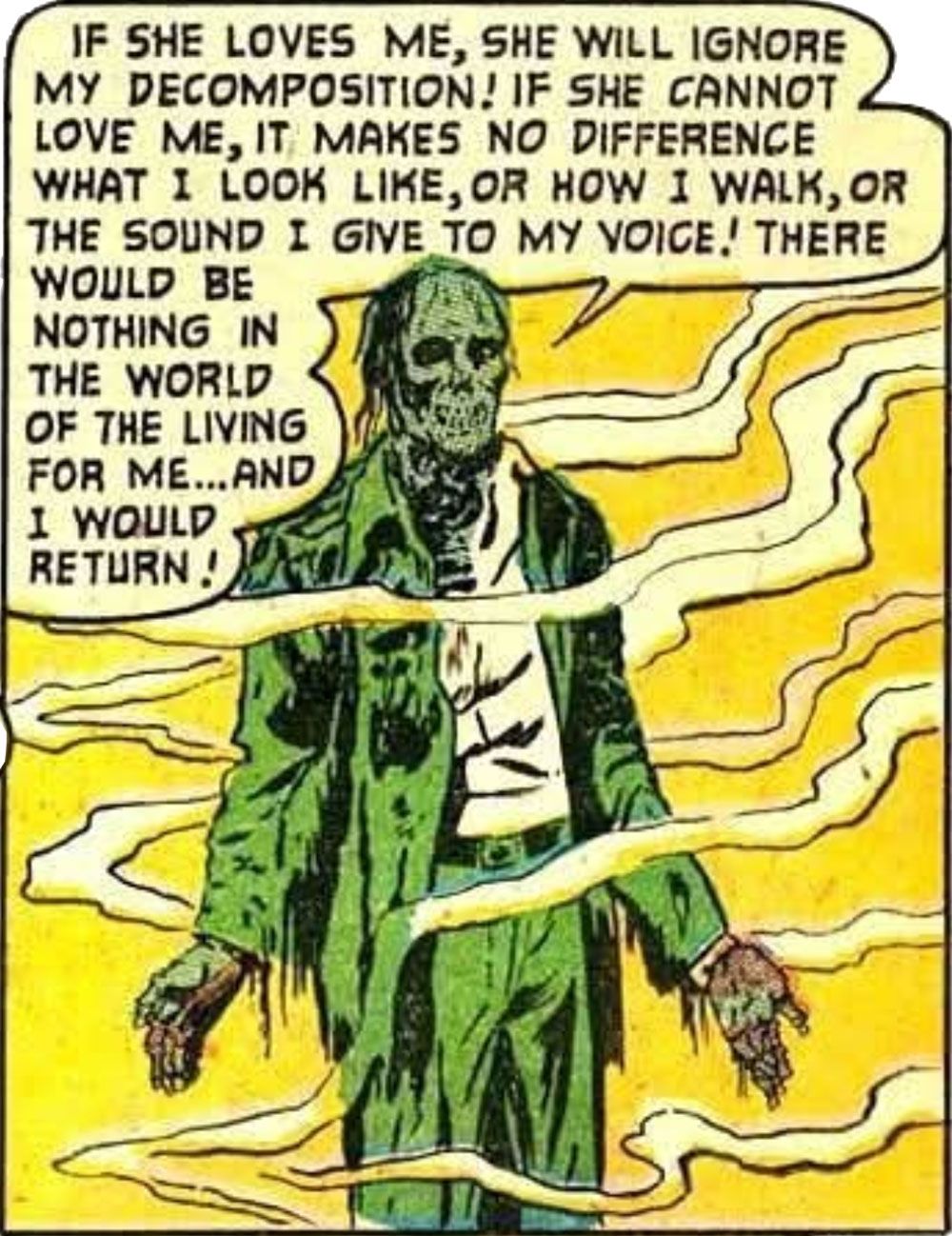
The first axiom of this essay is that decay is a building process; it has a chemical slant and a differential (hence open to mathematical formalisation) dynamic distribution. The process of decay builds new states of extensity, affect, magnitude and even integrity from and out of a system or formation without nullifying or reforming it. The decaying formation is dispossessed of its chances to die or to live wholesomely, to be abolished, reformed or delivered to its origin.
For this reason, decay is an irresolute process of building that potentiates architectures which, whilst infinitely open to new syntheses and transformations, cannot undergo complete annulment or return to their original form.
One of the basic questions regarding decay as a building process is, thus far, the question of its vectorial alignment: Is decay a positive or a negative building process? The answer is that the building process of decay is subtractive, which is to say, it is concurrently intensively negative and extensively positive. Just as the vector of perpetual subtraction adds to the subtracted amount by deducting from what is subtracted, the process of decay generates differential forms by limitropically subtracting from the rotten object. This process is manifested vividly in a rotting fruit as it generates gradients of decay and differentiates into close and distant derivatives, whilst at the same time progressively shrivelling. The differential or germinal derivatives of the rotting fruit – its rancid smell, maggots, colour changes, secreted enzymes, etc. – constitute the positive building vector of decay which extends outwardly. Yet the shriveling body of the fruit as it continuously shrinks forms the negative building vector of decay. As long as the fruit shrivels, it gives rise to its derivatives or gradations of decay. In fact, the longer and more the object shrivels, the more remote and distant – hence weirder – its putrid derivatives and differential forms become. The process of decay, therefore, exacerbates the blackening indeterminacy already entrenched at the heart of subtractive cosmogenesis: It is no longer possible to determine how much one can lose or shrink before it becomes void and zero or how much one can spew forth and generate before it becomes nature or God.
Confronting the problem of the infinitesimal persistence of the decaying object, it becomes increasingly difficult to say when the process of decay ceases to exist and is supplanted by complete ontological annulment or extinction. However, the problem of infinitesimal persistence (becoming infinitely close to zero but never effectively becoming zero) poses yet another perplexing quandary in regard to the process of decay, a problem which can be summarized as follows: If the decaying object never completely disappears, and, in so far as it continues to become less, generates derivatives and maintains a germinal capacity, then does this mean that death never occurs and the minimally surviving object can never be fully exteriorized? An affirmative answer to this question surely risks advocating a form of vitalism that is ultimately unable to think exteriority. An outright negative answer can also lead to a form of utopian naivety for which the outside – viz. inflection upon death and binding exteriority – is always available and at hand. In order to examine the process of decay whilst avoiding such tortuous traps, we propose that decay as a building process renegotiates – or simply twists – the loci for the effectuation of architecture, exteriorization and binding death. In brief, the process of decay finds and develops a different site for the unilateral power of negativity. The infinitesimal persistence of the decaying object – in other words, its limitropic convergence upon zero – and correspondingly, its unceasing germinal power in decay, should not be examined in an isolated manner. In decay, the infinitesimal persistence of the decaying object marks a limitropic line of transition along which the interiority of one decaying object falls back onto the interiority of its constitutive ideas, and those ideas in turn are undone to other fundamental interiorities whose intrinsic nature is exterior to the decaying object. As the ideas break into their more fundamental but minimal ideas, the infinitesimal persistence of the object becomes asymptotic to the extinction of the object. Correspondingly, if in the subtractive logic of decay, remaning (viz. residing within the interiority of what is left) means remaining less (viz. moving in the direction of more fundamental interiorities which constituted the horizon of what had previously remained), then to remain indefinitely means to limitropically converge upon zero. Therefore, although the inward and depthwise movement toward the constitutive ideas or the ideal substratum which manifests itself as ‘remaining less’ happens only within the confines of different horizons of interiority, its dynamism limitropically embraces the zero of ideas. In doing so, the interiorized movement becomes asymptotic to a line of exteriorization upon which death is inflected, and objectal persistence in decay becomes an asymptotic expression of loosening into the abyss.
In order to simplify the above argument, we shall develop a spatial model for decay whereby both the infinitesimal persistence of the decaying object (i.e. a horizon of interiority) and its outward differential productivity become the essential vectors of a process of exteriorization – a corrupt method of binding exteriority. The reason why, in decay, binding exteriority occurs in such a twisted way, comes down to the following: living things undergo decay, not so much because decay and life come hand-in-hand, as because the living – whether living on a biological level or not – secures a horizon of interiority whose envelopment must be exteriorized according to the differential rates or gradients that bind the horizon to that which is exterior to it. In other words, if decay is most frequently associated with life, it is because the manifestations of life are all founded on horizons of interiority.
All that is interiorized decays.
If the process of building is not exclusive to architecture and if, wherever building as a process is actualised, architecture too is potentiated, then the locus of architecture can also be renegotiated. Architecture and its socio-political aspects can be approached in territories where they are least expected. We call this architecture with an anomalous locus, ex situ architecture. The process of decay as a building process, as we will elaborate in what follows, generates an ex situ architecture where what is built cannot not be dwelled or grounded in any possible way. Because what is in the process of being built, in this case, is a nested exteriority wherein one interiorized horizon (such as the organism) falls back upon its precursor exteriority, which itself is another interiorized horizon built upon an exterior horizon which is in the process of loosening into its abyssal backdrop. Just as the lines of envelopment and growth for any horizon of interiority (whether the organism, earth, sun, or matter on the cosmic level) are convoluted and circuitous paths (umwege) toward the precursor exteriority, the line of exteriorization is also a circuitous path drawn along and through the horizons of interiority which fall back, decompose and loosen into each other.

Consider an elucidating – albeit reductive – example: Terrestrial organisms mark the organic interiority enveloped against the inorganic materials which under hospitable conditions can envelope the potencies of life. As both the vessel and the medium of complicity for inorganic materials, Earth is yet another interiorized horizon which is set against its immediate source of energy, the Sun. However, the solar empire is, in the same vein, an interiority enveloped and determined against its exterior cosmic backdrop. This nested continuum of interiorities goes on to the material substratum of all horizons. Yet even matter as the fundamental requirement for embodiment and materialisation is an enveloped horizon whose interiority and supposed necessity is a roundabout expression of a refractory indifferent universe in which even matter is an interiorized – hence idealised – contingency. Accordingly, what decay or putrefaction draws is a line of exteriorization toward the precursor exteriority. The organism decomposes into its inorganic terrestrial environment, the tellurian bedrock is in turn decaying into the solar horizon as the Sun’s thermonuclear decay dissipates the star into its cosmic backdrop, whose material veneer, in turn, is peeling away. Decay draws a line of exteriorization which traverses the nested interiorities in order to asymptotically bind exteriority. Therefore its dynamism is subjected to differential bonds which connect and nest these interiorities within each other. For this reason, such a differential line of exteriorization or dissolution into conceptless exteriority is neither manifestly a return to an ideal origin nor a decontraction back into the originary exteriority where even matter enjoys no privilege of any kind. This is because decay’s line of exteriorization builds a space of complicity between horizons of interiority wherein the unilateral power of exteriorization is mathematically and chemically contorted. This contortion or twist happens in a specific fashion: That which is exteriorized or dissolved into its precursor exteriority becomes a differential interpolation of a nested series of interiorities whose limitropic convergence upon zero (i.e. inflection upon death) has a weirdly chemical – thus contingent and productive – disposition which simultaneously forecloses the idea of return to the ideal origin and differentially convolutes the path of decontraction to the originary flatline of death. Let us recapitulate the reasons why the process of decay does not abide by the laws of return to the ideal origin and the energetico-dynamic principles of decontraction:
The site where decay’s process of exteriorization is effectuated is the interiority of the horizon. Therefore, the course of exteriorization conforms to the differential fields enveloped inside or extended from the interiorized horizon. Decay loosens up the interiority of the horizon, firstly through exploiting the horizon’s own differential links between its actualities and potencies; secondly by conforming to the differential bonds between the interiority of the horizon and its precursor exteriority. Yet precursor exteriority (whether as the material, systematic, formal or ideal fundament, as in the case of inorganic materials and the organic horizon) is itself an interiorized horizon determined by its inner and outer differential bonds. This nestedness of interiorities wherein every idea or form differentially – and in this case regressively – inflects the next idea or form keeps decay’s line of exteriority in conformity with the differential bonds and the increasing inflections of the nested horizons of interiority. Therefore, decay’s process of exteriorization does not bind the outside from without so much as it binds the exteriority from within nested horizons of interiority. This binding of exteriority, however, is in conformity with differential fields inherent to each horizon of interiority as well as inter-connective differential bonds between these nested horizons. Consequently, the course of decay’s process of exteriorization. is conducted in accordance with spatial involutions, differential rates and modes of distribution immanent to nested interiorities. Since courses of exteriorization are subjected to differential peculiarities and twists of the nested space of interiorities, effects of exteriorization – that is to say, the effects of binding exteriority and inflecting upon death on interiorized horizons and formations – are also expressed in different ways. For this reason, the persistent involvement of nested interiorities undoubtedly complicates the philosophical, political and social implications of binding exteriority, inflecting upon death and extinction, for all formations and systems (from basic terrestrial formations to social networks, political systems and the horizon of thought). In decay, what is considered as the bedrock of the originary turns into a slimy swamp of nested interiorities where the bottom is always too soft and unsolid to hold or ground anything. The sinking is neither swift nor clean.
The differential and regressive movement through nested horizons of interiority which the process of decay undertakes is not unidirectional and simplex, since, as argued above, this process conforms to the space of interiorities, which are nested within each other, not according to a one-to-one line of correspondence but according to a differential and multiplex nested structure. For example, in decay an idea qua an index of interiority is not merely differentially founded on one precursory idea but on a multitude of other fundamental and constitutive ideas which themselves are also inflected within different ideas. The image that the nested space of interiorities – as the site of decay – calls to mind is not a unidirectional tunnel of connected niches whose size and qualities are uniformly changing, but rather a rabbit warren or a worm-ridden cheese where every niche or hole opens into numerous smaller or larger interconnected caverns and holes. As the liquid that enters the first niche seeps into all such connected caverns, the gradationally rotting object, idea or formation also oozes, or more accurately, is exteriorized into the multitude of interiorities inside which it is nested. The model of exteriorization, in this sense, follows (1) the instantaneous rate of change between the decaying interiorized horizon and those non-uniformly nested interiorities into which it is being exteriorized, and (2) the instantaneous rate of change between the inter-connected multitude of interiorities which are differentially exterior to the decaying horizon of interiority. The idea X is inflected back upon its nested fundamental ideas which are themselves differentially interconnected (X inflects back to X1, Y, Z, D, F, X2 Z3, X3 Z2 Y1, D2, Y2, D3, …). The process of decay, accordingly, traverses multiple ever-changing ideas or variables (as indexes of interiority). Therefore, in order to differentially exteriorize or putrefy an object, the process of decay must operate according to the instantaneous rate of change not only between the decaying object (the variable X) and nested interiorities gradationally exterior to it, but also between those interiorities/variables into which X is limitropically diminishing. The instantaneous rate of change, accordingly, is calculated between X and X1, Y, Z, D, F, X2 Z3, … as well as between X1, Y, Z, D, F, X2, Z3, …. themselves. The interconnected and nested space of interiorities, for this reason, requires that decay operate as an instantaneous rate of change between different horizons of interiority or points of inflection. It is this ability to exteriorize a horizon of interiority via the relation – viz. nested interconnections – between exterior horizons which themselves are being exteriorized and thus changing – that posits the process of decay as the blackening counterpart of the differential calculus. This is because differential calculus is a technique to determine and calculate the instantaneous rate of change between different uniformly or difformly changing variables. Just as Leibniz’s solution for calculating the instantaneous rate of change between different changing variables involved the concept of infinitesimals, decay exteriorizes an object into its exterior backdrop through the limitropic shrinking of the object. For a decaying object, what is considered the exterior backdrop – as argued earlier – is a nested space of interiorities whose complicities do not allow the process of exteriorization to be vectorially unidirectional, structurally uncomplicated or, as a consequence, unproblematic. The complicity between interiorities cannot be undone or decontracted in a simple fashion, for such complicity engenders differential fields which can only be exteriorized by the subtractive logic, chemical techniques and mathematical dynamism of decay as a building process and a model of complicity. The political implications of decay as a model of complicity corresponding to the original ideas buried in differential calculus call for a thoroughgoing investigation into the calculus of decay.

The differentially regressive plunge of decay into the depth of nested interiorities always finds an extensive echo in the form of differential reverberations of rot. There is no depthwise putrefaction or nigredo without the wriggling of worms on the surface and the mephitic extension of the rotting object into the air. Decay’s intensive exteriorization of nested interiorities has an outward productive expression which is subtractively correlated to the blackening line that traverses the confines of nested interiorities. The more enveloped and interiorized the horizon, the more chemically productive its extension to the outside. It is as if the degree of interiorization – that is to say, the spatial confinement of the horizon and the amount of capital enveloped for sustenance and development – is directly proportional to the chemical fertility of the horizon when it begins to extend outside of its confines. Here, the degree of interiorization does not become an impeding factor for the extensive loosening of the horizon, but contributes to the differential extension of the horizon to the outside as well as the chemical – hence contingently dynamic – productivity of the horizon during decay. This illogical proportionality between the insistence on remaining interiorized and the spontaneous chemical loosening into the outside shares more with the laws of the grave than with the laws of nature – the putridly productive amalgamation of the restrictions of nomos and the confines of taphos.
We argued that decay is neither wholly negative nor wholly positive; it is rather subtractive.
The subtractive logic of decay suggests that decay does not merely build the nested horizons of interiorities as an intensive limitropic vector toward zero but that it also builds via extensive deployment of interiorities so as to create a dynamically contingent universe. Leibniz – following the proto-scientific ideas in the Middle Ages – frequently uses as an example the model of a rotting body (usually cheese) whose remaining perforated body suggests an intensive limitropic convergence upon zero. Yet this intensive movement in the interiority of the object, manifested as shrinkage, cannot exist without another opposite movement which extends the body into the outside in the form of contingently differentiated ideas or smaller bodies. At the same time as the apple shrivels, it spews forth worms as extensively deployed and hence dynamically contingent interiorities. These worms or derivatives in turn envelop smaller worms and further derivatives which contain yet smaller bodies ad infinitum… all ready to heave forth and be extensively deployed in the most contingent manners. This applied dynamics of contingency marks the rise of chemistry as a process commencing from within. The subtractive movement of decay’s blackening line of exteriorization through nested horizons of interiority produces two functions: firstly, a limitropic convergence upon zero dubbed complicatio and formally expressed as progressive shrinkage; secondly, a differential extension or divergence from the object, called explicatio and expressed in the form of a dynamic and contingent process of productivity. Complicatio and explicatio are subtractively correlated, in such a way that the intensive interiority of complicatio contributes to the extensive deployment of interiorities in explicatio. The decaying idea, in this sense, not only undergoes a nested twist as it limitropically approaches the zero of ideas, but also a productive twist as it is subtracted to the outside. For this reason, decay’s process of exteriorization is in complicity with interiorities and their differential fields on two levels: (1) the intensively enveloped – hence nested – interiority of the decaying idea or rotting object; (2) the extensively developed interiorities which are differentiated from the rotting object and whose contingent world points to a dynamic chemistry which enforces the irruptive contingencies of time mobilized through the involutions of space. To sum up, decay’s line of exteriorization has, weirdly, a productive disposition which generates extensively and contingently distributed differential fields (or sites of chemical activity). The eruption of these explicated differential fields reinforces the necessity for a complicity between the process of exteriorization (viz. binding exteriority and inflection upon death) and horizons of interiority, whether as fundamental terrestrial formations or socio-political grounds and networks.
The three reasons enumerated above briefly explain the complications that the process of decay brings about for the idea of return to the origin, and for a philosophy based on the implications of binding extinction and decontraction into originary death. Yet they also diagram the spatial model in which the process of decay operates. In order to present a formalism of decay which provides us with a mathematical model for decay’s dynamism, we must, in addition to decay’s conception of space, examine decay’s conception of time. For this reason, we shall inquire into decay’s conception of time and how it is expressed by the spatial involutions generated by decay’s line of exteriorization as it traverses nested interiorities.
MEMENTO TABERE: THE TERNARY CONCEPTION OF TIME, OR THE MISSING LINK OF CHEMISTRY
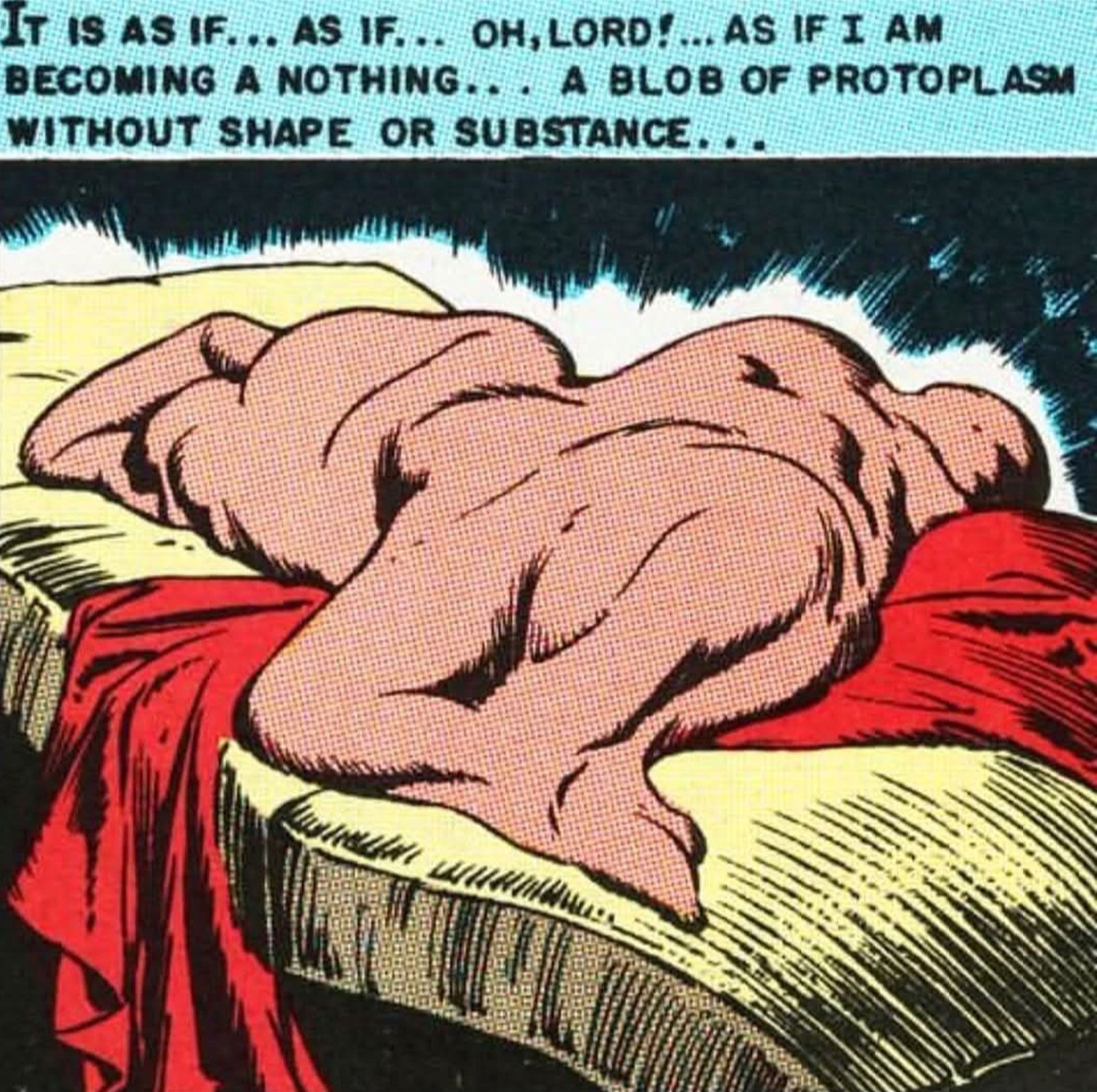
The process of decay has a spatial model comprised of intensive envelopment and extensive development, and whose subtractive correlation creates differential fields which are sites for the generation of abstract twists and deformities. In other words, these sites spatially narrate chemical activities potentiated by time’s contingencies; activities whose irruption endows the spatial plot with a holey and porous underside. Chemistry, therefore, as applied dynamics wherein contingencies of time are extensively enforced by the involutions of space, requires a third conception of time whereby absolute contingencies of time can operate from within the interiority of a horizon. If putrefaction marks the beginning of chemistry, its subtractively-productive process needs such a conception of time so as to mobilise the contingencies of time as the chemical traces of those spatial involutions and envelopments which are asymptotic with the conceptless exteriority of space. This brings us to more fundamental questions concerning the role of time in any politics or philosophy incorporating decay as the building process of its formations or ideas:
What is the relation of decay or putrefaction to time?
Is decay a narrative conception of time’s indifference to ontic differences, or is it the experience of time as presence which – in a Heideggerian fashion – turns death into an infinitely-deferred occurrence through Dasein’s already-dying? What exactly is the role of time in decay, and does this role reinscribe the correlationist appropriation of time through experience and presence, or amount to an idealism which favours and privileges time over space? And finally, if time is imbued with radical contingencies which suspend all affects and relationships through the indifference of time as an impenetrable alterity, then how can decay as a building process bring about the opportunities of complicity between the involutions of space and contingencies of time? It is evident that decay’s conception of time, which emphasizes the role of time in the chemistry of decay, is so pivotal that it determines different conceptions of decay and putrefaction. Decay as a romanticized concept, decay as a necrocratic fetish, decay as a differential form of emptiness, decay as an umwege (maze) toward base-matter and decay as an ontological fate, are all decided by different conceptions of time, in itself and in its relation to space.
The chemical potency of putrefaction (tabes) which decomposes the object into other horizons of interiorities across infinite latitudes of forms, attests to the fact that there is a complicity between irruptive contingencies of time and spatial folds and inflections of space.
Through such complicity, the diachronicity of time and the exteriority of space are evinced by each other: Whilst space is perforated by time’s emptiness or fundamental indifference, time’s contingency is formally expressed by space’s unbound ferocity for the assimilation of any ground of individuation. It is this collective fold of complicity – neither demanding a commonality between the parties involved nor the substitution of either of them by the other – that makes decay an unwholesome participation between the most abominable aspects of time (non-belonging and pure contingency) and the most degenerate aspects of space (space’s tendency for infinite involutions which undermine any potential ground for the emergence of discrete entities). It is the complicity between the worst nightmares of space and time that brings about the possibility of putrefaction (even an infinite decay) as a differential form of irresolvable emptiness disguised as ideal objectivity with a generative twist. To think of this impregnable hollowness endowed with a generative proclivity, one can envisage an infinitely porous abomination, an obscene hollowness, folded and mobilised in such a way that it has an objectal grimace: The mediaeval danse macabre depiction of the Tree of Rot – a ‘difformly difformly difformly difform’[5]See L. Thorndike, An Anonymous Treatise in Six Books on Metaphysics and Natural Philosophy. The Philosophical Review 40, no. 4, 1931: 317-40 (Nicole Oresme) tree trunk which spews forth a cosmic range of both familiar and nameless creatures as a differential extension of its arborescent emptiness.
The complicity between space and time – that is, between the dynamism of inflections and the irruption of contingencies – brings forth the possibility of chemistry as the concomitantly softening and loosening dynamism of putrefaction.
As the chemical space of decay, putrefaction exposes the object to the contingencies of time so as to thaw the object’s ideal integrity and initiate its loosening into the conceptless involutions of space. In order to explicate the nature of this complicity as an intrinsic act for the chemical dynamism of putrefaction, first we must clarify the modes of complicity at work here. If time belongs to no one and is absolutely indifferent to ontic differences, then how can its worst nightmares participate with space? And if, notwithstanding such irresolvable incommensurability, time and space can indeed participate with each other, then how can this participation be conceived outside of the correlationist ambit? Our conjectural solution for these problems concerning a blackening complicity between space and time consists of two stages: In the first stage, our solution entails the implementation of two conceptions of time. On the basis of these two conceptions, we seek to bridge the exteriority or diachronicity of absolute time and the exteriority of space. This means that in addition to the absolute conception of time, an intermediary conception is also required. The intermediating time must be interconnected with the absolute conception of time (i.e. time as an indifferently impenetrable alterity that belongs to nothing and no one) as a manifestation of the latter’s pure contingency. In other words, the intermediating conception of time should itself be a production of absolute time’s pure contingency which suspends all natural laws, obstructs the operation of belonging and nullifies ontic differences. To put it differently, the intermediary conception of time should itself be a symptomatic production of absolute time’s pure contingency. Accordingly, the intermediating time does not suggest a dichotomous scission in time, but a temporal and contingent conception of its absolute form. Only the vital temporality of this intermediating time can bring about the possibility of ontological difference in relation to appropriated regions (scales) of space.
Space-time syntheses – necessary to support ontological determination – require the bifurcation of Time into two different but interconnected conceptions. Without such a bifurcation, absolute time and thanatropic space remain inherently exterior to each other and cannot ground the conditions for ontological determination on any level. It was the Stoics who for the first time fully realised the necessity of having different conceptions of time with the aim of explaining the vital syntheses of time and space. In order to explain the intensive vitality of determination qua difference-in-itself, Deleuze adapts and ingeniously modifies the Stoic model so as to develop and employ two conceptions of time, the time of aîon and the time of chronos.[6] See John Sellars, ‘Aîon and Chronos: Deleuze and the Stoic Theory of Time’. COLLAPSE III, 177-205. Since the indefinite non-pulsed time of aîon is inherently closed to vital bodies, there must be another conception of time capable of synthesizing with the scales of space and supporting vital vibrations. This second conception of time is the pulse-time of chronos, which supports organic vitalities and provides time with qualities compatible with the structure of corporeal beings. Accordingly, the first already-established stage of our solution requires the bifurcation of Time into two different but interconnected times. Following Deleuze, but in contrast to his quasi-Heideggerian reading of time, these two conceptions are reabsorbed in this fashion:
1. The ungraspable and cosmic time which belongs to nothing and no one. It is the absolute time of pure contingencies or cosmic climates which unilaterally suspends all laws and eliminates all necessities.
2. The temporal conception of time, which is time insofar as we experience it and which, therefore, is characterised by the access to its presence rather than its quiddity per se. Yet, even more importantly, the temporal conception of time supports the temporality of beings by providing the conditions for their ontological determination and emergence. These conditions are nothing but the contingencies of the cosmic and absolute time. The temporal conception of time, accordingly, envelops and foregrounds contingencies of absolute time in the form of conditions for the emergence of life (or the subject of temporality). Therefore, the temporal conception of time is an interiorized or bounded form of absolute time, a temporal set wherein contingencies are taken as conditions for the determination and the continuation qua temporality of existence. In other words, temporal time posits the contingencies of absolute time as the ground for the determination of difference and ontic emergence, through a bracketing and interiorizing of those pure contingencies. We call this temporal conception of time, vital time or the time of determinations and making differences. Constitutive to the ground of life, vital time is accentuated in the organic realm through the compatibility of its interiorized and sequential structure with the sequential growth or the rhythmic difference of organic interiority. In other words, the interiorized contingencies of vital time become structurally compatible with the involutions or interiorized horizons of space. Without such basic structural compatibility between space and time – albeit at the cost of their envelopment and interiorization – ontological determination and the emergence of ontic differences which are tied to space-time syntheses are impossible.
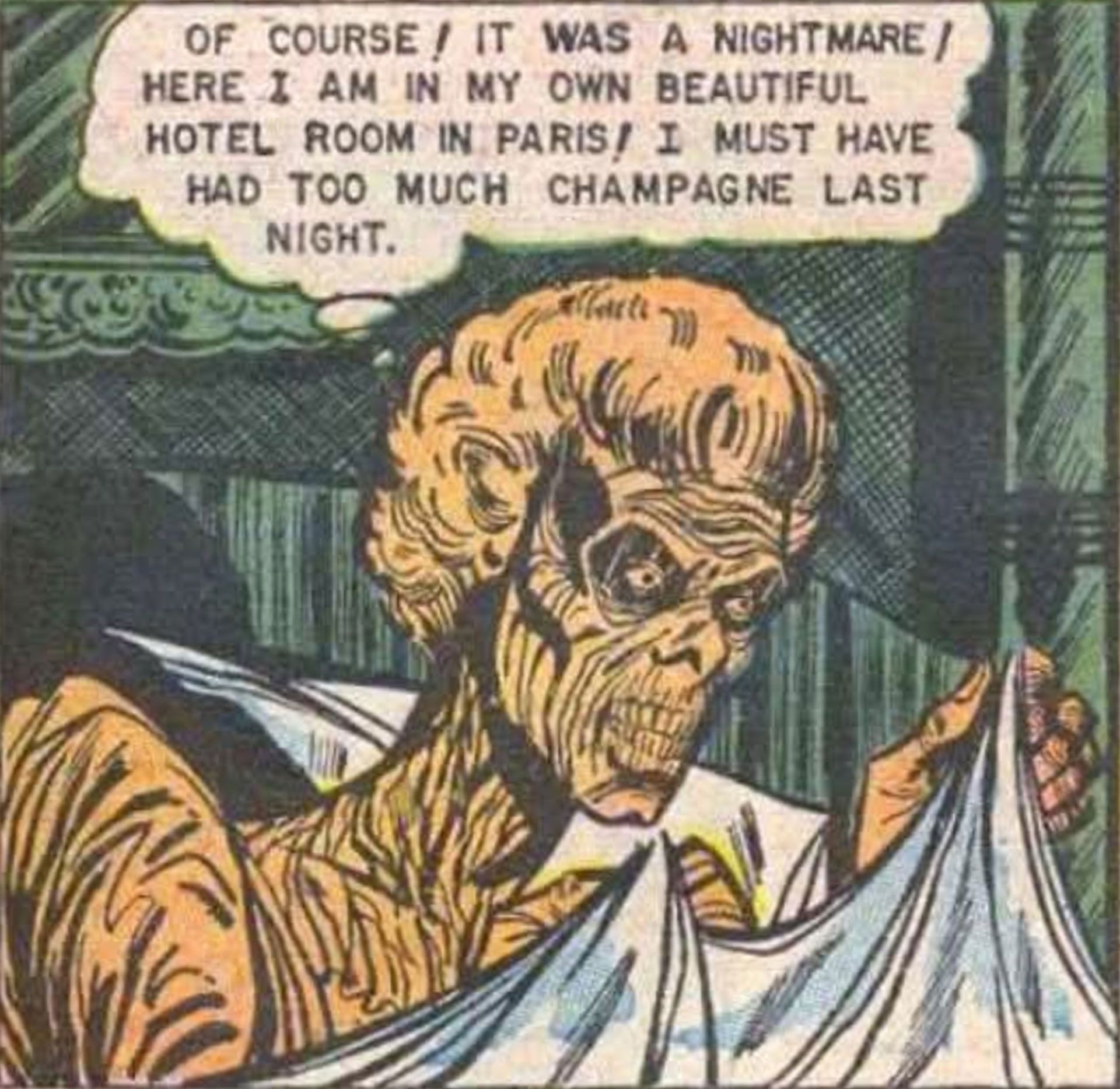
Vital time – the intermediary conception of time – emerges from the cosmic time of pure contingencies as ‘an interiorized set of contingencies.’ As a temporal set, vital time interiorizes contingencies as its elements. Since the function of the set is interiorization, it can intensively determine the contingencies of absolute time as conditions for the emergence of life, or as necessities for making difference. In the process of interiorizing contingencies and realizing them as concomitantly temporal and necessary conditions, vital time appropriates the exteriority of cosmic time and turns it into an interiorized conception of time accessible by life and its manifestations. Yet the cosmic time of non-belonging and pure contingencies can never be fully appropriated or assimilated (interiorized) by vital time and its temporal conception. This is because vital time is itself contingent upon cosmic time as a temporal condition for the interiorization and bracketing of absolute time’s contingencies and their realisation as the conditions required for the emergence of life. This means that since vital time is itself a temporal condition qua contingency of cosmic time, it cannot fully interiorize the exteriority of absolute time qua pure contingencies. Vital time suggests only one of the infinite pure contingencies of absolute time; its fundamental functions are simultaneously supported and derailed by other contingencies. For this reason, contingencies of cosmic time are never fully reintegrated and absorbed within the manifestations of life (viz. realised horizons of interiority) conditioned by vital time. To put it differently, vital time can be interiorized by beings as the necessary condition for their emergence because it is itself an interiorized conception of cosmic time’s pure contingency. This brings us to another problem which constitutes the second stage of our conjectural solution to the problem of complicity between space and time necessary for the chemical dynamism of putrefaction.
If cosmic time can never fully be appropriated by and within vital time, then the horizons of interiority inherent to manifestations of life or ontic differences cannot assimilate and appropriate the contingencies of cosmic time either. Consequently, the interiority of life is a host or a niche for the inassimilable contingencies of cosmic time – contingencies that never completely turned into temporal conditions within vital time but remained part of the unilateral ecology of the cosmic abyss within vital time’s temporal set. Briefly, vital time interiorizes contingencies of the cosmic abyss in order to form its temporality; however, there are still contingencies of cosmic time which, despite being interiorized, defy assimilation by the laws of the temporal set that turns contingencies into vital conditions. These interiorized yet inassimilable contingencies, consequently, implement the unilateral ecology of the cosmic abyss from within vital time and consequently, from within an interiorized horizon such as the organism or the planet. In conditioning the emergence of life, vital time introduces the nightmares of cosmic time into the phenomena of life. The horizon of interiority inherent to the manifestations of life becomes an incubating chamber for the pure contingencies and non-belonging of cosmic time. It is this non-belonging qua principle of negativity that is mobilized by the dynamism intrinsic to involutions of space. The subtractive process of decay is the outcome of such spatial mobilisation whereby the unilaterality of cosmic time underpinned by its irruptive contingencies gains a subtractive – that is, extensively positive and intensively negative – momentum through inflections of space.
As an outcome of its complicity with space, time’s unilateral negativity is imposed on the horizon of interiority in a way that forces the horizon to be concurrently swept away along the extensity of space and intensively shattered on zero qua the eternal.
Thus cosmic time is deployed inside vital time and, correspondingly, inside the life or the horizon of interiority that is conditioned by vital time. This remobilisation of cosmic time’s exteriority and redeployment of its contingencies within vital time and manifestations of life posits a third conception of time which constitutes the second stage of our conjectural solution. The blackening complicity between space and time can only be fully explained via recourse to a third conception of time which is always implicit – as an internal tension – to the dyadic conception of time. We call the third conception of time, the insider conception of cosmic time. It is conceived of as a treacherous insider insofar as it internalizes the complicity between time’s diachronicity and the exteriority of space within the manifestations of life and the horizons of interiority. The conception of cosmic time as the insider redefines the intermediary conception of vital time as a ‘temporal agent’ that brings with it into life’s horizons of interiority the contingencies and non-belonging of cosmic time. In other words, the insider conception of cosmic time interiorizes and cultivates the incommensurable tensions between cosmic contingencies within life and its manifestations – thereby giving cosmic ecology an eruptive (i.e. volcanically extrusive) expression rather than an intrusive insinuation.
In the wake of the insider conception of time, the termination of life does not exclusively mark the temporality of life qua its contingency, because the very interiority of life (its difference and internal vitality) can unfold as the abyssal infinity of material and ontological contingencies whose irruption is equal to death. This unfolding of cosmic time’s pure contingency through life and by life is expressed by decay as a dysteleological process. In this sense, life’s interiority is a medium for the cultivation of incommensurable tensions between the contingencies of cosmic time. And decay is the germinally-cultivated expression of these incommensurable tensions or contingencies along infinite involutions of space – a complicity between time’s subtractive enmity to belonging and the enthusiasm of space for dissolution of any ground for individuation, a participation between cosmic time’s pure contingency and the infinite involutions of space from whose traps nothing can escape.
The process of putrefaction or decay accentuates the compulsion to return toward pure contingencies of cosmic time through the third conception of time (i.e. cosmic time as insider time). This so-called ‘compulsion to return’ instigated by the insider conception of time becomes a source of tension between the principles of cosmic time (i.e. contingency and non-belonging) and the temporal conditions or necessities of vital time. These contingent and subtractive tensions are narrated by the degenerate qualities of space through the process of decay in the form of a progressive softening of forms and loosening of the horizon. We can say that in decay space is perforated by time: Although time hollows out space, it is space that gives time a twist that abnegates the privilege of time over space and expresses the irrepressible contingencies of absolute time through dynamic and formal means. This in-flective mobilisation of cosmic time’s radical contingencies heralds the birth of chemistry as the blackening complicity between time and space. It is chemistry that endows the subtractive process of decay with a putridly productive nature.

FIGURING OUT THE FACE OF ROT, OR IDENTITY AND THE FORMS OF BEING LESS THAN A THING, MORE THAN NOTHING
The subtractive dynamism of decay is generated on the basis of a complicity between space and time which allows for the chemical loosening of the horizon of interiority along nested inflections that are simultaneously extensive and intensive to the horizon. The dynamism of decay utilizes the complicity between space and time as the principle for an unconstrained deformability where loosening and softening – the lytic functions of chemistry and the smoothing functions of differential calculus, i.e. mathesis – are intertwined and unbound. Yet such unconstrained deformability is translated, as elaborated above, into the intensive complicity of nested interiorities as well as the complicity of interiorities in their extensive deployment. Through these intensive and extensive planes of complicity, interiorized horizons asymptotically bind the exteriority of space and the diachronicity of time.
The asymptotic binding of exteriority requires an interpolating dynamism capable of traversing all interiorities complicit in the process of exteriorization as changing variables whose ratio must be calculated. To put it differently, since interiorities are always in complicity with each other, the process of exteriorization must find a way, firstly, to grasp interiorities in terms of their complicities; and secondly, to conduct exteriorization based on the dynamic factors, elements and variables brought about by such complicities. Exteriorization is not possible without factoring in and acting upon the complicities between interiorized horizons. Yet acting upon such complicities – characterized by dynamic relationships and rates of change between horizons of interiority – requires a solution reminiscent of differential calculus, a solution capable of calculating the instantaneous rate of change between changing variables.
The solution of decay’s process of exteriorization for the problem of changing and complicit interiorities/ variables is the limitropic decomposition of the object or formation. Only though the limitropic movement of the object or formation toward zero (whether as the conceptless exteriority of space or the diachronic eternality of time), can the process of exteriorization cut through the complicity between interiorities which is too differentially convoluted to be disentangled or decontracted through regressive thanatropic movement. The limitropic wasting or subtraction of the object (or formation) along its extensive and intensive vectors does not allow for the complete eradication of the object’s ontological registers, structural fundaments or operating axioms. The effect of such limitropic wastage, in which the formation is loosened and softened to no end yet leaves traces which linger as the agents and particles of complicity, has a strong socio-political undertone.
Even after a political formation turns into an unrecognizable corpse, where all of its structural and operative influences have presumably vanished, there still remain active structural fundaments and functional axioms from that formation without whose complicity the political calculus of world politics cannot possibly be formed.
For, once again, in decay the relationship or change between horizons of interiorities (as entities intrinsically susceptible to decay) is possible only through limitropic deterioration toward a zero of interiority. The limitropic deterioration brings about the possibility of the differential interpolation of the decaying horizon between other interiorized horizons and, as a result, instigates the construction of a universal calculus of putrefaction. It is this limitropic deterioration that introduces the lingering and persistent axiomatic remnants of the decaying formation to an unsuspecting universal calculus, as minute but ineradicable agents of complicity.
Neither fully negating the system by overthrowing it nor reaffirming it through reformation, the process of decay imposes a perpetual deformability on the formation without completely erasing its ontological registers and functional axioms.
In short, decay extracts infinite deformability from an interiorized horizon without eventuating in radical erasure or complete transformation. Such perpetual deformability is supported by the intensive and extensive complicity of horizons of interiorities in the form of an unbreakable continuity in which every horizon of interiority either inflects the next or is nested within yet another horizon. Accordingly, it is the ceaseless continuity – in the sense of intensive and extensive inflections of forms and interiorities – that imparts a fluid continuity to the rotting object without essentially turning it into fluid. Each form is only gradationally preceded and succeeded by other forms in such a way that transition along latitudes (of forms) is always blurred. The gradients of deformities are differentially smooth, to the extent that the formal dynamism of rot appears to be that of sludge or oozing flesh. In decay, the solid undergoes a flowing series of deformations without becoming liquid, or in other words, without losing its basic principles of solidity. The wholeness or coherency of the solid is derailed within the fundamental principles of solidity. In a similar fashion, in putrefaction the liquid’s degeneration vacillates between solid and gas, slime or miasma, but in either case it remains fundamentally — albeit minimally — liquid. This minimum body of the element, horizon, formation or object, in fact suggests its concomitant asymptotic exteriorization and limitropic diminution. Recall Bishop Berkeley’s sneering deprecation of infinitesimal calculus as dealing with the ‘ghosts of departed quantities’;[7] G. Berkeley, The analyst; or, A discourse addressed to an infidel mathematician (1754), 59. the decaying object, indeed, is an evanescent yet lingering ontological register that is less than a thing but more than nothing.
Supported by the complicity of interiorities, the continuity of forms or the gradients of deformability ensure that the interiorized horizon is always formalized as a fluxion of contingent and even inconsistent forms.

It is actually in decay that inconsistent forms are smoothly connected to each other so as to form a congruous plane of deformability in which becoming does not essentially follow the logic of the affect but rather the logic of putrefaction and its method of exteriorization.
Victor Hugo concisely epitomizes this fluxional connection of inconsistent forms, ideas and entities in putrefaction in Les Misérables: ‘In a pit of slime (…) the dying man does not know whether he has become a ghost or a toad.'[8]V. Hugo, Les Misérables (London: Penguin, 1982), 1087. It is only in putrefaction that death is essentially and weirdly non-hauntological: one becomes a toad rather than a poltergeist annoyingly clamouring for appropriate mourning, for a proper judgment or a spectral solution. Whilst in putrefaction the human might end up as a toad, the toad itself grows a tail. The tail, in this case, speaks to the differential idea or latitudes of form between a toad and a tadpole, the mathemathico-chemical affect between them, the ratio of putrefaction: the longer the tail, the fouler the putrefaction:
It was observed in the great plague of the last year, that there were seen, in divers ditches and low grounds about London, many toads that had tails two or three inches long at the least; whereas toads (usually) have no tails at all. Which argueth a great disposition to putrefaction in the soil and air. It is reported likewise, that roots (such as carrots and parsnips) are more sweet and luscious in infection years than in other years. (…) So the parts of beasts putrefied (as castoreum and musk, which extreme subtile parts,) are to be placed amongst them. We see also that putrefactions of plants (as agaric and Jew’s-ear) are of greatest virtue. The cause is, for that putrefaction is the subtilest of all motions in the parts of bodies; and since we cannot take down the lives of living creatures, (which some of the Paracelsians say, if they could be taken down, would make us immortal,) the next is for subtilty of operation, to take bodies putrefied; such as may be safely taken.[9]F. Bacon, The Works of Lord Bacon (London: Henry G. Bohn, 1854), 159.

Putrefaction is comprised of these extremely subtle motions — infinitesimal fields of differentiation — according to which various and outlandishly incongruous forms can smoothly blend.
The idea of the human becomes a smooth gradient of different worms, flies, wasps, plants and fungi. The toad, the miasma, the sludge and the human all become part of a differential field wherein each entity can gradually unfold into another regardless of the congruity of their traits, environments and habits.
These subtle, fluxional or infinitesimal movements point to the gradational continuity of deformities in decay whose basal continuity is maintained by the dynamism of complicity as a form of participation in which, instead of commonality and replacement, inflection and nestedness – that is to say, the mathesis of the insider – are the guarantors of the collective action. To this extent, a politics of decay as building process fully employs the mathesis of the insider as the prerequisite for the dynamism of collectivity:
In the calculus of decay, it no longer matters if there is a commonality or even a minimal agreement between conjoined or discrete elements; putrefaction causes the decaying or infected parts or elements to interpolate themselves between other healthy elements and parts in such a way that everything is collectively mobilised by and toward putrefaction.
The fluxional continuity of decay gradients smoothly, or more accurately, differentially connects incongruous forms. The act of figuration, in terms of decay, is equal to smoothing what is already out of place; everything must be configured again according to the smooth gradients of decay whose basal continuity lies in the complicity of horizons of interiority. To putrefy means to ‘parabolify the straight line’ (to use Boscovich’s term),[10] J.F.Scott, ‘Boscovich’s Mathematics’ in Roger Joseph Boscovich, S.J., F.R.S., 1711-1787: Studies of His Life and Work on the 25th Anniversary of His Birth (London: George Allen & Unwin Ltd., 1961), 183-92. then to twist to the curve and eventually to convolute the already twisted curve. In other words, in order to approximate forms, the line of figuration must pass through points of inflections or latitudes of a given form. In this sense, figuration becomes more accurate as it passes more points of inflection or traverses more latitudes; yet to encompass more points means that the line of figuration cannot remain a straight line but must become an increasingly convoluted curve. The painter Francis Bacon presents such a model of smooth figuration in which a form is limitropically approximated through ever swirling and twisting curves. Bacon’s method of figuration becomes a function of approximation rather than reproduction and for this reason, it acquires a configuring mechanism that corresponds intimately to that of decay and its smooth gradients:
How many points can a line encompass, how many latitudes can be traversed by a differential function, before the line turns into a coiling abomination or the differential function becomes ‘difformly difformly… difformly difform’?
The thawing meat of Francis Bacon’s figures, the oozing colour gradients of his landscapes and the heads whose figural approximations are bundles of coiling tails all suggest a differential function which indexes instant and remote derivatives of a given form in the smoothest fluxional manner.
In decay, the act of figuration corresponds to the act of curve fitting in interpolation. Between two forms, two entities or two horizons, one can only make a continuously smooth connection by encompassing the derivatives which remotely connect these forms or entities together. The remoter and further apart the derivatives of these forms and entities, the smoother and more congruously they can be connected to each other. As the forms or given variables increase, the differential function also becomes more complex and the curve for smoothly connecting these variables or given data points becomes increasingly more convoluted. A curious literal depiction of these seething differential curves which connect putrefying forms together in the slimiest and most twisted ways possible can be found in Laurence Housman’s intricate art nouveau drawings. Cauchemar (which originally appeared in The Dome, published by Unicorn Press [1899]) is a nightmare of a slimy nature lost and perplexed in the putrid mazes of its evanescent forms and their derivatives. It depicts a man being consumed by trees, becoming a tree, yet this concomitant change of identity and forms leaves behind it a slimy trace, demonstrated by a pandemonium of twirling curves which connect the horizon of man to that of trees.

The universal calculus of decay does not tolerate an abrupt mutation from human to tree, as Hieronymus Bosch’s tree-man might imply. In decay as a process of cosmogenesis, the tree and human are not two entelechies or perfected bodies of actuality which can be connected together via a straight line. Both ‘being a tree’ and ‘being a man’ are changing variables – rates of change between their respective actualities and potencies on the one hand and between their interiorities and the exteriority on the other. Therefore, the most veritable line of transition that can be drawn between a human and a tree is not a line connecting their fixed actualities or traits but a line that encompasses their existing actualities (given points) as well as their potentials and derivatives (even the remotest ones). The tree is itself a differential field of ideas or in a Leibnizian sense a generative reservoir of smaller bodies – which themselves are changing and have their own derivatives; the same profusion with subtle bodies and movements is also applicable to man, its idea and its form. Therefore, in order for the line of putrefaction to draw gradients of decay between the man and the tree, it must encompass such ever-increasing (both in quantity and distance from their original ideas or formations as a whole) emerging bodies, ideas or derivatives. In interpolating between all these points and emerging values, the slimy line of rot becomes an ever-convoluting curve. For this reason, the nightmarish plunge of the human into the verdant inferno of growth is accentuated when the line between the human and the tree becomes infinitely convoluted, encompassing a cosmic array of beings which only differentially that is to say, very remotely connect to either the tree or the human. In other words, in decay, the object travels across a world of familiar and alien beings which may or may not have any inmediate relationship or affinity with the decaying object. This also means that the most accurate line of transition between a human and a tree is a line that progressively encompasses not only the tree and the human but also their remotest derivatives and the least actual potencies.
This is the taphonomic logic behind the slimy forms of putrefaction and the ever-shrinking bodies of decomposition (as in ruins) where the complicity between parts and derivatives becomes a subtractive and hence synergistic counterpart to the limitropically shrinking remnants of the thing’s former self.
In becoming a vividly accurate (i.e. nightmarish) transition between the human and the tree, the connecting line encompasses more beings and consequently becomes more convoluted. Decay corresponds to such an approximation of the distance or relationship between two given entities as continuously-changing variables. The minimum possible number of curves for passing through the maximum number of points or entities – this flawed but concise formula defines the nightmare of decay as an abominable curve that extracts values and beings from all that it encompasses, building worlds and corpses more efficiently than God. The effect of decay’s cosmogenesis for any horizon of interiority is a weird amalgamation of vitalistic trust in one’s survival and susceptibility to a unilateral terror from the inside – the treachery of the former and the non-negotiability of the latter. This is not just because decay draws its lurid forms upon the complicity of contingencies of an indifferent time with the conceptless exteriority of space, but because it mobilises the exteriorizing terror of such complicity right from the inside of the interiorized horizon and through its locus of persistence and its definition of survival.

Biofilms on this page by Scott Chimileski and Roberto Kalter, first published in Quanta Magazine here.
| 1. | ↑ | This essay was extensively developed from a seminar originally given at The Centre for Cultural Studies, Goldsmiths, University of London, in May 2007. Whilst the arguments and analyses are different, the fundaments are still the same. I could not have written this essay without engaging commentaries provided by Robin Mackay, Ray Brassier, Eugene Thacker, Nick Land, Mark Fisher, Eyal Weizman, Susan Schuppli, and Luciana Parisi, who chaired the seminar. |
| 2. | ↑ | L. Thorndike, A History of Magic and Experimental Science, Vol III (New York: Columbia University Press, 1934), 485. 380 |
| 3. | ↑ | This remark is associated with the Friulian miller Domenico Scandella, also known as Menocchio, who was declared a heresiarch by the Inquisition and burnt at the stake. See C. Ginzburg, The Cheese and the Worms: The Cosmos of a Sixteenth-Century Miller (London: Routledge & Kegan Paul Lid, 1980), xi. |
| 4. | ↑ | From Sweet Movie (1974) written and directed by Dusan Makavejev. |
| 5. | ↑ | See L. Thorndike, An Anonymous Treatise in Six Books on Metaphysics and Natural Philosophy. The Philosophical Review 40, no. 4, 1931: 317-40 |
| 6. | ↑ | See John Sellars, ‘Aîon and Chronos: Deleuze and the Stoic Theory of Time’. COLLAPSE III, 177-205. |
| 7. | ↑ | G. Berkeley, The analyst; or, A discourse addressed to an infidel mathematician (1754), 59. |
| 8. | ↑ | V. Hugo, Les Misérables (London: Penguin, 1982), 1087. |
| 9. | ↑ | F. Bacon, The Works of Lord Bacon (London: Henry G. Bohn, 1854), 159. |
| 10. | ↑ | J.F.Scott, ‘Boscovich’s Mathematics’ in Roger Joseph Boscovich, S.J., F.R.S., 1711-1787: Studies of His Life and Work on the 25th Anniversary of His Birth (London: George Allen & Unwin Ltd., 1961), 183-92. |