MARISA MARÉ
Beyond Solutionism: Decay as Relational Practice in Bioplastic Art
Abstract
Plastic, once celebrated as an innovative solution to the scarcity of natural materials, has become a defining marker of the Anthropocene, revealing the entanglement between human ingenuity and ecological breakdown. Realising that I cannot eliminate plastic from the world, I have chosen to address plastic pollution by engaging directly with its problematic materiality. My practice-based research explores this relationship through the production of bioplastic from natural materials for sculptural objects, allowing these artworks to undergo processes of decay and documenting the material degradation through microscopic imagery.
My research is practice-based, informed by posthumanist and new materialist theorists. I draw on Donna Haraway’s concept of response-ability, Jane Bennett’s vibrant matter, and Bayo Akomolafe’s ethics of uncertainty. These concepts allow me to explore the ecological and cultural entanglement of working with plastic matter.
This paper argues that decay can be a framework for ethical and response-able coexistence with nonhuman agents. Through theoretical inquiry and artistic practice, I point out how decay is active, agentic, and vital in a shared process in which humans and nonhumans co-exist. Reinterpreting decay in this way furthers ecologically attuned and relational approaches to artmaking in the Anthropocene.
1. Introduction
Plastic: From Innovation to Entanglement
Roland Barthes wrote about plastic in Mythologies (1957:99) at a time when it was seen as a wondrous material.
The hierarchy of substances is abolished: a single one replaces them all: the world can be plasticised, and even life itself […] [M]ore than a substance, plastic is the very idea of its infinite transformation; as its everyday name indicates, it is ubiquity made visible. And it is this, in fact, which makes it a miraculous substance: a miracle is always a sudden transformation of nature. Plastic remains impregnated throughout with this wonder: it is less a thing than the trace of a movement.
Reading Barthes’ analysis of plastic as a cultural myth retrospectively shows how the initial excitement over plastic as a new and innovative technology obscured its entanglement with ecological degradation.
Plastic does not merely coexist with other materials but infiltrates and persists within them.
As plastic spreads through every ecosystem, its toxicity becomes entangled with human and nonhuman bodies alike, with scientists detecting microplastics in bloodstreams (Osborne 2022 [sp]). Plastic was initially an innovative development designed to protect the natural world. Replacing scarce natural materials such as ivory, silk, fur, and tortoiseshell with human-made equivalents, it offered the promise of protecting animals from slaughter (Pound 2022:[sp]). This creates a productive tension. Plastic, now emblematic of extractivist capitalism, emerged as a response to environmental pressures that such systems continue to generate. As matter, it is deeply embedded in the Anthropocene.
Living without plastic is almost unimaginable, as it has become part of the socio-material fabric of our contemporary world. It is within this context and perhaps with an increased sense of urgency that recent shifts toward bio-based plastics have emerged as proposed solutions to plastic pollution. These innovative solutions have been critiqued as ineffective, potentially perpetuating similar environmental consequences as their petroleum-based counterparts (Chitaka 2021:100).
Considering plastic’s multiple and contradictory entanglements within the Anthropocene, I propose that thinking relationally with plastic opens generative ways to engage its contradictions. Realising that I cannot eliminate plastic from the world, I have chosen to engage directly with its problematic materiality. This paper traces that engagement through four artworks: Echoes in Time, Coexistence of Geological Vastness and Microscopic Closeness, Material Archive, and Stof tot Verhaal, arguing that decay is not an endpoint or loss but a generative, relational process that cultivates response-ability, care, and ethical coexistence with nonhuman agents. Starting with a literature review I, establish the theoretical framework after which I analyse each artwork.
2. Methodology
My research methodology is a practice-based research approach framed by posthumanist and new materialist thinking. I see knowledge production as inseparable from making. As an artist and maker of objects, I seek to think with and through plastic, a phrase I borrow from Davis (2022:73), since it cannot be eradicated.
This led me to develop bioplastics from natural materials as both a two- and three-dimensional art medium through a series of experiments conducted between 2020 and 2023. Initially, I saw the development and production of bioplastics as a pragmatic way to address plastic pollution innovatively. Creating more plastic in a world already overwhelmed by it may seem counterproductive. The aim was to allow these artworks to undergo processes of decay and document the material degradation through microscopic imagery. However, my observations of the bioplastic and my interactions with it shifted throughout my practice. Working with the properties of plastic matter, I learned that although bioplastic may initially seem like an earth-friendly material, it is also entangled in the mess of the Anthropocene.
My realisation that there is no single, clear solution to plastic waste, and that plastic influences our world in multiple ways, pushed me to work with plastic matter in an open-ended, relational way. Therefore, my practice moved towards a form of collaboration with plastic, in this case bioplastic, to investigate the complex connections between humans, plastic, and the Earth. Driving questions in my practice include: How can my experimentation with bioplastic generate knowledge through relational encounters with nonhuman matter, where matter such as dust, plastic, ash, and fungi is understood as active agents rather than passive substances? How might my experimental practice reframe decay as a relational and generative process rather than an endpoint or loss? How might the observation of decay, particularly through SEM images, reveal new aesthetic and ethical relationships with the nonhuman? How might the processes of decay, transformation, and return to the earth be understood as acts of care, and highlight the ethical and ecological significance of entanglement with nonhuman matter?
In my practice, I draw on Donna Haraway’s concept of response-ability, Jane Bennett’s vibrant matter, and Bayo Akomolafe’s ethics of uncertainty as guiding frameworks.
3. Literature Review
3.1 A Sense of Urgency
When I consider the evidence of global warming’s impact, I am easily overwhelmed by dystopian narratives, the volume of (often conflicting) information on the subject, and environmental campaigns that amplify an ever-increasing sense of urgency. At first, this sense of urgency pressed me to work from a moment of loss to develop a positive solution to plastic pollution by creating bioplastic. Rob Nixon (2011:277) suggests that sustaining urgency regarding climate change is difficult:
The challenges of sustaining urgency in a digital age are particularly acute in relation to climate change, given the temporal and geographical dimensions of the problem. Earth scientists may be alarmed by what they call the Great Acceleration […] but most people, especially in our Age of Distraction, don’t understand rapidity the way earth scientists do.
Like Nixon, who indicates that climate change is difficult to sustain cognitively and emotionally, Timothy Morton (2013:2) frames climate change as a ‘hyperobject’. Morton (2013:2) argues that global warming exemplifies a ‘hyperobject’ in that we experience only parts of the larger configuration, never its entirety. Relations to such ‘hyperobjects’ put strain on our conventional way of thinking. Morton (2013:15) proposes a reinvention of the way we relate to our world, stating: “these entities cause us to reflect on our very place on Earth and in the cosmos”. This mismatch between physical scale and cognitive perception could prompt humans to seek immediate, manageable responses. In this sense, solutionism is seductive when climate change exceeds ordinary comprehension.
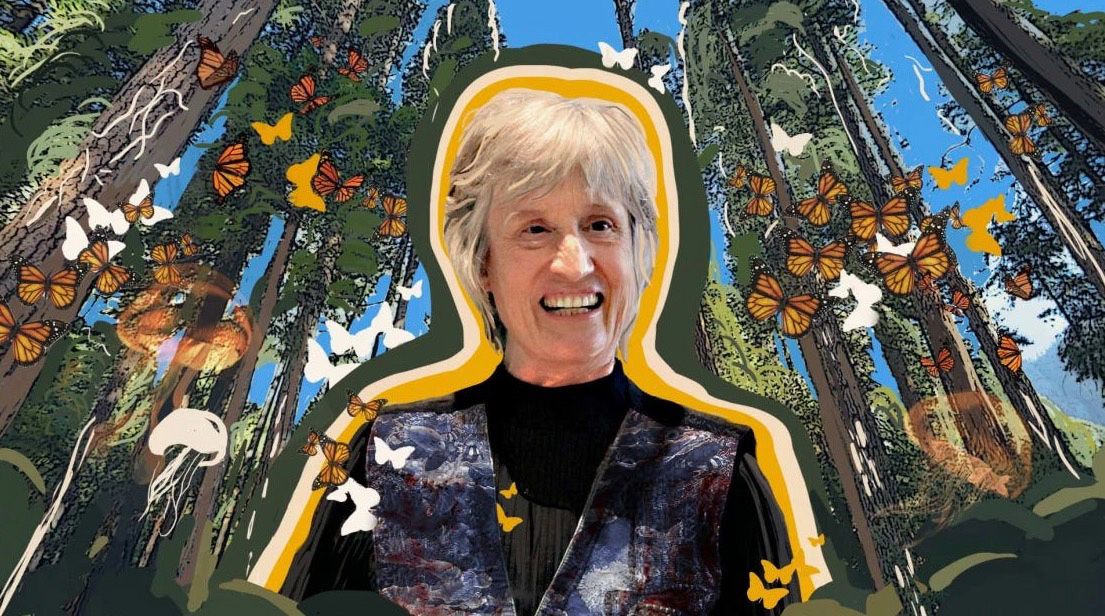
Donna Haraway (2016:35) challenges apocalyptic and self-indulgent narratives that privilege human capacities to repair the future:
How can we think in times of urgencies without the self-indulgent and self-fulfilling myths of apocalypse, when every fiber of our being is interlaced, even complicit, in the webs of processes that must somehow be engaged and repatterned?
Acknowledging my complicity within entangled systems rather than developing solutions to climate problems, such as plastic pollution, is therefore an ethical response. This requires that knowledge production is not limited to abstract information alone but grounded in situated, embodied, and relational practices of ‘making-with’ (Haraway: 2016:58).
Haraway (2016:56) claims that our hope in technology and religion will not help us navigate the challenges of the future, and that apocalyptic views generate despair and are generally unhelpful. Instead, Haraway insists on remaining in the present. She actively embraces the interconnected social justice and environmental problems of our current times, as the title of her book Staying with the Trouble: Making Kin in the Chthulucene (2016) suggests.
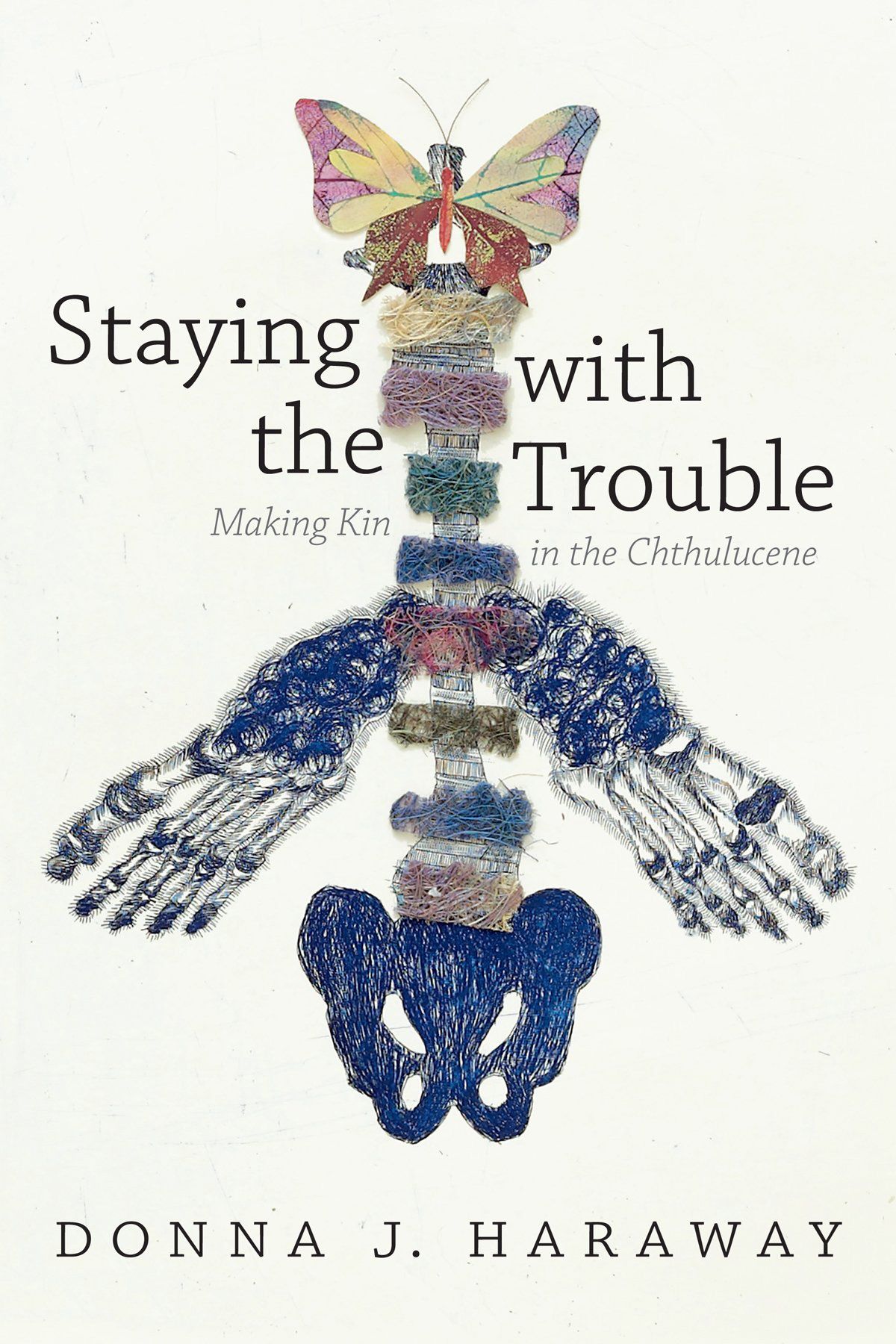
Haraway (2016:38) suggests that mourning loss during this time of climate change is a form of “response-ability” and that mourning is not reserved for humans alone, as animals grieve the loss of their loved ones too. She suggests that humans need to learn to “grieve-with” other species. Haraway (2016:39) states that the difficult work of grief acknowledges human and other-than-human entanglement and an “understanding [of] shared living and dying.”
It is this relational ‘making-with’ (Haraway: 2016:58) that underpins my work: a sympoiesis between natural and living matter and my creative intentions. The work is a push-and-pull between the needs of the microbes, the inherent potential of natural materials, and my creative processes. The artwork, in its decayed state, is the residue of negotiations between microbial action, environmental factors and my contingencies as a maker. I see this negotiated creative process and its resulting tensions as evidence of the precariousness of our current times.
3.2 Solutionism: an Anthropocentric Perspective
The assumption that I can solve plastic pollution by developing bioplastic is itself problematic, as it prioritises my human need to continue using it without critically considering plastic as an entangled entity in the Anthropocene. Developing bioplastic risks assuming human mastery over environmental problems and reinforces the idea that nonhumans exist merely as resources for human use. Timothy Morton (2013:172) addresses this anthropocentric perspective in Hyperobjects, when he notes that:
[w]e have even stopped calling nonhumans ‘materials.’ We know very well that they are not just materials-for (human production). We have stopped calling humans Spirit. Sure, humans have infinite inner space. But so do nonhumans.
As an artist interested in the materiality of sculpture and the processes of creating materials such as bioplastic for the production of artworks, I am challenged by Morton’s (2013:172) destabilisation of the human-nonhuman relationship. Some contemporary theorists see a lessening of the distinction between the human and the nonhuman. Richard Grusin (2018:vii), for example, states that the “traditional categories and distinctions between human and nonhuman, nature and culture are no longer tenable”. He adds that this binary idea creates the perceived permission for humans to take control of their environment and exploit it for their own gain. It is clear that simple definitions based on dualisms no longer suffice.
One response to addressing the power structures embedded within dualisms such as human/nonhuman and nature/culture involves decentering the anthropos through the concept of personhood. Personhood is a legal concept that allows a nonhuman entity, such as a park, animal, or river, to acquire rights and responsibilities on the same terms as a human. In 2012, the Whanganui River in New Zealand received personhood status as a “living being and legal entity” (Hsiao 2012:371). Hsiao (2012:373) describes this as a significant act of decolonisation, one that recognises the river and its people as fundamentally interconnected rather than separable.
The boundaries between what is considered human and nonhuman blur once the river’s intrinsic value as a living entity is acknowledged as one which has the right to protection.
As a dynamic body of water acting upon landscapes and ecosystems, and as an entity intertwined with human narratives and cultural significance, the river exceeds its reduction to a passive resource. In this way, agency between humans and the natural world is distributed.
Rather than framing humans as problem-solvers, a relational practice with distributed agency could offer a generative way forward.
3.3 Relational Ontologies
Relational ontologies understand existence as constituted through relations between humans and nonhumans. This challenges anthropocentric ways of thinking about existence making human boundaries porous to relations with nonhumans. Haraway (2016:71) advances this position, describing agency as distributed or a form of “becoming-with” through unexpected collaborations between humans and nonhumans. She (2016:71-72) posits that cross-disciplinary projects that link art and science offer speculative engagements that decenter the importance of humans in these relationships:
[H]olobiomes, or holoents [are created] in which scientists, artists, ordinary members of communities, and nonhuman beings become enfolded in each other’s projects, in each other’s lives; they come to need each other in diverse, passionate, corporeal, meaningful ways.
Haraway’s (2016:71-72) account of collaboration with nonhumans for future flourishing emphasises entanglement as a condition for meaningful engagement, not only as an ethical or methodological position but as part of a relational ontology. Her use of the microbiology term ‘holobiomes’ is a reminder that the human body hosts multiple nonhuman microorganisms such as fungi and bacteria. These entities coexist with human bodies in mutually beneficial ways. Furthermore, this challenges the conventionally accepted view of humans as singular entities and, within a relational ontology, proposes that the human body is an ecosystem or community of sorts. In this collectively producing system, all “critters” (Haraway 2016:125) are entangled in multi-species responsibility rather than viewing humans as the active agents in the relationship. In this sense, relational ontology stands as an alternative to a solutionism that privileges humans as the primary agents of change.
Drawing on Latour’s concept of the “actant” (in Bennett 2010:ix) — any entity, human or nonhuman, capable of acting and producing effects — Jane Bennett (2010:13) develops a theory of distributed agency in which agency emerges within assemblages of human and nonhuman actants rather than residing exclusively in the human. She (2010:13) calls for a:
[…] greater sense of the extent to which all bodies are kin in the sense of inextricably enmeshed in a dense network of relations. And in a knotted world of vibrant matter, to harm one section of the web may very well be to harm oneself.
Informed by Bennett’s concept of vibrant matter, my practice acknowledges that agency is not individual but located within a human-nonhuman assemblage, and therefore, I respectfully and thoughtfully engage as a collaborator. This understanding is reinforced by Bennett’s (2010:x) argument that regarding matter as lifeless and at the service of humans contributes to damaging behaviour and environmental harm:
[b]ecause [her] hunch is that the image of dead or thoroughly instrumentalized matter feeds human hubris and our earth-destroying fantasies of conquest and consumption. It does so by preventing us from detecting (seeing, hearing, smelling, tasting, feeling) a fuller range of the nonhuman powers circulating around and within human bodies.
Bennett’s speculative thought drives my inquiry into collaborating with nonhumans as “vibrant matter,” rather than as tools for my own creative production. By understanding the materials that I partner with as active agents in our exchange, I gain an alternative perspective on the environmental challenges of the Anthropocene. Here, the sensory experience of working with bioplastic draws me into relational engagement with nonhuman agents.
3.4 Relational Practice: Attentiveness Over Control
Haraway’s (2016:127) concept of ‘polite curiosity’ — an attentive, non-controlling participation in entangled relationships — finds a resonant parallel in Rachel Carson’s approach to environmental stewardship. Ecologist George Scarlett (2020:78) describes Carson’s practice of environmental stewardship as rooted in wonder and awe of the natural world. Carson pays attention to what may seem like the minor details of an ecosystem, such as beach fleas, which may be viewed as repulsive at first glance (Scarlett 2020:78).
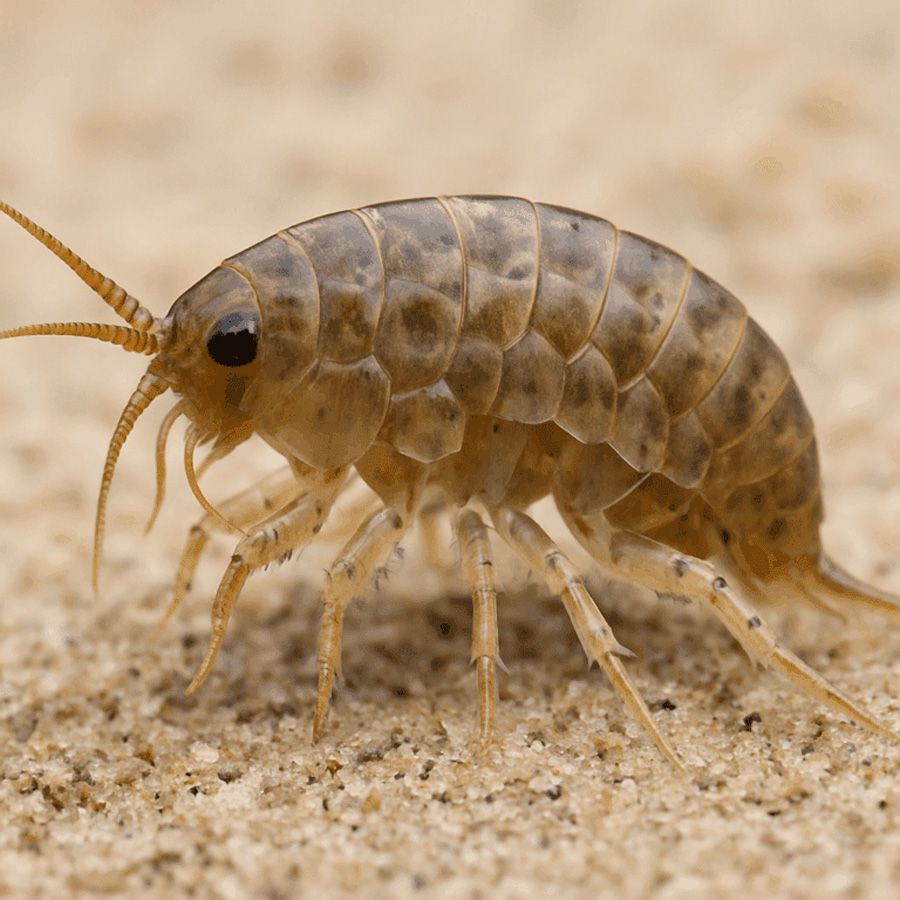
Benjamin Mangrum (2021:766-767) further emphasises Carson’s attentiveness to the seemingly mundane, recognising its role in revealing the multiple connections that sustain an ecosystem. Similarly, I experience Carson’s ‘wonder’ and Haraway’s ‘polite curiosity’ for the nonhuman when looking into the world of fungi through microscopic imaging. Although this way of looking introduces a degree of distance between me and the observed matter, it sharpens my sensory awareness. It reveals the nonhuman world at a scale that invites the kind of careful, curious attention that both Carson and Haraway advocate.
Aware that Carson is an environmental activist rather than a posthumanist thinker, her attentive ways of looking and her appreciation of the nonhuman are helpful. In her encounter with beach fleas, environmental ethics emerge from attentiveness rather than control. Beach fleas, as primary scavengers and decomposers on shorelines, play an ongoing active role in decay and nutrient circulation. Carson’s writing registers the fleas not as repulsive but as valuable in an ecosystem of relations.
Both Carson and Haraway advocate careful, respectful observation, an attentiveness that allows my practice to stay with uncertainty and decay rather than seeking to resolve or control them.
3.5 Staying with Uncertainty, Grief, and Decay
At a time of loss, Bayo Akomolafe (2023a [sp]) challenges a worldview centred on progress, accumulation and restoration. He sees loss not as something to be managed or solved but as an invitation to genuine responsiveness rather than solutionism:
In an open-ended world, the anthropocentrism of positivity obscures the pressingly urgent ways things fall apart – not to get back up again, but to be apart. The undulating waves of becoming do not carry any guarantees with them. And “healing” is not the final end of all things or rights we are entitled to. Much in the same way the neologism of “failing forward” has come to concretize corporate commitments to certitude in times of chaos, the expectation that we are entitled to confident futures and convenient closures diminishes our capacities to welcome the strange.”
Akomolafe (2023a [sp]) emphasises that there is no return to an earlier time where things are resolved neatly. Welcoming the strange requires relinquishing the demand for closure, which he understands as a form of anthropocentrism. For my practice, this means that taking a productive stance by creating bioplastic to solve an environmental problem is not helpful. Instead, a process-oriented approach that allows plastic matter agency; as an artist, I work with the material rather than controlling it for my own creative intentions, finding more generative ways of engaging relationally with it. Akomolafe (2023b [sp]) further notes:
Loss needs a new cosmology: not one that treats it as a deficit, something to fill quickly with a replacement. Not as sustainability – the disguised primal cry of the modern self for permanence. Loss needs a new home. Suitably, one that wanders.
Akomolafe’s (2023b:[sp]) call for an entirely different relationship with impermanence encourages me to think differently about my use of bioplastic — not as a solution to petroleum-based plastic, but as uncertain matter that moves beyond human control and offers no guarantee of solving environmental problems.
Akomolafe’s framing opens decay as something generative rather than terminal.
Decay is not a form of loss or a sustainability problem to be solved, but a positive space for exploration, the speculative, and imagination. It is not a passive acceptance of decay, but a refusal of solutionism. It is in creating experimental work with open-ended outcomes that my practice ‘wanders’ and resists the idea of resolution by remaining open to what decay makes possible.
Through these frameworks, decay functions not as loss but as a relational condition. Faced with decay, a practice attuned to entanglement and nonhuman agency, stays with this moment of loss or uncertainty rather than attempting to resolve it. In the sections that follow, I examine how these frameworks are enacted through experimental work with bioplastic and other matter, positioning relational practice as both an ethical and aesthetic response to the Anthropocene.
4.1 Echoes in Time
Plastic can be seen as a material signature of the Anthropocene: the physical presence of humans that impacts the functioning of our planet’s systems. A lithic layer that includes technofossils and plastiglomerates is a permanent part of Earth’s strata, a record of human existence since the Great Acceleration. Perhaps, if humans drive themselves to extinction, this layer will tell the story of our brief existence on the planet.
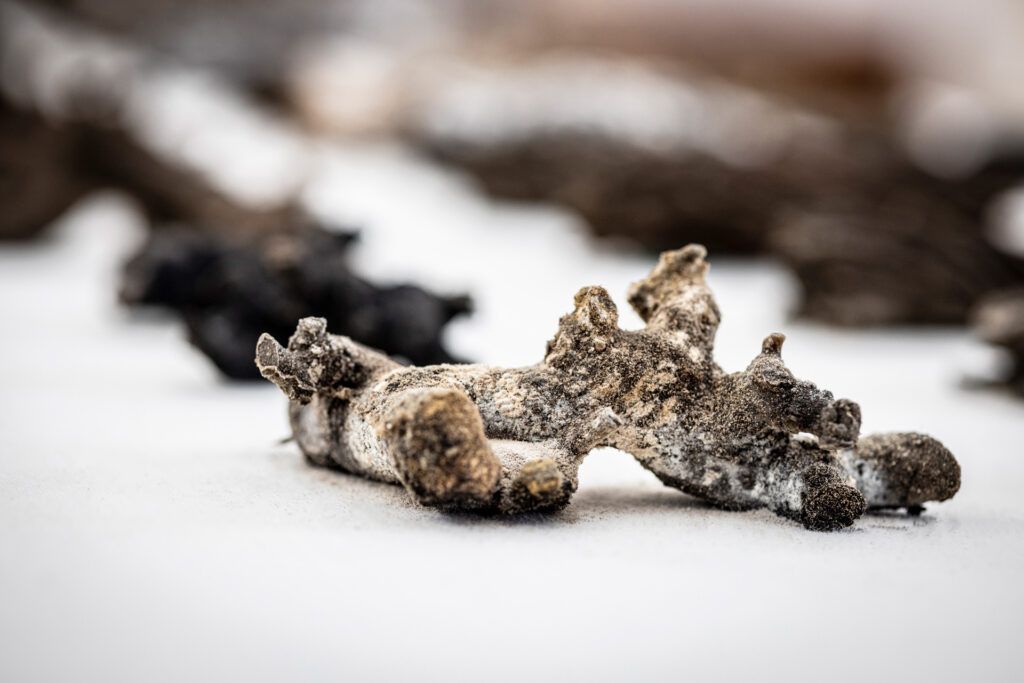
Echoes in Time[1]Echoes in Time was displayed in 2024 as part of my MAVA exhibition titled Making and Unmaking: Plastic Matters at GUS in Stellenbosch. is an amalgamation of the natural and the synthetic, comparable to a plastiglomerate[2]Haram, Carlton, Ruiz & Maximenko (2020:[sp]) define a plastiglomerate as a multi-composite material that comprises hardened, molten plastic as the matrix within which other natural matter like sand, coral, and woody debris may occur. These plastiglomerates typically form under heat like that of a fire. — a material indicator of the Anthropocene formed when melted plastic fuses with sand, rock, and organic debris to create a new stone-like composite. Like the plastiglomerate, the work makes visible the entanglement of human and nonhuman matter within a single form. The work is a visual archive of fossil-like sculptures moulded from bioplastic, wood ash and agricultural waste. Displayed in a linear sequence, the age of the sculptural objects becomes apparent. A timeline reveals itself as the most recently cast objects are larger and glossier, while others show evidence of fungal growth.
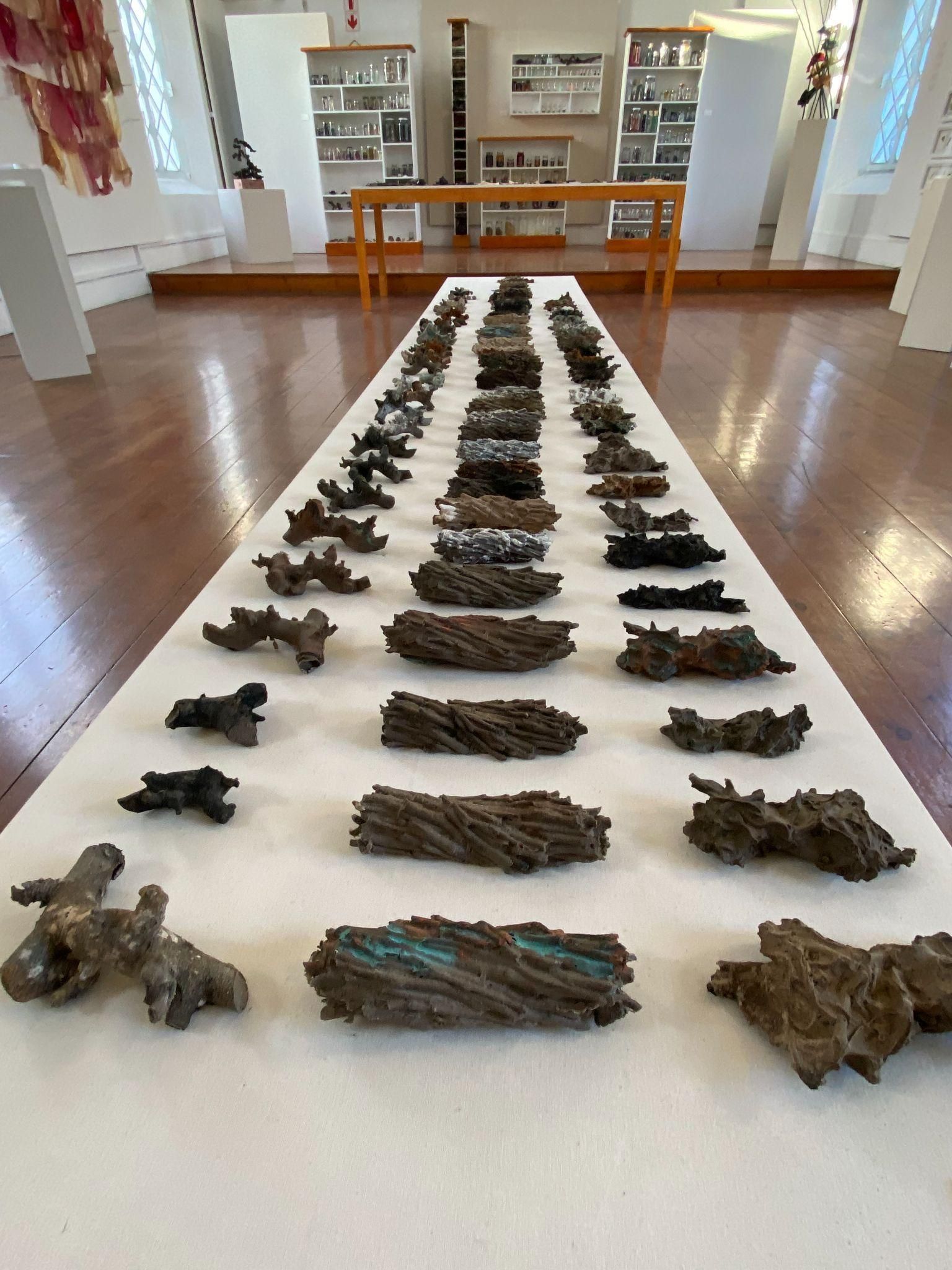
At the far end of the timeline, the fungal growth lies dormant, and the sculpture-substrate is dehydrated and much smaller. For me, this linear sequence considers various temporal scales: my making-thinking as a human artist within a limited or defined period of time, in contrast to deep time associated with the geological formation of our planet. The work evokes associations with the Earth’s strata, with younger rock formations closer to the planet’s surface containing evidence of human existence, including human debris and plastic waste. Homo sapiens have occupied only a tiny fraction of the Earth’s geological timeline, a fact marked in this installation by a small section of sculptures with a blue patina. I made this pigment from leftover red cabbage, a hue that is naturally fleeting and prone to fading.

Although I see this lithic layer that documents human existence as a tiny sliver of deep time, it remains a permanent part of Earth’s strata. I am reminded that my existence as a human has an impact beyond my current reality and experience. Kathryn Yusoff (2016:4) explains the collapse of temporality in the Anthropocene. She states that by considering the Anthropocene as a geological epoch and speculating that future geologists may study the plastic remnants of our current times, one should allow past, present and future to coexist. Davis (2022:19) builds on Yusoff’s work and makes a case for this simultaneous reading of time, as plastic derived from fossil fuels comprises the “compressed bodies of ancient plants and animals”, effectively bringing ancient time into the present. Through the concept of “petro-time”, Davis (2022:20) explains that plastic persists into the future as it “forces the geological past into the present”. She warns that the toxicity of the material will affect humans and nonhumans in the future (Davis 2022:20).
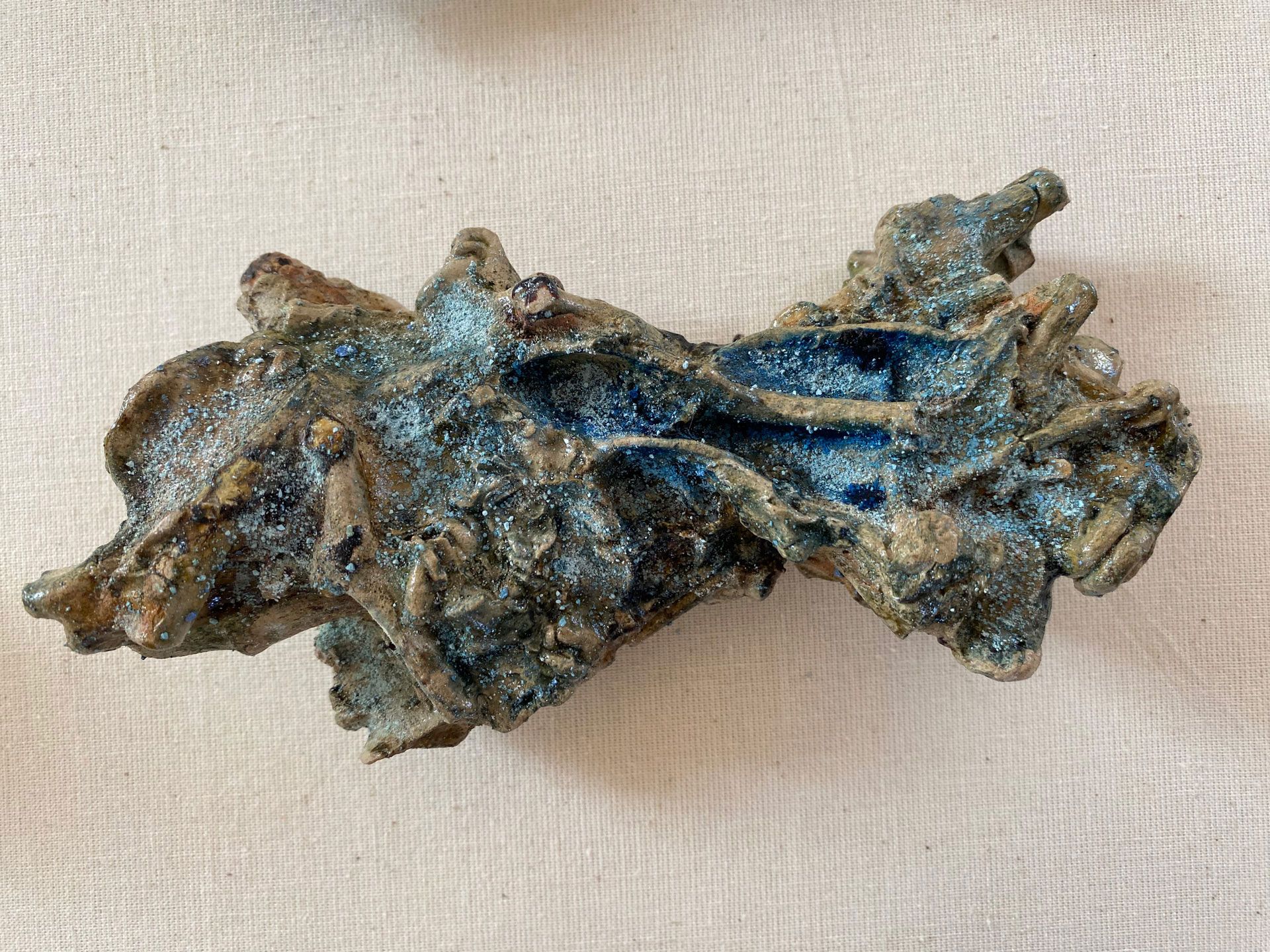
Marisa Maré. Echoes in Time (detail with blue patina). 2023. Bioplastic, wood ash, charcoal, spirulina powder and other natural pigments. Approximate installation dimensions: 4140mm x 710mm x 85mm.
Echoes in Time presents matter of uncertain temporality — simultaneously past, present, and future. Although the sculptures read as geological remnants with histories of eons trapped within them, they originate in wooden matrices assembled from vineyard and orchard prunings. These matrices make human presence legible within the material itself: the cuts and bindings are traces of intervention that become part of the sculptural record alongside the nonhuman processes of decay. The inclusion of wood ash points to the loss of the original wooden matrices, marking their transformation from organic matter into waste. As a filler to the bioplastic, ash helps to minimise the use of other raw materials and provides a stone-like or fossilised visual quality to the casts. Using the wood ash from my fireplace for these artworks may be seen as a good solution to my human waste; however, from a new materialist perspective, it is important to note that the ash has an intrinsic ecological efficacy as matter beyond my use of it or its value to me. For example, ash can change soil pH, contribute nutrients to plant growth, or affect microbial activity.
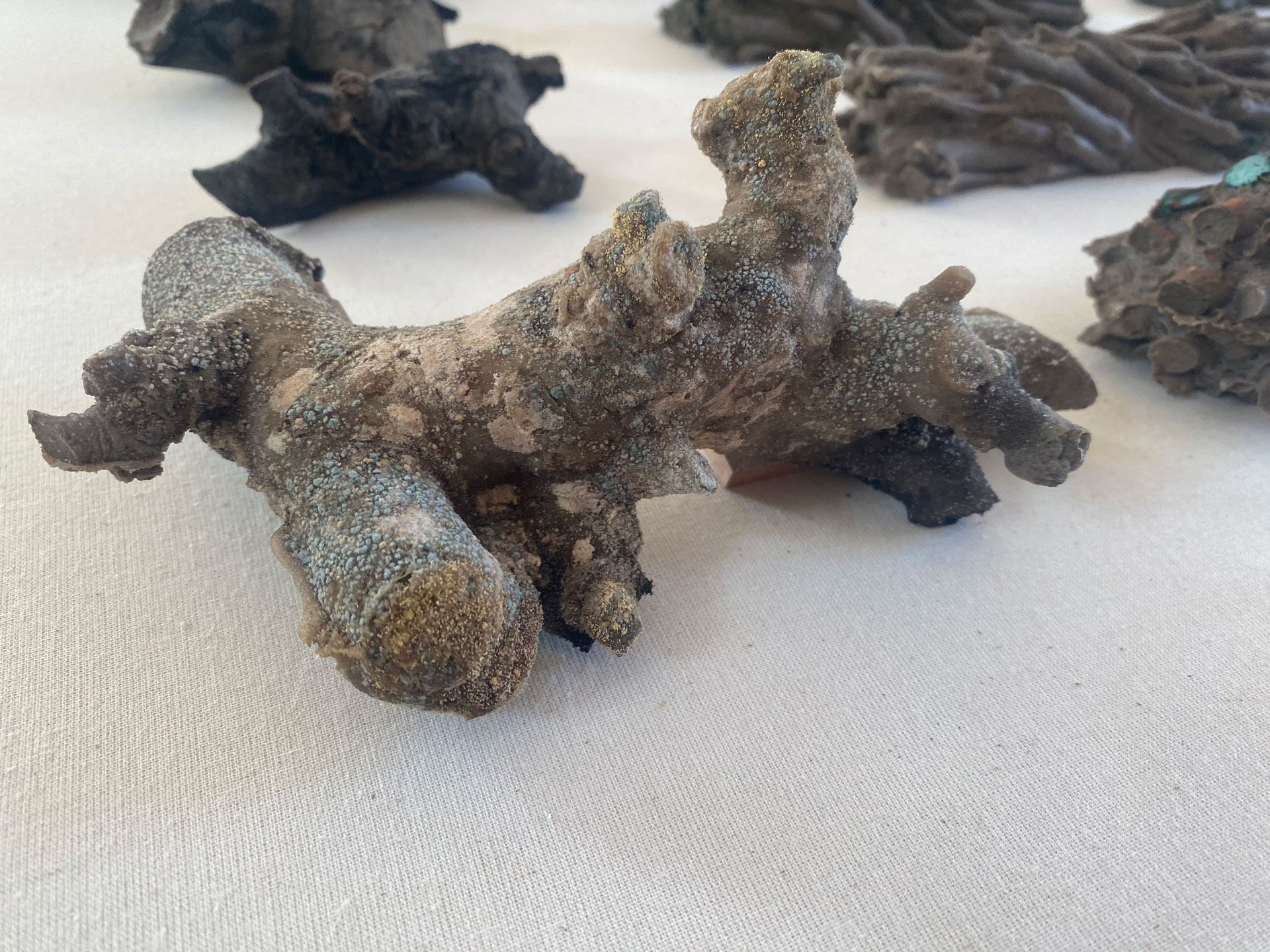
Marisa Maré. Echoes in Time (detail showing active fungus). 2023. Bioplastic, wood ash, charcoal, spirulina powder and other natural pigments. Approximate installation dimensions: 4140mm x 710mm x 85mm.
Although the ash may conjure biblical ideas of loss and mourning, ash directly contributes to microbial proliferation and to relations among matter, energy, and living systems. While the microbial growth might suggest decay, I see it as evidence that my sculptures and their materials possess, as Bennett (2010:x) suggests, a vitality that extends beyond my original intentions. Inviting microbial growth on the sculptural forms and allowing it to become part of the archive, rather than preventing it, enables me to work alongside material agency rather than imposing human or creative control. As Haraway (2016: 71 – 72) suggests, this assemblage of artist, microbe and ash becomes “enfolded in each other’s projects”.
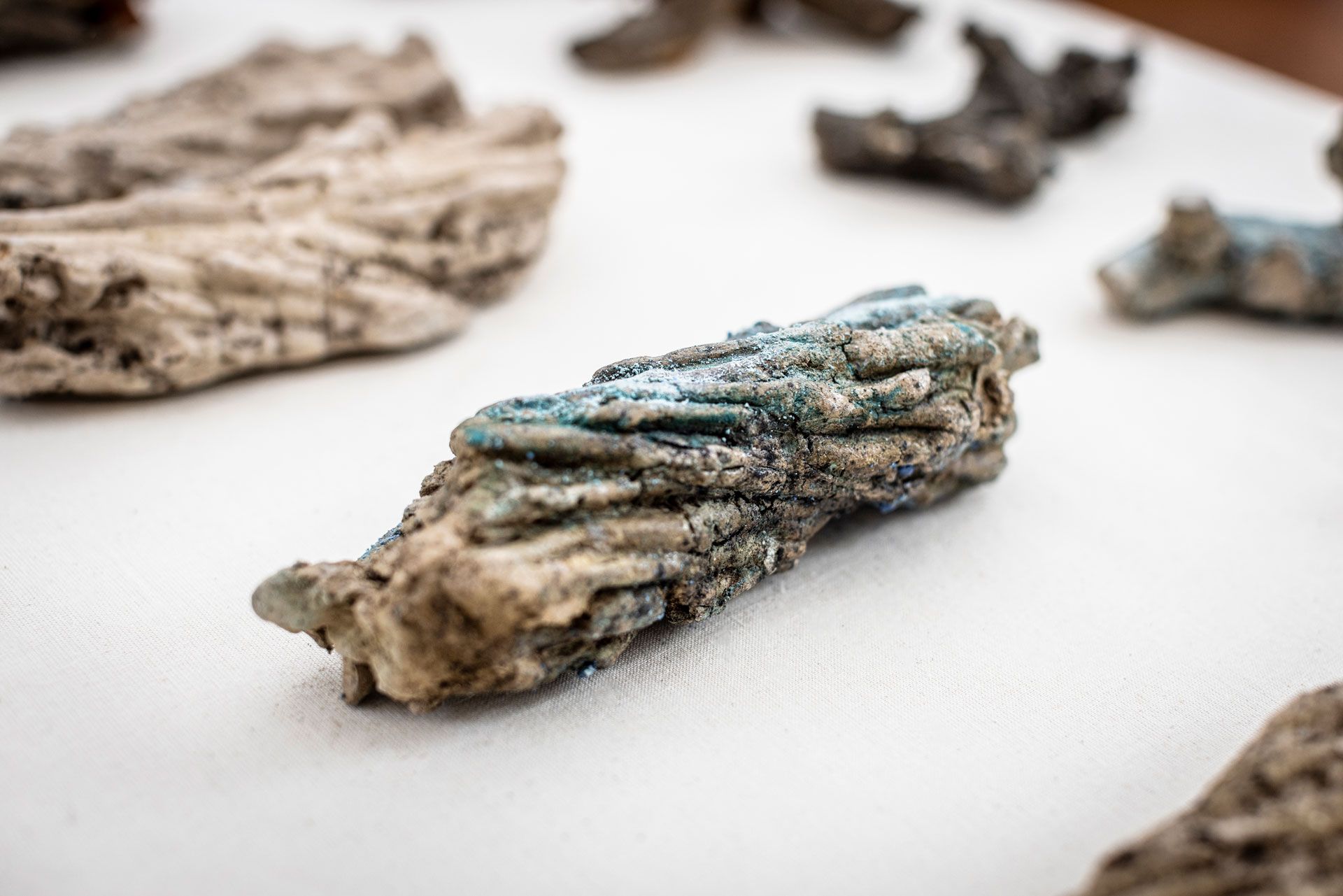
Marisa Maré. Echoes in Time (detail showing dormant fungus and blue patina). 2023. Bioplastic, wood ash, charcoal, spirulina powder and other natural pigments. Approximate installation dimensions: 4140mm x 710mm x 85mm. Image credit: Waldo van der Waal.
The ‘death’ of the plastic object sustains life in a different form: a plastisphere.[3]A new vocabulary has developed to describe the proliferation of plastic in the Earth’s systems. The term ‘plastisphere’ denotes ecologies that thrive off the human-made plastic matter that typically sinks to the depths of the ocean beds (Kelly et al 2022:1). The microbes that thrive on the bioplastic present me with an uncomfortable tension. I am simultaneously hopeful that these microbes could consume or digest the plastic and solve our plastic problem to some extent, but also suspicious of this idea. The more I worked with the bioplastic, the more I realised that neat solutions are not tenable. As Akomolafe (2023b: [sp]) reminds me, I need to stay open to the unknown, uncertain or even the strange. The bioplastic matter I work with has agency beyond my human desires and will continue in a process of decay and transformation. While the bioplastic matter may not return to an original state, it will re-enter an ecological system. This process of decay and ecological return has changed how I understand and relate to plastic as a material. The plastic I had initially perceived as other, non-living, and unnatural has taken on new potential. The artwork, in its decayed state, is the residue of negotiations between microbial action, environmental factors, and my own contingencies as a maker. The microbes might die, the sculptures may change unexpectedly, or I may struggle with the physical side effects of working with living organisms. I see these tensions as evidence of the precariousness of our current times. Control of the material gives way to change, acceptance, and even surprise.
4.2 Coexistence of Geological Vastness and Microscopic Closeness
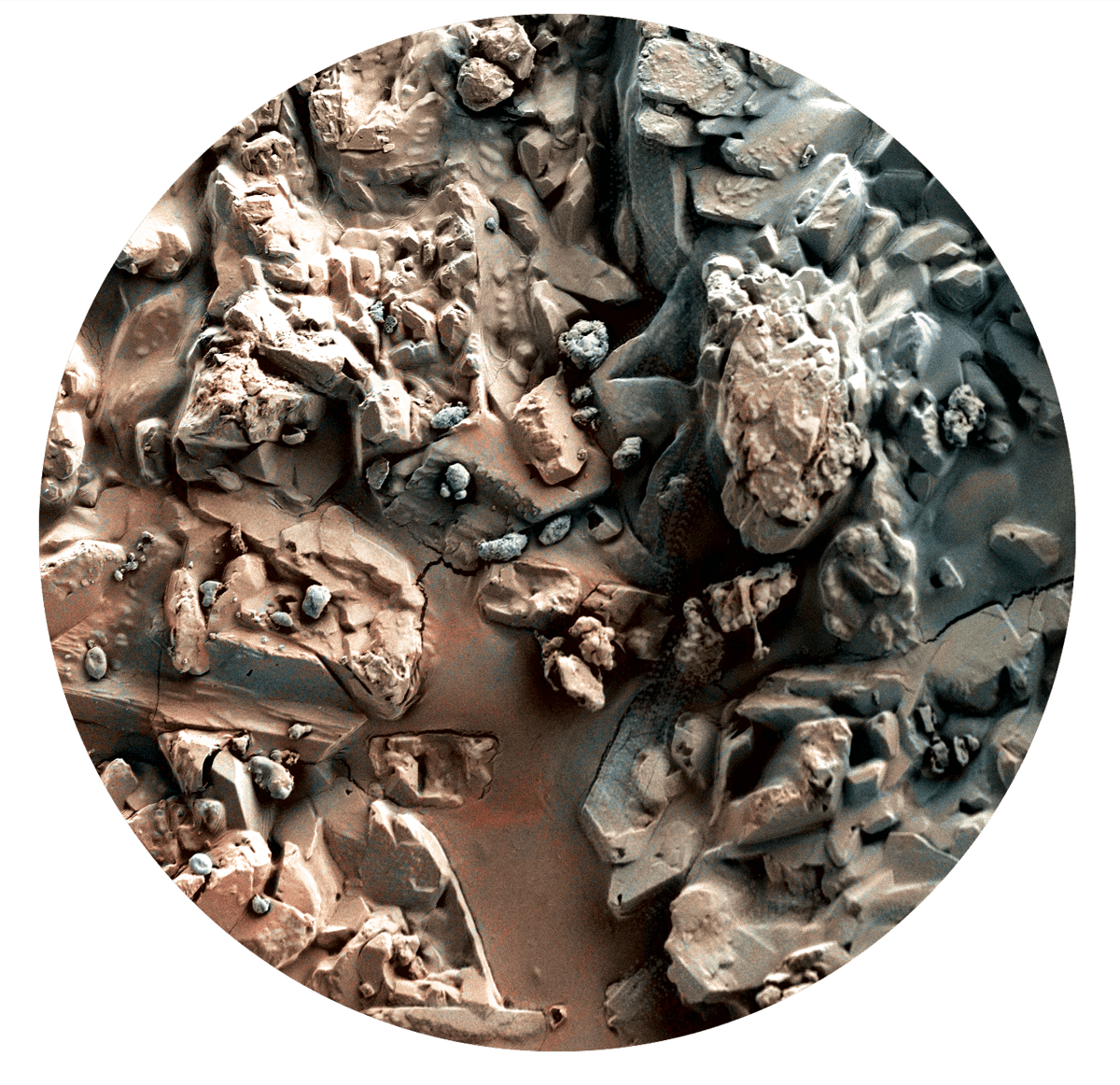
Coexistence of Geological Vastness and Microscopic Closeness is one of several scanning electron microscope (SEM) images from small portions of my sculptures, such as Echoes in Time. As a curious human, I wanted to see into the mostly invisible world of bioplastics and fungi with which I collaborate. This work is based on an SEM image that I captured with assistance at the Central Analytical Facility at the University of Stellenbosch. Magnifying the bioplastic sample 500 times revealed a landscape-like structure with layered topography similar to an eroded valley strewn with boulders. The scanning electron microscope provided a black-and-white image with basic metadata, which I then extended through colour rendering and imaginative interpretation. The bioplastic substrate seems to be a unifying but fractured structure in this image. In some places, this substrate appears more geometric, which may suggest the crystallisation of salts or the plasticiser (in this instance, glycerol) used during the making and curing of the original sculpture. The ‘boulders’ could be read as particles that settled on the surface during the curing process, where dust from the immediate environment became part of the bioplastic’s structure.
In many of the other images from this series of works, I saw evidence of decay as fungi and bioplastic co-exist and shape each other. In Coexistence of Geological Vastness and Microscopic Closeness, the bioplastic serves as a sedimentary layer that attracts atmospheric debris. Although it appears to be a geological image that captures the slow processes of deep time, it could be seen as a recent and unfolding collaboration between human and nonhuman agents.
This glimpse into a nonhuman world, unusual and unexpected, left me with a sense of awe and the ‘polite curiosity’ that Haraway (2016:127) suggests. During my exploration, I was surprised by the vibrancy of the bioplastic matter I observed under the SEM microscope. As suggested by the title, the image features a radical shift in scale that seeks to reposition human-nonhuman relationships and destabilise human centrality. Although I had specific intentions when creating the bioplastic shown in this SEM image, its form and interpretation are also shaped by nonhuman actants. For me, these images highlight the symbiotic co-creation between humans and nonhumans and the entangled nature of synthetic and natural. What emerges are assemblages where matter and meaning are inseparable.
As the title Coexistence of Geological Vastness and Microscopic Closeness suggests, different temporal scales are collapsed in this image, which, to me, challenges a human-centred perspective. The title also sets up a contrast or tension to consider. Plastic is not a homogeneous entity that can be framed as positive or negative, but holds multiple tensions and paradoxes. One such tension is its ability to transcend natural and synthetic boundaries. Davis (2022:69-70) explains her approach to plastic: “The plasticity of plastic matter […] is framed, not in the binary terms of positive and negative, but in the complicated enmeshments of lively being in and through toxicity.” It is in plastic’s shape-shifting nature to straddle dualities and challenge conventional thinking.
If the very materiality of plastic is shape-shifting in nature, so too are the uses, receptions and impacts of plastic materials. The same material that seems to be smothering our planet is also responsible for sustaining life in the ‘plastisphere’ or augmenting the human body. Is this material synthetic and toxic, or has it become a natural and helpful component of contemporary bodies? What started with my concern for plastic pollution as an indicator of the Anthropocene in a time of climate crisis has shifted to further considerations of how I relate to matter, specifically plastic matter.
If I cannot eradicate plastic, how might I learn to live with it differently, and, by extension, what might it show me about how I fit within the web of life as a human being? It is in staying with this question, rather than resolving it, that drives my practice.
4.3 Material Archive: Settling
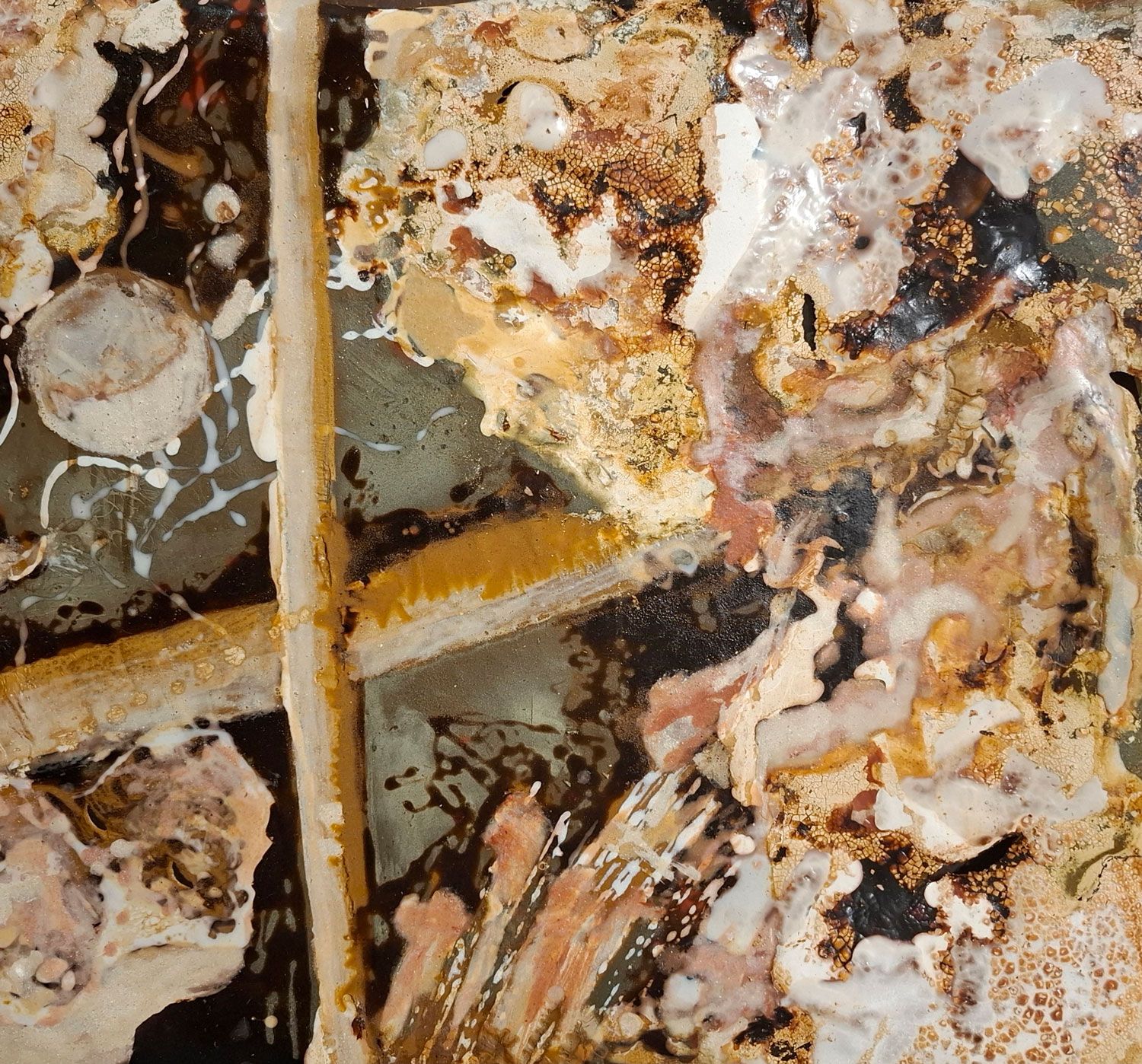
Dust, as evidence of decay, is usually something we sweep away. In this series, titled Material Archive, I embrace dust. This series aims to rethink portraiture, moving away from focusing on a particular person toward an assemblage of multiple entities. Scanning electron microscope images of dust collected from my clothing closet serve as a starting point for these paintings in bioplastic. These ‘dust portraits’ are an intimate material archive of being. Here, ‘being’ does not refer to a fixed person, but indexes the ongoing processes of existence.
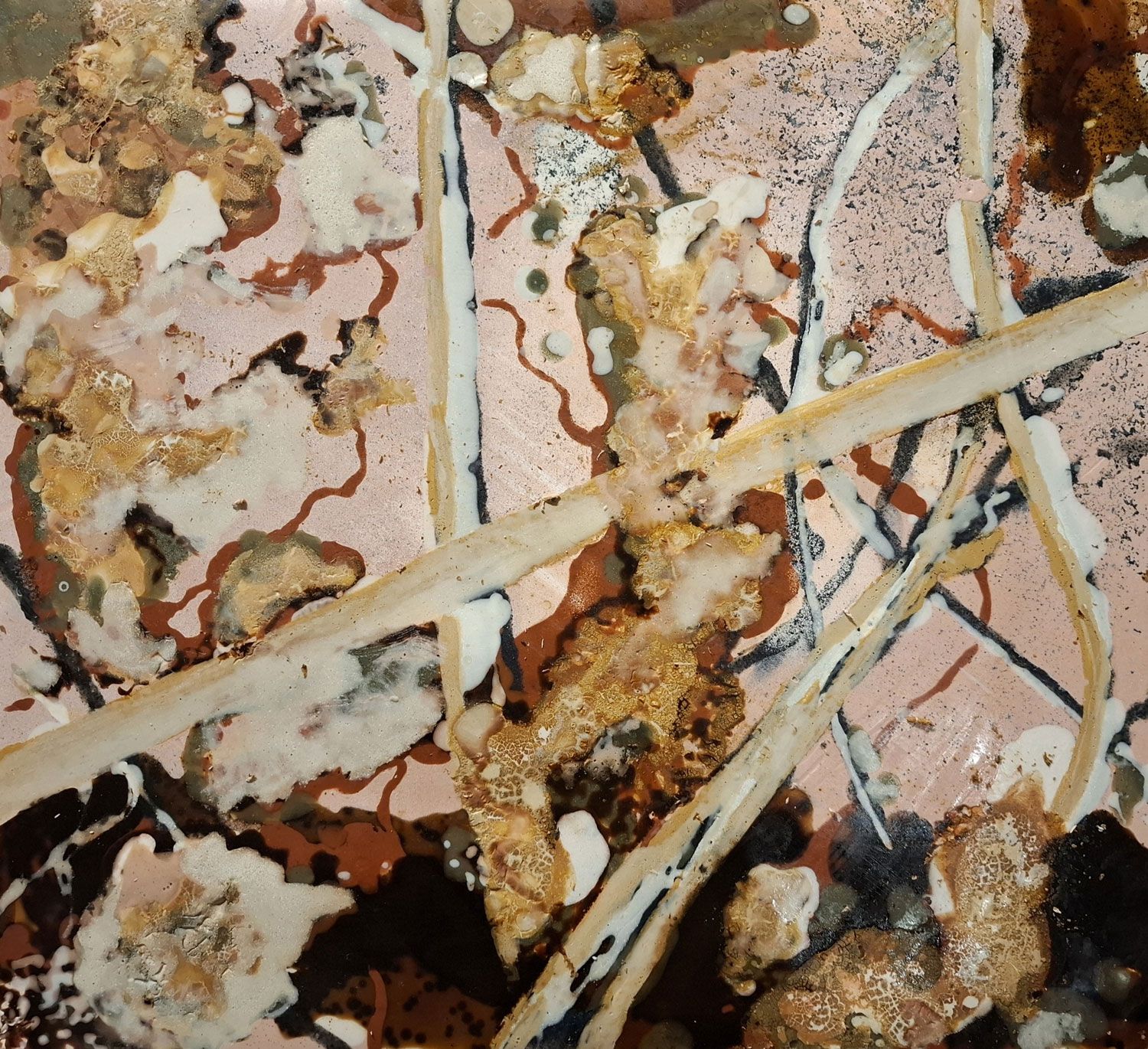
Marisa Maré, Material Archive: Gathering, 2026. Bioplastic, natural pigments and dust, framed size 47 cm x 47 cm.
The artworks in the Material Archive series are painted on glass using multiple layers of thin bioplastic. I colour the bioplastic layers with natural pigments such as plant and earth pigments. Once the layers have cured, the bioplastic ‘skin’ is peeled off the glass and displayed, almost object-like, within a frame. Some pigments are plant-based lake pigments that I produce by extracting pigments from red cabbage (blue), madder root (red), mphepu flowers (yellow) or earth pigments such as wild-harvested clay from various locations in the Western Cape. The plant-based lake pigments[4]I harvested and cooked the natural material and created lake pigments by adding salts that bind to the pigment and drop to the bottom of the solution. This precipitate is filtered, washed, and pulverised with a mortar and pestle to form a finely powdered pigment require extensive processing to extract usable pigment from leaves, roots, and flowers.
The behaviour of these pigments resists full human control, enacting the kind of material agency that Bennett (2010:x) describes as vibrant matter. The plant-based pigments surprise me: shifting the pH slightly can change a colour from murky green to bright yellow, or from green to blue. Earth pigments from wild-harvested clay can be used directly by simply pulverising and sifting to remove coarse particles. The earth pigments are the most stable, and colours do not change easily. The plant-based pigments are not very stable and will deteriorate over time. For example, the blue-purple anthocyanins in red cabbage are not light-fast and typically return to a dusty beige colour when exposed to ultraviolet light from sunlight or artificial lighting. While the yellow carotenoids are heat-sensitive, the anthraquinones in the reds are more archival. The instability of certain pigments means the work will change over time and take on a life of its own. The weather will also impact the appearance of the work, allowing it to contract in heat and expand (and perhaps even ooze) with humidity. The artwork will likely shed small particles within its enclosed frame. These particles may include dust, spores, and lake-pigment flakes, making the work problematic for archival preservation.
Here, the failure of the work to be stable and archival is intrinsically part of the meaning of the piece.
The physical instability of the work generates connections with the changing and ageing human body: the colours will change, dust contains skin traces, and human bodies return to dust. The changing nature of the work is very different from the purpose of traditional portraiture, which immortalises and venerates the image of a human being. The artwork is not only far removed from traditional portraiture but also does not accurately follow the visual cues of the SEM reference image. Even after using a SEM image as a reference, the work operates through semblance rather than resemblance, through associations of body, objects, and dust with marks and gestures. These variables that co-constitute this alternative portrait form what Haraway (2016:125) would recognise as sympoiesis — a collectively-producing system in which all ‘critters’ are entangled in shared responsibility rather than viewing humans as the active agents.
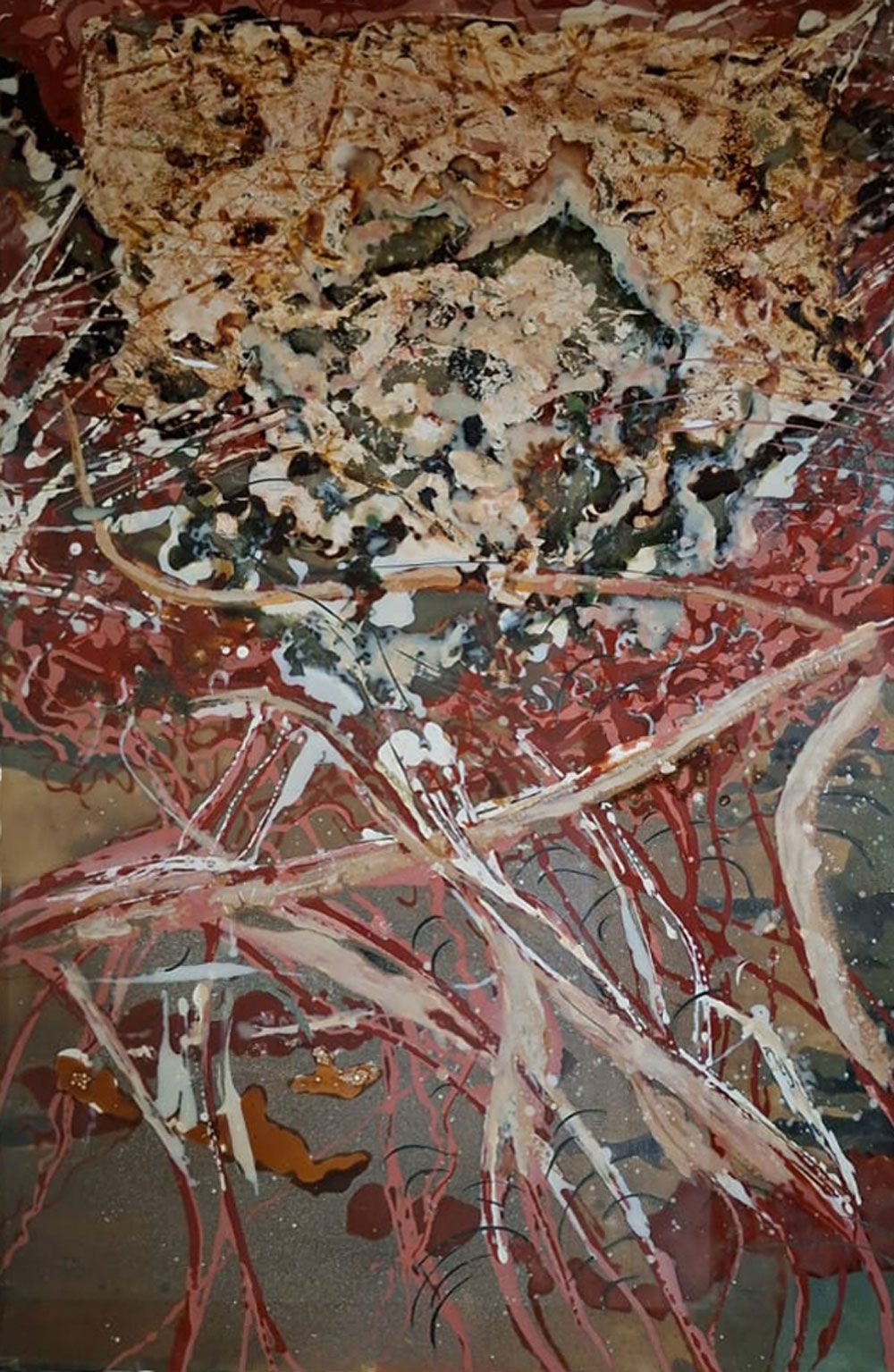
Marisa Maré, Material Archive: Accumulating, bioplastic, natural pigments and dust, framed size 78 cm x 112 cm.
The process of making this work emphasises the ontological multiplicity of dust.
Dust is not a single entity or subject. Dust contains bits of skin, hair, pollen, clothing fibre, sand, insect remains and even micro traces of cosmic dust that settle on the Earth’s surface (Plane 2012: 6507). Multiple human and other-than-human elements come together from the natural and built environments. I understand dust as the gathering of time, carrying traces of different temporal scales and pointing towards the impermanence of human life. In this sense, the work is a humble portrait that neither venerates nor immortalises an image. Instead, the image and dust gather and disperse, creating a shifting impression or moment in time rather than a fixed identity or image. The titles of this series, for example, Material Archive: Settling, Material Archive: Accumulating, and Material Archive: Gathering, denote dust as something active and in the process of becoming rather than something stable and fixed. Therefore, the instability of dust emphasises the persistence of matter beyond my immediate human existence.
4.4 Stof tot Verhaal
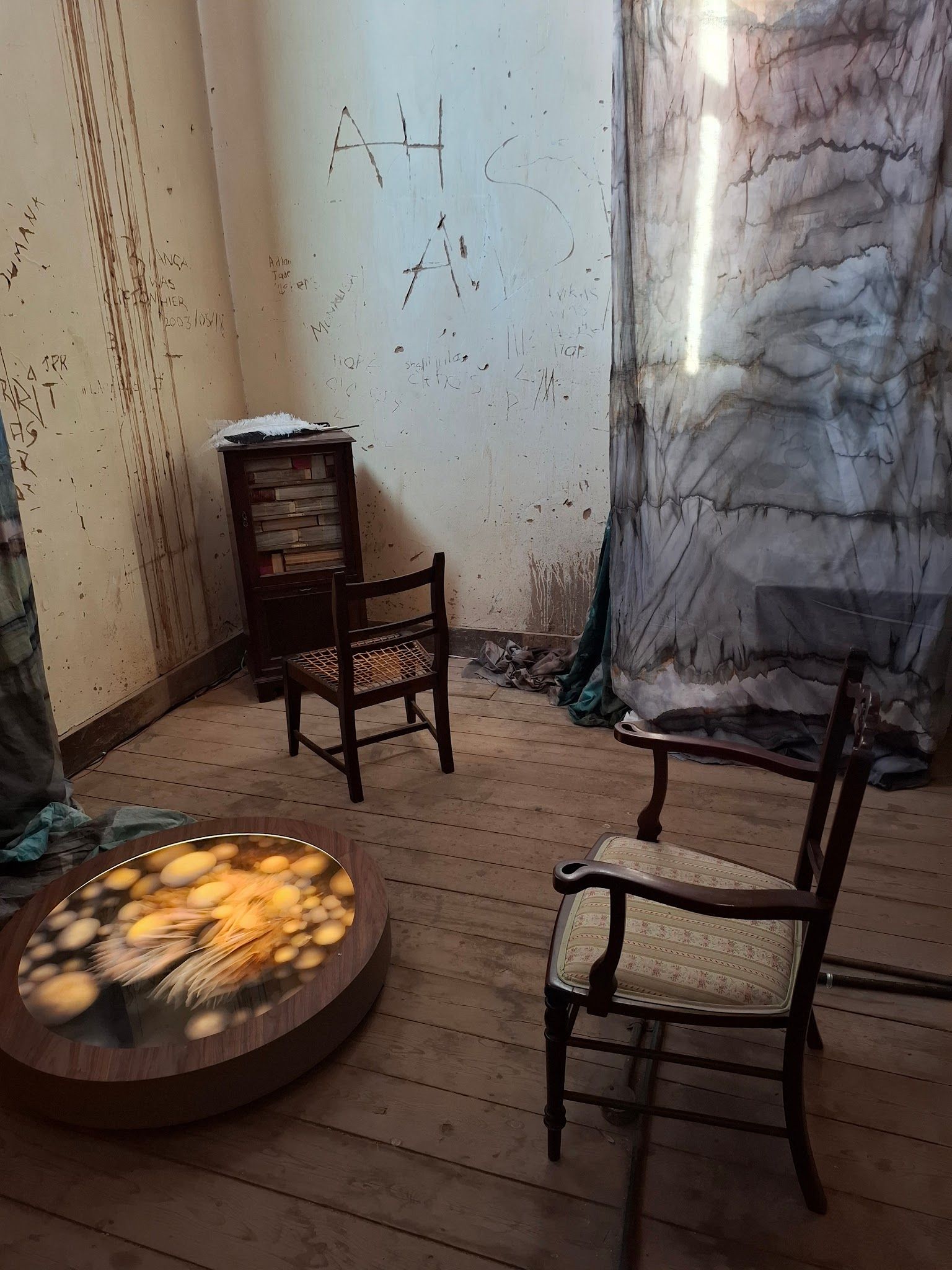
In Stof tot Verhaal, a collaboration between myself and musician and composer Lucas Heinen, I continue to investigate the agency of matter, specifically dust. The installation does not include bioplastic in the end product, as we needed to create something more durable, suitable for physical interaction. However, my interest in matter, decay and the agency of matter, which in this instance considers dust rather than bioplastic, remains central to my investigation. Similar to the Echoes in Time installation, which uses ash (a type of dust) from my fireplace, this installation’s sculptures also include ash. The fungal growth on the sculptures of Echoes in Time is caused by spores, which are active agents in dust. Where Echoes in Time references the idea of sound returning and repeating from deep time, this installation uses soundscapes triggered by viewer interaction.
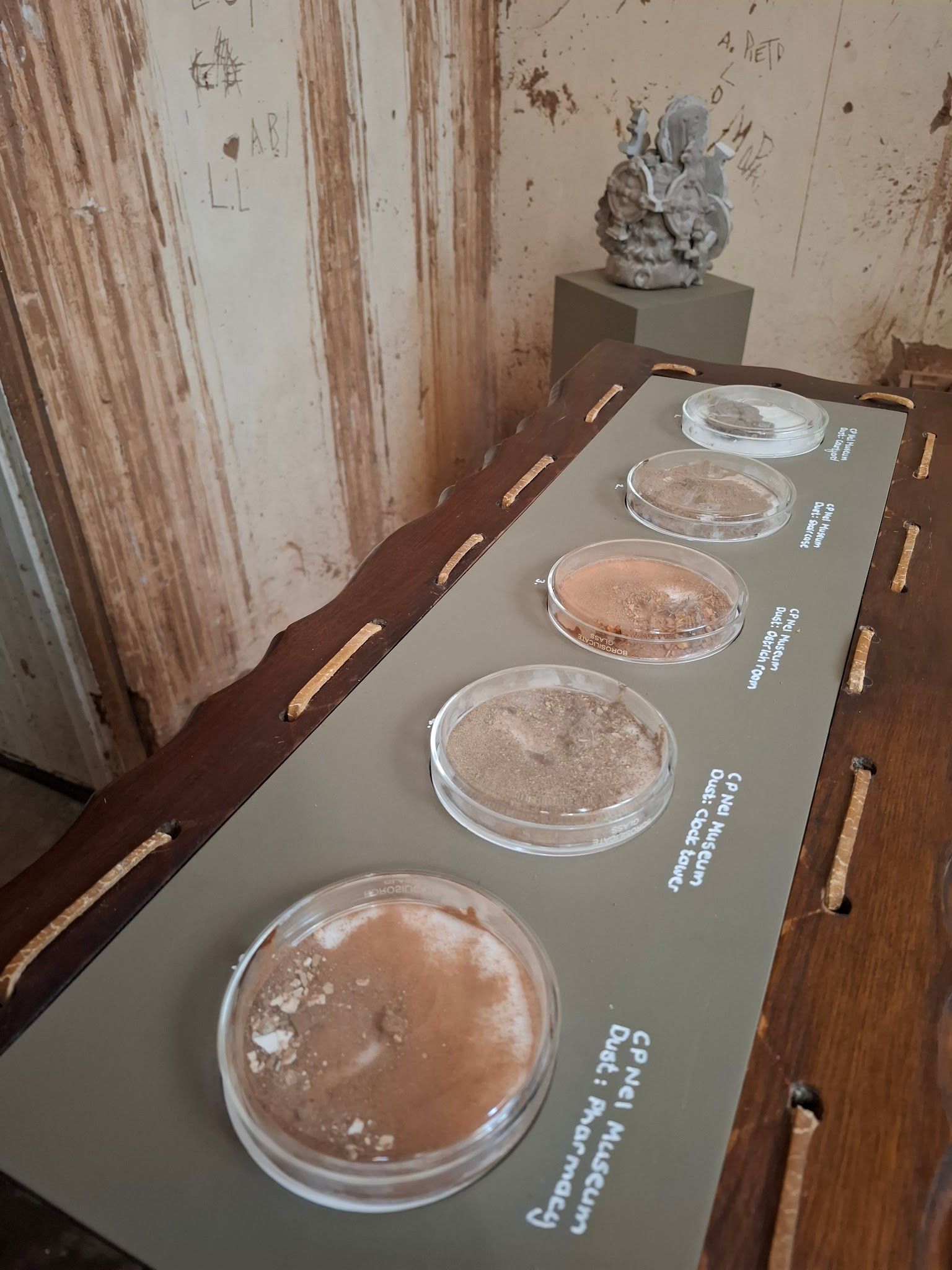
Stof tot Verhaal is a site-responsive installation in the clock tower of the CP Nel Museum in Oudtshoorn[5]The C. P. Nel Museum originated from the private collection of Colonel C. P. Nel, donated to the public in 1951. Housed since 1972 in the former Oudtshoorn Boys’ High School, the sandstone building, designed by Charles Bullock, features gables, arched windows, stained glass, and a clock tower, and was declared a Provincial Heritage Site in 1979. (About the CP Nel Museum [sa]).. For this work, we respond intuitively to the museum’s repository rather than conducting an in-depth study of its curatorial practices of collecting and classification. Aware of the colonial and Afrikaner histories held within this space, we chose a mundane, non-heroic subject for exploration: the museum’s dust. Rather than perpetuating or contesting official narratives, we redirect attention toward the overlooked and discarded.
We are interested in the decay, neglect, and the relational agency of matter which persists regardless of which histories are foregrounded.
We investigate dust samples collected from the museum’s exhibition venues using a scanning electron microscope (SEM) at the University of Stellenbosch’s Central Analytical Facility. Magnified up to 5000 times, the images reveal alternative and surprising perspectives and offer us an entry point into a nonhuman world. In this work, dust is not treated as evidence of decay or as a nuisance to be swept away. It is not a homogeneous entity, but a mixture of skin, hair, pollen, clothing fibres, sand, industrial residue and insect remains, rendering it ontologically multiple and perhaps an unwitting observer of history as it gathers and disperses over time. Similar to the ideas explored in Coexistence of Geological Vastness and Microscopic Closeness (discussed in section 4.2), these microscopy images become a speculative point of departure, allowing us to imagine both the history of Oudtshoorn and deep time through scientific, speculative, and creative lenses.
In analysing the surface morphology of the dust samples, we identified the bubble-like structures in the largest SEM image as fly ash, with the spherical structures denoting industrial processes involving coal combustion. The presence of fly ash in the museum reveals that it is not a sealed space but a porous, entangled space, intertwined with its environment, energy, and climate systems. The presence of fly ash, a remnant of coal combustion, also reminds me of Davis’ (2022:20) notion of petro-time, in that the burning of ancient organic matter settles in the present as dust in the museum, the SEM image, and my artwork: deep time forcing itself into the present.
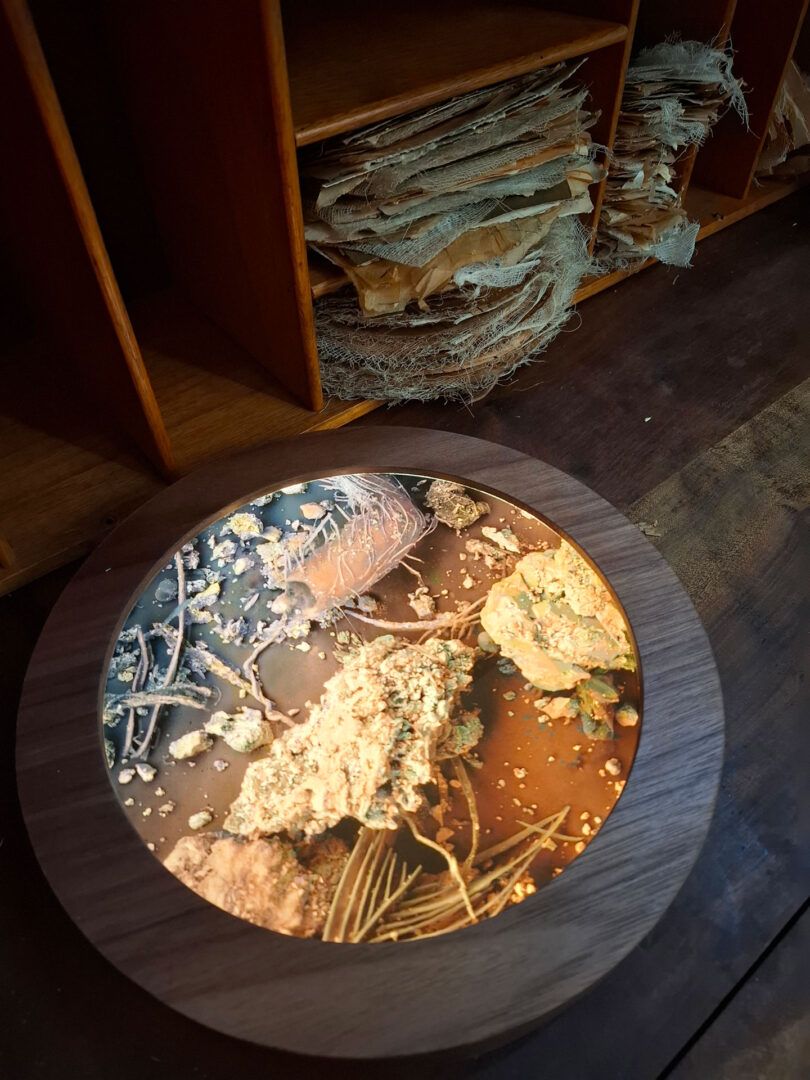
Apart from identifying the structures, we were able to probe particular aspects of each sample to identify specific elements within the structure. For example, dust particles that contained silica were likely from the sandstone building or grains of sand dragged in by visitors’ feet. Carbon and oxygen are components of organic matter, and sulphur is a distinctive element in hair. Metals such as iron, aluminium and even lead were present. The presence of lead is particularly telling. Once commonly used in building materials and now removed from the museum’s visible structures, its toxicity persists in the dust. This serves as a reminder that harm does not disappear when it is no longer seen. Like plastic, lead lingers and continues to act. Dust under the microscope’s magnification remains ambiguous and speculative, not fixing the subject as a stable object for analysis but rather opening possibilities for noticing its ontological multiplicity. Here, knowing is not only analytical but affective, encouraging ‘polite curiosity’ (Haraway 2016:127).
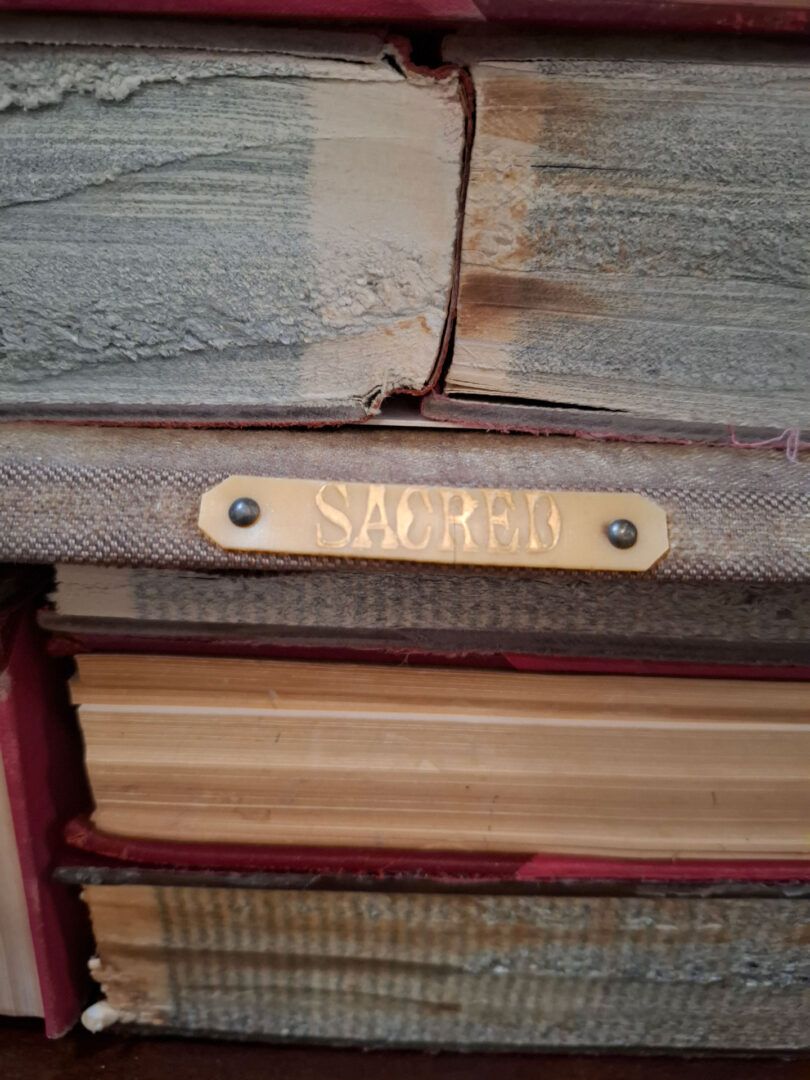
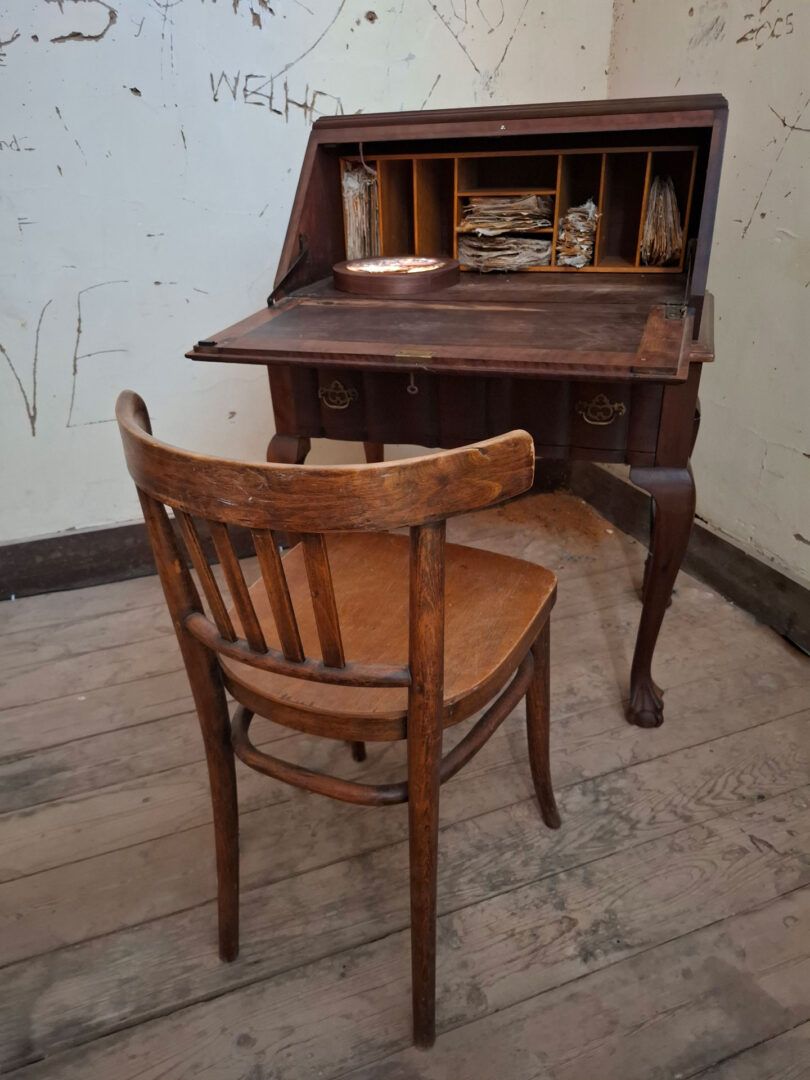
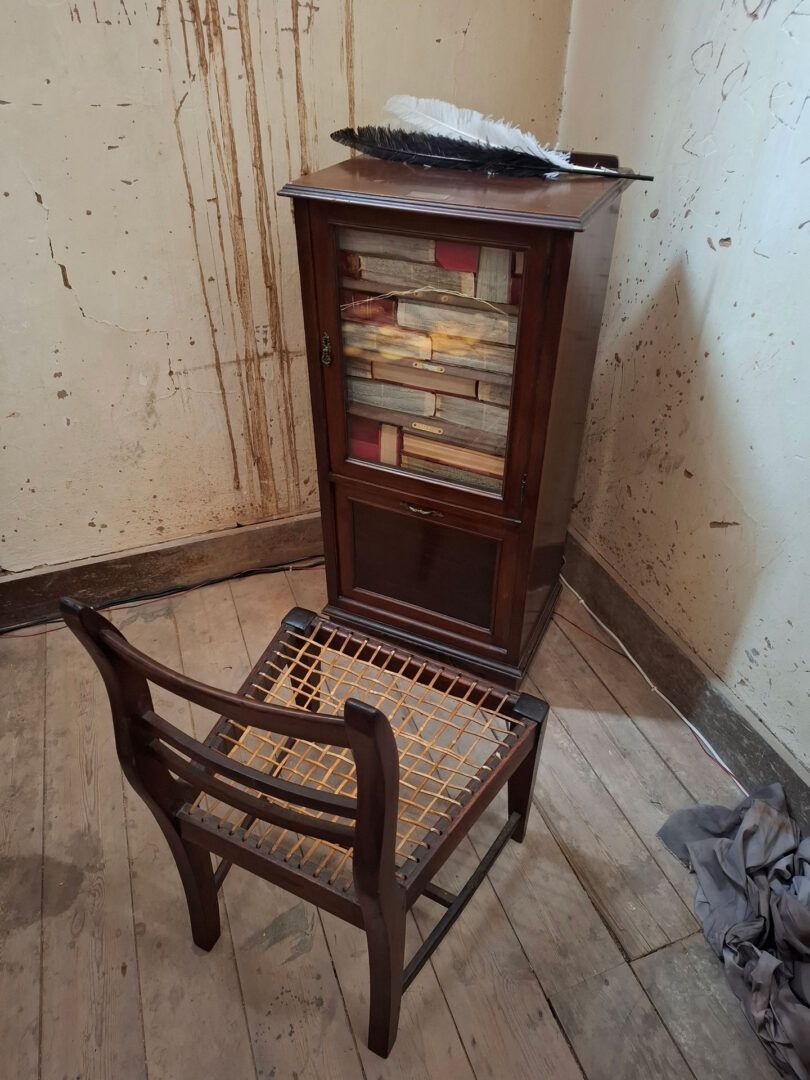
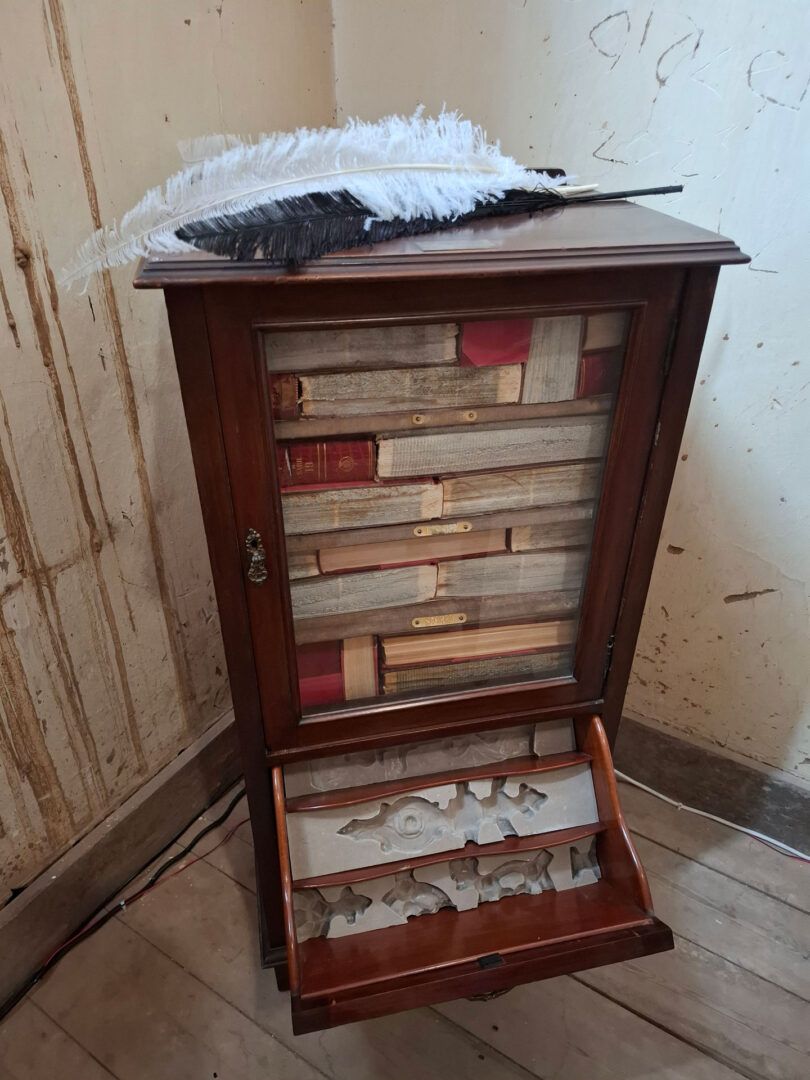
To this end, we pair the SEM images with sculptures and ball-and-claw furniture, evidence of colonial and Afrikaner material culture, each accompanied by a unique soundscape composed by Heinen. These elements are exhibited in the defaced and neglected clock tower, in the storey below the dysfunctional clock. The plaster on the interior walls is soft and crumbly, and visitors over the years have carved their names and dates into the surface, revealing the warm ochres of the original plaster beneath the whitewashed layer. For this installation, we decided not to restore the space but to retain these inscriptions as a collective and more representative archive. This gesture to preserve decay is contrary to the museum’s institutional impulse to permanence and order.
Experimental and playful actions lie at the core of Stof tot Verhaal. Electronic components hidden within the installation trigger interactive soundscapes[6]Heinen recorded these sounds authentically, sometimes by playing instruments in unconventional ways and at other times by capturing simple, everyday sounds such as a pot of boiling liquid. in response to viewer engagement. Viewers become active participants in the work by lifting sculptures or opening drawers and doors to activate the sounds, enacting the relational curiosity that underpins the work.
Upon entering the clock tower space, viewers encounter petri dishes that contain dust samples gathered from the museum’s exhibition venues. By lifting the petri dishes, bell-like sounds are triggered that harmonise when multiple dishes are lifted simultaneously. These sounds are muted and blend with the space’s ambient acoustics. In this initial encounter, the combination of dust samples and triggered sound positions dust as vibrant matter rather than a passive residue of time and stimulate curiosity to explore and interact with the rest of the exhibition.
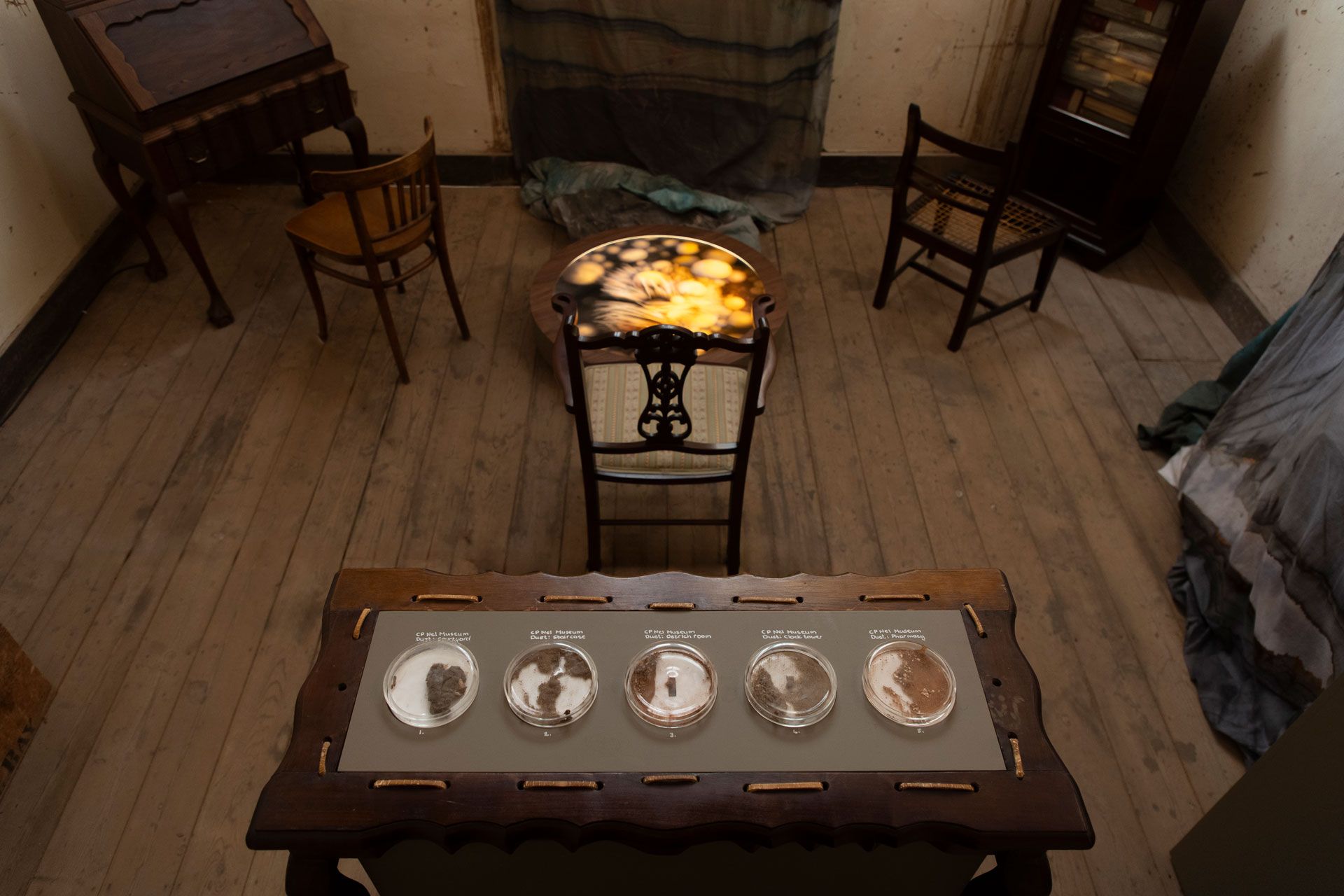
Next, the viewer encounters a sculptural piece positioned on an unconventional plinth that incorporates a ball-and-claw furniture element. For this work, I take moulds of the museum’s Victorian wrought-iron details and reconfigure them into a sculpture using ash as the primary material, a substance associated with decay, and transformation. Similarly, Heinen distorts elements of history in the accompanying soundscape through experimental techniques, using bones and an old steel bar to capture sounds.
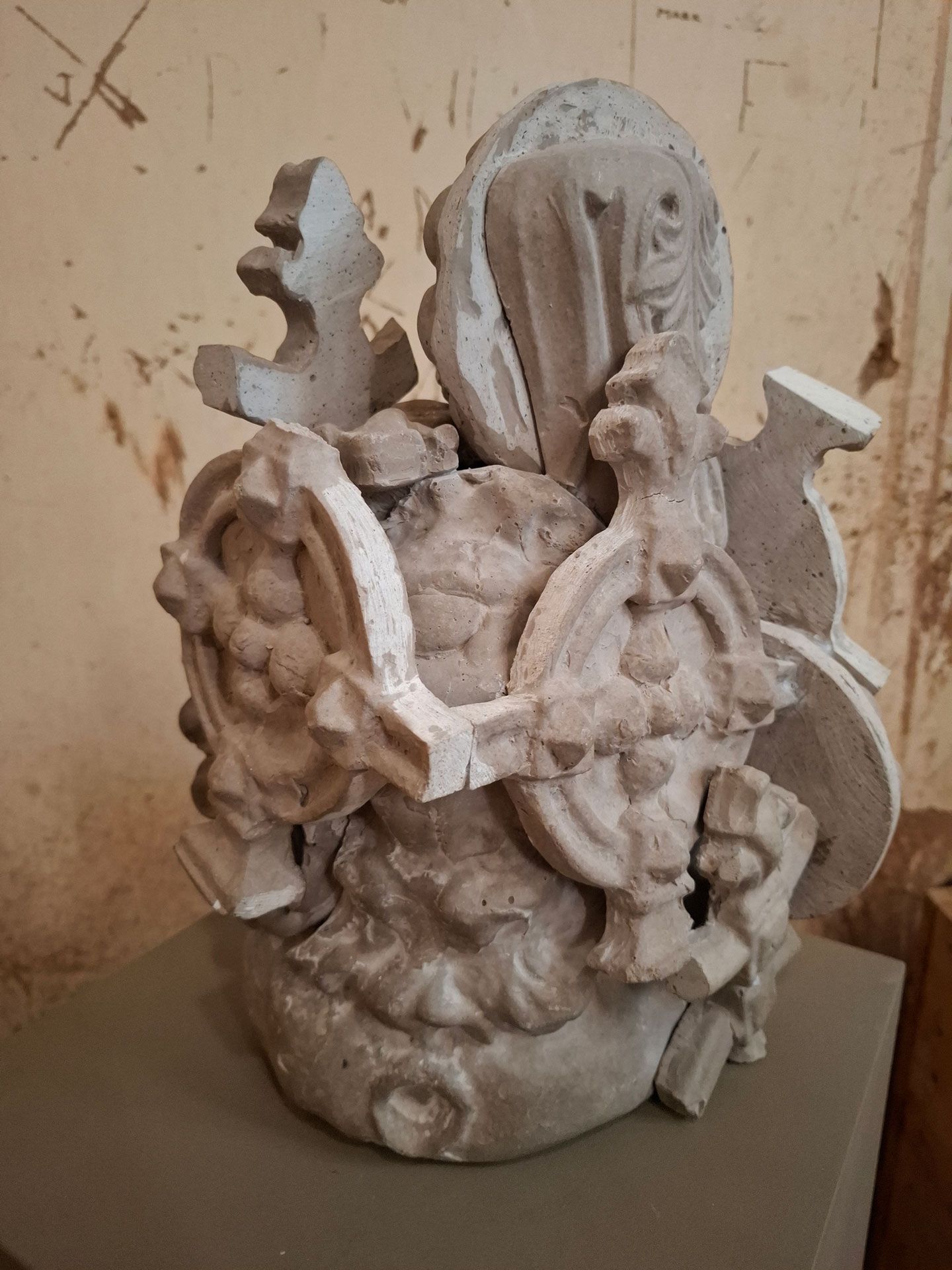
Lifting the sculpture off the base triggers a haunting soundscape. Both the sculpture and the soundscape use familiar materials and make these strange through process, the outcome of which neither Heinen nor I fully anticipated.
When unlocking an old writing bureau, a SEM image of insect remains is paired with a soundscape narrative. Urgent footsteps enter the scene as a person impatiently writes notes on a piece of paper, then crumples it up and walks away. The scene ends with the sweeping sound of a broom, erasing the traces of the discarded writing but perhaps unable to erase the dust’s persistence.
We used a sheet music cupboard dated 1906, the same year the original school building was designed and erected, now housing the museum. In this cupboard, the soundscapes collapse temporalities by layering narratives. While one track recounts Oudtshoorn’s feather boom from a more conventional historical perspective, the other soundscape traces geological histories and earlier inhabitation. When played simultaneously, coherence breaks down, and a disjointed soundscape is presented. Carefully listening, one starts noticing certain dates and moments emerging with unexpected prominence. This is not by Heinen’s deliberate composition but by splicing the reversed and linear recordings together. Here, meaning emerges not from human intention but from the behaviour of the recordings themselves. The strangeness of the soundscape resembles the uneven ways in which histories are remembered and prioritised. It is in staying with this strangeness, rather than resolving it, that the installation enacts Akomolafe’s refusal of convenient closure.
The installation extends this collapse of temporality through sound, combining the measured ticking of a clock with what Heinen imagined as the sounds of deep time. Mechanical time is embodied in the clock tower, a device designed to measure time; however, the clock in this tower is no longer functioning.
The museum similarly attempts to stabilise and preserve time. Yet the museum too remains subject to decay. The soundscapes that combine the mechanical ticking sound with imagined rumblings and drones of deep time creates a temporal tension and an awareness that some processes exceed human control. The combination of these sounds evoke the ‘hyperobject’ (Morton 2013:2) quality of deep time itself. Incidental sounds, such as footsteps or creaking floors, become part of the work, as viewers unknowingly contribute to the soundscape.
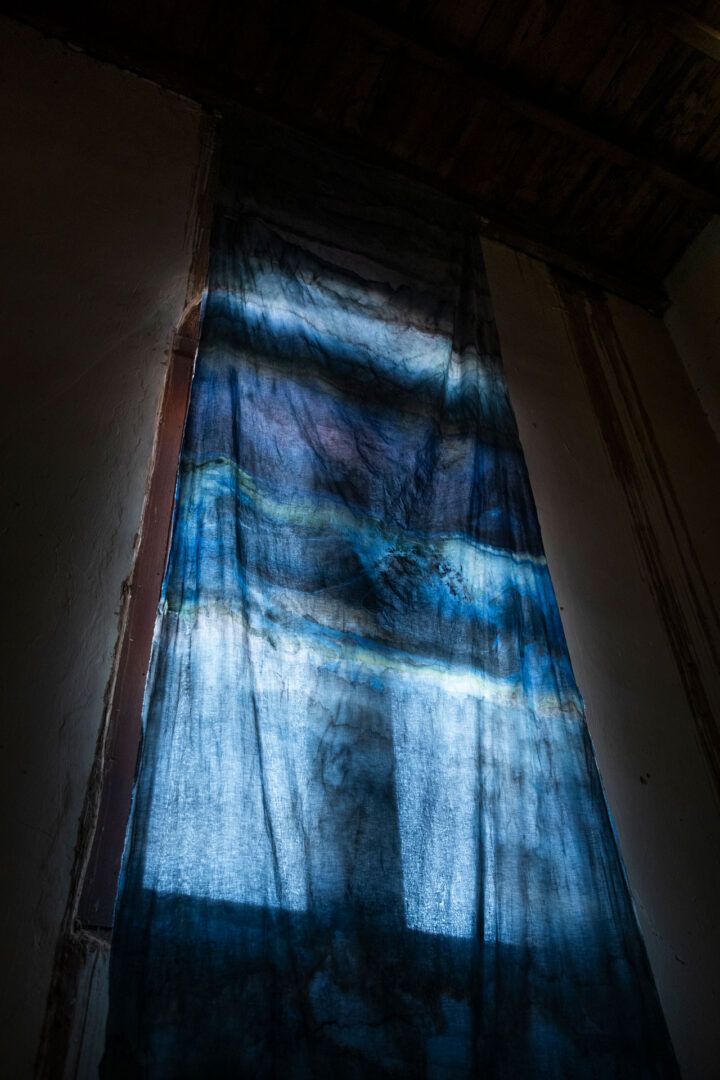
The soundscapes in this installation extend beyond the auditory. Cotton fabric dipped in ink records the physical effects of sound vibrations transmitted through ink suspended in salt water. As pigments separate, react with the salt, and settle unpredictably, these processes make sound visible as pattern and trace, creating a semblance of geological strata and the landscape of the Klein Karoo. Although Heinen and I had visual outcomes in mind, the experimentation revealed surprising results that exceeded our intentions. In this sense, sound behaves as what Bennett (2010:x) would call vibrant matter. Similar to Echoes in Time, the process becomes an important indicator of the behaviour of matter itself, reminding us that meaning arises from matter as much as from human intention.
In a museum space such as the CP Nel Museum, noticing colonial and institutional histories of collecting and classification are unavoidable. Within this context, technologies such as the microscope may be viewed as an instrument of ordering and control. However, the installation redirects microscopy towards curiosity and sensory exploration in a playful manner.
The experimental and interactive approaches of the installation unsettle the museum’s authority as a fixed archive by allowing viewers to interact with the work rather than passively view history preserved in vitrines.
Though initially unfamiliar and perhaps even cautious, viewers negotiate new ways of engaging with what is typically untouchable. Viewers enter a space where history is no longer sealed behind glass but open to entanglement, participation, and reinterpretation.
The installation does not attempt to point out the failures of preservation or provide a suitable solution but provide an opportunity to sit with loss and arouse curiosity. In this space, decay is not a curatorial problem to be solved but a condition that the installation inhabits, staying with the crumbling, the dysfunctional, and the overlooked as generative rather than mournful.
This paper has argued that decay is not an endpoint or loss, but a generative, relational process that can cultivate response-ability, care, and ethical coexistence with nonhuman agents in the Anthropocene. By analysing four works, Echoes in Time, Coexistence of Geological Vastness and Microscopic Closeness, Material Archive, and Stof tot Verhaal, I have explored what it means to work with matter rather than controlling it, allowing dust, ash, fungi, and bioplastic to act as active participants rather than passive substances. Rather than functioning as a passive or terminal process, decay has revealed itself as active, agentic, and vital.
Rather than searching for innovative solutions to environmental problems, these works engage relationally, where process is more important than the end result. Listening, waiting, and reconfiguring become key gestures in the creative process and meaning emerges through ongoing negotiation between human and nonhuman agents.
I remain sceptical of technofixes that attempt to solve the environmental problems of the Anthropocene. Although bioplastic offers some possibilities as a material that touches the Earth lightly, I remain suspicious of materials that pose as innovative solutions. What my practice has shown instead is the generative potential of staying with uncertainty, of welcoming decay, transformation, and the strange rather than seeking to resolve or replace them.
I remain curious.
About the CP Nel Museum.[Sa]. CP Nel Museum: Incorporating the Dorpshuis. [O]. Available: cpnelmuseum(Accessed 12 April 2026).
Akomolafe, B. 2023a. Anthropy / Entropy. [O]. Available: bayoakomolafe (Accessed 12 February 2026).
Akomolafe, B. 2023b. Loss needs a new home. [O]. Available: bayoakomolafe (Accessed 12 February 2026).
Barthes, R. 1957. Mythologies. 1st ed. Paris: Edition du Seuil.
Bennett, J. 2010. Vibrant matter, a political ecology of things. Durham: Duke University Press.
Chitaka, T. 2021. Environmentalism or greenwashing? Responses of South African value chain actors to plastic straw marine pollution. South African Journal of Science 117(7-8): 98-102.
Davis, H. 2022. Plastic Matter. Durham: Duke University Press.
Grusin, R. 2018. Introduction in After extinction, edited by R Grusin. Minnesota: University of Minnesota Press: vii-xix.
Haram, LE, Carlton, JT, Ruiz, GM & Maximenko, NA. 2020. A plasticene lexicon. Marine Pollution Bulletin 150, January:110714:1-4.
Haraway, D. 2016. Staying with the trouble: making kin in the chthulucene. Durham: Duke University Press.
Hsiao, EC. 2012. New Zealand: Whanganui river agreement – indigenous rights and rights of nature. Environmental Policy and Law 42(6): 371-375.
Kelly, MR, Whitworth, P, Jamieson, A & Burgess, JG. 2022. Bacterial colonisation of plastic in the Rockall trough, north-east Atlantic: an improved understanding of the deep-sea plastisphere. Environmental Pollution 305:119314:1-10.
Krieger, A. 2019. Are bioplastics better for the environment than conventional plastics? [O]. Available: anjakrieger (Accessed 16 April 2022).
Mangrum, B. 2021. Rachel Carson, environmental rights, and the publicity of aesthetic judgments. English Literary History 88(3): 765-793.
Morton, T. 2013. Hyperobjects: philosophy and ecology after the end of the world. Minneapolis: University of Minnesota Press.
Nixon, R. 2011. Slow Violence and the environmentalism of the poor. Cambridge: Harvard University Press.
Osborne, M. 2022. Microplastics detected in human blood in new study. [O] Available: smithsonianmag. (Accessed 4 April 2022).
Plane, J.M.C. 2012. Cosmic Dust In The Earth’s Atmosphere. A Review. Chem. Soc. Rev 41, 6507–6518
Pound, C. 2022. The downsides of a ‘wipe clean world’. [O]. Available: bbc (Accessed 1 April 2026).
Scarlett, WG. 2020. Rachel Carson and the development of earth stewards. Journal of Character Education 16(1):77-86.
Yusoff, K. 2016. Anthropogenesis: origins and endings in the Anthropocene. Theory, culture & society 33(2): 3-28.
| 1. | ↑ | Echoes in Time was displayed in 2024 as part of my MAVA exhibition titled Making and Unmaking: Plastic Matters at GUS in Stellenbosch. |
| 2. | ↑ | Haram, Carlton, Ruiz & Maximenko (2020:[sp]) define a plastiglomerate as a multi-composite material that comprises hardened, molten plastic as the matrix within which other natural matter like sand, coral, and woody debris may occur. These plastiglomerates typically form under heat like that of a fire. |
| 3. | ↑ | A new vocabulary has developed to describe the proliferation of plastic in the Earth’s systems. The term ‘plastisphere’ denotes ecologies that thrive off the human-made plastic matter that typically sinks to the depths of the ocean beds (Kelly et al 2022:1). |
| 4. | ↑ | I harvested and cooked the natural material and created lake pigments by adding salts that bind to the pigment and drop to the bottom of the solution. This precipitate is filtered, washed, and pulverised with a mortar and pestle to form a finely powdered pigment |
| 5. | ↑ | The C. P. Nel Museum originated from the private collection of Colonel C. P. Nel, donated to the public in 1951. Housed since 1972 in the former Oudtshoorn Boys’ High School, the sandstone building, designed by Charles Bullock, features gables, arched windows, stained glass, and a clock tower, and was declared a Provincial Heritage Site in 1979. (About the CP Nel Museum [sa]). |
| 6. | ↑ | Heinen recorded these sounds authentically, sometimes by playing instruments in unconventional ways and at other times by capturing simple, everyday sounds such as a pot of boiling liquid. |