LIZE-MARIÉ HANSEN VAN DER WATT
Imperialism, South Africa’s Antarctic Heritage and Decay, 1910-1961
This essay is a reflection on tenuous heritage and imperialism in South Africa’s Antarctic history and chasing memories of things that do not (yet) decay.
South Africa is an original signatory to the Antarctic Treaty (signed 1959, ratified 1961) and remains the only African signatory to the Treaty – almost 70 years later.[1]South Africa is party to all the legal agreements included in the Antarctic Treaty System, including the Convention on the Conservation of Antarctic Seals (CCAS, signed 1972) and the Convention for the Conservation of Antarctic Marine Living Resources (CCAMLR, signed 1980) and the Protocol on Environmental Protection to the Antarctic Treaty (Madrid Protocol, signed 1991). Namibia is a full member of CCAMLR only. The Antarctic Treaty is central to a system which governs not only Antarctica, but also a substantial part of the earth’s maritime biomass and the vast majority of its freshwater reserves, all increasingly threatened by climate change, biodiversity loss, and human activity. This is a position – a representative responsibility – that South Africa is keenly aware of, maintaining that its “voice reflects both a national and regional perspective, bridging Africa’s interests with those of the broader international community.”[2]Department of Forestry, Fisheries and the Environment website “South Africa’s role in Antarctic & Southern Ocean Governance” dffe.gov (retrieved 20 July 2026). The notion is also reflected in South Africa’s 2020 Antarctic and Southern Ocean Strategy (ASOS).
The same strategy acknowledges that South Africa’s Antarctic heritage largely builds on an imperial history. Antarctic bound expeditions have used Cape Town as a port of call since the Discovery journeys of James Cook. Many Norwegian (through its whaling history) and British (and its imperial geographies) led expeditions saw Table Mountain recede on their way southbound or returning home, their vessels laden with produce from the colonised lands of the Cape Peninsula.[3]For a summary of the expeditions that set forth from South Africa during the so-called ‘Heroic Age’ (including Scott’s last expedition), see John Cooper and Robert K Headland, “A History of South African Involvement in Antarctica and at the Prince Edward Islands,” South African Journal of Antarctic Research 21, 2 (1991), 77–91.
What the strategy does not enunciate, however, is the South African government’s policy towards Antarctica’s historic sites and monuments (HSMs), a subsection of the Protocol on Environmental Protection to the Antarctic Treaty. The practice of listing of historic sites and monuments predates the Protocol (Treaty Parties agreed to an initial list in 1972, but the process was subsumed by and formalised through the Environment Protocol, signed 1992). The Protocol designates Antarctica as a “natural reserve, devoted to peace and science” and sets forth basic principles applicable to all human activities in Antarctica. South Africa also largely applies its environmental protection measures to the Prince Edward Islands, the sub-Antarctic Islands it annexed in 1947/48. Any Antarctic Treaty Party may nominate a site or monument of recognised historic value. Proposals are assessed against agreed criteria, including association with significant events, individuals, scientific achievements, exploration, architectural value, educational potential or symbolic significance. Designation requires approval by Antarctic Treaty Consultative Parties through consensus at an Antarctic Treaty Consultative Meeting. Once designated, HSMs receive formal protection under Annex V of the Protocol on Environmental Protection to the Antarctic Treaty.[4]Rebecca Hingley, “Ice-locked Huts, Snow-buried Cairns, and Sunken Ships: The Prevailing Discourse on Heritage in Antarctica,”International Journal of Heritage Studies 28, no. 8 (2022): 940–954. South Africa, a non-claimant to Antarctica, has not actively followed most other original signatories in using cairns, huts, memorials and expedition sites to maintain historical claims to influence and legitimacy within Antarctic governance.
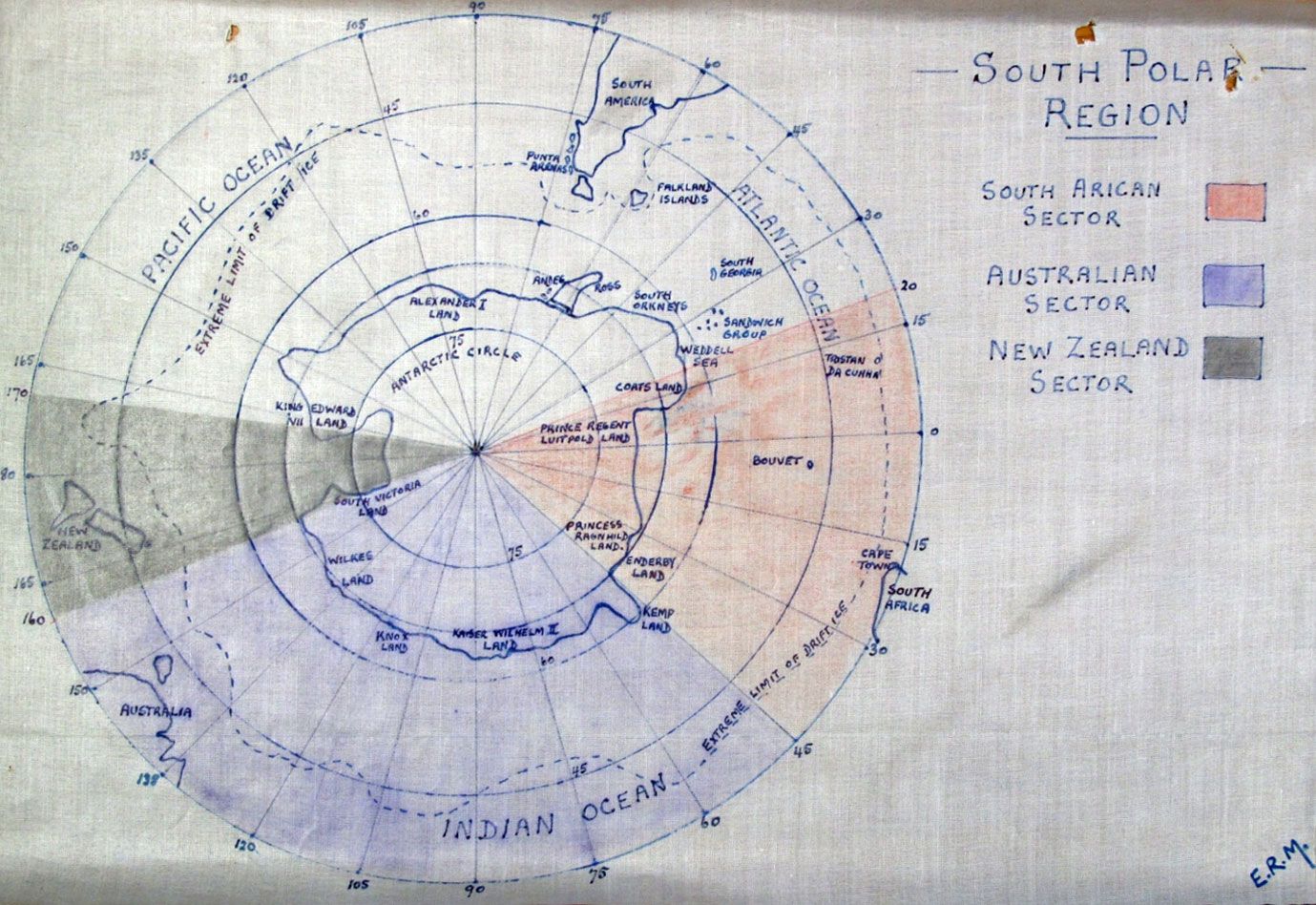
While South Africa’s Antarctic history is intimately linked to its sub-Antarctic history and its role in the south Atlantic whaling industry, this essay focusses on the Union of South Africa and the white continent during the first half of the twentieth century, and what it means for how South Africa’s Antarctic heritage is treated today.[5]For a more detailed analysis of South Africa’s Antarctic history during the interwar period, see Lize-Marié van der Watt and Sandra Swart, “Falling off the Map: South Africa, Antarctica and Empire, c. 1919–59,” The Journal of Imperial and Commonwealth History 43, no. 2 (2015): 267–91, https://doi.org/10.1080/03086534.2014.982409. This is the period that ended with the 1957-58 International Geophysical Year (IGY) which saw a large-scale scientific conquest of Antarctica, and signing of the of the Antarctic Treaty in 1959 (ratified 1961), essentially a peace treaty which froze all claims to continent. It is a romanticised period of heroism and exploration. Forty-five – almost half – of the formally recognised HSMs are from this period. Moreover, artefacts in Antarctica dating back from 1957 that are known but not located or unknown are automatically afforded protection under the Antarctic Treaty System until further assessments can be made.
Between 1910 to 1961, the Union of South Africa was a self-governing dominion under the British Crown. It was a time when South Africa only made nominal contributions to Antarctic exploration and demonstrations of effective occupation (including through scientific prowess), and then almost always spun by the British imperial loom.[6]Which also means that historian working with the archives and the official stories therein encounters an extremely white narrative. On race and South Africa’s Antarctic history see Lize-Marié van der Watt and Sandra Swart, “The Whiteness of Antarctica: Race and South Africa’s Antarctic History,” in Antarctica and the Humanities, ed. Peder Roberts, Lize-Marie van der Watt, and Adrian Howkins, Palgrave Studies in the History of Science and Technology (London: Palgrave Macmillan, 2016), https://doi.org/10.1057/978-1-137-54575-6_6. One of the first official examples was that of the British – Australian – New Zealand Antarctic Expeditions (1929 – 1931). Douglas Mawson, Australian geologist and explorer, proposed an Empire-wide expedition to Antarctica involving all the southern Dominions. At first, the United Kingdom was reluctant, its Treasury remarking that
We do not dream of asking Australasia and South Africa to contribute to the maintenance of the Empire’s prestige in (say) North America and the Arctic; and there is no reason why the British taxpayer should be asked to contribute towards this expedition.[7]Quoted in Ann Savours, The Voyages of the “Discovery”: The Illustrated History of Scott’s Ship (London: Virgin Books, 1994), 223.
However, given Norwegian activities in the same region, the UK changed its position. Mawson, a staunch supporter of British domination in Antarctica, insisted that the expedition depart from Cape Town, despite its impracticability. The South African government – an historically reluctant participant in matters of the Commonwealth – nevertheless paid for the overhaul of the vessel and waived harbour duties.
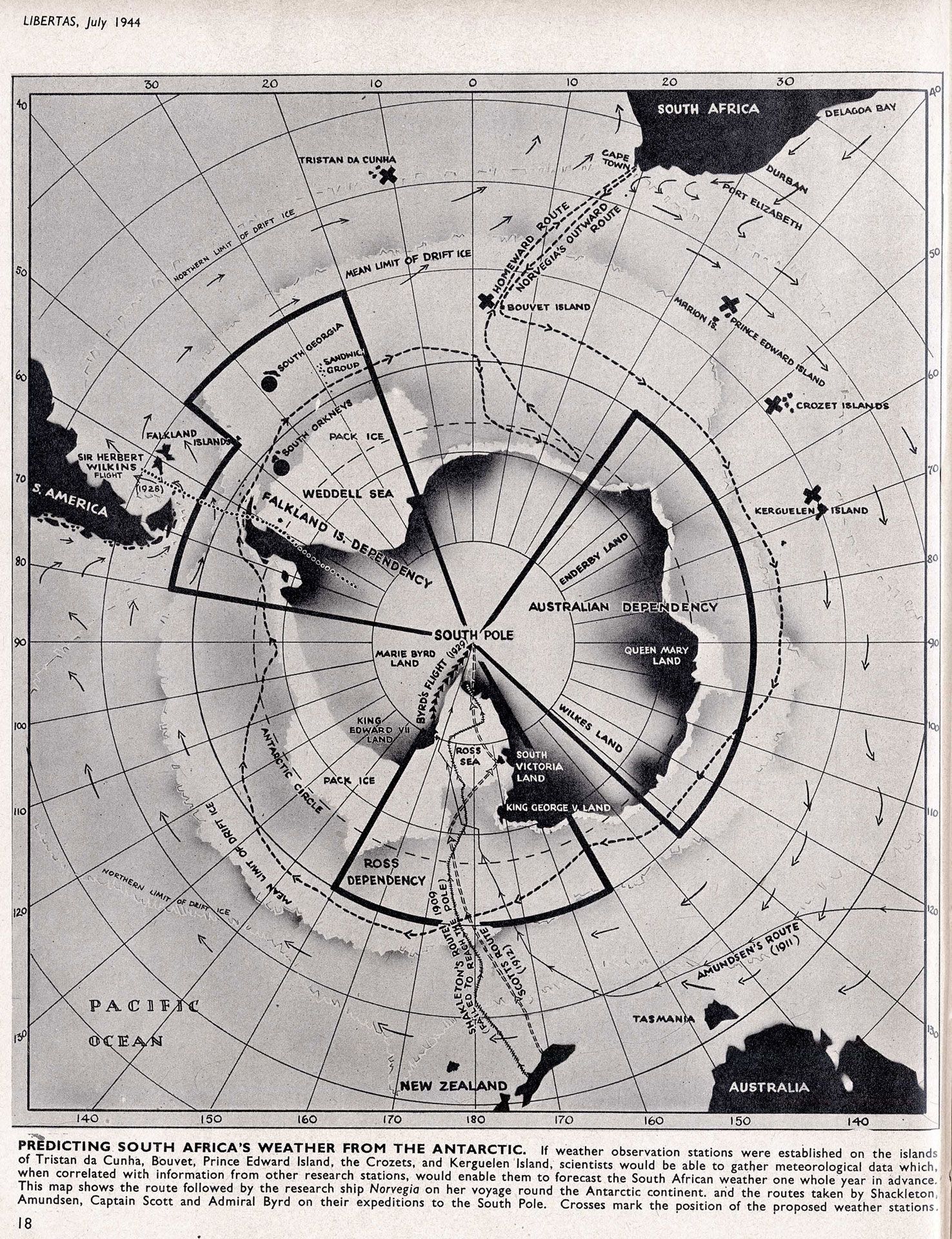
In the 1930s and 1940s, Chile, the United States and others did not include the Union of South Africa in early proposals to establish an agreement over international management of Antarctica.[8]For detailed discussions of the politics behind these proposals, see Adrian Howkins, Frozen Empires: An Environmental History of the Antarctic Peninsula (New York: Oxford University Press, 2020). Seen from the viewpoint of the South Americans, Britain and the US, it would look like South African involvement was a non-issue until South Africa pointed out that they were excluded. As a Commonwealth country South Africa was included in the despatches from Britain that invited their comment. South African officials believed that their involvement with the Prince Edward Islands, as well as South Africa’s geographical contiguity with Antarctica, warranted their inclusion in discussions around the continent.[9]A.H Hamilton to Secretary for External Affairs (13 February 1948), South African National Archives, Department of Foreign Affairs (SAB BTS) 102/2 vol. 5. In 1948, the South Africans emphasised three points regarding these proposals. First, that it should only apply to the continent and not the outlying islands. Secondly, that the continent probably ‘holds vast mineral treasures… which new scientific discoveries may make available in future.’[10]Surveys during the American Operations Highjump and Windmill revealed that if Antarctica contained mineral deposits, they would not be exploitable soon. It was likely that the South African officials were not well-read in Antarctic research. Nevertheless, they were not alone in ascribing long-term strategic importance to the mineral potential. This meant that international arrangements with regards to exploiting what they considered to be res nullius should be made. Lastly, the South Africans expressed their worry that the increasing range of weapons might pose a threat, should Antarctica become a base from which they are launched.[11]Telegram from Minister of External Affairs, Cape Town to peers in London, Canberra, Ottawa, Wellington and Washington, 9 March 1948, SAB BTS 102/2 vol.5. The Union, officials believed, should be included in any international discussions in Antarctica, as in ‘the field of long range and long term strategy, the control of Antarctica must always be a matter of primary concern…’, citing economic and strategic reasons and emphasising the role of South Africa in the Southern Hemisphere.[12]Telegram from Secretary for External Affairs, Pretoria to High Commissioner in London re Antarctic, 27 July 1948, SAB BTS 102/2 vol. 5. Even so, it was still lukewarm towards the Antarctic and had not demonstrated their interest in the Antarctic with more than paper memoranda – and certainly not with exploration and discovery. Their eventual token role played in the Norwegian-British-Swedish Antarctic Expedition was illustrative of a haphazard attitude where just enough was done not be left out in the cold.
It was with the internationalisation proposals in mind that the South African Minister of External Affairs urged the Department of Transport to re-examine the possibility of sending a South African scientist on an international expedition in the making, the Norwegian-British-Swedish expedition (NBSX).[13]B.J Jarvie for the Secretary of External Affairs to Secretary for Transport, 20 June 1949, SAB BTS 102/2 vol. 6. This expedition has often been described as the first international expedition to Antarctica focussing primarily on science, specifically meteorology, glaciology and the effects of climate change.[14]For more on the political and strategic issues around the NSBX, including the politics and strategies related to science, see Peder Roberts, The European Antarctic: science and strategy in Scandinavia and the British Empire (New York: Palgrave Macmillan, 2011). Since the early planning stages, there had been suggestions in South Africa that this expedition should be used as a means to give a South African scientist Antarctic exposure, but for the time being it was felt that the Council for Scientific and Industrial Research (CSIR) could not support it and ‘that moneys for research could be better employed in extending its own activities and those of the Universities.’[15]Schonland (head of the CSIR) to Hofmeyr, 9 October 1946, SAB BTS 102/2 vol. 3.
J.M Wordie, chairman of the U.K Polar Committee and advocate of greater Commonwealth participation in Antarctica, told South African officials in 1947 that he personally knew of two South Africans who would like to join the expedition and that it would be an unusual opportunity for South Africa to participate in Antarctic research. One of them was Joe King, a meteorologist.[16]At the time he was head of the Synoptic and Forecasting Branch of the Union Weather Bureau. He went on to play an important role in South Africa’s international relations with the World Meteorological Organization. Wordie also pointed out that the area that the NBSX proposed to visit was in the sector directly south of South Africa and as such could hold geological and meteorological significance for the country.[17]The South African official dealing with the correspondence was cognisant of its being Norwegian territory, even though not officially recognised by South Africa. He recommended that the Secretary of External Affairs should have a word with the Norwegian minister in Pretoria. Sole to Secretary for External Affairs, 7 July 1947, SAB BTS 102/2 vol. 3. The CSIR remained sceptical, maintaining that ‘there is not a good case for the expenditure of money by South Africa on Antarctic Research’[18]Sole to High Commission in United Kingdom, 28 August 1947 and Lester King to Assistant Secretary for the Geological Association of South Africa,18 September 1947, SAB BTS 102/2 vol. 3. unless political factors made it worthwhile.[19]Schonland to the Secretary for External Affairs, “U.K-Norwegian Expedition to the Antarctic,” 8 August 1947, SAB BTS 102/2 vol. 3. The fact that Antarctic matters were dealt with in an ad hoc manner, with no one having the expertise or being assigned clear authority to make decisions also led to inaction.[20]Sole to High Commission in United Kingdom, 28 August 1947 and Lester King to Assistant Secretary for the Geological Association of South Africa,18 September 1947, SAB BTS 102/2 vol. 3.
The NBSX was postponed, but when it was on the cards again, the political landscape and the view on the importance of polar science had changed.[21]Roberts, The European Antarctic. After the occupation of the Prince Edward Islands, the Department of External Affairs decided that it ought to make a nominal contribution to the Scott Polar Research Institute as a means to access information, both practical and political.[22]This was agreed upon by all the departments consulted, except Commerce and Industries, who could see no immediate value in investing in the Southern Polar Regions. A.H Hamilton to Secretary for External Affairs, 19 January 1948, SAB BTS 102/2 vol. 3. Moreover, South Africa’s exclusion from earlier internationalisation proposals made a small section of the foreign office pay more attention. South Africa’s attitude towards international relations, including those relating to Antarctica, also changed with the National Party (NP) victory in the 1948 elections. They emphasised South Africa’s position as an autonomous nation and were more likely to draw on national prestige when considering international questions. Furthermore, the NP harboured strong feelings of anti-communism. To the NP, Soviet activities on the Antarctic would have raised suspicions of real threats to the country’s security. Thus, when asked again if they wished to include a meteorologist in the NBSX, officials hurriedly organised King’s passage.[23]There was not even time for King to acquire the right gear. High Commissioner to Secretary for External Affairs, 2 December 1949, SAB BTS 102/2 vol. 6.
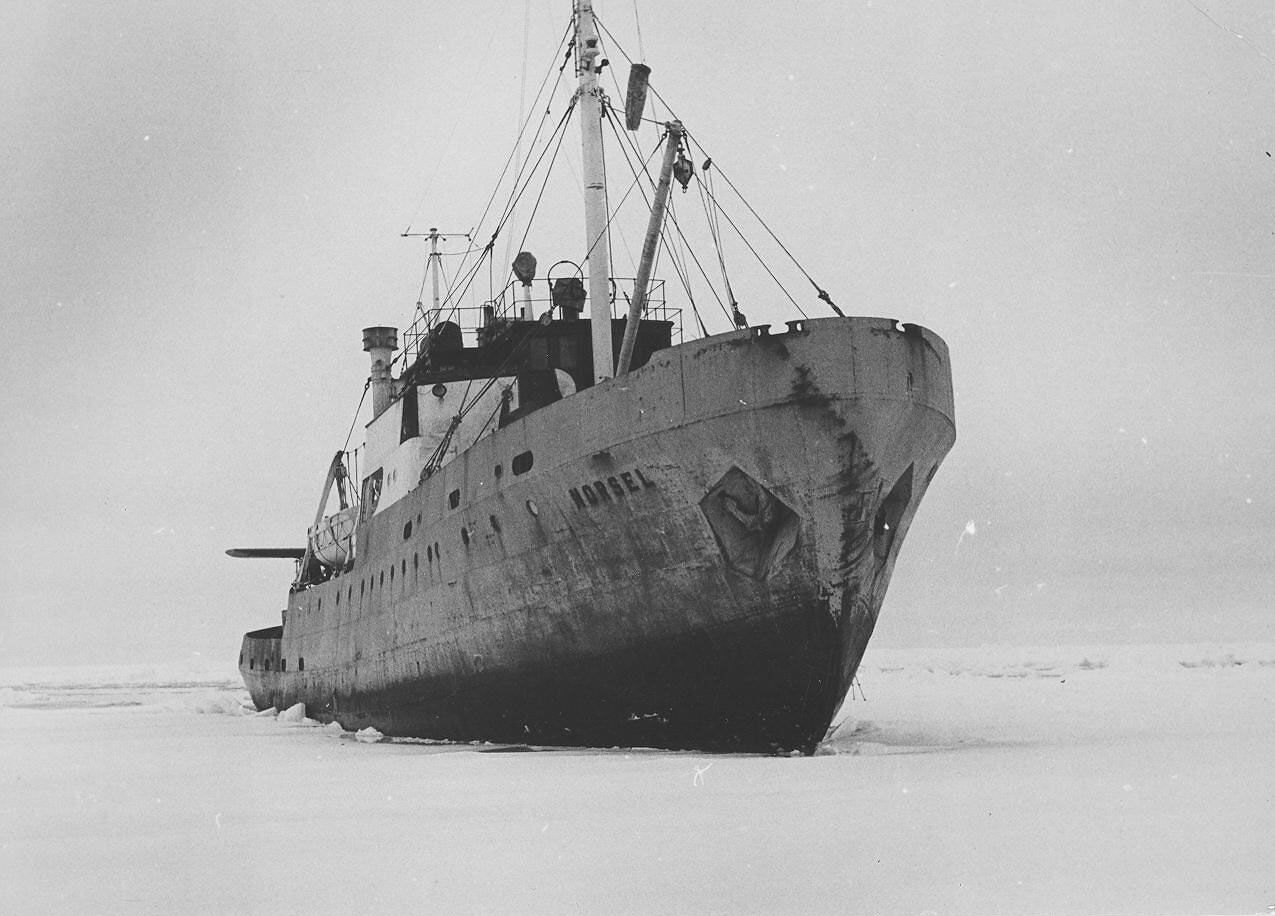
The South African scientific community in Cape Town made use of the opportunity to network with their colleagues when the Norsel docked in the Mother City. Similarly, there was a display of generous hospitality to an important polar expedition, including hosting telegraphic communications, so that telegraphs could be relayed through Cape Town at minimum cost.[24]Minutes of the Meeting of the Minutes of a meeting of the Polar Committee, 1 June 1951, SAB BTS 102/2 vol. 7. Other displays of hospitality included an evening event organised by the S2A3 and gifts of wine and other drinks from the South African Government and an exceptionally friendly welcome at the harbour, ‘even from custom officials’. John Giæver, The White Desert: The Official Account of the Norwegian-British-Swedish Antarctic Expedition (London: Chatto & Windus, 1954), 40–42. These actions however, remained mere gestures made by individuals with some personal interest in polar science and there was little to no cabinet level interest. It was only with the approval of South Africa’s participation in the International Geophysical Year (IGY) that South Africans became involved in Antarctic science on any international platform.
Many decades later in the 1990s, teams of South African expeditioners found a depot of food and other amenities close to a nunataq called Pyramiden in Dronning Maudland, left there by a team from the NBSX expedition. Some souvenirs were taken, and many stories told among the small community of South African Antarcticans. When South Africa National Research Foundation started investing in a long-term project Antarctic Legacy of South Africa (ALSA), a few colleagues and I made some efforts to trace the originators of the stories, and some of the objects that were maybe or maybe not taken to South Africa. Lukewarm efforts. They still surface from time to time, questions whether the depot is there or not, and who has the resources to plan perhaps trying to include finding as part of their summer’s fieldwork. It is the kind of artefact that would have likely rotted and rusted by now in most other environments, but not in this part of the world, populated by mundane and simple things humans transferred to the continent to use and disregard.[25]María Ximena Senatore, “Things in Antarctica: An Archaeological Perspective,” The Polar Journal 10, no. 2 (2020): 397–419, doi.
Proposals for a trans-Antarctic journey followed soon after the successful NBSX. From its inception, what became known as the British Commonwealth Trans-Antarctic Expedition (CTAE) consciously drew on a romantic notion of Antarctic exploration. It would pay homage to the dream of British polar hero, Ernest Shackleton.[26]Klaus Dodds, Pink Ice: Britain and the South Atlantic Empire (London, New York: I.B. Tauris, 2002), 59.0) It was felt that, in an environment where Antarctic exploration took on a clinical military aspect, (especially as pursued by the United States and the Argentineans), a crossing of Antarctica was one ‘of the few big things that remained to be done in the sphere of exploration.’((Proposals for a Commonwealth Trans-Antarctic Expedition (1951–1953), Vivian Fuchs, Extract from the Minutes of the 2nd Meeting of the Polar Committee, 15 September 1953, The National Archives, Kew, UK, Commonwealth Office files (TNA CO) 1024/60.0
Scientific justifications for such an expedition were many in view of the dearth of geographical data available.[27]Klaus Dodds, Pink Ice: Britain and the South Atlantic Empire (London, New York: I.B. Tauris, 2002), 59. Exploring a wide swath of continent was also useful in extenuating territorial claims in the Antarctic.[28]This was not, however, universally accepted. The United Kingdom Foreign Office representative, for instance, was described by the SA representative to have been ‘rather severe in discrediting the suggestion.’ A.M Hamilton, South Africa House to Secretary for External Affairs, 8 October 1953, SAB BTS 102/2/4 vol. 1. The overriding characteristic of the endeavour however, was the attempts to mount a display of the strength of the ties between the (white) states of the British Commonwealth – Australia, New Zealand, South Africa, Canada and United Kingdom – in a period where the Empire as it was known slowly being dismantled.[29]Klaus Dodds, Pink Ice: Britain and the South Atlantic Empire (London: I.B. Tauris, 2002), 59-60.
The CTAE plans did not excite the Commonwealth countries, however. Australia was in the process of planning a National Antarctic Expedition and was unwilling to divert its attention, manpower and funds to another expedition. The CSIR held that they would not be able to justify participation, but that it might be possible that the Weather Bureau would be interested and that South Africa may wish to participate as a ‘question of prestige’.[30]S.M Meiring, WNNR aan Sekretaris van Buitelandse Sake, 22 October 1953, SAB BTS 102/2/4 vol. 1.0 The Weather Bureau was not convinced about the meteorological value of the expedition: ‘[w]hatever the romantic and human attraction of a safari across the South Pole might be, it can be said with conviction that the meteorological observations done during the trek will be of little value.’((Sekretaris van Vervoer aan Sekretaris van Buitelandse Sake, 24 November 1953, SAB BTS 102/2/4 vol. 1. The laying of the depots could potentially be valuable, however, if it was a means for continuous observations from the same location and it could continue after the expedition. Based on the ‘basically free’ information they received from the NBSX, the Weather Bureau proposed that the Union Government make a financial contribution, but that they do not commit themselves.[31]Ibid. The other Commonwealth governments had similar attitudes. By November 1954 it was feared that, ‘…in the absence of any indication that Commonwealth Governments will provide financial aid, the main justification for the project, i.e. a demonstration of Commonwealth solidarity in the Antarctic, has not so far been achieved.’[32]D.M Cleary, C.R.O. to W.A Morris, C.O, 2 November 1954, TNA CO 1024/60.
Considering the Commonwealth disinclination – the lack of support from Antarctic-experienced Australia was especially detrimental – the expedition had to be postponed. It was, however, already publicly known that such a journey had been on the cards. This meant that a lack of action would result in a greater loss of prestige than mere postponement of the expedition would. Aggravating the potential for embarrassment was the fact that the IGY planning was gathering momentum, that the Argentineans added yet another base in their strategy of ‘saturating Antarctica with scientific bases,’ and that the Americans were commencing with an impressive flying programme.[33]C.C.L Bertram, “Notes for Discussion with Sir John Martin on the problems of FIDS and related problems,” 7 March 1955, TNA CO 1024/60. For a detailed account on the politics within the British Antarctic establishment over the CTAE see Dodds, Pink Ice, 59–74. The United Kingdom subsequently considered employing diplomatic pressure for this ostensibly private expedition. A brief drafted for the meeting of the Commonwealth Prime Ministers the importance of the Expedition was explained as follows:
Taking place, as it would, partly in the IGY, it would be an inspiring and striking demonstration of Commonwealth collaboration of a kind that would stir public interest and imagination throughout the world and give a great boost to the idea of the British Commonwealth of Nations…[34]Preliminary draft of a brief to Commonwealth Prime Ministers Meeting, January1955, TNA CO 1024/60.
In their efforts to garner public support, the men behind the CTAE nevertheless persisted with the strategy of emphasising its elevated purpose of ground-breaking exploration and science, adventure and prestige. Their efforts received a huge boost when it became known that Sir Edmund Hillary, whose feat on Mount Everest in 1953 was fresh in Imperial subjects’ minds, would be co-leader.[35]“To the South Pole by Jeep,” Daily Worker (10 January 1955) and “New Zealand Antarctic Crossing Plan,” Daily Telegraph (11 January 1955) This noticeably raised the public profile of the CTAE and added the much needed celebrity factor to fund-raising efforts.[36]Klaus Dodds, “The Great Trek: New Zealand and the British/Commonwealth 1955-1958 Trans-Antarctic Expedition,” The Journal of Imperial and Commonwealth History, 33, 1 (January 2005), 93-114. Confidence that the venture would succeed grew. The Secretary of State for the Royal Air Force was singularly fervent in his support for the CTAE and its goals:
…here is an opportunity of something imaginative, adventurous, Elizabethan, popular and perhaps ultimately remunerative, in a cooperative Empire adventure at little cost.[37]Letter signed Phillip, (Secretary of State) (Rt. Hon. Viscount Swinton) to Bill, Secretary of State for Air (The Rt. Hon. Lord De L’Isle and Dudley), 14 January 1955, TNA CO 1024/172.
The CTAE was also an overt symbolic display on the part of Great Britain that it was still ‘Great’, that it was still able to play a meaningful role in the world dominated by the USA and the USSR.[38]Dodds, “The Great Trek,” 105.
Another round of internal lobbying followed, with the South African Department of External Affairs writing missives to institutions from the CSIR to the departments overseeing the military, fisheries and mines, with similar polite but uninterested responses.[39]D.J Joubert, Sekretaris van Vervoer aan Sekretaris van Buitelandse Sake, 7 August 1954, BTS 102/2/4 vol.1.; Hoof van Generale Staf aan Sekretaris van Buitelandse Sake, 30 September 1954, BTS 102/2/4 vol.1.; Rousseau, Waarnemende Sekretaris Handel en Nywerheid aan Sekretaris van Buitelandse Sake, 27 October 1954, BTS 102/2/4 vol.1.; Sekretaris vir Mynwese aan Sekretaris van Buitelandse Sake, 30 October 1954, BTS 102/2/4 vol.1. What many South African officials were deeply interested in, however, were racial politics. In terms of its racial ideology South Africa’s relationship with the international community was already showing strains, especially on a United Nations (UN) platform. In the discussion of the Vote of his Ministry, Erik Louw, as Minister of External Affairs, had to explain to the House of Assembly why South Africa withdrew from the United Nations Educational, Scientific and Cultural Organisation (UNESCO). According to Louw UNESCO was meddling with South Africa’s domestic affairs by publishing pamphlets attacking South Africa’s ‘internal racial policy’. South Africa’s membership of the UN was not guaranteed either, especially if the UN did not curtail what Louw and his colleagues saw as interference in domestic matters. He then ended by announcing that South Africa will participate in the Antarctic expedition because it had a ‘distinct interest in the Antarctic’, pertaining to meteorology and whaling.[40]“No Guarantee That S.A. will stay in the United Nations,” Natal Mercury, 6 May 1955.
It is possible that, with sporadic calls for Antarctica to be put under UN trusteeship – and UNESCO being its likely caretaker – the South African government realised it would then have very little say in Antarctic matters. The South African High Commission also informed Louw that South Africa’s participation in the CTAE would serve as proof of the Union’s interest in the Antarctic, and that South Africa should be included in consultations about this area.[41]Memorandum by J.J Becker of South Africa House, “Die Voorgestelde Ekspedisie na die Suidpool,” 6 April 1955, SAB BTS 102/2/4 vol. 2. By announcing this during the same Vote in which he had to explain South Africa’s withdrawal from UNESCO, it could be that Louw wanted to counter the potential negative reaction by also announcing active participation in an international enterprise.
The announcement that South Africa will take part in the expedition, London observed, passed ‘practically unnoticed [in] the South African Press.’[42]Inward Telegram to CRO from U.K High Commissioner in South Africa, “Proposals for a Commonwealth TAE,” 12 May 1955, TNA CO 1024/172. This was an accurate observation – where it was mentioned it was part of longer articles focussing on Louw’s remarks in the House of Assembly in general and far greater attention was paid to the withdrawal from UNESCO. The Cape Times had to rely on the London Times for information on what the expedition’s aims were. See “Aims of Expedition to South Pole: S.A to Join,” Cape Times, 7 May 1955. The lack of media attention was perhaps anticipated and as such the CTAE presented a domestically non-controversial way for the South African cabinet to show nominal support for the Commonwealth. Once Louw made his rather sudden announcement (the Commonwealth Relations Office heard about it in the Times), it was for some time unclear exactly what the nature of South Africa’s contribution would be. Eventually, they contributed £10,000 plus a further £8,000 for meteorological equipment and the services of two meteorologists.[43]Commonwealth Trans-Antarctic Expedition Correspondence, TNA CO 1024/173
The two men seconded to participate in the expedition were J.J. ‘Hannes’ la Grange and Piet S. du Toit, both men that overwintered on Marion Island before.[44]Another version is that both Du Toit and La Grange wrote to Fuchs, who then used his influence to convince Schumann. Private interview, (25 August 2010). La Grange, whom Fuchs described as a ‘blind date’ that turned out well, also volunteered for Fuchs’ main party – the party that did the actual trekking to the Pole – after his first winter.[45]Minutes of the Twentieth Meeting of the Committee of Management: Trans-Antarctic Expedition, 14 August 1956, SAB BTS 102/2/4 Vol 2. It was an offer Fuchs gladly accepted.[46]Ibid. On 19 January 1958, Hannes la Grange reached the South Pole as the first South African to do so.[47]Hannes la Grange, “I carried Union Flag over the South Pole,” Cape Times (22 March 1958). He did it in a Sno-Cat nicknamed ‘Haywire’ that flew the South African flag and pulling a sledge sporting a springbok and protea pennant he had embroidered himself. By all accounts a steadfast, dutiful Afrikaner, La Grange proceeded to lead South Africa’s first overwintering expedition in 1959.[48]He saw spending another winter in Antarctica very much as a calling to do his nationalist duty, he maintained Afrikaner traditions such as observing the Day of the Vow in Antarctica and did not want the only dual national on the South African team wave the Dutch flag at the base. André le R. van der Merwe, Die Wit Horison: Antarktiese Dagboekverhaal Desember 1959–Januarie 1961 (Cape Town: Human & Rousseau, 1968), 19. Interviews with Mettie la Grange, Hannes la Grange’s widow, Johannesburg (15 October 2010) and Dick Bonnema (5 August 2010).
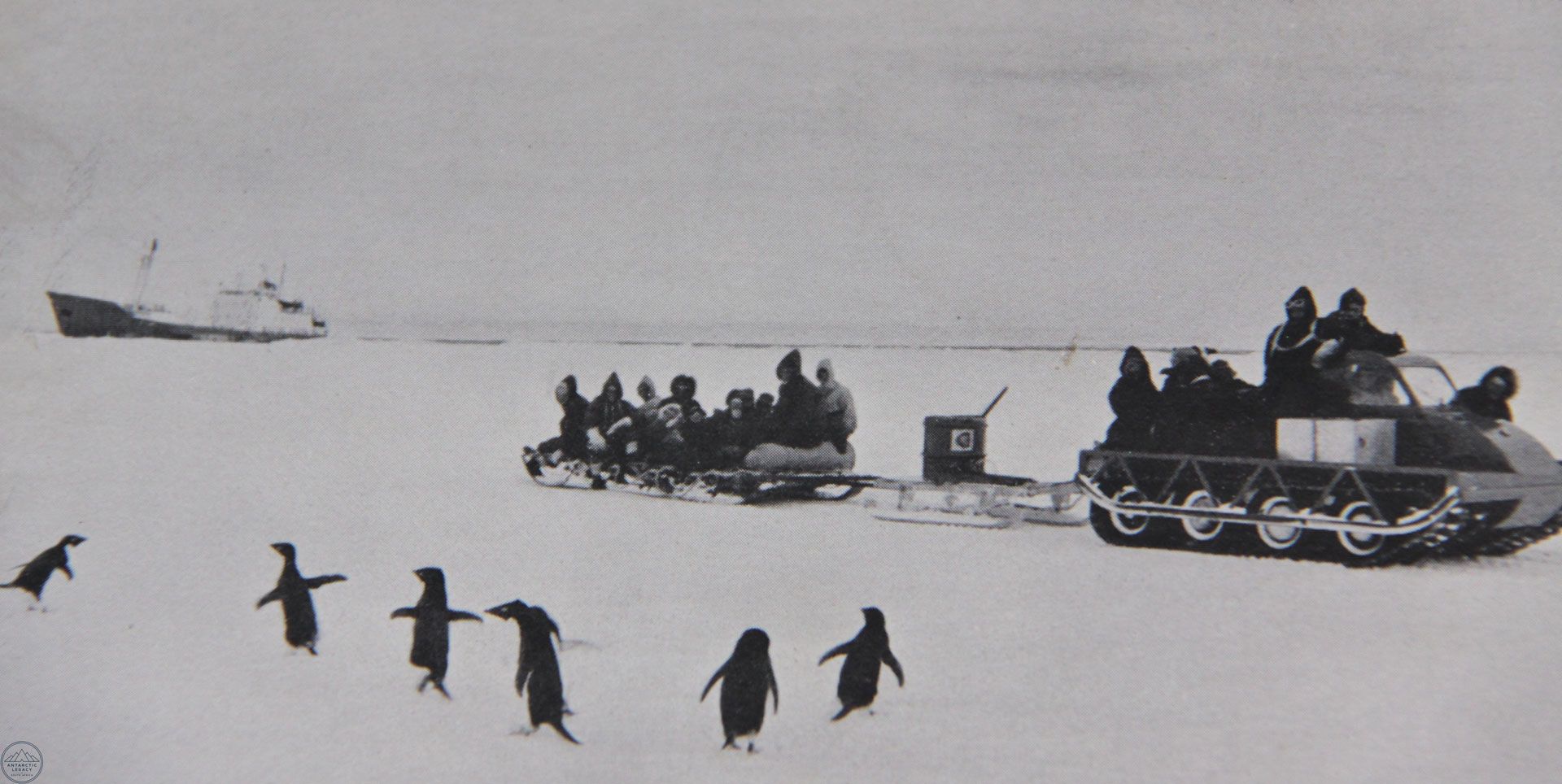
The artefacts from this expedition which were part of a traditional diorama – centred on exploration, science and nation-building – in a 2019 exhibition at the Iziko South African Museum following a collaboration between the Museum and the Antarctic Legacy of South Africa project.
South Africa’s pre-1961 Antarctic legacy is part of an imperial tapestry, and given the very thin thread of the story, its absence from the broader narratives for Antarctic heritage during this period is to be expected. Recently South Africans were, however, involved in the high-publicity search for one of the most spectacular pre-1957 artefacts: the shipwreck of Shackleton’s Endurance. Shackleton’s expedition set sail in 1914 with the goal to cross the Antarctic continent, but January 1915 the vessel got stuck in the Wedell sea-ice and slowly sank. An epic journey of survival followed.[49]Daniela McCahey “Endurance captain Frank Worsley, Shackleton’s gifted navigator, knew how to stay the course” in The Conversation 11 March 2022. https://theconversation.com/endurance-captain-frank-worsley-shackletons-gifted-navigator-knew-how-to-stay-the-course-179045 In March 2022, the privately financed Endurance22 expedition chartering the South African ice-class vessel, Agulhas II, captained by Knowledge Bhengu, a black South African with roots in rural KwaZulu Natal, located the shipwreck only four miles from its last known position.
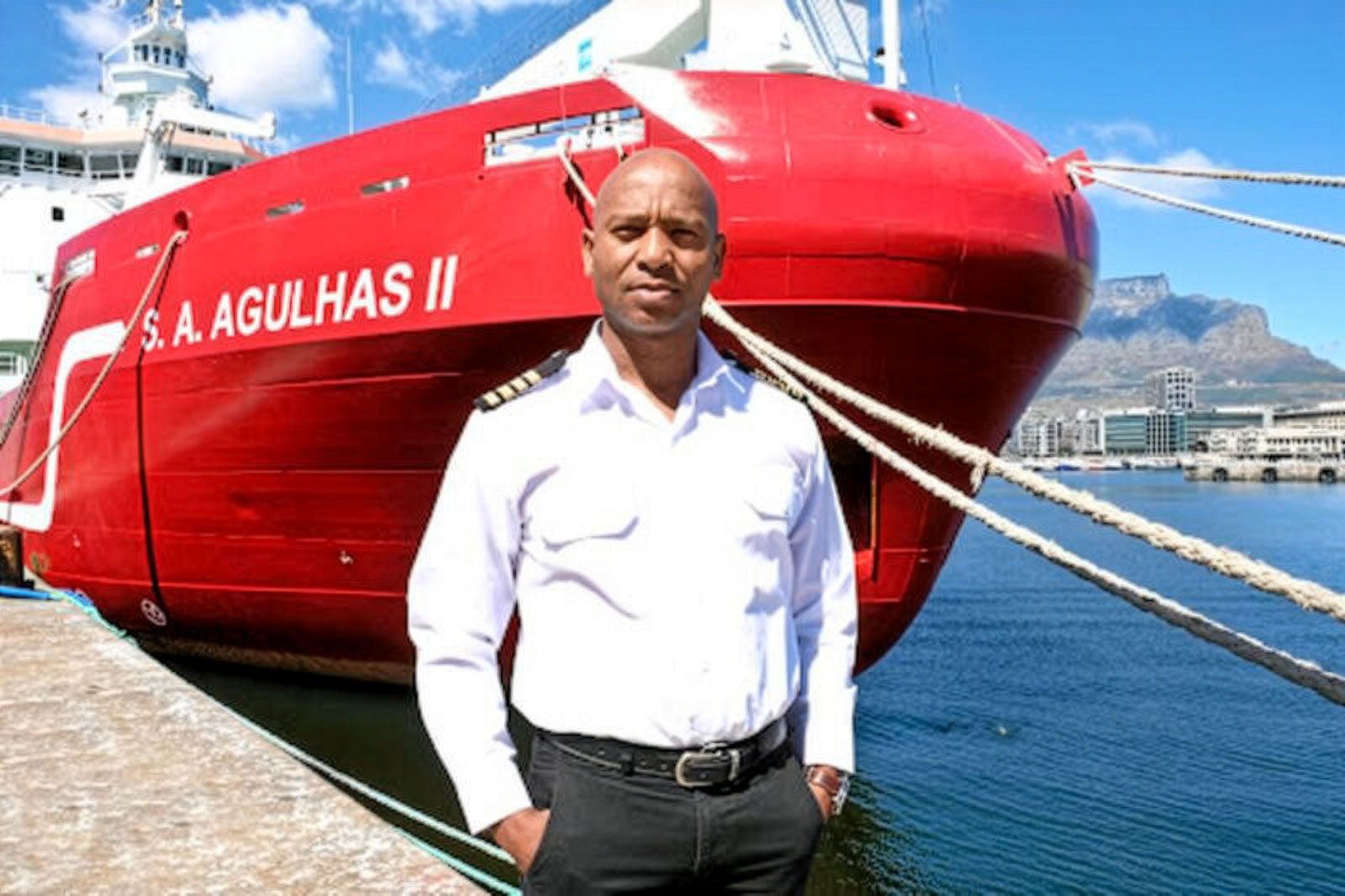
The wreck, which already received HSM status in 2019, was found in well-preserved condition due to the harsh conditions in the Wedell sea.[50]This was not the first site of unknown location designated as a Historic Site and Monument, with Amundsen’s tent, buried under the ice and drifting towards to coast at glacial pace, being the first. The first, unsuccessful, search for the Endurance also took place in 2019, using the same vessel. However, with a fast-warming ocean comes among other things timber-eating marine creatures – and the potential rapid decay of the wreck. In 2026, Antarctic Treaty Parties agreed to propose the area as the first underwater specially protected area under the Environment Protection Protocol, but this would need to be agreed by CCAMLR. Declaring it a specially protected area will not have any effect on rapid climate change, but could be a management tool to decide, for example, which vessels have access and how and when the wreck can be accessed, limiting vectors for new wood-chowing and invasive species.
South Africa has not been actively involved in the official heritage politics of Antarctica. The question also remains – how much can and should South Africa engage in a system that (still) so overwhelmingly celebrates the feats of empire? Historical heritage is a sub-point on the Antarctic agenda but one of increasing urgency, even if exactly that system stabilises some sovereignty issues through performances of care for these sites and the artefacts they contain? (see Kati Lindström). The funding exists – as does the academic knowledge. The government, through the National Research Foundation, made large investments in outreach and digitisation efforts to promote South Africa’s Antarctic legacy. In particular, South Africa also has vast experience with critical heritage studies and the political intersections between natural and cultural heritage – and decay – that it could contribute. What other kinds of heritage practices can South Africa put forward, from its vantage point as a gateway to Antarctica – and to the Indian, Atlantic and Southern Oceans? To preserve the traces of exploration in a way that is meaningful – not least in the face of rapid climate change – has its place. But perhaps even more important is investing resources in the heritage of the ordinary—the everyday routines and labour of Antarctica, that made its heroic past possible.
The work on this article has been supported by the Riksbankens Jubileumsfond’s project Decay Without Mourning: Future Thinking Heritage Practices (GI21-0001), and the first iteration of the South African National Research Foundation (NRF) Antarctic Legacy of South Africa project (2008-2012).
| 1. | ↑ | South Africa is party to all the legal agreements included in the Antarctic Treaty System, including the Convention on the Conservation of Antarctic Seals (CCAS, signed 1972) and the Convention for the Conservation of Antarctic Marine Living Resources (CCAMLR, signed 1980) and the Protocol on Environmental Protection to the Antarctic Treaty (Madrid Protocol, signed 1991). Namibia is a full member of CCAMLR only. |
| 2. | ↑ | Department of Forestry, Fisheries and the Environment website “South Africa’s role in Antarctic & Southern Ocean Governance” dffe.gov (retrieved 20 July 2026). |
| 3. | ↑ | For a summary of the expeditions that set forth from South Africa during the so-called ‘Heroic Age’ (including Scott’s last expedition), see John Cooper and Robert K Headland, “A History of South African Involvement in Antarctica and at the Prince Edward Islands,” South African Journal of Antarctic Research 21, 2 (1991), 77–91. |
| 4. | ↑ | Rebecca Hingley, “Ice-locked Huts, Snow-buried Cairns, and Sunken Ships: The Prevailing Discourse on Heritage in Antarctica,”International Journal of Heritage Studies 28, no. 8 (2022): 940–954. |
| 5. | ↑ | For a more detailed analysis of South Africa’s Antarctic history during the interwar period, see Lize-Marié van der Watt and Sandra Swart, “Falling off the Map: South Africa, Antarctica and Empire, c. 1919–59,” The Journal of Imperial and Commonwealth History 43, no. 2 (2015): 267–91, https://doi.org/10.1080/03086534.2014.982409. |
| 6. | ↑ | Which also means that historian working with the archives and the official stories therein encounters an extremely white narrative. On race and South Africa’s Antarctic history see Lize-Marié van der Watt and Sandra Swart, “The Whiteness of Antarctica: Race and South Africa’s Antarctic History,” in Antarctica and the Humanities, ed. Peder Roberts, Lize-Marie van der Watt, and Adrian Howkins, Palgrave Studies in the History of Science and Technology (London: Palgrave Macmillan, 2016), https://doi.org/10.1057/978-1-137-54575-6_6. |
| 7. | ↑ | Quoted in Ann Savours, The Voyages of the “Discovery”: The Illustrated History of Scott’s Ship (London: Virgin Books, 1994), 223. |
| 8. | ↑ | For detailed discussions of the politics behind these proposals, see Adrian Howkins, Frozen Empires: An Environmental History of the Antarctic Peninsula (New York: Oxford University Press, 2020). Seen from the viewpoint of the South Americans, Britain and the US, it would look like South African involvement was a non-issue until South Africa pointed out that they were excluded. |
| 9. | ↑ | A.H Hamilton to Secretary for External Affairs (13 February 1948), South African National Archives, Department of Foreign Affairs (SAB BTS) 102/2 vol. 5. |
| 10. | ↑ | Surveys during the American Operations Highjump and Windmill revealed that if Antarctica contained mineral deposits, they would not be exploitable soon. It was likely that the South African officials were not well-read in Antarctic research. Nevertheless, they were not alone in ascribing long-term strategic importance to the mineral potential. |
| 11. | ↑ | Telegram from Minister of External Affairs, Cape Town to peers in London, Canberra, Ottawa, Wellington and Washington, 9 March 1948, SAB BTS 102/2 vol.5. |
| 12. | ↑ | Telegram from Secretary for External Affairs, Pretoria to High Commissioner in London re Antarctic, 27 July 1948, SAB BTS 102/2 vol. 5. |
| 13. | ↑ | B.J Jarvie for the Secretary of External Affairs to Secretary for Transport, 20 June 1949, SAB BTS 102/2 vol. 6. |
| 14. | ↑ | For more on the political and strategic issues around the NSBX, including the politics and strategies related to science, see Peder Roberts, The European Antarctic: science and strategy in Scandinavia and the British Empire (New York: Palgrave Macmillan, 2011). |
| 15. | ↑ | Schonland (head of the CSIR) to Hofmeyr, 9 October 1946, SAB BTS 102/2 vol. 3. |
| 16. | ↑ | At the time he was head of the Synoptic and Forecasting Branch of the Union Weather Bureau. He went on to play an important role in South Africa’s international relations with the World Meteorological Organization. |
| 17. | ↑ | The South African official dealing with the correspondence was cognisant of its being Norwegian territory, even though not officially recognised by South Africa. He recommended that the Secretary of External Affairs should have a word with the Norwegian minister in Pretoria. Sole to Secretary for External Affairs, 7 July 1947, SAB BTS 102/2 vol. 3. |
| 20. | ↑ | Sole to High Commission in United Kingdom, 28 August 1947 and Lester King to Assistant Secretary for the Geological Association of South Africa,18 September 1947, SAB BTS 102/2 vol. 3. |
| 19. | ↑ | Schonland to the Secretary for External Affairs, “U.K-Norwegian Expedition to the Antarctic,” 8 August 1947, SAB BTS 102/2 vol. 3. |
| 21. | ↑ | Roberts, The European Antarctic. |
| 22. | ↑ | This was agreed upon by all the departments consulted, except Commerce and Industries, who could see no immediate value in investing in the Southern Polar Regions. A.H Hamilton to Secretary for External Affairs, 19 January 1948, SAB BTS 102/2 vol. 3. |
| 23. | ↑ | There was not even time for King to acquire the right gear. High Commissioner to Secretary for External Affairs, 2 December 1949, SAB BTS 102/2 vol. 6. |
| 24. | ↑ | Minutes of the Meeting of the Minutes of a meeting of the Polar Committee, 1 June 1951, SAB BTS 102/2 vol. 7. Other displays of hospitality included an evening event organised by the S2A3 and gifts of wine and other drinks from the South African Government and an exceptionally friendly welcome at the harbour, ‘even from custom officials’. John Giæver, The White Desert: The Official Account of the Norwegian-British-Swedish Antarctic Expedition (London: Chatto & Windus, 1954), 40–42. |
| 25. | ↑ | María Ximena Senatore, “Things in Antarctica: An Archaeological Perspective,” The Polar Journal 10, no. 2 (2020): 397–419, doi. |
| 26. | ↑ | Klaus Dodds, Pink Ice: Britain and the South Atlantic Empire (London, New York: I.B. Tauris, 2002), 59.0) It was felt that, in an environment where Antarctic exploration took on a clinical military aspect, (especially as pursued by the United States and the Argentineans), a crossing of Antarctica was one ‘of the few big things that remained to be done in the sphere of exploration.’((Proposals for a Commonwealth Trans-Antarctic Expedition (1951–1953), Vivian Fuchs, Extract from the Minutes of the 2nd Meeting of the Polar Committee, 15 September 1953, The National Archives, Kew, UK, Commonwealth Office files (TNA CO) 1024/60.0 |
| 27. | ↑ | Klaus Dodds, Pink Ice: Britain and the South Atlantic Empire (London, New York: I.B. Tauris, 2002), 59. |
| 28. | ↑ | This was not, however, universally accepted. The United Kingdom Foreign Office representative, for instance, was described by the SA representative to have been ‘rather severe in discrediting the suggestion.’ A.M Hamilton, South Africa House to Secretary for External Affairs, 8 October 1953, SAB BTS 102/2/4 vol. 1. |
| 29. | ↑ | Klaus Dodds, Pink Ice: Britain and the South Atlantic Empire (London: I.B. Tauris, 2002), 59-60. |
| 30. | ↑ | S.M Meiring, WNNR aan Sekretaris van Buitelandse Sake, 22 October 1953, SAB BTS 102/2/4 vol. 1.0 The Weather Bureau was not convinced about the meteorological value of the expedition: ‘[w]hatever the romantic and human attraction of a safari across the South Pole might be, it can be said with conviction that the meteorological observations done during the trek will be of little value.’((Sekretaris van Vervoer aan Sekretaris van Buitelandse Sake, 24 November 1953, SAB BTS 102/2/4 vol. 1. |
| 31. | ↑ | Ibid. |
| 32. | ↑ | D.M Cleary, C.R.O. to W.A Morris, C.O, 2 November 1954, TNA CO 1024/60. |
| 33. | ↑ | C.C.L Bertram, “Notes for Discussion with Sir John Martin on the problems of FIDS and related problems,” 7 March 1955, TNA CO 1024/60. For a detailed account on the politics within the British Antarctic establishment over the CTAE see Dodds, Pink Ice, 59–74. |
| 34. | ↑ | Preliminary draft of a brief to Commonwealth Prime Ministers Meeting, January1955, TNA CO 1024/60. |
| 35. | ↑ | “To the South Pole by Jeep,” Daily Worker (10 January 1955) and “New Zealand Antarctic Crossing Plan,” Daily Telegraph (11 January 1955) |
| 36. | ↑ | Klaus Dodds, “The Great Trek: New Zealand and the British/Commonwealth 1955-1958 Trans-Antarctic Expedition,” The Journal of Imperial and Commonwealth History, 33, 1 (January 2005), 93-114. |
| 37. | ↑ | Letter signed Phillip, (Secretary of State) (Rt. Hon. Viscount Swinton) to Bill, Secretary of State for Air (The Rt. Hon. Lord De L’Isle and Dudley), 14 January 1955, TNA CO 1024/172. |
| 38. | ↑ | Dodds, “The Great Trek,” 105. |
| 39. | ↑ | D.J Joubert, Sekretaris van Vervoer aan Sekretaris van Buitelandse Sake, 7 August 1954, BTS 102/2/4 vol.1.; Hoof van Generale Staf aan Sekretaris van Buitelandse Sake, 30 September 1954, BTS 102/2/4 vol.1.; Rousseau, Waarnemende Sekretaris Handel en Nywerheid aan Sekretaris van Buitelandse Sake, 27 October 1954, BTS 102/2/4 vol.1.; Sekretaris vir Mynwese aan Sekretaris van Buitelandse Sake, 30 October 1954, BTS 102/2/4 vol.1. |
| 40. | ↑ | “No Guarantee That S.A. will stay in the United Nations,” Natal Mercury, 6 May 1955. |
| 41. | ↑ | Memorandum by J.J Becker of South Africa House, “Die Voorgestelde Ekspedisie na die Suidpool,” 6 April 1955, SAB BTS 102/2/4 vol. 2. |
| 42. | ↑ | Inward Telegram to CRO from U.K High Commissioner in South Africa, “Proposals for a Commonwealth TAE,” 12 May 1955, TNA CO 1024/172. This was an accurate observation – where it was mentioned it was part of longer articles focussing on Louw’s remarks in the House of Assembly in general and far greater attention was paid to the withdrawal from UNESCO. The Cape Times had to rely on the London Times for information on what the expedition’s aims were. See “Aims of Expedition to South Pole: S.A to Join,” Cape Times, 7 May 1955. |
| 43. | ↑ | Commonwealth Trans-Antarctic Expedition Correspondence, TNA CO 1024/173 |
| 44. | ↑ | Another version is that both Du Toit and La Grange wrote to Fuchs, who then used his influence to convince Schumann. Private interview, (25 August 2010). |
| 45. | ↑ | Minutes of the Twentieth Meeting of the Committee of Management: Trans-Antarctic Expedition, 14 August 1956, SAB BTS 102/2/4 Vol 2. |
| 46. | ↑ | Ibid. |
| 47. | ↑ | Hannes la Grange, “I carried Union Flag over the South Pole,” Cape Times (22 March 1958). |
| 48. | ↑ | He saw spending another winter in Antarctica very much as a calling to do his nationalist duty, he maintained Afrikaner traditions such as observing the Day of the Vow in Antarctica and did not want the only dual national on the South African team wave the Dutch flag at the base. André le R. van der Merwe, Die Wit Horison: Antarktiese Dagboekverhaal Desember 1959–Januarie 1961 (Cape Town: Human & Rousseau, 1968), 19. Interviews with Mettie la Grange, Hannes la Grange’s widow, Johannesburg (15 October 2010) and Dick Bonnema (5 August 2010). |
| 49. | ↑ | Daniela McCahey “Endurance captain Frank Worsley, Shackleton’s gifted navigator, knew how to stay the course” in The Conversation 11 March 2022. https://theconversation.com/endurance-captain-frank-worsley-shackletons-gifted-navigator-knew-how-to-stay-the-course-179045 |
| 50. | ↑ | This was not the first site of unknown location designated as a Historic Site and Monument, with Amundsen’s tent, buried under the ice and drifting towards to coast at glacial pace, being the first. The first, unsuccessful, search for the Endurance also took place in 2019, using the same vessel. |