MICHAEL SCHOFIELD
Decay, Creativity and Care in Stellenbosch
“it becomes apparent that the inside of me is as much corrupted and rotten as Stellenbosch itself, not a molecule undetected or unperverted”
Aryan Kaganof, Stellenbosched (2025)
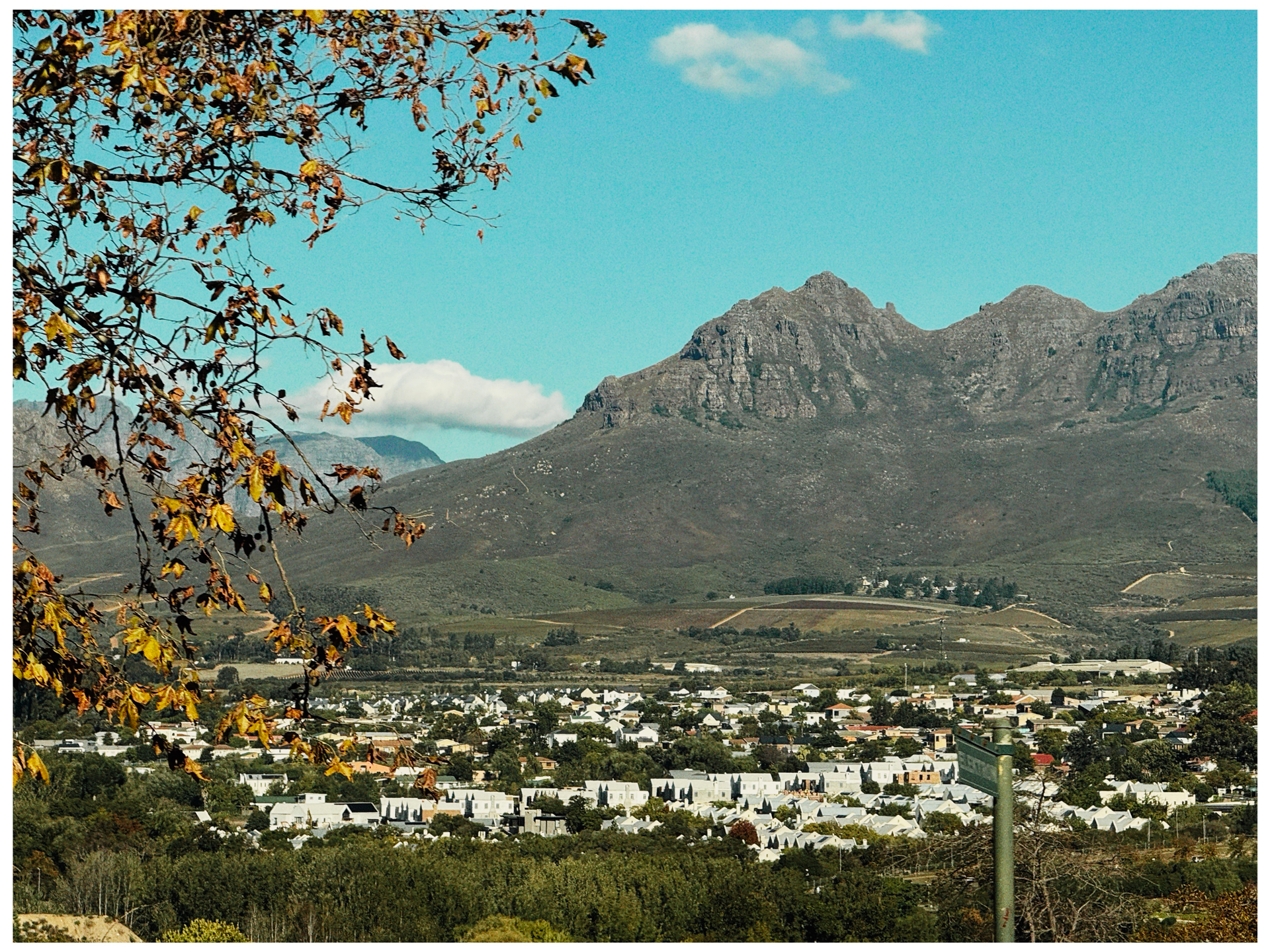
Coming in from the outside, from very far away and in one’s privileged naivety, it is easy to get seduced by the shiny veneer of a place. Its beautifully decorated façade. Seemingly beautiful people swanning around in the sunshine doing seemingly beautiful things. There is something truly intoxicating about Stellenbosch, especially when one is just a tourist there, when one is mostly ignorant of what the place really represents. As I was taxied from Cape Town airport, past the many vineyards and gated communities, the scenic mountains and pristine white buildings, to my guesthouse, with its pretty yet distinctly colonial aesthetics, the unusual joy that I felt in this new adventure was about to be turned on its head. How was I to know I was about to receive a crash-course in the hidden rot behind that very veneer, the putrid smell lurking beneath the picturesque avenues of English oaks. And yet, it was that repulsive decay that brought me closer to people than I ever usually allow. Facing decay, it seemed to me then, began to precipitate something like its opposite. A tension emerging between poles – between beauty and decay. But in making these assumptions, perhaps I was misunderstanding what decay truly is…
This realisation was also a surprise, as decay is my “bread and butter”, so to speak. The theme of decay has been the background substrate of all my creative work and academic research for many years now, but it wasn’t until I flew halfway across the world to South Africa, to talk about it with other decay obsessives, that I realised I hadn’t ever thought about it fully or properly enough, or ever really addressed it head-on. Decay was mostly a vague but totally ubiquitous abstraction for me, like “time” or “space” or “death”, and also some sort of invisible web binding these three vast concepts together. It was an abstract part of the music and sound design I worked on every single day. Attack. Decay. Sustain. Release.
Decay on endless repeat. Decay time on reverb; decay on an echo. Decay as a key part of the art of sculpting time and noise with machines, carefully controlling how things disappear, fade out and eventually become something else. But that’s not to say my relationship with decay was purely technical or dispassionate before. It wasn’t purely conceptual either. I was aware of the very real, very embodied, emotional and material dimensions to decay too. The physical and friable substances of familiar bodies and objects, like old photographs of loved ones and abandoned houses. Their matter and their melancholy. The black mould under the old kitchen sink. The cobwebs in the attic. The mouse skeleton found in the garden, when I was a child. The dust and grime and fading of all things had always been frightening and fascinating to me. I was drawn in by their repulsive magnetism. And I understood grief too. The pain and sadness of losing someone important was burnt into my very fabric. I feel these feelings too acutely. Too regularly. I feel grief when a building is demolished. I mourn when I return from a holiday! The same feeling echoes again. Not always suddenly but gradually and inevitably. Not always a bad thing, either. Loss is just life, after all. This too shall pass. Wait long enough and it will be over… Everything and everyone is truly transient, and living is forever a series of comings and goings, passings and shiftings, and a gradual coming-to-terms with constant change and aging. Awareness of decay is basically the human condition. It is key to being both mortal and conscious at the same time. Part of all human love and care. Part of every lasting or meaningful experience. Part of all our rituals. I knew this already, of course. I’m sure we all do, deep down. But it was, until very recently, for me, still pretty abstract and ambiguous in my own mind. Always already there, but without solid form. Like something constantly lurking in the corner of your eye but never coming into full focus.
I knew I wanted to talk about the productive role of decay in my own work but was unsure exactly how to frame it critically. I read Decay without mourning (Lambrechts et al., 2025), an article written by the conference organizers, looking for clues and new paths forward, and I saw a whole host of connections, points of intersection, parallels and potential synergies… I was definitely in the right place. I knew what to write about for the conference, now. In my own research on the peripheries of heritage practice, working creatively with disintegrating photographic archives, I saw the same inevitability of decay that was recognised here. Not only the futility that is bound up in all acts of attempted preservation, but the potential cultural value in embracing the processes of decay itself. The “alternative perspectives that recognise destruction and change as inherent to heritage” (Lambrechts et al., 2025) were closely aligned to my own thoughts on the subject. Even more encouraging, was the observation the authors made about the relationship between decay and authenticity – decay as a key part of an artefact or artwork’s “aura” (Benjamin, 1935). This was also something I had written about in my thesis. Not only that decay is “tightly linked to the concept of authenticity and acts as a code” (Lambrechts et al., 2025), but that the patina of decay becomes a vital part of an object’s affect and unique story, part of why it is valued at all. As decay progresses it renders artefacts and images into traces – and then traces into uncanny ghosts.
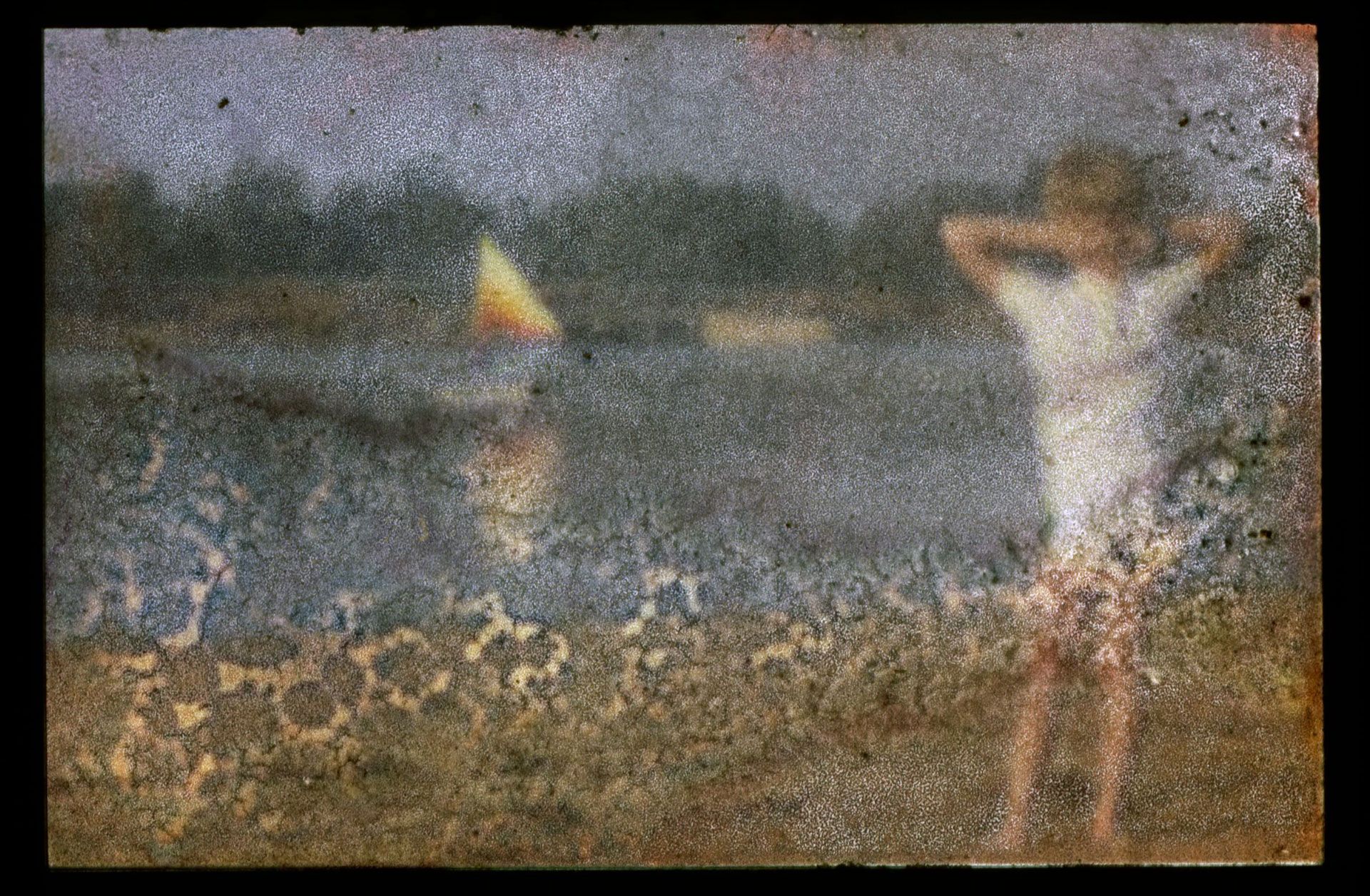
Decay engenders spectrality and reveals it where it was hidden before. In photography, it does this by breaking “the spatial depth of the original image by adding a perceptible temporal layer” (Lambrechts et al., 2025), a poignant “temporal disjuncture” (Fisher, 2006), in fact, that is implicit to the medium. Its hidden material substrate is just waiting to emerge with time. This is clear in the decaying and auratic works presented in both Lambrechts and Deane’s salvaged photographs – Deaccessioned (2026) – and those that I presented myself, years ago, in The Remote Viewer (Coldwell, 2018).
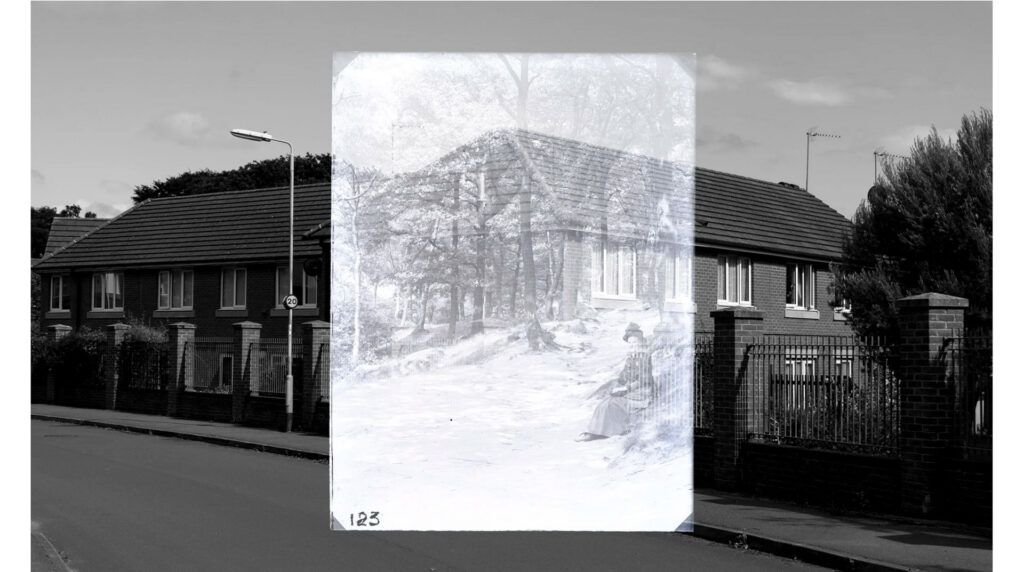
In both of these exhibitions, the very visible decay represents not just the authentic signifiers of real time travel, and layers of history or human memory somehow made solid, but the role of creativity and the imaginary in (re)interpreting such objects as affective windows onto forgotten worlds. This aspect is not limited to photography, either. Many different media have this same imaginative and generative relationship to decay and spectrality. I’ve explored this myself in experimental music using decaying analogue recordings, and so I was extremely pleased to encounter Cara Stacey’s work at the Deaccessioned (2026) opening night in Stellenbosch, which also served as an album launch for her new work Hypha (2026). Here too, crumbling audio tapes were used as the basis for haunting new compositions, but this time using Stacey’s fantastic skill with traditional bowed instruments and group improvisation, “playing with and reacting to a backdrop of the archive’s garbled voices, grainy filaments of silence and blooming negatives, the group presented a living diorama of strange and unrepeatable moments in musical history” (Stacey, 2026). Using the decaying photographs themselves as graphic scores and creative guides for new compositions, was truly inspired, bringing the two media closely together in a way I’ve always strived and failed to do myself. The hidden decay and the creative potential in Stellenbosch University’s Hidden Years Music Archive, was truly unlocked by these multi-modal collaborations, and I began to see a dizzying array of connections between these works and my own, stretching across the world like the secret underground threads of hyphae found in mycelium.
The Decay without Mourning article (Lambrechts et al., 2025) also helped me frame the role played by decay in the generative AI models I’d been researching. Feeding my fading photographs into these algorithms presented a new form of exponential digital decay, that possessed generative and degenerative aspects capable of giving “birth to new aesthetic qualities and values, functioning as portals between the past, present and future” (Lambrechts et al., 2025). Such transformative decay could indeed be creative, but it was also highly disruptive and destructive. In eroding and obliterating the original traces and their meanings – using “Vectorplasm” (Schofield, 2026) – incomplete fragments begin to coagulate into new entities and forms, their very incompleteness activating the imaginary, in both human and machine minds. AI, in this context, can also be seen as a kind of “dark archive”, growing underground like mycelial networks. Largely inaccessible, un-curated and chaotic, but something that will nevertheless become increasingly important in future heritage practices, and our many technologically-mediated views of our past. A potentially new “hegemonic core” might emerge, without an explicit ideological or “expert” version of past and future to consolidate. Hegemonic views and biases are certainly still encoded in these models (example – the racist and sexist biases readily found in AI), but they are also often corroded by forms of stochastic processing and data decay.
AI decay is certainly anarchival and “without mourning”, but is it welcome?
The cultural consensus increasingly says that it is now not. Can it nevertheless be used creatively, ethically or as a mode of resistance, as we see in these works with other forms of decay? Much still remains to be seen on that front, but the odds are increasingly stacked against it.
The ideas I wrote about photography, AI and decay for the conference were mostly pretty good. There was definitely some insight to share there, and obvious relationships with the organiser’s own notions and framings of the topic. Many different ideas resonated. I thought about developing some sort of typology of decay, to work through all the different forms and meanings. But decay was still too ambiguous, for me, still a kind of meta-abstraction. Transfixed by the eerie forms of decay that I discovered in the machine, I had forgotten something human. As I delivered my paper on the work above – to a very receptive audience in Stellenbosch – I began to realise that it wasn’t yet enough. I still needed to really feel it, somehow.
Then there were two dances.
Two transportive and transformative performance works, that it was impossible to just sit back and observe passively. Two events, that in sequence, ended up dealing me a solar plexus blow. The gaze fell away, as did the fourth wall, and the scales from my eyes, and any clear distinction between subject and object… Everything was connected now. Scores for Decay and Transformation, presented on the first day by Maija Hirvanen and Peter McCoy, invited a fungally-inspired form of emergent audience participation. Small codes and gestures started very privately and ended with all the delegates moving together as if acting as one single organism. Discussing this choreographic experience with other attendees afterwards, we were struck by how gently we observed each other’s personal spaces, despite their increased convergence in the work.
The “mycelium dance” seemed to “decay” the usual professional distances one would expect at an academic conference full of strangers, while still practicing a mindfulness of consent and bodily autonomy.
A new and caring group-think had emerged seemingly from nowhere. Conference organizer Lizabé Lambrechts reflected on this, insightfully noting how “noticing and paying attention to decay releases practices of care, mending and curatorship… not something you can easily stand separate from as an observer – hyphae – reaching out, reaching across, touching, dancing with, tending to, caring for…”
In this newly established group feeling of interconnectivity and conviviality, the second performance felt completely devastating. Connection and disconnection were sent spiralling into erratic oscillation. Nelisiwe Xaba’s vROT was a truly visceral experience. I won’t try and describe the work, or even its emotional effects, in words here, as they could never do it justice. Decay and mould were used as a metaphor for the corruption and greed present in South African society and its current politics. The striking staging and unexpected denouement of the piece had the chilling effect of making the audience feel completely involved and complicit within this disgusting rot. This was the moment I felt myself being “Stellenbosched”… (Kaganof, 2025).
My eyes were now wide open. There was also something ambivalent in the relationship to decay that was presented in the piece, though. Studying mould as inspiration for choreography, Xaba initially found its forms and colours “beautiful”, but the beauty troubled her. It felt too superficial and there were more important things to discuss about decay as a theme. The real threat of decay lay in the “corruption eating all of us, slowly but surely” and the “the moral decay” that “is across all spheres of society” (Xaba & Maart, 2026). But there remained a real tension between the “biological phenomenon and political metaphor”, between the natural and social processes of decay that were evoked, and between beauty and horror. What could possibly connect all these opposing things? The clue came in the phenomenal costume that was used in the work, a kind of stretching morphic “skin” inspired by mycelium.
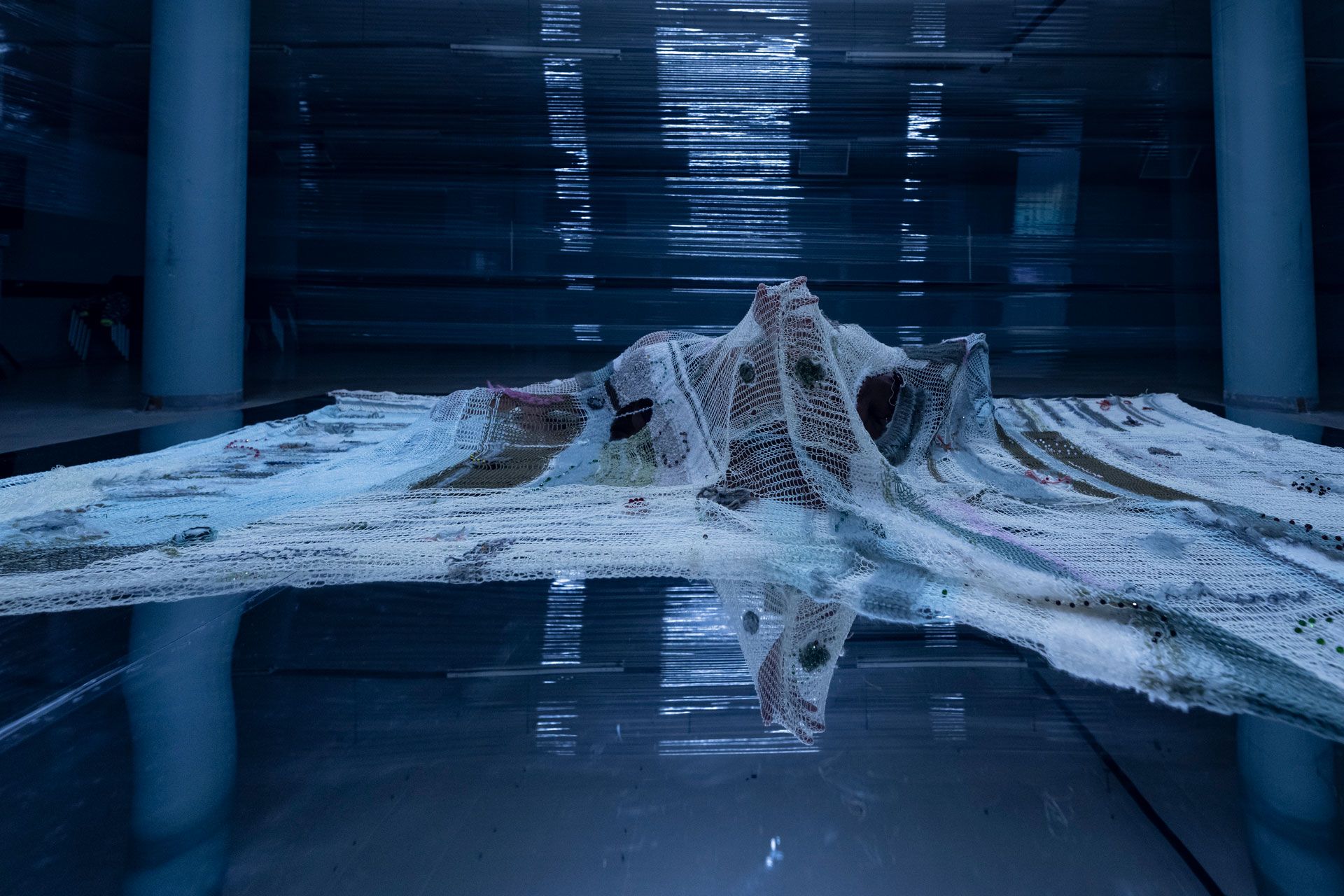
Xaba seems to be trying to escape this beautiful skin during the performance, even as it appears part of her, and connects everything together. The skin did not just appear like a living thing, though, it also acted as one. It needed constant care and attention to survive, in fact. As in the dance itself, off-stage became as important as on-stage, in understanding all this. Here there were many acts of care and creativity to consider, another kind of hidden dance taking place behind the scenes that “became part of an ongoing process of making – layering, stitching, and mending” (Xaba & Maart, 2026). The heavy negativity of corruption in the work was somehow balanced by something very similar to that experienced during the first performance – to echo Lizabé again, “hyphae – reaching out, reaching across, touching, dancing with, tending to, caring for…” Still, this remediating realisation came too late for me. I emerged from the dark theatre as if from a car wreck. But decay was no longer abstract. It was a wound now. And decay was part of the healing of that wound, as well. Something we then all seemed to try and do together.
The tension between the two conflicting forms of decay in Xaba’s work gave the performance its mystery and its emotional energy, but it also highlighted to me the dangers of a term like “decay”, when used theoretically. The conference really presented a vast plurality of differing decays – “decay in its different modes (material, cultural, institutional)” (Lambrechts et al., 2025).
Decay was thus revealed as a giant umbrella term in this curation.
What really connected mushrooms with endemic bribery, apart from the abstract word “decay” itself forced upon these things in our framing of them? Why bring these very disparate elements together at all? The genuine convergence – and true meaning, for me – that I encountered in Stellenbosch, was not in the multitude of forms of decay presented there, but in the strange similarity of responses that looking at decay seemed to engender in this delegation. The emotional register of those responses. The collective empathy experienced. Regardless of the particular theme or context being addressed, creativity and care recurred in every single contribution that I encountered, and every single interaction that those contributions elicited.
While mourning is a recurrent and ritualistic way of trying to deal with tragic endings, decay is merely the first phase of any change of state. Acts of care and reparation are key human responses during such a phase, that can not only help usher in the new – and help us deal with the emotional difficulties of liminality and transition – but can work to make that new thing a positive change for those involved, not just the devastating destruction of familiar ground. This is evident in Neith Moore’s Nestled piece, that was presented in Stellenbosch as part of the events too. A series of suspended ceramic pods housed “soil, fungal mycelium, seeds, roots, and wood shavings” (Moore, 2026) – and dispersed human remains. Here too, decay left traces as a kind of haunted matter, but Moore was not interested in creating any static monument to that loss. Rather than present a relic or a crypt, the matter was redistributed through a combination of natural processes of biochemical transformation, and something that resembled the careful tending of a much-loved garden. Aside: caring for a garden is not really about preservation at all, but about looking after new things as they grow. Embracing cycles of change but also carefully guiding them. And decay is vital to these processes. Think about the origin and role of compost… In the work, this did not just concern a coming-to-terms with a new configuration of life, as part of grieving, but also a creative intervention in that key phase, through a total acknowledgment of the human body as porous biological assemblage. An uncanny connectivity that applies to everyone and everything. For Moore, this is something that calls for an “ethics of relational accountability and an ecology of care.” A wider look at mycelial interconnectedness might help us with this, and also with our fears of change, death and a related mycophobia.
“Along the border of living and dying, mycelia sense and digest, interpret and destroy. More visibly than the bacteria with which they work, the fungi walk between worlds, acting as custodians of the darkness.” (McCoy, 2016, p. 76)
This, and several other works and papers presented at STIAS, also demonstrated to me, for the first time, that decay is never just the breaking down of extant forms, but a whole ecosystem in itself – the organisms involved in decomposition, such as mycelium, are incredibly complex and vital – and to the new lifeforms that subsequently benefit from their redistribution of organic matter and natural resources. That is a view of decay as a composite and natural “building process”, in which we might even see “the generation of one species from the putrefying corpse of another species” (Negarestani, 2026), as part of an inevitable evolution. Could such a biological observation be extended to the other forms of decay discussed and presented in Stellenbosch – those more social or political in nature, perhaps – or would that be stretching the metaphor too far? Reza Negarestani certainly doesn’t think so, asserting that such parallels are definitely worth considering – that “a rotting political formation can germinate other forms which might overlap revolutionary, emancipatory and civilised political formations.”
Mindful creativity and care are important as responses to any decay because there is nothing teleological about that first phase of such an emergence, whether chemical, biological or social. Nothing is guaranteed at all, other than a universal entropic force, once decay is set into motion within any given system. We can’t be sure that decay will always usher in the new, or that it will be better than before, if it does. Any meaningful “ushering” will be down to us and our responses to the decay we are forced to deal with. We must somehow be the connective mycelial hyphae in this particular metaphor, if it is to work at all. We can’t even be sure the process of decay will always completely complete. What if “the decaying object never completely disappears, and, in so far as it continues to become less, generates derivatives and maintains a germinal capacity” (Negarestani, 2026)?
What if the death throes of a rotten system continue to perpetually haunt whatever tries to take its place?
In Florencia Levy’s Audience of Spectres (2026) we see this kind of decay on a truly vast scale – the environmental devastation wrought by a rotting system, exploiting nature and peoples to try and sustain its latest – and possibly last – economic bubble. Mining for rare earth minerals in Argentina and Mongolia, for our “phones, batteries, screens, military technologies, and electronic devices” – not to mention the huge data centres required for AI – has “left behind an enormous artificial dam of toxic and radioactive waste, visible from space” (Levy, 2026). There is something extremely haunting about the images and sounds presented in Levy’s film, that even as it leaves the viewer with a feeling of almost total despair, is still intensely beautiful and beguiling to behold, as a work of art.
“Decay forces us to withstand an image that, treated unaesthetically, risks revulsion. Revulsion might prove beneficial, however… Amid aesthetics and collapse, a void opens. In between the opposition, the exposure of danger reveals the origin of aesthetic interest” (Trigg, 2006, p. 172)
Decay can certainly be very beautiful, but an aestheticization of decay can work towards sanitising it, making it more palatable and therefore seem less of a threat – but that threat can also be reduced by actively working with processes of decay, and those affected by them, rather than merely presenting decay as an aesthetic object to be contemplated in splendid isolation. Revulsion and beauty must therefore live uncomfortably together in meaningful representations of decay, but there is even greater beauty to be found in our human responses to decay and our attempts to really connect with it. This was more than evident in Stellenbosch, a place which inhabits this contradiction.
A place that hides a repulsive history of hate and division, but that still allowed the space for something which genuinely moved counter to that threat. But are these relatively small gestures of care and creativity enough in the face of new, vast and mutant forms of decay: AI breaking down human labour, agency, knowledge and understanding into new ghosts and existential obsolescences; the accelerating racism and corruption we encounter as capitalism enters in its “xenomorphic stage” (Armand, 2023); the destruction of entire environments that these processes now propagate? Are we just trying to make ourselves feel better with such events, as we rearrange the deck chairs on a sinking Titanic?
Perhaps. But what Stellenbosch has taught me, more than anything, is that we should never underestimate the hidden power in mycelium-like interconnectivity. This is something human beings and fungus have in common. And that, paradoxically, decay is a part of all growth and positive change. That looking at decay closely, and through a different lens, “may offer alternative value-constructs” (Lambrechts et al., 2025) that we can then build upon, as people striving for something better. Doing so, also offers a reframing of care’s role in such processes. “Care is not the refusal of change. It is a way of remaining with things as they change” (Lambrechts, 2026). The urge to be creative and to care for things or people most often comes from a near universal human desire to make something positive out of endings, transitions and cycles of renewal, that are almost always beyond our immediate control, anyway.
So, has this changed how I see decay and what it really means to me, and in my own work? And what does it mean to try and address decay without mourning? I knew I had to deal with this personally and subjectively – a purely theoretical summary would never be sufficient. A solely academic approach to these materials and works would miss the most important discoveries I had made. The only way I could try and make sense of all these things, and weave together the many mycelial threads that I found, was to examine how I had been affected by them all, myself, and then relate that to my own understandings and preoccupations. This article then devolved into something resembling a confusing memoir or diary entry. And for that, I can only apologise to the reader. The fog has yet to fully clear, I must admit. Perhaps it never will. Perhaps that doesn’t matter. But out of that decayed intellectual process itself came real creativity and care again. Grief is recast as a potentially generative progression – a way of processing our inner ghosts and defects, creatively. Recurring acts of putting new flesh onto the bones of remembered feelings, where any detail or context for the affect has long since decayed away. An apophenic (mis)reading of atrophied mnemic fragments. These are the hauntings that fuel real creativity, inside us, endless grieving for the psychic victims of memory loss and time’s relentless melt. The creative results never capture the absent, never fill the inner hole, but they are always new things in their own right. New things that can reach out and touch other people. Sometimes we call this strange process “art”. Without this inner form of decay, perhaps creativity and care would not happen at all.
And while the forms of decay we are faced with outside of ourselves, can sometimes seem insurmountable – and we certainly didn’t solve the world’s problems this time around – this kind of art was alive and well in Stellenbosch. There was real hope to be found in the way that art brought us all together, and the palpable care that was present in that brief confluence of bodies and minds, around these various emotive artefacts. A transient commune emerged in which we couldn’t help but open ourselves up, and then try and tend to those wounds as we found them. This is the most important thing that we have, as human beings. We can at least briefly attempt to attend to the emotional needs of those we find ourselves alongside – through those small acts of creativity and care – as the beautiful facade of now, inevitably crumbles around us.
Armand, L. (2023). Entropology. Anti-Oedipus Press.
Benjamin, W. (1935). The work of art in the age of mechanical reproduction. In: Jahsonic.com.
Coldwell, M. C. (2018). The Remote Viewer [Installation]. Treasures of the Brotherton gallery, University of Leeds Light Night.
Fisher, M. (2006). Phonograph Blues. k-punk
Kaganof, A. (2025). Stellenbosched. In We who are not dead yet. Mwanaka Media and Publishing.
Lambrechts, L. (2026). To Decay – on custodianship, care, and the ethics of returning. Herri(13).
Lambrechts, L., & Deane, N. (2026). Deaccessioned [Photography exhibition]. Decay Without Mourning, Stellenbosch., Oude Leeskamer.
Lambrechts, L., Lindström, K., Hansen van der Watt, L. M., Pitta, F., Deane, N., Moreschi, B., & Petersen, L. (2025). Decay without mourning: future-thinking heritage practices. International Journal of Heritage Studies, 31(3), 340–357. doi.org
Levy, F. (2026). Audience of Spectres. Herri(13).
McCoy, P. (2016). Radical Mycology. Chthaeus Press.
Moore, N. (2026). Molecular Fabulations: From Ashes to Algorithms. Herri(13).
Negarestani, R. (2026). Undercover Softness: An Introduction to the Architecture and Politics of Decay. Herri(13).
Schofield, M. (2026). Aura, Decay and the Simulation of Ghosts Herri(13).
Stacey, C. (2026). Hypha. carastacey
Trigg, D. (2006). The aesthetics of decay: Nothingness, nostalgia, and the absence of reason (Vol. 37). Peter Lang.
Xaba, N., & Maart, B. (2026). In Conversation about vRot: The politics and poetry of decay. Herri(13).