LAURENCE HAMBURGER
The Lost Films of Abdullah Ibrahim
This is a story, and being so, none of it is lies. Yet as you will see, only some of it might be true. Some of it is clearly a matter of assumption, projection, or hope. Nevertheless this is what I know, heard, and remember. It is therefore obviously not in any way exact, but as I say, there are no lies.
Upon the recent passing of the South African musical genius Abdullah Ibrahim, social media was alive with a significant number of great personal stories about him. There were so many warm and moving memories of a great life. Tough, but nevertheless rich with the resilient nature of an uncompromising artistic existence. It was in this beautiful outpouring that I recall my own single meeting with him, a little more than 10 years ago, sometime in 2015.
It was a few simple facts in my possession that became the cause of a sincere quest.
Since 2005 I’d been looking into the stories around a few thousand records of South African music I’d found in the backroom of a concession store in a small mining town on the Reef. The images and the music were mostly from the 70’s and 80’s, both familiar enough for me to recognise as some kind of local pop, but I recognised very little of it. I realised I knew almost nothing about this. It took me over a year to finish listening to nearly all of it, and in that year my life was changed. I had discovered some truly incredible music.
It was through various attempts over the next years, mostly through contact with other collectors engaged in their own way with piecing together the narrative of what I came to call Township Pop under Apartheid. While there had been some important work, mainly by Gwen Ansell and David Coplan, there hadn’t been any kind of visual interrogation into the nature and complications of the design; how these artists were represented, what were the circumstances under which certain pictures were made, framed and chosen, and by whom and why. I began to talk to the musicians themselves about these covers. After a few really remarkable experiences talking to some of them, I realised I had no desire to produce any kind of journalistic history of popular music. I had neither the appetite nor ability. I did however want to find a way to record the often incredible stories that were tumbling out of people in this strange endeavour to investigate how creativity seemed not just to function, but at times even thrive, under extreme repression. Thus began what is now a 20 year journey into collecting not just amazing South African records but also some remarkable personal stories surrounding the making of them.
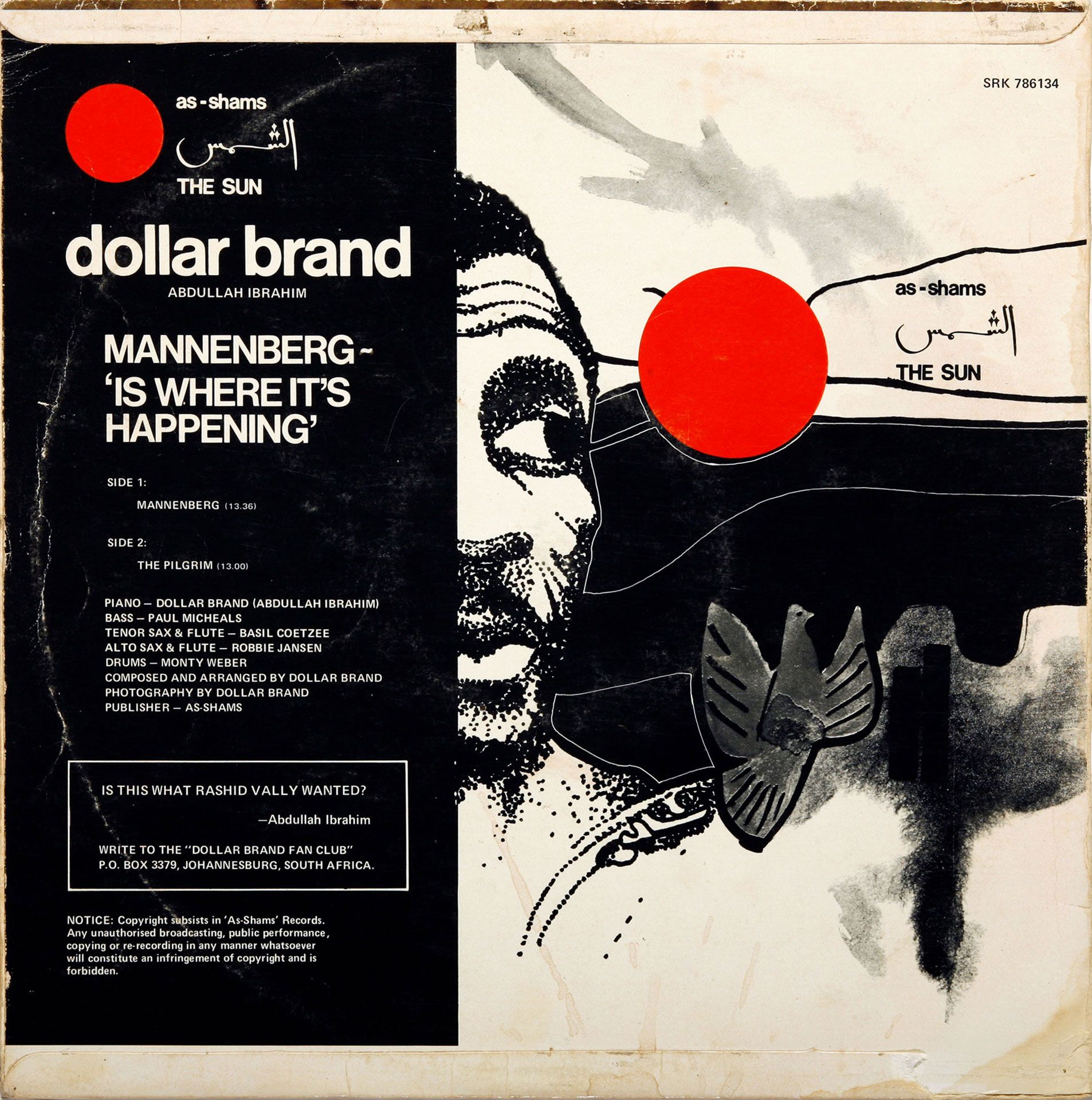
It all began with Mannenberg, which for all intents and purposes is considered the first black-owned piece of pop music in this country. It came in the wake of the destruction of District 6, and just before the tumult of the 1976 Uprising. It was a song without words that spoke to its time. Now as I began my work in the early 2000’s, I found the story of Mannenberg was being re-told; how Abdullah had come back from New York, and convinced the producer and owner of As-Shams records, Rashid Valley to gather a group of Cape musicians to make a record of the music he’d grown up playing. As one of the musicians Robbie Jansen had told me, “Abdullah wanted to take jazz back, to when people used to dance to it”. He wanted a return it to its roots, to a people’s sound – something that Mannenberg achieved with extraordinary effect.
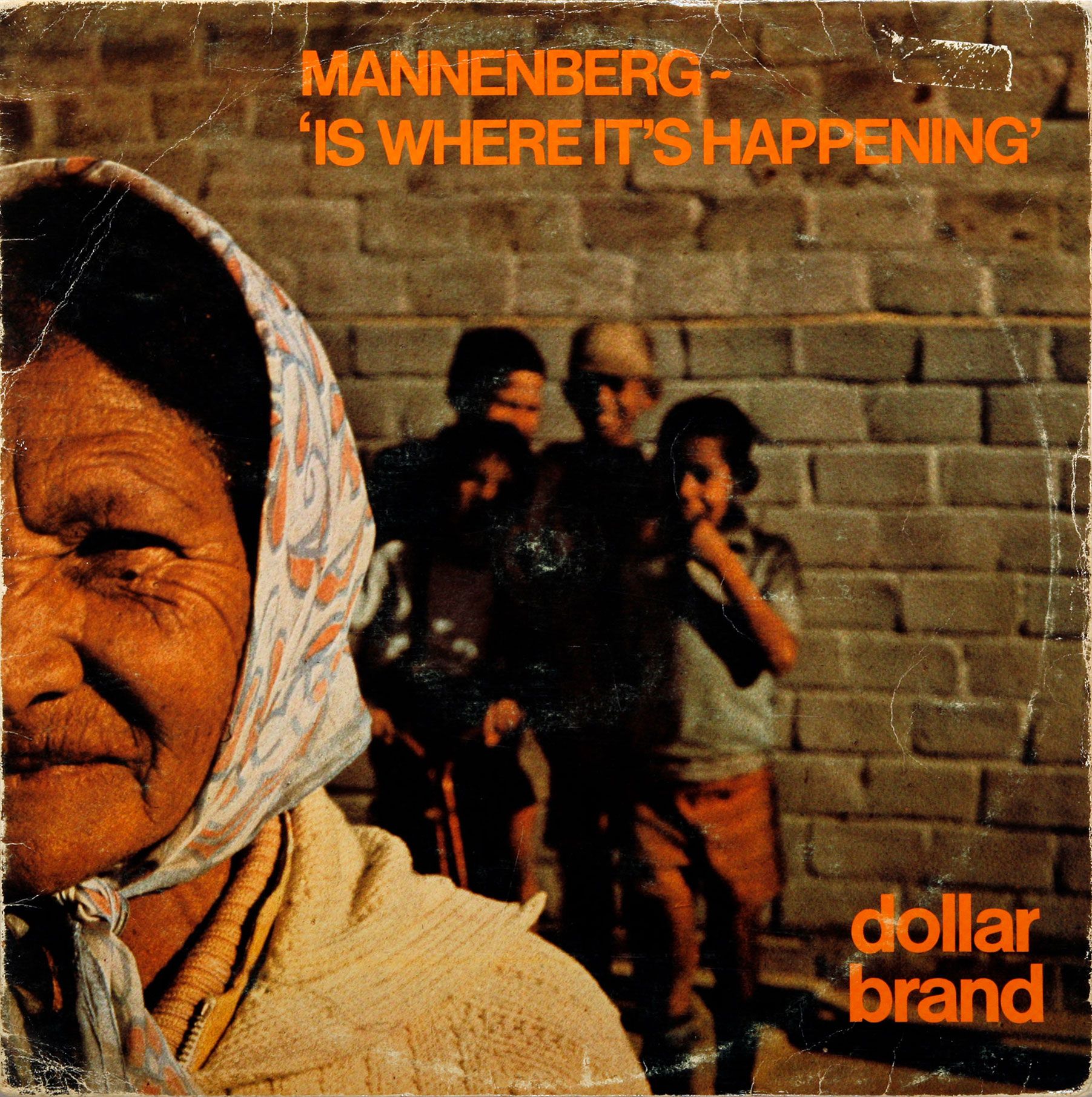
Everyone knows the photo on the album cover, but few knew that Abdullah himself had taken the picture. The full story had actually just been published in a paper by John Edwin Mason called The Making of Mannenberg, and the story had been covered in the fantastic African periodical Chimurenga. I went to visit Rashid, then still running his store Kohinoor in downtown Johannesburg. He confirmed what I’d read and what Robbie had told me, that at one stage, Abdullah wanted to call the record Mrs Williams from Mannenberg. I called Morris Goldberg and he confirmed that indeed Robbie’s story was correct. The woman in question, a ‘Mrs Williams’, did work for his sister, in Camps Bay, and that Abdullah had arrived suddenly at the house one day to drive with her back home and take a photo of her there, in Mannenberg. It was clearly a very considered act of Abdullah’s – to tell the unfolding story of Apartheid both in music and imagery.
That story of Mannenberg’s cover was forever near the front of mind whenever I went talking to people about my project. Maybe because I felt so haunted by Robbie’s telling it to me. This once dynamic horn player was on a C-Pap, struggling to breathe, let alone talk. But for 2 hours he told me everything he knew that I asked about. Two months after we spoke, he tragically passed away.
Soon after, I finally tracked down a copy of a book called Jazz People of Cape Town by Lars Rasmussen, a compilation of old photos of the local jazz universe. As I turned through the pages as one does, something stopped me. There was a photo from Montreux[1]The picture is taken in the garden of Helligaandskirken (The Church of the Holy Ghost) in Copenhagen, September 1969, not in Montreux. The photographer is Ib Skovgaard, a Danish jazz journalist and a close friend of Abdullah Ibrahim and Sathima Bea Benjamin who used to stay in his flat when in Copenhagen – at one time for several months. Ib passed away some ten years ago. Lars Rasmussen, email correspondence, Sunday 2 August 2026. in the 70’s of Abdullah and his wife, the beautiful singer Sathima Bea Benjamin. They sat sprawled on the lawn watching the stage, and nestled in the crook of Abdullah’s arm, almost like an infant, was a Bolex film camera. I knew from my job as a film director that this was not an ordinary, home-movie Super 8 camera. The size of the 3 barrel lenses told me this was the more high-end machine that was used to make newsreels, documentaries, and feature films. To use it required an advanced interest in the technical aspects of filming , even if it was just knowing how to ‘lace’ film into the camera body. In a way, it wasn’t unlike being able to play an instrument.
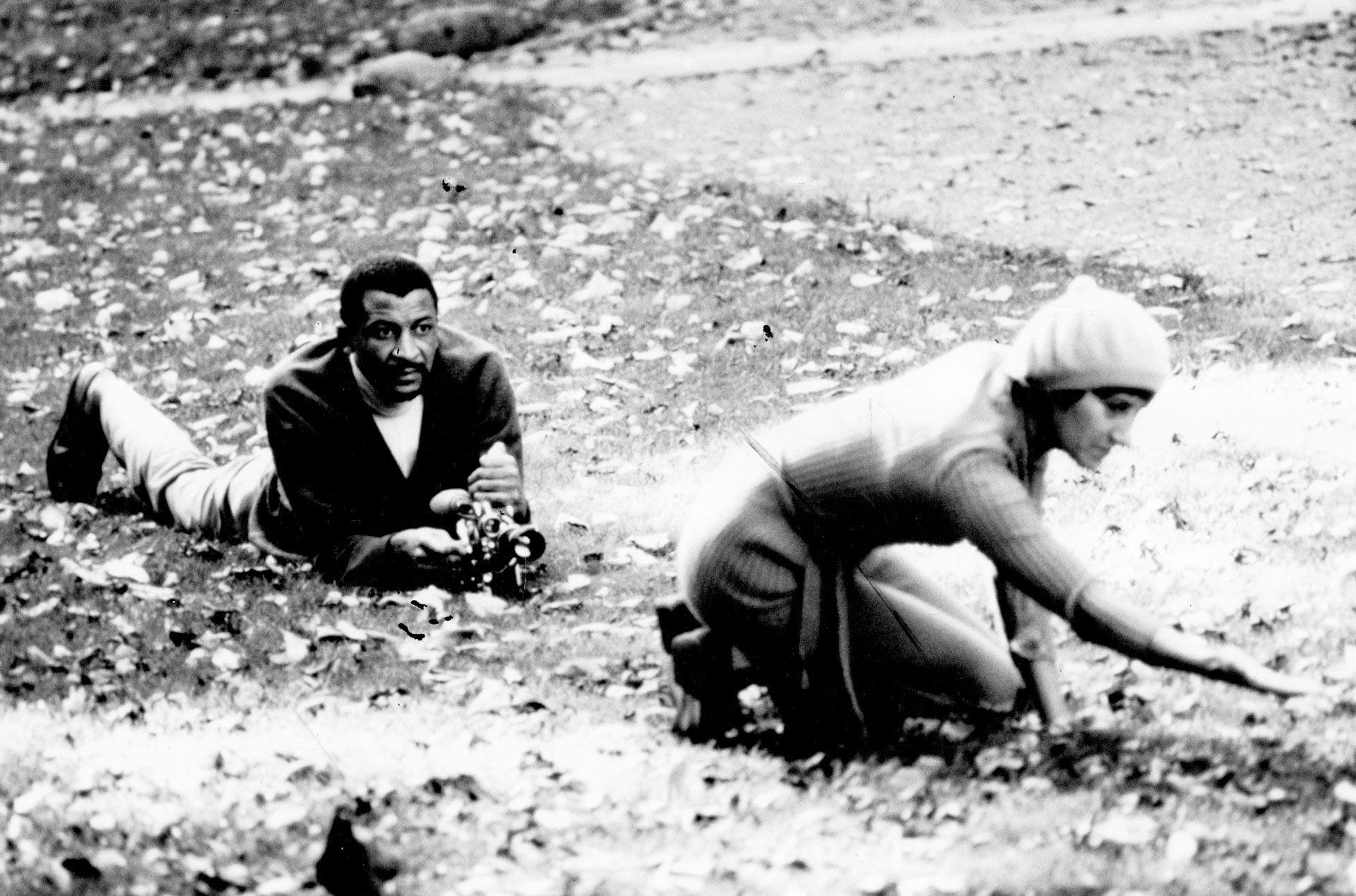
Staring compulsively at the image I was overcome by a feeling that Abdullah had real aspirations to filmmaking, even if only in the fashion of an advanced amateur. Only someone who took this seriously was using this kind of camera. I immediately had the urge to talk to him and ask him about it. More importantly, what was he shooting, and why?
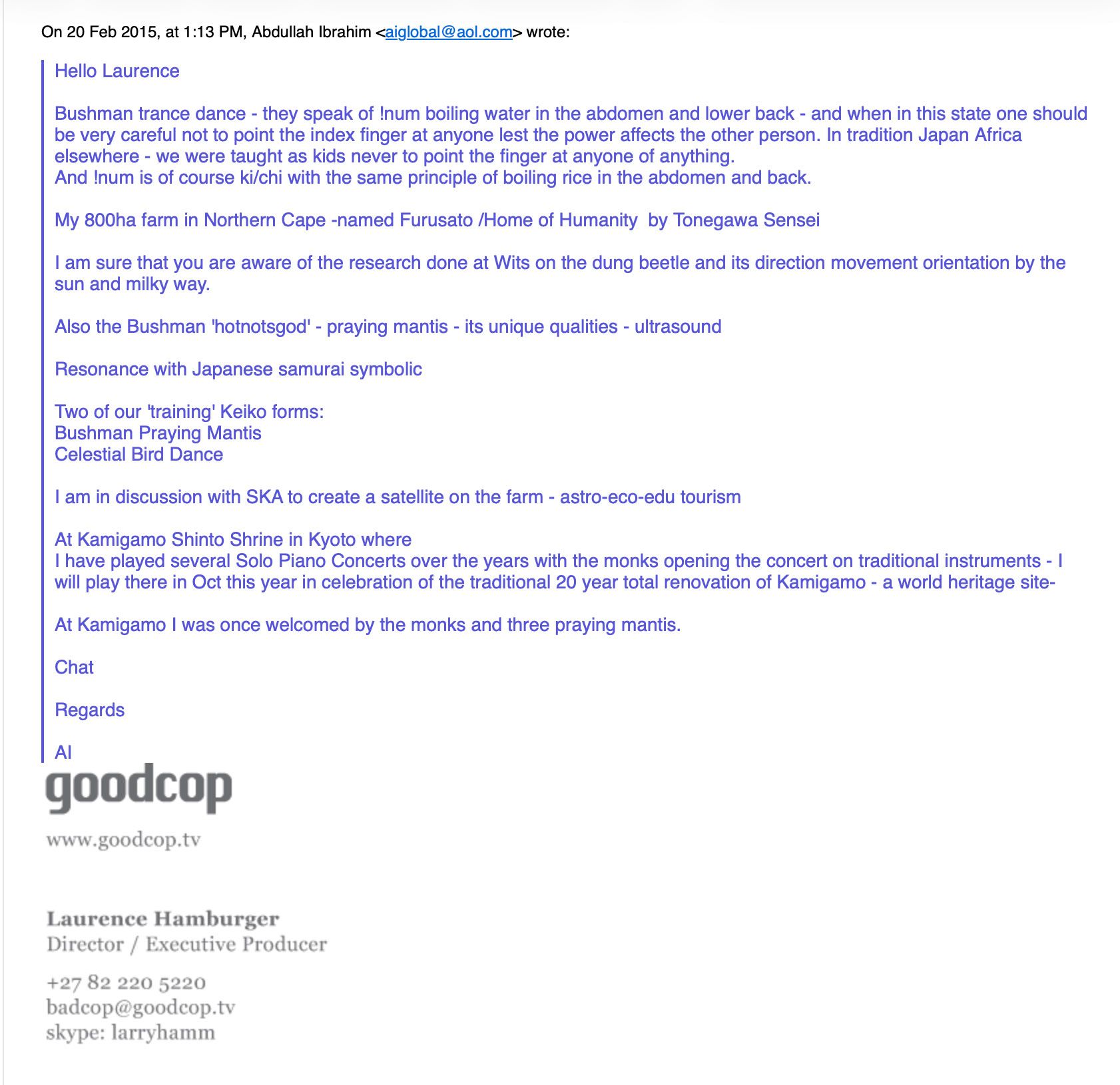
I was lucky in that someone I knew, Jay Savage, had recently become his manager, and I got in touch by email. I asked if what I suspected was true – that Abdullah had made films, even of some minor kind? If so, would he be interested in doing a project with me involving them? Jay soon replied, enthusiastically, to say that he’d spoken to him, and yes he said, apparently he had, and yes, he said, we could talk. He started an email thread with me and Abdullah. I told the great man of my discovery and what I wanted to do. He didn’t really acknowledge the questions I had, but instead sent me articles to read, about himself and a lengthy discourse on Bushman trance-dance, the praying mantis, and also playing a gig in a shinto shrine in Japan. I remember lying awake in disbelief that I was in this amazing exchange with one of my heroes, and a true musical legend. He suggested we meet in a few weeks’ time, while visiting Joburg for a gig.
I arrived at a fairly pleasant, corporate-lite hotel around mid-morning. I entered the dining area, scattered with post-breakfast debris, and saw Abdullah and Jay sitting at a table. I remember that for some reason the blinds in the room had all been drawn, and I wondered if it was at his request, possibly to stop the harsh winter sunshine from bouncing around in all that nasty architectural glass. As I approached the table the two figures sat half-hidden in this half-light, their conversation seemingly whispered.
My eyes adjusted as I reached them. He slowly stood up to greet me. He was a lot taller than I’d imagined and the sudden length of his body extending upwards immediately overwhelmed me. As we smiled and introduced ourselves, I found myself looking into this set of penetrating dark eyes. They were not without warmth, but also so un-yielding and fierce.
We sat. I smiled. He nodded.
Jay smiled. I nodded.
So I spoke.
I told him I wouldn’t record the conversation, thinking it might be a nice gesture, hoping to encourage him to feel less guarded. I didn’t want to appear as a journalist, who he was notorious for dismissing.
“Let us talk, not record’, he said bluntly.
I look back at him and I’m suddenly aware of exactly what kind of man I’m sitting with.
I think of how many tens of thousands of nights he has stayed up to play music just to make a buck, and the hundreds of conversations over tables in dining rooms, just like this. Jay, who was sat back a little from him, caught my eye with a kind of empathetic smile as if to say, ‘You’re on, kid.”
I began by appreciating his time, as a substantial musical figure in my life, and his stature in this world. He nodded as if to indicate this was neither unimportant nor substantially new for him to hear. I told him a little about what I was doing, about how I was developing a series of South African film projects made by non-filmmakers, mostly fine artists, photographers and musicians; that I was beginning to believe more in a universal creative intuition than a overly studied methodology. He interrupted me,
“You can’t create without study. My life is an ongoing study”.
I was in mid breath and it caught me a little like a light slap around the chops. In a panic to show I understood, and over eager to fill the gap, I just stuttered something back, like, ‘Of course, I just mean technique alone can be empty.” Immediately I felt that instead of showing agreement I just appeared as wanting to contradict him. So, brilliantly, I chose to just babble on. ‘I think filmmaking can sometimes be over-complicated. I’m interested right now in facilitating people who have genuinely great stories to tell on film, but don’t know quite how to… you know…do it. People with other creative skills…”
He stared back.
“…and I know the story of the Mannenberg cover. I spoke to Robbie, and Rashid, and spoke on the phone to Morris Goldberg in NYC. You took that picture with a borrowed camera, apparently. It’s extraordinary. Not just as a record cover. I mean, as a photograph of history, it’s really just iconic.“
I became aware I might not be making the most sense.
He sat and waited for me to calm down.
“Yes. She worked for Morris’s family…”
“Right, so then I saw a photograph of you at Montreux in Lars’s book and you were on the grass holding a 16mm Bolex. Have you seen this photograph? Do you know the book? “
He answers somewhat cryptically, “Yes, maybe, probably…I’m not sure”
I continue, “Did you own a film camera?”
“Yes. Of course”, he answers immediately, almost dismissively, “I’ve had many cameras.”
Why these confirmations of his should not be of some comfort to me I can’t explain, but instead of listening and trying to just relax into a conversation about taking photographs, I just blurt out,
“So, it was 16mm, then?”
Followed immediately with “Did you own a 16mm camera?”
And “So then, back in the day, you were shooting 16mm film?”
I realise I’m starting to sound like some kind of a lawyer.
I can’t imagine he likes lawyers. I’ve never met a musician who did.
I have a kind of itch rising behind my knee and want to bend down under the table and scratch it, but I can’t so it just hangs on the surface of my skin while I pray for it go away.
Then he says “Yes”. And nothing else further.
Now we all just sit.
He’s like a mountain. I feel like he’s asking a question, but I don’t quite know what it might be. I’ve read how hard it can be to get Abdullah to give way, and now I can’t think of anything else. I try breathe, thinking non-stop that all this man talks about in every interview he has ever done is how important it is to control your breathe. I try but all I seem to do is think of how I’m struggling to do it.
“So?” he says
“Well…”, I say, finally breathing, “that’s a very sophisticated camera. How did you come to get it? What were you using it for?”
“I bought it. I was filming things.”
Somehow I feel like a moron, while still asking completely legitimate questions.
“Wow! What did you film?”
Pause.
“Everything. My life.”
“You mean, like your gigs? Backstage? Your family? Other musicians…?”
Another pause.
“Ja. That stuff…Lots of things….”
He pauses again.
“Look, it was whatever I saw….places…District 6…”
I can literally feel my heart beat in my cheekbones.
“You shot film in District 6??”
Another, longer pause
“No.” he finally replies.
“I shot films…”.
God.
“Ok shit,…you have a lot of films from District 6? Where?”
He looks completely uninterested in my excitement.
“I dunno.., in a box.”
His voice now trails off into something between a conversation with himself and this one he’s having with me.
“… In a cupboard. Maybe in New York….…I think some I left with a doctor I knew from then…a guy from the neighbourhood…”
I’m trying to stay calm but all I can think of is “Bloody Hell! I was right. Abdullah Ibrahim shot movies. This is amazing.”
It feels like the threshold of a truly unique moment in the artistic history of this new country. This is what we need.
“Ok, well how can we get them?”
“I have no idea. It’s very difficult. I’m not sure…It’ll be hard to find him, them…”
Again, cryptic half-phrases overlapping with each other, as he somehow makes it clear that they’re somewhere, but actually, well…nowhere. I’m now concerned that they really are lost and worse, he actually doesn’t know if he’s kept them, or when or where he saw them last.
“Mr Ibrahim, “I say, with some juvenile instinct to think that the formal address will impart some gravitas into my enquiry, “this could be an incredible thing if we could retrieve them. I could… we could help you, scan them, preserve them…”
He sighs as he leans his large cheek into his upturned open palm.
“What do you want these for?”
“Well, as I said in the email, I’m not quite sure yet, but probably to make a film of it. Together I suppose. We can edit it. I can get you an editor and you could make a film, about all these things that you saw. However you want. We can just start with the footage and see.”
I continue my pitch.
“Imagine the story of your life, literally through your eyes. Your eyes then, and now, on a large screen in an auditorium, your hands playing the soundtrack to it, live…It would be something… just incredible!”
I feel completely sincere in my enthusiasm.
A very, very long silence, into which very soon disappear my dreams.
“No.” he replies, stopping me with his eyes.
He appears anxious that this is still going on.
“No, I don’t want to do this. It doesn’t interest me.”
Now I’m just pleading.
“Please sir, why not? … Who would not want to see such a thing?”
“It’s not of interest. To anyone.”
“No, no it is. Trust me, people couldn’t more interested in the world through the eyes of Abdullah Ibrahim…” There’s an almost feral irony in that statement that I couldn’t see till after I wrote it.
I make a desperate final offer.
“Let me send someone at my expense to the apartment in NY to look for it. Who is there? Sathima? (his then estranged wife). What about your daughter, maybe she can go look?”
This is actually probably the worst suggestion I could’ve made. Without knowing it, my best offer has killed off any chance I have of trying to retrieve this stuff, as it’s only later that year that I find out how badly estranged he is from Jean Grae, his daughter, then building her own successful career as a musician in NY.
Something in all of this was clearly a problem.
He then spoke, slowly.
“Maybe we can make another film…”
The dark ferocity in an otherwise gentle face made it clear, that this particular enquiry was definitely, certainly, quite finished.
He began to tell me the story he’d hinted at in the email about being invited to a monastery of Shinto monks in Japan. No one had ever played music there, he said, or rather, no music that wasn’t for the purposes of Shinto prayer. They invited him because he has had a long and deep appreciation for Japanese culture and beliefs, through his unique achievements in Karate. He was asked, the first ever, he said, to play his own music in the shrine.
When he arrived for the concert, the monks, numbering in their hundreds, were all waiting for him, standing dead still around a Baby Grand piano. When he came to sit down and took his centering breathe before starting to play, he looked up and noticed, walking along rim of the piano’s shiny black surface, a praying mantis.
“Do you know what that is? It is a god. The San people worship the mantis, and here it was, in Japan, in a monastery, as I was about to play….”
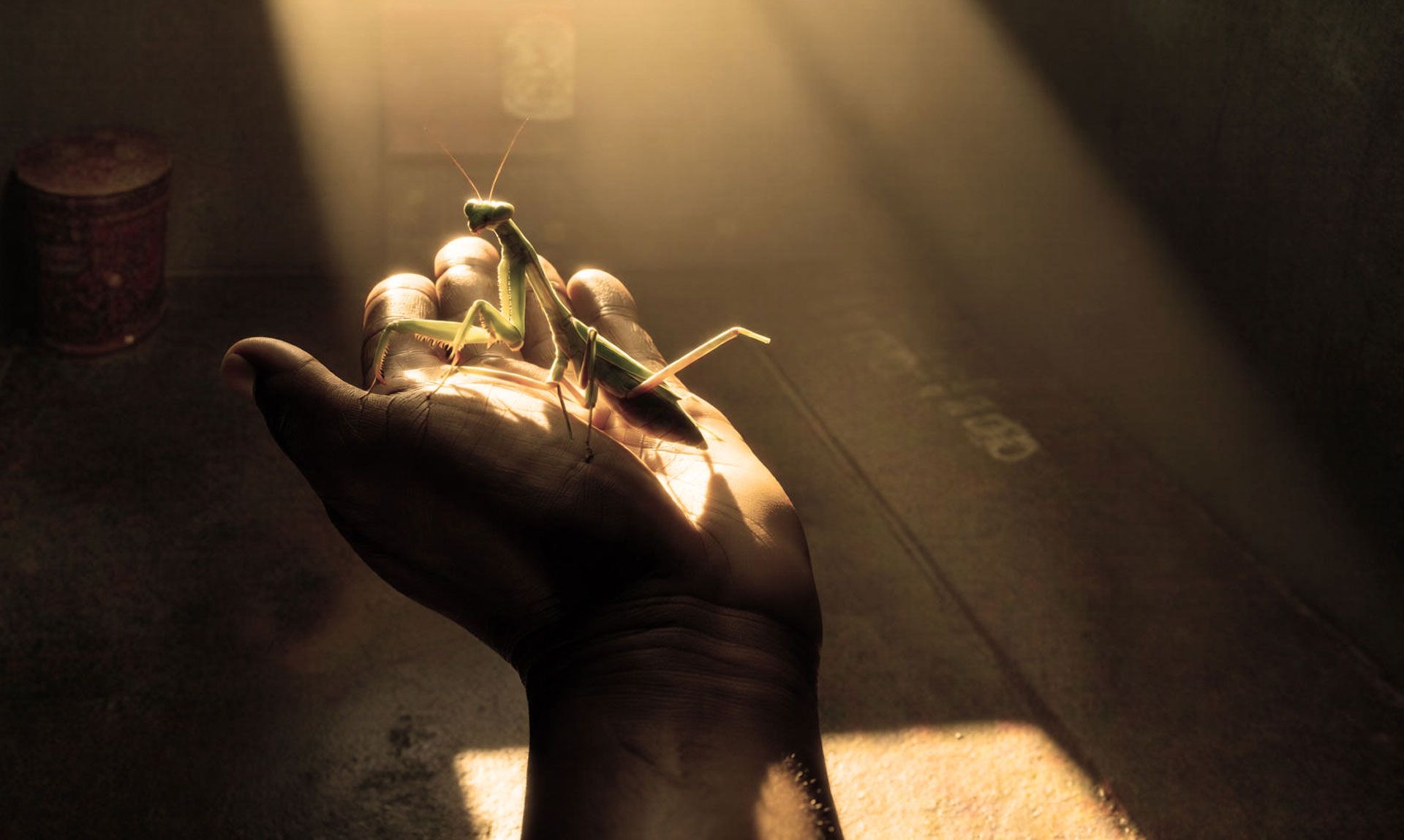
I stared back at him. He must have taken nearly 30 minutes to tell me this story I’ve summarised as a few brief moments. It was so vivid in the telling, I could never do it justice. The details were extraordinary, the nature of his belief was stunning, his love for the monks deep and sincere.
“That’s a film….”, I gasped.
“Maybe we should go back with you to Japan, film another, new concert?”
‘No.“ he responded flatly.
“We can’t film at the shrine?”
“No, I don’t want to make a film in Japan. That was just a story I wanted to tell you, about my relationship to God.”
Abdullah continued to speak for nearly another 2 hours, about what he did want to make a film about, although it was never really clear. At times it was about his farm in the Northern Cape, a large expanse of semi-desert gifted to him by the country where he said he was teaching both martial arts and music. He wanted me to come there, to the land and see the sunset, film the dawn, hear the wind, stand and feel the ancient air. It sounded amazing, but I knew as he spoke that I was never going to go to the land, nor film those things. He wasn’t going to invite me, and I knew I would never have done that experience justice, not just because my skill as a filmmaker was dwarfed by his understanding of nature, but because I think film might be incapable of evoking such expectations. That’s why we have music. It doesn’t resemble what we see, but what we feel. Music doesn’t compete with reality, or re-order it. It makes its own self-sustaining version of it.
The only way I can explain it is that you can’t live in a film the way you can live in a piece of music.
It was now nearly lunch and the staff were starting to wander back in. Abdullah Ibrahim had given me nearly three hours of the most extraordinary storytelling, a lot of truth and probably some bullshit, and I couldn’t tell which was which and I didn’t care. I felt both elated and sad. He had point-blank refused my dream, and yet seemed to have valued my company. We warmly said goodbye and agreed to talk further, but of course we never did.
This happened (more or less) as I’ve told it. I wasn’t alone. There was Jay Savage as my witness, who I’m sure has his own thoughts on it all, although we’ve never really discussed it since. I’m sure he has his own regrets for the results or lack thereof in the encounter, his own story of a day arranged with enthusiasm and hope.
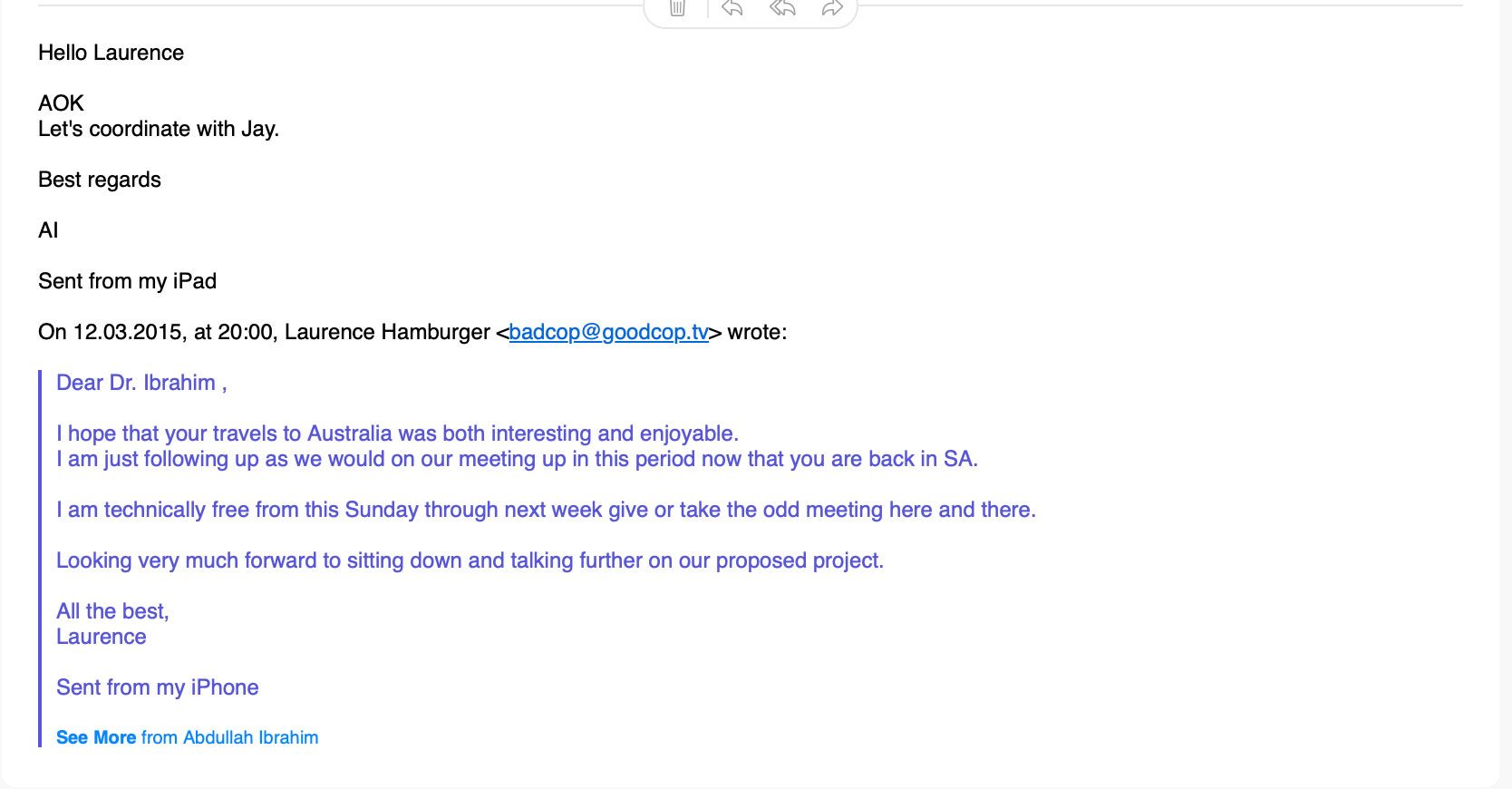
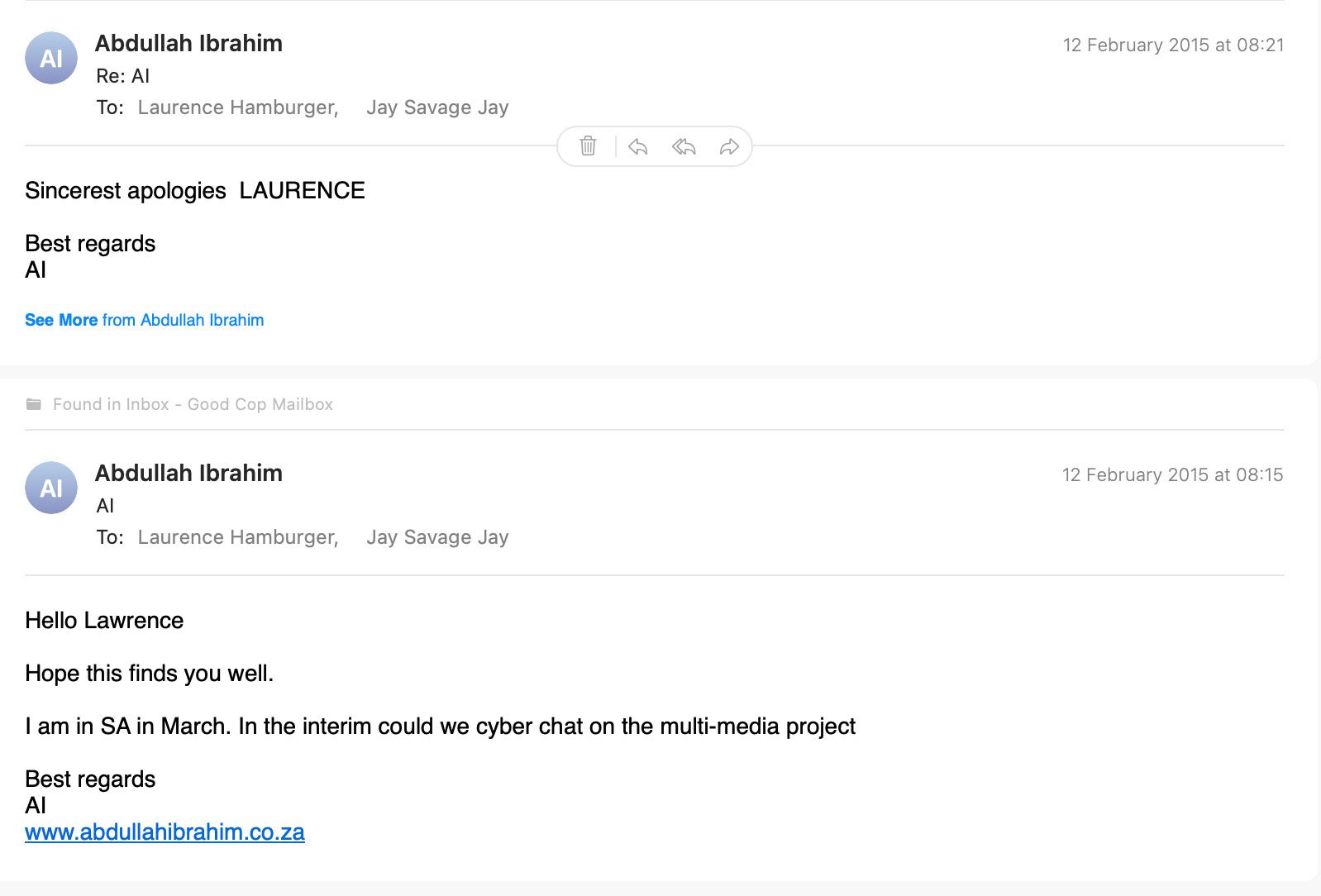
For a few months after, Abdullah and I wrote each other emails trying to figure out a story, but I soon realised I couldn’t pursue it. I was never quite sure what he wanted me to help him say. When I re-read the correspondence now it almost feels like he was just up late at night in a hotel and needed someone to listen to his thoughts. Musicians can be like that. They can communicate with the world, and still find no one to talk to.
I have spent years thinking about why Abdullah so flatly turned down my offer to find his films. Did he not want the films to be seen for fear of what they showed, or maybe it was what they didn’t show? Maybe as an artist he felt they were full of meaningless moments; that allowing me or anyone else to see them would expose an insincerity, a series of unedited views on whatever he was passing through that now just felt fickle. Maybe he imagined they lacked the insight or the depth of his music, or maybe that, like anyone who picks up a camera and attempts to tell a story, he feared it was pretentious, an amateur reach at being interesting. Maybe he couldn’t remember what was on them and he wasn’t keen to go back there; it would be an exposure, of intimacies; delicate moments that he felt best left unrecovered. Maybe he remembered in them a few significant indiscretions, possible distractions from his better life, potential de-railings of an already complex and complicated personal narrative he was still trying to control. Maybe he really had lost them and knew exactly when. In some trunk on the way to or from New York, or thrown out in a fit of rage in the pain of exile, and he couldn’t bring himself to admit this, least of all to some meaningless stranger. You could imagine anything and you wouldn’t actually know. Anyway it wouldn’t make a difference. Abdullah Ibrahim has left us now, and his music was what he wanted us to know. We really should just be grateful.
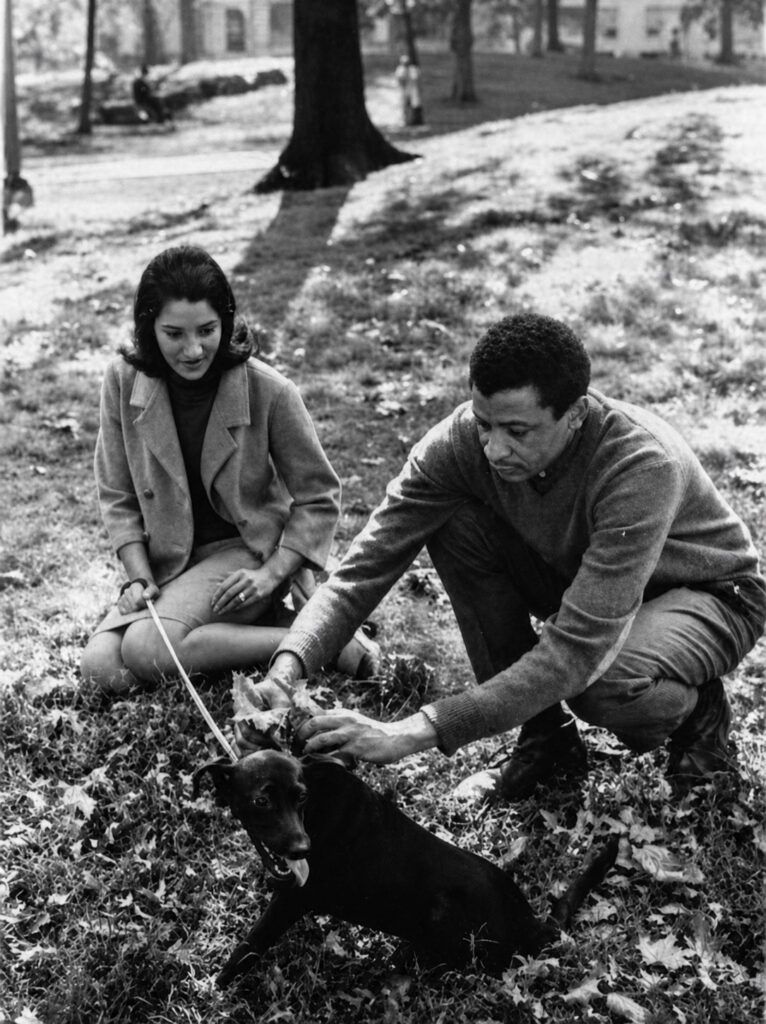
| 1. | ↑ | The picture is taken in the garden of Helligaandskirken (The Church of the Holy Ghost) in Copenhagen, September 1969, not in Montreux. The photographer is Ib Skovgaard, a Danish jazz journalist and a close friend of Abdullah Ibrahim and Sathima Bea Benjamin who used to stay in his flat when in Copenhagen – at one time for several months. Ib passed away some ten years ago. Lars Rasmussen, email correspondence, Sunday 2 August 2026. |