NELISIWE XABA & BRENTON MAART
In Conversation about vRot: The politics and poetry of decay
How does Nelisiwe Xaba’s performance artwork vRot require us to feel the presence of rot directly, in our bodies? The work invites the audience into what theatre scholar Erika Fischer-Lichte calls ‘a transformative encounter’ – an experience that is visceral rather than merely conceptual or abstract. To understands its mechanism, it is useful to begin with some context.
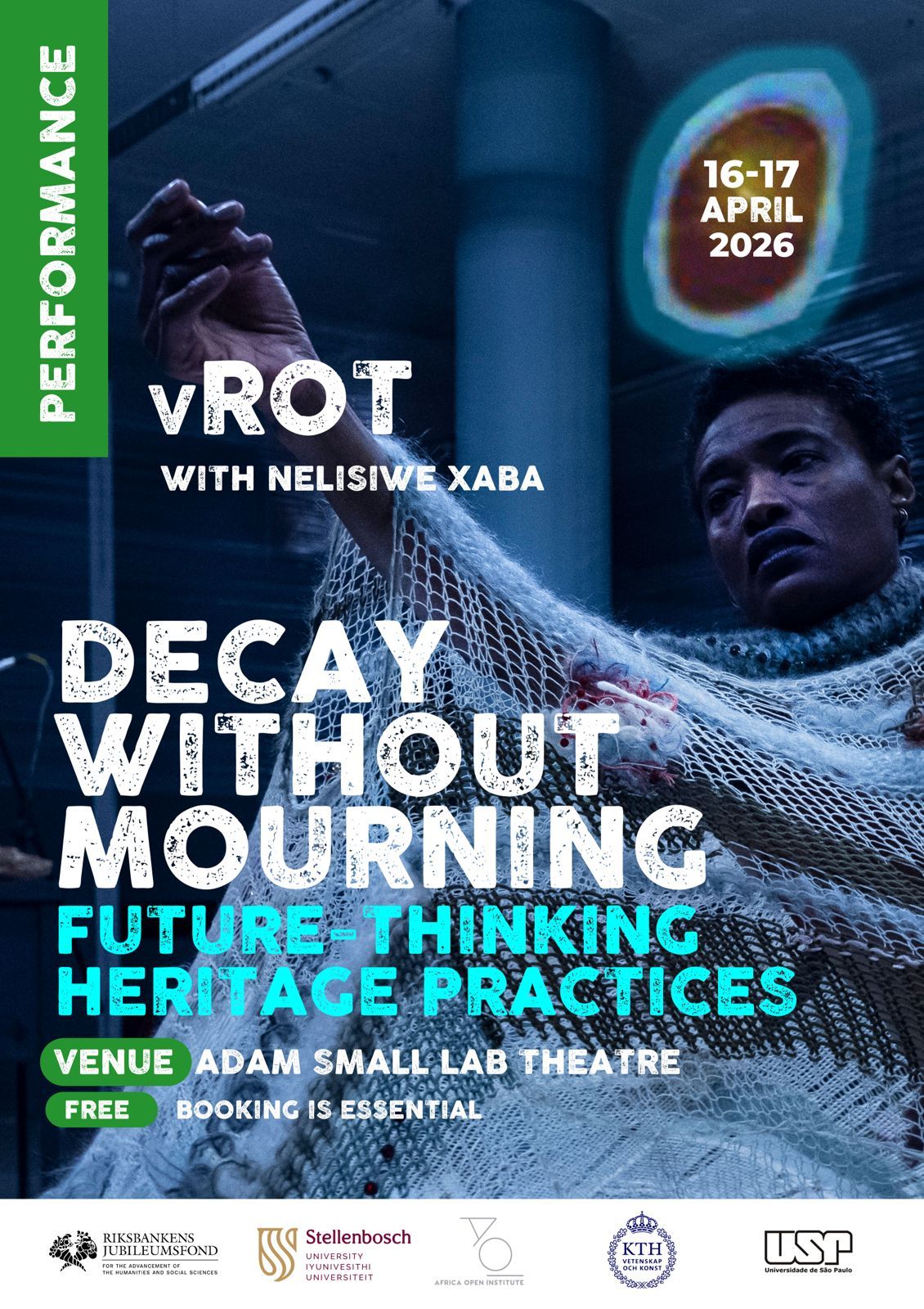
In 2023, Leora Farber and I commissioned Nelisiwe to create a new work for Sym/Bio/Art, an exhibition we were curating as part of a new research programme – then called the Creative Microbiology Research Co-lab, and since renamed Bioart + Design Africa – at the University of Johannesburg, which operates at the interface between biology, creative practice, and decolonial activism. Its focus is the trans-disciplinarity of art/science practice, and foregrounds the use of living, semi-living and non/living biological material as both medium and subject, enabling experimental inquiry into the conditions and politics of life itself. The exhibition Sym/Bio/Art positioned microbial and other organic life forms life as collaborators in aesthetic and epistemic production, challenging anthropocentric authorship and foregrounding interspecies entanglement. Within this context, Nelisiwe conceptualized, created, and performed vRot – with Joshua Brayton Arnold – for Sym/Bio/Art, FADA Gallery in Johannesburg (2023), thereafter performing the work again at the ICA’s Live Art Festival in Cape Town (2024). The Decay Without Mourning conference in Stellenbosch (2026) is the work’s third iteration – this time performed with Killian Blerk.
Brenton Maart: Nelisiwe, let’s begin our discussion here, by asking you to allow us a glimpse into your creative process. How did this work first form in your mind, and how did that concept evolve into the performance artwork vRot?
Nelisiwe Xaba: It started with fear actually, because when you commissioned me for Sym/Bio/Art, my first thoughts were that I don’t do science; I don’t do biology; I don’t know anything about those subjects. Then, through research, and by going into science departments and looking around and talking to scientists, there emerged the possibility of engaging with bioart.
I started with the simple process of just moulding bread as a process to inform and inspire a costume for the performance work. I started watching the mould happen to a piece of bread, and I started being fascinated by that process and how – when you zoom into it – you see worlds. It’s like a spider web, and channels, and cute little things that you can’t see from afar. It became beautiful. I realised that what comes from moulding, and the process of moulding, is really beautiful.
But, I have difficulties in doing beautiful things. I have to embody myself into the process, so it can’t just be a pretty thing. Maybe it is beautiful, but that’s not where my interest is. From there, molding became VRot, and VRot represented the vRot-ness of what’s happening in this country, politically. It became such that I had to use, simultaneously on stage, these two ideas, as performance. They are so similar in process – how corruption is eating all of us, slowly but surely. That is how the work began.
Brenton Maart: We had built a bioart laboratory within the Faculty of Art, Design and Architecture at the University of Johannesburg as a space to bring arts and sciences together. However, the lab was off-limits to working with fungi. So, when Nelisiwe first developed her concept and proposed working with mould, she started in her kitchen, conducting experiments with rotting foods. She wrapped various fruits and bread in cellophane, and observed the mould growing – sometimes via macro photography – into what she described as ‘living landscapes’. I remember Nelisiwe’s registration of the disjuncture between, and her discomfort with, material beauty on the one hand, and political horror on the other. For me, curatorially, that brought together the politics and the poetry of processes of ruination – where beauty may be found in putrefaction, and putrefaction in beauty.
Lets move to the scenography and its materials. Nelisiwe, you’ve created an eerie laboratory, where your performance is seemingly hermetically separated from the audience by an undulating wall of shimmering plastic sheeting. Within the performance area you’ve created what is presented as a second skin – a vast blanket that covers your writhing, pulsating, at first amorphous body. Beneath you a mirrored floor reflects mercurially, darkly. To one side, your black-suited collaborator positions Barbie dolls and cars on a table and devours fast food and drink as his actions of excess are captured – noisily, slurpily – by an ASMR microphone and by an overhead camera projected onto a screen.
As he gluttons himself, your near-naked body writhes beneath the second skin to emerge – haltingly, in fits and starts – freeing itself, like a pustule from a landscape of suppuration.
In the final scene you smear yoghurt all over your body. Some of it makes its way into your mouth and down your alimentary canal. You are coated on the inside and on the outside with a slimy product of fermentation. You leave imprints on the plastic lab wall. At the very end you highlight the permeability of the staged area by crossing through to the other side – to the side of the audience – infecting us with transformative rot, forcing us to confront our own complicity. Could you tell us more about why you chose these materials? What do they mean to you creatively and politically?
Nelisiwe Xaba: I’ll start with the blanket/tissue/skin – I’m not sure what to call this material, but I think tissue is the more appropriate word. I asked Hannelie Bekker from Wrapt Knitwear to construct it. At first, it was very light and didn’t have weight, so we had to find ways of giving it a form of heaviness, and a gravity. At first I thought beads could bring some weight, but that became problematic because they snagged into everything, and that would become a nightmare on stage. So, instead, as part of my creative process, I layered the tissue using many samples from Hannalie’s studio – patches of fabric, knitwear, and crocheting. This became part of an ongoing process of making – layering, stitching, and mending – which then become part of the making of the concept of vRot. I kept adding more and more weight, and that is how the material became political.
For the first two iterations of vRot, when constructing the laboratory on stage, I used pallet wrap plastic, which is stretchable, like cling film. I liked this material because it gave bounce; it became strangely alive. However, it’s difficult to install. Also, because it only comes in a width of 40cm, it became too tedious to work with. So, for the Stellenbosch performance, cellophane became the answer. It doesn’t have the spring or elasticity, especially effective for the final scene, but it still works.
One image that stayed with me is that of an X-ray – looking in. We are not looking deep enough into corruption. Society has become complacent. Its become a case of: this is what happens, and we’re not involved. And yet we do participate. Most South Africans will tell you that, oh I paid a cop so that I don’t get a ticket for driving badly… We say that proudly. But, through this, we feed corruption. We’re happy to point out politics and and business, but I think it also is vested somewhere with the social body. Corruption transformed the principled public service, justice and governance into greed and loot. The crudeness of corruption which I demonstrate in the piece with the ASMR artist shows the obscenity of excess of luxury cars, fashion, jewellery and mansions, the jarring imbalance, flaunting privilege in the face of the poor they represent. I’ve always thought it would be extremely hard work for anyone to take over governance, because the moral decay is across all spheres of society, and none of the political organisations speak to that when they campaign for the next local elections. The African National Congress allowed for what we used to call Comrade Tsotsi into governance and the Government of National Unity continues on the same trajectory.
Brenton Maart: Fungi have become increasingly central within bioart due to their ambiguity. Neither plant nor animal, they help us, writes Anna Tsing[1]Tsing, Anna Lowenhaupt. The Mushroom at the End of the World. Princeton University Press, 2017., understand the world by paying close attention to non-human lives in damaged landscapes, rather than relying solely on progress narratives. It involves tracking the more-than-human connections that sustain life in the ruins of late capitalism. Within your vRot performance, you create the conditions to cultivate mould and to transform it from invisible to visible and then to ubiquitous. This shift over time mirrors fungal growth patterns – often unnoticed until proliferation becomes undeniable. Your work vRot engages mould as both biological phenomenon and political metaphor, tracing the slow accumulative process of decay that mirrors corruption within South African sociopolitical bodies. By coupling mould to this critical political register, your work – your body – becomes a site of microbial and social and ideological inscription, and a site of political critique. You frame mould as analogous to corruption. Rot here is a condition. It is gradual, systemic, and ongoing.
This is such a rich field in contemporary humanities scholarship and there is much that aligns with your work. Donna Haraway’s concept of staying with the trouble, for example, encourages us to engage with entangled messy processes rather than seek purification. Karen Barad’s theory of intra-action allows entities to emerge through entanglements instead of being siloed as separate agents. But the texts I find most resonant and the idea I’d like to explore here comes from Achille Mbembe’s writings on the post-colony, where power operates through diffuse, often banal systems of decay rather than by singular ruptures. Also intriguing is Mbembe’s notion of the aesthetics of vulgarity in postcolonial power where decay is internalized, normalized, and performed in daily rituals. Within this framing, fungal growth becomes a material allegory for systemic failure. Could you talk us through this narrative of aesthetic vulgarity within your creative practice, and how it emerges in the work?
Nelisiwe Xaba: My roots are dance, and dance requires an athletically trained body, which allows for the body to be pliable and molded to any shape required for choreography. In a way, this function resembles dough. So whatever I do with my body is art because it authentically communicates politics of gender, race and emotions. In the vRot performance I was particularly interested in endurance and speed. I was happy to actually hear an audience member, after the performance, observe the pace of the moving body, remarking that they hardly saw how I arrived at one point, and then at another, on stage. For me this was to mimic a conducive environment for and the rate of the growth of fungi and social decay. The center for my work is my body. That’s where it starts. And then, of course, when I start to work, it goes beyond choreography. I go somewhere else, and then wherever I go, whatever I find must come back to inform choreography, and that’s how my work unfolds.
This discussion about the performance vRot, took place during the Decay without Mourning Conference, STIAS, Stellenbosch, on 17 April 2026. The performance itself took place on 16 & 17 April 2026, Adam Small Lab Theatre, Stellenbosch.
| 1. | ↑ | Tsing, Anna Lowenhaupt. The Mushroom at the End of the World. Princeton University Press, 2017. |