MBE MBHELE
Notes on the return to the rural in Nakhane Touré's PIGGY BOY's BLUES
It is perhaps for the better that contemporary writers are increasingly moving away from the old literary tendency that positioned the rural as the site of goodness and moral purity in opposition to the corruption and evil of the city. There is something refreshing in the gradual collapse of this binary imagination of space. The rural is no longer represented primarily as a place populated by fawn shrubs in winter and colourful birds singing perfect melodies in spring. When we listen to the rural now, we no longer merely hear a cow bellowing in the distance, nor are we compelled to romanticize the weight of firewood balancing gracefully upon a woman’s head. We no longer have to squint sentimentally at the village sun preparing to rest behind the mountains.
In many ways, we are no longer trapped within an idealized understanding of rural life, one that almost always collapses upon confrontation with lived reality. It is from this position that I want to invoke Nakhane Touré’s Piggy Boy’s Blues, a text about which a lot of ink has been spilled, much of it attempting to suture together various concerns regarding ancestry, queerness, masculinity, spirituality, and the return to one’s origins. However, I wish to limit myself primarily to one aspect of the novel: the treatment of rural life and the complicated question of rootedness.
There are, of course, different ways in which people experience the rural. There can be no universal account of what the rural is or what it means. We all experience it differently. The pastoral life in Piggy Boy’s Blues is radically different. In the text, Davide, who is the protagonist, experiences the rural not as grounding or restorative, but as hostile, dull, and emotionally oppressive (Stuit 2024, 11). When Davide arrives in his Ancestral homestead in Alice in the Eastern Cape, to live with his uncle, Ndimphiwe, he realizes that many of the assumptions he had about what the rural could do for him were wrong.
The protagonist, Davide, finds himself in the midst of collapse and decay.
Everything he had come to believe about the place is proven wrong upon his arrival. The physical decay he observes upon arriving at the homestead would later be matched by the overall experience he would have as events unfolded.
For others, the experience of the rural is completely different. Withdrawal from the city allows them to have an intimate relationship with themselves and their surroundings, and it grants them clarity of mind. The philosopher Martin Heidegger is one such person. In his piece Why Do I Stay in the Provinces?, he argues that returning to the provinces, where his body is in harmony with the environment, allows him to think in a much more rigorous manner. For Heidegger, the provinces are places that function in a particular way, they serve as a place of solitude. This solitude (found in the provinces) whose power he accounts for as “projecting our whole existence out into the vast nearness of the presence [Wesen] of all things” is equally accounted for elsewhere as a form of withdrawal that “opens up openness.”
However, things are different for the protagonist, Davide, in Touré’s text. But what could be the reasons for Davide experiencing the rural differently from Heidegger? There are many, perhaps, but I want to highlight that one is black and one is white; the black’s relation to space has been affected by the history of colonialism, while the white’s has not. A similar sentiment can been seen in a movie (Inxeba) in which Touré stars, a subtle introduction to how the afterlife of colonialism still lingers and affects how we view space.
Sometimes characters from the rural are introduced as naïve. They are represented as innocent people who exist only for the still beauty and quietness of their ancestral homes (Abraham 2019). But how can this be the case when the colonial moment, and the violence that came with it, changed the very way in which we interact with space? When the spectre of colonialism is omnipresent, how can Davide find purity in Alice? How can he say, “I feel at home,” and not stutter when so many things have happened?
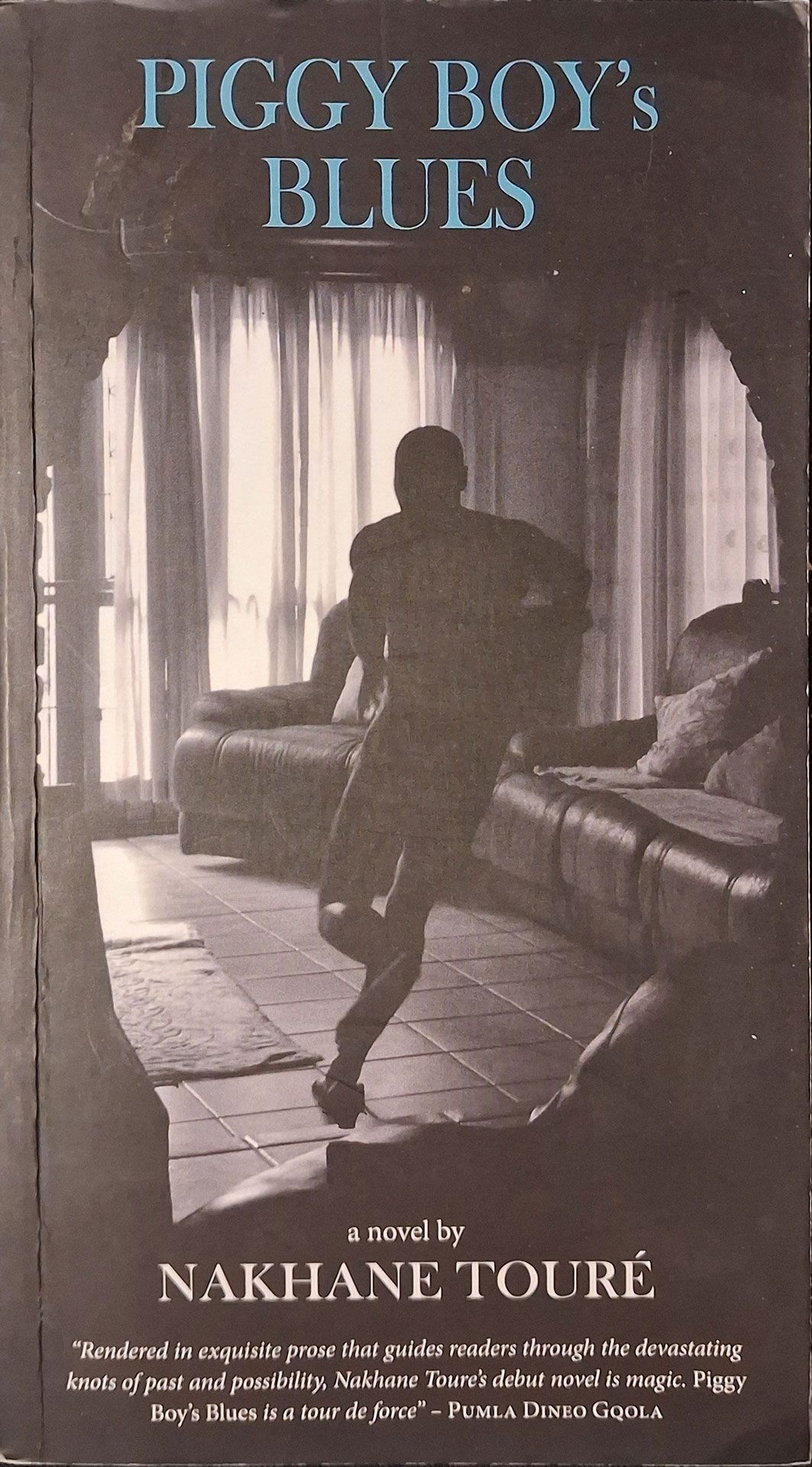
In Piggy Boy’s Blues, something terrible happens in Alice. There is a violence that severs any possibility of harmony. It is Gray, uncle Ndimphiwe’s boyfriend/lover who unleashes this violence, which once and for all makes it clear to Davide that the sanctuary he expected was merely an illusion. Gray is described as “…pig-bodied: short and thick limbed with a fleshy face and burned yellow cheekbones. He had a wide, unsubtle behind he had no qualms exposing with belts that were too tight” (2015, 14). The stark violence makes it clear that running is permissible, but we should not so easily think that the rural is the place to run to, or that it is less dangerous to both the psyche and the body.
Here is the scene:
“A stone pressed hard against the back of his head. Several stones appeared to be trying to make blunt incisions through his clothes. Gray turned him round onto his stomach and pinned him to the ground with his knee. Davide spat out soil and bits of stone. They made a paste with the wet on his face. His pants and underwear were pulled down with quick, chafing precision. Now the stones had better access to his skin. They scraped and dug in.” (Touré 2015, 67)
What emerges in Davide’s experience is a unilateral and violent relation, one that does not lend itself to healing, openness, or communion. The experience is akin to the one we have when university batters us, when the city rejects us and we go back to the rural areas to try to find solidarity and rejuvenation, only to discover that even the village no longer recognizes us. It is the same experience our fathers have when life in the city defeats them and they run back home, sick and barely recognizable, thinking they will find redemption. But the rural offers none of that; it stands waiting with gossip and a coffin.
The rural in Piggy Boy’s Blues has its complexities. The idea that a return to the womb and to nature might bring some sort of salvation is abandoned in the text. What also interests me is how the urban is often presented as the source of pollution to the rural, which is to suggest that if the urban had never been invented, the rural would never have been polluted. The city becomes a supplement that upsets the origin of indigenous culture, erasing its clean and distinct cultural identity. For Thabo Jijana, this is not the case. He refuses to accept the rural-urban dichotomy and argues that these spaces feed on each other, that they exist in some sort of dance. He insists that we must reject the idea of the rural as an isolated, static backdrop (Jijana 2017).
Davide is not only estranged from his village but equally from his ancestors and his own body, he becomes something akin to what Frank B. Wilderson calls a ‘cosmic hobo,’ an expression of generalized dislocation and rootlessness.
At different moments in the text Davide informs us of this generalized state of estrangement, he says of himself that, in accounting for the distance between him and his ancestors, who are “men of blood, shield and spear” (2015, 85), and further on: “God surely knows that even though I was included in the lineage of what I have been told were warriors, I do not possess mythic lack of fear of confrontation.” (2015, 127).
When Davide is raped by Gray what one sees is how he simultaneously assumes the position of an observer and this is one of the intimations of this estrangement, he, as if separate from his own body, can do nothing other than be a mere observer.
This is the life that Davide is condemned to live. At different moments, he speaks about his fraught relationship with the totality of the atmosphere in Alice, and this remains the case until he departs for Port Elizabeth. He likens his departure to that of an initiate returning from ulwaluko; he wishes to start his life anew. He uses the notion of ulwaluko metaphorically here, in that the events that unfolded have since crystallized into the formation of a new person, one who possesses a different outlook on life.
Even though Davide has painful experiences in the rural areas, he never completely loses his positive view of the place; the idealized notions still linger. Perhaps what we have to contend with here is what happens when a place of refuge ceases to be one, what happens when one’s body is in constant tension with its environment, what happens when the imagined is struck out of balance with the real. These are the fundamental questions that the text tries to grapple with.
Clark, (2019). “Grief, Ecocritical Negativity, and the Queer Anti-Pastoral,” New Review of Film and Television Studies 17 no.2 (2019), 214. doi.org
Heidegger, M (1934). Why Do I Stay in the Provinces.
Sheehan, T. (2001). Kehre and Ereignis: A Prolegomenon to Introduction to Metaphysics. In R. Polt, & G. Fried (Eds.), A Companion to Heidegger’s Introduction to Metaphysics (pp. 3-16). New Haven: Yale.
Stuit, H. (2024). (Re)Turn to the Rural: Queer Anti-Pastorals and Usable Traditions in John Trengrove’s Inxeba and Nakhane Touré’s Piggy Boy’s Blues. Regeneration: Environment, Art and Culture, 1(1-2). https://doi.org/10.16995/regeneration.16504
Touré, N. (2015). Piggy Boy’s Blues. Johannesburg. Blackbird Books.
Jijana, T. (2017, March 28). Rented Grave: Looking beyond the rural-urban dichotomy. Chimurenga Chronic