SIGRID ADORF & ANDREA SICK
Restaging, De-closing, Versioning: Unfolding Temporalities of “the Archive” (Lecture Script)
Restaging, De-closing, and Versioning are three concepts that we would like to propose for approaching the archive not as a sealed repository, but as a living, unstable constellation. They offer a framework for understanding how critical aesthetic practices, in their effort to challenge dominant social and historical narratives, participate in negotiating and transforming archival knowledge production.
We are particularly interested in how artistic inquiries deal with and reflect upon practices of care, handling, and storage, as well as in how they attend to media, materials, and their agencies. “Decay Without Mourning” offers a promising point of departure for reflecting on these concerns in relation to the decay of systems of order, their coming into being and passing away – in short, their living temporalities as they unfold through processes of Restaging, De-closing, and Versioning.
De-closing
In German, one speaks of gaining Aufschlüsse when referring to a process through which something given is recognized in its genesis and complexity. In difference to “gaining insight” it remains literally at the threshold and names the turning of the key in the lock, the act of opening. Our interest in the term “de-closing” lies precisely in this sense: in the persisting relation between closure and opening.
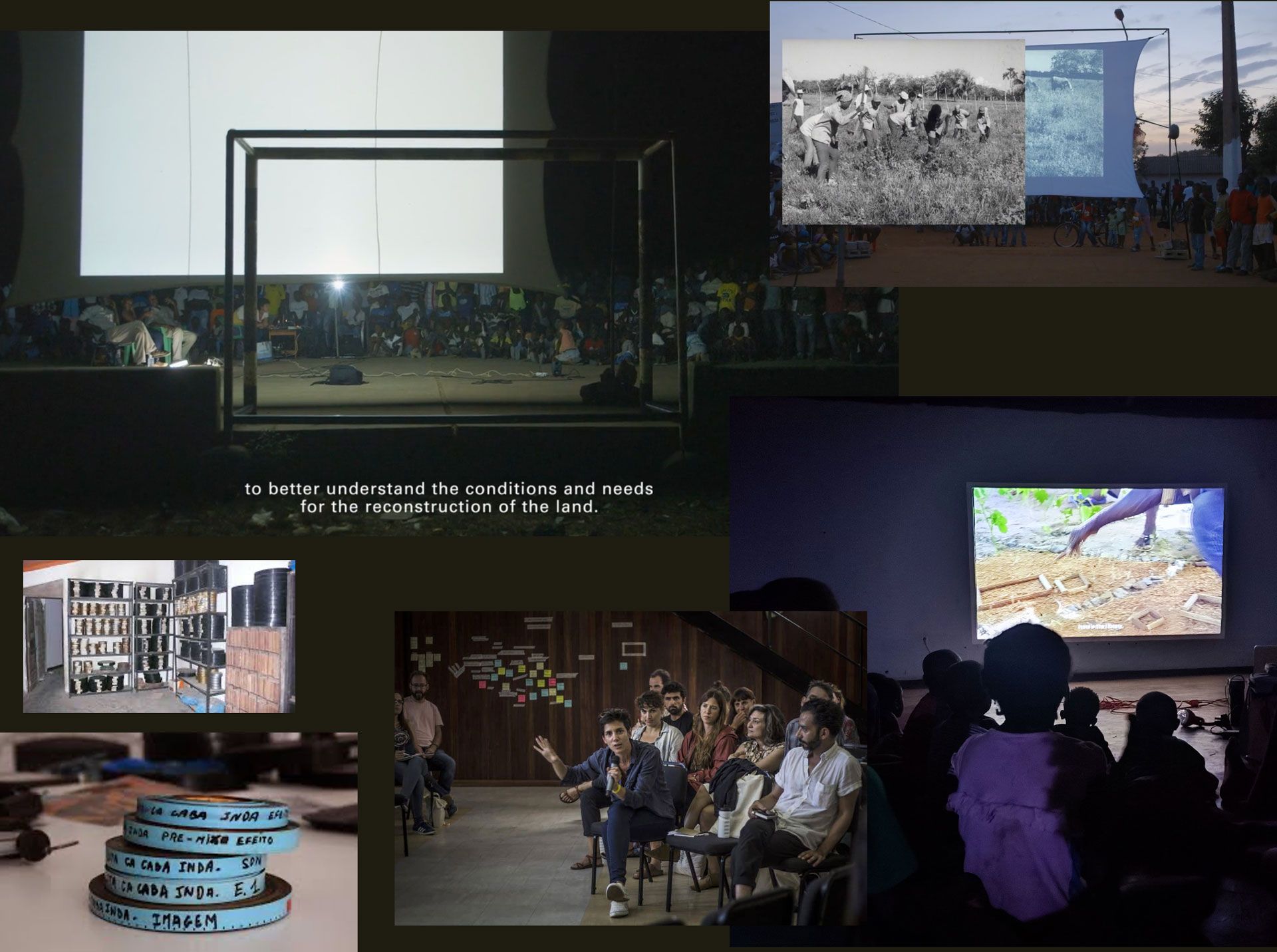
A compelling example can be found in the essay film Spell Reel (2017), produced by the Portuguese, Berlin based artist Filipa César together with the filmmakers Sana na N’Hada and Flora Gomes from Guinea-Bissau. The film shows old canisters from the Guinea-Bissau liberation movement being carefully opened, while celluloid reels—stuck together and damaged by acetic acid—are inspected with great care and attention.
Past and present appear simultaneously within the image: the gentle gestures of handling the fragile material frame excerpts from the old black-and-white footage.
Filipa César, Spell Reel 2017; compilation of stills and screening situations: S.A.
The multi-year project, which connects to the collective film work initiated by Amílcar Cabral, continues to resonate aesthetically and activistically on several levels. By cinematic means, it reflects upon itself as a form of critical work of remembrance, operating through acts of translation, but also through transmissions in the media-technological as well as psychoanalytic sense.
“transferring the reels | into digital matter | convoking spectres | to materialise,”
César notes in the margin, thereby invoking the much-discussed dimension of the spectral, of haunting, that runs through the discourse on postcolonial archival work.
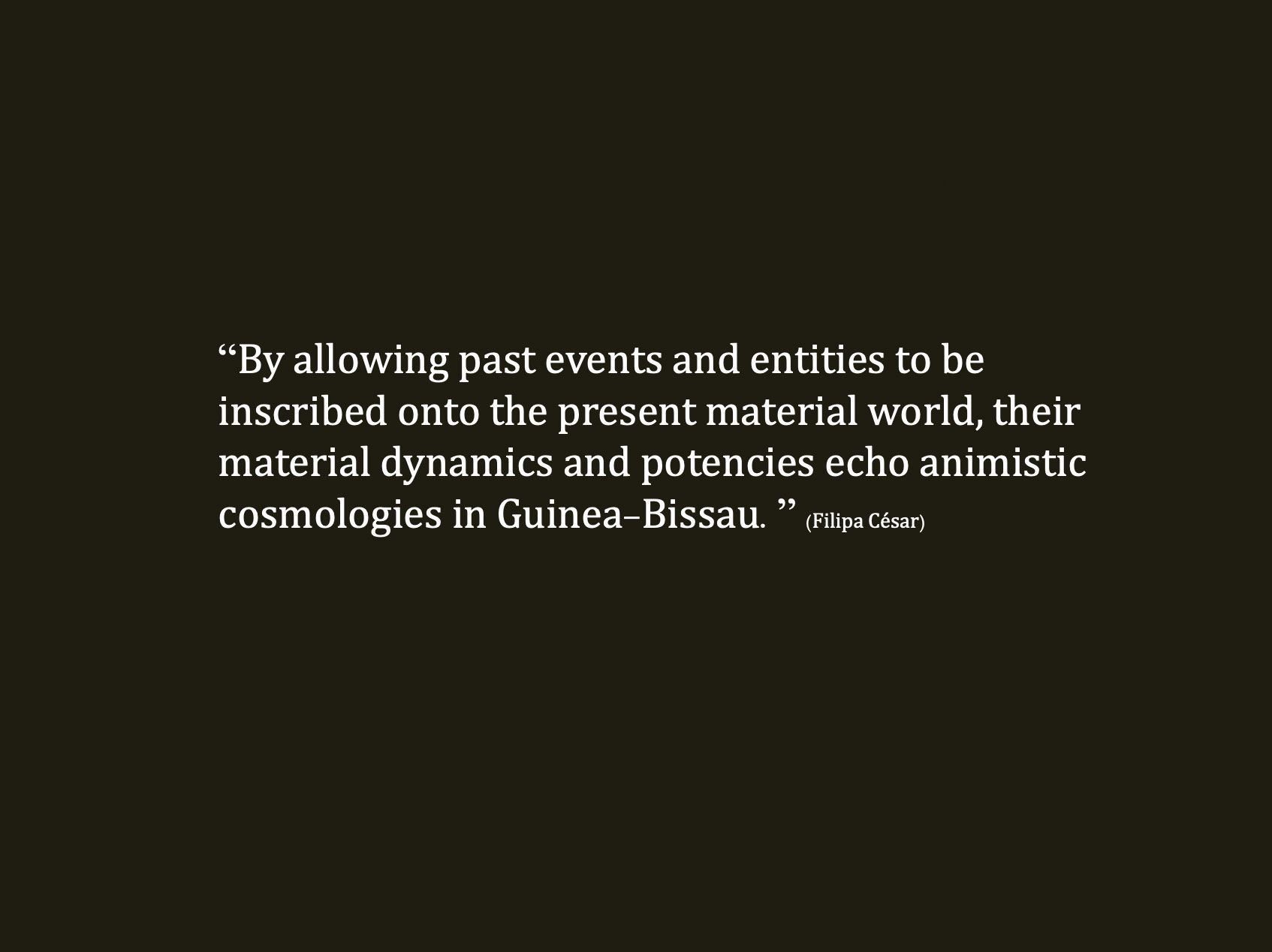
The film draws connections between the film reel as an image of the spiral, the work with testimonies from the past and a non-linear understanding of time conveyed to her by N’Hada and Gomes: “By allowing past events and entities to be inscribed onto the present material world, their material dynamics and potencies echo animistic cosmologies in Guinea-Bissau.”[1]Filipa César: „Present Present Present. On grounding the Mediateca and Sonotera spaces in Malafo, Guinea-Bissau“, in: Sonic and Cinema Commons. Past in the Present, L’internationale, 27. November 2024, internationaleonline, accessed: 14 July 2026.
Past, present, and future remain unfinished and constitutive of one another; the film stages a de-closing negotiation of their interrelations. In this sense, it can be understood as a form of critical pedagogy that challenges the modern conception of the archive as a site in which the past appears as finished and therefore closed.
In Spell Reel patina—the traces of material decay as an expression of passing time—does not become a nostalgic gesture legible as a continuation of the vanitas motif. Rather, it becomes an aesthetic marker of a history in dissolution, one that appeals to the living to reactivate testimonies of resistance again and again.
As Walter Benjamin cautioned almost one hundred years ago in the face of the threat of fascism: “even the dead will not be safe from the enemy if he wins.”[2] Benjamin, Walter. “Theses on the Philosophy of History.” In Illuminations. Edited by Hannah Arendt. Translated by Harry Zohn. New York: Schocken Books, 1968, 253–264, here: Thesis VI, p. 255; PDF: cemus, accessed: 19 March 2026.
It is often argued that an act of preservation such as the one staged here in the filmic archive is less a form of conservation than a mode of activating the past in the present. It involves a careful handling of significant remains in view of an as-yet unknown future, one that remains suspended in a state of becoming.
To understand de-closing in this sense also means taking it as a touchstone for scholarly work. I [Sigrid Adorf] take seriously those moments in which an artwork raises a question and opens up a subject in ways that resist closure. In this case, it is not my own biographical history, as César herself notes that it was her father, not she, who served in the Portuguese colonial army. Yet it is still part of my history as a European, and I try to join in the work of transmission by referring to it and telling of it, since history is, in any case, a matter of ongoing narration. It does not function as a full stop, but rather as a question mark: How can we relate to this past and reckon with it in our own present?
In this sense, the slight shift from Spell Reel to Spell Real leads from the medium to the real as that which must be spelled out, summoned, and articulated without ever being fully mastered.
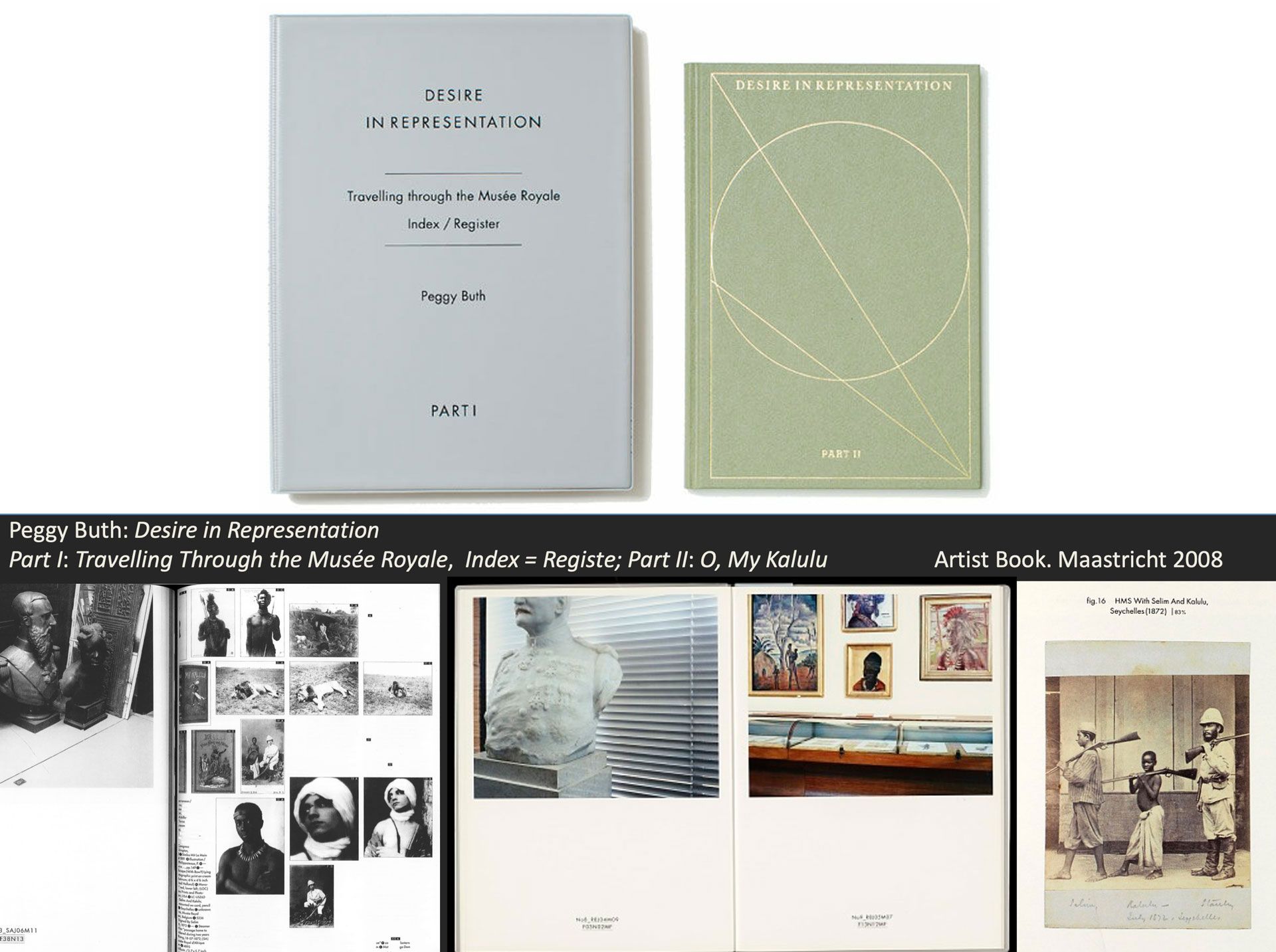
Another particularly intriguing example of an artistic practice of de-closing is Peggy Buth’s extensive project Desire in Representation. Trained in photography, the German artist conducted research between 2004 and 2008 within the Royal Museum for Central Africa and its archival holdings in Tervuren in Belgium.
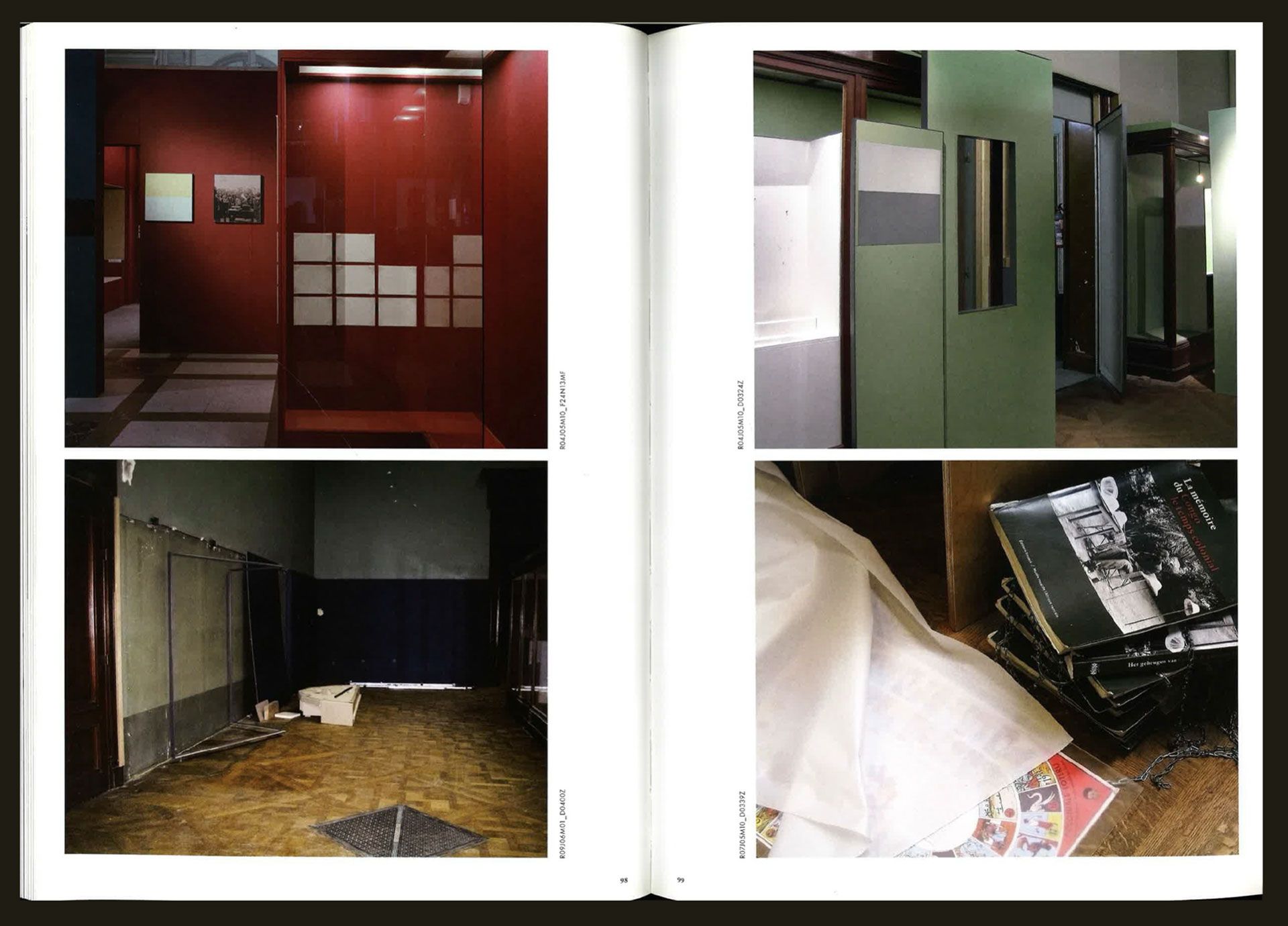
What she shows are not views of the representational building opened in 1910 for the display of Belgian colonialism, but rather its backstage: images of empty vitrines and archival filing systems that make the museum’s administrative apparatus visible—not in its ordered, stable, and seemingly timeless form, but in its raw materiality: a heavy velvet curtain, floor panels exposed during the redesign of an exhibition, and empty cabinets—elaborate stage settings for the museum’s gestures of showing and telling, in Mieke Bal’s sense.
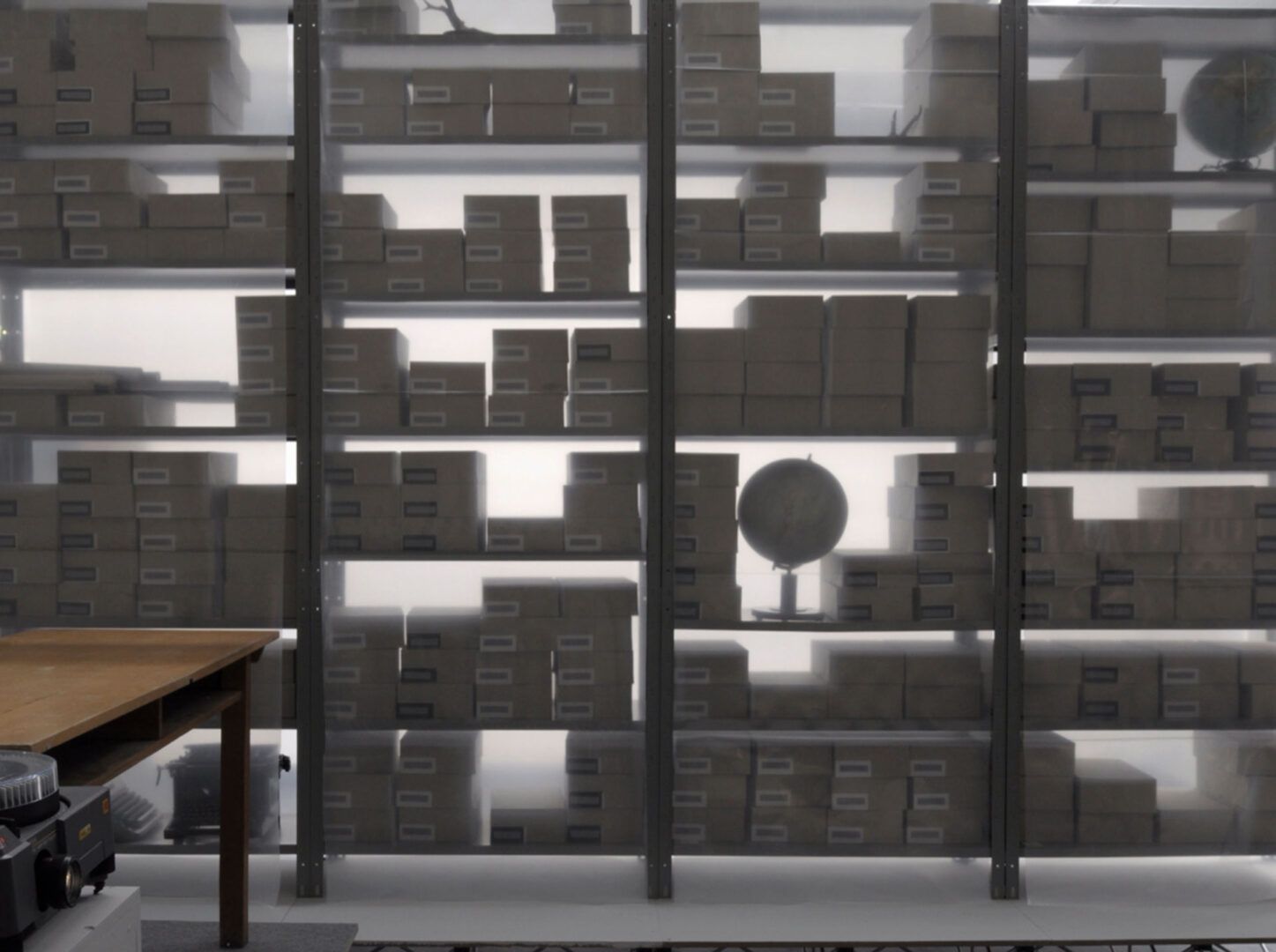
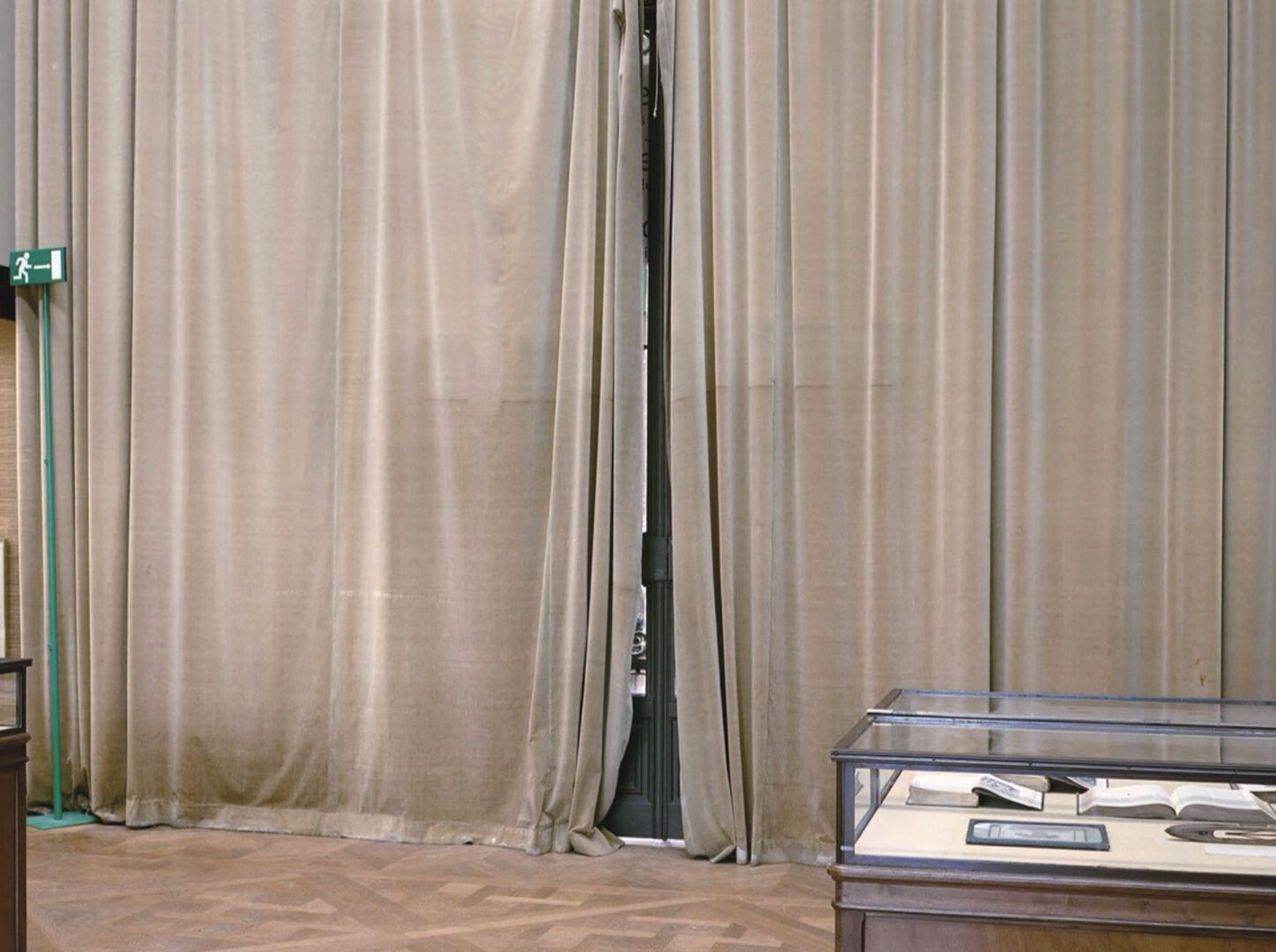
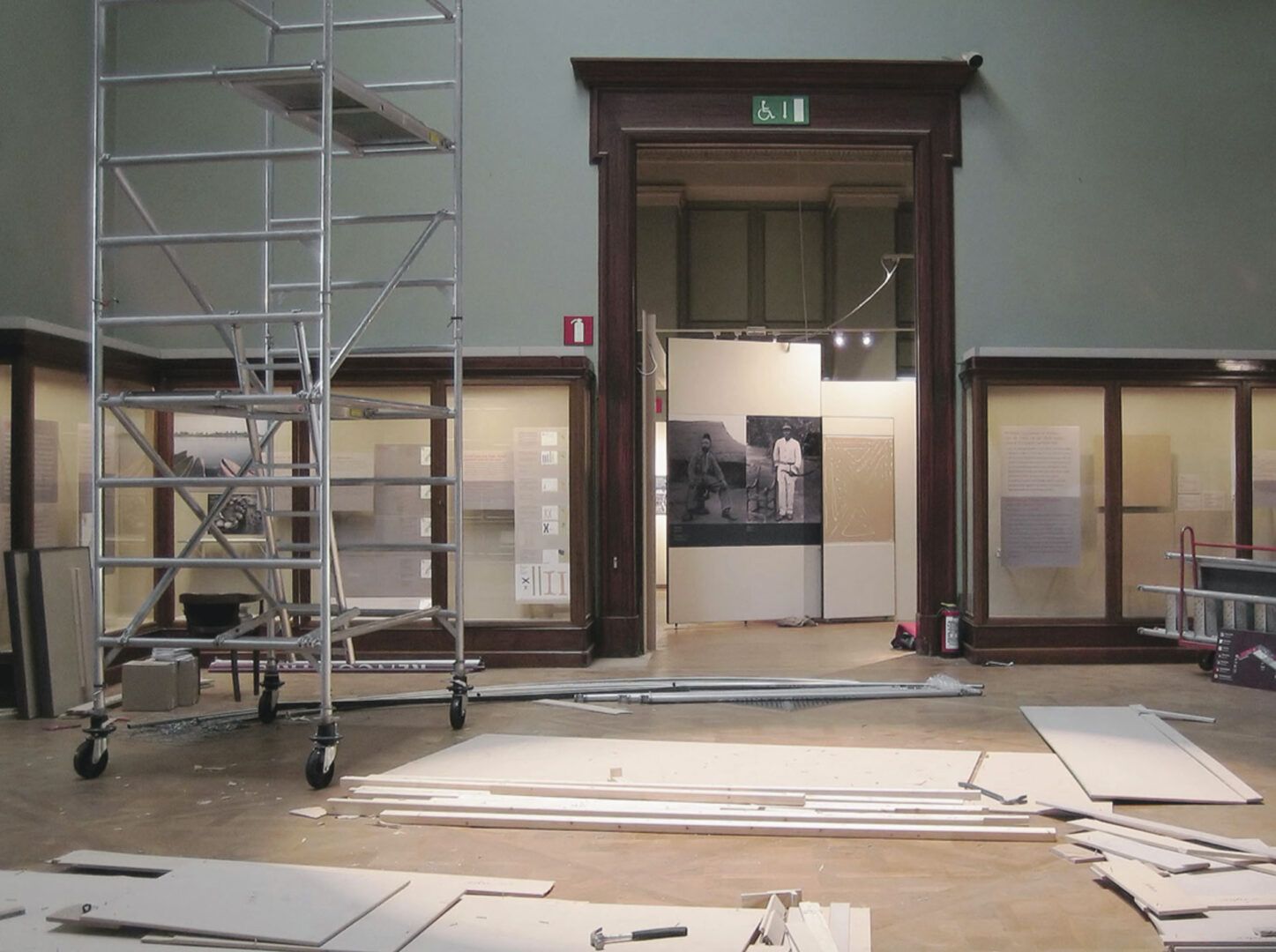
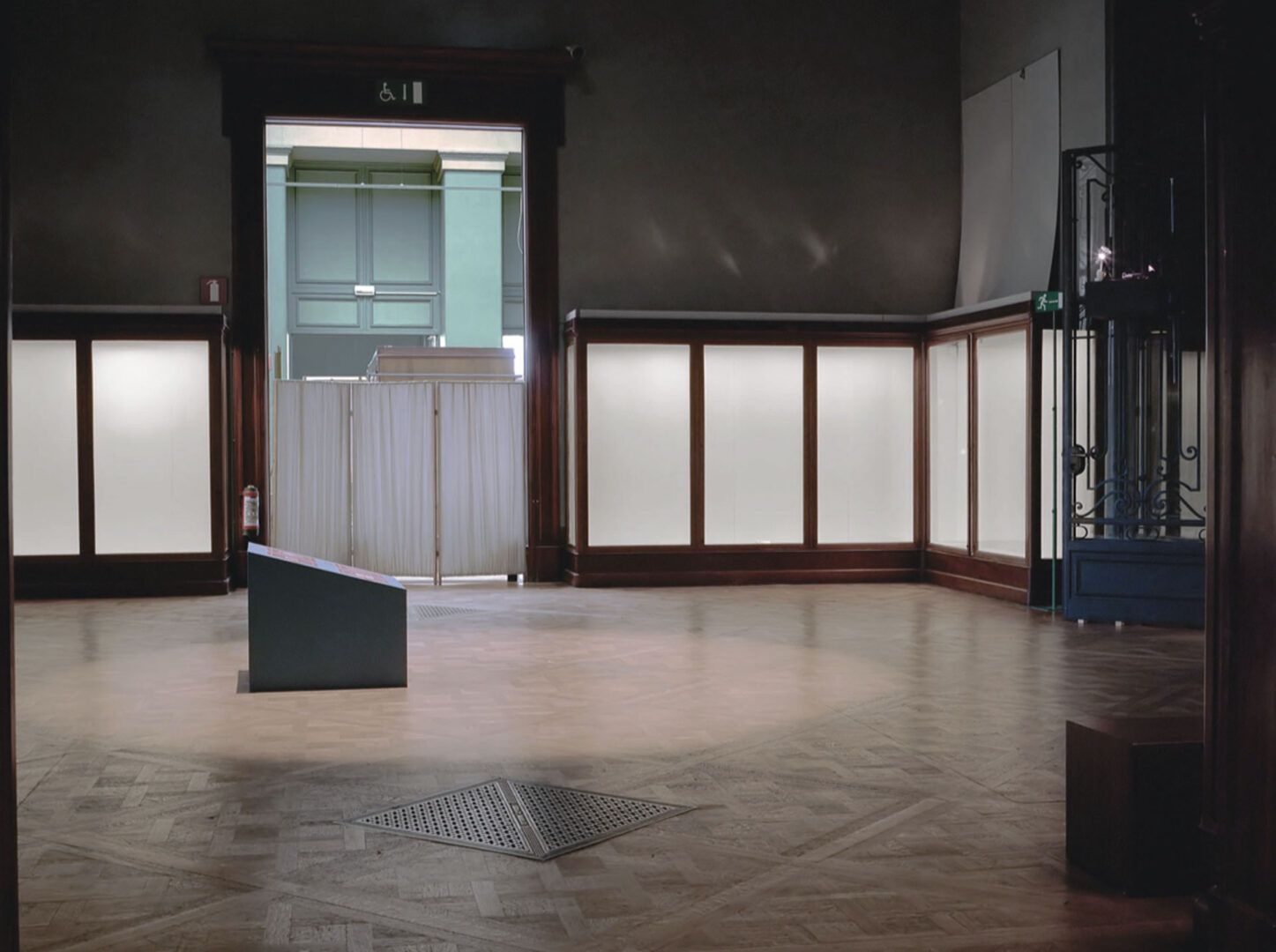
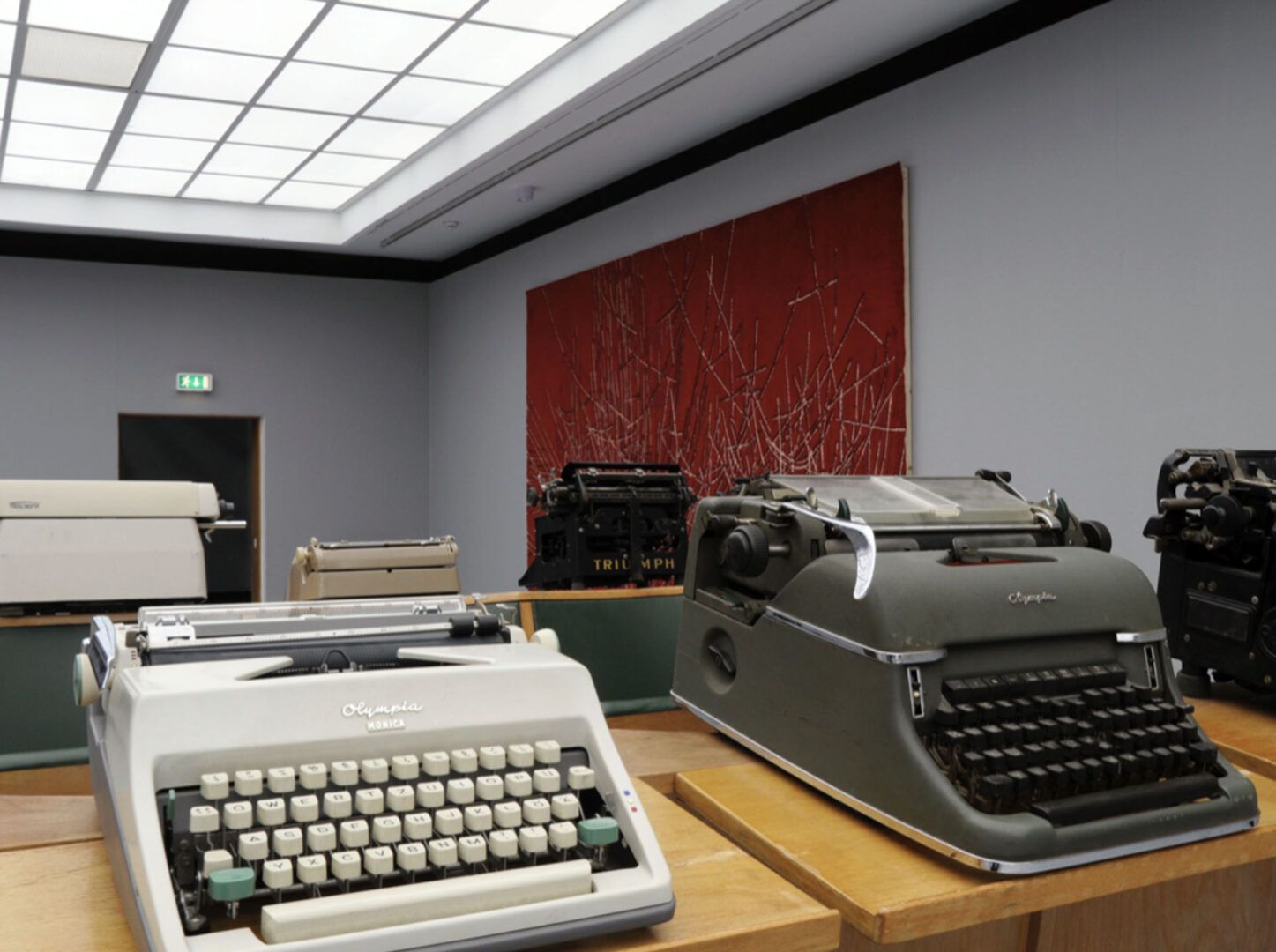
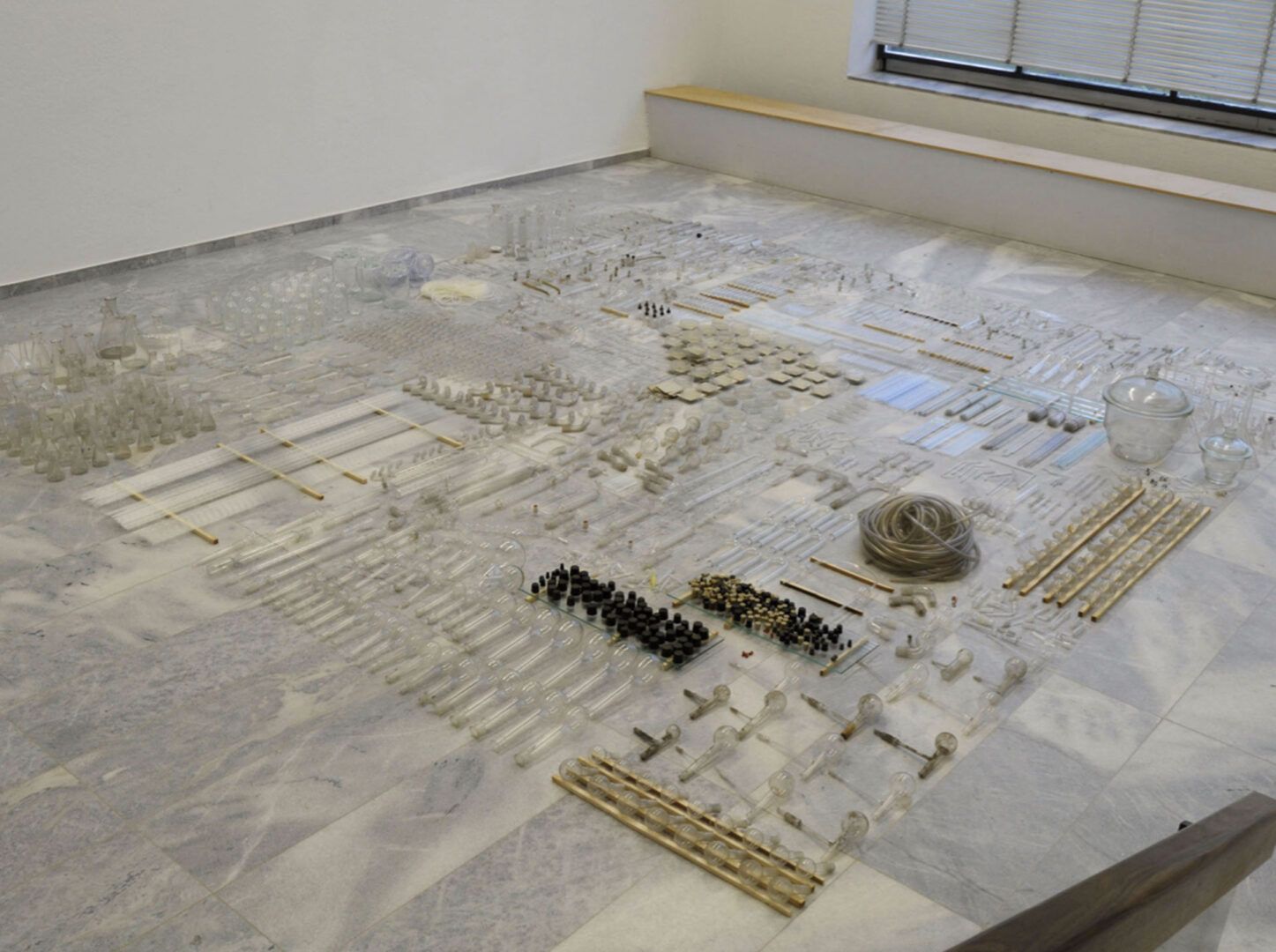
Peggy Buth’s attention is directed toward the background techniques through which museum objects are produced as objects of desire. She installs empty plinths, shows typewriters as emblems of registration and reporting, and presents arrangements of archival boxes and laboratory glassware that mark the systematic appropriation. She shows no people, not even hands at work, only the traces of the museum’s infrastructure and its own powerful performativity.
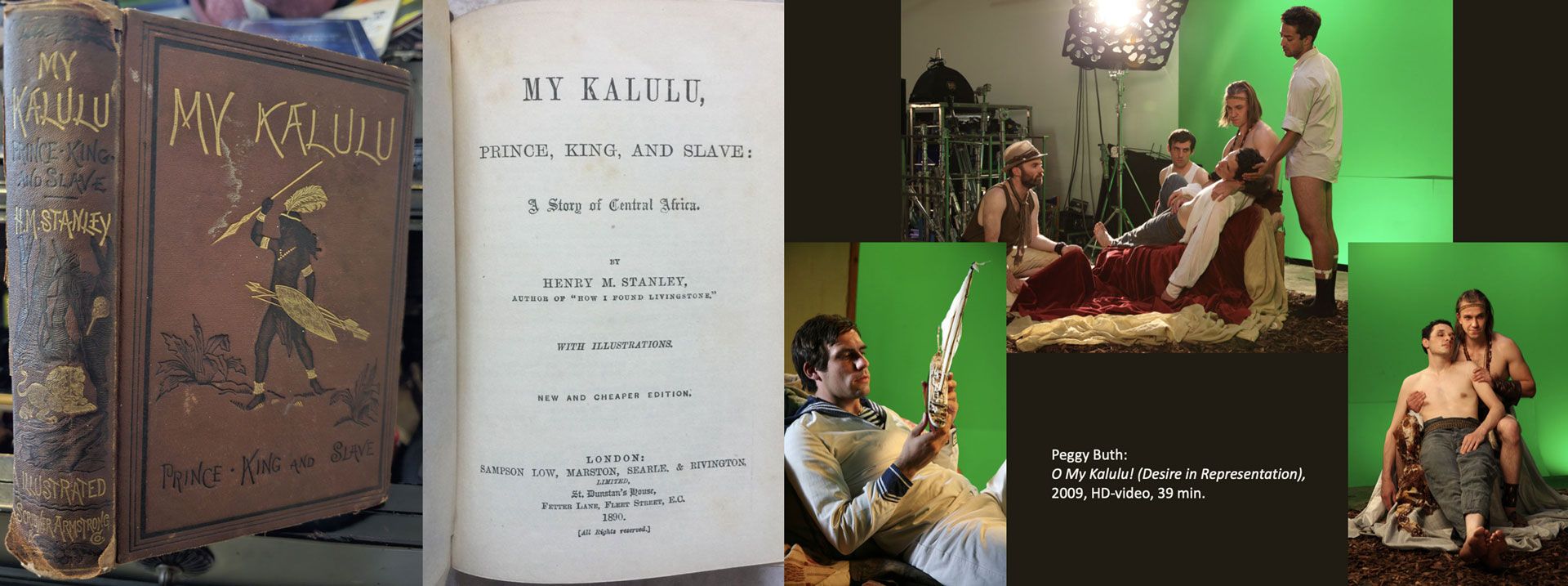
Yet it does not remain at the level of documentation and rearranging installation. In her five-part video work O my Kalulu, Buth opens up further layers of history, desire, and the narratives woven around them. Dialogues drawn from Henry Morton Stanley’s 1873 adventure novel My Kalulu: Prince, King and Slave are staged in a deliberately oversaturated aesthetic as a kind of tableau vivant, rich in allusions to tropical heat, representations of Christ, and bodily imagery from gay magazines. In turn, the screenplay’s hyper-matter-of-fact tabular form renders legible the richness and analytical depth of an associative montage that deconstructs—and thereby de-closes—the underlying desire at work in the colonial narrative.
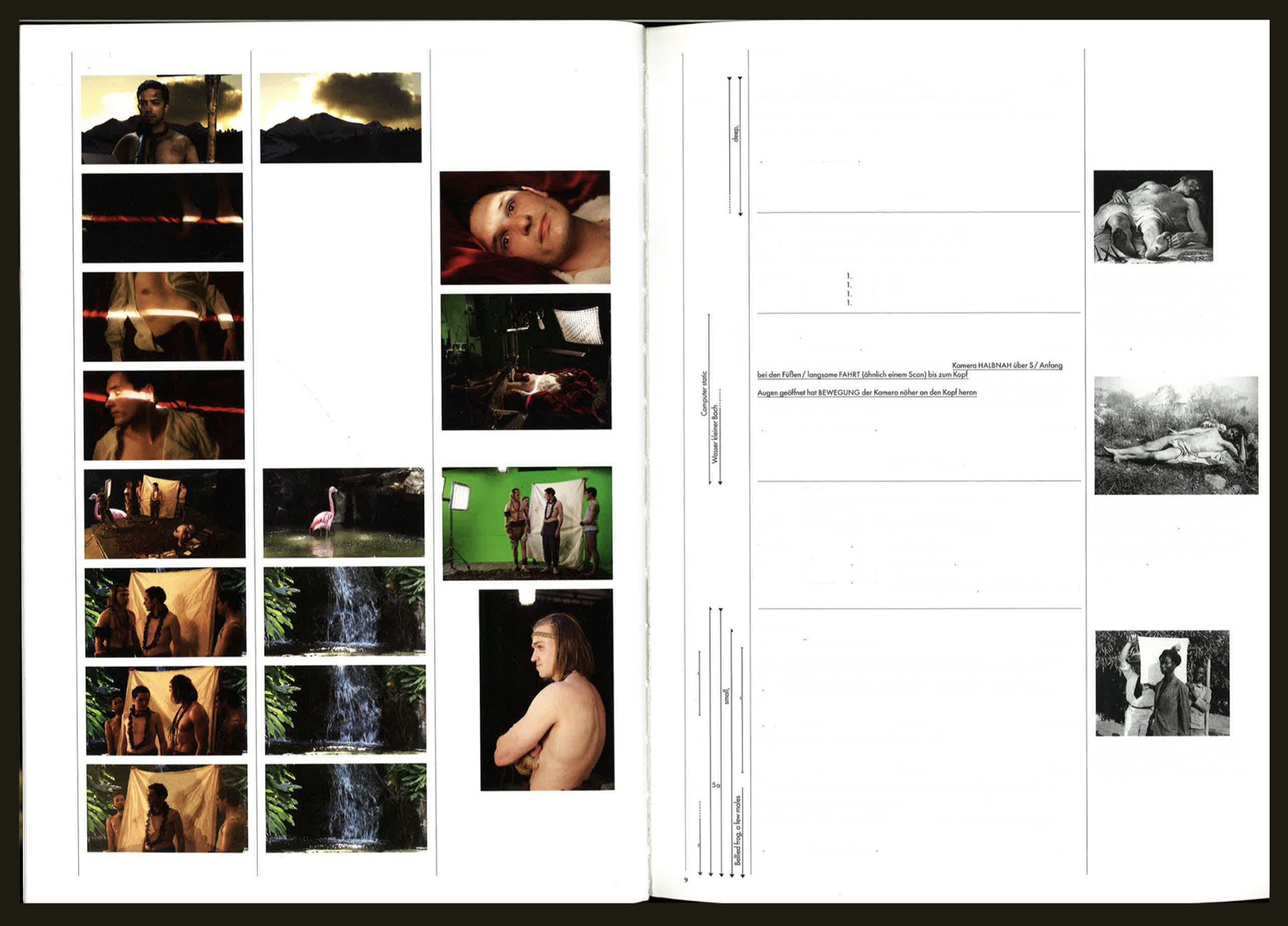
To open the end: The vitrines of the “explorers” remain empty. Desire in Representation does not open a view onto what is hidden and thereby reproduce the trope of the pleasure of discovery; rather, it opens up the closure of museal representation itself: its hermetic sealing-off of the precious and the untouchable, together with the associated impression of something worthy of preservation for “eternity.”
De-closing thus becomes an intervention into the museum’s and the archive’s concept of time, which is oriented toward timelessness, and in doing so returns them to the space of action of the present in favour of another future that remains open. At this point, I would argue that the desire in representation invoked by the title of the work refers quite concretely to a desire for immortality—one that the museum serves, but that is unsettled at the very moment when the exhibition surfaces remain empty. Photography, after all, fixes precisely this in-between moment for eternity.
The second method is versioning.
Versioning from to turn (versio, vertere lat.: a turning, a change) can be understood as a practice of unfolding. It describes an attitude that does not treat instability as loss but as a condition for transformation. To celebrate versioning therefore also means a generative movement through which new forms, relations, and possibilities emerge.
This practice resonates with what Gilles Deleuze describes as folding and unfolding. The fold does not refer to a fixed origin but to a movement in which inside and outside, past and present, potential and actual continuously pass into one another. Each version can thus be understood as a fold within a field of possibilities. Repetition does not reproduce identity but generates difference. As Deleuze argues, repetition is always difference in itself—a return that inevitably produces variation. Versioning, then, can be understood as repetition.
A related perspective appears in Édouard Glissant’s thinking of Relation[3]Glissant, E. (1990 french/2023). Poetics of Relation, translated by Betsy Wing, The University of Michigan Press.. In his Poetics of Relation, the world emerges as an archipelagic network in which elements connect without dissolving their differences. He emphasizes the richness that comes from the interplay of different identities, suggesting that not everything needs to be made clear or understood in a straightforward manner. Versioning in connecting to it meaning to turn can be understood as such a practice of relation. Each new version becomes another connection within an open network of transformations.[4]Benjamin, W. (1921 german/ 1968). The Task of the Translator, edited by Hannah Arendt, English translation 1968 by Harry Zohn, in: Illuminations, p.69-82, Schocken Books New York. Meaning does not originate from a stable source but from ongoing processes of encounter and translation. Within this process something always remains opaque—not fully transparent or controllable. Versioning acknowledges this opacity as productive.
„Opacities can coexist and converge, weaving fabrics. To understand these truly one must focus on the texture of the weave and not on the nature of the components[…] The right to opacity would not establish autism; it would be the real foundation of Relation, in freedoms.“[5] Glissant, p.190
Karen Barad’s concept of intra-action further shifts the perspective.[6]Barad, K. (2007). Meeting the Universe Halfway: Quantum Physics and the Entanglement of Matter and Meaning. Duke University Press. For Barad, entities do not pre-exist their relations; rather, they emerge through them. Knowledge is therefore not a neutral representation of the world but a material-discursive practice. Versioning can thus be understood as a form of intra-active knowledge production in which each version alters the conditions under which further versions become possible.
In digital culture, such logics appear in practices like forking and branching in collaborative environments such as Git Hub (Git)[7]Git: is a distributed version control system that helps developers track changes to their code and manage different versions of their projects. GitHub is a proprietary developer platform that allows developers to create, store, manage, and share their code. It uses Git to provide distributed version control and GitHub itself provides access control, bug tracking, software feature requests, task management, continuous integration, and wikis for every project.. Software is treated as a temporary state—continuously rewritten and extended by multiple contributors. Authorship becomes distributed; the work no longer belongs to a singular “I” but emerges from a network of contributions, translations, and deviations. Versioning assigns identifiers to different states of a project, not as a linear chain, but as a branching field of relations. Git is an example of version control system that allows tracking changes and restoring previous versions.
In this context, technology is not neutral; rather, it reveals the living conditions it produces and can serve as a space for resistance, speculation, and reorientation. Within this framework, versioning operates as a critical research practice, functioning as a process of activation and transformation. Approaching archival processes as practices of versioning and disclosure entails understanding them as open, relational, and ongoing.
These processes generate queer temporalities, emphasizing non-normative experiences of time, including failure.[8]Halberstam, Judith (Jack) (2011). The Queer Art of Failure. Duke University Press. Time no longer unfolds linearly; instead, it exists as a field of simultaneity, divergence, and return. Versions coexist, intersect, and transform, while repetition manifests as non-identical recurrence.
This logic is equally relevant to the fields of archival and artistic research. The project The Dynamic Archive experiments with versioning as a method—or rather, a process—of knowledge production. Scores, methods, and conceptual components are made available as open structures that can be reused, modified, and re-versioned by others. Through their use, new versions emerge, feeding back into the system and creating connections.
Versioning thus becomes both an epistemic and aesthetic process, keeping knowledge in motion rather than fixing it. It also makes recognizable that scores, methods, and knowledge can never be neutral; they are shaped through a dynamic infrastructure as well as through the accumulated experiences of contributors.
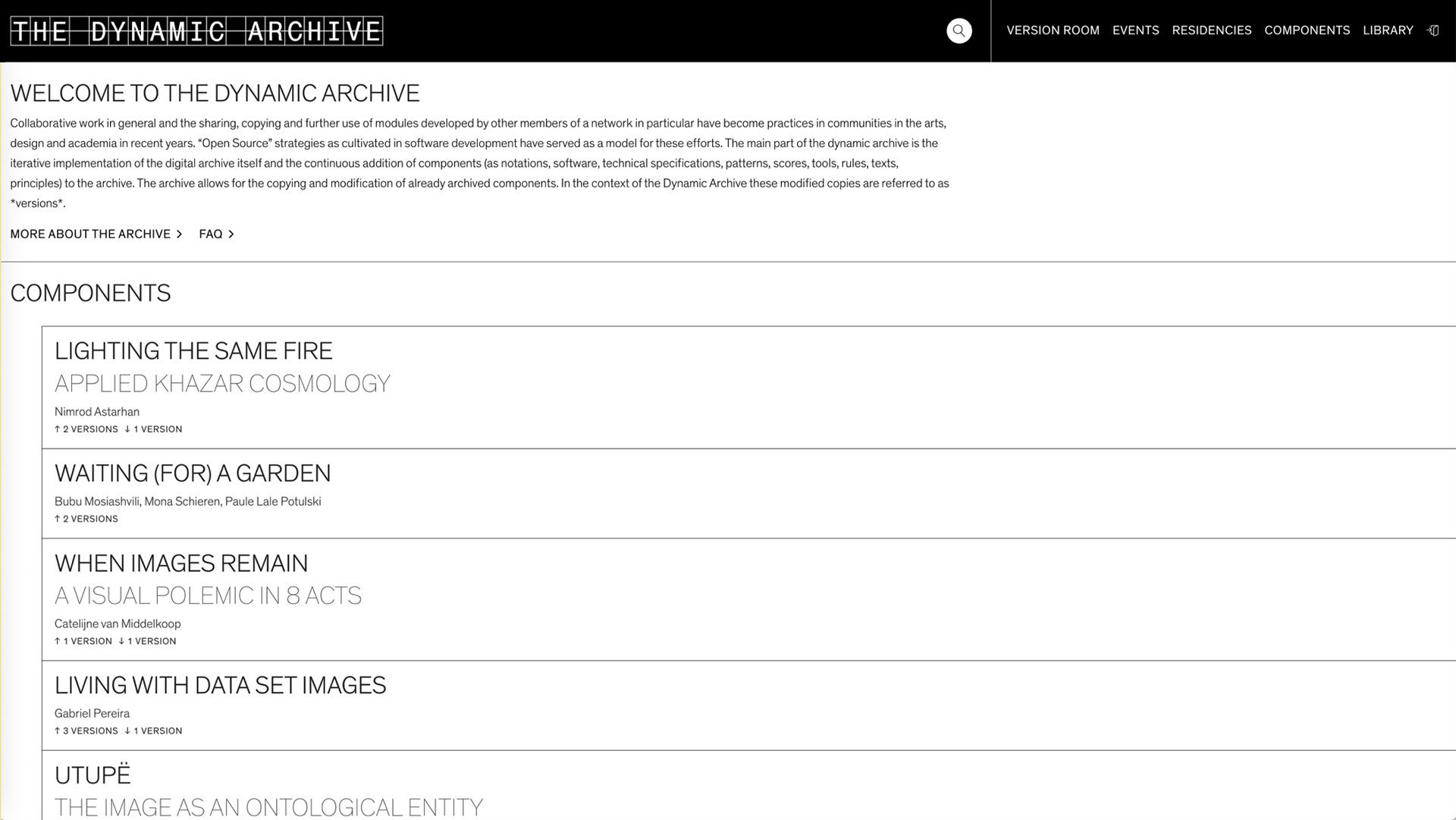
The logic of versioning, illustrated through a series of transformed, interconnected components and forks, will be demonstrated with four series of components from the artistic research project Dynamic Archive.
1.A. The Untied Body of History – A Museum Visit Proposal | Lucas Odahara
This project references Nosa Senhora Desatadora dos Nós (Our Lady – Mary – Untyer of Knots), a popular Marian devotion in South America believed to resolve everyday problems. The devotion and images originate from a European painting around 1700. Lucas Odahara revisits this motif by researching knot imagery in Latin American museums and reconstructing its meaning through contemporary encounters.
1.B. Chains, Knots, Wounds — The Revenge of Others | Elburuz Fidan
Building on Odahara’s work, this project traces the history of the Hercules knot—a symbol of love, marriage, and fidelity—but reinterprets and discloses it as a structure of closure and constraint. The heteronormative narrative is critically re-read through a queer lens, introducing the idea of “revenge”.
_
2.A. Scores of Matter — Methods of Matter | Eva Meyer-Keller
This investigation explores how objects become storytellers, forming an “archive within the archive” that narrates fragmented histories through these objects.
2.B. Errors | Bruno Moreschi
Nails with production flaws are gathered by the artist and presented as small sculptural pieces.Since 2012, these nails have been distributed to different members of the art world (other artists, curators, and producers) to be used in art exhibitions for their initial purpose: holding or supporting artworks. In every exhibition by Bruno Moreschi, some works are installed using nails from this collection.
2.C. N-1. Substruction as a method that allows for new connections an Relations | Mona Mahall and Asli Serbest
As a method that removes a piece, an element, a room, a function, or a protagonist from a given context to reset its relations and structures, they think of n-1 as a politics of form.
_
3.A. When Images remain | Catelijne van Middelkoop This component explores the merging of images and texts to investigate uncharted territories in visual narratives. A selection of decontextualized glass lantern slides and digital images from an art course create a grid where images lose their prominence and blur the boundaries between background and foreground.
3.B. From Slop to Slop | Gabriel Pereira
This project examines AI “slop” not as failure, but as process (of recycling). It shifts attention from output to the infrastructures behind image production. “A slop is not about quality it is about the volume“.(Transfroming Dataset Images into stories with vibe coding.)
__
4.A. Street University— Analogisation | Mobile Albania
A mobile educational format that rethinks knowledge transfer through analog and situated practices.
4.B. Ronde-Deux-Voir. Walking with Passages of Texts as a Gift. | Mona Schieren, Stephan Thierbach
Ronde-Deux-Voir is an experimental Game in which a giving person invites a receiving person for a walk with a prepared text or topic to discuss and a planned route.
For the present context, I have selected specific paths and versions from this broader framework.
The Frame:
The Dynamic Archive itself is larger, about 300 components —continuously expanding. Each version is connected to a conversation or interview with the networkers of The Dynamic Archive. The recordings of many of these encounters exists as a second archive. So far stored and waiting.
Most contributors are invited; others reach out, asking to become part of the archive. Some are also brought together in physical gallery spaces, where they work collaboratively for a limited time, developing new iterations. The resulting versions are presented to the public in a so-called Version Room, where physical and digital manifestations of the archive intersect. (seen with the two first shown versions)
This approach does not only create connections between works, but—equally importantly—between people across both physical and digital spaces. Rather than preserving relations as stable entities, it allows them to transform, fade, and re-emerge without the imperative to fix or mourn their passing. Through these encounters, relationships take shape that extend beyond the final outcome of each project, not as enduring forms but as evolving constellations. This care translates into concrete practices: staying in touch as colleagues and friends, offering support, and generating new opportunities. In this sense, care does not oppose decay but accompanies it. The concept of versioning thus foregrounds and sustains this relational structure, unfolding simultaneously within digital infrastructures and embodied encounters, grounded in friendship, continuity, and mutual support—while remaining open to change, disappearance, and reconfiguration.
In The Dynamic Archive, metadata is not merely written in a language but constitutes a language of operations: a hybrid assemblage of human-readable description, technical standardization, and machine execution. It discloses the archive as processual, relational, and in constant flux. Metadata does not secure permanence but registers transformation. It does not stabilize meaning but traces its shifts. Metadata is never neutral; it is always contextual, dependent on changing circumstances, infrastructures, and positionalities. It becomes a site of negotiation, continuously rewritten across distributed practices of authorship—where descriptions may erode, mutate, or be re-inscribed without the necessity of preserving an original state.
The notion of an “initial version” is thereby unsettled. To posit an origin is already to impose a chronological and hierarchical order onto what might otherwise unfold as a non-linear field of versions. Such an origin becomes less a point of departure than a temporary crystallization—one that is subject to dissolution and reinterpretation. Ordering reflects a specific epistemic position rather than an inherent property of the data, and opens onto the productive potential of decay: the gradual disarticulation of fixed beginnings and the emergence of multiple, overlapping temporalities.
This approach does not only create connections between works, but—equally importantly—between people across both physical and digital spaces. Rather than preserving relations as stable entities, it allows them to grow. This care translates into concrete practices: staying in touch as colleagues and friends, offering support, and generating new opportunities, unfolding simultaneously within digital infrastructures and embodied encounters, grounded in friendship, continuity, and mutual support.
The Dynamic Archive intervenes here by foregrounding versioning as an open-ended, performative process rather than a system of discrete states.
At the same time, the persistent identifier DOI—each instance carrying its own metadata and fixing a specific version—asserts an opposing logic: stability, fixity, and citability. It enforces the idea of a bounded, immutable object, even where none exists. From the perspective of decay without mourning, the DOI can be understood as an attempt to suspend decay—to arrest what is inherently in motion and stabilize what is defined by transformation. Yet this stabilization remains provisional at best, as the metadata it relies on continues to shift through copying, re-authoring, and iterative change. The DOI thus exposes its own limits: a technical promise of permanence imposed upon a fundamentally unstable, processual field that perpetually generates transformations
Although the versioning system aspires to decentralization—echoing broader discourses of distributed infrastructures—this remains only partially realized. The archive still relies on server-based storage, revealing a tension between imaginaries of decentralization and the material conditions of technical systems. This tension becomes part of what the archive discloses: not a seamless infrastructure, but its situatedness and constraints. What follows is the need to deepen the question of who holds the power to assemble, structure, and sustain archives.
In this sense, versioning can be understood as a practice that does not stabilize forms but attends to the relations and conditions that allow processes to continue and remain open. Versioning—and disclosing—thus become practices of sustaining openness: working with difference, fragments, and potentials that unfold through use and encounter, transformation, and decay.
Versioning produces what might be called open scores—dynamic structures that do not progress toward a first or final form but remain oriented toward ongoing transformation. As Stefano Harvey and Fred Moten in the Undercommons say:
In the end, it’s the new way of being together and thinking together that’s important, and not the tool, not the prop. Or, the prop is important only insofar as it allows you to enter; but once you’re there, it’s the relation and the activity that’s really what you want to emphasize.
Summary of our methods / principles
(reading: S: Sigrid Adorf; A: Andrea Sick)
S: De-closing lays bare the infrastructures, exclusions, and hierarchies through which the archive is formed.
A: Versioning opens the archive—toward other pathways, other readings, other constellations.
S: De-closing interrupts hegemonic orders by making the archive’s conditions visible.
A: Versioning unsettles the archive by proliferating alternatives within it.
S: De-closing operates through critique, exposure, and reopening.
A: Versioning operates through reuse, mutation, remix, and deviation.
Together: A: Both are archival practices of restaging—S: where what is stored is neither fixed nor final.
Filipa César: Spell Reel, 2017. Director: Filipa César, Screenplay: Sana na N’Hada, Documentary Form, 96 min, Colour, Germany / Portugal / France / Guinea-Bissau, Spectre Productiones / Rennes FR [see additional informations: berlinale, accessed: 14 July 2026]
All video excerpts and filmstills from: Filipa César, „Present Present Present. On grounding the Mediateca and Sonotera spaces in Malafo, Guinea-Bissau“, in: Sonic and Cinema Commons. Past in the Present, L’internationale, 27. November 2024, internationaleonline, accessed: 14 July 2026.
Stills all courtesy of Filipa César / Arsenal – Institut für Film und Videokunst e.V. / © Spectre Productions
Slide compilation of stills and screening situations use further images cited from: kaaitheater; kadist; instituteofradicalimagination all accessed: 15 July 2026
Peggy Buth: Desire in Representation, 2004–2010
Works (all courtesy of Peggy Buth)
70 photographs (Desire in Representation), 2004–2009
untitled (archive), mixed media installation, 2009
listeners & typewriters (Olympia) / listeners & typewriters (Triumph), mixed media installation, 2009
untitled (laboratory), mixed media installation, 2009
O, My Kalulu, HD video in 5 parts, sound, colour, total duration: approx. 40 min.
Artist book, together with Till Gathmann
Part. 1. Travelling Through the Musée Royale. Index = Register
Part. 2. O, My Kalulu
Maastricht: Jan van Eyck Akademie, 2008
Catalogue
Peggy Buth: Desire in Representation. Exhibition at Württembergischen Kunstverein Stuttgart (2 September 2009 – 3 January 2010), spector books, Leipzig 2010
Slide compilation from artist book use scans cited from:
Peggy Buth: Desire in Representation, Smithsonian Libraries, library., accessed: 15 July 2026
The Dynamic Archive, since 2018
thedynamicarchive
Artistic Research Project
Created and organized by: Andrea Sick (Professor for Theory in Media and Culture, HfK)
Researcher, curator: Irena Kukric and Marcela Antipán Olate
Projektpartner: Dennis P Paul (Professor for Interaction and Spaciality, HfK)
Webapplication by: Studio TheGreenEyl
Hosted by: The University of the Arts Bremen (HfK)
All copyrights remain with the respective contributors. The content is published as open access under the Creative Commons Attribution License
Credit mobile header: Image Lucas Odahara: The Untied Body of History. A Museum Visit Proposal (2019–), in: The Dynamic Archive.
| 1. | ↑ | Filipa César: „Present Present Present. On grounding the Mediateca and Sonotera spaces in Malafo, Guinea-Bissau“, in: Sonic and Cinema Commons. Past in the Present, L’internationale, 27. November 2024, internationaleonline, accessed: 14 July 2026. |
| 2. | ↑ | Benjamin, Walter. “Theses on the Philosophy of History.” In Illuminations. Edited by Hannah Arendt. Translated by Harry Zohn. New York: Schocken Books, 1968, 253–264, here: Thesis VI, p. 255; PDF: cemus, accessed: 19 March 2026. |
| 3. | ↑ | Glissant, E. (1990 french/2023). Poetics of Relation, translated by Betsy Wing, The University of Michigan Press. |
| 4. | ↑ | Benjamin, W. (1921 german/ 1968). The Task of the Translator, edited by Hannah Arendt, English translation 1968 by Harry Zohn, in: Illuminations, p.69-82, Schocken Books New York. |
| 5. | ↑ | Glissant, p.190 |
| 6. | ↑ | Barad, K. (2007). Meeting the Universe Halfway: Quantum Physics and the Entanglement of Matter and Meaning. Duke University Press. |
| 7. | ↑ | Git: is a distributed version control system that helps developers track changes to their code and manage different versions of their projects. GitHub is a proprietary developer platform that allows developers to create, store, manage, and share their code. It uses Git to provide distributed version control and GitHub itself provides access control, bug tracking, software feature requests, task management, continuous integration, and wikis for every project. |
| 8. | ↑ | Halberstam, Judith (Jack) (2011). The Queer Art of Failure. Duke University Press. |