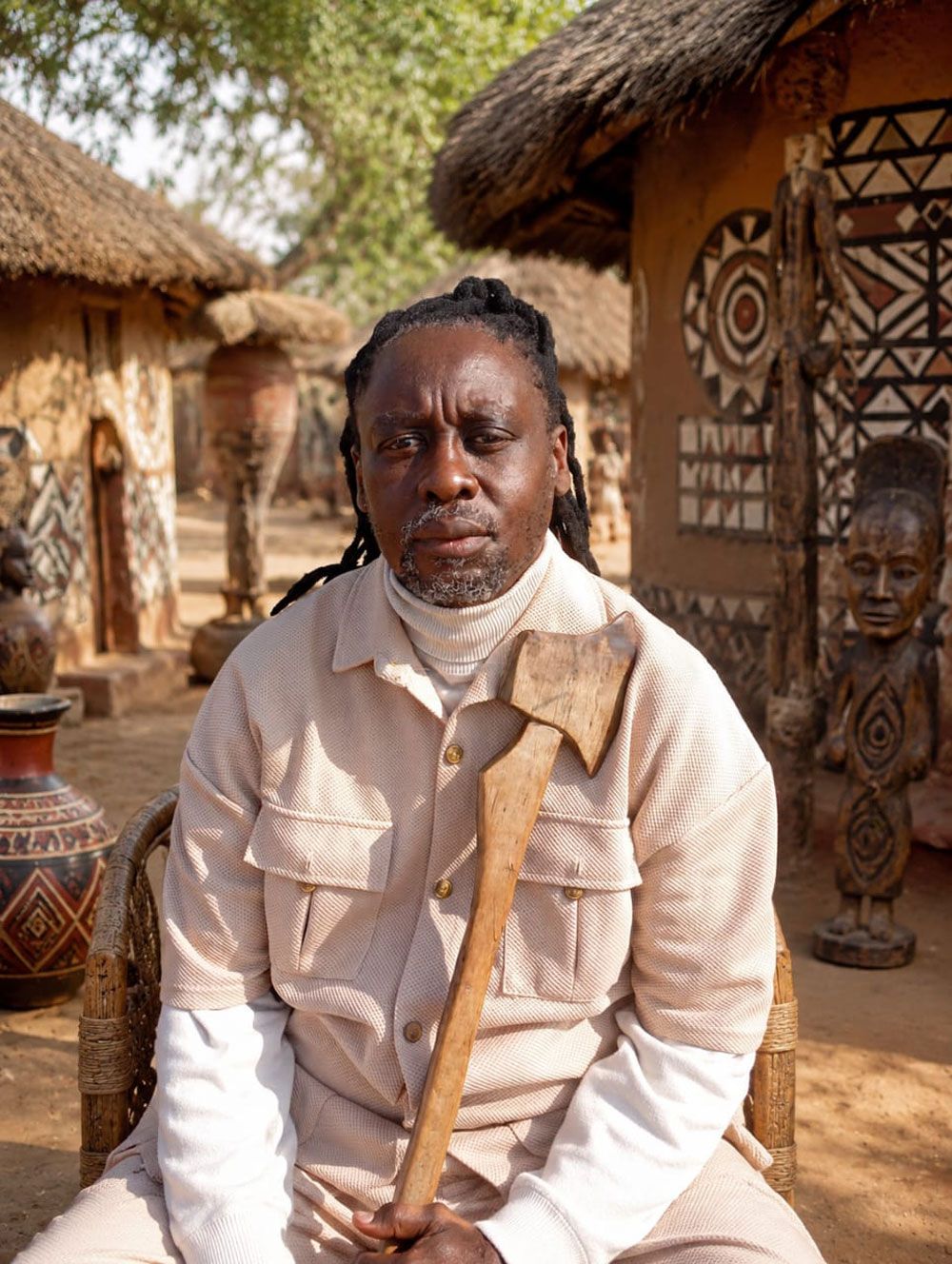
MKHULU MBAZO
Under good influence: a warning on the dangers of idolatry and the worship of money.
“For the love of money is the root of all evil: which while some coveted after, they have erred from the faith, and pierced themselves through with many sorrows”
Timothy 6:10
‘So, every woman wants to be someone. To be seen, to know that they have earned their place at the top of the food chain. Each of these bags, is a status symbol, from celebrities to influencers and the rest of us who follow them, wanting to be them. These bags are a sign that you are someone who matters.’

These opening lines from Bad Influencer, currently streaming on Netflix, provide the perfect setting for this thrilling South African mini-series. The series borrows strongly from many popular Hollywood themes about essentially “good” people forced by circumstances to commit crime for money in order to support their loved ones. Think of films like Breaking Bad, Set It Off, and Gone Girls. In many of these stories, the captivated viewer is lured into the trap of rooting for these characters, silently “praying” that they don’t get caught because they are all just “victims” as well in a vicious cycle of debt and survival.
And the moral of these stories is that it is acceptable to commit crime for the greater good.
“No man can serve two masters: for either he will hate the one, and love the other; or else he will hold to the one, and despise the other. Ye cannot serve God and mammon”.
Matthew 6:24
The aim of this article is to put into sharp focus the central role played by the love and worship of money in the problems that not only beset South Africa in particular but the whole world in general using Bad Influencer as the model. Because in reality, while the series may focus on bling, fake bags and the ever-growing role of influencers in our society, it is in essence, about the worship of money and all the fake transient life it can buy, where material and the temporal takes precedence over the spiritual and the eternal.
Let us go to the root of the problem. We live in a demonic capitalistic system where money and the pursuit of the secular is a prerequisite for a happy and successful life. Therefore, from the cradle to the grave, we are subtly groomed and gradually introduced into a life where everything revolves around money. We are taught to go to school so that we can pass, earn good money and “make a living”.
Eh bathi thina sifuna lemali
Sifuna le cash-eh, sifuna le stash-eh
Asifuni amameter
Asifuni amamb’ta
Sifuna amagumba
Sonke sifuna amagumba
On daily basis, our “poor artists” compose hit songs that celebrate money and the pursuit of it. They produce popular songs like Ska Bhora Moreki, just to emphasize how society worships those who have the power to buy.
Over time, we have also coined (pun intended) various terms to emphasize the value of money calling it, inyuku, chelete: “ching ching”, “amachankura”, izaka, “ibukubuku”, “isaka” etc. Expressions like “amagents ayaphanda”, “uzoyithola kanjani uhlel’ ekhoneni”, constantly remind us we all need to make fast money, no matter the consequences.
For the love of money is the root of all evil
1 Timothy 6:10
Through language, we are introduced as children to certain expressions like “cash is king”, “time is money”, “money makes the world go round”, “money talks, bullshit walks”, and one of my favourites, “the client is always right”. And what makes the client right even if he is wrong? Because he has money.
Inevitably, we are gently ushered into a dog-eat-dog world where everyone wants to make you a client and you also seek to make someone else a client. As you get enmeshed in Bad Influencer, it opens up to a bigger world around you. You also get to see yourself as an extra in a bigger movie set in the stage of your own life. You realize that the setting is a criminal web of lies where everyone is out to swindle you of your hard-earned cash.
“You shall not charge interest on loans to your brother, interest on money, interest on food, interest on anything that is lent for interest”.
Deuteronomy 23:19-20
In the scriptures, Psalm 15:5: describes a righteous person as one “who lends money to the poor without interest”. Not so with the banking system.
You discover that instead of “saving you money”, the bank is actually out to rob you. How? By making money out of you through interests that you don’t understand. Through interest, you pay for twenty years for a house that you can pay off in five years. While the bank may ‘finance’ your car, it just cannot wait to repossess it as soon as you land in some financial trouble.
Pharmaceutical companies are not interested in providing medication that can end disease, but in prolonging it so that they can maximize profits. The insurance company is very happy for you to keep up with your premiums but will find every loophole possible in your contract not to pay when it is their turn to do so.
Your princes are rebels and companions of thieves. Everyone loves a bribe and runs after gifts. They do not bring justice to the fatherless, and the widow’s cause does not come to them.
What comes into sharp focus is that our problem is not only a structural but a spiritual one which goes into the very foundations of our system.
Ephesians 6:12 highlights this spiritual corruption in high places, stating, “For we wrestle not against flesh and blood, but against principalities, against powers, against the rulers of the darkness of this world, against spiritual wickedness in high places”. This verse emphasizes that corruption often stems from unseen spiritual forces controlling earthly leaders. This explains the political corruption that filters through and erodes the very fabric of our society.
As you read this article, there is not just one group of men and women planning a heist, but even more are secretly hatching a plan to steal money from the public coffers meant for the poor, the orphan and the widow. Government officials, politicians and businessmen are discussing how they can keep natural water from the people so that they can make money out of the crisis.
This is a world where crisis is manufactured in high places.
Where multinationals collude to fix prices. They are forever devising new methods on how to get people addicted to the foods they eat.
On daily basis, we hear of construction and protection mafias in this rat race to become rich. In fact, the system is so satanic that you wonder how it is at all possible for one to keep out of crime. Crime is big business.
Because there are so many invested interests in one becoming a criminal. There are so many business opportunities that arise from people committing crime. Think of the tender that goes into building a C-Max prison. Then someone has to provide high tech security to keep the prisoners at bay. There is business that goes to designing clothes for criminals. More business goes into the supply of blankets, food catering, providing criminals with TV sets so that they can watch movies like Bad Influencer, rooting for the character who actually belongs with them in their cells.

This desire to acquire money has led many to drug, human, and sex trafficking. The business of “izinkabi”, (professional hitmen) is thriving because of the worship of money. So is the world of “Blessers” and professional prostitutes posing as slay queens. This insatiable lust for money leads to gambling addictions. This is a world where the richest people are those who sponsored both sides of the conflict in the previous two world wars and continue to do so in Africa and many other parts of the world.
It would seem, this worship of money is a historical problem that partly contributed to Joseph being sold to the Egyptians. In the sacred texts, we learn of a man who received a curse that extended to future generations because he tried to profit from a spiritual gift. We go on to learn about a man who wanted to know how he could buy a spiritual gift. The book further relates to us how the son of man brought his wrath on those who turned his Father’s house into a marketplace in order to make as much cash as possible.
This son of man went on to reject an offer by the adversary to give him all the riches of the world in exchange for the worship of the devil. This was a firm rejection of a practice we know today as “ukuthwala”, entering into a Faustinian pact. And yet still, one of his disciples sold him out to the Romans for thirty shekels of silver.
Despite all these lessons, we still believe money is the Golden Calf that liberates us from the shackles of poverty.
Because of the love of money, we not only have the corrupt politician, we also have the false prophet, the fake pastor and Sangoma, and the influencer all out to make some quick cash. Everyone is selling something and everything is on sale, including the judges, the lawyers and the justice system itself.
Where there is cheese, there are rats
Wherever there are rats, there are cats
Wherever there are cats, there are dogs,
If you got the dogs, you got bitches
Bitches always out to put their paws on your riches…
-Kelis
“We are going to get rich bitch”, cries our main character in desperation as she is about to sink deeper into the world of crime. The line rhymes well without alerting us to the dangers of selling your soul for money. That money is dark force that devours everyone who worships at its altar. It is a spirit of greed. Little do those who worship on the altar of money know that the address of the altar is a cold, lonely place devoid of all love.
Because what profits a man to gain the whole world but lose his very soul?
While it might seem to provide temporary bliss to the hearts of those who hold it in their hands, the worship of money is a spirit that come with its own problems and a life devoid of principle. Money comes dressed in beautiful clothes but where it has passed it leaves a sad trail of broken friendships and promises, lost value systems, a multiplication of enemies and a wedge between lovers and families. When it finds one without love in their heart, it leaves a glorified but empty, lonely shell where there is nothing but the gnashing of teeth.
As we come towards the end of this article, I a reminded of the rich man who came to the Son of Man and asked a very profound question:
“Teacher, what can I do to achieve eternal life?”
The answer the rich man received was not the one he expected because it involved selling all his riches and following some poor teacher. It is reported that the rich man was left a very sad man. The truth is that the man in question was not only wealthy in terms of his earthly possessions, but also in terms of his position in society, his influence and worldly knowledge. So his cup was full and not receptive to new ideas. He did not have a teachable spirit. He was poor in judgement because if he was wealthy in matters of the spirit, he would have understood that if there was a world where you could have everything without buying it with money, truly that world would be heaven on earth.