ARYAN KAGANOF
The Entropic Real: Louis Armand's Entropology through the lens of decay studies
Louis Armand is the author of numerous works of fiction and theory, and directs the Centre for Critical and Cultural Theory at Charles University, Prague. Entropology is published by Anti-Oedipus Press, an imprint of Raw Dog Screaming Press, and was written between 2018 and 2021. This curious volume of essays reflects, among other things, the intellectual conditions of the COVID-19 pandemic, conditions that, in Armand’s telling, are not exceptional but merely the latest iteration of capital’s ongoing “automatic revolution,” in which the system discovers, in the spectacle of its own apparent collapse, a new mode of self-perpetuation.

Entropology is a work that runs hot. Its pages are dense with citation, fragmented into subsections with titles like “Covidology,” “Entropophagy,” and “Eschatologistics.” It zigzags from Lévi-Strauss to Deleuze to Rancière to the CIA’s MKUltra programme to a biopoetic experiment aboard a Japanese asteroid-sampling spacecraft. But It would be facile to mistake this febrile restlessness for incoherence. What Armand is doing with considerably more rigour than his feverish style initially suggests is attempting to think entropy itself as a theoretical practice: not entropy as mere decline, but entropy as the generative condition of every system that exists, collapses, and reconstitutes itself in the process. This is what he calls, following Lévi-Strauss’ throwaway coinage at the end of Tristes Tropiques, “entropology”: the study of the highest manifestations of disintegration.
The word itself has a certain dignity as an orphan. Lévi-Strauss, in that famous 1955 passage, suggested that anthropology would better be renamed entropology, “the name of a discipline concerned with the study of the highest manifestations of this process of disintegration.” He then essentially forgot about it, returning to structuralism with its faith in stable combinatory grids. Armand inherits the term and does the work that Lévi-Strauss declined to do: he follows it into the entrails of capital, pandemic, posthumanism, science fiction, bioengineering, and the geopolitics of planetary terraformation. The result is a work that sits awkwardly between genres, part critical theory, part cultural polemic, part experimental essay-cycle, and that probably will not satisfy readers expecting the measured step-by-step argumentation of academic philosophy.
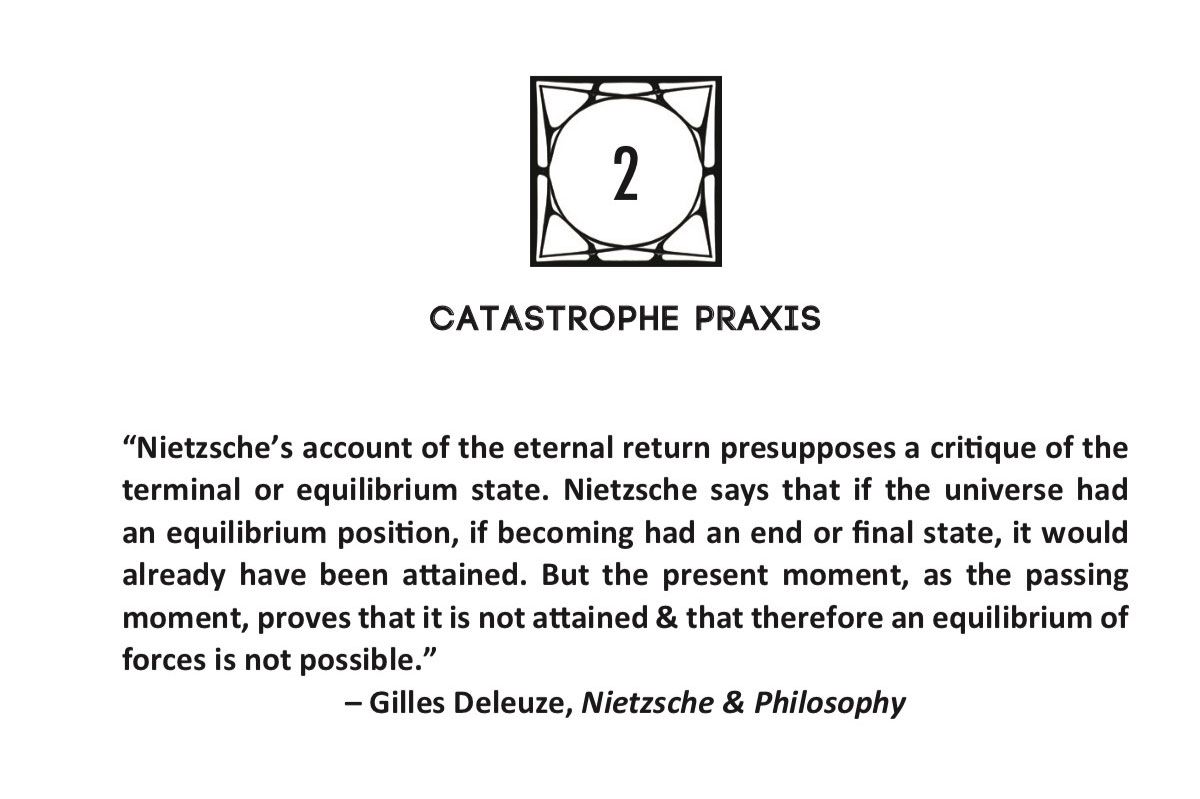
Armand’s central argument, though “argument” is perhaps too linear a word for what he does, is that entropy is not what cultural theory has long taken it to be. In the Stieglerian dispensation that has dominated much critical posthumanism, entropy figures as the enemy: the dissipative force that neoliberal capitalism accelerates, that destroys memory and attention and care, and against which the saving concept of “negentropy” (borrowed, rather loosely, from Schrödinger’s What Is Life?) offers some hope of cultural pharmacology. Bernard Stiegler’s Neganthropocene, published in 2018 and one of Armand’s primary foils throughout, is the most elaborated recent instance of this narrative. For Stiegler, entropy is the “Entropocene”: an epoch of systemic degradation that only a cultivated politics of negentropy can reverse. Entropy, in Armand’s reading, is not the opposite of organisation; it is the condition of possibility of organisation. No entropy, no differential, no signal, no system.
“No entropy, no being.”
This argument connects in interesting ways to debates within new materialisms and what might be loosely called “decay studies” — a sprawling intellectual formation that has grown considerably over the past two decades under the combined influence of feminist science studies, process philosophy, and speculative realism. Karen Barad’s agential realism, developed most fully in Meeting the Universe Halfway: Quantum Physics and the Entanglement of Matter and Meaning (2007), insists on intra-action as prior to interaction: entities do not precede their relations but are constituted through them. What matters for Barad is the ongoing “materialization of phenomena” — the way matter comes to matter through differential cuts that are simultaneously ontological and epistemological. Armand does not cite Barad directly, which is a perplexing lacuna in a work otherwise clamorous with citation, but the structural resonances are unmistakable. His insistence that entropy names not a property of systems but the very operation by which systems differentiate themselves from one another, maintaining what he calls “a minimum of self-separation,” a “Planck constant of différance”, recalls Barad’s notion of diffraction: the pattern of difference made by differences, the irreducible agentiality of the material world.
Yet there is also a tension. Where Barad’s account of materiality is, despite its deconstructions, ultimately affirmative, oriented towards a posthumanist ethics of response-ability and entanglement, Armand is suspicious of all such affirmative turns. For him, the appeal to entanglement, to “more-than-human” assemblages, to ecological solidarity, is all too liable to become another form of mystified recuperation: the latest version of what he calls the “New Myths,” those grandiose conceptual schemes by which critical theory perpetually defers the actual violence of its object.
Armand is particularly withering on the Latourian turn in this regard, dismissing the “Gaia hypothesis” as one among several intellectual “pathological retreats” into myth-making that occurred in response to COVID-19. This may strike some readers as ungenerous, Latour’s actual arguments about modes of existence and the political ecology of Gaia are considerably more careful than Armand allows, but the polemical thrust is clear.
Theory, for Armand, has a constitutional tendency to romanticise the very processes it claims to analyse, to transform entropy’s radical indifference into a cosy ecology of becoming.
Donna Haraway, whom Armand also does not cite but against whom his argument might productively be triangulated, offers a different challenge. Where Barad’s work tends to dissolve entities into relations, Haraway’s figures, the cyborg, the compostist, the symbiont, insist on the generative power of inappropriate/d others, of unexpected kinships across species boundaries and ontological divides. Her concept of “making kin” in Staying with the Trouble (2016) is explicitly oriented towards livability in damaged worlds, towards finding ways to flourish amid collapse rather than transcending it. In this respect she is closer to Armand than either might be comfortable admitting: both are suspicious of salvage narratives, of the dream of clean extraction from catastrophe. But Haraway’s ontology of co-evolution, her insistence on the “chthulucene” as a more-than-Anthropocenic narrative, retains a commitment to care and reciprocity that Armand’s corrosive materialism refuses. For Armand, symbiosis is just another name for parasitism under better lighting. The viral analogy that runs through his account, the virus as “obligate translational parasite,” existing “only within the larger dynamical, regulatory network of the cell”, is not deployed, as it might be in Haraway, as a model for companionship in difference. It is deployed as a model for capital itself, for the parasite that “has found itself both in direct alignment and direct competition with the parasitism of COVID.”
This is characteristic of Armand’s method: to take figures that in more optimistic theoretical hands become resources for alternative ontologies, and to turn them back towards the structural logic of capital’s self-evolution.

In the chapter titled “Entropology,” the longest and most sustained section of the book, Armand moves through Vernadsky’s noosphere, Schrödinger’s negentropy, Marx’s concept of metabolic rift, Prigogine’s dissipative structures, and Jeremy England’s recent statistical physics of self-replication; all in the service of the claim that capital is not an epochal phase that entropy will eventually dissolve, but rather capital is entropy’s current form, the mode by which the tendency to dissipate has crystallised into a self-accelerating system of exosomatic production.
“Xenocapitalism,” the somewhat dystopian neologism Armand deploys towards the end of this section, names a capital that is no longer recognisably human in its operations, a capital that has become what he calls “the jouissance of incompletion” — an apparatus of desire whose satisfaction is structurally impossible and therefore perpetually productive.

It is here that Reza Negarestani becomes a relevant interlocutor, even if Armand engages him only briefly and in the footnotes, citing his essay “Unidentified Gliding Object” from Šum 11 (2019). Negarestani’s influence is nonetheless palpable throughout the book. Negarestani’s work, particularly Cyclonopedia: Complicity with Anonymous Materials (2008) and the more recent Intelligence and Spirit (2018), has proposed a materialist metaphysics in which the earth itself is understood as a “hypersurface of insemination”, a medium for flows of petroleum, trauma, and xenogenous intelligence that have no interest in human welfare or intelligibility. Oil, for Negarestani, is not a resource but an agency: a solar capital, a means by which the sun’s archival energy re-activates itself through the burning of accumulated organic death. There is a direct line from this darkly vitalist materialism to Armand’s concept of entropy as technopoiēsis, entropy as the condition by which “life” and “non-life,” “culture” and “physis,” become indistinguishable as modes of dissipative production.
Armand’s account of the Anthropocene is Negarestanian in register if not always in letter: it treats the geological inscription of human activity not as evidence of human mastery but as evidence of human subsumption into processes that have always exceeded and conditioned human agency. The Anthropocene, for Armand, is not primarily a story about what humanity has done to the earth; it is a story about what the earth, as an entropic system in perpetual phase transition, has done through humanity.

The chapter “The Teratologists,” with its extraordinary excavation of postwar geopolitical fantasies about weather control, nuclear terraforming, and “planetary ecosynthesis,” makes this point with something close to black comedy. From Jack W. Reed‘s proposals to nuke hurricanes to Elon Musk’s suggestion to detonate thermonuclear devices over the Martian poles, what Armand traces is a consistent pattern of what he calls “teratogenesis”: the production of monsters not by nature but by the fantasies of instrumental reason encountering the irreducible complexity of dynamic systems. “Reed’s ‘divergent systems,'” he writes with dry wit, “no doubt producing Godzillas instead of monster hurricanes.”

The turn to Barad becomes especially useful in reading Armand’s account of the posthuman. Barad has argued, against humanist and transhumanist positions alike, that the “human” is not a pre-given entity but a material-discursive phenomenon, a “boundary phenomenon” produced through particular intra-actions. The cut between human and non-human is always already political, always already a matter of what gets included in the frame of moral concern and what is externalized as mere resource or mere environment. For Armand, the posthumanist turn in critical theory has largely failed to honour this insight: it has announced the dissolution of the human-nature divide while quietly preserving the structure of a humanist subject who observes this dissolution from a position of theoretical exemption. His critique of Stiegler, of Fukuyama’s “Our Posthuman Future,” and of what he calls the “posthuman abstract”, the tendency for posthumanism to reinstate a renovated humanism by the back door, is essentially Baradian in its structure, even if Armand would resist the formulation.
What distinguishes Armand’s position from Barad’s, however, is his adamant refusal of any ethics of accountability or response-ability that is not already implicated in the problem it addresses. For Barad, diffraction is a practice as well as a concept, a way of reading texts and phenomena that exposes how differences are produced, and that opens possibilities for rethinking the cuts we make.
For Armand, no such practice is available from within the system, because the system is entropy itself, and entropy does not cut; it concatenates.
This is perhaps the deepest tension in the book, and it is one that Armand himself seems unwilling fully to acknowledge. If capital is entropy’s current form, and entropy is the condition of possibility of every system, then what purchase does critique retain? The book circles this question repeatedly without quite settling it, and one suspects, with a certain admiration, that this is deliberate. To resolve the question would be to fall back into the teleological thinking that Armand has spent the entire book dismantling.

The book’s final two chapters, “Trans/Morphic” and “Xenotext,” are its most formally adventurous, and in some ways its most successful. The chapter on Christian Bök’s The Xenotext project, in which a sonnet is encoded into the genome of an extremophile bacterium capable of surviving in the vacuum of space, and programmed to generate a response-poem through the machinery of its own transcription, allows Armand to develop his arguments about entropy, technicity, and the posthuman in a register that is simultaneously concrete and speculative. Bök’s project is, as Armand notes, utterly extraordinary: a “poiēsis” rather than a vehicle, an attempt to initiate a “coherent tropological process” in which the inscribed texts serve an immediate biological function.
What Armand finds most significant about The Xenotext project is not its avant-garde ambition but its ambivalence: it is simultaneously an archive and a mausoleum, a form of living-on that is also an acknowledgement of erasure, a logos cast upon the void.
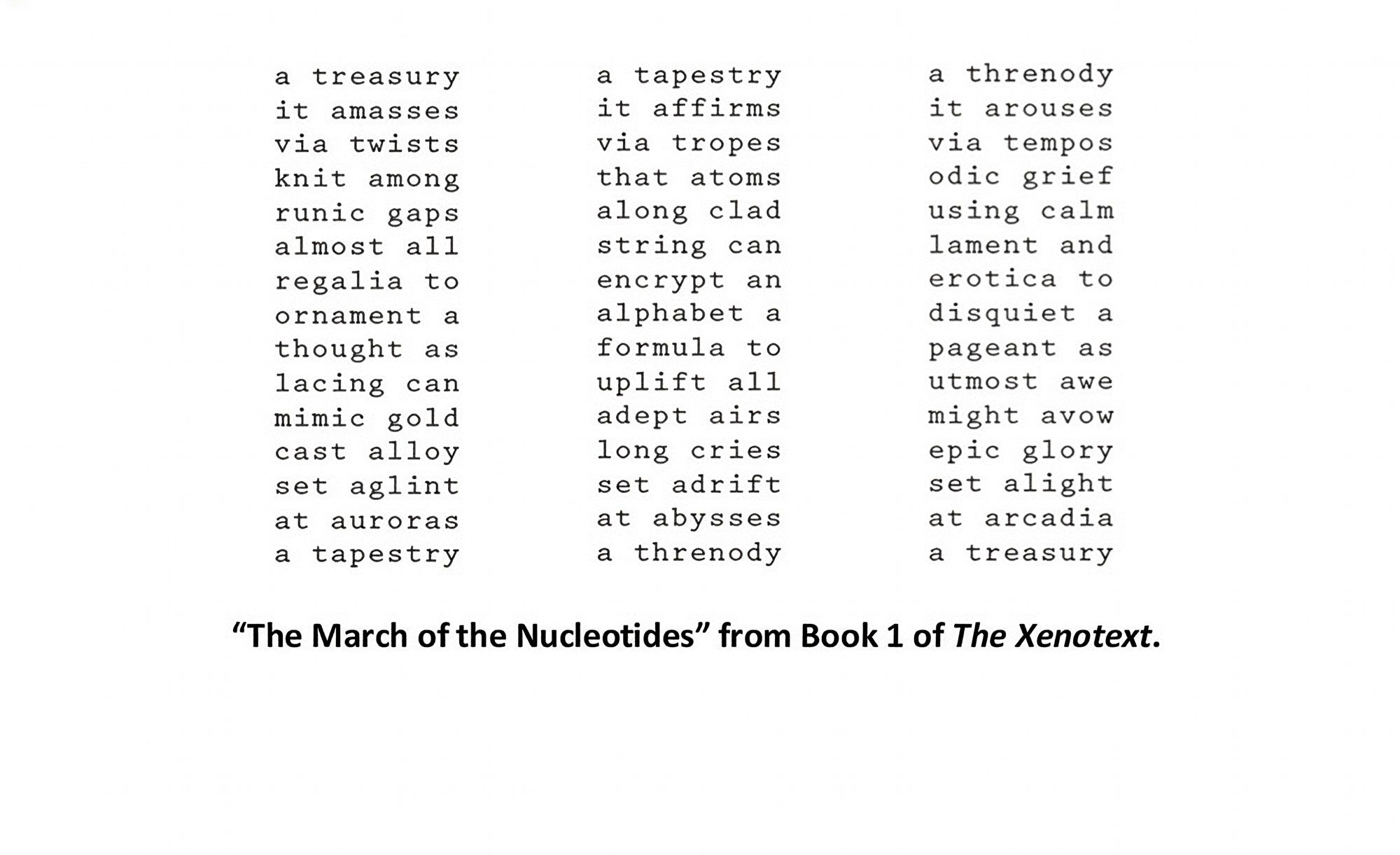
The Xenotext, in Armand’s reading, is an “entropological feedback system”, a machine for generating meaning beyond the horizon of any possible human reader. As such, it crystallises everything the book has been building towards: the indistinction of writing and transcription, the viral logic of the signifier, the impossibility of stabilising the concept of “life” outside the entropic processes that produce and dissolve it. When Bök writes that language is “traversed, inevitably and invariably, by the entropic dyslalia of chance-driven phenomena — mistakes, blunders, ruptures, hiatuses, glitches”, Armand notes that this is not language’s problem but language’s condition.
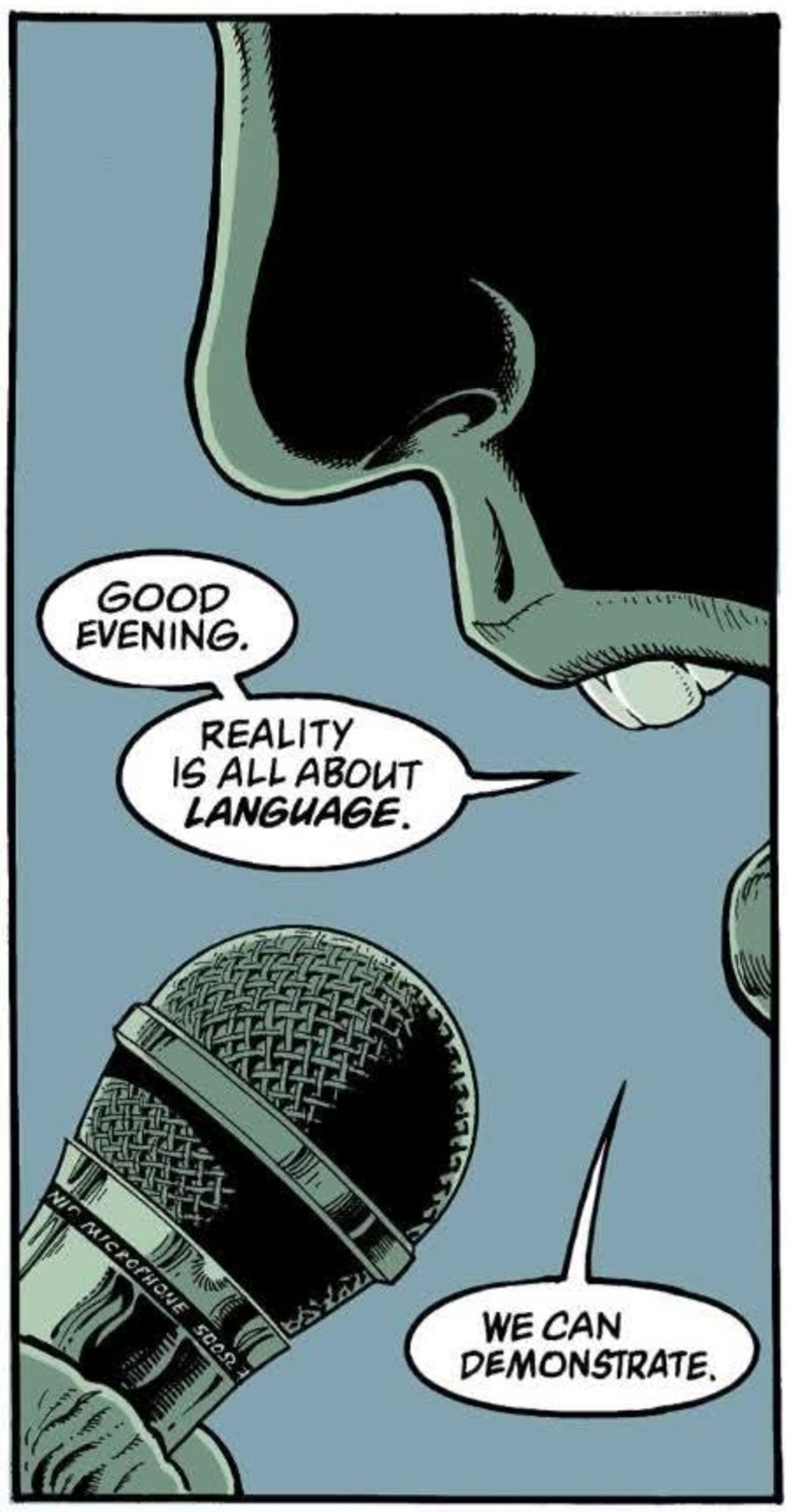
Those seven trillion possible substitution ciphers are not the background against which the Xenocode stands out as signal; they are signal all the way down, indistinguishable from the evolutionary processes that produced Deinococcus radiodurans, its cell structures, and the transcriptive operations that underlie all of life. This is as close as Armand gets to a positive thesis. Against the New Myths, the myths of salvage, of negentropy, of the posthuman exception, he proposes what might be called a generative nihilism: an acceptance of the radical productivity of entropy that does not slide into passive resignation, because resignation is itself an entropic figure, a particular state in a particular phase transition. What Armand calls “entropological technē” or life as the technopoietic art of dissipation, is not a programme for action but a description of what is already happening, has always been happening, at every scale from the quantum field to the biosphere to the apparatus of global capital.
The chapter on “Re-evolutionary Abort” deserves closer scrutiny because it is here that Armand makes his most substantial intervention into the philosophy of history. The received wisdom of the left, that capitalism is a phase, that revolution is an available category, that the task is to identify the correct historical subject and the correct moment, is subjected to a systematic dismantling that draws on the book’s entropic framework in a way that distinguishes it from the more familiar (and somewhat exhausted) post-Marxist positions. Where someone like Fredric Jameson argues that it is easier to imagine the end of the world than the end of capitalism,[1]Frederic Jameson first articulated this sentiment in the preface to his 1994 book The Seeds of Time. He later refined and famously popularized the phrase as “Someone once said that it is easier to imagine the end of the world than to imagine the end of capitalism” in his 2003 essay “Future City” for the New Left Review. The phrase was later popularized by the Slovenian philosopher Slavoj Žižek and became the foundational thesis of Mark Fisher’s 2009 book, Capitalist Realism. a claim that, for all its wit, still operates within a humanist framework of imaginative failure, Armand argues something structurally more radical: capitalism is not resistant to imagination but is itself a form of imagination’s entropic self-production.
Capitalism does not resist its own supersession; it incorporates supersession as one of its operational modes.
This argument connects to what Armand calls, in a passage that is one of the book’s sharpest, the “inverse symptomatology” of Deleuze and Guattari’s post-1968 position. Anti-Oedipus, for Armand, made the error of treating capitalism as a force of inertia set against liberated flows, when capital is precisely the most sophisticated machine yet devised for channeling, amplifying, and profiting from those flows. The “schizoanalytic” project thereby produced not a critique of capital’s movement but a description of it: accelerationism before the term existed, without the honesty to acknowledge what it was describing. This has a contemporary application that Armand does not belabour but allows the reader to draw: the various currents of left accelerationism and left vitalism that have proliferated since 2008 are, on this account, subject to the same diagnosis. They mistake capital’s dynamism for an outside to capital, its recombinatory restlessness for evidence of its instability.
What saves this from being merely another statement of left melancholia is Armand’s insistence that the critique of these positions is itself an entropological event, that the analysis does not stand outside what it analyses, does not occupy a position of theoretical exemption. This is where the Negarestanian influence is most productive. Negarestani’s geophilosophy, with its insistence on the earth as a “geocosmic megamachine” indifferent to human categories, provides a model for thinking capital’s self-organisation as a planetary-scale entropic phenomenon that does not require human intentionality for its maintenance or its critique. The question of agency, who or what can intervene, and from what position, remains radically open, not merely as a rhetorical gesture of despair.
The chapter titled “Alternative Three”, its title a reference to a 1977 British television programme that alleged, with deliberately uncertain sincerity, that world governments had secretly evacuated their élites to Mars, functions as the book’s extended meditation on science fiction as a mode of thought rather than a genre. Armand’s argument, which is as rigorous as it is playful, is that the distinction between science fiction and “serious” cultural or political analysis has itself become ideologically loaded in ways that demand examination. The Apollo programme, the moon landing as media event, the dissolution of the future into simulacrum, these are not merely occasions for Baudrillardian melancholy. They are evidence that science fiction has become the dominant mode by which capital projects and legitimates itself. “Realism is the dream-life of tax collectors” is the section heading, and it earns its aphoristic sharpness: the insistence on sober, incremental, “realistic” political thought is itself a form of ideology, a way of foreclosing on the imagination precisely where imagination is most needed, as ideological analysis.
This connects to Armand’s treatment of what he calls “hyperstition”, a term borrowed from the CCRU (Cybernetic Culture Research Unit) and its aftermath, meaning fictions that make themselves real, ideas that function as agents of their own actualization. Projects like Stormfury and Plowshare, the book suggests, are hyperstitions: they do not merely respond to the problem of controlling weather; they produce the problem in the act of imagining its solution. “Teratogenesis,” Armand’s name for this process, is not simply the production of monsters; it is the mode of production of the Anthropocene as such, the mental characteristics of a technological condition in which the boundary between tool and world has dissolved.
The book is not without its weaknesses. Armand’s style, always dense, occasionally topples into full-throttle obscurantism, passages in which the philosophical vocabulary appears to be working harder than the ideas it is meant to carry. His dismissals of Žižek and Agamben, though entertaining, are occasionally glib: two pages of polemic where fifty might not be enough. The absence of any engagement with feminist science studies, not just Barad and Haraway, but Isabelle Stengers, Maria Puig de la Bellacasa, Anna Tsing, leaves a significant flank exposed, since much of the most rigorous recent thinking about entropy, symbiosis, and the conditions of possibility of life has come from precisely this tradition. And the book’s formal structure, a cycle of essays written between 2018 and 2021, in Prague, Maribor, Krakow, and elsewhere, gives it a necessarily occasional character that sometimes works against the sustained argument it is simultaneously trying to make.
But these are relatively minor objections to a book of considerable ambition and intellectual force. In a landscape increasingly populated by works that gesture at complexity while retreating into unconvincingly reassuring frameworks, viz., the ethics of care, the turn to the commons, the various forms of new materialism that have made their peace with hope, Entropology is a book that follows entropy wherever it leads, without flinching.
Lévi-Strauss, in the passage Armand returns to repeatedly, proposed entropology as the study of the “highest manifestations” of disintegration. Armand takes him at his word. The manifestations he finds are indeed high: capital in its xenomorphic phase, the Anthropocene as technopoietic process, the bacterium drifting through interstellar space encoding a poem that no one will ever read.
Louis Armand | Entropology | Anti-Oedipus Press | Raw Dog Screaming Press | 160 pp. | ISBN: 978-0-99-915357-4 | 2023 |
| 1. | ↑ | Frederic Jameson first articulated this sentiment in the preface to his 1994 book The Seeds of Time. He later refined and famously popularized the phrase as “Someone once said that it is easier to imagine the end of the world than to imagine the end of capitalism” in his 2003 essay “Future City” for the New Left Review. The phrase was later popularized by the Slovenian philosopher Slavoj Žižek and became the foundational thesis of Mark Fisher’s 2009 book, Capitalist Realism. |