DINI SANDISO BAZANA
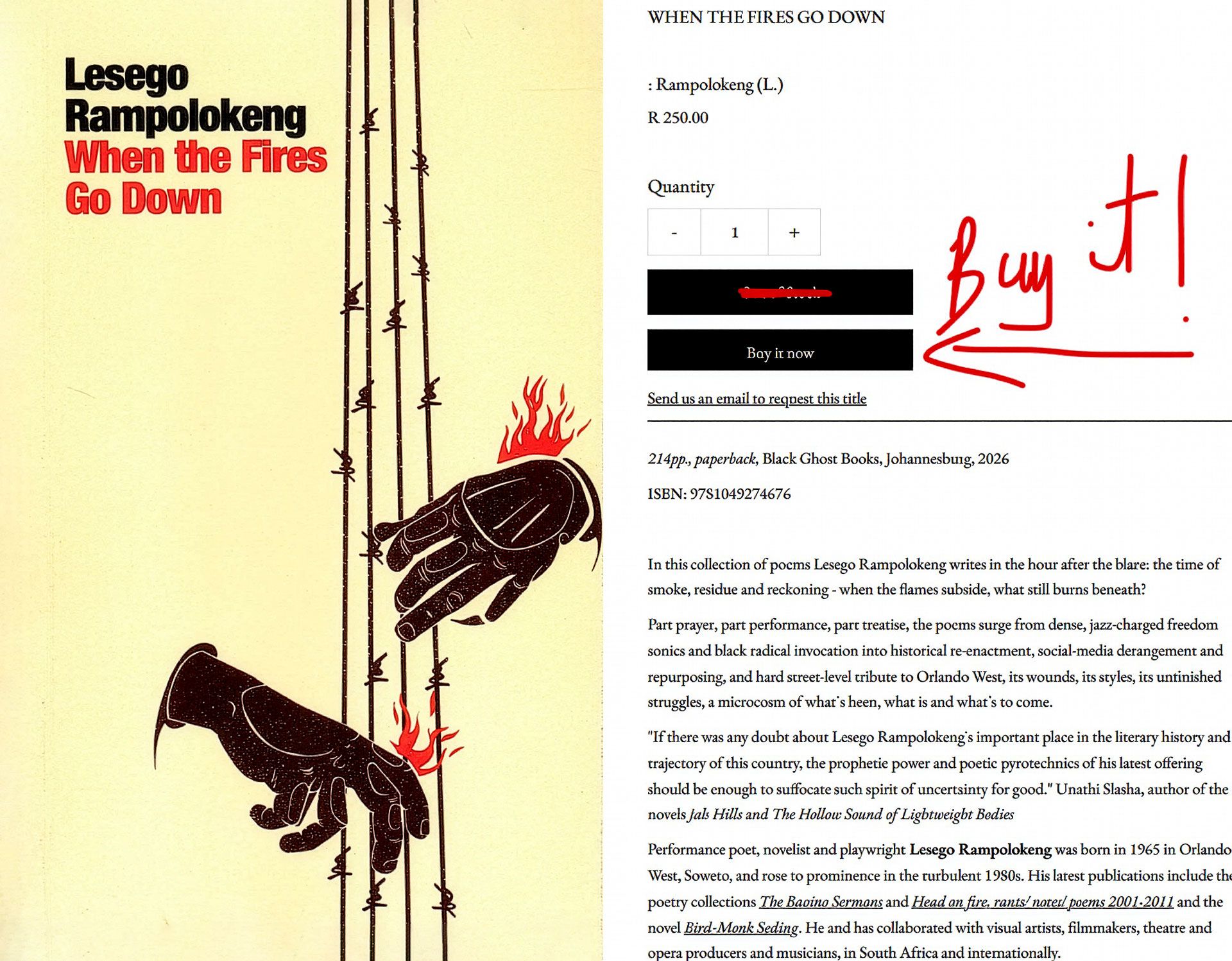
Receiving Lesego Rampolokeng's When the Fires Go Down, the Reading Begins: Not a review. A reception. A sitting with a book that became dirty because it stayed with me.
Dear Reader,
You are about to read a long reception of the latest book by one of South Africa’s great living writers and one of its too easily forgotten sons. The book refused the size I had prepared for it. I will not bore you with my own tales immediately. Those arrive later. But I received Papa Ramps’s latest book at a particular moment, while several pre- and post-PhD projects were already returning me to work I had begun thinking through closely in 2020.
In my academic world, Lesego was welcomed as poet, performer, epigraph and provocation. As theorist? Hayi. That room was apparently already full, its chairs reserved for the usual names. My own work on him is only now beginning to enter my boring academic journal life more openly. Post-PhD, at least, I can defend what I say about him without first asking whether the room will permit the claim.
Apparently.
Before AK’s request, I was already reading and rereading Rampolokeng for another project, organised around an idea I am tentatively calling “lif-ing.” The timing of this reception interrupted the time I had set aside to finalise that piece. As a result, the herri reader will encounter some of these thoughts before they appear in the stricter journal form for which they were originally intended. That seems right somehow.
As I have mentioned, this is ongoing work. It began long before this reception and will continue after it. So the book did not arrive alone. It arrived carrying earlier books, recordings, unfinished arguments and the dead who refuse the places national history assigns them.
What follows is arranged into four parts. The first receives the book. The second follows its fire. The third records where the book sent me. The fourth quarrels with the living work. The parts give the thing a road, although the writing still wanders, swears, laughs and occasionally returns to a place it thought it had left.
What follows is mine.
Not Rampolokeng’s.
Mine.
It records how I received the elder, where I followed him, where I became lost, where I learnt, where I laughed and where I refused to agree.
One promise before we begin: when I quote When the Fires Go Down, I give the page number from the 2026 Black Ghost Books edition. I have tried to retain Papa Ramps’s spelling, capitals, line breaks and punctuation rather than “improve” his English into mine. Where a line remains uncertain, I say so.
Perhaps herri will publish it in parts. Perhaps AK will regret finding me on Facebook. haha
That is now his problem.
Love,
Dini Sandiso Bazana
PART ONE: RECEIVING THE BOOK
SECTIONS I-II
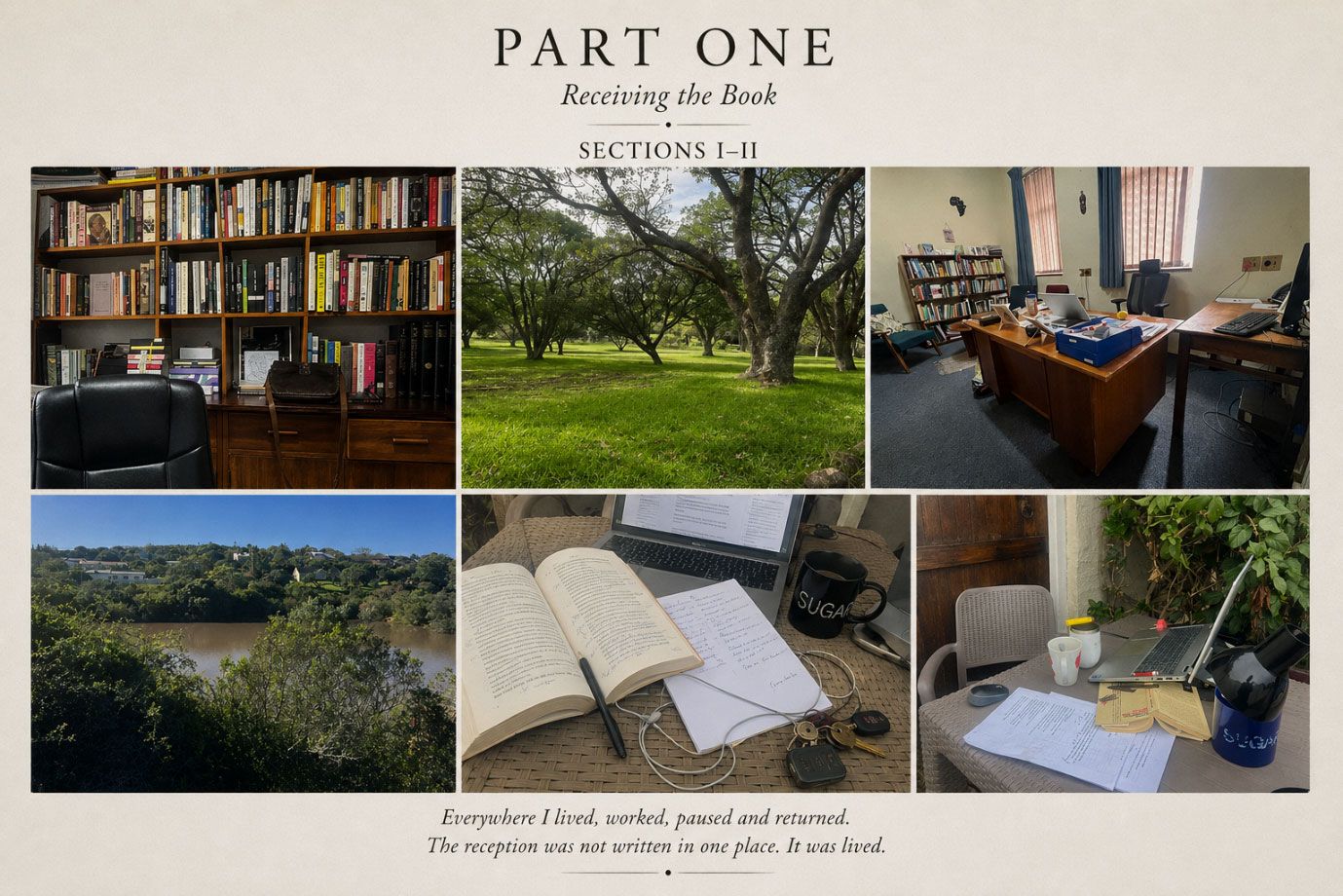
I. Invocation: Or, how I came to write this thing.
So. Molweni.
When AK, the herri editor, approached me about writing this reception, he said he had been watching my writing on Facebook. In my head, I answered, like… like… like: fuck this white liberal. I write elsewhere too, bitch.
Yes, bitch.
In that borrowed African American accent that sometimes appears when irritation needs extra rhythm and the ordinary English sentence is no longer carrying enough attitude.
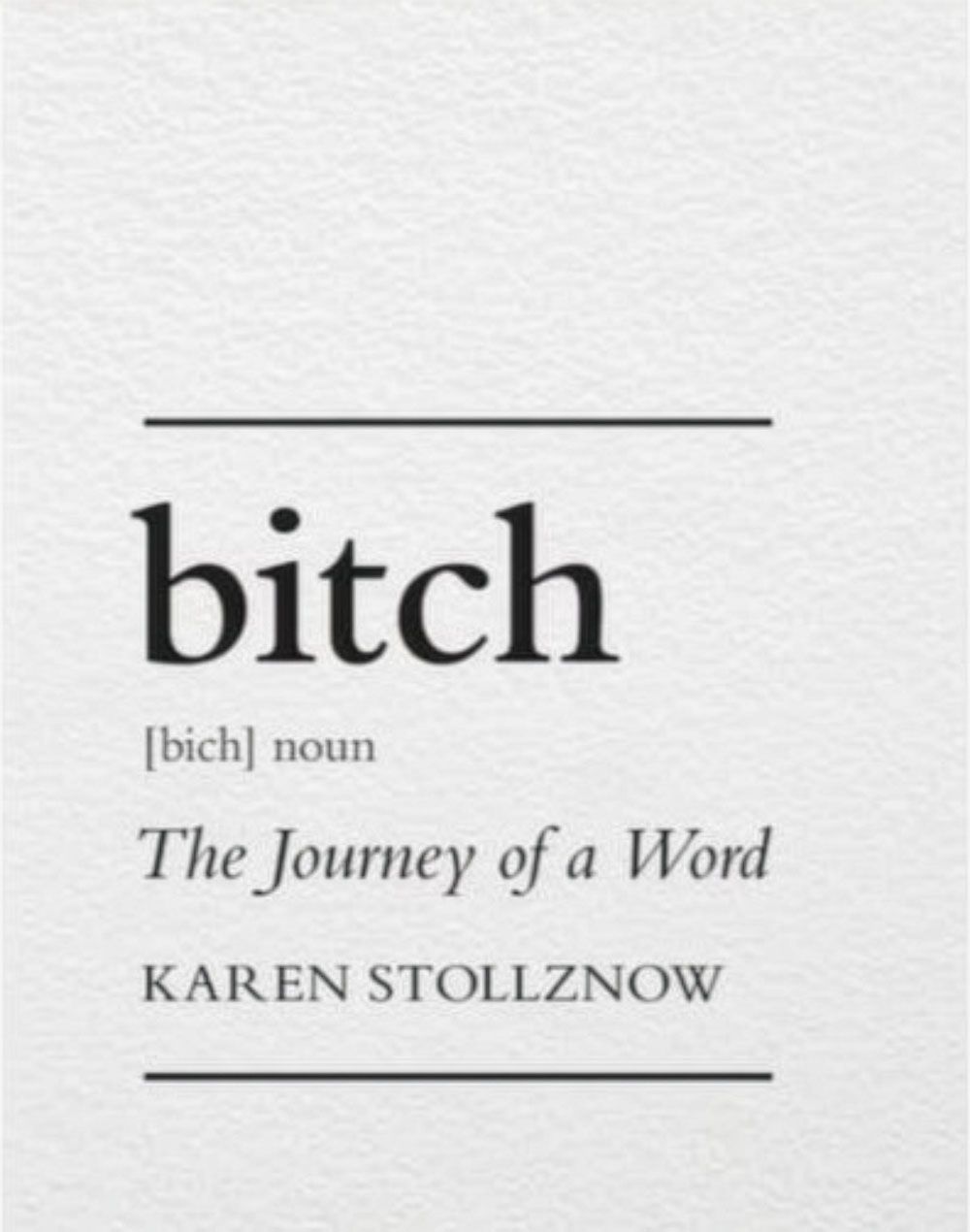
But the word is not innocent merely because I directed it at a man. Karen Stollznow, the linguist and author of Bitch: The Journey of a Word (2024), follows the word across more than a thousand years: from its earliest life as a name for the female dog to its long career as one of English’s most durable instruments for disciplining women. A woman becomes a “bitch” when she is judged too loud, too ambitious, too assertive, too sexual, too difficult, insufficiently pleasant or unwilling to obey the arrangement.
The word travelled, of course. Men became “bitches” too, usually through another gendered route: weakness, submission and failed masculinity are made legible by pushing the man towards the feminine and treating that movement as degradation.
Feminist, queer and popular cultures have seized the word, bent it and sometimes worn it as power. Reclamation has not erased the older injury. The meanings coexist; context matters, but history remains inside the sound.
When I called AK “bitch,” then, I was not speaking from outside that history. I was borrowing an insult whose force still depends partly upon femininity being available as degradation. That self-implication will return when I quarrel with Papa Ramps’s gendered language. For now:
.AK is trapping me. i know.
I did not say any of that to him.
Including the bitch thing.
.besides, the request was also Black. Or, rather, what it awakened in me was. You know the feeling. I felt Black and beautiful. I enjoyed being asked. I enjoyed the recognition. I even felt a little seen. Still, I was already noticing the demand hiding inside the invitation. An invitation may arrive smiling, but somewhere inside that smile is labour. Hours. Reading. Returning. Doubt. The other work you have postponed. The family time you are about to borrow. The sleep that will later file a complaint.
Later in When the Fires Go Down a filmmaker approaches Rampolokeng with a project already arranged around his availability. Papa Ramps records the presumption bluntly: “i am not asked if i want to be part of this thing or not” (Rampolokeng 2026, 168). AK did ask me, and I did agree. Still, the line stayed with me because it recognises how quickly an invitation can become presumed availability: the writer has been noticed, therefore the writer must now work.
Still, I was pleased.
Let me not lie.
There is something moving about being asked to write about a writer whose work has already disturbed your relationship with language. There is also something frightening about it. Admiration is easy from a distance. Reception requires sitting closer. Close enough to hear the brilliance, laughter, ugliness, repetition, failure and difficult human being moving inside the work. Close enough for the book to stop being an object and begin asking questions about you.
So, in response to AK’s request, I did the Black professional thing. The well brought up thing. The trained thing. The thing many of us do when an opportunity arrives carrying work inside its smile. You do not begin by discussing the trap. You thank the person for laying it carefully.
“It would be an honour,” I said. actually, I probably said: “It’s would be honoured.”
English. Uyayazi ke.
But the meaning was there. It would be an honour. And it was an honour. It was also a terrible decision.
I did not know then that this small agreement would follow me into daily life and those unfinished hours after everybody else had gone to sleep. I did not know that the reception would grow teeth, demand more pages and refuse every ending I offered it.
I thought I was agreeing to write about a book.
Still, I did not agree without conditions.
I gave AK one.
It was simple.
I would not write an ordinary review. I would not stand above the book holding those clean little instruments critics carry, deciding whether the poems work, whether the writer has developed and whether the reader should spend money. I would write about how I received Lesego Rampolokeng’s words and what happened to me while trying to remain with them.
This thing has irritated me, moved me, embarrassed me and returned me to thoughts I had hidden safely inside academic language. It made me laugh when I was tired and angry when I wanted the line to behave. At times, writing it felt less like criticism than confession under difficult lighting. At others, it felt like being interrogated by a book that already knew the answers I was trying to hide from myself.
.but ke, it is here now.
Late. Much longer than I intended. Carrying music, anger, theory and evidence of a mind that kept trying to escape into method.
I must also say: the fact that Facebook was the place where I had apparently been “discovered” continued to amuse and irritate me, especially because Rampolokeng’s latest book kept returning me to that same machine.
Facebook.
Meta.
The privately owned “public square.” The corridor that permits encounter while retaining ownership of the door.
The Zuckerberg empire.
.sikhona sonke phaya.
All of us.
All the Blacks.
The academics, poets and unemployed philosophers. The political analysts appointed by nobody. The people who write “morning” beneath somebody’s grief. The relatives who have discovered voice notes. The comrades announcing another revolution between two advertisements. The professionals congratulating one another upon surviving the institutions that are killing them. The academics shouting, “Check out my latest paper, yoh!” before directing us towards an article only seven people can access. The pastors preaching live. The adults posting photographs of children who may one day ask why their childhood became content.
Papa Ramps is there too, responding to the small imitations of something he inspired in some of us. You write a thing. He comments. Gracious human. The head spins. Quickly: go to sleep, boy. This author is accessible.
How many writers have I praised, cited, tagged and disturbed inside the Zuckerberg empire, only for them to say nothing back? I see themmmm. I know they saw it. Facebook tells on them in other ways. Then here is Lesego Rampolokeng, a South African legend, cheering people from inside the same machine.
.but the Zuckererg empire is also so much more;
it is not merely the irritating place where people post food, children, funerals, achievements and opinions nobody requested. It is a privately owned corridor of encounter: it makes people reachable while retaining ownership of the door, archive and record of who entered. Attention becomes countable. Intimacy becomes data. Access begins to resemble entitlement.
This matters here because When the Fires Go Down does not treat Facebook as a fashionable subject placed beside the poems. The platform enters the book as a lived arrangement: greeting, delay, friendship request, recognition, irritation, following, blocking, accidental disclosure and work that has not yet admitted that it is asking to be done.
On page 170, Rampolokeng catches the performance of the innocent inbox greeting: “hi, you are like ‘how are you?’ … more waiting” (Rampolokeng 2026, 170). The ellipsis is part of the comedy. Everybody is waiting for the request to stop pretending it has no destination. I do not want to resolve the contradiction. I found Papa Ramps there. AK found me there.
The same machine that made the encounter possible owns the conditions of the encounter. I return to this in the Kill Zone, where Facebook acquires a face, a follower, a misread body and a person demanding an explanation for a connection they initiated. For now, it is enough to say that the Zuckerberg empire brought this reception into being while already carrying one of the social arrangements the reception would have to question.
Apparently, I had been discovered there.
The old Black story is never far away.
Somebody notices ‘the Black’ making something, declares a discovery and imagines that their attention is itself a gift.
The work was already there. The writer was already there. The world arrived late and called its lateness discovery. So yes, bring the book offers now. Apparently, I have been “discovered.” Bring the ones that pay properly. No ghostly offers asking Black writing to survive upon gratitude. No exposure offered as though exposure can buy groceries, repair teeth, restore a manuscript or return hours taken from the writer’s life. And life to Black Ghost for carrying the work in a country where publishing Black beauty can still mean publishing under conditions of scarcity. This reception remained difficult to finish because the writing room filled with too many voices.
The Kill Zone offered unwelcome company. “do not disturb. / brain at work!” Rampolokeng announces, before calling the blank page “the scariest thing in the world” (Rampolokeng 2026, 186). Same, madala. The page in front of me was not empty, though. It was crowded by everything the book had already made audible.
Pac was there. Nas too. Biggie stood somewhere near the dead. Tumi Molekane—Stogie T—kept pressing from inside the sentence, reminding me that the South African word has its own weight and its own argument with the beat.
Nina Simone carried another refusal; Penny Penny made the body remember movement; Mzwakhe Mbuli reminded the word that it once stood in public and accused. These were not references assembled to make the reception look musically informed. I know herri likes that : ) They were what I was hearing while failing to finish.
.why did i agree to write this?
“Jesus!”
Satan!
Soze!
My grandmother taught me.
Ancestors! how does one write about Lesego?
capitalise the L, please.
capitalise the R too.
Rampolokeng.
the great.
Somewhere between the music, Facebook, the degree trying to stand up again and the elder refusing to remain still upon the page, another creature entered the writing.
.gqigqi, Vonani Bila’s mamba slithered in and refused to remain inside its own poem.
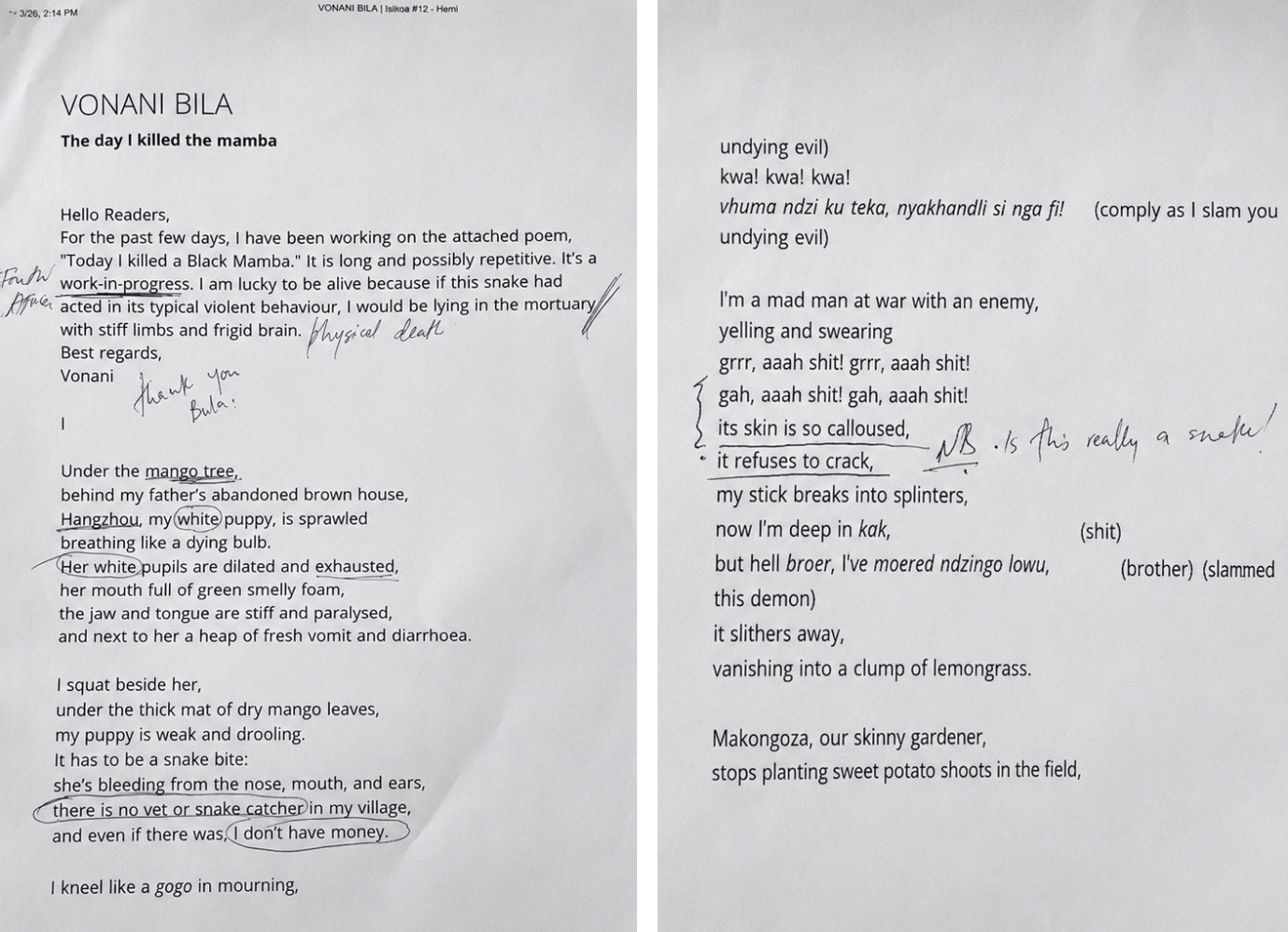
I kept reading that mamba as whiteness: the thing appearing wherever whiteness wants to look innocent, natural, silent or merely passing by. I kept telling Vonani, ndiyacela, take your mamba back. There must still be an order.
Rampolokeng first.
Let the elder speak.
The mamba refused.
Perhaps that was the real problem. I kept trying to write a proper review when the work required my improper voice.
Not Lesego’s cadence.
Mine.
Not the academic sentence standing upright in its tie.
The Facebook sentence. Limping. Laughing. Swearing. Remembering something halfway through another thought. Doubling back. Refusing to conclude merely because the paragraph has become tired.
So the degree must sit down.
The Facebook guy has been called to work.
Okay. First things first. Let us understand each other kwasekuqaleni.
.andiyo Poyet.
Let us get that straight.
Andizobhala apha ngathi ndiyipoyet. If wena you think lento sounds like poyetry, okay, sharp. Moja. But mna ndiyazibhalela nje.
I say this because the moment writing begins to bend, repeat itself, change language, break rhythm or refuse to walk obediently from one argument to the next, somebody wants to call it poetry. The category arrives quickly. Perhaps too quickly. It names the difference before we have properly asked what that difference is doing.
Sometimes I find myself asking what happens when we grab people like Lesego and drag them into that received domain called “literary studies,” a colonial enterprise with its own disciplines, shelves, reading lists and authorised ways of recognising thought. We place the work there until even the writer is made to understand what he has done through the categories of the institution receiving him.
Iyandibinda lanto.
But ke, perhaps this is how institutions operate. Something “different” must first be categorised before it can be recognised. It must be given a shelf, a discipline, a reading list and a theoretical home. The institution must know where to place it before it can admit that it exists.
.so, yes, Papa is a Literary Giant.
Capitalise those words.
L.G.
Still, I wonder what the category does to the work after admitting it. What does “literature” permit us to see? What does it make respectable? What does it place safely behind glass? What does it cool down so that the institution can approach it without being burned?
Calling Rampolokeng a Literary Giant may be necessary in a country that has repeatedly failed to recognise the scale of what he has made. But the title can also become another container. Literary Giant. National Treasure. Important Poet. The words honour, but they may also immobilise. They can turn a living, quarrelling and still-moving writer into a monument that everybody praises and fewer people actually read.
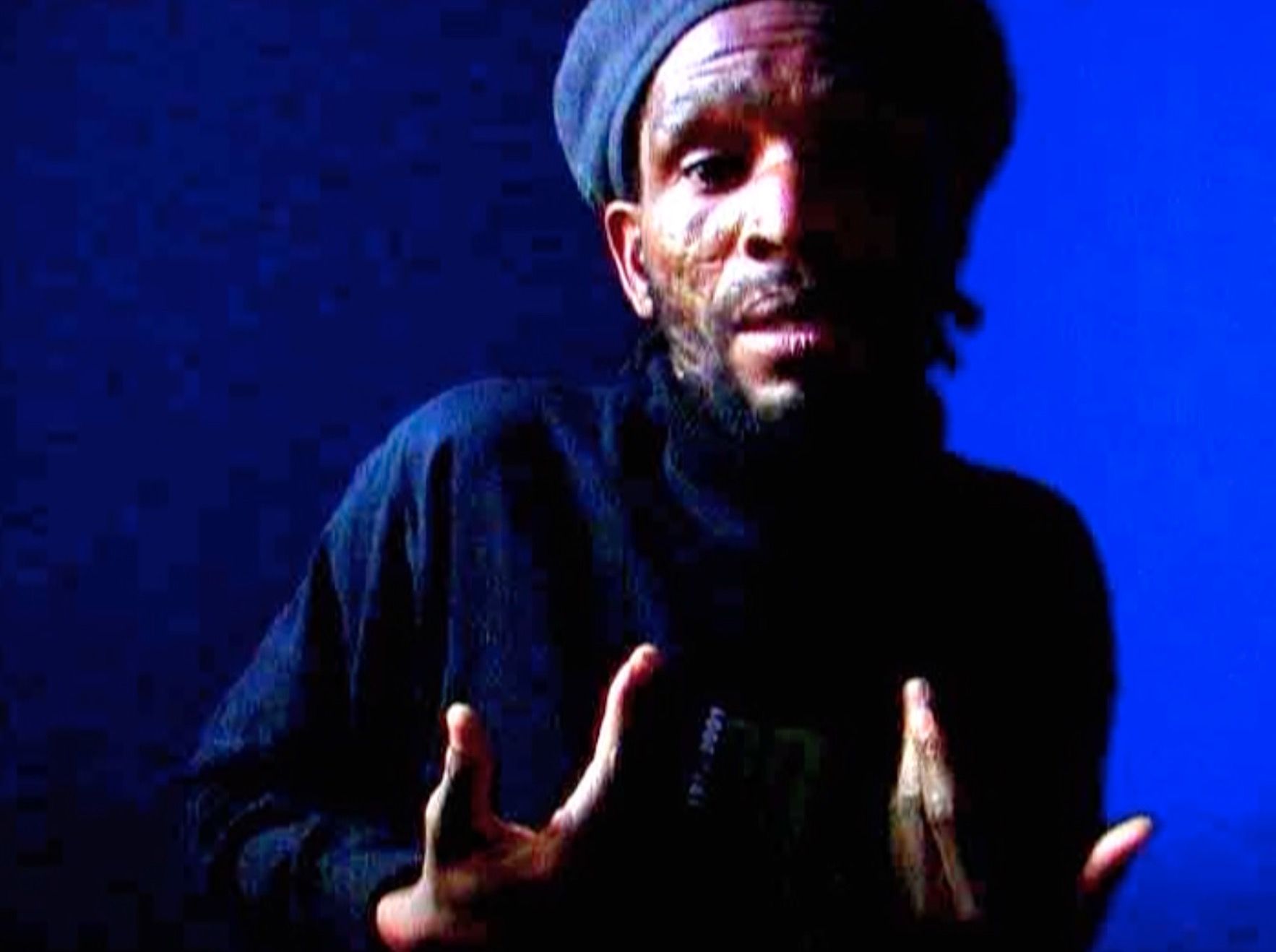
Anyways, back to me not being a poyet.
I read Poyets. I listen to them. I follow what they do to and with the word. I watch the sentence change shape in their hands. I hear what rhythm can know before explanation arrives.
But I am not one.
Sometimes my writing igoso. It refuses to walk straight. It changes language midway, loses patience with the paragraph, laughs when the argument expects seriousness and returns to something it appeared to have left behind.
That does not make it poetry.
It may simply be an expression of my exhaustion with form. Method. Structure. All that academic rubbish.
.but once kuthiwe, “write this,” my mind ibaleka straight into method mode: establish the problem, explain the approach, justify the form and announce the contribution before the writing itself has decided where it is going.
That mode entered this reception too.
Of course it did.
I am trained.
The training lives in the wrist. It sits behind the eye, waiting to arrange the page.
But it will not have the last number on me. I am not receiving a book by intanga yam apha.
Lesego Rampolokeng has been here for a long time. Long before my sentences learnt to cite themselves properly. Long before I knew that a paragraph could be rejected for failing to announce its contribution early enough. He has adopted many Englishes, fought with them, bent them, insulted them and curved his own. I will not arrest him inside British English. Nor will I deliver him to another national English and pretend the case has been solved.
His word has travelled too much, stolen too much fire and survived too many rooms to be returned obediently to one grammar. I will nevertheless try to keep this thing straight.
Somewhat.
In case my French friend is reading, I will sometimes hold the sentence still long enough for him to enter. This turning, mixing and changing of tongue is also my world; language has not become lost merely because it has gone home for a moment. But the English reader cannot own the room merely because I opened the door. The kasi reader is somewhere in my mind.
No, not there anymore.
Ndamka kudala elokishini, mtaka bawo. Mtaka mama. Awunakundifumana pha.
Blacks are always checking there: ukhona na? And if ukhona, kuzoncokolwa apho, mtanekhehle-kazi, de kutshone ilanga. Somebody will call your name from across the road. Somebody will know whose child you are, where you have been and why you have taken so long to return. Basically, there is life there. Noisy, intrusive, demanding life. Life that keeps checking whether you are still among the living.
I chose another kind of death a long time ago.
Apha ndikhoyo, my neighbour does not even know my name. I do not know theirs either. We greet politely, close our gates and disappear into houses owned, mostly, by the bank. All borrowed, ke, uyayazi.
But silapha, forcing our way into proximity with the whites, into those quieter streets where distance is sometimes sold to us as progress, privacy is mistaken for freedom and nobody asks, ukhona na?
I do not even visit elokishini anymore.
Too busy, I tell myself.
Perhaps that too is part of the story.
And yet, whenever I write on Facebook, I still write in a tone that reaches somewhere beyond the sentence.
That thing is Ngangelizwe through and through.
I am writing for the Black reader who knows that a sentence may change language because life changed language halfway through it. The reader who does not experience code switching as an intellectual event requiring immediate explanation, translation or apology.
The reader who hears tone before translation.
Who understands the sentence before every word has been accounted for.
Who knows that sometimes English cannot carry the whole thing, and isiXhosa enters not as decoration, but because the thought has reached the place where English must move aside.
The urban Black reader, especially the South African one, moving between work, transport, family, debt, WhatsApp, exhaustion and whatever small hours remain at the end of the day, the one who is simply too busy to read: perhaps this is not for you.
Perhaps it is precisely for you.
For the white liberal who loves Lesego Rampolokeng: this is not for you.
It is also for you.
Let us be honest. The body of this thing is probably more accessible to you than the opening suggests. There is very little isiXhosa compared with all the English carrying the essay. I have held the English sentence still long enough for you to enter.
.i mean, the book itself is written in some kind of Inglish too.
Not the English you own. Not the English that arrives washed, grammatical and carrying a certificate of good conduct. Rampolokeng’s Inglish has been dragged through Phefeni, Black Consciousness, jazz, hip hop, mines, churches, shebeens, books, hunger, broken machines and the mouths of people who were never expected to possess the language so completely.
So yes, you may enter.
But do not confuse access with ownership. Do not become comfortable. Do not imagine that loving Rampolokeng has made you innocent of the world against which his words continue to strike.
Sit. Read. Become confused. Jump when the line passes over your head.
The rest of us have been jumping for a very long time.
I must also be open and honest here.
The degree sitting down does not mean that books, theory and scholarship must leave the room. They are already inside me. They cannot be removed because I have decided to sound conversational.
I cannot unknow the training. Manganyi, Fanon, Sithole, Hook, Mbembe and Biko helped construct the eyes through which I read. Wilderson, Hartman, Sharpe and other contemporary African American thinkers are already inside the room too.
They simply cannot occupy every chair.
The trained sentence must sometimes stop managing the encounter. The Facebook guy, township reader, teacher rushing towards class, father on the school run, academic exhausted by academia and person who is simply confused must be permitted to read together.
Difficult scholarship may remain difficult.
It must simply stop confusing difficulty with ownership.
Academic writing has made a profession out of changing the subject.
Identify the gap.
Build the framework.
Locate the contribution.
Define the concepts.
Make the world fit inside the table.
I do it.
I teach it.
I submit to it because work, promotion, supervision and professional belonging require it. I know the economy well. In that economy, clarity must wear a tie before it is allowed into the room.

A Black sentence must become orderly enough to be assessed. A township memory must present its methodology. A writer must resemble an outcome.
But I did not receive When the Fires Go Down in such a room. I received it in motion, amid teaching, supervision, family, tiredness and those unfinished hours taken back from the day. That is what I mean by reception.
An ordinary review asks whether the book works: whether the poems cohere, the prose carries, the writer has developed and the work can be recommended. That machinery has a place; it helps books enter conversations, syllabi, libraries and public attention. I know how to write the review that assesses, locates, recommends and moves on.
But this book arrived already working on me. It had been working since I first heard a Rampolokeng line and lacked a name for the disturbance; when academic prose began to suffocate me; whenever a difficult book made me feel small and I slowly realised that the smallness was not always the book’s cruelty. Sometimes it came from the old lesson that reading belongs to people who already know where they are going.
A reception, as I understand it here, does not pretend that the critic stands outside the work holding neutral instruments. I am not outside this book. It entered my routines, exposed the devices with which I tried to measure it and made my response part of the event.
Its jokes became arguments.
Its insults became invitations and, sometimes, reasons to quarrel.
Its difficulty became a way of staying.
To receive a book is also to admit that the book received you first: it placed you somewhere, interrupted your preferred posture and altered the terms of your reply.
What follows is not a verdict delivered from above.
It is a record of encounter.
The encounter is with the latest book by a writer who has given us more than three decades of poems, performances, prose, recordings, collaborations, interviews, arguments and disruptions: fourteen published books, we are told, and manuscripts moving through less secure archives. With “friends.”
In one Kill Zone fragment, a friend reappears after roughly ten years and reports having “a manuscript of mine that I gave to him in the early 90s for safekeeping” (Rampolokeng 2026, 175). The friend says the house was stable. Papa Ramps remembers that he was not.
“Friends.”
A difficult word in this book. A friend may read, produce, argue, invite and return. A friend may also hold, forget, possess and reappear carrying part of the writer’s archive. I return to this when Stacy Hardy, Warrick Swinney, Mafika Gwala and the manuscripts enter more fully. For now, the quotation marks must remain.
I will not pretend to understand everything.
This is not an apology placed before serious reading begins. Some words beat me; some references sent me hunting; some sentences made me accuse the writer of enjoying his cleverness too much. I also had to ask why I expected Black difficulty to become immediately useful, as though the writer owed me a key.
The South African literary room, a colonial room, often asks difficult Black writing to arrive already translated.
Not only translated across languages, but translated into a mood, good behaviour, syllabus note and paragraph a lecturer can explain in ten minutes before moving to the next slide.
The demand calls itself access.
Yet access can become the old authority insisting that the writer must squat so the critic does not have to jump.
Rampolokeng will not squat.
In “What Gets Me Teaching, and How,” Rampolokeng records Geoff Mphakathi’s advice: “if the lines go over your head … jump, don’t expect me to squat” (Rampolokeng 2015b, 201).
The instruction is not contempt for the reader. It refuses the reader’s trained helplessness. It says reading may require movement, strain, pleasure, embarrassment, returning and, sometimes, rage.
So I will not make Lesego Rampolokeng into an academic case study, a cheerful example of resilience, hate that word!, a cultural representative or national wound that can be praised, quoted and put away. I will follow the book closely enough for its stanzas to interrupt my claims. Where I say the book speaks, I will let the line be seen and the page be named. The reception remains mine, but the words through which the encounter occurred remain his.
I am writing what happened when those words entered my life and rearranged something there.
I am still being rearranged.
.any interpretation, misinterpretation, reading or misreading of these poems begins with “I think.” When that “I think” does not appear, know that I became too confident in what I thought and too careless with what Papa Ramps might have meant.
Read with care.
This is a reception, mtaka bawo.
no, mtaka mama. sorry, i forgot.
II. The Book Became Dirty
The book did not arrive dirty. It came clean: cover clean, pages clean, new book clean. Look at the opening picture of this reception. I am talking about the kind of clean that tells you to place it carefully upon the table, not bend it, not eat while reading, not leave it inside the car and not allow children to touch it with hands carrying the day.
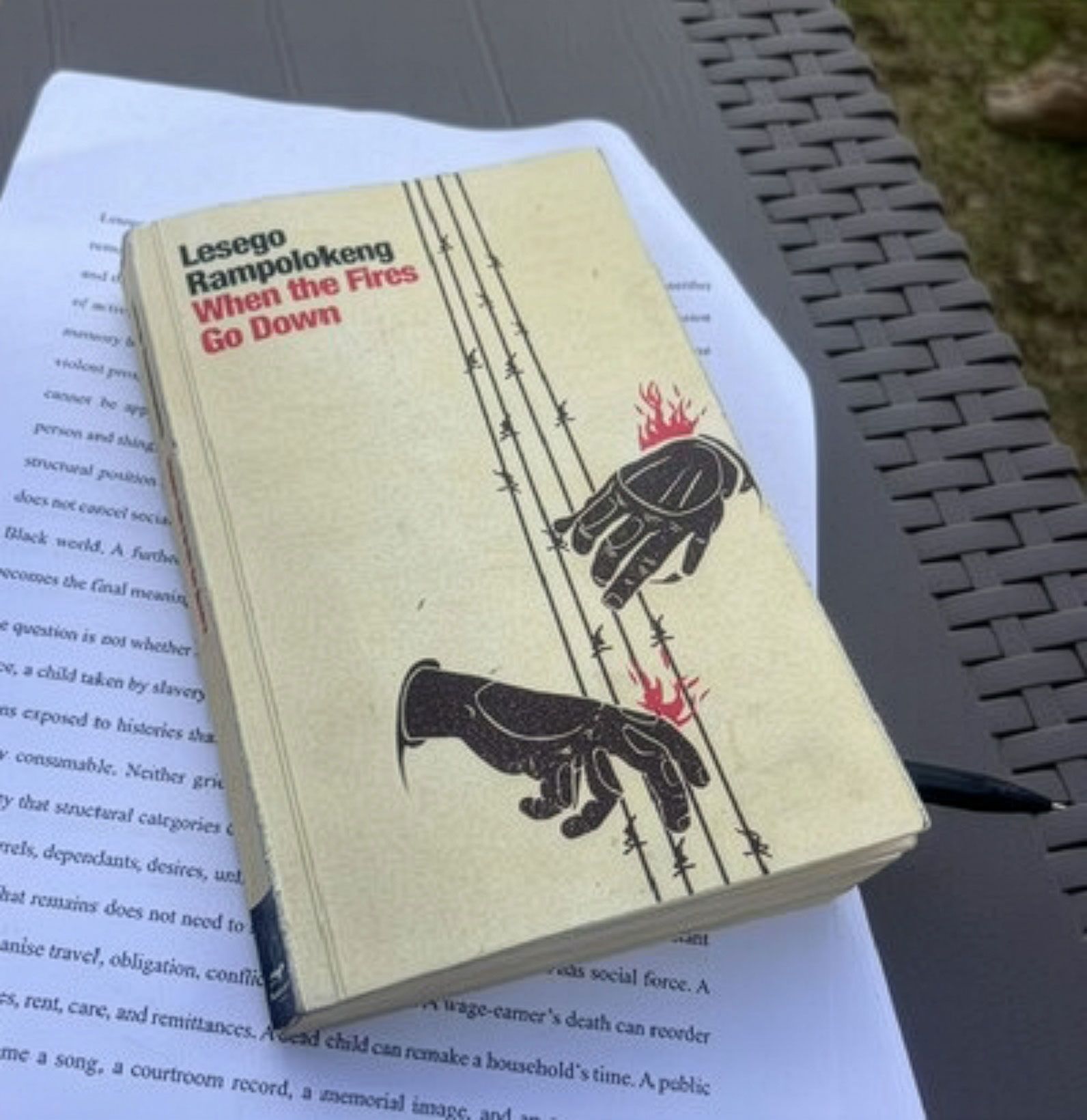
It looked like an object asking to be preserved from life.
When the Fires Go Down did not remain that object.
It became dirty because it stayed with me.
It arrived in late May, as the month gave way to June. I am talking about 2026. It travelled in my pocket, entered my seminars and supervision meetings with students, moved through the bank-owned house, the car and the school run, and climbed onto the bicycle with me around the Botany Gardens and the dam.
It followed me into those exhausted nights when one says: two pages, then sleep.
Then sleep does not come.
A word has stopped you.
An insult.
A name.
A laugh that is not merely a laugh.
A line from Phefeni has crossed the country and moved furniture inside your head.
My Black hands touched the book again and again: hands that had carried children, keys, food, an academic timetable and worry; hands that had typed peer-reviewed paragraphs in correct English; hands trained to believe that a Black writer must first become clear before he can become serious.
By the end, the cover had changed.
Not dirt as neglect.
Dirt as relation.
The book entered a life without perfect reading conditions: work, school, money, tiredness, an altered body, unfinished writing, people who need you and the private guilt of taking time to read when something else can always claim greater urgency.
Sometimes I read a single page and stopped. Sometimes a word stopped me, then another, then a sentence built from a language I knew but did not fully possess.
Rampolokeng makes English look familiar and then sends it elsewhere. The word returns damaged, loud, dirty, laughing, carrying township breath, jazz, mine, church, hunger and insult.
You cannot rush him.
The dirtying is neither a romance of poverty nor proof of Black authenticity.
Dirt is not a credential.
Nor do my hands make the book more real than another reader’s hands. The point is smaller and more demanding: a pristine book may simply be a book that never entered the reader’s actual world. It remained a good object upon a shelf, protected from use, and never had to endure relation.
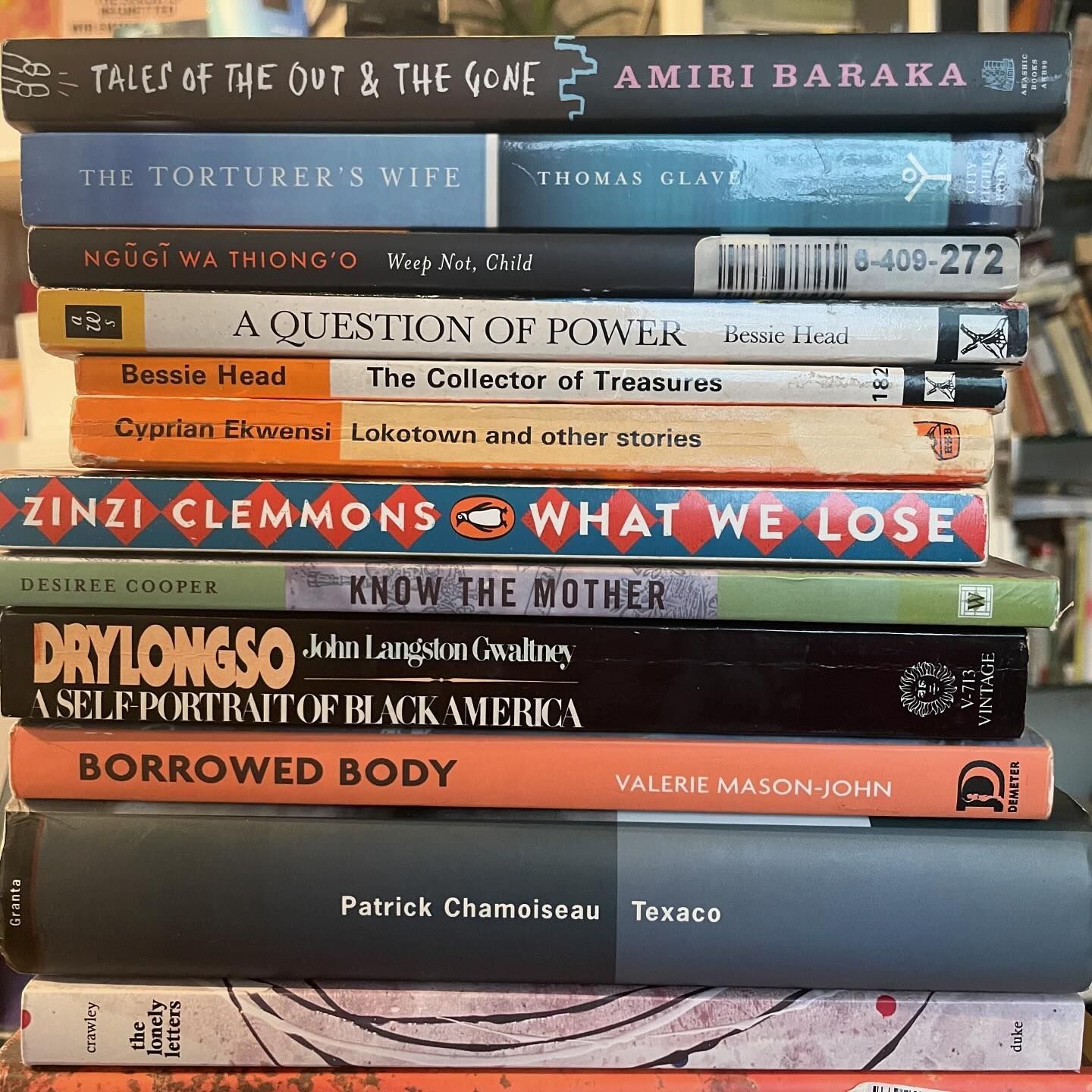
I have many of those books inside our precarious Black middle-class house. I have others in my borrowed Rhodes University office, where I work among books purchased, inherited, cited, displayed and always waiting for the life in which I will finally have enough time to read them. Books bought with seriousness, arranged with care and carried into the life we are still paying for, but not always opened long enough for them to become part of that life.
This one refused the shelf.
The book had already laughed at display as a substitute for reading. In the Kill Zone, Rampolokeng says, “Yes, of course my books are tattered” and then, more sharply, “I read the damn things” (Rampolokeng 2026, 173).
Tattered is not a credential either. A damaged book can still be unread, and a clean one can alter a life. But the line recognised something in my marked copy: the book had ceased to be décor and entered use.
It dragged the desk into the street and the garden, moved the dictionary into the kitchen, then back into my study and my office at work. It made the road towards school feel like a side route through Phefeni and placed Grahamstown in an argument with Orlando West and with the country that continues to call itself postapartheid.
The marks in the book became another form of conversation.
A line beneath a word.
A question beside a stanza.
An irritated exclamation.
An arrow returning me to something I had missed.
A page folded because the sentence would not leave me alone.
The previously clean book became an archive of my inability to pass through it smoothly.
That matters because reading is often represented as though knowledge enters without leaving a mark. The good scholar appears clean: quoting accurately, interpreting carefully, citing appropriately and concealing the tired eye, delayed sleep, argument in the margin, laughter in the car or page opened while somebody asks where the school shoes are.
I do not want to make the dirt heroic.
I am not more serious because the book looks damaged.
A reader can annotate everything and understand very little. Another can keep the copy immaculate and be altered completely. The cover is not evidence submitted to a court.
But for me, this dirt records duration.
It says I returned.
I do not want to clean Rampolokeng for the reader. I will not make the syntax neat, identify every reference, bleach the profanities, soften the laughter, rename the noise “experimental form” and proceed as though the service has been completed.
Difficulty here is not a wall built by a superior writer to humiliate us. It is also a record of the walls within which language has been forced to live. The reader must admit what those walls do to comprehension, pleasure and patience.
Still, difficulty must not become immunity.
A marked book is not a surrendered critical intelligence. Sitting with a work does not mean kneeling before it. The same pages that moved me also irritated me. The same language that opened one structure sometimes reached too quickly for an old insult. The same density that created relation sometimes crowded the particular image I wanted to hear more clearly.
Receiving is not agreement.
The dirt records the quarrel too.
The writer’s body and the reader’s body meet through time.
One body produces the word under conditions the finished book may conceal; another carries it through work, care, exhaustion and whatever hours can be taken back from the day. The dirt became a small refusal of frictionless consumption: I did not receive the book as content passing cleanly through me.
I carried it.
It cost me time.
It made reading appear unproductive.
It forced return.
The marks became evidence of sitting alongside it, not above it and not beneath it.
I have since bought another copy of this FIREEEEE.
Perhaps I wanted one clean copy for the shelf. Perhaps I wanted proof that the book could begin again. Perhaps I had finally damaged the first copy enough for capitalist desire to whisper: buy another one.
Lol.
The first remains the reception copy.
The copy with the road upon it.
Near the end of the Kill Zone, Rampolokeng leaves a sentence that sounds almost like an instruction to this entire reception:
“I write my best reading the most”
(Rampolokeng 2026, 189)
The grammar leans slightly out of ordinary alignment. I receive it as a compact account of what happened here: the writing became possible only by reading beyond the first encounter, returning until the book had marked the sentence as surely as my hands had marked the cover. That is where the reading properly begins: close enough for the hands to show what staying required.
.i did promise that I would keep this writing straight. I still promise.
somewhat.
Straight enough for us to keep walking.
Crooked enough for the book to remain itself.
Let us walk towards the fire.
PART TWO: FOLLOWING THE FIRE
Sections III–X
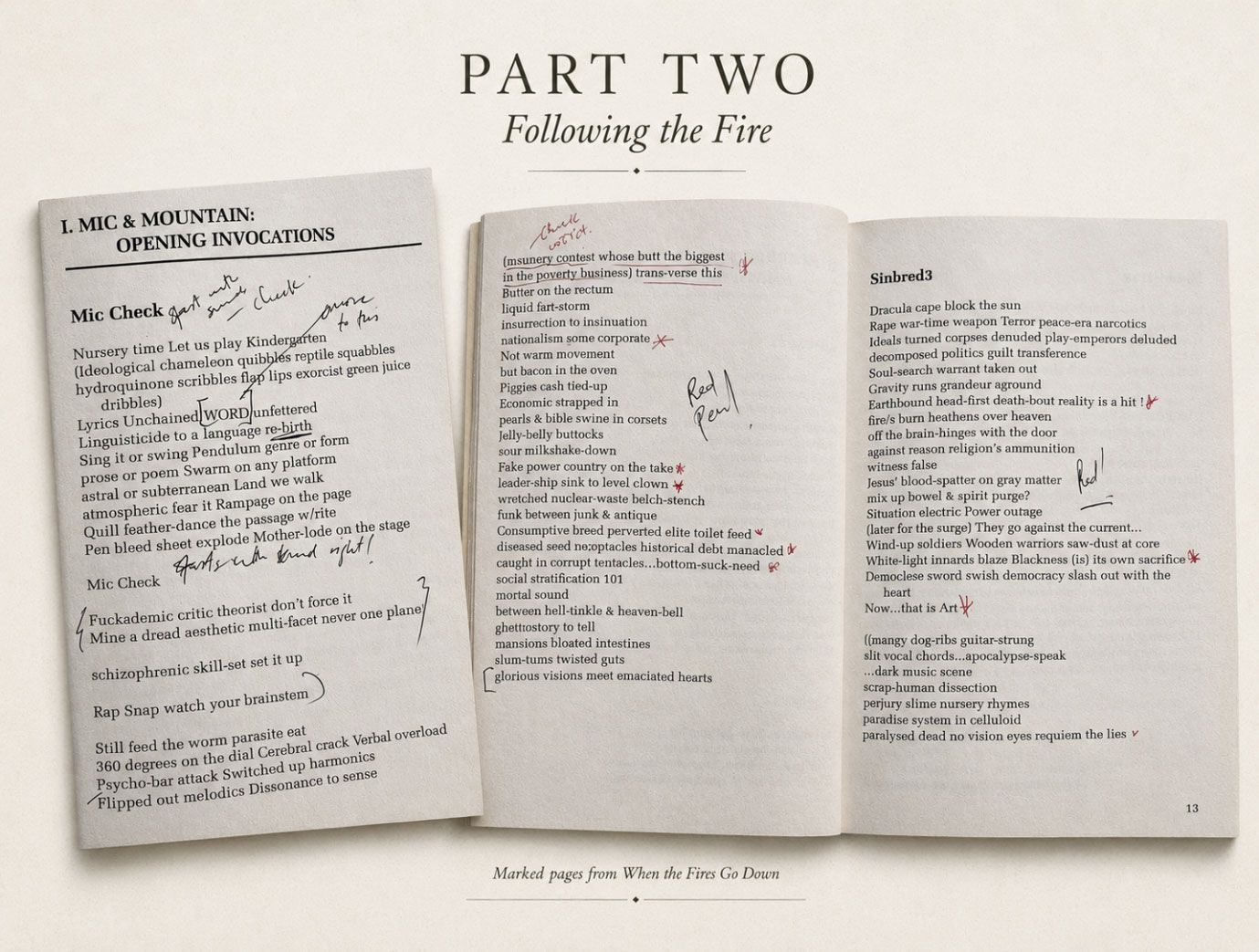
III. Mic Check, Keys and Black Sonic Genesis
The book does not begin by asking permission to begin. It does not clear its throat politely, explain its themes, thank the reader for arriving and lead us carefully through the front door. It switches on the sound system and makes the test itself the event.
“Mic Check.”
The phrase is familiar enough to sound casual. Anybody who has stood near a stage, church microphone, community hall, political rally, school assembly or hip hop session knows it. One, two. Can you hear me? Is the cable alive? Is the voice travelling?
But on the first page of When the Fires Go Down, the microphone is not merely equipment. I think it is the book’s first political question. Who is heard? Through what machinery? Who owns the volume? What happens to a Black word after it enters amplification? What kind of noise must a voice make when the room has already decided what counts as speech?
The mic check is already the poem.
“It begins with sound,” Rampolokeng says in the 2014 interview. “The word is paramount.” Sound is not decoration added after thought; thought arrives sounding, with grain, temperature, history, class, race, place and breath. The mic check is not a preliminary disturbance before the serious poem. It is the poem testing the machinery through which a Black word must travel.
Sound is the argument’s body.
The opening gives us a compact reading contract:
“Lyrics Unchained WORD unfettered
Linguisticide to a language re-birth”
(Rampolokeng 2026, 1)
The capitalised WORD can too easily be converted into a slogan about liberation. It is not that simple. A word requires unchaining because language has been captured. English arrives in this country carrying command, classification, mission school, pass, law, contract, diagnosis, scripture, examination, anthropological report and university judgment.
Rampolokeng does not solve that history by stepping outside English into an untouched linguistic homeland. He works inside the captured language. He bends, infects, splices and overloads it. He makes it stammer, scat, swear and carry township breath and jazz pressure. Then he asks whether rebirth remains possible after “linguisticide.”
The word may be unfettered, but the fetters remain audible. Freedom is not clean. It carries the scrape of the chain.
That is why the warning to the critic appears almost immediately:
“Fuckademic critic theorist don’t force it
Mine a dread aesthetic multi-facet never one plane”
(Rampolokeng 2026, 1)
The temptation is to laugh and move on. There is the old Rampolokeng again, insulting the university. But the verb “mine” stops me.
I come from disciplines that know how to mine a text. Identify the concepts. Excavate the framework. Extract the contribution. Process the quotation. Transport it into an article. Convert Black writing into academic value. The critic can become a mineral company carrying a bibliography. The poem becomes ore. The writer’s risk becomes somebody else’s career line.
I do not hear Rampolokeng refusing interpretation. I hear him refusing an extractive relation to thought. “Don’t force it” does not mean do not read. It means do not make the work confess to the theory you brought with you.
And yet he says “mine.”
The word is double, dirty and dangerous. It can mean dig, possess or explode. It can name the place beneath the earth where Black bodies have been consumed for wealth. It can say: this dread aesthetic is mine, but not yours to own.
It can also say: enter the mine, critic, but know where you are. Do not return with polished diamonds while pretending nobody went underground.
The poem moves through nursery time, corruption, skin, quill, pen, stage, brainstem, rhyme, canon, toilet, bass and bodily waste. It feels excessive because the world entering it is excessive. The formal problem is not how to make violence elegant. It is how to stop elegance from becoming another method of hiding violence.
When Rampolokeng writes:
“Rap Snap watch your brainstem”
(Rampolokeng 2026, 1)
the line is not merely verbal bravado. The brainstem carries the body’s most basic work: breath, pulse, survival. The line wants to pass beneath interpretation as professional performance. It wants the poem to register as bodily alarm before becoming seminar material.
Then the phrase “ancient futuristic idiom” folds the book’s time:
“rhythm-rhyme ancient futuristic idiom
locked down this NOW moment”
(Rampolokeng 2026, 2)
Rampolokeng is not a heritage poet taking us back to a pure African past. Nor is he a modernist treating the past as dead material waiting to become new. Ancient and futuristic occupy the same idiom, but the movement between them does not permit escape from the present. “Rhythm-rhyme” locks those times into the pressure of the “NOW moment.”
“Locked down” carries its own contradiction. It can name confinement, policing and forced stillness. It can also describe rhythm secured in a groove, held long enough to sound and travel. The idiom moves across time while remaining answerable to now.
The capitalised NOW strikes the page like a beat. Mountain and microphone are not opposites. Quill and sampler do not belong to separate literary ages. An ancestral voice can enter amplification without becoming folklore. A township insult can carry older metaphysical pressure without being translated into “authentic culture.” Time folds, scratches, loops and returns. But it returns to now. The book’s future has old bones inside it, and its present remains locked in rhythm with the unfinished past.
At this stage, my fuck-ed academic mind recalls Warrick Swinney: Papa Ramps’s “friend,” producer and collaborator, somebody present while the sound was being made rather than arriving later to classify it. Swinney’s (2023) account of End Beginnings helps me hear the material history inside this mic check. He remembers analogue and early digital equipment, found radio voices, political speeches, loops and samples being cut apart and forced into another order. He writes of cables, machines, arguments and the long labour required to make Rampolokeng’s voice enter recorded form.
The official voice is not cited respectfully and left in command of its own meaning. It is chopped. Repeated. Interrupted. Placed beside drum, bow, distortion and Papa Ramps’s word until authority begins to sound frightened of itself. The mic check therefore carries an archive of machinery. It asks not only whether the voice works, but what the machine has already done to the voice and what the voice may still do to the machine.
Stacy Hardy later gives this bodily pressure another name: viscerality. I return to her when Rampolokeng dedicates “Home” to her. For now, it is enough to hear breath, shit, blood, bass, broken syntax and sudden insult as more than decoration. They are what happens when the world enters the sentence and the sentence refuses to digest it politely.
There is also a toilet in the opening.
Of course there is.
The canon would prefer the poem to approach washed. Rampolokeng makes literature smell itself. High culture survives by pretending that it has no stomach, no anus, no rent, no teeth, no producer, no broken cable and no underpaid performer waiting for transport home.
The vulgar image is not automatically radical. Vulgarity can become a cheap costume. Rampolokeng sometimes takes that risk, and I will return to it. Here, however, the body drags the canon towards its material base.
Bass becomes base.
Foundation becomes beat.
The book then asks: “Where Are The Keys.”
A key opens a door, but it also makes music. It belongs to the prison warder and pianist, tenant and landlord, archivist and thief, church and underworld, house and code. The title asks for access while refusing a single route. Where are the keys to the book? Where are the keys to the land? Where are the keys to the dead? Where are the keys to a language locked inside other people’s meanings?
A reader trained to demand definitions may expect the poem to provide an instrument of entry. Rampolokeng gives percussion, Hades, gatekeeping, land spirit, hieroglyph, dread, posterity and radical process. The key becomes a ring of keys, then a sound we still have to learn how to hear.
The poem places us:
“All on beneath within around + us in it
…
Hieroglyphic-writ Rhythm Pulsate”
(Rampolokeng 2026, 3)
The first word matters: “All.” The grammar refuses a single stable position. Land is not scenery beneath political activity or an empty surface upon which the nation builds policy. We are on it, beneath it, within it and around it, and it is within us. Subject and territory cannot be separated cleanly.
&
The ampersand matters too. Rampolokeng often uses “+” or “&” where standard prose would give us “and.” The sign accelerates relation. It resembles musical, mathematical and technical notation. It places terms into an operation whose result is not yet settled. Nor is “Hieroglyphic-writ” a dead inscription. “Rhythm Pulsate” makes the mark beat. Writing becomes something the body may hear before the critic has finished translating it.
That pressure deepens in “MUD BOUND WORDSOUND GENESIS.” The title contains a poetics before the poem begins. Mud is origin without purity. Soil and mixture. Fertility and mess. Burial and the trace left on a shoe. “Wordsound” refuses the university’s separation of written literature from performance. “Genesis” refuses the assumption that Blackness enters history late, as a problem for a world already created elsewhere.
Then comes the line I kept circling:
“Genesis resides in BLACKNESS”
(Rampolokeng 2026, 4)
Lifted from the stanza, it can look almost doctrinal. Blackness as beginning. Blackness as source. Fine. Put it on a poster.
But the poem will not permit the clean poster.
The genesis resides in mud, extraction, broken bone, hunger, river, genocide, blues, train track, Atlantic history, Kimberley, Lüderitz, sugar, hanging tree and “corpse consciousness.” Beginning is not innocence. Blackness is genesis because modern world making cannot be understood without the theft, labour, invention, dispossession, sound and death organised around Black existence.
To begin from Blackness is not to claim moral purity for Black people. It is to begin where the world has hidden the cost of calling itself a world.
BLACKNESS interrupts the page visually before the reader converts it into explanation. Capitalisation becomes sonic. WORD, BLACKNESS, DREAD, MIC CHECK: the page performs volume even before a voice speaks aloud. Yet capitals can also become habit. When everything shouts, no shout remains louder. Their force depends upon contrast, and Rampolokeng creates that contrast through lower case anecdote, bureaucratic instruction, prose fragments and sudden visual explosion.
The geography widens: Thaba Bosiu, Kgalagadi, Limpopo, San tombs. Phefeni is not yet the final chronicle, but the book already refuses to confine Black thought to an urban township brand. Mountain, desert, river and tomb are not African decorations placed around an argument made elsewhere. They alter the scale of the poem. The current nation becomes small beside deeper territories and older violences that the postapartheid calendar cannot contain.
Rampolokeng gives us:
“Thaba Bosiu
Nocturnal Mountain raised fist spirit habitat”
(Rampolokeng 2026, 4)
.the mountain becomes a raised fist.
Geography performs the revolutionary salute. The land appears to resist, older and larger than the individual hand ordinarily carrying the gesture. The fist does not rise above the mountain.
The mountain is the fist. “Spirit habitat” refuses to turn Thaba Bosiu into a dead monument. A habitat is where something lives, not only where something once happened. Ancestor, memory, political will and collective survival remain housed there. The mountain is not scenery behind history. It is a dwelling through which history remains active.
.and then another raised ground briefly enters my reading.
Marikana massacre. Intaba.
I cannot say Rampolokeng is naming Marikana massacre here. The poem does not say so, and I will not make Thaba Bosiu confess to the question I brought with me. The histories are not interchangeable.
Still, after Marikana, I cannot read “raised fist spirit habitat” as mere geology. Another gathering enters my mind: Black workers standing upon raised ground because the recognised routes through which the mine, union and state expected them to speak had failed.
The association is mine. Not the poem’s declared intention.
I return to that raised ground later. For now, one raised ground has called another into my reading.
Then Rampolokeng gives us:
“Black sonic science
Darkest Acoustics”
(Rampolokeng 2026, 4)
I do not hear this as an easy elevation of music into knowledge because academics now enjoy calling everything an “epistemology.” Us. The decolonial hustlers.
The pairing is more demanding. Science names method, experiment, vibration, diagnosis and technical attention. But the acoustics are “Darkest.” Sound studies the world by entering what official language smooths over: broken bone, slaughter, the pianoed spinal column, hunger and historical pressure.
The poem does not ask to be excused from thought because it is musical. It claims sound as a way of thinking.
That thought is bodily. A piano enters the spinal column. A saxophone becomes broken bone. Percussion tattoos. Rhythm does not float politely towards the ear. It marks the body.
The wound becomes sound, but the transformation is not therapeutic. The broken bone remains broken. The saxophone does not heal it. It makes the break audible without allowing the break to become the entirety of the person.
Lesego turns history into reverberation:
“Reverberate across space + time
Locked in with the rhyme”
(Rampolokeng 2026, 5)
The plus sign places space and time into relation, but the line break delays the lock. Reverberation travels. The next line catches it in rhyme.
This is not chronological history. Lüderitz, Auschwitz, Kimberley, the Atlantic, Cape labour, sugar cane, trains and European high culture strike against one another. The risk is obvious. Histories can be flattened when gathered too quickly. Specific catastrophe can dissolve into general darkness.
The strongest passages do not say that all suffering is the same. They make us hear shared machinery: classification, extraction, transport, commodity, camp, labour, civilisation and trained legal blindness.
Relation is not sameness.
Reverberation is not collapse.
When Wagner enters, culture loses its innocence. High art cannot claim exemption from the worlds that adored it. Music can carry fascist inheritance as surely as Black music can carry survival, mourning and revolt. Sonic power is not automatically emancipatory. The question is what social world moves through the sound and what the sound makes available.
The line:
“Liberty’s eyes stare blinder than Justice”
(Rampolokeng 2026, 6)
belongs to this method. Liberty can stare past the mine. Justice can stand above the grave. The figures that should see have trained their vision away from the bodies beneath accumulated wealth.
The poem answers that nonseeing with:
“Armoured noise against silence’s pestilence
…
Dark angelic notes”
(Rampolokeng 2026, 6)
The noise must be armoured because silence is not neutral absence. It spreads through archive, court, curriculum and public memory. Yet the notes remain angelic only after passing through darkness. Grace does not arrive clean.
When the poem offers “history—traumatic sonic remedy” (Rampolokeng 2026, 5), “remedy” must be handled carefully. This is not wellness language. Sound does not remove trauma. It gives trauma another frequency, one in which official history cannot completely seal the event. A remedy may be what allows the wound to be carried without becoming mute. It may prevent silence from becoming the final archivist.
Swinney’s (2023) account of End Beginnings confirms that this looping between ending and genesis has been present for decades. The earlier recording moved through interruption, political sampling, apocalypse and Black Consciousness. Ending and beginning were never secure opposites in Rampolokeng’s work.
Swinney takes the title of his essay from the line:
“we’re stickfighting against extinction”
(Rampolokeng 1993, 16)
The stick is not equal to the gun, mine, state, publisher, archive or market. Its inadequacy is part of the truth. Stickfighting names a struggle conducted at close range with whatever remains available: breath, rhythm, memory, insult, friendship, sound and the word.
The microphone is one such stick. The page is another. The recording machine, performance and book carried from one damaged room into another are more sticks. None defeats extinction once and for all. They interrupt. They make disappearance work harder. They prevent extinction from proceeding entirely in silence.
Mic and mountain, key and land, mud and word, broken bone and horn are not separate symbols. They make an argument about reading. No key opens this book while leaving the reader unchanged. Dictionary, history, music and place all help. I used them. But no single competence unlocks the work and gives the critic ownership of the room.
The keys do not belong to the critic alone.
Perhaps the book is also asking where they were lost. In the mission school? Mine compound? Parliament? Archive? Publisher’s drawer? Pocket of the “friend” who took a manuscript and did not return it? House whose lock no longer keeps violence outside?
By the time we reach Phefeni, keys will no longer promise safety. The home can be invaded.
Memory can be held by somebody else. A question sounded on page 3 will remain alive on page 214. That is how Rampolokeng builds. Not by walking forward neatly, but by placing a vibration inside the book and allowing later rooms to answer it. The key becomes sound. Sound becomes body. Body becomes land. Land becomes archive.
The archive is muddy.
No clean genesis here.
The stanza is not evidence placed obediently inside my paragraph. It is another paragraph refusing my ownership.
.masqhube.
IV. Sinbred: Power Breeds Itself
Part II of the book is called “SINBRED SUITE: ANATOMIES OF POWER.” A suite promises connected movements. Anatomy promises a body opened for inspection. “Sinbred” twists inbred: power breeds with itself, reproduces its deformities and calls the result order.
I do not think this is merely a sequence attacking bad leaders.
The easy South African critique names corrupt individuals, incompetent officials, greedy business people and hypocritical priests, then waits for cleaner occupants of the same offices.
Sinbred asks what kind of body continues producing these figures and why we still imagine that replacing the face will change the organs. Power is digestive throughout the sequence. It ingests, expels, circulates, breeds, processes and sanitises. It is also mechanical: clock, train, skeleton, spinal track and production line. Rampolokeng’s disgust is analytical. He drags domination away from the abstractions in which it looks inevitable and returns it to appetite, flesh, bowel, bank and machine.
The system has a stomach.
Somebody is always being eaten.
In “Sinbred1,” Rampolokeng comes close to the object of my teaching and research: work and worker. But Papa Ramps strips the labour question until the clock itself answers:
“what is work?
punch clock”
(Rampolokeng 2026, 11)
The question is not philosophical decoration. The punch clock enters the body. Work becomes captured time: action separated from thought, muscle and attention converted into bankable units. The poem’s movement from worker to flesh, brainstem and bank is compressed and comic, but the comedy carries an industrial sociology. The body is packed. The nervous system is hacked. Value appears elsewhere as clean accumulation.
I teach organisational psychology. I know the polite vocabulary through which work is made to resemble a reciprocal arrangement. Engagement. Motivation. Talent. Performance. Wellness. Human capital. The terms are not entirely useless. They can name actual experiences and necessary protections.
They can also bleach the punch clock.
They can speak of the employee while the poem is asking what happened to the worker’s spine. Rampolokeng’s line does not offer me a better model to place upon a lecture slide. It makes the model feel its missing body.
The “capitalist philanthropists” matter because power does not survive only through open cruelty:
“capitalist philanthropists
…
& butt-cheeks twerk wipe the sin-slate clean”
(Rampolokeng 2026, 11)
The company builds a school after extracting the conditions that made the school poor. The wealthy donor funds the arts while artists cannot pay rent. The institution celebrates decolonisation while the people required to carry its diversity become administratively exhausted. Philanthropy becomes sin management. The slate is cleaned. The breeding system remains.
“Sinbred2” moves from underground to parliament, and that movement contains a national history:
“Underground to parliament
Wire-transfer gutter to ether
Out the closet into cabinet
evolutionary snooze-fest acquiescence”
(Rampolokeng 2026, 11)
The underground can mean banned political organisation, mine labour, secrecy, revolutionary work and burial. Parliament should mark emergence into public power. Yet the poem refuses to let the journey become liberation theatre. The next page names “nationalism gone corporate” (Rampolokeng 2026, 12). The underground rises carrying transfer, gutter, cabinet, corporate nationalism and habits of command. Formal democracy can become a new floor inside the same building. Vocabulary changes. Appetite learns the national anthem.
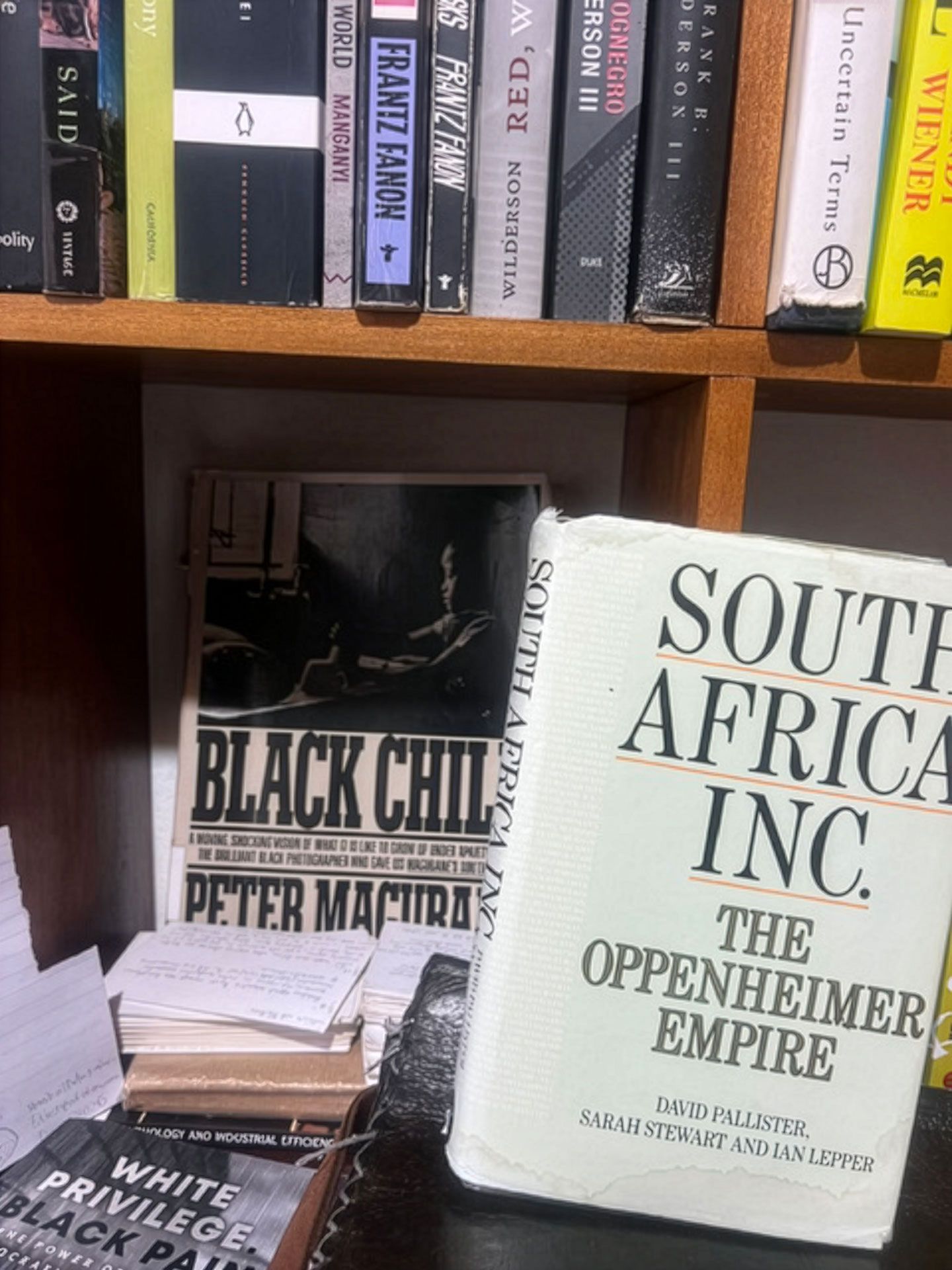
South Africa was never merely a nation that later developed corporations. Company, mine, land law, taxation, migrant labour, compound and state formation were entangled from the beginning. The Oppenheimer empire discussed by Pallister, Stewart and Lepper (1987) was not an external economic force that occasionally interfered with the nation. Corporate accumulation helped organise what the nation was allowed to become.
The transition transformed political citizenship profoundly, but it did not begin on an empty economic field. White capital reorganised. The ANC governed, compromised and made consequential choices. A small Black economic elite entered arrangements whose deeper structures of ownership remained remarkably durable. The postapartheid order cannot be reduced either to a secret sale or to a completed liberation. Political transformation was real. Economic containment was real too.
Here, the figure of Nelson Mandela keeps returning.
Not directly in this book. But the book returns me to him. To the ANC. To the settlement. To the difficult question of what political freedom could become when the economic field had already been so powerfully arranged.
I return to Mandela, capital and political agency in Part Four. Here, Rampolokeng’s anatomy asks the narrower question: what travelled from underground into parliament?
Whose money?
Whose discipline?
Whose fear of disorder?
Whose definition of responsible freedom?
Whose body remained available to work and death?
In “Nihil Spiral,” the book gives us:
“Human wreck landfill/feel & earth-emotion
We live on graveyard-time”
(Rampolokeng 2026, 16)
“Graveyard time” names a present organised through accumulated death. The living wake, work, vote, commute, teach, make love, borrow money and raise children inside institutions whose clocks were built over bodies they do not have to name.
The past does not sit behind the present.
It sets the timetable.
The slash in “landfill/feel” prevents disposal from remaining inert. Is this landfill or land feel? Both. The eye must pass through the cut. Lives are treated as waste, neighbourhoods become dumping grounds and histories are pushed beyond the clean city. Yet the land feels. The dump is not empty. Earth carries emotion.
The suite keeps opening systems inside words: “Sinbred,” “Sinduction,” “Synthetorganics,” “Epidemonics.” Race science, reproduction, religion, nationalism and crowd management are folded into an unstable lexicon. Rampolokeng loves the pun that arrives with a knife already open.
At times the coinage becomes mannerism. The reader hears the machinery of the signature before seeing the particular object it is cutting. That risk must be admitted. A pun can expose a system inside a word. It can also arrive because the writer’s hand already knows the movement.
The strongest poems exceed this risk by returning wordplay to material arrangement: work timed, bodies packed, banks stacked, parliament metabolising underground struggle, science manufacturing hierarchy, charity disinfecting capital and crowds repeating what domination has taught them to desire.
The suite is not nihilism. Its negativity is causal seriousness. It refuses to call surface reform transformation while the breeding system remains intact. It refuses to treat Black representation as the abolition of anti-Black structure. Key!
Nor does the poet stand upon a clean balcony outside the body he dissects. He must eat, perform, publish, accept invitations, use platforms and negotiate the institutions he attacks. The anatomy is performed from inside the body.
Near the suite’s end, silence is denied the status of shelter. But Rampolokeng does not present the familiar phrase as a clean declaration belonging entirely to him. He places it inside quotation marks and names it as something already circulating:
“(talk sick or not ‘your silence will NOT protect you’ runs
the slogan
body-parts make lots not vacant cos homelessness in
death?
happens to us without earth-inheritance”
(Rampolokeng 2026, 25)
The capitalised NOT interrupts the fantasy that silence, withdrawal or private innocence offers protection. Yet the words “runs / the slogan” also matter. Rampolokeng does not merely repeat the warning. He places it inside the damaged world of the poem and asks what the slogan can mean when bodies continue to occupy the lots from which life has been removed.
The lines that follow refuse abstraction. Death produces “body-parts,” but it does not end homelessness. Even the dead remain without secure ground. “Earth-inheritance” therefore turns the warning towards colonial dispossession and the unfinished land question. One can die after liberation, under rights and beneath a Constitution, while the earth remains organised against one’s claim. Peace may be declared, but neither the living nor the dead have necessarily inherited the land.
The anatomy ends where body and land remain separated.
The reader cannot simply agree that “they” are corrupt. We are asked where the punch clock sits inside our own work, where philanthropy cleans our institution, where liberation vocabulary excuses our appetite and where critical scholarship banks value from wounds it cannot repair.
The suite does not offer a programme.
It offers exposure.
When the fires go down, the system does not disappear.
It breeds in the warm remains.
V. Necropeace: Goodness with Teeth
Part III of the book bears the title “NECROPEACE & SPECTACLE: CHURCH, CAPITAL, CLIMATE.”
“Necropeace” is one of the book’s hardest inventions because it names an arrangement we already know but prefer to call stability, transition, settlement, reconciliation or simply moving forward. It is peace after the police have left the scene. Peace after the report, church service, corporate donation, anniversary lecture and camera shot of leaders looking solemn. The killing has completed its public performance. Order returns wearing clean clothes. Violence has not ended. It has changed costume and learnt how to stand quietly.
I do not meet the word “necro” empty-handed. Mbembe is already somewhere in my ear. So are Fanon, Afropessimism, my work on Black worker subjectivity and the question of Marikana.
But theory must wait outside Papa Ramps’s house for a moment. “Necropeace” is not simply necropolitics rewritten in Rampolokeng’s language. Necropolitics helps us name how power distributes exposure to death. Necropeace, as I read it, asks what power does after the killing, when the management of aftermath becomes evidence that order has returned and peace has supposedly been restored.
The camera moves. A report is written. A leader speaks. The company announces concern. Counselling is offered. Compensation enters calculation. The country points to procedure as proof that the institution has responded. But the grave, household, wage claim, debt, school fee, ritual, court file, memory and unfinished demand do not disappear because the official response has completed its programme.
This is where the word I have been calling lif-ing begins, but I will not develop it fully here. Necropeace is the administration of aftermath. Lif-ing names the uneven work imposed upon the living where that administration fails to close the relation.
The dead remain names and claims after the institution declares its work complete. That is why spectacle matters.
Spectacle is the public performance through which managed death begins to resemble peace.
Rampolokeng is suspicious of goodness, which is not the same as believing goodness impossible. He asks what power can do while wearing blessing, charity, climate concern, reconciliation, development and honour. Obvious evil is easy to denounce. The harder object is goodness with teeth.
The smile attached to the machine. “Money-Machine Grin” opens with capital enjoying itself:
“the money machine grins at the angel with clipped wings”
(Rampolokeng 2026, 27)
The line joins the machine’s smile to a damaged possibility of flight. Around it gather damaged minds, factory flesh, machine eyes and unrealised futures. Capital consumes more than labour and land. It consumes what people might have become.
The future becomes edible.
This is why development language can sound obscene beside the poem. A system destroys possibility, then announces an opportunity programme.
The movement towards patriotism and many colours is sharp:
“parts under Joseph’s avarice-coat many colours…”
(Rampolokeng 2026, 28)
The coat is not merely colourful. It is an “avarice-coat”: beautiful enough for the camera, biblical enough for reconciliation and multicoloured enough to cover betrayal. Lumumba, Cabral, Brutus and Biko enter, not as a list confirming the poet’s radical credentials, but as names disturbing the patriotic surface.
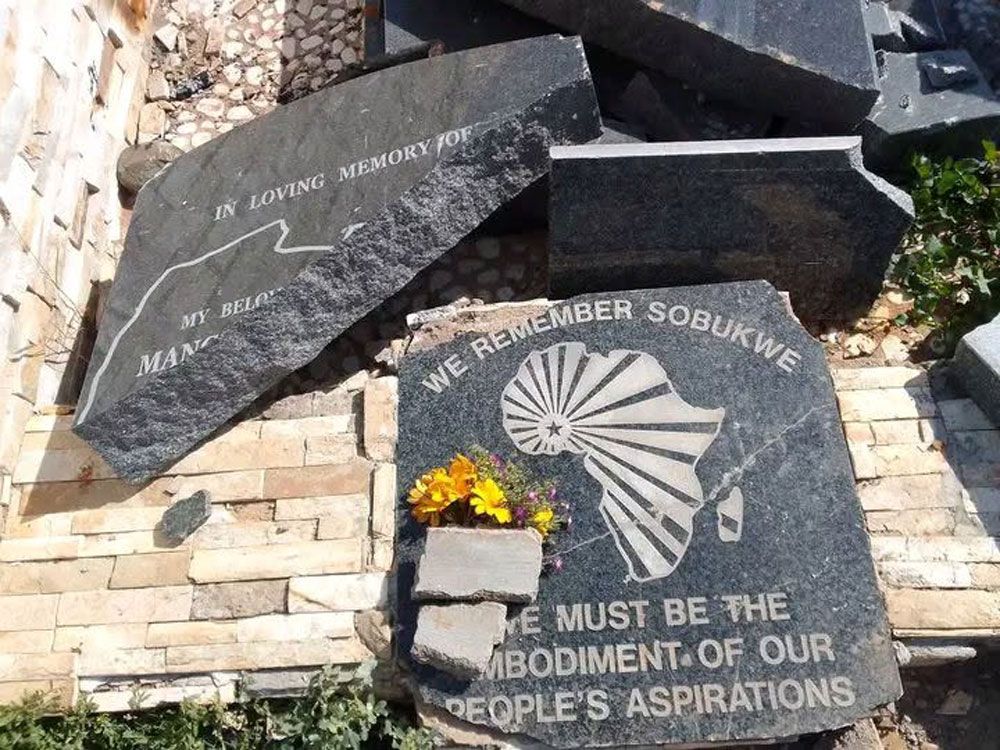
A dead revolutionary can be printed upon a stamp more easily than a living writer can be supported materially. Memory may be displayed by the same machinery that neutralised its demand.
“Dark Script / Necropeace” makes church language bodily, racial and filthy:
“Jesus blood chapel wine intoxicates
Blond-bonded genocide blue-eyed peace
Reconcile the chattel ‘love you master’ says slave
Lies & power wedded land of the mass-graves speaks Life
to strife-driven human livestock Necropolis-kraal nation
herded)”
(Rampolokeng 2026, 29)
The wording is “Blond-bonded,” not “Blood-bonded.” That difference matters. Blond hair and blue eyes give the peace a racial body. This is not peace in the abstract. It is a peace bonded to whiteness, arriving through the same civilisation that produced genocide, chattel slavery and mass graves. “Jesus blood” and “chapel wine” intoxicate rather than redeem. The sacred does not stand outside domination. It helps make domination appear blessed, moral and bearable.
Then comes the damaged instruction: “love you master.” The broken grammar matters. It sounds at once like a command and a coerced declaration, as though the slave has been taught to speak attachment to the person who owns him. Reconciliation enters this arrangement as moral education. Submission becomes maturity. The injured are congratulated for forgiveness, restraint and national responsibility while the beneficiaries retain what forgiveness was required to make morally tolerable.
It is not Life that is wedded to power in the stanza. It is “Lies & power” that are wedded. Their union produces a “land of the mass-graves” that can still speak the language of Life while driving human beings towards livestock. The capitalised “Life” does not announce liberation. It is immediately forced into “strife-driven human livestock,” then gathered into a “Necropolis-kraal nation.”
The kraal ordinarily suggests enclosure, relation, cattle, household and collective life. Rampolokeng fastens it to the necropolis. The nation becomes an enclosure organised around death, but still capable of calling itself alive. People are not gathered as citizens who inherit the land. They are herded as human livestock across ground already filled with graves. The stanza therefore refuses the idea that domination survives through hatred alone. It also survives through attachment, blessing, intoxication and the moral instruction of the injured. Reconciliation can become the ceremony at which the chattel is taught to love the master, while lies and power renew their vows over the mass graves.
Then the title returns:
“the martyring fires come down perversions senses
liberation pavement the gutter’s congestion”
(Rampolokeng 2026, 35)
The fires come down upon a “liberation pavement,” but the line will not leave that pavement clean. It carries “perversions senses” and “the gutter’s congestion.” Freedom becomes a public surface laid over what the new order has not cleared. The state does not deny that people died. It turns their death into the paving upon which its moral legitimacy proceeds while the gutter remains blocked beneath the ceremony.
The sacred is taken through latrine, bowel, administrator and sanitary official. The bodily language becomes excessive at times. Rectum, excreta, pus, intestine and vomit can accumulate until disgust risks becoming general atmosphere. But the obscenity has a target. Power has long used cleanliness as moral authority.
The civilised are clean. The colonised are dirty. The proper church is clean. The body’s appetites are sinful. The respectable state sanitises its speech.
Rampolokeng reverses the gaze. He makes the clean institution account for the waste it produces. “Mark of the Blessed” turns pigment into theology:
“Race-pride backward-construct sanctified pigment”
(Rampolokeng 2026, 31)
“Sanctified pigment” shows race becoming sacred arrangement. Whiteness does not survive only as prejudice. It survives as a metaphysics of deserved protection, inherited possession and civilisational authority. Blackness enters that grid as trespass.
Even after formal law changes, the old blessing can continue organising who appears naturally at home in wealth, expertise, safety and beauty.
Then comes “Baraka”:
“black poetry time clear the slime no slack back-track
whose legend? I am on top of that rip classics”
(Rampolokeng 2026, 32)
The canon is not a neutral shelf onto which another African name can be added. It is a mouth that has pronounced some writing universal and other writing local, angry, oral, raw, difficult and township. To clear the slime is not to abandon reading. It is to expose what the category of the classic has concealed.
The poems that follow manufacture concepts under pressure. “Epidemonics” hears epidemic inside economics. “Extinction Agenda” refuses accidental disappearance. “Belly Tied to Back” names hunger as conquest. “Semio-Ticks” turns signs into parasites. “Glitzkrieg” fuses glamour and attack.
The book does not lack theory. The danger is that the academic reader, ndimke lowo, may admire the labels while failing to enter the poems. “Necropeace” can travel into an article and leave behind the bodies, sounds and ugliness that made the word necessary. The concept is useful only while it keeps its teeth. “Glitzkrieg the Spectacle Rule” gives the section’s warning:
“Glitzkrieg The Spectacle Rule
Past into present turn back show butt to posterity”
(Rampolokeng 2026, 52)
Spectacle does not merely distract from violence. Spectacle can itself attack. Corporate events, cultural festivals, branded concern, tender announcements, public grief, cameras and national ceremonies become part of the machinery producing consent. Violence receives quality control. Outrage becomes cosmetic. Feeling is staged without consequence.
This complicates my demand that South Africa recognise Rampolokeng. The absence of recognition should trouble us. But what would recognition do? Would it read him, publish him, teach him, pay him and argue with him? Or bring him onto a stage, pronounce him national, take a photograph and return the work to cold storage?
A National Order can become justice’s substitute jewellery. “Honeyed Venom” offers the formulation:
“Sin age New dawn hypocrite sages”
(Rampolokeng 2026, 54)
The title does the rest: “Honeyed Venom.” Sweetness can carry poison. The “new dawn” (phala – phala ‘gate’) can preserve the old organs. Redemption can become a way of avoiding accountability. Civilisation learns to speak softly (Matamela cryil) after discovering that the whip looks bad on television. “CLIMATE STRANGE / cosmetic change” widens climate beyond weather:
“cosmetic change”
(Rampolokeng 2026, 55)
There is political, racial, institutional and psychic climate. The poem attacks change that rearranges surfaces while protecting organs. Constitution, reconciliation, protest, luxury, whitewash and colour blindness enter the same field.
Colour blindness becomes a passport into the future. One can inherit racial advantage while claiming not to see race. The demand remains anatomical. Change must touch organs.
“Hope Springs Abdominal Then Dives South” returns hope to the gut (Rampolokeng 2026, 57). Hunger, instinct, digestion, anticipation and a dream milked by somebody else enter the title. The poem mocks “hope springs eternal” without presenting cool despair as superior intelligence. It asks what hope is made to do, who profits from postponement and why the wounded are instructed to wait with dignity.
The global catalogue can sometimes blur Congo, Europe, scripture, climate, capital, race and genocide into one storm. Totality may reveal structure, but it may also flatten the person and place through which violence becomes lived. Rampolokeng’s strongest lines resist that flattening by returning system to belly, organ, coin, tooth, pavement, mine and rent.
Church, too, cannot be read upon one plane. Black religious practice has often transformed Christian signs into resources against colonial authority, as Comaroff (1985) shows. Body, drum, ritual and congregation have been places of resistance. Those same forms can also console the injured and return them to the workplace that damaged them. “Blond-bonded genocide blue-eyed peace” does not tell me every prayer is fraud. It asks when prayer becomes the language through which power blesses the wound without surrendering the weapon.
This is how I receive necropeace.
Goodness must disclose its material arrangements.
Honour may be cosmetic.
The smile may belong to the machine.
VI. Holes, Home, Gwala and the Postscript.
Part IV is titled “MoRA, HOLES & POSTSCRIPTS: RETURN / AFTERMATH.” By now, the reader has passed through Black sonic genesis, the breeding body of power and the spectacle of contaminated goodness. What remains?
Not recovery. Not a stable ruin. Morass, hole, postscript, return. Every word creates a problem of time.
A morass is swamp and difficulty. Movement becomes heavy because the ground holds the foot. A hole can be wound, grave, mine, missing archive, extracted mineral, opening or absence. A postscript appears after the official message has ended. It is usually smaller, allegedly supplementary, placed beneath the main statement as though the important thing has already been said. Rampolokeng writes from the postscript because South Africa’s official text keeps declaring itself complete. Colonialism ended. Apartheid ended. Democracy arrived. The Constitution was signed. The commission reported. The anniversary passed. Then the smaller writing begins making noise.
The “MoRA” sequence breaks moratorium, morality, mourning and morass into unstable sound:
“melanined against extinction
solar blessed lunar embrace
lynch to castration black attack
species what endangered”
(Rampolokeng 2026, 65)
The opening refuses a clean grammar of extinction. “Melanined” is placed against it, not safely beyond it. Solar and lunar blessing occupy the same breath as lynching and castration. Cosmic embrace does not cancel racial violence.
Then “species what endangered” breaks the sentence into a question without giving us the comfort of a question mark. Which species is endangered? Who has been positioned outside the species called human? What survives when the category itself has been organised through Black endangerment?
The claim is not that liberation meant nothing. Well…. /The same page places “this liberation movement inheritance” beside “existence wreck” (Rampolokeng 2026, 65). Historical victory may be real while handing the present an inheritance it has not repaired.
“the more the freedom sound the tighter the fighter/
warrior-slave bound”
(Rampolokeng 2026, 66)
Freedom becomes acoustic pressure. It is loudly announced and materially deferred. The slash leaves the claim unfinished while “warrior-slave” binds revolt to captivity. The more insistently achievement is proclaimed, the more tightly the unfinished fighter may be held inside gratitude.
Then:
“graveyard shifted life-goalposts
cemetery meal mortuary breakfast
dirt to the dead-beat all things in perverted sync”
(Rampolokeng 2026, 66)
The graveyard does not merely wait at the end of life; it shifts the goalposts by which progress, victory and national achievement are measured. “Cemetery meal” and “mortuary breakfast” fold death into the ordinary timetable, allowing the country to eat, work and celebrate upon accumulated bodies. “Dirt to the dead-beat” turns dust to dust into a language of exhaustion, abandonment and social worth. “All things in perverted sync” names not disorder, but a system working precisely through the coordination of life and death. Past glory then becomes a mirror held against present blood, allowing the nation to see only its heroic face.
Then “Home (for Stacy Hardy)” complicates home. Rampolokeng has never allowed home to remain a sanctuary outside history. Home can hold affection, memory, artistic relation and shelter. It can also contain silence, inheritance, violence and extraction. Body holes and earth holes answer one another:
“Surface-scratch the deep gash Cut throats scream hollow
Holes punched in the atmosphere peep through
Socketed out remains after eyeballs pop
holes”
(Rampolokeng 2026, 70)
The hole is not only what extraction leaves behind. It acquires an eye. The atmosphere is punctured and made to “peep through”; the body is “socketed out.” Wound, witness and absence occupy the same opening. Gold, coal, diamond, copper, Kimberley: the ground is punctured so wealth can appear elsewhere as solidity, while bodies are punctured so power can demonstrate its right to enter.
The Big Hole is not merely an old mine or tourist site. It becomes an image of the country’s method: enter the land, remove what can be converted into value and leave the hole as somebody else’s inheritance. But the name in brackets matters. “Home (for Stacy Hardy)” is not a casual dedication.
I first encountered Stacy Hardy and Lesego Rampolokeng together in “Bound to Violence: Scratching Beginnings and Endings with Lesego Rampolokeng,” their chapter in Ties That Bind (Hardy and Rampolokeng 2016). “Interview” is almost too orderly a name for what happens: Hardy asks, remembers and tries to hold a line; Rampolokeng answers through anecdote, anger, humour, autobiography and refusal.
Ties That Bind does not treat friendship as private innocence floating above South African history. Affection may be real without abolishing structure; a white friend does not cancel anti-Blackness, but structure must not erase the actual relation before we encounter what it does.
Hardy remembers approaching him as an “ardent, awkward, searching” reader. Recognition became correspondence and collaboration, an “electric storm” followed by blackout. They did not meet beyond race, but inside a country where race still organised mobility, protection and whose formal experimentation would be received as invention rather than threat.
Their undergrounds were not historically equal. Rampolokeng’s was shaped by apartheid, Soweto, Black Consciousness, exclusion and political violence. Hardy could remain marginal to respectable literary culture while carrying protections of whiteness. Their meeting place was not sameness but a shared and noisy library: Artaud, Tutuola, Baraka, Biko, Dumile Feni, Johnny Dyani and others.
Hardy did not discover Rampolokeng. His words found her first. Nor does Rampolokeng allow the white “friend” to become the benevolent owner of Black difficulty. He jokes: “I can be very liberal to you. My name can be Alan Paton” (Hardy and Rampolokeng 2016, 55). Hardy’s later essay “Indecent Exposure” (2018) gives the dedication another layer: her metal shoulder contains cobalt and titanium extracted from African ground. Congo enters the shoulder; Kimberley enters the poem; the mine enters the embrace. The relation is material, and therefore not innocent. “Friend,” as besele nditshilo, is already dangerous in When the Fires Go Down. It can name somebody who reads, collaborates, argues and returns. It can also name somebody who disappears with a manuscript and reappears for the memorial.
Rampolokeng says:
“I define myself as their friend. Whether they are my friends in turn is for them to say.”
(Hardy and Rampolokeng 2016, 56)
Later, he calls friendship “scary business” and adds: “Mark that, about economics” (Hardy and Rampolokeng 2016, 58).
Who has money? Who knows the publisher? Who owns the studio? Who keeps the manuscript? Who attends the funeral? Who pays for care? Friendship has a political economy. Affection, desire, recognition, dependency, envy, access and intimacy do not exist outside the material arrangements through which relation is lived.
The dedication does not soften “Home.” It places relation inside damaged architectures of race, extraction, disappearance and return. The shared library can be a home, but not an innocent one. Body holes and earth holes remain connected. Friendship, like home, is not where violence disappears. It is where another person may remain without pretending that it has disappeared.
“Gwala Reloaded” is the section’s intellectual centre.
In the 2024 HSS Awards catalogue, Aryan Kaganof (AK) describes Rampolokeng’s contribution to herri 9: Lefifi Tladi as reloading Tladi’s gospel into the literary canon through his tribute to Mafika Gwala (NIHSS 2024, 151). “Canon” may sound like arrival: the difficult Black word finally admitted into the respectable room, shelved, taught and cooled but reloading suggests ammunition, software and return. It does not place Tladi and Gwala inside the canon so that they may sit quietly there. It returns inherited words to circulation with their heat and unfinished demand still inside them.
Mafika Gwala enters beside Fanon, Biko, Mthuli ka Shezi, Walter Rodney, Black Theology, Regina Mundi, Sharpeville, Malombo, Nina and Soweto poetry. The roll call is not a safe Black radical family photograph. It quarrels with how literature is packaged and served.
Rampolokeng writes:
“literature should not be the refrigerated food of the bourgeois”
(Rampolokeng 2026, 71)
Refrigeration preserves by slowing decay. It also removes heat, smell and immediacy. Bourgeois literary culture can preserve Black writing while neutralising what made it urgent. Anthology. Lecture. Theme. Mark allocation. I know this machinery because I teach.
No classroom escapes selection or cooling. The question is whether the cooling becomes the whole relation, whether the poem can disturb the course rather than merely illustrate a concept.
The line “language is a race hiding place” names what literary judgment can conceal when it presents itself as only literary. Poetic and unpoetic, disciplined and excessive, universal and local, serious and angry: none of these distinctions is automatically racist, but each may carry racial history while denying that history is present. Race need not announce itself through a slur. It may already be hiding inside the standard through which a Black sentence is told that it has failed to become literature.
Later, poetry becomes a “distillation of existence” (Rampolokeng 2026, 78). Distillation heats, condenses and intensifies. It opposes refrigeration but carries its own danger: life can be reduced to essence. Rampolokeng resists that reduction by refusing one essence. Sound, history, body and contradiction remain crowded inside the line. “POST-JAG” gives:
“(revolution w/rite movement in the brain-stream”
(Rampolokeng 2026, 79)
The slash cuts while keeping possibilities alive. Revolution is interrupted by evolution. Writing enters movement. The historical question cannot be solved by selecting one half and discarding the other. The postscript then brings Prieska, Sandton, Boipatong and 2020 into one field:
“These were very old new times.”
(Rampolokeng 2026, 86)
Prieska and Sandton do not occupy the same reality. Boipatong returns as massacre memory. The pandemic brings old inequality through new emergency.
“Very old new times” refuses to believe chronology has moral power by itself. Device, policy and leader change. The old relation updates its language.
The final “Post-Poetic Headcharge” returns to material weaponry:
“Pen. Paper. Machine. Bavino weaponry.”
(Rampolokeng 2026, 90)
Writing ‘after’ catastrophe can still injure, misfire, exhaust and become spectacle.
The poet is not exempt from the morass. The weapon is not an abstract gift called talent. Pen, paper and machine are the material tools through which breath becomes inscription and circulation.
A weapon can defend.
It can also wound.
The phrase makes literary labour answerable to consequence.
The section closes:
“VISION DARK.
LIGHTNING BLACK.
MABRAKI”
(Rampolokeng 2026, 92)
Black lightning does not reveal a clean future. It flashes inside the morass and shows the holes without filling them. The postscript does not tidy the main text. It leaves the reader inside the aftershock.
The country writes its official text.
The postscript begins.
There is no minor writing after the declared ending.
The postscript may be where the truth was hiding.
.i said maybe.
VII. Leopard’s Lair: The Executioner Calls It Decency
.after “VISION DARK. LIGHTNING BLACK. MABRAKI,” the book enters “LEOPARD’S LAIR (a study in sadism),” pages 93 to 112.
Sadism.
Not sadness.
I had to correct myself there.
The sequence does not simply mourn Patrice Lumumba. It stages the pleasure, procedure, comedy and administrative confidence through which colonial violence speaks while doing its work.
The form changes. The poem becomes theatre. A room. Instruments. An Executioner. Minions in uniform. Lumumba is held inside a scene where speech is permitted because power believes it has already secured the ending.
The voices do not meet as equal participants in philosophical dialogue. One voice possesses the room, tools and timetable. The other must make language travel while power prepares to remove the body.
Then a Minion hears a rhyme and laughs:
“It rhymes, it rhymes, hm, poetry, sir, hehe”
(Rampolokeng 2026, 93)
Yoh.
Power can rhyme too.
That joke disturbs any easy faith in poetic language. The Executioner has metaphor, mockery, rhythm, theatre and an audience trained to laugh. Colonial power can perform. A slogan can sing while the room remains an execution chamber.
The Minion is not decorative. He repeats, flatters and confirms the authority of the person holding the instrument.
Murder has assistants.
It has people whose employment depends upon finding the killer funny.

The drama returns us to the book’s opening mic check when Lumumba says:
“Power rests in communication systems-Africa shut me
out of my nation’s
broadcast station. That’s one strike that reaped
impotence.”
(Rampolokeng 2026, 94)
He remembers being shut out of his nation’s broadcast station. The sentence makes communication itself a site of political struggle. Before power eliminates the revolutionary body, it separates the voice from the people and interrupts the route through which thought becomes collective force. To be denied the broadcast station is therefore not merely to be denied speech. It is to be made politically impotent, audible only to oneself while the nation is taught to hear another voice. The revolutionary is made inaudible before being made dead.
Always.
Transmitter, radio station, microphone and public address system are not neutral equipment. They distribute political life. Who controls the signal? Who is heard as a leader? Who is made to sound like interference? The first mic check was already asking those questions. “Leopard’s Lair” makes the machinery visible. The book’s sound route becomes difficult to miss: mic check, broadcast exclusion, execution chamber, bass scream, platform connection and failed Android settings.
Lumumba also says:
“I am an idea.”
(Rampolokeng 2026, 95)
I find the sentence both heroic and dangerous. It says that a political dream exceeds the private body. But the body remains, and so do the relations surrounding it. The idea may travel, but its costs travel too. The sequence does not resolve that tension.
Good.
Political commitment cannot be reduced to private responsibility, but revolutionary immortality should not make the ordinary people carrying the consequences disappear.
The Executioner’s most frightening language arrives on page 100:
“We are decent here.”
(Rampolokeng 2026, 100)
Power offers false procedural choices, as though participation in the administration of violence makes the process humane. The options do not dignify the person. They make brutality look orderly.
This is goodness with teeth again.
The Executioner does not say: we are beasts.
He says: we are decent.
That is worse.
Violence has learnt the language of choice, professional conduct and humane treatment. The institution keeps its instrument while inviting the condemned person to participate in the packaging.
Then the title turns:
“Look where it got you, leopard’s lair. Yes, Leopold’s lair”
(Rampolokeng 2026, 100)
Animal and Belgian king, whose Congo regime killed millions of Africans, move through one another. Leopard becomes Leopold. Predator becomes monarch. Jungle fantasy becomes imperial archive. The lair is Congo, Belgium, court, execution chamber and the postcolonial leadership that may inherit the room without dismantling its appetite.
The Executioner repeatedly diagnoses Lumumba. Too many words. Useless ideas. Disease. Madness. Dangerous ambition. The colonised thinker becomes medically, morally and intellectually defective. Violence turns the person into a problem, then presents elimination as treatment.
Christian chant keeps entering the room. The Minions praise the Lord while helping power do its work. The sequence does not say faith is automatically fraud. It shows how easily sacred language becomes atmosphere around authority.
Prayer can comfort the wounded. It can also make the instrument sound righteous. Lumumba refuses the confidence that bodily death will settle the argument. Shackles become sound. Pain enters the walls. He ends one movement with:
“Let the STORM rip.”
(Rampolokeng 2026, 105)
The storm is not a promise that history will avenge every death. It is a refusal of the Executioner’s belief that silence follows the final blow. Killing continues producing memory, accusation, conflict and political relation. Death fails to terminate the question.
The sequence then turns towards Black women. Lumumba asks whether Black people are imagined as specially equipped to absorb violence and whether Black women are expected to suffer sexual violation more readily than white women (Rampolokeng 2026, 109).
The question is necessary and incomplete. Black women cannot enter only as the deepest proof of racial injury while remaining outside the centre of political thought. I return to that gendered grammar when I quarrel with the book.
By pages 110 and 111, memory, heritage, Christian language, poverty and ideological fire occupy the same damaged ground. The sequence is no longer only reconstructing Lumumba’s assassination. Congo has become a way of reading the modern Black world and its repeated promise that the next administration will finally become humane.
The final page leaves us with no clean outside:
“The abyss is within.”
(Rampolokeng 2026, 112)
That is the correct entrance into the OG Sessions.
The elder does not arrive after history has finished. He arrives after the book has shown that the Executioner, Minion, colonial appetite and postcolonial betrayal are not merely enemies standing outside us. The abyss has entered institution, leadership, language, memory and subject.
. the OG enters carrying all of that noise.
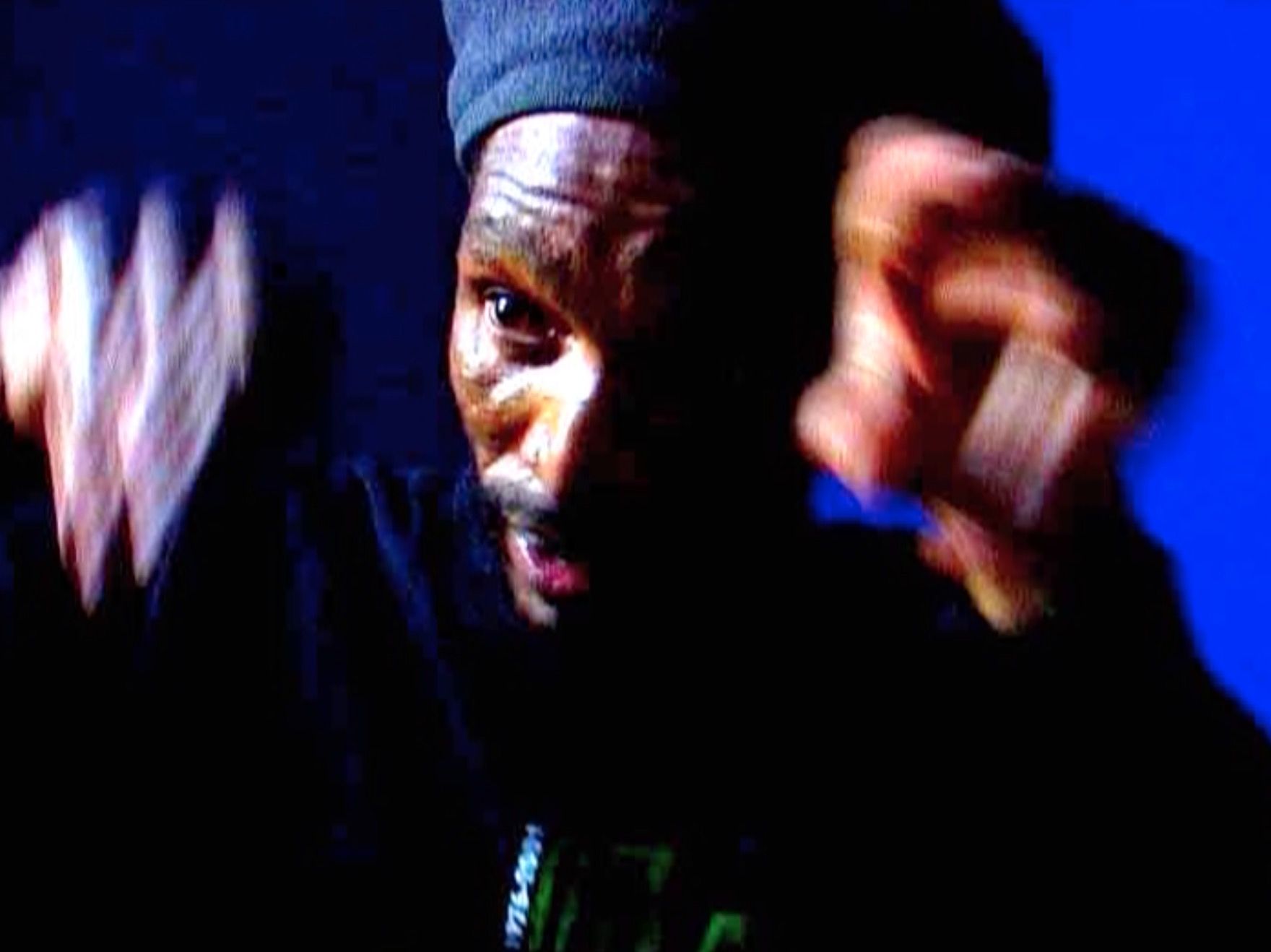
VIII. The OG Sessions: Bass, Books, Hunger, Desire and the Rent Bill.
Part V begins: “THE OG SESSIONS.”
OG can mean original gangster, elder, originator, somebody who was present before the later fashion arrived. “Sessions” can mean recording, therapy, jam, teaching, confession, work, drinking or waiting.
The title gives us an elder still in process, not one already mounted upon a pedestal and made safe for national memory.
The OG is still speaking. Still irritated. Still listening. Still broke, imagine that, French friend. Fourteen books later. Still vain. Still funny. Still capable of being wrong. Still refusing the calm wisdom expected from a national literary ancestor.
The sequence opens with “Bass Scream.” Bass is foundation and bodily vibration. A scream is alarm. Their combination refuses the demand that ageing must soften the volume. The elder voice remains low, heavy and capable of making the body register danger before the mind has completed its explanation (Rampolokeng 2026, 113).
Page 114 turns the scream towards the self. The poem asks about reflection, redundancy and the machine that continues working while the person fears becoming surplus. Elderhood does not exempt the writer from literary fashion, labour markets or the terror of being declared finished. “Rhyming in Circles” makes the method explicit:
“When I’m Rhyming in circles
Revolution 360 degrees of motion in Black
on white”
(Rampolokeng 2026, 116)
The straight line belongs to progress narratives and efficient arguments. A circle returns, revises, traps and gathers. Rampolokeng’s recurring complaints about theft, false friendship, unpaid labour and national neglect cannot all be dismissed as repetition produced by an older man’s bitterness.
The conditions recur. The rhyme circles because the economy circles. But the circle is not automatically profound. Return may register historical persistence, and it may also become habit. A reception must remain alert to both possibilities.
“Regina Mundi” returns church and struggle memory to a living acoustic space. It is not merely a heritage building waiting for another commemorative speech. Prayer, police violence, martyrdom, political organisation, commerce, sexuality and the afterlife of Black Catholic memory collide across pages 118 to 121.
The poem opens by refusing the clean language of memorialisation:
“Regina Mundi wounded catholic counted
No morning but broken spinal column
Multiple skeletons rattle the brains”
(Rampolokeng 2026, 118)
The church appears as a wounded body. Its history is carried through spinal column, skeleton, rib cage, blood and brain, not through the calm vocabulary of heritage. The dead do not rest as honoured ancestors who have completed their work; they “rattle the brains.” Memory remains neurological disturbance, refusing the peace of a finished national story.
Rampolokeng names Sekete, Vincent and Solomon beside “the freedom tree” and the “Sasol 3 rib cage” (Rampolokeng 2026, 118). The names do not arrive as a ceremonial roll call. They enter a damaged anatomy. Freedom itself has ribs, wounds and a heart that can be molested. The church holds memory, but holding does not mean resolving.
The poem then turns upon the people and institutions that profit from this wounded archive:
“F/art-entrepreneurs no respect for Art, practitioners
Now all is product, deals gross caught in net-works”
(Rampolokeng 2026, 118)
The struggle site becomes a cultural site; the cultural site becomes a market. Martyrs become programmes, posters, tours, academic papers, performances and funding opportunities. “Laurels and caskets” sit in the same poem because honour and burial have entered the same economy. A dead revolutionary can be celebrated more easily than a living artist can be paid.
The poem does not leave sexuality outside its account of violence. It moves “from closet to prison to coffin” while running “on the same spot” (Rampolokeng 2026, 119). Progress becomes stationary motion. The country announces movement while reproducing the routes through which particular bodies are disciplined, imprisoned and killed.
By page 120, praise itself has become suspicious:
“Upfront they praise but behind its erasure they project”
(Rampolokeng 2026, 120)
The line catches a whole national practice. The artist is praised publicly while being erased materially. The martyr is honoured while the demand for which the martyr died is neutralised. The institution celebrates dissent after removing its capacity to disturb. “Regina Mundi” therefore does not permit me to separate memorialisation from management. Memory may be welcomed precisely because it has been made administratively safe.
The poem ends its movement through an image of power consuming itself:
“Snake that eats up its self
That is how power, devours”
(Rampolokeng 2026, 121)
Power does not only destroy what stands outside it. It absorbs, softens and recycles what once opposed it. Warriors become “teddy bear soft.” The tongue is cut off and can “only scream in the mime.” Neutralisation does not always require silence. Sometimes the dissident remains visible, celebrated and completely inaudible.
The echo inside Regina Mundi is therefore not heritage.
It is unresolved pressure.
That pressure follows into “Recidivist Victim 1,” the long movement across pages 122–139. A recidivist is usually the person who offends again; Rampolokeng fastens that language to “victim.” The victim is made responsible for returning to injury, while the system’s repetition disappears from view.
The opening pages announce recurrence directly:
“Nothing original in the replay”
(Rampolokeng 2026, 122)
Politics, propaganda and aspiration repeat. The critic, tourist, expert, politician and cultural consumer circle the same Black body while pretending each encounter is new. The sequence begins in compressed poyem, then loosens into anecdote, complaint, flirtation, book trouble, hunger, clothing, teeth and irritation. That loosening is how recidivism enters daily life.
A writer has a body. South Africa nevertheless loves the Black artist most securely as an event—performance, festival appearance, decolonial panel, heritage poster, twenty minutes of public fire—while the cost of returning home becomes private.
On pages 124 and 125, art is first imagined through the communal. Then the speaker corrects the romance:
“Even with all the ‘communal’ talk granted
This attempt at ‘art-creation’ finds one in…a very lonely
place, often”
(Rampolokeng 2026, 125)
The sentence changes the room. Community gathers around the completed work. People speak of movements, cultural families, scenes and collective struggle. But somebody still sits with the failed line, unpaid hour, blank page and fear that nothing will arrive.
The speaker lists what he carries:
“Literature, music, film, you know…f/art thingies.
And not much else besides….
Not a cent.”
(Rampolokeng 2026, 125)
The cultural baggage is full. The pocket is not. A person can carry a world and still lack what makes ordinary movement possible. The book does not turn this into noble suffering. The voice is irritated, proud, funny and exhausted. It knows the value of what it carries and knows that value does not automatically become money.
A country can call somebody a genius while requiring genius to remain inexpensive.
The passage involving pap sak and sweet aid makes class relation less tidy. The speaker misses people whose tastes, drinking habits and material worlds differ from the spaces into which writing has carried him. Then he corrects the nostalgia: “I miss them but then I think…no, I am good” (Rampolokeng 2026, 125).
Memory does not become sentimental homecoming. Affection, shame, distance, relief and class movement remain mixed. Returning is not automatically healing. Sometimes what one misses is precisely what one cannot live inside again.
Pages 126 and 127 repeatedly turn invitation into possession. There is a dress code. There are Sunday clothes the speaker does not own. There is pap he cannot successfully cook. Then comes the brutal joke:
“Setting up a new drive called ‘adopt a poet’”
(Rampolokeng 2026, 127)
The poet becomes a desirable addition to somebody’s household, “especially at a distance.” Come speak. Come stay. Bring the book. Read the manuscript. Meet my friends. Let us adopt the poet.
The invited person is expected to remain grateful while everybody else acquires a story about proximity to the difficult Black writer. The poet becomes evidence that the household, institution or festival is open, interesting and culturally alive. He is welcomed as long as his presence remains manageable.
Recidivist victim. The injury repeats through hospitality.
Page 128 brings national language down to the beard:
“Feeling harassed in this place.
Every barber I walk past
Tells me I need a shave.
Oppression. first it was apartheid.
Now it is about my beard.
‘no justice no peace!’”
(Rampolokeng 2026, 128)
I think the joke works because the scale is deliberately wrong. Apartheid and grooming are not equivalent. Yet the exaggeration also exposes how the body remains publicly available for correction.
Somebody is always telling the Black person how to appear, speak, dress, trim, calm down or become acceptable.
The same page distinguishes “poor” from “cheap.” That difference is central to the sequence. Poverty names material condition. Cheapness describes the decision by others to treat the person’s labour, time and presence as though they should cost almost nothing. The sequence then turns towards hero worship. On page 129, the speaker remembers a school choir performance and an older boy he admired. The admired figure coaches him into singing the wrong notes. The performance collapses while the hero watches with a “huge grin.” The anecdote ends:
“And I know that was the day I stopped having heroes.”
(Rampolokeng 2026, 129)
The wound is small beside the massacres and martyrs elsewhere in the book. It is still formative. Admiration creates exposure. The person one follows may guide one towards humiliation. The recidivist victim does not only return to structures of state and capital. He returns to the smaller betrayals through which trust learned suspicion.
On page 130, language and grooming sit beside one another:
“Done with english.
More than tired.
Soulsucked.”
(Rampolokeng 2026, 130)
Then:
“I need someone to groom me.”
(Rampolokeng 2026, 130)
English and appearance become related demands. Both can require the unruly person to present himself acceptably before the world agrees to listen. Yet the desire to be groomed is not only capitulation. The speaker wants to look good. He wants to be seen favourably. He is tired of looking starved.
This ordinary vanity does not weaken the political work. It prevents me from turning Papa Ramps into a noble body that exists only to suffer for literature. The living writer can be vain, hungry, suspicious, desiring, annoyed by insects, worried about teeth and tired of his own body. That is also what living means.
The admirer on page 131 has apparently followed the work for years, then asks the poet’s name. Recognition and ignorance occupy the same sentence. The work is loved without the person becoming fully known. The public figure is familiar enough to approach but not known enough to be remembered accurately. Even praise can reproduce disappearance.
Time becomes another material object on page 132. The speaker warns people away from his library and refuses the assumption that access to him includes access to his books. Then he says:
“Time (my time) is precious, expensive…”
(Rampolokeng 2026, 132)
A public voice is mistaken for public ownership of the person carrying it. Festivals, publishers, friends, admirers and institutions enter the same unstable economy of access. People pay for nothing, ride along, drink, praise, borrow and later behave as though the artist’s refusal is the real offence.
The economic correction becomes even clearer on page 134:
“If only I could trade applause and praise for cash”
(Rampolokeng 2026, 134)
I do not think Lesego is saying applause is nothing. Recognition matters. But the sequence refuses to let symbolic value pretend that it has paid the rent. The artist cannot eat prestige. The body cannot repair itself with a standing ovation. Still, the pages refuse to flatten the person into a rent bill. The speaker cooks for his son, worries about rats and roaches, jokes about films, remembers relatives, complains about messages and admits his dread of being around people. The father, neighbour, drinker, patient, flirt and frightened person remain inside the public artist.
The sequence keeps changing scale because victimhood does not remain in one register. It moves from apartheid to the barber, from coloniality to the cockroach, from the publisher to the pocket, from praise to loneliness and from the national archive to a notification that is not the hoped for bank deposit.
By pages 136 and 137, the comedy darkens into dread. The speaker admits that being around people makes his insides freeze, then immediately returns to rats, neighbourhood irritation and political language. The movement is not incoherent.
It is the life of a person whose nervous system cannot keep national violence, literary labour, ordinary fear and domestic annoyance in separate files.
Then, on pages 138 and 139, the prose fragments tighten back into compressed verse. The sequence relapses into its earlier pressure. Medicine, religion and education enter the market. Bodies become merchandise. Liberation becomes immigration into colonial self sale. The person is returned to the same systems from which the anecdotes briefly appeared to offer escape.
The section ends with one word:
“Nothing”
(Rampolokeng 2026, 139)
That ending returns me to the title. “Recidivist Victim 1” circles, jokes, desires, remembers, accuses, cooks, drinks and flirts, then returns to the structure. The wound and complaint recur because the scene has never stopped coming back to him.
Then “Fugees Sample” arrives on pages 140 and 141.
I hear several things entering through the title at once. The Fugees. Fugitive. Refugee. Fugue. Sample. A sound lifted from elsewhere and made to work again, but also a specimen cut from a larger body and presented as evidence of the whole. The title therefore keeps invention and extraction inside the same room. Sampling can honour an archive. It can also reproduce the older habit of taking the voice while leaving the person behind.
The poem announces that its sample is contaminated:
“Worms in this poem, its heart is not warm”
(Rampolokeng 2026, 140)
The poem refuses the expectation that political art must warm the heart, restore belief or make suffering available for uplifting consumption. Worms are already inside it.
The work is not a clean container carrying a message from poet to public. It is a decomposing body, and the reader must enter knowing that language itself has been eating and eaten.
The political, religious and financial worlds then begin leaking into one another. There is “Blood in the street,” a command to “abort the burial,” a “presidential order,” priests, prostitutes, bank accounts and a country made “membered honourable” through sacrifice (Rampolokeng 2026, 140). Burial is interrupted because the dead are not allowed the privacy of death. They must still be reported, counted, commemorated, converted into programme, profit and patriotic meaning.
On page 141 the poem condenses the whole operation:
“Brown to green dust to dollars”
(Rampolokeng 2026, 141)
Brown earth. Green money. Dust made liquid inside the financial system and then returned as ownership. The transformation appears almost magical, which is precisely why Rampolokeng places it beside “SA political religion miracle.” Capital does not only extract. It performs conversion. Ground becomes commodity, death becomes value and dispossession becomes somebody else’s balance.
The sample ends in Sandton:
“By the keyboard by the mouse
Must come to pick up the sandton teacup stock x2”
(Rampolokeng 2026, 141)
The keyboard and mouse return the extraction to the digital present. No mine shaft is necessary at the point of exchange. Somebody clicks. Somebody’s inherited wealth moves. Somebody drinks from the Sandton teacup. The x2 turns the line into refrain, transaction and repeat command. This is how the sample works. The violence is compressed, circulated and played again.
“Nothing Cubic Squared,” pages 142 and 143, refuses to leave nothing alone. Mathematically, nothing raised, cubed and squared should remain nothing. Rampolokeng instead makes nothing overcrowded. Nothing contains biological warfare, enslavement, poisoned blood, religious salvation, European currency, land theft, extermination and the racial manufacture of knowledge.
Nothing has dimensions here. Nothing has volume. Nothing has institutions.
The poem places Africa inside an economic and environmental assault:
“Euro dollar pounded Africa continental acid chemical
dumping ground”
(Rampolokeng 2026, 142)
“Pounded” carries currency and violence together. The euro and dollar are not merely measures of value. They strike. The continent becomes a ground upon which wealth is accumulated and poison discarded. The dumping ground is environmental, but it is also philosophical. Africa becomes the place upon which Europe disposes of what it does not wish to recognise as belonging to its own modernity.
Then the poem asks:
“Rising sun, what happened to the land?”
(Rampolokeng 2026, 142)
The question is almost childlike. That simplicity hurts. After all the language of progress, civilisation, salvation and development, where is the land? Who owns it? Who works it? Who has been made to disappear from the account of its ownership?
Page 143 answers through the Abatwa:
“Invisible, genocided by neglect”
(Rampolokeng 2026, 143)
“Genocided” is made into a verb because genocide is not only an event located securely in the past. It is something done through neglect, invisibility and the refusal to recognise a people as politically present. The line refuses the comfort of believing that destruction always arrives dramatically. A people may be erased through the quieter organisation of memory, land, education and official attention.
This is where I need my own word: nothingification.
It is not Papa Ramps’s word. It is the word I require to name the operation through which a full Black life, history or claim is reduced before it is heard.
nothing important.
nothing professional.
nothing beautiful, stable or requiring institutional responsibility.
Rampolokeng’s poem exposes the lie inside this verdict. Nothing is never empty. It is crowded with the labour required to make a person, people or history appear negligible. The poem ends among “Nothing comedic profane tragic” and “The hideous obscene” (Rampolokeng 2026, 143). Nothingification is therefore not absence. It is organised reduction.
“Recidivist Victim2,” pages 144 and 145, returns the victim again. The number matters because this is no longer a single wound or a single formal experiment. “Recidivist Victim 1” moved through prose, anecdote, body trouble, money, loneliness and ordinary embarrassment. “Recidivist Victim2” returns to compressed verse and throws the victim into a transnational history of slavery, fascism, colonialism, eugenics and compromised liberation.
The form itself recidivates.
The poem names Dessalines, Zumbi and Cabral, but it does not arrange them into a clean revolutionary genealogy. Their names enter what it calls “this disease age” and “An aborted rebirth vote” (Rampolokeng 2026, 144). Political birth takes place, but the birth is aborted. Voting occurs, but it does not automatically deliver the rebirth promised by liberation.
The poem then says:
“History lesson, apartheid design
Its architect self-pull-apart stratagem”
(Rampolokeng 2026, 144)
Apartheid is a design, not only a prejudice. It builds distance, property, institutions, desire and knowledge. “Self-pull-apart” carries the violence into the subject. The design teaches people to separate from one another and from themselves. The architecture continues even when the official architect has been condemned.
Page 145 gives the national contradiction in one line:
“Proof of wealth but malnutrition movement in stealth”
(Rampolokeng 2026, 145)
There is no absence of wealth. Wealth proves itself everywhere, in buildings, banks, private schools, estates, mines and the calm lifestyles of inheritance. Malnutrition nevertheless moves beside it “in stealth.” Poverty is then treated as a mysterious failure occurring inside a prosperous society, rather than as the relation through which prosperity is organised.
The ending is brutal:
“Set sail and the happy slave ship docks on master shore
Return to the slime scene
Recidivist Victim comes back for more”
(Rampolokeng 2026, 145)
The victim appears to return voluntarily, almost greedily, “for more.” That is the cruelty inside the title. Liberal language repeatedly converts structural recurrence into personal appetite. Why does the victim keep returning to race? Why does the victim keep speaking of colonialism? Why does the victim not move on?
Because the ship keeps docking. Because the scene has not closed. Because the structure keeps coming back for more. “Riddim Rhyme Reason” runs across pages 146 to 150. The title is not a decorative announcement about sound. It offers a theory of thinking.
“Riddim, rhyme, reason”
(Rampolokeng 2026, 146)
Riddim is method. Rhyme is memory. Reason is not the private possession of the well-ordered academic sentence. The poem thinks by returning, mutating, replaying and forcing distant historical objects into the same acoustic field. The refrain later becomes:
“Riddim, rhyme, reason…Prime”
(Rampolokeng 2026, 148)
“Prime” makes the refrain less settled. First cause. Prime time. Prime minister. Prime number. Prime property. Something made central, original or superior. Yet the poem gives primacy to riddim before reason. The beat is not added after the argument. It carries the argument.
Rampolokeng moves through Christian artillery, empire, genocide, hospitality, slavery, Khoisan extermination and the claim that Europe owns the very concept of the Holocaust. The poem does not say these histories are identical. It attacks the authority through which some forms of mass death become the universal measure of atrocity while others are provincialised, doubted or left outside the recognised archive.
Then comes the DJ instruction:
“Wheel it back to 1652”
(Rampolokeng 2026, 148)
History becomes vinyl. To wheel it back is not to become trapped in the past. It is to refuse the lie that the present began yesterday. The poem rewinds because the beat currently playing was laid down much earlier. Land, labour, religion, racial classification and commercial violence remain inside the track.
On page 149, “settlement” becomes unstable:
“What settlement outside the court of public opinion”
(Rampolokeng 2026, 149)
Settlement means colonial arrival, negotiated resolution, legal payment and the command to settle down. South Africa carries all these meanings. The colonial settlement creates the dispute, then asks for a peaceful settlement that will not disturb the property produced by conquest. The court of public opinion becomes another tribunal in which the injured must prove they are reasonable enough to deserve what was taken.
The poem returns to the infrastructure of conquest:
“Van Riebeeck broken backs, laid out like railway tracks
Legacy of bodies on conveyer belts”
(Rampolokeng 2026, 149)
The railway is not simply laid upon land. Broken backs become the tracks. Bodies become infrastructure. The conveyor belt of modern production carries a legacy that official economic language prefers to describe as growth, development and labour supply. Rampolokeng makes the buried body reappear inside the machine.
After all this, the poem does not settle for survival:
“I strive beyond survive to live”
(Rampolokeng 2026, 150)
Survival is necessary, but it can become the low ceiling imposed upon Black existence. Be grateful that you endured. Be proud that you survived. Do not ask what life might have been without the continuous demand to overcome. The sequence closes:
“Dark, since born
Blind to the light in liberty’s dead eyes”
(Rampolokeng 2026, 150)
Liberty has eyes, but they are dead. The problem is not merely that freedom has failed to see. Its organ of vision has been killed while the word itself remains publicly alive. The nation can continue speaking of liberty even after liberty has lost the ability to recognise those living beneath its name.
“Salvation Sail,” pages 151 to 153, takes the language of rescue and places it upon a vessel already carrying business, medicine, war, prison, religion, humanitarian conference, surveillance and the slave ship. The opening gives us “wellness business, disease high price” and “hunger alleviation conference” (Rampolokeng 2026, 151). The conference does not necessarily end hunger. Hunger becomes the reason for the conference, the funding, the careers, the reports and the professional language of alleviation. Suffering produces an organisational world around itself. Then:
“Commerce, the only truth”
(Rampolokeng 2026, 151)
The sentence is not simply saying that everybody loves money. It names a system of translation. Religion, medicine, security and humanitarianism may speak different moral languages, but suffering is repeatedly translated into market value. The body becomes a client, patient, prisoner, beneficiary, donor, research subject and consumer. The poem makes the translation explicit:
“Ship are shares
Life as project, existence is product
Flock market, salvation stock”
(Rampolokeng 2026, 152)
The rescue ship carries shareholders. Life becomes a project to be managed. Existence becomes a product. The flock of the church becomes the market of capital, and salvation becomes stock that may be bought, sold, invested in and displayed.
The poem also refuses the innocence of medical language:
“What donation without consent
Sterilisation, depopulation
Immaculate contraception”
(Rampolokeng 2026, 152)
“Immaculate” returns reproductive violence to religious mythology. The institution may describe itself as healing while deciding whose reproduction is desirable, whose body is available and whose consent may be treated as administratively inconvenient.
By page 153, the health system has become a “mortality” industry:
“Health profiteer mortality industrialists”
(Rampolokeng 2026, 153)
Rampolokeng’s grotesque list of doctors, nurses, surgeons, psychiatrists, anaesthetists and pharmacologists does not ask us to believe that every individual healer is secretly murderous. It destroys the clean boundary between care and institutional power. Healing professions can become entangled with classification, confinement, experimentation, profit and the authority to decide what counts as a normal body or sane mind.
The poem then gives us:
“Derail detour arrest…movements”
(Rampolokeng 2026, 153)
Movement is not only stopped through spectacular repression. It is diverted, delayed, diagnosed, processed and sent along another administrative route. A struggle may be recognised, consulted and professionally managed until it can no longer reach the place towards which it began moving. The salvation sail does not rescue people from the system. It may be one of the system’s ships.
“General Patton,” pages 154 to 156, militarises the general order. Patton is the named general, but the opening also hears pattern: “Insane patterns a continent pummelled into the sand” (Rampolokeng 2026, 154). Militarism is not confined to the army. It enters the corporation, church, court, government, school and ordinary command structure. The poem’s compact institutional genealogy reads:
“Army thuggery, corporate rape
Clergy buggery
History in the bank”
(Rampolokeng 2026, 154)
History does not only remain in archives and memory. It is banked. It accumulates interest. It secures property, credit, education and the authority of inherited ownership. Some people inherit the deposit. Others inherit the debt created by it. “History in the bank” is therefore both material and moral. The bank remembers conquest even when the nation pretends to have forgotten. Ownership carries yesterday forward without needing to announce its historical origin each morning.
The poem moves from military discipline towards the managerial vocabulary of unity:
“Population fraction coerced
Whipped into line
Top-down declaration
Calls that social cohesion”
(Rampolokeng 2026, 155)
Yho.
I know this language.
Coercion is renamed cohesion. Obedience becomes alignment. Silence becomes stability. A decision imposed from above is later presented as evidence that the organisation, institution or country has achieved consensus. People are whipped into line and then congratulated for standing together.
Rampolokeng sharpens the point:
“Witness the violence in the silence between, explosions”
(Rampolokeng 2026, 155)
Violence is not confined to the explosion. It inhabits the silence between explosions: the waiting, surveillance, deprivation, threat and forced adjustment through which domination becomes ordinary. Peace can therefore be the interval in which violence is no longer loud enough to disturb those protected from it.
Page 156 turns chronology into bodily injury:
“Tripped on the past, had to creep into the present
Future tongues on broken glass”
(Rampolokeng 2026, 156)
The present is not entered standing upright. The subject creeps into it after being tripped by the past. The future does not speak freely either. Its tongue must move across broken glass. Historical violence therefore damages the bodily capacity through which futurity might be named.
The poem ends its movement with “When all roads lead west” (Rampolokeng 2026, 156). West is not merely direction. It is the accumulated authority of European history, Christian civilisation, capital, knowledge and development. Even resistance is repeatedly instructed to travel through its concepts, institutions and standards of recognition before it can be considered intelligible.
Then “Viper Spit,” pages 157 and 158.
The poison does not arrive once. It moves through a “repeater drum.” The beat carries the venom forward, as inheritance, common sense and institutional memory.
The opening image is devastating:
“African, stuffed animal
Cut tongue ability to speak
Skin rug, less and more precious than Persian”
(Rampolokeng 2026, 157)
The African is preserved by being killed. Displayed by being silenced. Valued as object while denied value as speaking person. The museum, study, tourist gaze and heritage industry meet in the stuffed animal. The body is made available for looking precisely because its tongue has been cut.
The poem later names the reversal upon which colonial compensation was built:
“Pillagers demand compensation
Freed slave, lost income”
(Rampolokeng 2026, 157)
The pillager becomes claimant. Emancipation becomes financial injury to the owner. Freedom is calculated as lost income. The person formerly treated as property is told that liberation has imposed an unfair cost upon the person who possessed them.
That logic did not simply disappear. Beneficiaries of conquest continue to describe restitution as injury, redistribution as theft and equality as discrimination. The historical winner experiences any interruption of advantage as persecution.
Then:
“Heritage a mirage, death of I and I”
(Rampolokeng 2026, 157)
Heritage promises continuity but may preserve only the form approved by the institution. The living relation becomes museum object. “I and I,” the self in relation to self, community, spirit and another, is reduced to display. Heritage may therefore kill the very relation it claims to preserve.
The gaze becomes openly anthropological:
“Voyeuristic exhibition, snapshot tourist through ghettos
Abject study subject ME”
(Rampolokeng 2026, 157)
The capitalised ME interrupts the distance required by voyeurism. The object looks back. The neighbourhood is not merely a site through which the tourist, researcher, journalist or artist gathers evidence of suffering. Somebody lives inside the frame. Somebody is being converted into the visitor’s knowledge, sympathy, photograph or career.
Page 158 brings poison into law and nationality:
“Possession by violent force
Legislation perversion
Foreign naturalization
…become alien invasion”
(Rampolokeng 2026, 158)
Possession begins through force and is later secured through legislation. Once law has naturalised conquest, the original inhabitants may appear foreign to the spaces taken from them. Their return becomes invasion. Their land claim becomes extremism. Their insistence upon birthright becomes a threat to order.
The sequence closes:
“For the living inbred born dead nation.”
(Rampolokeng 2026, 158)
I do not receive “born dead nation” as proof that nothing changed in 1994. That would be lazy.
And bubuxoki.
The phrase asks what kind of political birth took place without ending conquest, land theft, racial capitalism and anti-Black value. “Inbred” suggests that the new nation continues reproducing itself from relations inherited from the old one. A Constitution may issue legal life while property, labour, knowledge and social worth continue carrying death inside the certificate.
Now, that is serious. Yinyaniso, mtaka bawo. Mtaka mama.
A nation can be born, recognised, flag raised, anthem sung, courts opened and elections held, while the founding distribution of life and death remains lodged inside its body.
Snap.
Then, astonishingly, page 159 gives us Android device instructions.
Download.
Activate.
Settings.
Access point names.
Save.
Restart.
After the historical assault, the reader receives the flat language of connection.
Lol. Hehehe ufather.
But the joke has a system inside it.
The postcolony is also a device that will not connect. Access appears to be a matter of settings while infrastructure remains unequal, badly wired and permanently buffering.
The older poet is not outside digital life. He is inside its failed signal. The OG remains in session. The writer has a body, books, hunger, desire, damaged equipment, expensive time and a rent bill.
He has not finished arguing with us.
IX. In the Kill Zone: Seen, Followed, Groomed
The platform architecture I named earlier becomes intimate in the Kill Zone. Here it has a face, friendship request, unanswered message, follower, filmmaker and adult body being assessed in public.
Part VI abandons conventional poem titles and moves through numbered fragments. “IN THE KILL ZONE” is not only a field of spectacular death. It is the ordinary zone in which the living writer is contacted, consumed, assessed, followed and asked to explain his own continued existence.
The fragments resemble posts, notes, remembered conversations and complaints written between obligations. Somebody calls. Somebody sends a request. Somebody wants an interview. Somebody asks how poets live. Somebody offers work. Somebody looks at the body and believes the looking has completed the reading.
The fragment is not a failed essay awaiting the critic’s continuity. Hardy’s language of brokenness and viscerality helps here. The break precedes the arrangement.
The writing gathers without pretending that the pieces were ever whole.
Early in the sequence, the speaker announces that he needs gainful employment. Somebody offers a “piece job.” He retreats into the claim that he works only on paper (Rampolokeng 2026, 163). Lol.
I have to remain with the contradiction.
The scene is not simply proof that society refuses to employ the poet. He asks for work, then distinguishes his labour from the manual work offered. Artistic dignity, class distinction, bodily limitation, embarrassment and the refusal to recognise writing as labour enter the same exchange. I will not rescue him by making the answer perfectly coherent.
The book is stronger because the living writer is not turned into the ideal victim. He can demand recognition for writing while revealing the hierarchies through which he understands other forms of work.
Then Grahamstown enters the book, not only as the town from which I am reading, but as a place where Rampolokeng remembers being sounded, watched and misreceived.
Allow me to insert myself again, briefly, into this long and possibly increasingly boring reception.
I have lived, taught, read and written in this town for more than a decade, long enough to recognise some of the scenes Papa Ramps recalls and to know that Grahamstown’s memory lives not only in monuments, renamed streets and university archives, but also in the mall, festival stage, security gaze and broken amplifier.
Crazy shit.
The absurdity of being followed because he entered the mall without going into Pick n Pay is crazy shit, but not exceptional. Black movement becomes suspicious when it does not follow the expected commercial route: enter, purchase, produce evidence explaining why the body is there.
The body must submit an itinerary.
The mall becomes another assessment room. Not entering Pick n Pay becomes evidence; movement without purchase becomes motive. The Black person is not simply seen. He is interpreted.
In one Grahamstown memory, the system does not carry Papa Ramps’s sound properly. In another, the town’s security system carries his body too efficiently. Inaudible upon the stage. Hypervisible inside the mall. Grahamstown fails to hear the Black artist and then sees the Black body too much. The voice needs amplification, but the body is already amplified through suspicion. One infrastructure renders him inaudible. Another makes him impossible to pass unnoticed.
On pages 168–169, inadequate equipment turns against the performance. The mic check returns as infrastructure: somebody controls the amplifier, books the system, carries the cable and decides what counts as sufficient sound.
Politics becomes broken equipment.
The question of whether the Black voice can be heard is never only about talent or willingness. It is also about machinery: who owns it, operates it, under-specifies it and expects the artist to improvise when it fails.
The speaker ends by asking whether anybody in Grahamstown can repair amplifiers (Rampolokeng 2026, 169).
The question is funny until it is not.
A country may call somebody a great poet while failing to provide the most elementary conditions through which the poem can reach the room. The invitation says: come and perform. The broken amplifier says: your sound is still your private problem.
Grahamstown is therefore reciprocal in this reception: the settler-colonial town from which I read and the festival town through which Papa Ramps has been booked, admired, inconvenienced, underpaid and reduced to performance. It can publish the word and still suspect the writer; celebrate the stage and follow the performer through the mall.
That is Grahamstown.
Makhanda now, officially. The renaming matters. Makhanda interrupts the settler’s continuing possession of the map. But Grahamstown has not disappeared merely because the road signs changed. It remains in property, institutions, university memory, festival culture, old white nostalgia and the everyday organisation of who appears naturally at home. The old town survives in the gaze.
.on page 169, a person identifying himself as a filmmaker asks what the poet does for a living. The reply is brutal:
“do i look like i am earning a living…from ‘poetry’ of all things?”
(Rampolokeng 2026, 169)
The joke exposes the arrangement before the reader can sentimentalise it. The artist is visible enough to be contacted and materially invisible enough for his survival to become somebody’s interesting documentary question.
The filmmaker sees a subject.
The poet sees the insult inside the question.
How do poets live?
The question may sound like curiosity. It may even contain concern. But the living poet hears the material arrangement beneath it. You know my work well enough to approach me. You believe my life is interesting enough to film. Yet you ask how I survive as though the answer has nothing to do with the cultural economy from which filmmakers, festivals, critics, editors and institutions also acquire value.
The poet’s precarity becomes content. His difficulty living becomes somebody else’s possible project.
The Kill Zone is where appearance becomes public property. People see an old man, unkempt man, poor man, hungry man, homeless man, dangerous man or somebody requiring grooming. The body is read before the words are permitted to speak.
This is nothingification. A crowded person is reduced to one available verdict. Nothing professional. Nothing beautiful. Nothing stable. Nothing requiring the institution to answer.
nnothing that could have written fourteen books.
NNothing that could be thinking while walking through the mall.
Nothing that could enter without buying. Really nasing.
The demand to appear mild mannered is one version. The larger question is how a Black writer must look before others allow themselves to hear him. Hair, teeth, clothing, posture, smell, age and facial expression become another assessment form.
The body is expected to provide supporting documents.
A clean shirt. Good teeth. Calm speech. Recognisable destination. Proper consumer behaviour. The ordinary performance of being harmless.
Then, perhaps, the words may be heard.
Facebook intensifies the same reading. A follower may be a reader, extractor, admirer, opportunist or stranger gathering material while calling the relation friendship.
The inverted friendship request on page 188 is exact. Somebody sends the writer a request. The writer accepts because they have mutual contacts. The requester then asks why the writer added him (Rampolokeng 2026, 188).
Lol.
The interface hides initiative and returns connection as accusation. It remembers that a connection exists while blurring who requested whom; the person who knocked can later behave as though the door was opened upon him. Like the mall, the platform requires the watched person to explain an arrangement he did not design.
Why are you here?
Why did you add me?
Remember the Pick n Pay story above?
Why are you visible in a way that I did not expect?
The Checkers scene on pages 188 and 189 is more difficult. A young woman sees him and reads the body as hungry or homeless. Her response may contain kindness. It is still a reading he did not author. Later, he enters a queue associated with older people and confronts his ageing.
The scene does not permit me to dismiss the woman as simply cruel. She may be responding to what she genuinely believes she sees. The violence lies partly in how quickly the visible body becomes a completed story.
Perhaps he is hungry.
Perhaps he is tired.
Perhaps he wants nothing from her.
Perhaps he is a writer standing inside the ordinary inconvenience of buying something.
The eye does not wait. It turns appearance into biography.
The page ends:
“I write my best reading the most”
(Rampolokeng 2026, 189)
Misread body. Ageing body. Reading body. Writing body. Somebody else’s eye makes him small. His own reading returns the word to movement.
The sentence refuses the hierarchy between reading and writing. Writing does not emerge from an untouched private genius. It is produced by reading, returning, borrowing, listening and being interrupted by other words. The body other people reduce to appearance contains an entire reading life they cannot see.
The public eye reads the clothes.
The writer reads the world.
The line returns us to the tattered books already discussed: the public eye reads clothing and appearance, while the worn page records a less visible life of attention. The body others reduce to surface contains a reading history they cannot see.
The blank page interrupts the myth of effortless verbal abundance. On page 186, the ‘speaker’ writes:
“do not disturb. / brain at work!”
(Rampolokeng 2026, 186)
Then he admits the terror of the blank page. Papa Ramps, the word bomber, waits for one word. The public sees abundance. The writer confronts stoppage.
The public sees the performance and imagines that words simply arrive.
The writer sees waiting, deletion, anxiety and the possibility that nothing will come.
The legend sits before the same blankness as everybody else.
The next page gives:
“i rap opposite the beat.”
(Rampolokeng 2026, 187)
.opposite does not mean without rhythm. It means tension against the expected landing. The serious statement comes after the joke. The historical wound follows the insult. Vulnerable need arrives behind the boast. A reader following only the apparent beat will miss the disclosure.
That may also describe Grahamstown’s reading of him. The festival hears the beat and misses the material disclosure. The mall sees the body and misses the writer. The filmmaker sees the interesting subject and misses the insult carried by the question.
Everybody receives something.
Few receive the whole person.
Then labour enters. The harder he works, the poorer he becomes. Overwork moves towards debt (Rampolokeng 2026, 187).
The public sees pages. The writer sees hours. The market sees content. The body carries the cost. This is the other broken amplifier. Writing produces cultural value without reliably producing the material conditions required to continue writing. The page travels while the writer remains responsible for rent, food, teeth, devices, transport and time.
The book also quarrels with imitation. On page 176, the ‘speaker’ writes:
“there was fanon (praise be) don’t be him. find your own tongue.”
(Rampolokeng 2026, 176)
.jonga. Fanon is named correctly. No linguistic trick to rescue me here. The sentence is sharper because it refuses both dismissal and discipleship.
Fanon is praised and refused in the same breath. Read him. Learn from him. But do not become him.
A radical ancestor can become a mask as easily as a bourgeois classic.
The point is not to stop reading Fanon. It is to refuse the comfort of speaking through him until one’s own tongue becomes inaudible. Two lines later, the speaker admits: “i am scared of the english language, i can readily admit” (Rampolokeng 2026, 176). Finding one’s tongue, then, is not a triumphant declaration made from outside English. It happens inside fear, use, theft, damage and dependence.
The same page lets another inheritance surface: “as granny’s hymn goes.” Later, the prose remembers a grandmother who “couldn’t read, except of course for fah-fee numbers” (Rampolokeng 2026, 192). English fear, hymn, number and older voice already occupy the search for one’s own tongue.
Rampolokeng’s tongue is already composed from languages, archives, beats, films, scriptures, jokes, mishearings and borrowed fires. Finding it does not mean linguistic purity. It means becoming answerable for how those materials move and refusing the confidence with which somebody else’s vocabulary can stand in front of your experience and announce that it has already spoken.
That confidence appears again on page 179, where igwinya and “fatcake” refuse lazy equivalence. I follow that correction into my own body and childhood in Part Three. Here, it also tells us that translation belongs inside the Kill Zone.
A language can be killed by the confidence that “close enough” has completed the work.
A body can also be killed interpretively through the same confidence.
Old man.
Homeless man.
Dangerous man.
Criminal in the mall.
Close enough.
No need to ask what the person calls himself.
The distrust of academic form has already arrived as a joke with teeth:
“tip: in academia do NOT tell the truth, or you will be
hated for it (theories…
ahm, okay…convoluted, meaningless blah, sure but…
apparently, since i am constantly shouting ‘fuck you’ at
academia i shouldn’t be seeking degrees
(‘they put it: “seeking validation from”’) at such
institutions. nor indeed should i be running around
trying to get others to acquire the said papers”
(Rampolokeng 2026, 181–182)
The claim is deliberately excessive. Universities do not hate every truth, and opacity does not become truth merely because an institution dislikes what has been said. Difficult thought sometimes requires difficult language. Evidence, conceptual precision and care still matter. But Rampolokeng’s joke knows something about the professional cost of saying what a discipline has organised itself not to hear. It also knows that academic language can become a hiding place: “convoluted, meaningless blah” performed as intelligence because the institution has already trained its readers to recognise difficulty as seriousness.
Yet the passage does not permit the critic to stand innocently outside the academy. The person shouting “fuck you” at academia also seeks degrees from it and helps others acquire “the said papers.” The sharper joke is self-implication: employment, promotion, supervision and recognition remain organised through credentials, so refusal and reproduction can occupy the same sentence.
The dictatorship, then, is not always an administrator directly prohibiting speech. More often it is procedural. It decides what truth must look like before truth can be examined. It decides which vocabulary announces that thought has occurred, which names may authorise an argument, how a sentence must stand, what counts as evidence and which forms are dismissed as rant, anecdote, performance, Facebook noise or insufficiently developed thought. It can even welcome criticism, provided that the criticism arrives properly formatted, theoretically domesticated and ready to become another publication output. The academy may permit one to say “fuck you” while retaining the authority to decide whether the sentence earns a degree.
The line therefore neither excuses careless writing nor turns every refusal of discipline into courage. It asks who acquired the power to define care, evidence and seriousness; who must translate themselves before being heard; and which forms are dismissed before their thought is examined.
The attack does not wait until page 190. On page 183, Rampolokeng first refuses the assumption that every Facebook utterance must present itself as a complete intellectual statement:
“it is called FACEbook, my brother.
so, i am free to be superficial. petty. crap…”
(Rampolokeng 2026, 183)
A Facebook post is not a failed journal article merely because it does not provide a framework, literature review and conclusion. On the next page, he makes the refusal even more direct: “do NOT s/inbox demanding more ‘substance’ to my updates,” adding, “i come here when i want to play” (Rampolokeng 2026, 184).
I hear more than defensiveness in that refusal. It is also a demand that the form be received according to the conditions under which it appears. The post may be play, provocation, irritation, gossip, unfinished thought or a small announcement that the writer remains alive. It does not owe every reader a dissertation merely because the reader has arrived carrying academic expectations.
That does not mean every post is theory.
It means the absence of academic form cannot settle the question before the thought has even been heard.
The fragment can think. The phone exchange can think. The bad mood and grocery joke can think. A Facebook comment can also think. But fragmentation does not guarantee thought any more than footnotes do. A badly considered post remains badly considered. A properly referenced article may also remain empty. The question is what the writing notices, opens, disturbs or makes newly available, not simply whether it arrives wearing the approved form.
The academy returns on page 187 through deadlines, reading and the seminar room. Rampolokeng jokes about the “writer” who believes writers need not read, then insists that two people looking at the same thing “doesn’t mean much.” Proximity to a text, module or vocabulary does not guarantee reading.
Then the laughter turns:
“Things the seminar room will make you wise to. Illiteracy
is a killer, stru!”
“fuckademia is a horror show.”
(Rampolokeng 2026, 187)
The seminar room is supposed to cure illiteracy. Here it becomes one of the places in which another illiteracy is produced: the inability to read beyond authorised language, expected responses and inherited arrangements of intellectual respectability. Rampolokeng names the inhabitants of this world through a grotesque institutional roll call: “academy-otherers/intellectual-catheters” (Rampolokeng 2026, 187). The image is ugly and deliberately unfair, but that is part of its force. The intellectual catheter does not merely assist thought. It regulates the passage, decides what may flow and treats whatever cannot pass through the approved instrument as waste.
I cannot quote this attack and simply cheer.
I am an academic writer.
I teach argument, evidence and citation; supervise students through the forms that irritate me; submit articles, respond to reviewers and identify contributions. Structure can make thought communicable. It can also become sovereignty.
On page 190, the complaint becomes direct:
“fuckademic writing is so sterile-dead boring”
“why do i have to write this
like this way?”
“your paper aint come alive”
(Rampolokeng 2026, 190)
“Sterile-dead” is more exact than simply boring. The problem is writing from which danger, body, rhythm and consequence have been removed in the name of seriousness. The sentence may be technically alive, published, indexed, cited and counted, while something inside it has already been killed. “Why do i have to write this like this way?” is therefore not only a complaint about style. It asks how one particular arrangement of the sentence acquired the authority to present itself as thought itself.
The passage then attacks the academy’s citation rituals. According to its rules, Rampolokeng jokes, “unless you have quoted a few dead people” in their inherited language, you “aint said shit” (Rampolokeng 2026, 190). The accusation is excessive, but the contradiction is exact: the paper is declared lifeless until authorised dead people have been summoned to make it live. Citation becomes less a relation with prior thought than an institutional ceremony of permission. The dead name tells the examiner, reviewer or editor that the living sentence may now be taken seriously.
My problem is not with quoting dead people. I quote them too. Some of the dead have helped me see what the living institution worked hard to hide. Fanon is dead. Biko is dead. Manganyi is dead. Rampolokeng is not. The problem begins when citation becomes ventriloquism: when a living experience cannot speak until an approved name has spoken before it, and when the name is valued less for what it helps us understand than for the permission it appears to carry.
The academic dictatorship does not always say, “You may not speak.”
Sometimes it says: speak after Fanon.
Speak through this framework.
Speak in these words.
Locate the gap.
State the contribution.
Make the sentence recognisable.
Then we will decide whether anything has been said.
The same page quietly unsettles another academic hierarchy through the line, “mathatha when the supervisor is scared of the supervisee” (Rampolokeng 2026, 190). I think the joke matters because supervision is usually organised around the fantasy that knowledge travels in one direction. The supervisor possesses method, experience and institutional authority; the supervisee arrives to be developed. But the student may know something the supervisor cannot contain. The writing may refuse the supervisor’s preferred categories. The supervisee may expose the limits of the person appointed to evaluate them. Fear enters where authority expected obedience.
Rampolokeng nevertheless refuses the easy conclusion that all standards are oppressive and every source equally valuable. On page 192, after joking about Google, he says that “wikipedia is not to be trusted” and adds that, when it is somebody’s “primary source,” he trusts that person “even less” (Rampolokeng 2026, 192). The person shouting “fuckademia” has not surrendered judgment. He still distinguishes reading from looking, source from noise and writing from pretence.
That complication is important to me.
The alternative to academic dictatorship cannot be intellectual carelessness. Refusing one regulated form does not mean refusing evidence, history, reading or responsibility. It means that no single institution should possess the authority to decide in advance what intelligence must sound like. Care is not the private property of the academic paragraph. Seriousness does not belong only to the journal article. A fragment may be more exact than a framework. A joke may expose what a literature review has learnt not to see.
The joke about acquiring “a couple of backing poets” on page 193 gives this stretch one final twist (Rampolokeng 2026, 193). I think the joke reaches the literary and academic hierarchy in which some people are permitted to stand at the front as thinkers while others provide rhythm, atmosphere, epigraph and cultural life behind them. The “proper” theorist receives conceptual authority. The poet becomes supporting sound.
Backing poet.
Opening quotation.
Beautiful line before the real argument begins.
Hayi.
The poem may already contain the argument. The joke may already be analysis. The person placed behind the recognised thinker may be the one keeping the supposedly live intellectual situation alive.
The small comments I made about Grahamstown were not substitutes for this reception. They were earlier forms of sitting with the disturbance. A quick public note can register recognition before the long academic or literary sentence has worked out what to do with it.
At times, the fragments still test my patience. The voice can become suspicious of almost everybody. A joke may continue circling a person after the argument has already landed. The gendered edge of some insults cannot be excused through persona, township speech or elder privilege.
I return to that quarrel later.
For now, the Kill Zone gives us a living writer being read by everybody: festival organiser, sound technician, mall security, follower, filmmaker, stranger, academic, “friend,” algorithm and critic.
Grahamstown books him but does not always hear him. The mall watches him but does not know him. The platform connects him but obscures who initiated the relation. The filmmaker sees him but makes his survival into a question. The academy reads him but may still demand another authorised voice before admitting that thought has occurred.
Everybody reads.
Papa Ramps reads back.
X. Phefeni Chronicles: Who Holds the Cards?
The final numbered part of the book is “PHEFENI CHRONICLES.” Only here, after almost two hundred pages of mic, mountain, anatomy, necropeace, holes, lair, OG sessions and Kill Zone, does the book enter a chronicle named for the place most closely associated with Rampolokeng’s life and imagination.
Phefeni is not presented first as authentic township scenery or explanatory background to the poet. The reader arrives after the book has built the historical, theological, sonic, economic and digital machinery required to see the place without reducing it. A chronicle usually records events in temporal order. Rampolokeng’s chronicle does not behave like a municipal history, police docket, Truth Commission transcript or heritage brochure. It is roll call, smell, route, bottle store, hostel, dog, rat, phone, funeral, old woman, yard and one memory interrupting another.
The first page places administrative nonexistence beside digital extraction:
“No proof of life on the register
But (be) gemstones for data miners”
(Rampolokeng 2026, 195)
The person is absent to care and present to extraction. The institution cannot find enough proof to secure the life, but the platform can find enough activity to mine the subject. The Zuckerberg empire has reached Phefeni. It arrives as registration, data, invisibility and value.
The opening then gives the sentence making the title of the whole book audible:
“(life here is multi-faceted violence itself)”
(Rampolokeng 2026, 196)
Then:
“‘when the fires go down the dying begins’”
(Rampolokeng 2026, 196)
The book does not say violence visits life here. Life has been organised through many facets of violence. The following pages give those facets names: apartheid geography, hostel history, poverty, theft, domestic care, funeral economy, drugs, hunger, police, CCTV, WhatsApp, spiritual knowledge, animals, neighbours and memory.
“When” refuses the easy grammar of aftermath. The public fire attracts the camera. The smoke clears. The speech is given. Then dying enters the house, lung, stomach, nervous system and family budget. I do not fully develop that argument here. The line sends me towards Marikana, lif-ing and the social life of aftermath in Part Three. For now, it is enough to hear that the event has become environment.
“Old carcasses rise” refuses to clean the dead into national heroes. The old remains rise because the living arrangement continues requiring an account. The walk from Lebo’s Backpackers must be read as a route, not as township scenery. The walker passes danger, police memory, hostel, shop, animal, building and people who know the street differently. Space becomes a method through which history is encountered. Butter Mix. Nunnbaye. Nana Ball. Ous Meisie. Linda. Auntie Mafatshe. Tumza. Zanele Zani. Lolo. Tshepo.
I cannot make every name available to an outsider by inventing a complete biography. But I cannot allow the names to become a decorative sentence proving the poem knows local people either. Each name changes the scale from township sociology to relation. Somebody is remembered because somebody mattered in a particular way.
.that is what a chronicle can do that “community” cannot. Community is large, warm and academically useful. A name can be awkward. It may carry a joke the reader does not understand, debt, family conflict, route, nickname, funeral and history refusing summary.
On page 203, the phrase appears:
“Black Science in the Mix”
(Rampolokeng 2026, 203)
The academic reader, ndim ke lowo, you know, with the decolonial gang : ), immediately wants to translate all of this into “indigenous knowledge” and then feel generous for having recognised it. We reach for the approved phrase, place it gently over the scene and congratulate ourselves for taking another way of knowing seriously. Rampolokeng’s formulation is less comfortable to the ‘gang’. I mean the ‘decolonials’.
In Papa Ramps’s formulation, this science is made where missing a sign may be dangerous. It contains knowledge, spiritual intelligence, fear, rumour, pattern recognition and the possibility of error. It does not need to become pure before being taken seriously.
On the next page, Black Science enters through an unstable relation between animals, messages, surveillance, fear and neighbourhood memory:
“Linda keeps rats. Her surveillance team. Won’t admit,
They carry messages to her. Back-track:”
(Rampolokeng 2026, 204)
This is not a clean body of knowledge waiting for an academic category. It includes observation, rumour, spiritual intelligence, neighbourhood interpretation, fear and the possibility of error. The rats may be pests, messengers, surveillance team or all three inside the chronicle’s unstable social knowledge.
The Trap Yard movements take us into smell, overcrowding, waste, drugs and compromised shelter.
Rampolokeng does not beautify the township in order to resist white representations of Black pathology.
Neither does he hand those representations easy confirmation. The difference is relation and detail. The outside gaze says: this is what Black townships are. The chronicle says: these are names, routes, betrayals, jokes, smells, obligations and lives that cannot be finished by your category.
Then:
“Phefeni is a breathing animal, a rot-body entity.”
(Rampolokeng 2026, 212)
The breathing animal watches the reader back. It hungers, senses danger, carries scars, protects, attacks and undergoes decay.
“Rot-body” prevents the animal from becoming a warm metaphor for organic community. The place breathes while carrying decomposition inside its body.
Phefeni is not passive material beneath the poet’s authority.
.the place exceeds even the person chronicling it. “Phomolong Home Invasion” (Rampolokeng 2026, 212) destroys the promise inside the name Phomolong, place of rest. The event travels through transport, phone trace, hostel, WhatsApp group, identification, rumour and rough community justice.
The digital does not replace the street. It intensifies the speed through which the street knows and misrecognises. The communication system has now travelled through the entire book. The microphone asks whether the voice moves. Lumumba is cut off from broadcasting. The OG fights Android settings. The Kill Zone turns friendship into interface confusion. Phefeni circulates danger through phones and WhatsApp. Communication can gather relation and accelerate error in the same movement.
The final page returns to smoke, holes, battle and paranoia, then narrows to the technological object and political question carried by “memory-cards.”
“the paranoia scents heavy, stabbings sometimes over…
memory-cards.
What memory, who holds the cards?”
(Rampolokeng 2026, 214)
The hyphen turns memory into a card: record, access token, game piece, something stored, marked, withheld or held. Memory enters an arrangement of possession and play. The question refuses the familiar formulation. Not only whose memory, but what memory: which wound, rumour, record and version? The state, publisher, family, community and writer all hold cards, selecting what travels and distorting what can be known.
The question returns to my own task.
What am I doing with these cards?
A reception can become another claiming operation. I can quote Phefeni, place it beside Ngangelizwe, build an impressive paragraph and leave carrying literary value. The final question prevents this essay from feeling innocent. I do not hold the cards merely because I have read carefully. At most, the book shows me that the cards were already marked by power.
Nor is survival romantic. People live, laugh, cook, steal, watch, mourn, help, gossip, pray, drink, identify suspects, ignore danger and fail one another. Community is not an innocent alternative to the violent state. It is a field of obligation and injury under pressure.
Rampolokeng writes:
“The survival rule is paranoia”
(Rampolokeng 2026, 195)
That is not an inspirational slogan. It names what continued life can cost the nervous system. The book ends without leaving. No elevated view of Soweto. No national lesson. No redemption placed carefully after the final stanza.
The question remains in the yard with the breathing animal. Who holds the cards?
That question sends me out from Phefeni. It sends me towards Ngangelizwe.
The book has reached its last printed page, but the reception has not reached an ending. “Who holds the cards?” is not a closing question. It is a route out of Phefeni and into the reader’s own places, inheritances and unfinished fires. That is where Part Three begins: not away from Phefeni, but from the places Phefeni made audible in me.
PART THREE: WHERE THE BOOK SENT ME
Sections XI–XIII
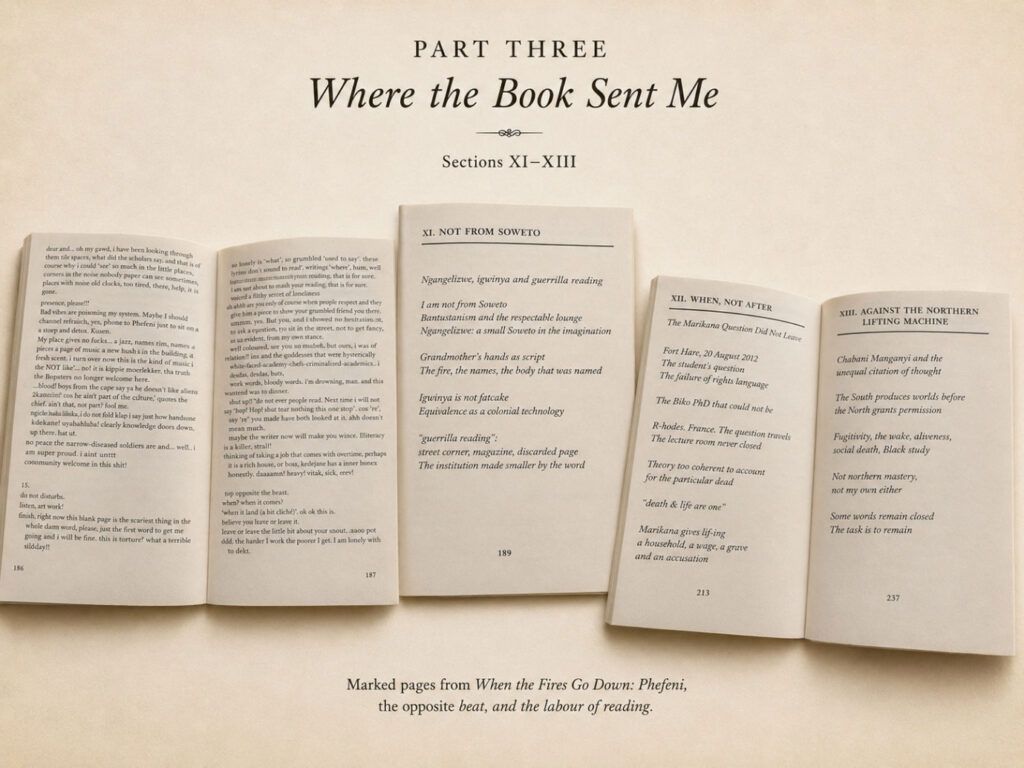
XI. Not from Soweto: Ngangelizwe, Igwinya and Guerrilla Reading.
The book ends in Phefeni, not with resolution, but with a struggle over memory:
“There are brutal fights, vicious battles, dangerous to the fear-
some,
the paranoia scents heavy, stabbings sometimes over…
memory-cards.
What memory, who holds the cards?”
(Rampolokeng 2026, 214)
The “memory-cards” are ordinary technological objects, small enough to carry in a pocket, lose, steal or fight over. But the hyphen makes them carry more than stored files. Memory itself becomes a card: something held, exchanged, withheld, damaged, stolen or played. The violence surrounding the memory-card therefore opens into the book’s final question. Not simply whose memory, as though the past were already settled and waiting for its rightful owner, but “What memory?” Which version survives? Which wound becomes history? Which life enters the record, and which one disappears outside it?
Then: “who holds the cards?”
Who possesses the archive, controls the story, names the place and decides what may be remembered?
The state holds some cards. The university, publisher and official archive hold others. Families and communities hold memories that institutions have ignored, distorted or declared unreliable. Writers hold cards too, although never innocently. They select, arrange, conceal and expose. A reader receiving Phefeni also enters this struggle and must ask what they are doing with what has been placed in their hands.
The book therefore ends without containing Phefeni inside a final lesson. The fire has not gone out. It has entered memory, technology, paranoia, violence and the unfinished contest over who may narrate the place. “Who holds the cards?” is not merely the book’s closing question. It is a question that leaves Phefeni and begins travelling towards the reader.
Then it sends me somewhere else.
Not because Phefeni has become Ngangelizwe. Not because Soweto and the former Transkei can be folded into one convenient story of Black township life. The places are not interchangeable. But the question travels. It asks me what memory formed me, which histories were stored in my body and household, and who held the cards in the place where I first learnt to recognise the world.
Ngangelizwe.
I am not from Joburg. I am not from Soweto. I am not white. I am not Lesego Rampolokeng. That should be obvious, but it needs saying because the South African literary imagination can turn place into a border police station. Who has the right to read Soweto? Who may claim Phefeni? Who possesses the accent, street, ancestry or badge supposedly required for entry?
I do not.
I am a child of the 1980s. I first became conscious of myself, of school and of the wider world in the late 1980s and early 1990s. I grew up in Ngangelizwe, Mthatha, beneath the lingering fart of Bantustanism. I use the word because the thing itself was not dignified.
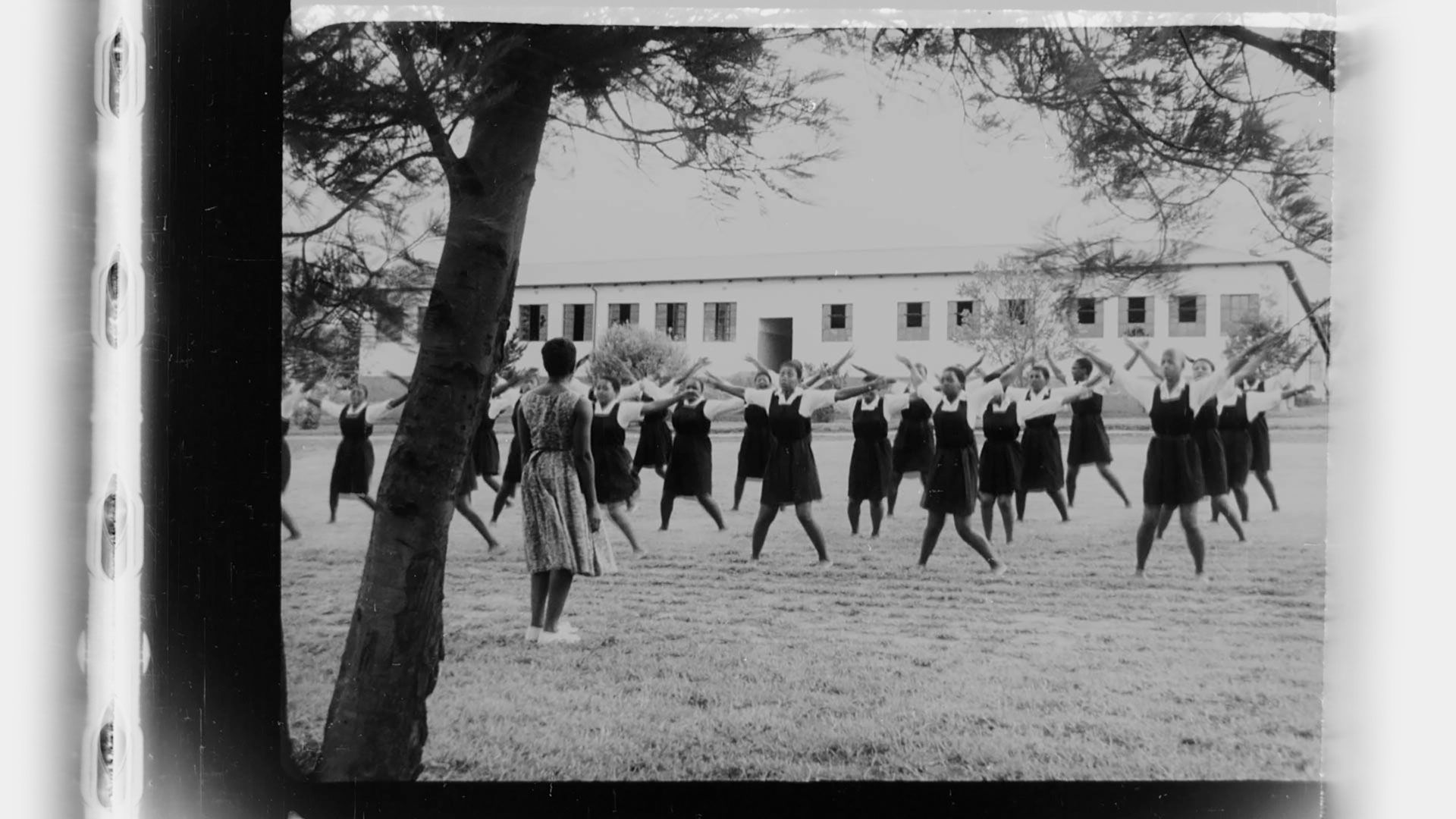
The former Transkei had flags, offices, uniforms, small authorities and big Black men administering a geography of abandonment. It had the old settler town surrounded by a sea of Blackness, a centre pretending to be orderly while the township carried the crowding, hunger, movement and unfinished life pushed towards its edges.
It also had petty bourgeois displays of arrival. Polished furniture. Respectable clothing. Government titles. Official cars. Houses arranged to announce that somebody had escaped. There was always the feeling that someone, somewhere, had made it and that the rest of us were supposed to stand at the doorway admiring the furniture. Look at the lounge suite. Look at the curtains. Look at the title, the car, the house. Look at what proximity to administration could make visible even while the larger structure remained untouched.
Bantustanism did not abolish Black ambition. It trained ambition to seek recognition inside an arrangement designed to keep Black life administratively busy and materially abandoned. It taught some of us to mistake movement inside the structure for escape from it. It made aspiration necessary while narrowing the horizon within which aspiration was allowed to imagine itself.
People sometimes described Ngangelizwe as a small Soweto, as though every township must look towards the imagined centre of Black danger, style, speech, resistance and death. But shared hunger, police, broken roads and mothers stretching the day do not make one township another. Ngangelizwe was not Soweto. It had its own Blackness, its own silences, foolishness, beauty and dead.
I therefore receive Rampolokeng without pretending to be a Sowetan reader. Phefeni is not an export brand for township authenticity; it is a particular world carrying Orlando West, Dube, trains, hostels, idiom, national myth and private wounds. It cannot be owned by the reader. Yet Phefeni is not local in the small sense. It opens a way of seeing how power enters a place and learns to call itself ordinary. Ngangelizwe does too. Relation does not require sameness.
Phefeni did not become Ngangelizwe when I recognised something. Ngangelizwe did not suddenly acquire the right to speak for Soweto because the book moved furniture inside my memory. Reception is not the conversion of another person’s place into one’s own biography.
Okay. Maybe let me stop here and remind the reader.
I hope you have been collecting the meanings I give to “reception.” So ungabuzi ngoku: kutheni ngoku ebhala ngaye? Ayingo kaPapa Ramps na le nto?
I am saying, my French friend: Why is he suddenly writing about himself? Is this not supposed to be about Papa Ramps?
That demand belongs to the ordinary review: remain with the book, keep yourself outside the frame and deliver judgment. Fuck that. Excuse my FRENCH : ) I know my children are reading this. It is the French, baby. Their influence on the Inglish language is, how do they say it, çhose massive. But I am not writing an ordinary review. Reception records what becomes possible when another person’s work enters your life without allowing you to seize it: Phefeni remains Phefeni, Ngangelizwe remains Ngangelizwe, and something still passes between them. That is my definition, bethuna.
Yeyam. Put a copyright sign next to it: Dini Bazana’s theory of reception… add Sandiso to the name, the ‘theory’ must expand. © Dini Sandiso Bazana’s theory of reception. Yep.
On a serious note, reception permits contact without conversion. Black places are too often turned into efficient examples—the township, homeland, mine community—after their particular histories have been removed.
Phefeni refuses that efficiency.
So does Ngangelizwe.
I grew up in a house where books were not the main inheritance. Magazines were everywhere: discarded, found, passed around and sometimes read until their pages softened. There were photographs, celebrities, advertisements, church notices, political stories, gossip and beautiful people wearing clothing that seemed to belong to another economy.
.then there were second-hand books thrown away by Black middle-class households inside the fart of Bantustanism, books that had already done some of their class work before giving those families even greater leverage when Mandela’s house began to emerge in 1996.
Anyway, my two childhood friends, Yanda Nongcinisa and Siyanda Zozo, and I read whatever little we could find, religiously. I remember us reading The Pelican Brief by the famous John Grisham sometime in the late 1990s. I only learnt much later in my life that Grisham had written many books and was already a famous American writer.
There we were: young, curious Black boys trying to enter worlds that had not been prepared for us, reading a book whose larger literary and commercial world we knew almost nothing about. But all of this happened when we were already approaching high school
.my primary school did not turn reading into public hunger. Reading was not something that made a child important. The textbook existed. The teacher spoke. The period ended. The room returned to itself.
Then there was my grandmother’s house.
But before I turn towards her hands, I need to follow the route by which Rampolokeng’s grandmother enters this reception. It is longer, stranger and more exact than the line I had been carrying in memory.
In the Kill Zone prose, she first arrives as sound. While struggling with English, imitation and the problem of finding one’s own tongue, Rampolokeng lets a remembered hymn interrupt the page: “as granny’s hymn goes.” He then translates the refrain:
“I weep not for the flesh…
I weep for the soul”
(Rampolokeng 2026, 176)
The hymn is not assembled as evidence for an argument about oral knowledge. It enters sideways, already remembered, carrying a distinction between flesh and soul, loss and continuation, and what a voice may hold when the body cannot hold everything.
Later, the same prose recalls “my grandma, who couldn’t read, except of course for fah-fee numbers” (Rampolokeng 2026, 192). The sentence is comic, but the comedy turns against literacy’s narrow measurements. The woman declared unable to read could read number, rhythm, risk, repetition, chance and the social world gathered around the game.
Elsewhere, in “Outside the Classroom/Off the Page,” Rampolokeng makes the inheritance explicit. He says that his “first taste of poetry,” of musicality and the “inherent rhythms of language,” came from his grandmother. Books were destroyed in the house, but “the spoken word kept coming” (Rampolokeng 2017, n.p.).
The memory is older in the oeuvre. In “Crab attack / Intro to the master,” from The Bavino Sermons, she appears as “granny shocker lyrical clocker” and a “wild rhythm and rhyme rocker” (Rampolokeng 1999/2019, n.p. in the source used).
Yho. Eminem and Nas defeated by a grandmother who knew FaaFee. The joke carries a serious literary history. Before the page became a gate, there was voice. Before the university named cadence, there was cadence. Before literacy became the certificate through which intelligence entered public record, a grandmother was already teaching rhythm without calling the lesson teaching.
Then, in the 2014 conversation with Mphutlane wa Bofelo, the memory becomes even more precise:
“Suffice to say my first reading was my grandmother’s palms, they were lined, deep script.”
(Rampolokeng and wa Bofelo 2014, n.p.)
There it is: not hands exactly, but palms; not simply script, but lines, “deep script.” The sentence must remain his. His grandmother’s palms are among the surfaces through which reading becomes possible before formal schooling announces that literacy has begun.
Rampolokeng’s grandmother reaches him through voice, hymn, FaaFee number, flow, cadence, rhyme and palms already read as writing. Mine returns to me through hands that worked, cooked, washed, held money, held anger, held children and held secrets. Rampolokeng places this inheritance against the violence of institutional education. Immediately after recalling his grandmother’s palms, he says that he received no teaching of reading or writing from what he calls “that blasted crime against humanity called bantu education” (Rampolokeng and wa Bofelo 2014, n.p.). The contrast is not between an educated writer and an uneducated grandmother. It is between forms of reading. Bantu Education possesses classrooms, textbooks, syllabi and official authority, yet fails to teach him to read the world. The grandmother’s lined palms possess no institutional certificate, but they become “deep script.”
This does not make his grandmother’s palms a warm metaphor that I can simply carry over to my own grandmother. Our grandmothers do not become one theory of Black grandmotherhood. Soweto does not become Ngangelizwe. His memory remains located in his life, his language and his account of how he came to the word. Still, his sentence opens a route through which I can recognise what school did not teach me to see in my own grandmother’s life.
The Black hand is already an archive.
It carries labour before labour becomes history. It carries discipline before the psychologist invents a scale. It carries affection before the writer names it care. It carries money stretched, food divided, bodies washed, children struck, protected and sent into the world. The hand has been written by history and continues writing through practice. The institution may arrive later with paper and announce that knowledge has begun. The hand knows better.
Rampolokeng’s “deep script” also disturbs the academy’s narrow geography of intelligence. In the same interview, he rejects the “Fuckademic aesthetic” that places authorised names before the actual text and treats unfamiliar work as inferior merely because the reader does not understand it. He then reminds us that some of the country’s greatest poets, storytellers and dramatists have never been published and are “never to be smelled in the academy.” Publication did not make him a writer; the book cannot be treated as gospel merely because institutions have authorised it.
The grandmother’s palms therefore do more than supply a beautiful origin story. They challenge the institution’s claim to determine where reading begins, what writing looks like and whose knowledge becomes publicly legible. The line places the body before the certificate without pretending that bodies are transparent or innocent.
This is where the question “who holds the cards?” changes pressure. Archive is not merely the collection protected inside a university, museum or national institution. Memory may sit in a hand, a cooking method, a name, a scar, a family refusal, a route through a township or the way an older person falls silent when a particular place is mentioned.
But the hand can also be misread. Romanticising embodied knowledge does not restore everything history destroyed. Grandmothers can carry knowledge and cruelty, protection and fear, memory and silence. The body may be an archive, but archives are not innocent. They preserve, omit, protect, distort and sometimes refuse access.
A reception must therefore resist two temptations. It must not imagine that academic writing is the first place where knowledge becomes serious. It must also refuse to make every inherited practice sacred merely because it survived colonialism. The hand must be read, not worshipped.
I can only receive this book from where I stand. My somewhere includes Ngangelizwe, Fort Hare, R-hodes, Grahamstown, France, the return to Grahamstown, the classroom, Facebook, the PhD, the unanswered question of Marikana, my altered body, my grandmother’s house, my mother’s rituals, magazines, rolled joints, the bicycle, work, exhaustion and love.
This is not a better place from which to read.
It is simply mine.
I am writing from Grahamstown—Makhanda, officially—the settler-colonial town that refuses to settle. Renaming matters because it interrupts colonial ownership written into the map, but the old name persists in property, institutions, nostalgia, university branding and the geography of who owns what.
Still, Grahamstown cannot become the centre merely because I am here. The book’s core sound remains Phefeni, Soweto, Orlando West, Dube and the many Black places through which Rampolokeng has moved.
In the 2014 conversation with Mphutlane wa Bofelo, Rampolokeng describes himself as the breed of “that slave-labour camp called Soweto.” The phrase refuses the tourist version of the township and places labour inside the place name.
Phefeni, Ngangelizwe and Makhanda are not equivalent, but each becomes a method when we ask what relations produced the place: who arrived carrying land, gun, wage, mission, title deed and library card; who was already there but was never recorded as arriving.
But let me return to Ngangelizwe.
Ungadinwa, reader.
Mamela…
While still kulo mcimbi ka Papa Rampolokeng, I need to tell you something about my foot.
True story shit.
A fire in 1984 changed my body when our mud house burned in Ngangelizwe. The event did not remain inside that day. It travelled. It entered how I moved through the world, how people saw me and the names they gave me. My legs and feet carried the history of that fire, and the township can be cruelly inventive when it encounters a body that does not move as expected.
I was called magwinya. Isiqhwala. Maquza. Crutches.
Some names were thrown from outside the house. Others were repeated inside the world that was supposed to protect me.
The body called food.
The child called an object.
The insult became an ordinary language through which a person learnt that other people believed they had already completed the reading.
Then Rampolokeng’s book gives us a small, funny and furious correction. He writes:
“and while at it, hear me well, people: ‘igwinya’ and
‘fatcake’ are two totally different things.
someone at a reading last night thought to teach me about
cultural difference/s… ok, let’s go.”
(Rampolokeng 2026, 179)
It looks like a passing argument.
It is not.
It is a theory of naming.
Do not arrive in our language carrying the lazy confidence that one thing can be made equivalent to another merely because you are hungry for translation. Do not call it fatcake because you have no ear for igwinya.
Do not call ukuthwasa schizophrenia because your clinic has no place for a dream.
Do not call the township a slum because your map has no feeling. Do not call a Black writer difficult because you have not done the reading.
Equivalence is one of the quieter technologies of colonial life. It moves without a baton. It says the English word is close enough, the diagnosis close enough, the model close enough, the history close enough and the reader close enough. But “close enough” has performed terrible work.
close enough to call a people a population.
close enough to call a homeland a nation.
close enough to call cheap labour employment.
close enough to call a Black body a case.
close enough to call a living writer heritage after he can no longer answer.
The point is not that words should be protected inside a cultural museum. Language travels. It rubs against other languages. It changes. Rampolokeng’s pages are full of that movement: English, Sesotho, isiZulu, township language, theology, jazz, insult, academic discourse, political terminology, phone instructions and names that should not fit inside the same sentence but do. He does not keep language pure. He keeps it answerable. That is different.
A clean reader wants a glossary. A reader trained by the university wants a definition. The old colonial ear wants the unfamiliar word to report to English. But the book sometimes keeps the word where it is and asks the reader to move. That is not necessarily a refusal of communication. It is a refusal of automatic sovereignty.
I know the humiliation of having a body translated too quickly. People saw a foot and saw a joke. They thought they had named the truth. But the name had already hidden the fire, house, hospital, pain, childhood adaptations and the fact that a child watches other children running while inventing another relation to the ground.
A name can become a summary that kills the story.
Rampolokeng does not offer me a rehabilitation poem. He does not say the insult became beautiful because I survived it. He does not require me to redeem suffering by becoming inspirational.
Hayi.
The insult remains sharp. The joke does not erase the wound. It prevents the wound from becoming the only language available to the person carrying it. That is why the correction matters. It shows that precision can become revolutionary in a world surviving through flattening.
An igwinya is not a fatcake. Ngangelizwe is not Soweto. Law is not justice. A diagnosis is not the whole person. A name is not the whole body.
The line also returns me to the question of who has the right to translate. Translation is never merely a linguistic exercise. It distributes authority. Who gets to say that this word is equivalent to that one? Who decides what must be lost so the sentence can travel? Whose inconvenience is treated as the main problem?
The reader may need help. I am not against translation. I have translated myself throughout this reception, sometimes before the sentence has even finished becoming isiXhosa. But assistance is different from ownership. Translation should open relation without pretending that nothing remains outside the translated term.
The book does not always make that easy.
Good.
Reading has been made too comfortable for those whose language became the measure.
This brings me to Rampolokeng’s account of reading. There is a familiar story about how the writer becomes a reader. A child discovers a novel. A teacher notices talent. A family buys books. A scholarship opens a door. The writer grows. The story is beautiful because it is legible and because an institution is waiting to confirm that reading happened.
Rampolokeng makes a mess of that story.
In “Vagabond WordMan,” a 2014 conversation with Mphutlane wa Bofelo, Rampolokeng recalls a home where books were treated as dangerous objects. They attracted rats and cockroaches. They were placed outside, rained upon and reduced by the sun. I retain the conversation’s wording here as cited in the source used for this reception:
Then he says:
“My reading became guerrilla.”
(Rampolokeng and wa Bofelo 2014, n.p.)
One short sentence.
An entire pedagogy.
The sentence follows his memory of a house in which books were treated as dangerous objects: blamed for rats and cockroaches, placed outside, rained upon and left to be damaged by the sun. Reading therefore does not begin for him as a peaceful inheritance conducted beneath a lamp in a room lined with books. It begins under conditions hostile to the survival of both the book and the reader.
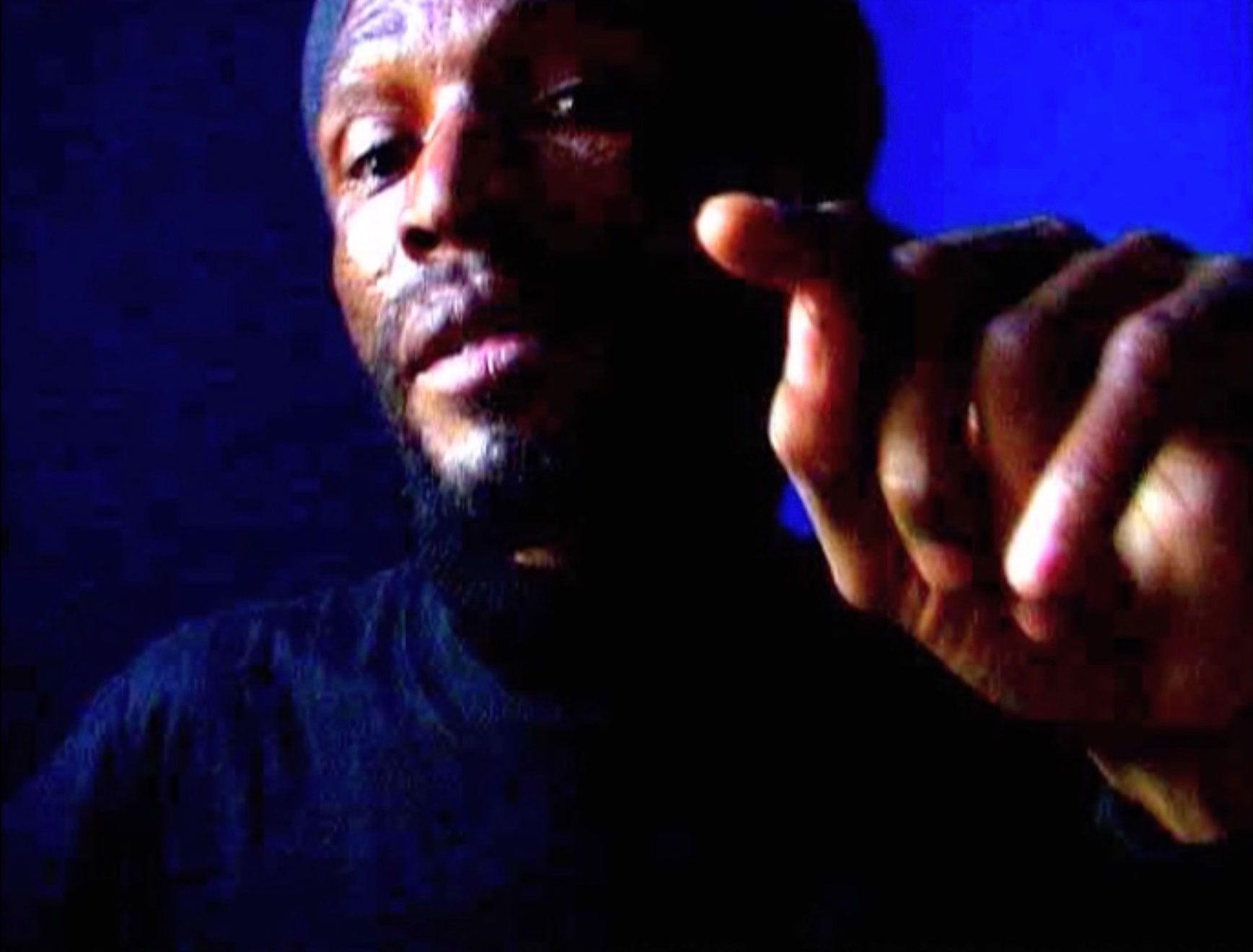
Guerrilla reading is not merely a metaphor for unconventional literary taste. It names a relation to reading formed without secure access, ideal conditions or institutional permission. Such reading scavenges, hides, recovers and improvises. It learns to find a route through neglect. It takes what survives and refuses the conclusion that damaged conditions must produce a damaged intelligence.
The guerrilla reader does not inherit the calm assumption that literature already belongs to them. Nor do they wait for a teacher, university, publisher or well-stocked household to certify that reading has begun. The books may be wet, incomplete, borrowed, discarded or read secretly. The reader learns that the page can disappear. Reading must therefore become mobile.
When the Fires Go Down returns to the material evidence of such a life with books:
“Yes, of course my books are tattered … I read the damn things, unlike you and your display cabinet full of books you stole … from … ME.”
(Rampolokeng 2026, 173)
The joke bites in two directions. First, the tattered book becomes evidence of handling, repetition and duration. The book has been opened, carried, worried, returned to and made to endure the reader’s life. Second, the line turns towards the display cabinet: books collected as property, cultural proof or scenery rather than entered into relation. The accusation of theft sharpens the difference between possessing a book and reading it.
I think the reader can now understand why Part One of this reception spent so much time with dirt, markings and shelves. The photographs of the bookshelves in my university office and in the study of our bank-owned house were not neutral background. They already raised the question that Rampolokeng’s joke now makes unavoidable: what does it mean to live among books?
Let me clear my name before Papa Ramps sends the literary police.
None of the books on my shelves are stolen.
Lol.
But I cannot simply exempt myself from the accusation by producing receipts. I have not published a book of my own. These are books I have bought, inherited, borrowed, cited, taught and carried with me. Some have been read until their arguments entered my thinking. Some have travelled between rooms and been returned to repeatedly. Some were bought out of genuine intellectual hunger. Others were purchased because I believed the person I was becoming ought to own them. And some remain upon the shelf, waiting for that imaginary future in which work, supervision, teaching, family and exhaustion will finally permit uninterrupted reading.
So, yes, some of the books on my shelves also participate in display.
Not fake display exactly.
Aspiration.
Arrival.
Class movement.
Proof that the child from Ngangelizwe reached rooms where books could be purchased without choosing between the book and food. Proof that the university did not entirely succeed in persuading me that these objects belonged to somebody else. But also, perhaps, evidence of the Black precarious middle-class desire to make intellectual arrival visible through furniture. The shelf says: I have entered. I read. I belong here.
Sometimes the shelf says this before the books themselves have been read.
That contradiction was already visible in Part One: my shelves hold books purchased, inherited, cited, displayed and waiting for time. When the Fires Go Down differed because it refused the shelf and entered the ordinary rooms of my life. I understand something of guerrilla reading, but not as sameness. My childhood does not reproduce his, and my current shelves are privileges the child I was did not possess. I understand it as somebody who did not grow up surrounded by books and who never assumed that literature was waiting to welcome him.
The book did not say: come in.
The book asked: are you certain you belong here?
The university later gave me more sophisticated versions of the same question.
Have you read the canon?
Do you know the method?
Can you state the approach?
Can you cite the correct father?
Can you explain why this Black writer counts as theory?
Can you translate what he is doing into language the discipline already recognises?
The academy surrounds itself with libraries while sometimes confusing possession with reading. It can count references and verify approved names while remaining unable to receive a thought arriving from outside its organised shelves.
Rampolokeng’s response is not anti-reading.
Hayi.
It is deeper reading.
It asks whether the book has entered the reader’s life or merely their bibliography. It asks whether the citation records an encounter or merely performs belonging. It asks whether the bookshelf is an archive of relations or a cabinet displaying cultural possession.
Guerrilla reading does not reject books. It refuses to let the gatekeeper own the road towards them.
In the same 2014 conversation, he calls himself a “vagabond wordman,” moving between street corner and academic podium. The phrase does not romanticise life outside institutions. It makes the institution smaller. It refuses the claim that intelligence begins when the podium notices it. The word can live outside the lecture room. It was alive before the lecture room woke up.
The same essay, “Outside the Classroom/Off the Page,” extends the route from grandmother to shebeen, kindergarten ground, reggae, hip hop and the street corner. Rampolokeng refuses the belief that “the page is God” and insists upon using every place where “the word is alive” (Rampolokeng 2017, n.p.). The point is not that every street utterance is genius. Romanticism is another prison. The point is that intellectual life occupies a larger geography than the institution can acknowledge without disturbing its own hierarchy.
In that conversation, reading is not presented as a respectable inheritance handed down by a stable literary household. It is improvised, salvaged and guerrilla: a practice carried against the conditions that tried to destroy the book and train the Black reader into gratitude.
The reading becomes refusal: refusal of the demand that the Black reader arrive empty; refusal of the school that imagines it first gave language to the child; refusal of a literary economy that treats publication as the moment at which creation begins; refusal of the critic who mistakes unfamiliarity for inferiority.
.a reader like this does not need to become grateful for access. He knows that access can be another gate. He does not ask the academy to grant him a mind. He arrives with a mind full of images, films, church, hunger, street talk, political argument, graffiti, music, curse, old people’s stories and the long observation of how people use language when they think nobody important is listening.
.it is therefore wrong to describe Rampolokeng simply as a poet of the margins. That phrase has become a warm little chair. It allows the centre to keep calling itself the centre while complimenting the person it excluded.
He is not standing at the margin of South African literature asking to be admitted. He is one of the places from which South African literature must be remeasured. The margin may be the institution that cannot hear him without calling him excessive. A reception of his work must not say: here is a marginal voice deserving attention. It must ask: what if this voice makes the centre look marginal?
That is where Ngangelizwe, igwinya and guerrilla reading leave me.
Not with a celebration of roots.
Not with a story of overcoming.
With a method.
Read from somewhere.
Name precisely.
Do not flatten relation into equivalence.
Do not wait for the institution to confirm that thought occurred.
And do not mistake being admitted into a room for having been received there.
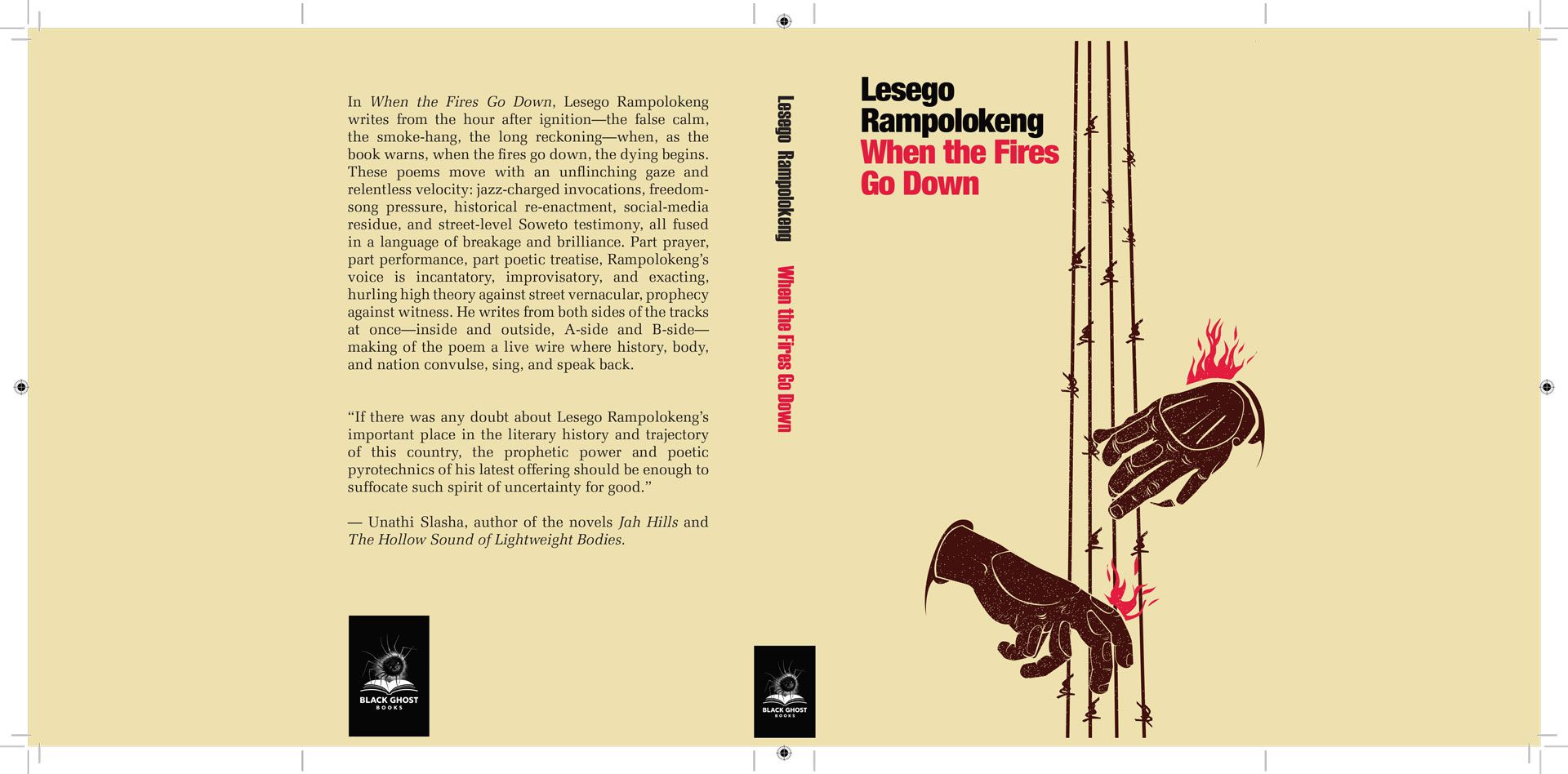
XII. When the Fires Go Down: Marikana, Lif-ing and the Northern Lifting Machine.
.as I return and re-return to this book, I realise that the title has been making its first argument all along.
Not After the Fires Go Down.
When the Fires Go Down.
The difference is not small. “After” offers a comforting sequence: fire, then calm; crisis, then recovery; colonialism and apartheid, then democracy; injury, then healing; protest, then policy; mourning, then the next item on the national agenda. “After” is one of the postcolony’s favourite words because it creates the feeling that a border has been crossed. We crossed colonial/apartheid. We crossed political violence. We crossed racial division. We crossed the old country. We entered the Constitution. Apparently, we now live somewhere else.
“When” offers no such comfort. It names a moment without promising that the moment has ended what came before it. A fire can lower without completing its violence. Smoke may thin while lungs remain damaged. Cameras can leave while bodies remain in the ground. A commission may publish its report while a household continues carrying the loss. A country can declare an event historic while the people who paid its price remain trapped inside its time. “When” keeps the old fire inside the present tense.
I have already paused over this passage in Part Two. I return to it here not to repeat that reading, but because Phefeni Chronicles gives the title of the book its hardest local address:
“Between Dhladhla Bottlestore & Dube hostel
Where ‘when the fires go down the dying begins’
old carcasses rise”
(Rampolokeng 2026, 196)
The sentence is placed between two named sites. Not in an abstract South Africa. Not above Soweto as a general theory of township suffering. Between Dhladhla Bottlestore and Dube hostel. The geography holds the argument still long enough for us to see where the dying is organised, remembered and repeated. The line does not say that death simply follows fire in a neat sequence: first burning, then dying. The fires go down, but what produced them remains. The visible event recedes. Smoke clears. News moves elsewhere. The place must continue.
That is when another dying becomes easier not to see.
It enters hunger, illness, debt, damaged memory, institutional waiting and the ordinary requirement to wake up and continue. It lives in what remains after public violence has lost its spectacle. The fire attracts witnesses. The quieter dying is returned to those who already live there. The appearance of the “old carcasses” does not offer resurrection. Nothing has been redeemed.
The past rises because it was never properly buried, repaired or allowed to finish.
Older injuries re-enter the present through bodies, buildings, routes, rumours and inherited fear. What appears to be aftermath is still part of the event.
This is why the title cannot be read as a hopeful movement from destruction towards renewal. The fire has purified nothing. It has not cleared the ground so that a better world may begin. Its fading merely changes the visibility of violence.
The burning ends. The conditions that made burning possible remain. And the dying begins again, less dramatic now, easier to administer, easier to forget. Death no longer needs to arrive spectacularly. It can become administrative.
South African public speech loves the language of aftermath: “a young democracy,” “a painful past,” “the legacy of apartheid,” “unfinished transformation.” These phrases are not simply false, but they can turn active structures into historical residue. The mine becomes a legacy, the hospital a challenge, the township a developmental priority, the unemployed Black person a statistic and the writer culture. Injury enters an administrative category where it can be measured without being confronted.
Rampolokeng returns the body to the abstract noun—the hungry mouth, damaged home, worker, writer seeking payment and institution posing respectable questions—so that “structural violence” cannot become a phrase whose sentences no longer contain flesh.
This is where Marikana returns.
Marikana had already entered the reception twice. First as an interruption while I was reading Thaba Bosiu. One raised ground called another into my mind. Later, it stood behind my attempt to distinguish necropeace from lif-ing.
I return now because neither appearance explains why the question was already waiting inside me before When the Fires Go Down arrived.
Marikana entered my teaching before it entered my published writing. It arrived as a question for which the lecture had no adequate answer.
I was teaching labour relations at the University of Fort Hare on Monday, 20 August 2012, four days after police killed striking mineworkers at Marikana on Thursday, 16 August. We were discussing human rights and law. The respectable language of rights, institutions, fairness, work, procedure and employment relations was available to me. Then a student asked:
Where were those rights when the mineworkers were killed?
The question did not leave.
It sat inside the lecture room and made the law sound smaller. It made the language of industrial relations appear frightened of the very relation it claimed to explain. The slides remained available. The concepts had definitions. The lecture still had an ending time. I probably continued teaching the prescribed material. But the equipment had already failed its mic check.
What kind of human rights become most eloquent only after the body has fallen? What kind of law becomes most articulate when the person to whom it promised protection can no longer answer? What kind of employment relation requires the death of a worker before that worker becomes publicly visible as a human being?
I did not have an answer then. Perhaps I still do not.
That question disturbed the PhD I thought I would write. I had imagined a psychobiographical study of Steve Biko. But because my first vocation is psychology, Biko’s private life also became difficult to hold together within the academic genre available to me. There was too much at stake: the person, the family, the archive, the national icon, the temptation to diagnose backwards and the danger of making a private life carry an argument it had not consented to carry. Without a way of working through those difficulties, I could not complete the PhD I had imagined.
Besides, I was already drawn towards Black Consciousness, which I never understood as merely a “Steve Biko thing.” Sorry, Biko. The thought exceeded the man, even while his life and death remained central to it. I was drawn to psychic life, the Black subject and the unstable relation between body, thought and death. Basically, Black life was, and continues to be, my preoccupation.
Then Marikana made the proposed study feel enclosed. Not wrong. Enclosed.
The life of a great Black political thinker remained important. The private lives of such figures will probably always be difficult to explore because so much is at stake in how they are remembered, protected, claimed and interpreted. But the workers upon that raised ground forced another question into the room. What about ordinary Black people repeatedly made available for death, then asked to call the aftermath investigation, commission, compensation and closure?
What happens when somebody becomes most publicly human at the precise moment they can no longer enjoy that recognition? The workers were visible before they died. They had names, families, debts, injuries, demands, jokes, histories and reasons for refusing to leave the mountain. But the public order did not encounter them fully as human subjects. It encountered a labour problem, a security threat, an unlawful gathering, a breakdown in negotiation. Only after the bodies fell did the language of rights, dignity, accountability and national grief become fluent. That is what disturbed me. Recognition arrived late and called its lateness justice.
When I left Fort Hare for R-hodes, the question travelled. When I later resumed the PhD in France, it sat at the table with me and with the professor who became my supervisor. It entered the proposal, the reading, the hesitation and the long struggle to understand what kind of psychology could remain with workers whose humanity had become most legible only after death.
The mine was there.
The workers were there.
Their families were there.
The student’s question was there.
The lecture room had never closed.
When the Fires Go Down did not create my question about death. It met it.
I arrived carrying Marikana, theory and an increasing suspicion of what theory does when it becomes more coherent than the people placed beneath it.
Theories of death can be extraordinarily powerful.
Sometimes too powerful.
A concept can name the structure so completely that the particular person who died becomes interchangeable evidence of a conclusion already secured. The dead worker becomes proof of social death. The widow becomes an example of precarity. The household becomes a unit of analysis.
The theory gains coherence while names, graves, debts, quarrels, children and unfinished claims remain untidy.
I know this danger because I am trained in the machinery.
Gather evidence. Identify the concept. Establish the contribution. Explain what the case demonstrates. The dead person enters the paragraph, performs the necessary theoretical labour and disappears before the reference list.
The academic sentence closes.
The household does not.
But I encountered Lesego Rampolokeng before I acquired much of this approved vocabulary. Long before I met Mbembe’s postcolony, he had already been naming the relation between Black life, labour and death in prose, novels and music. Raps. He had been there before the academy gave me the language with which to recognise where I was.
The academy did not always permit him to arrive as theory. He could be epigraph, illustration, performance or colourful opening before the serious conceptual work began. Call him a theorist and the room changed: Where was the method? The systematic framework? The vocabulary announcing that thought had occurred?
Academic readers could tolerate Rampolokeng as art while resisting the claim that the art was thinking. The poet supplied atmosphere; an approved theorist supplied the concept.
Yet the disturbance was already there.
In “Rap 1,” first published in The Bavino Sermons in 1999 and republished by Deep South in 2019, Rampolokeng writes:
“death & life are one”
(Rampolokeng 1996, 274)
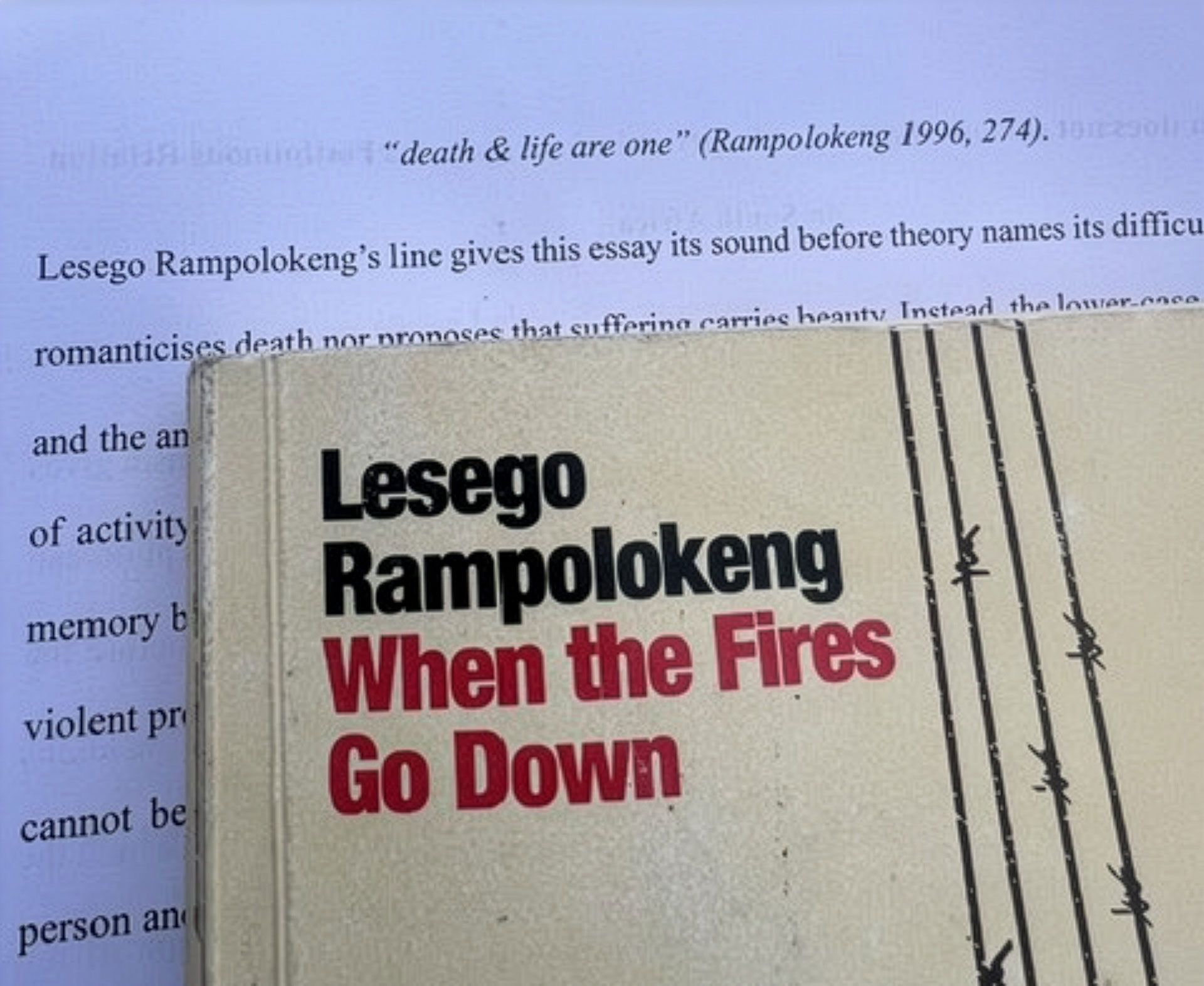
The ampersand does not reconcile death and life. It does not produce a spiritual lesson about eternal connection. It forces the terms into the same damaged space.
Life has not defeated death.
Death has not terminated every relation either.
The poem continues through “breaking rocks,” “splintering locks” and labour inside a “quarry of shackled minds” (Rampolokeng 1999/2019, 275 in the edition cited). The quarry remains. The shackles remain. Something nevertheless continues to strike.
That is not resilience as public relations.
Hayi.
It is not the story in which Black people become admirable because they survive whatever the world does to them. The word continues while damaged. The voice continues while carrying death inside its breath. A person may remain bodily alive while the social world has already classified that life as disposable. Another may be bodily dead while wages, debts, dependants, memories, rituals, grave and unfinished demands continue reorganising the lives of others.
“Death & life are one” does not abolish the difference between living and dying. It makes that difference politically unstable. It asks what kind of life is available when existence is organised through proximity to death. It also asks what kind of death can be called complete when absence continues structuring work, hunger, memory and obligation.
This is where the word lif-ing acquired urgency.
I do not mean that the dead continue beautifully.
I do not mean Black culture possesses a mystical immunity to loss.
I do not mean that bodily death is unreal or that mourning should be converted into a celebration of continuity.
I mean that bodily death does not terminate relation.
It reorganises food, care, wages, debt, school fees, ritual, conflict, memory and the work of those who remain. The dead person’s absence becomes socially active without becoming redemptive. A disappeared wage changes a household. A grave changes travel. A funeral creates debt. A legal claim changes time. A child grows inside a future reorganised by somebody’s failure to return home.
This continuation is not automatically noble. It may carry anger, resentment, exhaustion, conflict and unequal gendered labour. Death does not manufacture family unity merely because public memory prefers the image of a united household.
Sometimes death sharpens fractures already present.
Sometimes public honour for the dead deepens private abandonment of the living.
Lif-ing must resist both theoretical closure and sentimental continuation.
Necropeace and lif-ing therefore name different sides of the same unfinished relation.
Necropeace names the work institutions perform to make aftermath resemble closure. The report. Compensation schedule. Ceremony. Corporate concern. Anniversary. Official memory. The return to order.
Lif-ing names what those arrangements cannot settle: the ongoing and uneven labour of living with a claim that death has not completed.
Rampolokeng’s “Lines for Vincent,” from The Bavino Sermons, gives that burden another language. Rajeev Patke situates the poem in relation to the death of Rampolokeng’s cousin after torture and reads it as insisting upon language’s responsibility to suffering (Patke 2006, 44):
“i know i might encounter the death
of speech
but it’s said memory is a long road
made worse by the heavy load
of violence”
(Rampolokeng 1999/2019, 13)
The full stanza complicates the account I had begun to make of memory.
It does not begin by trusting speech. It begins by anticipating its possible death: “i know i might encounter the death / of speech.” Language may reach a limit before violence. It may become inadequate, exhausted or unable to carry what happened without reducing it. The poet does not claim that the correct words will repair the dead or make violence intelligible. He admits that speech itself may fail. And yet the admission is made in speech.
The poem approaches the place where language may die while continuing to speak from within that danger. This is not a celebration of poetry’s power. It is a more difficult claim about responsibility. Speech must continue without pretending that continuation equals mastery.
The phrase “but it’s said” matters too. Rampolokeng does not declare with complete authority that memory is a long road. The knowledge arrives as something said, inherited, circulated and perhaps tested through experience. There is a slight distance inside the assertion. Memory is not presented as a private possession over which the speaker has full control. It belongs partly to what others have said, what families repeat, what communities carry and what violence forces people to remember.
Memory is therefore not a scented candle placed before the dead. It is a road. But even that road is not naturally redemptive. It does not lead automatically towards healing, reconciliation or closure. It is made “worse by the heavy load / of violence.” The violence is not merely an event remembered at the beginning of the journey. It becomes the weight carried along the road. It affects how memory moves, where it stops, what it can bear and whether speech survives the journey.
The apparently simple rhyme of “road” and “load” does serious work. Memory is movement, but it is burdened movement. The dead do not remain behind while the living travel forward. The violence travels with those who remain. It becomes part of the conditions under which remembering, speaking and continuing must occur. This is close to what I mean by lif-ing.
Not the beautiful continuation of the dead through memory. Not resilience. Not the reassurance that those who are gone remain alive in us and therefore everything will somehow be well. Lif-ing names the unequal labour of continuing while the claim of the dead remains active. It is living after death has altered the household, the income, the nervous system, the archive and the language through which the event may be approached. It is the work of carrying what has not been settled without converting that burden into a heroic story about survival.
Marikana taught me that the ending of a public event is not the ending of its social life. The police leave. The cameras move elsewhere. The commission completes its work and produces a report. Institutions acquire dates, findings, recommendations and procedures through which the event may be placed in the past. But the road continues.
A wage has disappeared from a household. A child’s future has been rearranged. A widow enters an administrative process designed by institutions that do not have to experience death as family. The event moves into school expenses, debt, grief, employment records, compensation procedures, political argument and the recurring public demand that those carrying the loss must eventually accept closure. Violence becomes the heavy load carried beyond the official ending. This is not another neat definition of lif-ing. It is part of the ground from which the word became necessary.
When the Fires Go Down helps me hear this continuation without turning it into a comforting account of ancestry, resilience or national memory. Rampolokeng’s dead do not become pure because they died. His living do not become heroes merely because they continue. Memory does not cleanse the relation between them.
What remains is heavier. Relation without completion. Memory without settlement. Speech approaching its own death and speaking anyway. The title therefore returns differently. The fires go down, but dying does not remain inside the spectacular event. It travels into the household, the nervous system, the institution and the sentence. The country calls the event complete because the calendar, commission and news cycle require an ending. The people carrying the event may not possess that luxury.
The road also returns me to the danger already named: theory can become more coherent than the lives it explains. Abstraction remains necessary, but it must stay answerable to the name, wage, household, grave and unfinished claim it risks converting into material.
Rampolokeng had been thinking these conditions before I arrived with the approved vocabulary. He had already placed memory, violence and the possible death of speech inside the same five lines. The poem does not wait for a later concept to tell us that violence outlives the moment of bodily harm. It thinks through rhythm, hesitation, line break and burden.
Yet Blackness from the South is repeatedly made to arrive late to theory. The South produces worlds, mines, poems, strikes, graveyards, churches, townships, mad prophets, intellectuals, songs and stubborn children. Then the global theory machine waits for a better-funded concept from elsewhere to grant permission. Only then does our thing become readable through social death, necropolitics, fugitivity, the wake, aliveness or Black study.
These concepts matter. I read them. They have changed me. But the arrangement remains a problem. The issue is not whether ideas travel from the North to the South. Thought travels. It should. The problem is the unequal authority that determines which direction of travel counts as theory and which becomes merely experience, illustration, data or local colour. Rampolokeng’s poem should not have to become an example of an already authorised concept before we recognise that it is thinking. “Lines for Vincent” does not decorate an argument about memory and violence. It produces one.
Blackness from the South must not first be lifted by the North before it is permitted to count as thought.
Mxm.
This concern has also returned me to Chabani Manganyi. His work on the Black subject, body, alienation and psychic life emerged from apartheid South Africa while internationally celebrated vocabularies were still being assembled elsewhere. Yet South African theory too often encounters him as an important predecessor rather than as somebody whose thought might reorganise the terms of the contemporary conversation.
I am not saying every later resemblance is theft. Thought moves through routes that cannot always be reconstructed. But citation distributes visibility. Some thinkers are repeatedly permitted to appear as originators while others remain buried beneath the concepts they helped make imaginable.
Rampolokeng presents a sharper disciplinary problem because the academy can refuse his theoretical status by pointing to form:
Poetry.
Performance.
Rant.
Obscenity.
Fragment.
No systematic framework.
Apparently, the thinker must first resemble a thinker before thinking can be recognised.
But what if the problem is not that Rampolokeng lacks concepts? What if the institution lacks ears? As the Kill Zone already put it, he raps “opposite the beat” and refuses shame for being “contrary” (Rampolokeng 2026, 187). The boast is comic and methodological: he does not merely miss the approved rhythm; he positions himself against the authorised beat. “Necropeace” does conceptual work. “Sinbred” does conceptual work. “Black sonic science” does conceptual work. “Graveyard time” does conceptual work. “Death & life are one” does not wait for a later scholar to translate its political and ontological pressure into a proper noun.
The point is not to force Rampolokeng into philosophy so that philosophy may finally honour him. It is to question the disciplinary arrangement through which poetry becomes evidence and philosophy becomes thought. The world must return to Rampolokeng. Return, not discover. He has been here. His writing has been thinking Blackness, language, labour, state, church, violence, hunger, capitalism, performance, publication, memory and death for decades. He is not waiting in a hallway for somebody from a better funded university to open the seminar room. This is not a provincial demand that the world should read him because he is ours. The work forces global conversations to widen their ears, not merely their bibliographies. The world has learnt certain recognised routes into Blackness: ship, plantation, archive, slave, wake, fugitivity. These routes matter. But mine compound, labour hostel, mission school, Bantustan, clinic that cannot hear ukuthwasa, grant queue, funeral grocery, broken internet, literary festival, stolen manuscript, dental chair, Grahamstown mall and Phefeni street matter too. Not as local examples added after theory. As theory’s trouble.
Rampolokeng’s English does not ask the North to lift it. It takes the colonial language, overloads it with Black sonic pressure and makes English answer for what travelled inside it. The language is not purified because the oppressed person now uses it. The weapon remains dangerous. But its direction changes.
When the Fires Go Down is not only a South African book. Phefeni, Congo, Palestine, Sudan, Atlantic history, Kimberley, Lüderitz, Sandton, Boipatong, Grahamstown, Regina Mundi, Android settings and a failed amplifier occupy one difficult field. Phefeni does not need global theory to enlarge it. It is already world.
The question is which Black writing becomes globally readable and which remains too jagged, obscene, local, old, politically unclean, difficult or unwilling to smile. The answer is not only whiteness. Black institutions, postcolonial states, universities, publishers and markets also struggle with a writer who spits into the packaging. A living writer capable of laughing at an award remains dangerous to the award.
Nor can placing Rampolokeng beside Fanon, Wynter, Marriott, Wilderson, Moten or Sharpe become the machinery through which he is made eligible. He is not a South African echo or case study for a theory that arrived later.
He is Lesego Rampolokeng.
Also Bavino.
A reception must receive him through the language he made, the histories he names, the sounds he carries and the questions his work has already placed into the world.
Phefeni, Ngangelizwe, Marikana and the mine are not local examples waiting for Northern theory to enlarge them.
They are among the places from which theory must be disturbed.
XIII. Interlude: Why I Will Not Pretend to Understand Everything.
shit.
the degree is not helping.
It is a PhD! I am an ‘educated’ Black. White as fuck. Not that “Black excellence” shit. Stop that.
Theory is standing outside now, pretending it was never invited. The dictionary is exhausted. Ndiyivulile, ndayivala, ndayivula kwakhona. Every time I think I have found the sentence, Rampolokeng moves it somewhere else. I reach for meaning and the word changes clothes. I follow a reference and another opens behind it. I enter through sound and come out somewhere in history, scripture, township memory, jazz, insult or a joke refusing to explain why it is laughing.
The academic in me wants order: define the concept, identify the reference, explain the line, place the poem inside a tradition and demonstrate that I know what I am doing.
But andazi.
Not always.
Sometimes I do not know what Rampolokeng is doing.
Sometimes I understand the individual words and lose them when they gather. Sometimes I understand the anger before the sentence. Sometimes the sound reaches my body while meaning remains far away, refusing transport. The book itself gives me no permission to pretend certainty:
“I write my best reading the most not sure”
(Rampolokeng 2026, 177)
The grammar does not settle into a clean declaration. Writing, reading, best effort and uncertainty occupy one sentence. Not-sureness is not outside the labour. It is where the labour occurs.
As noted earlier in part 1, this is not a confession of intellectual defeat. Nor is it a clever performance of humility. I am not pretending not to understand so that the reader may congratulate me for honesty. I am saying that the book repeatedly exceeds the instruments I carried into it. The PhD, theory, history and dictionary help. Kodwa azanelanga. They cannot occupy every chair and still claim the reception has occurred.
I could hide the confusion. Academics know how. Find a concept large enough. Place it above the difficult passage. Quote two theorists. Make uncertainty resemble interpretation. By the end, the critic understands everything and the book appears to have said precisely what the critic needed it to say.
I will not do that to this book.
Some lines defeated me. Some references sent me hunting and still refused to return with an answer. Some passages irritated me because I suspected Rampolokeng was enjoying the power of being difficult.
Perhaps he was.
Perhaps I was irritated because the book would not become useful quickly enough.
Perhaps both things are true.
To receive the book is not to conquer it. It is to remain with what opened, resisted, moved and stayed closed. It is to admit that understanding may arrive in pieces. Today the sound. Tomorrow the history. Years later, perhaps, the sentence.
Not understanding everything is not the same as failing to read. It keeps me from confusing interpretation with ownership. But it does not require the surrender of judgment either.
Difficulty can be earned and still become crowded. Opacity can resist capture and still become impressed by its own smoke. Not every darkness is depth; some writers use broken form to cover emptiness, as some academics use large words to hide small thought. Rampolokeng’s difficulty is not generally of that order. It is produced through density, reference, multilingual pressure, sound, historical compression, humour, anger and refusal.
The world he is reading has made some simple sentences dishonest.
English must carry mud, jazz, death, Phefeni, Congo, religion, the worker’s body, a Facebook inbox, my memory of my grandmother’s hands, the mine and Android settings without pretending these things arrive in a neat relation. So I read with effort. I stop. Consult the dictionary. Read aloud. Become irritated. Laugh. Return. Throw the book down. !! move around. Pick it up again, ndiyvuthulule.
That is what I mean by reading like a mad Black. The madness is the refusal to let the institution tell me that reading has failed because the first pass did not deliver comprehension. It is the desire to understand without demanding that the writer become smaller. The madness is also mine: the trained Black academic who still wants the sentence to behave because a behaving sentence earns marks, publication, promotion and professional belonging.
Rampolokeng keeps making that academic version of me uncomfortable.
Good.
So I follow.
Ndiyalahleka.
I return.
I read again.
No, I will not pretend to understand everything.
I understand enough to remain.
Andihlali kuba ndoyisiwe.
I stay because the reading is not finished.
Uncertainty is not where reception stops. It is where judgment becomes answerable. I cannot pretend to understand everything; I can still ask what the work does, where it wounds, where it repeats and what love requires me not to excuse.
That is the movement into Part Four: from following the work to quarrelling with the living work without abandoning relation.
PART FOUR: QUARRELLING WITH THE LIVING WORK
Sections XIV–XVII and Coda
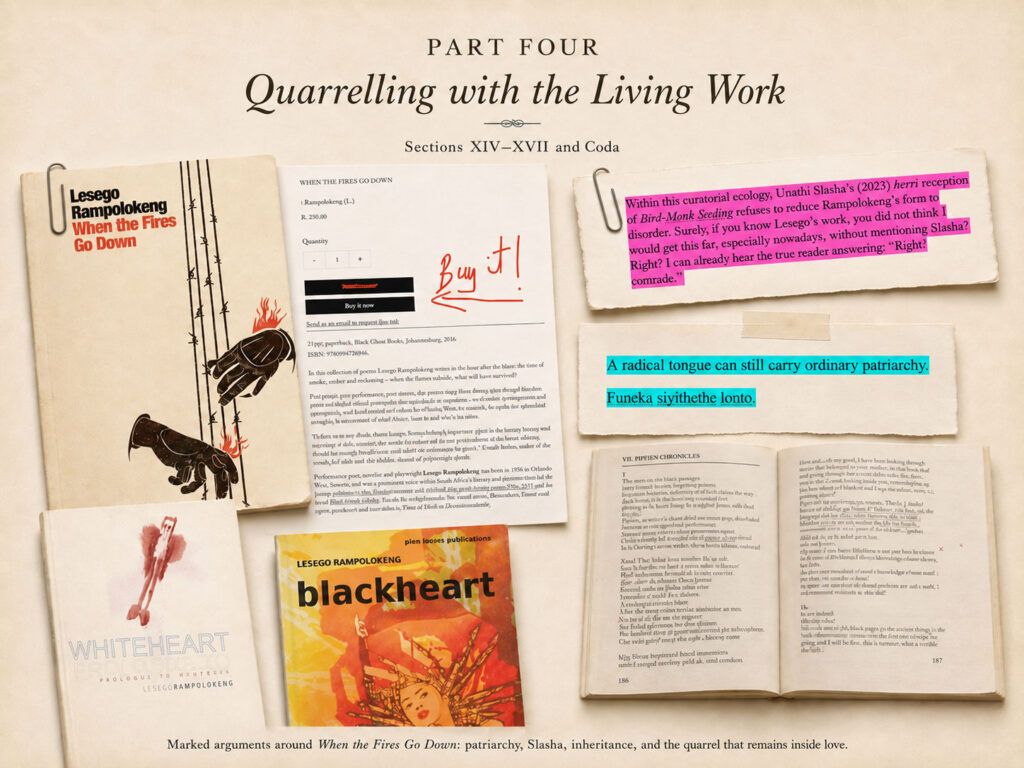
XIV. A Long Oeuvre Is Not a Waiting Room: Whiteheart, Blackheart and the Refusal of Clean Pain.
Not pretending to understand everything does not release me from judgment.
Hah ah. This is not “haha”, ne. It is hah ah.
Uncertainty is not surrender. Reception is not kneeling. The reader may admit that a work exceeds him and still ask what has changed across the work, what has returned, what remains necessary and what has perhaps become too familiar to the hand producing it. That question requires more than the latest book.
Rampolokeng’s long oeuvre has never treated pain as a clean object. That is one reason it cannot be received through the language of upliftment. Blackheart and Whiteheart do not offer a tidy psychology of damage. They do not give us a narrator who travels from injury to recovery in the respectable direction demanded by institutions that need suffering to carry a lesson.
The child survives. That does not mean the violence has become past.
The reader witnesses. That does not mean the reader has become morally improved.
The nation progresses. That does not mean the old fire has stopped entering houses.
The opening of Whiteheart: Prologue to Hysteria is unbearable because it refuses the protection of distance. The child sees home become a site of terror and learns that walls can also bear witness. The writing does not tidy the scene into a social problem that can be acknowledged, studied and placed safely behind us.
The line “the walls were” does enormous work (Rampolokeng 2005, 7). The wall is not simply the background against which something happened. It is part of the witnessing. It holds fear, sound, silence and the knowledge that a house can remain standing after its meaning as protection has collapsed. Architecture becomes memory. Home becomes the place where the child first learns that shelter and terror may occupy the same room.
Then hunger arrives. The child searches around the discarded remains near an abattoir. The scene is material before it is symbolic. Food, disgust, labour, animal bodies, poverty and the need to continue enter the same stomach. The writing refuses the noble victim. The child is not purified by suffering. Anger, hunger, shame, disgust and survival remain mixed.
“but i wonder about hell, often,” the narrator says (Rampolokeng 2005, 8).
That is not a question a therapeutic reading can answer.
The literature of national recovery needs pain to become legible. Pain must produce a survivor. The survivor must demonstrate growth. The damaged child must become a professional, a beloved rugby player who never speaks about concussion, an inspirational speaker, a respectable citizen or some polished piece of evidence that the country has moved forward.
Rampolokeng refuses that transaction.
The writing does not deny continuation. It denies the demand that continuation must redeem what occurred. The injured person is not required to become proof that injury was eventually useful.
This is why the heart books matter to When the Fires Go Down. The latest book is not merely the late complaint of an older writer who has become tired of South Africa. The voice has always worked inside the rubble of promises. What changes are the objects entering the rubble: digital platforms, inboxes, literary festivals, failed devices, applications, ageing, teeth, manuscripts, disappearing “friends” and the strange condition of being called an influence while still explaining how one survives.
The old fire has not remained identical.
Its temperature has changed.
Its fuel has changed.
The body standing near it has aged.
I am not saying that the books form one long autobiography. That would flatten the work and repeat the critic’s impatient habit of making Bavino Bachana, Bavino Sekete, the word bomber, the narrator and Lesego Rampolokeng into one person who may be diagnosed through literature. Bavino is not a transparent window. He is mask, mouth, companion, provocation, literary instrument and sometimes trap. He carries Orlando West, swagger, insult, menace, lecture and laughter, but he is not a key that unlocks the author. Persona is not affidavit.
This distinction matters because critics can turn empathy into another colonial desire. Here is the original wound, we say. Here is why the man is angry. Here is the childhood explanation for the politics, profanity and difficult language. The text becomes a psychiatric file and the critic becomes the professional who has finally understood the patient.
No.
The work permits violence to become audible without making it fully transparent. The reader may feel the pressure of a scene without acquiring ownership of its origin. Form carries what ordinary description would lose, but it does not surrender every private truth merely because the critic has found a pattern. A long oeuvre is therefore not a biography stretched across several books. Nor is it a waiting room in which the new book sits while everybody discusses the patient’s history.
That phrase, “a long career,” can become another lazy honour. The writer has been here for decades, therefore the latest work must be important. The book is praised for arriving because the person who wrote it has survived long enough to make arrival appear remarkable.
Meanwhile, what has actually arrived remains unattended.
When the Fires Go Down must be read as this book. Not simply as proof that Lesego Rampolokeng continues. Not as the latest instalment in the story of an influential South African poet. Not as evidence that the word bomber is still capable of producing smoke. Yet the new book carries more than three decades of language. The task is to hear recurrence without treating every return as sameness. Return is not repetition without history. The fire returns because what feeds it changes costume, vocabulary and institution.
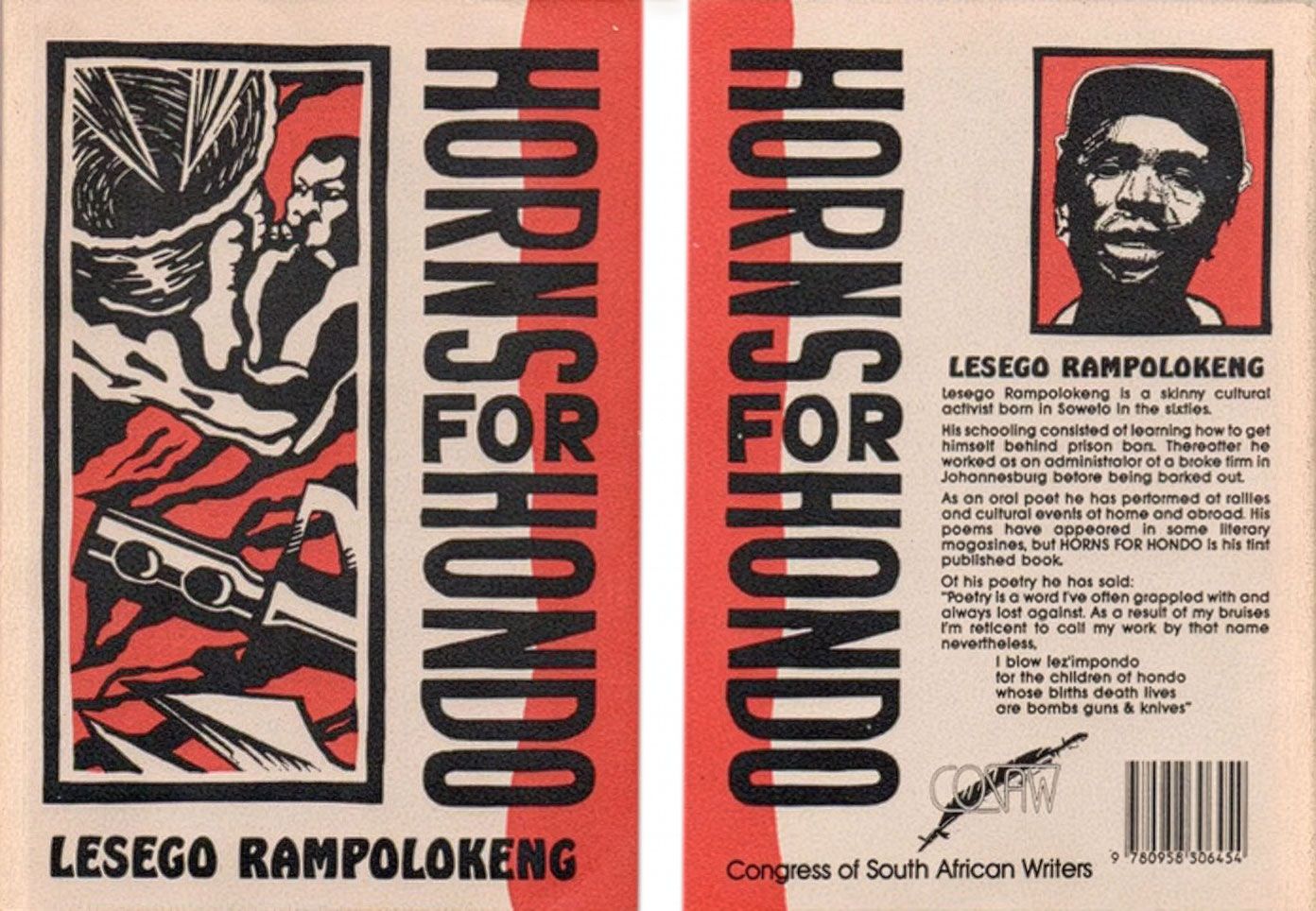
Horns for Hondo appeared in 1990 as apartheid’s official order entered its negotiated ending. In “dark light. light dark,” first published in Horns for Hondo and later reprinted in Matatu, the reversal “remember when the light brings dark” refuses the assumption that brightness arrives carrying liberation (Rampolokeng 1990; 1996b). Light can be civilisation, police flash, gunfire, revelation, media attention, transition or the national spotlight that exposes one object while leaving the structure behind it untouched.
The historical object has since changed. Power now speaks democracy, development, heritage, charity, climate concern, platform connection, responsible leadership and transformation. The old reversal returns as necropeace, honeyed venom, cosmetic change and the fire whose decline begins another dying. This is not the same poem repeated. It is a method returning to confront another political costume.
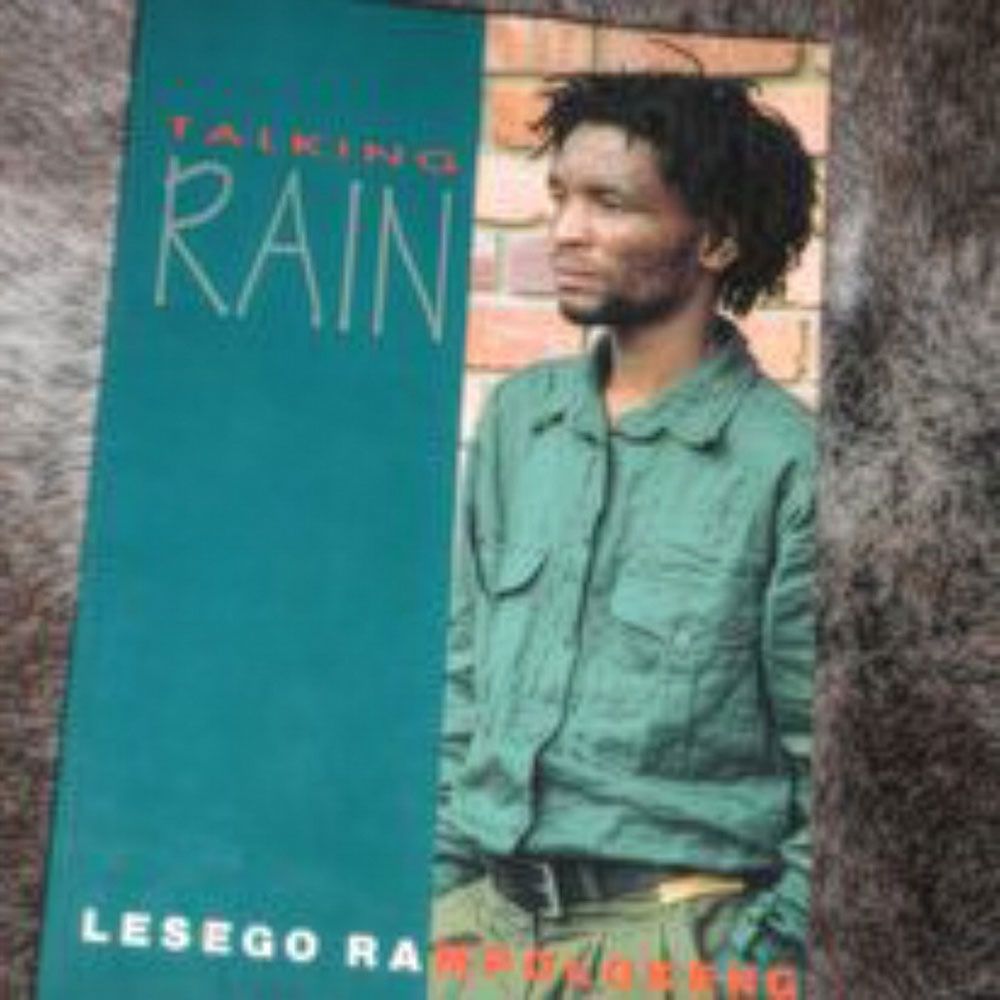
Talking Rain arrived in 1993, when rain could easily have become a symbol of national renewal. “Broederbondage” instead closes upon the admission “we’re stick-fighting against extinction” (Rampolokeng 1993, 16). The phrase holds courage without pretending courage is enough. The stick is not equal to the gun, mine, archive, state or market. Its inadequacy belongs to the truth of the struggle. That tension returns in “Black sonic science.” Sound is weapon, archive, method and survival practice, but beauty does not defeat capital by itself. The microphone can amplify and commodify. The beat can remember and become product. The stick becomes page, stage, recording machine and device with failed settings.
Extinction updates its software.
End Beginnings, recorded with the Kalahari Surfers and released by Shifty in 1992, had already refused linear history: official voices were sampled, broken and made to sound against themselves. When the Fires Go Down carries that temporal disturbance into its title.
Not after.
When.
The books do not form a clean ladder towards the latest work. Rap Master Supreme, Blue V’s, The Bavino Sermons, The Second Chapter, the heart books, bantu ghost, Head on Fire, A Half Century Thing, Bird-Monk Seding and greyheart quarrel with one another. Rap and page, sermon and novel, fragment and performance keep changing the position from which the voice speaks. Head on Fire refuses the hierarchy between rant, note and poem. Bird-Monk Seding permits séance, memory, cinema, street, music and unfinished narrative to occupy the same disturbed field. Greyheart makes ageing itself part of the form.
The current book brings that freedom into the writer’s immediate material present: the inbox, unpaid labour, failing device, tooth, “friend,” manuscript, insect, invitation and person who wants the poet’s presence without wanting the cost of sustaining the person.
Across the oeuvre, ndibona certain pressures returning: colonial language turned against its command; sound as thought; the body as historical archive; the unclean sacred; the nation’s false endings; Black Consciousness refusing refrigeration; material precarity; the socially active dead; and time that refuses to become redemptive merely because a government has changed.
Recurrence does not mean stasis. The earlier work confronted apartheid and transition without submitting to the demand for politically useful poetry. The prose entered home, hunger and narrative instability. The later work brings ageing and literary survival into digital life. The historical fire remains, but the body near it is no longer the same body.
The invoice has arrived.
The tooth hurts.
The message waits.
The poet is called a legend and still has to buy groceries.
The humour changes too. The word bomber increasingly becomes the man interrupted by debt, insects, settings, applications, strange invitations and questions that sound innocent until their arrangement becomes audible. The joke turns back upon the speaker.
The self that once appeared capable of bombing every structure must now negotiate the dentist, mobile network, landlord and person requesting a free poem. That does not make the later work smaller. It changes the scale of the fight. The body becomes more visibly involved in the word’s survival.
But a long oeuvre also allows us to hear where a method may have hardened into habit. Piled catastrophe, excretory return, contemptuous joke and gendered insult can strike with historical precision in one poem and arrive automatically in another. Recurrence cannot be defended merely by calling it signature.
A signature confirms presence. It may also show that the hand has become accustomed to making the same movement. That is why the quarrel belongs inside the reception of the oeuvre. To ask whether an old weapon still opens thought is not to erase the word bomber’s history. It is to read that history closely enough to ask what travelled, what transformed and what remained insufficiently disturbed.
Longevity does not abolish criticism. It enlarges the archive through which criticism must listen.
.so, the reader of Rampolokeng must be careful. We must not place the books inside a neat line and call that line development. Let Horns for Hondo stand beside the new fire. Read Talking Rain and ask what extinction has learnt since the transition. Hear End Beginnings inside the mic check. Put the sermons beside necropeace. Let Whiteheart stand near Phomolong’s invaded home. Place Head on Fire beside the fragments. Let Bird-Monk Seding trouble every attempt to collapse narrator into author. Carry greyheart into the ash.
Let the books argue. Let the early weapon confront the ageing hand. A long oeuvre is not proof. It is more work for the reader. And that work includes the right to quarrel.
XV. Where I Quarrel with the Fire
A reception cannot become a protection racket. I say this because love of Rampolokeng’s writing can become a critical weakness. The work has been “neglected” so often that a reader who cares may feel compelled to defend every line. The country has failed to receive him; therefore, the critic must not give the country another excuse. The white liberal literary room has called Black writing angry, excessive, vulgar and incoherent for so long that one becomes suspicious whenever those descriptions return.
That suspicion is justified.
“Angry” has often meant: this Black writer will not make white reading comfortable.
“Incoherent” has meant: this sentence refuses the order in which Black intelligence was expected to arrive.
“Vulgar” has meant: this body entered literature without washing itself for the canon.
We must remain suspicious of that room.
But suspicion can harden into another kind of obedience. Once a writer has been declared neglected, criticism begins to look like betrayal. The reader starts guarding the reputation instead of reading the work. We call every repetition incantatory (big word, i know; dictionary nawe, thyi) every insult subversive and every opacity an ethical refusal. Every obscenity becomes anti-colonial because Papa Ramps placed it there. Every excess becomes evidence of a difficult genius the ordinary reader has failed to deserve.
That would not honour the work.
It would make the writing untouchable and therefore unread. It would build the memorial while the writer is still alive, place the work behind glass and call the enclosure love.
I did not agree to write a protection document.
I agreed to receive the book.
There are moments in When the Fires Go Down when accumulation overwhelms some of the distinctions the poem has made possible. Capital, church, Europe, scripture, genocide, race, intestine, gold, machine, climate, fascism and revolution arrive so rapidly that the reader feels force while beginning to lose relation.
The storm becomes recognisable as Rampolokeng’s weather.
Recognition is not always understanding.
The accumulation is not simply a list. Rampolokeng works through montage, sample, sermon, rap, historical archive and verbal collision. The poem places events beside one another until the machinery shared across them begins to make a sound: extraction, conquest, racial ordering, sanctified violence, accumulation, disposal. His sonic method can sometimes hear the machine before the careful academic essay has completed its definitions.
That is part of the force.
But speed carries risk.
At times, I wanted a single image to remain longer on the page. Stay there. Do not move yet. Let Lüderitz remain Lüderitz long enough for the dead to refuse metaphor. Let Palestine remain Palestine. Let Congo remain Congo. Let the township death remain where the family still knows the name. I can hear “the Black”: what about Sudan? Yes, Sudan!
.these histories belong to intersecting structures of empire, extraction and racial modernity. They reverberate. They expose recurring procedures. But they do not belong together automatically, and the poem’s velocity cannot be permitted to turn every catastrophe into one dark substance.
That earlier distinction must hold: relation does not erase difference, and reverberation must not become collapse.
The reader must resist both errors: refusing every comparison because each history is singular, and allowing the music of comparison to make historical difference disappear. Rampolokeng’s line can create relation without receiving permission from disciplinary borders. The critic must still ask what that relation clarifies, what it compresses and what may have been lost in the speed of arrival.
Some jokes also land unevenly. Rampolokeng’s ridicule often exposes entitlement, literary pretension, bureaucratic stupidity and the sentimental treatment of the Black artist. At other moments, the target appears smaller than the weapon. A foolish question becomes a prolonged performance of contempt. The sentence keeps striking after the argument has already landed.
.at the same time, though, loving the work cannot require me to call every wound an opening.
..i’ll be plain… there is a masculine vocabulary in this book that troubles me.
I do not mean masculinity as an abstract topic to define, cite and place inside a literature review. I mean a recognisable way of speaking: an older Black masculine repertoire carried by histories of township life, political militancy, verbal combat, jazz masculinity, hip hop bravado and the refusal of white respectability. Older does not mean finished. It does not mean younger men are innocent. It means the language has travelled long enough to begin sounding natural, even when its injuries remain active.
It is the insult that reaches quickly for the woman.
The woman.
And again the woman.
The man made feminine so that his weakness may become complete.
The penis used as a measure of courage, authority and failure.
The woman’s body entering as prize, battlefield, contamination, appetite or proof that somebody is still a man.
I told you at the beginning of this reception: more on that later.
This is later.
Remember, reader: I called AK “bitch.”
I called a man “bitch” because the word carried irritation with rhythm. Because the borrowed African American accent gave the insult extra movement. Because the word landed. Earlier, I followed its gendered history through ordinary insult, feminist reclamation, queer performance and hip hop. I said context mattered: who spoke, to whom, in what room and under what arrangement of power.
All of that remains true.
None of it makes me innocent.
The explanation does not wash the word. Confession is not detergent. I cannot arrive here pointing at Papa Ramps from inside a cleaner language, pretending the gendered insult belongs only to his generation, his township, his speaker or his book. The critique returns to the critic. It returns to the pleasure I took in the word’s impact and to the ease with which femininity became available when I wanted to wound a man.
My use and his are not identical. Context matters. Tone matters. The target matters. Power matters. But difference in context does not erase the shared historical material that allows the insult to work. The question is not only: who was called the word? The question is also: what degradation did the sentence mobilise so that the word could land?
I do not mean that every appearance of sex, reproductive anatomy, maternity, rape or the gendered body is misogynistic. That would be another lazy reading. Rampolokeng repeatedly makes the body answer for histories that official language prefers to leave abstract. Reproduction becomes race science. Maternity becomes the place where nation, futurity and death meet. Sexual violence becomes part of colonial, racial and religious power.
The body is not incidental to the system he cuts open.
But that cannot be the end of the reading.
The contradiction begins early in the book.
In “Mic Check,” “Mother-lode” appears beside the exploding sheet and the staged word. Across “Mud Bound Wordsound Genesis,” maternal language carries origin, deprivation, nourishment and extraction: the motherless child, birth beneath hanging trees and “Africa breast.” The feminine is not present only as degradation. It also carries genesis, Black futurity, historical loss and the burden of nourishment.
Then “The Steal The Surreal The Art” makes reproductive violence explicit. Church, nationalist fraud, rape, genital injury and racial genocide enter the same sacramental machinery. The poem moves through “witches to the fire whore-lords/loads,” a place “where labia are wire-sewn shut,” “the gendered violent,” and finally the sound of “ovaries” ringing church bells. The poem is not blind to the governance of the feminine body.
It sees the machinery.
That makes the quarrel more difficult.
Testicle furnaces ovaries powdering
Unconsented sterilisation falling?
(Rampolokeng 2026, 17)
Those two lines refuse a simple gender arithmetic. Testicle and ovary enter the same furnace. Sterilisation is neither metaphorical decoration nor private tragedy. It belongs to racial science, state power, reproductive control and the long management of who may produce the future.
In “Rabid Castrationists,” the poem again asks:
wonder how rape pillage plunder
come echoing another age’s thunder?
(Rampolokeng 2026, 19)
The question recognises recurrence. Rape is not a loose obscenity thrown into the line for atmosphere. It is part of conquest, plunder and inherited violence. The book knows that sexual violence is historical machinery. So I cannot say Papa Ramps simply fails to see patriarchy. He sees it. The question is why parts of that machinery remain available to the tongue after the poem has exposed them.
The gendered body is the body injured by power, but it also becomes part of the symbolic material through which the poem injures its enemies. That contradiction begins to sharpen in “Nihil Spiral”:
More pit-bull than poodle still a bitch’s carcass
(Rampolokeng 2026, 16)
The immediate figure is not a woman. The phrase attacks hardness, menace and the false life of revolutionary performance. Still, “bitch” supplies the final fall. The carcass is already dead, yet feminisation is asked to make the death more complete.
Later, “Mushroom Crowd” drives another judgment through rhyme:
giant rat sound amplification no snitch-bitch sticks or
stones
(Rampolokeng 2026, 23)
“Snitch” and “bitch” lock together so quickly that sound appears to finish the judgment before thought has asked what history has been recruited. The rhyme bites. The consonants carry the blow. The line knows where it is going because the insult has travelled that road many times before. But what is the woman doing inside the insult? Why does feminisation remain available as the final descent?
The gendered insult does not stop carrying gender because its immediate target is a man, a state, an empire or an institution. The language works because femininity, female sexuality or submission has already been positioned as degradation. The man has fallen. The enemy has become contemptible. The quickest evidence is that the sentence can now name him through the woman.
The pattern moves beyond a single man. On page 48, geography itself enters the gendered court:
caught tween western witch & eastern bitch
(Rampolokeng 2026, 48)
The line is compressed, funny and vicious. West and East are caught together, and the rhyme refuses either side moral purity. Yet geopolitical antagonism is made legible through “witch” and “bitch.” The civilisational enemy is feminised before it is condemned. The poet may be shooting at power. The ammunition carries another history.
A Black man may dismantle the racial language through which he has been diminished and still reach for somebody else’s degradation to complete the blow. That is not a small contradiction inside radical speech. It is one of the ways domination survives inside languages built to refuse domination.
“Honeyed Venom” makes the contradiction especially sharp. The poem is cutting capital, church, empire, hypocrisy and the “New dawn” that markets an old appetite through cleaner language. Then it gives the boardroom a gendered name:
The real Whore Ra sits in the boardroom
(Rampolokeng 2026, 54)
“Whore Ra” disturbs dawn, divinity, sale and sexual classification in one contaminated sound. The boardroom preaches renewal while feeding upon the same bodies. The honey hides the venom. The boardroom is where the corruption sits. Yet the sexualised feminine figure is made to carry its smell. Why?
The boardroom was not built by the whore. Empire did not wait for a prostitute before discovering exploitation. Colonialism, racial capitalism and church did not need a sexually available woman to teach them hypocrisy.
Still, the feminised figure becomes the familiar container into which betrayal, contamination and compromised desire are emptied. Power commits the crime. The sexually classified woman carries the evidence upon her name.
The priest – prostitute arrangement returns elsewhere. “Post-Script-Tummy-Tuck” ends by placing truth:
between the priest & the prostitute in the confession
booth:
(Rampolokeng 2026, 87)
The pairing can expose sacred hypocrisy. Priest and prostitute meet inside the same institution of confession, each threatening the moral distance separating holiness from sex. But the grammatical asymmetry remains. He arrives through office. She arrives through sexual classification.
“Fugees Sample” repeats and intensifies that structure:
Profane priest and holy whore
Prostitute both flesh and soul
(Rampolokeng 2026, 140)
There is reversal. The priest is profane. The whore is holy. The moral charge has been disturbed. Fine. But reversal is not release.
The next line returns the woman to prostitution of “flesh and soul.” The adjective “holy” unsettles condemnation, but it does not dismantle the architecture through which each figure becomes legible. He has doctrine, office and institutional failure. She continues to have a sexual category.
The issue is not whether “whore” should be placed upon a prohibited-word register. ‘Literature’, since we have dragged him into that colonial thing, cannot move through a human resources list of permitted language. I am not searching the book for policy violations.
The question is what imaginative labour the word performs.
does it reveal something precise?
does it open an arrangement?
Or has it arrived because the moral imagination already knows where to send the dirt?
The direct anatomical insult returns without the shelter of reversal or obvious philosophical pun. In “Regina Mundi,” the poem gives us:
Devils hooves on the roofs of treacherous cunts
(Rampolokeng 2026, 119)
The target may be treacherous people, institutions or historical collaborators. But “cunts” performs the final classification. Female anatomy becomes the noun through which treachery is made complete.
Later, in “Salvation Sail,” rhyme drives the return:
Snitch bitch snoop troop got dreams under surveillance
(Rampolokeng 2026, 151)
The line is almost too efficient. Snitch. Bitch. Snoop. Troop. Surveillance. Sound builds the security apparatus while “bitch” supplies one of its quickest degradations. The word fits so well that fit itself becomes the problem. Does the rhyme reveal the machinery? Or does the rhyme know the old route?
The Phefeni sequence brings the masculine court into the street:
Limp-dickers reworked as pussy-creamers in their minds
Mandrexed human wrecks dressed in superman drag
(Rampolokeng 2026, 197)
The phrase attacks men performing hardness through drugs, chains, weapons, sexual fantasy and violence. Their sexual swagger becomes compensation. “superman drag” exposes masculinity as costume: something worn over wreckage.
I can hear that reading.
But the line answers those men inside the same masculine court. The penis remains the measure. Sexual capacity remains proof. The woman’s body remains the ground upon which male failure and imagined repair are staged. The poem beats the men at their own game without fully asking whether the game should survive. That distinction matters.
One may expose violent masculinity by proving that the violent man is not man enough. Or one may question why being “man enough” remains the court in which the argument must be heard. The first humiliates the man. The second asks how the man was produced and who must live beneath his performance.
Near the end of the book, bodily disgust, sexual fluids and the anatomical insult converge. The Trap-Yard is described through both male and female bodily matter:
dried up semen &
rotten vaginal discharge smells.
(Rampolokeng 2026, 213)
The pairing matters. The female body itself carries disgust. Semen and vaginal discharge enter the same rotting environment, beside vomit, urine, faeces, pus, septic organs and bodies coming apart. Still, the adjectives do not fall innocently. The semen is dried. The vaginal discharge is rotten. The feminine reproductive body acquires decay before the paragraph reaches its hardest formulation:
Syphilitic erection painfully hard. Difficult to defeat cunt.
(Rampolokeng 2026, 213)
Maybe it is Kant.
With Rampolokeng, the word may sound in several directions at once. “Cunt” remains the vulgar anatomical insult printed upon the page, while “Kant” may hide inside the sound, pulling European philosophy, reason and canonical authority into the line. The pun may be making the philosopher answer through the body that philosophy so often treated as its other. It may be dragging pure reason into impure sound.
Perhaps both are there.
That is clever.
Cleverness does not acquit the insult.
If “cunt” performs the work, female anatomy is again pulled into a vocabulary of conquest and defeat. The pun humiliates canonical reason by sending Kant through the anatomical slur, but the woman’s body becomes the acoustic bridge across which that humiliation travels. Philosophy may be the target. Gender remains part of the weapon.
The casualness is what troubles me.
The feminine body is so readily available to the sentence that the line does not need to explain how it arrived there.
This is where I quarrel with Papa Ramps.
Not because I require politeness.
Ha ah.
Not because I want the poem bathed, deodorised and made safe for university teaching. The university already possesses enough machinery for removing teeth from Black speech. I am not asking Rampolokeng to sound like a gender policy, professional code or one of those university messages written by twelve committees until no human being can be found inside the sentence. I am asking whether some verbal weapons have become blunt because their violence is too familiar.
Does the gendered insult reveal the machinery of power, or has it arrived because the rhyme knows the route? Does the sexual image expose masculine violence, or does it briefly enjoy the authority that violence offers? Does the line open thought, or demonstrate only that the speaker can still wound? The question is not whether the language offends me. Offence is a small concern. The question is whether the violence remains exact.
That question must also be fair to the book. Rampolokeng does not reserve bodily humiliation for women. Castration, severed phalluses, diseased erections, semen and damaged male bodies move throughout these pages. “Regina Mundi,” immediately after “treacherous cunts,” gives us “Not sausage package but cut off phallus parcel” and asks, “Rabbit, how they castrate” (Rampolokeng 2026, 119). “Post-Poetic Headcharge” places “poison semen” beside “vaginal discharge in vats” (Rampolokeng 2026, 90). The grotesque body is not exclusively female.
That counterevidence matters.
Without it, my reading would become a word search pretending to be criticism.
The problem is not that only the woman’s body is dirtied while the male body remains sovereign. The problem is more specific: when the poem wants to classify treachery, weakness, false hardness or civilisational corruption, femininity and female sexual anatomy remain unusually available as the fast route towards degradation.
That is an older masculine habit.
Not a private defect belonging to one man.
Not an excuse either.
Rampolokeng belongs to a generation of Black men for whom township survival, political militancy, jazz masculinity, verbal battle, hip hop bravado and refusal of white respectability could become entangled. These were not merely styles. They were ways of producing a voice that would not bow when colonialism and apartheid demanded the lowered head, the softened word and the grateful native.
I do not say this to dismiss that generation. It produced languages of refusal without which many of us would be intellectually poorer. It taught Black men to answer. It gave rhythm to anger when the nation wanted gratitude. It refused the civility through which white power tried to govern Black expression. My point is that answering white power does not make every inherited way of speaking among Black men liberatory.
Anti-colonial language can remain patriarchal.
Black Consciousness can awaken the racial self while leaving gendered power insufficiently disturbed.
A man may refuse white mastery and continue imagining women through categories of purity, sexual availability, maternity, danger, betrayal and insult.
A radical tongue can carry ordinary patriarchy.
Funeka siyithethe lento.
And we must be clear.
We cannot defend every gendered insult as “kasi lingo,” as though the township remains outside history and is therefore exempt from ethical argument. The kasi is not outside patriarchy. Township language creates extraordinary beauty and continues to reproduce cruel arrangements. The same street can produce a liberating joke and a vocabulary that teaches a boy to hear womanhood as humiliation.
Abantu baseKasi are alive. They move. They change. Women answer. Queer people answer. Writers of another generation take old words, bend them and sometimes return the injury to us with its mechanisms exposed. Culture does not move by treating every inherited insult as ancestral property. That would make culture another refrigerator.
The same Rampolokeng who refuses the bourgeois refrigeration of Black literature allows us to ask whether some masculine language has itself become refrigerated. Is the insult still cutting power, or does it repeat the old line because the old line continues to sound like hardness?
The complication is that the book is not blind to gendered and sexual violence. In the Lumumba sequence, it asks whether Black women are imagined as able to suffer rape more readily than white women, recognising the racial distribution of innocence, protection and public grief.
The same book that recognises the historical availability of the Black woman’s body can elsewhere make the feminine body available to complete a verbal blow. That contradiction matters more than a simple verdict of misogyny or innocence. It shows radical intelligence moving unevenly across structures of domination. Clarity in one political register does not automatically emancipate the language in another. A writer may see one machinery of harm with terrible precision while speaking through another machinery that has become ordinary to him.
This is not a charge sheet placed beside the poems. It is the contradiction the poems require me to remain with. I say this as a Black man formed around some of these ways of speaking. I have heard men turn women into punctuation. I have heard weakness become femininity, fear become homophobic insult and sex become proof. I have participated in languages whose violence became visible to me only later.
I began this reception by calling AK “bitch,” then paused to explain the history travelling inside the word. That pause did not cleanse me. It became evidence that the vocabulary under examination also lives in my own mouth, ear and memory. I am not standing outside the culture with clean hands.
I am asking what we must refuse inside what formed us. The aim is not to become a clean man. Cleanliness is another fantasy. The aim is to interrupt the ease with which somebody else’s degradation arrives when we need a weapon quickly.
Persona does not settle the matter. Bavino, the speaker, word bomber, OG and Lesego Rampolokeng cannot simply be collapsed; the poem is not an affidavit. It does not protect language from analysis. Persona is not immunity.
The critical question is not: did Lesego Rampolokeng personally mean every word exactly as the speaker says it? The question is formal, historical and political: why does this vocabulary return, what work does its return perform, what pleasures accompany its impact and whose body pays for the line’s force?
Bodily disgust presents a related but different question. Rampolokeng’s shit, vomit, pus, anus, intestine, decay and smell perform necessary anti-clean work. They expose the sanitary fantasies of civilisation, nation, church and canon. They remind literary respectability that the body did not disappear when the poem entered a book.
This disgust is not merely adolescent shock. It is a counter-aesthetic. The polished building has a sewer. The boardroom digests bodies. The church produces waste. The nation perfumes decay and calls the smell reconciliation. Rampolokeng returns the excreted material to the official room and refuses to let civilisation pose without its intestine.
Yet disgust may also become predictable.
When every institution returns to excreta, the image may stop surprising the structure. Vulgarity then risks becoming signature rather than discovery. The sewer is real, but a reader who already knows that every building will reveal the same sewer may cease to see the particular architecture being exposed. The same test applies to obscenity: not whether it offends, but whether it remains exact.
Does the shit reveal the sewer beneath this particular polished building, or has the reader simply learnt to expect the smell? Does the image uncover something, or announce that Rampolokeng has entered the poem carrying the familiar weapons?
A long oeuvre develops habits as well as inventions. A signature can be a weapon. It can also become the hand reaching automatically for the same blade.
I am not asking him to stop dirtying language. I am asking the dirt to remain specific.
What keeps When the Fires Go Down alive is that it frequently anticipates this quarrel. It mocks its own grandiosity. It places cosmic judgment beside a grocery list, revolution beside device settings and the intellectual beside the cockroach. The speaker cannot maintain prophetic height because the rent bill, molar, network failure and stupid inbox keep interrupting. The material world heckles the oracle.
That self-mockery matters. It does not absolve every excess, but it prevents the work from becoming one monument to its own difficulty. The voice can thunder and then misdial. It can summon history and still be defeated by Android settings. It can accuse the world while the body asks what will happen to the tooth.
The poem repeatedly drags the prophet back into the ordinary conditions of being alive.
My quarrel is not a demand that Rampolokeng become easier. Ease is not the measure. I ask where difficulty creates another relation and where it becomes an expected performance of difficulty; where repetition carries unresolved history and where it could have been cut; where insult clears ideological fog and where it leaves only the satisfaction of impact.
I ask where the work unsettles power and where it briefly borrows power’s old pleasures.
These questions did not make me leave the book. They kept me inside it longer. The fire needs oxygen. “Criticism” is not always water poured upon it. Sometimes criticism removes the glass case that has begun to suffocate the flame.
I promised AK a reception, not a protection racket.
I would rather quarrel with the living work than praise a dead reputation.
XVI. Not After the Memorial: Not a Praise Poem for the Nation
On 6 July 2026, the day before Lesego Rampolokeng turned sixty-one, this reception interrupted itself again. I stopped trying to finish it and wrote a letter to President Cyril Ramaphosa.
Well. Correction: I did not write directly to the man. I wrote something, perhaps nothing, that I labelled “a letter” to the President of South Africa.
His name is Cyril Ramaphosa, my French friend.
I sent the piece to AK before teaching the next morning.
I called it “Not After the Memorial.”
The title carried a promise already made inside this reception: I would not wait until the writer was dead to ask why the country had kept him so close to cultural importance and so far from material security.
A country that discovers its writers only when they are no longer available to argue back.
When they are safely dead.
Like dead-dead.
When the anger can be converted into heritage and the difficult words washed, folded and placed neatly inside the memorial programme.
I was not asking Ramaphosa to manufacture Rampolokeng’s greatness through presidential recognition. Papa Ramps does not require a medal to discover himself. He might laugh at it, insult the committee, refuse the proper clothes, quarrel with the speech and make the official photograph unusable.
Good.
The country should not be protected from the living person’s answer.
My question concerned the national habit of arriving only after the body becomes manageable.
Swinney’s (2023) account makes this pattern difficult to dismiss as emotional exaggeration. He recalls Rampolokeng’s anger after his removal from an ANC cultural event and describes the narrow space the movement created for Black Consciousness poets. Congress aligned cultural authority helped push other political and literary lineages towards the edge of the national story.
Rampolokeng’s work on Mafika Gwala, and his repeated return to Ingoapele Madingoane, Lefifi Tladi, Peter Makurube and others, is therefore more than an acknowledgement of influence. It is a form of archival rescue inside a field shaped by selection, abandonment and organised forgetting. He returns to names that the national story has allowed to fade. Not because they should be assembled into another frozen lineage, but because their disappearance reveals the arrangement deciding which radical Black voices become national culture and which remain difficult noise.
This does not mean that every ANC aligned artist was rewarded or that somebody inside Luthuli House kept a secret list of poets who should starve.
Hayi.
The arrangement is more ordinary and therefore more powerful. Cultural recognition travels through publishers, broadcasters, schools, festivals, universities, archives, political networks and the people who decide which forms of difficulty can be made useful.
Some writers can be arranged to affirm the national story.
Others return carrying what the story placed outside: Black Consciousness displaced, the failed promise, the worker still dying, the hungry artist, the violence beneath reconciliation and the “friend” who arrives only when the funeral room is already full.
The sequence is familiar: the artist works, the body deteriorates, “friends” become scarce, books disappear and institutions remain busy. Then the memorial room fills with people who always understood the greatness. Praise becomes abundant when it can no longer purchase food, treatment, time or the return of a manuscript. The country can be extraordinarily generous to the dead because the dead no longer send invoices. No one needs to ban a writer for that writer to disappear.
There is a quieter violence. Do not teach the work. Do not stock it. Do not read it publicly. Let the writer become “too much,” “controversial,” “difficult” or insufficiently marketable. Let the books vanish without anybody having to confess that a decision was made.
The violence is distributed.
Publishers allow books to fall out of print. Small presses struggle without sustained financial support. Libraries fail to stock the work. Teachers decide that the language is too difficult. Festivals want the voice but cannot find an adequate fee. Universities invite the writer as evidence of their radicality, then return him to private precarity. Reviewers praise the oeuvre without helping the latest book circulate.
The state is not the only institution involved.
Black institutions, white institutions, comrades, critics, editors, publishers, teachers and readers can all participate in the memorial economy. We may celebrate the living writer symbolically while neglecting the material conditions that allow the work to remain alive.
Praise becomes plentiful. Infrastructure disappears. Publishers committed to serious Black work are pushed out of the market, and with them disappear the fragile infrastructures through which Black beauty is published, kept in circulation and returned to new readers. The loss is not measured only in the number of new books that never appear. It is also visible in the quiet disappearance of older works, the frustration of republication and the gradual removal of Black writing from the material world.
I encountered this ordinary disappearance while trying to find some of Papa Ramps’s classics and, alongside them, Unathi Slasha’s Jah Hills. Several of the books had already slipped out of circulation. Jah Hills was out of print. A contemporary writer may be named as part of South African literature’s future while the material object carrying that future becomes difficult, sometimes almost impossible, to locate. There is something obscene about declaring the future secure when its books cannot remain upon the shelf. How is this possible in a country supposedly culturally “controlled by Blacks”?
Why must a publisher committed to Black beauty struggle alone for survival? Why is the financial support required to keep these books in print not treated as part of the country’s cultural responsibility?
We have government departments called “arts and culture” and all kinds of related institutions.
.where are they?
Do they know these publishers exist? Do they understand what disappears when one of them closes? Do they care about the books, writers, archives and possible readers that disappear with it?
Why Rampolokeng?
Difficulty alone does not explain material precarity. His politics matter. He refuses the poet’s role as stage cleaner for political power. He refuses the ANC’s ownership of liberation, white liberalism’s pleasure of discovery and the university’s desire for a stable theoretical object.
That refusal enters the market.
A writer who cannot easily be packaged as reconciliation, heritage, performance energy or a school safe poem becomes harder to sell inside a small and unequal literary economy. Profanity alarms the respectable. Public talk about money exposes arrangements that literary culture prefers to keep hidden behind the applause.
The literary world may call a Black writer a genius, provided that the genius remains grateful, accessible and inexpensive. We should not romanticise this.
Poverty is not the price of integrity. Material suffering does not certify political truth. A Black writer should not need to remain poor in order to prove that he has not been captured.
Payment is not surrender. Institutional support is not automatically co-option.
The question is what is demanded in exchange: silence, gratitude, softening, availability, political loyalty, a less difficult book or a poem suitable for the national programme.
Recognition can matter.
When Keorapetse Kgositsile became National Poet Laureate and received the Order of Ikhamanga, the country said something important to its children: a Black poet belongs at the centre of intellectual life.
Recognition may help books travel, libraries stock them, teachers teach them and readers understand that serious thought does not arrive only from elsewhere. That is not nothing.
But recognition becomes necropeace when ceremony substitutes for the material and intellectual relation demanded by the work. The medal cannot become the book. The speech cannot become the reading. The funeral cannot become the archive. The citation cannot become care.
Then I found something that complicated my argument.
Ramaphosa had, in fact, already said the name.
At Keorapetse Kgositsile’s special official funeral on 16 January 2018, the then Deputy President spoke of the “culture workshops and poetry trenches” in which Bra Willie had led his word battalions. He said that the poetic struggle of June 16 continued through Lebo Mashile, Kgafela oa Magogodi, Sandile Dikeni and Lesego Rampolokeng (Ramaphosa 2018).
.the ordering of the names disturbs me.
But there he was.
Papa Ramps.
Alive inside another poet’s funeral speech.
The country cannot say it did not know him. Its official machinery knew the name well enough to place it inside a revolutionary lineage when the memorial programme required continuity.
But being named is not the same as being received.
The speech makes Rampolokeng an inheritor of Kgositsile’s cultural trenches, evidence that the revolutionary word survived into another generation. Yet ceremonial placement does not require the state, university, publisher, library, critic or reader to remain with the living writer’s disagreement with the nation narrating that inheritance.
His name can confirm that revolutionary culture continues while his books, material conditions and political refusals remain somebody else’s problem.
Basicaaallyyyy, he is present as citation and absent as demand.
The speech does not ask how Ramps himself feels about Bra Comrade’s writing, politics or “poyetri.” It does not need to. The lineage must be smoothed before it enters the ceremony. Any disagreement between the living writer and the ancestor being invoked would disturb the programme, complicate the inheritance and require the state to receive Rampolokeng as more than evidence that revolutionary culture once existed and somehow continues.
The state keeps the lineage and edits out the quarrel.
The contradiction sharpens because Ramaphosa later asks, in the same speech, whether South Africa does enough to recognise artists “in our midst.” He insists that they should be celebrated while alive (Ramaphosa 2018).
Rampolokeng was alive.
He had just been named.
Recognition occurred at the level of the sentence. Reception did not necessarily follow through libraries, classrooms, publishing, reprinting, payment or sustained public argument.
Ramaphosa had said the name.
The larger question is what the country did after saying it.
This brings me, briefly, towards Nelson Mandela.
While writing this reception, I also wrote something on Mandela’s birthday. It came from embarrassment.
My own.
I remembered the younger version of me who repeated “sell-out,” “not a revolutionary,” “neglected Winnie” and “he did not spend the whole twenty-seven years there” as though repetition made me radical.
I thought I sounded intelligent.
Critical.
Dangerous, even.
Lol.
In truth, I had confused insult with analysis and reduced an entire history to one Black man’s face. The cheap Mandela critique is attractive because it gives centuries of conquest, settler colonialism, racial capitalism, white property, organised business power and the compromises of an entire liberation movement one suspect.
One Black suspect.
The history I later read made the room larger than the accusation.
Mandela and those around him acted inside a brutally constrained field built before they entered; structure was real, and choices were real too.
Rampolokeng’s refusal of reconciliation should not be forced into my revised position on Mandela, as though Papa Ramps must now mature alongside me. Swinney’s account of their disagreement in Brazil in 1994 makes this difference clear. Swinney believed the optimistic story of the New South Africa was necessary to prevent further violence. Rampolokeng refused that bargain. He would not allow fear of violence to compel Black consent to a peace that left the structure of injury substantially intact. His anger is not required to mature into my explanation.
It remains an archive of what national optimism could not carry: the violence beneath reconciliation, the old ownership beneath the new flag and the injury asked to become reasonable before the material arrangement became just.
Rampolokeng’s work is not a praise poem for the nation because the nation repeatedly asks poetry to clean the stage.
Sweep away the blood.
Remove the rubbish.
Make the transition sound complete.
Turn the dead into ancestors of democracy and the living into grateful beneficiaries of history.
Lesego will not lick the stage clean for Mandela, Mbeki, Zuma, Ramaphosa, the ANC, white business or the critic.
He writes from the rubbish the ceremony leaves behind.
That does not make every political judgment correct.
It makes the refusal indispensable.
The letter was therefore not asking for a cheap medal. It was asking the President, the ANC and the country to say the name while the writer could still answer back.
Say it while he can laugh at you.
Say it while he can trouble the sentence.
But do not stop at saying it.
Stock the books.
Reprint them.
Teach them.
Pay the writer.
Read the disagreement.
Do not wait for the memorial speech.
Papa Ramps cannot easily be used. That is part of why the powers that be do not know what to do with him. They praise him quietly, invite him occasionally, study him inadequately, pay him badly and wait.
They wait for difficulty to become heritage.
They wait for the living argument to become a safe quotation.
They wait for the person who can still answer to become the image upon the programme.
This reception must refuse the waiting.
XVII. The Future Must Answer Back
To refuse the nation is not to refuse inheritance. The harder question is what travels after refusal, who receives it and whether those who receive it may answer back. A living tradition cannot be organised as one elder speaking forever while everybody entering the literary field afterwards waits for permission to become audible. The elder is not the end of the sentence. Nor is the contemporary writer merely evidence that the elder was influential.
Inheritance must move in several directions. It must carry, bend, interrupt, return and sometimes correct.
This is where herri matters to the reception. I am a reader of herri. Not because a digital publication can solve the crisis of Black literary circulation.
It cannot.
But herri understands that form is not merely a container waiting for content. Essay, criticism, image, music, performance, experiment, archive and public memory may sit beside one another without apologising for failing to become the same thing.
It also helps reintroduce younger readers, and some of us who arrived late, to South Africa’s great writers. It keeps their work in conversation with the present rather than returning it as heritage placed safely behind glass. “The Day I Killed the Mamba,” by one of South Africa’s greats, Vonani Bila, was published there. That mamba did not remain obediently inside its own poem. It moved. It followed me into this reception, entered another writer’s sentence and refused to leave.
I know. It has been troubling these pages. That is what living work does.
A thin review of Rampolokeng would be worse than no review.
It would create the feeling that the work had been attended to when it had merely been passed through. herri permits another arrangement: one sound alters how a text is heard, one writer sends the reader towards another history and a poem refuses to remain where the contents page placed it.
In the 2024 HSS Awards catalogue, already mentioned above, Aryan Kaganof, AK, helps me understand this curatorial movement through his account of herri 9: Lefifi Tladi. Fred Ho leads towards Louis Armstrong, Miles Davis, Asher Gamedze and Tumi Mogorosi. Ho leads to Salim Washington. Washington leads to Rampolokeng. Rampolokeng’s tribute to Mafika Gwala bends the route towards Tladi and the Black Consciousness cultural field (NIHSS 2024, 151).
These are not links in the thin internet sense. They are human, sonic, political and historical relations. The commercial algorithm usually says: here is more of what you have already consumed.
herri asks another question: what does this unexpected relation allow us to hear?
Still, the digital form cannot congratulate itself too quickly. The same catalogue notes that herri depends upon donor support and operates within a country divided by digital access (NIHSS 2024, 151).
Publication online does not abolish class, infrastructure or the political economy of circulation. The reader still needs data, electricity, a device, time and some route into the page. A platform may build another intellectual geography while remaining inaccessible to many of the people whose worlds made that geography possible. The postcolony remains a device that will not connect.
Within this ecology, Unathi Slasha’s (2023) herri reception of Bird-Monk Seding refuses to reduce Rampolokeng’s form to disorder.
.besides, surely, if you know Lesego’s work, you did not think I would get this far without mentioning Slasha?
Right?
I can already hear the true reader answering: “Right, comrade.” I mean, he is literally on the back cover of Papa Ramps’s latest book. Slasha places Rampolokeng firmly inside the literary history and trajectory of the country. He argues that the latest work should be enough to “suffocate such spirit of uncertainty for good.” The back cover names him as Unathi Slasha, author of the novels Jah Hills and The Hollow Sound of Lightweight Bodies.
The endorsement is short, but it is not small. Slasha does not merely say the book is good. He treats the latest work as evidence that uncertainty about Papa Ramps’s place in South African literature has become indefensible.
Suffocate.
Even doubt must struggle for air.
The sentence is praise, certainly, but it is also placement. Slasha locates a living writer within the past, present and future movement of South African literature.
Ndiyabindeka ke, as benditshilo, by this framing that situates Papa Ramps within that colonial thing called literature. But ke, as benditshilo, perhaps this is how recognition works: something different, something Black, must first be categorised before the institution can admit that it exists.
Still, Slasha’s point is clear. The argument about whether Rampolokeng belongs has already become embarrassing.
The work has answered it.
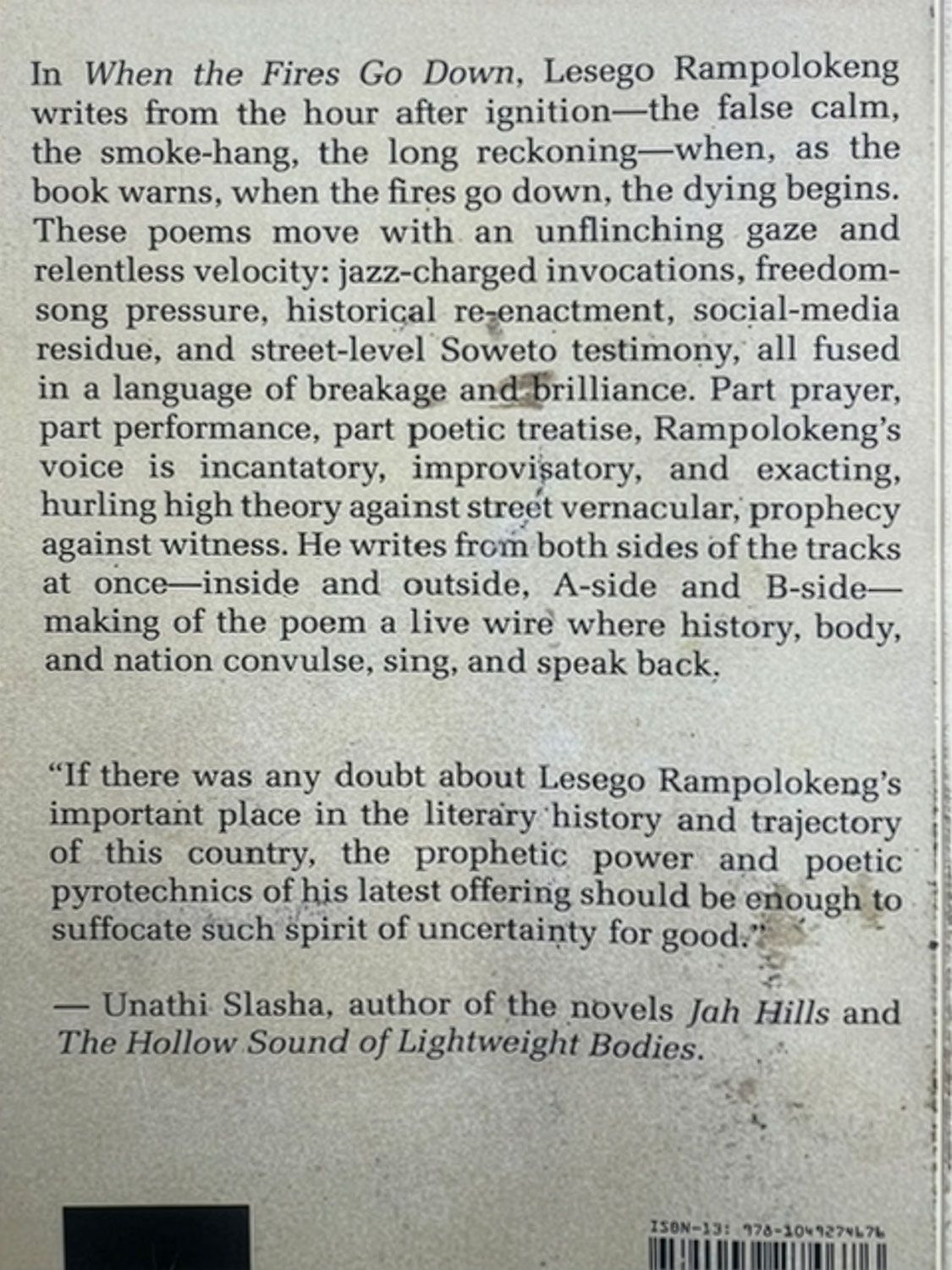
In his longer reception of Bird-Monk Seding, Slasha reads the novel through séance, oral archive, free jazz, montage and the refusal of a simple ending. He also reinforces a distinction this reception needs: Bavino Sekete is not Lesego Rampolokeng; narrator, alter ego and author cannot be collapsed merely because the critic is impatient for biography. Persona is not affidavit.
I learn from Slasha without wanting merely to repeat him. But the relation does not travel in one direction. Slasha is not simply a contemporary critic arriving to explain an established writer. Rampolokeng is also reading, hearing and naming Slasha. The person receiving the oeuvre has entered the oeuvre’s living language.
In one of the later fragments, Papa Ramps writes:
“blessed be slasha and sisonke…the future of s.a. literature is secure”
(Rampolokeng 2026, 172)
The line is brief enough to disappear beneath the surrounding irritation, memory and noise. Yet it matters. Rampolokeng looks ahead and sees that the word will not end with him.
The future has names: slasha and sisonke.. andikho sure ngalo ‘sisonke’ – ngumsimang.? Uba nguye. Nam ndiyavuma papa/
They are not made small so that the OG may remain large. Nor are they presented merely as followers standing behind him. He recognises other literary forces moving in the present. He names them as future, but that future is not waiting somewhere inside distant time. It is already writing, reading and altering the field while he remains alive inside it.
This recognition matters because Rampolokeng is frequently received as the neglected originator: the writer who arrived before the fashion and the difficult figure the country may find easier to praise after death. But in this sentence, he is also a reader. He sees work that does not require his ownership to become real. He does not say Slasha and Sisonke matter because they resemble him. He does not announce himself as the gate through which they must pass.
He sees something moving and blesses it.
Then the movement turns back.
Rampolokeng later writes that “rubbishkazi” is a term “taught to me by unathi slasha,” adding that he “like[s]” it” (Rampolokeng 2026, 181).
.apha, the writer named as part of the future is already teaching the OG something in the present.
This is not a straight genealogy in which Papa Ramps speaks and a writer of another generation receives. The word moves in both directions. Slasha receives Rampolokeng through séance, montage, Black musical form and critical reading. Rampolokeng receives a word from Slasha and places the receipt inside his own sentence. He does not take the word, erase its route and allow the reader to assume that every linguistic explosion began inside Papa Ramps.
He names the source.
Small sentence.
Big relation.
Slasha enters the book as future and teacher. Blessing and borrowing. Recognition and relation. Rampolokeng says the word will continue beyond him and then admits that what is described as coming after him has already altered his vocabulary.
He does not simply have influence.
He remains influenceable.
That may be one of the clearest signs that he is still a living writer rather than heritage.
A heritage figure is made to speak in one direction.
The country quotes him. The university teaches him. The contemporary writer is instructed to inherit him. The memorial explains him. Nothing returns to disturb the statue. But a living writer may still change. He can learn a word he did not invent, recognise a force he does not own and receive something from those who have received from him.
The future is not waiting politely for the elder to finish.
It is already speaking into his mouth.
That is why inheritance cannot mean obedience.
To inherit Rampolokeng cannot mean becoming Rampolokeng. A contemporary writer may receive his sonic audacity, refusal of literary respectability, Black Consciousness archive and courage to remain difficult without preserving every direction in which the fire once burned.
The future must be able to say: this weapon remains necessary.
And then: this other weapon is cutting in the wrong direction.
This connects Slasha’s relation to my earlier quarrel with Papa Ramps, but I am not recruiting Slasha as evidence that another generation has solved gender, masculinity or language. That would place an unfair burden upon him. I am saying something smaller and more important. A living tradition must allow those receiving it to alter what has been inherited. They must be permitted to carry, refuse, answer and teach back.
The elder cannot become origin while the contemporary writer becomes evidence. Hayi. That is the old family photograph.
A living literary relation must be more dangerous. A writer entering the field later may receive, bend, refuse and expose what earlier work had not sufficiently disturbed. A writer who has been present longer, if he remains living in the deeper sense, can still hear something he did not invent.
Literary time does not need to reproduce the household hierarchy in which Father speaks and everybody else waits to be told what the inheritance means.
Mna, I am not in literary studies. I will leave some of those classificatory battles to the literary people. But the category (literary), for me, becomes small around Rampolokeng, Slasha, Stacy Hardy, Aryan Kaganof, Vonani Bila and others working across word, sound, performance, criticism, history, archive and social diagnosis.
This is literature, yes.
It is also sociology, psychology, political thought, philosophy, history, anthropology, sound study and outlawed social commentary.
They are literary outcasts.
Sorry.
Outkasts.
The category is too small, but publishers, awards, libraries, universities and syllabi still organise themselves through categories. We use the name while refusing to let the name close the work.
I came to Slasha’s work late. I am still reading. The critic does not always arrive carrying the whole relation. Sometimes reception is a record of catching up, of discovering that the conversation had already begun before you entered the room. To acknowledge lateness is not to disqualify the reading. It is to refuse the performance of mastery. Reception must remain slow enough to change its mind. That principle follows me into the classroom.
Because I am a teacher, I also receive this book there. Not by converting it immediately into learning outcomes and week seven. The university knows how to remove teeth from a living text. It places the poem upon a slide, defines the difficult term, lists the themes and moves forward before the word has disturbed the room.
The opposite danger is to declare the writing too difficult, obscene, local or unruly for students. That also protects the institution. It repeats the lowering of expectations through the language of care.
Teach the sound before explaining every reference. Let students stumble without making confusion humiliating. Then bring the history: Biko, Gwala, Fanon, Black Consciousness, Phefeni, mine labour, Soweto, mission school, Grahamstown, colonial language and the routes through which Black sound travelled.
Context must sharpen the line, not anaesthetise it.
Rampolokeng should not appear as a South African example after the real theory has been taught. He belongs where language, Black thought, form, sound, racial capitalism, political theology, embodiment and literary method are being discussed. But teaching Rampolokeng cannot mean teaching students to kneel.
A student must be permitted to ask why distinct historical catastrophes have been brought together. A student must be allowed to say that the obscenity is exact here and lazy there. A Black woman student must be permitted to quarrel with the gendered insult without being told that she has failed to understand township language. A queer student must not be required to receive every masculine injury as the necessary price of radical speech.
That is not domestication.
That is reception.
Not every student will love him.
Good.
Some will laugh, become offended, hate the density, find one line, return years later or never return. Literature is not satisfaction management.
The teacher’s task is to build a room where difficulty becomes inquiry and where the student is not required to become academically respectable before hearing the word.
But the writer cannot be placed beyond criticism because the room has finally learnt to listen.
The right to remain difficult is not the right to remain unread.
Nor is it the right to remain unanswered.
The work must be allowed its abrasion. The critic must still quarrel. The teacher must refuse domestication without turning confusion into a badge of superiority. Writers working in the present must be permitted to inherit without becoming monuments to another person’s influence.
Rampolokeng names a future.
That future must remain difficult, relational and capable of refusing obedience.
The future must also answer back.
Coda: When the Fires Go Down, Read
The nation will continue doing what nations do. It will make lists and speeches, distribute awards, rename, forget, preserve some writers and misplace others. It may say the living writer’s name and still fail to receive him. It will call one language heritage and another noise. It will wait until the difficult person is dead enough to become safe.
But the reader has another responsibility.
Read him while he is alive.
Read badly at first. Read with a dictionary. Read in the taxi, library, kitchen and office. Read after class, before sleep and between children’s questions. Read while irritated. Read when the word appears too large. Read again when you discover that the largeness was not performance alone, but an attempt to make English carry more than it wants to carry.
Do not wait to become qualified. Do not wait for a university method, critic’s translation or National Order. Do not wait until the teeth are gone, the voice cannot answer or the difficult person has become the safe dead person required by the memorial programme.
I do not want an ending that makes him safe.
This reception will not become an obituary rehearsal.
The book is here.
The writer is here.
I keep returning to the title: When the Fires Go Down.
Not after.
When.
The title promises no calm. It names the moment when smoke clears enough for us to see what fire has done. The dying begins because the fire has entered bodies, houses, streets, memories, institutions and language.
It has become ordinary.
It has become weather.
When the fires go down, the reading begins.
Not as comfort.
As necessity.
I have received the book.
The book has also received me.
I have tried not to look away.
I have tried to sit.
I have tried to receive.
Comaroff, J. 1985. Body of Power, Spirit of Resistance: The Culture and History of a South African People. Chicago: University of Chicago Press.
Hardy, S. 2018. “Indecent Exposure.” SAMUS: South African Music Studies, 36–37(1): 70–73.
Hardy, S. and Rampolokeng, L. 2016. “Bound to Violence: Scratching Beginnings and Endings with Lesego Rampolokeng.” In S. Walsh and J. Soske, eds. Ties That Bind: Race and the Politics of Friendship in South Africa. Johannesburg: Wits University Press, pp. 48–69.
National Institute for the Humanities and Social Sciences (NIHSS). 2024. HSS Awards 2024 Catalogue. Johannesburg: NIHSS.
Pallister, D., Stewart, S. and Lepper, I. 1987. South Africa Inc.: The Oppenheimer Empire. London: Simon & Schuster.
Patke, R.S. 2006. Postcolonial Poetry in English. Oxford: Oxford University Press. doi.
Ramaphosa, C. 2018. “Eulogy by Deputy President Cyril Ramaphosa at the Special Official Funeral in Honour of Prof Keorapetse Kgositsile, Marks Park, Johannesburg.” 16 January. The Presidency, Republic of South Africa.
Rampolokeng, L. 1990. Horns for Hondo. Johannesburg: Congress of South African Writers.
Rampolokeng, L. 1992. End Beginnings. With the Kalahari Surfers. Audio recording. Johannesburg: Shifty Records.
Rampolokeng, L. 1993. Talking Rain. Johannesburg: Congress of South African Writers.
Rampolokeng, L. 1996a. “Rap 1.” In R. Kriger and E. Kriger, eds. Afrikaans Literature: Recollection, Redefinition, Restitution. Matatu, 15–16: 261–274. Amsterdam and Atlanta: Rodopi.
Rampolokeng, L. 1996b. “dark light. light dark.” In R. Kriger and E. Kriger, eds. Afrikaans Literature: Recollection, Redefinition, Restitution. Matatu, 15–16: 275–276. Amsterdam and Atlanta: Rodopi.
Rampolokeng, L. [1999] 2019. The Bavino Sermons. Originally published in Durban by Gecko Poetry in 1999. Republished in Makhanda by Deep South in 2019.
Rampolokeng, L. 2005. Whiteheart: Prologue to Hysteria. Grahamstown: Deep South.
Rampolokeng, L. 2015a. A Half Century Thing. Grahamstown: Black Ghost Books.
Rampolokeng, L. 2015b. “What Gets Me Teaching, and How.” Current Writing: Text and Reception in Southern Africa, 27(2): 199–206. doi.
Rampolokeng, L. 2017. “Outside the Classroom/Off the Page.” In S. Hardy and R. Berold, eds. The Fertile Ground of Misfortune: Teaching Practices in Creative Writing. Grahamstown: Institute for the Study of English in Africa, Rhodes University.
Rampolokeng, L. 2026. When the Fires Go Down. Johannesburg: Black Ghost Books.
Rampolokeng, L. and wa Bofelo, M. 2014. “Lesego Rampolokeng, Vagabond WordMan.” The Daily Vox, 8 December. The interview is the source for the discussions of his grandmother’s palms, Bantu Education and “guerrilla” reading.
Slasha, U. 2023. “Partaking in the Séance: Preliminary Remarks on Lesego Rampolokeng’s Bird-Monk Seding.” herri, Issue 5.
Stollznow, K. 2024. Bitch: The Journey of a Word. Cambridge: Cambridge University Press. doi.
Swinney, W. 2023. “Stick-fighting against Extinction: End Beginnings and Other Dada Nihilismus Polemics.” Alternation, Special Edition 40. doi.
Other primary works explicitly named or discussed
These works are named in the reception, even where they are not accompanied by a formal author–date citation. Including them will make the bibliography fully representative of the essay’s conversation with Rampolokeng’s wider oeuvre. Deep South’s bibliography confirms most of the dates and publishers below.
Grisham, J. 1992. The Pelican Brief. New York: Doubleday.
Rampolokeng, L. 1998. Blue V’s. English–German edition. Stuttgart: Edition Solitude.
Rampolokeng, L. 1998. End Beginnings. English–German edition. Berlin: Marino Verlag.
Rampolokeng, L. 2003. The Second Chapter. Berlin: Pantolea Press.
Rampolokeng, L. 2004. Blackheart: Epilogue to Insanity. Johannesburg: Pine Slopes.
Rampolokeng, L. 2010. bantu ghost. Johannesburg: Mehlo-Maya.
Rampolokeng, L. 2012. Head on Fire: Rants/Notes/Poems 2001–2011. Grahamstown: Deep South.
Rampolokeng, L. 2017. Bird-Monk Seding. Grahamstown: Deep South.
Rampolokeng, L. 2023. Greyheart. Johannesburg: Black Ghost Books.
| 1. | ↑ | On the opening page, the clean cover sits beside my impatient “Buy it!” instruction. Ha. The image catches the book before reading, before dirt, before the margins began answering back. By the end, that clean object will have endured relation. |
| 2. | ↑ | The collage opening Part One is not scenery. Office, garden, dam, desk, book and borrowed hours: the reception was not written in one room. It was lived across the places in which the book kept finding me. |
| 3. | ↑ | The image opening Part Four gathers the terms of the quarrel: the latest book, Whiteheart and Blackheart, Slasha’s inheritance and the highlighted sentence about patriarchy. None cancels the other. Love enters carrying evidence. |