TSHOLOFELO MOCHE
Home Truths II: What Is in A Name
Opening thoughts
Several years ago, my father handed my brother and I a piece of paper with these words written on it: Mina ndzi nwana wa Khensani wa Alpheus wa Nyanisi wa Semende wa Mjeli wa Mandlogwani wa kufka Nhena kufumbiwa yinwana ntokulu wa Mbhalamajeje. Switukulonhuva swa Machangana! The gesture was intended to introduce us to a condensed version of our isithakazelo[1]Isithakazelo(plural: izithakazelo) is a traditional clan name or praise name used by the Nguni people of Southern Africa, most notably among the Zulu, Xhosa, Swati, and Ndebele cultures. It acts as an extension of a person’s surname and serves as a vital identifier of their ancestral lineage and family history. An isithakazelo is not just a single word; it is usually a poem or a list of historical names and phrases that tell the story of the clan’s historical achievements, traits, or migrations. and to initiate a possible change of my surname from Moche to Mahlaela. Yet instead of providing clarity, the moment left me circling a set of questions: What is in a name? And if identity is the immediate answer, does this mean it is something given at birth; to be received, be accepted, and carried from the cradle to the grave?
African names and especially those preserved in the praise of isithakazelo bestow identity which is historical and cultural in their meaning. History is elucidated by the manner in which it unpacks an ancestral lineage and pays homage to my forbearers, and their cultural significance is exemplified by relating my family’s name with those of other families, thus locating us as part of the Mbalamajeje clan within the Tsonga indigenous group. In asserting isithakazelo, the past is not only made visible but is also rendered alive as it is woven into the present in an attempt to re-name and acculturate me with pride of who I am, the meaning of my existence, my value systems and my culture.
Isithakazelo not only acculturates me as Mahlaela, it also shifts my perspectives from the socio-cultural, religious and political contexts that have informed my identity and identification thus far. To state it differently, isithakazelo abstracts me from the contexts in which meaningful accounts of my emotional experience and my identity as Tsholofelo Moche were formed, and thus subordinates them to my father’s ideological accounts of how identity politics are understood and played out. In this sense, isithakazelo becomes a kind of stimulus response which, in varying ways, and depending on where one finds himself, forms a rhetoric signifying that my sense of self is informed by processes that are both outside of my consciousness and within the scripting of generations inside of it. In this way, the person I am exists in relation to both my ancestors as well as the contexts in which their identities were fashioned or claimed.
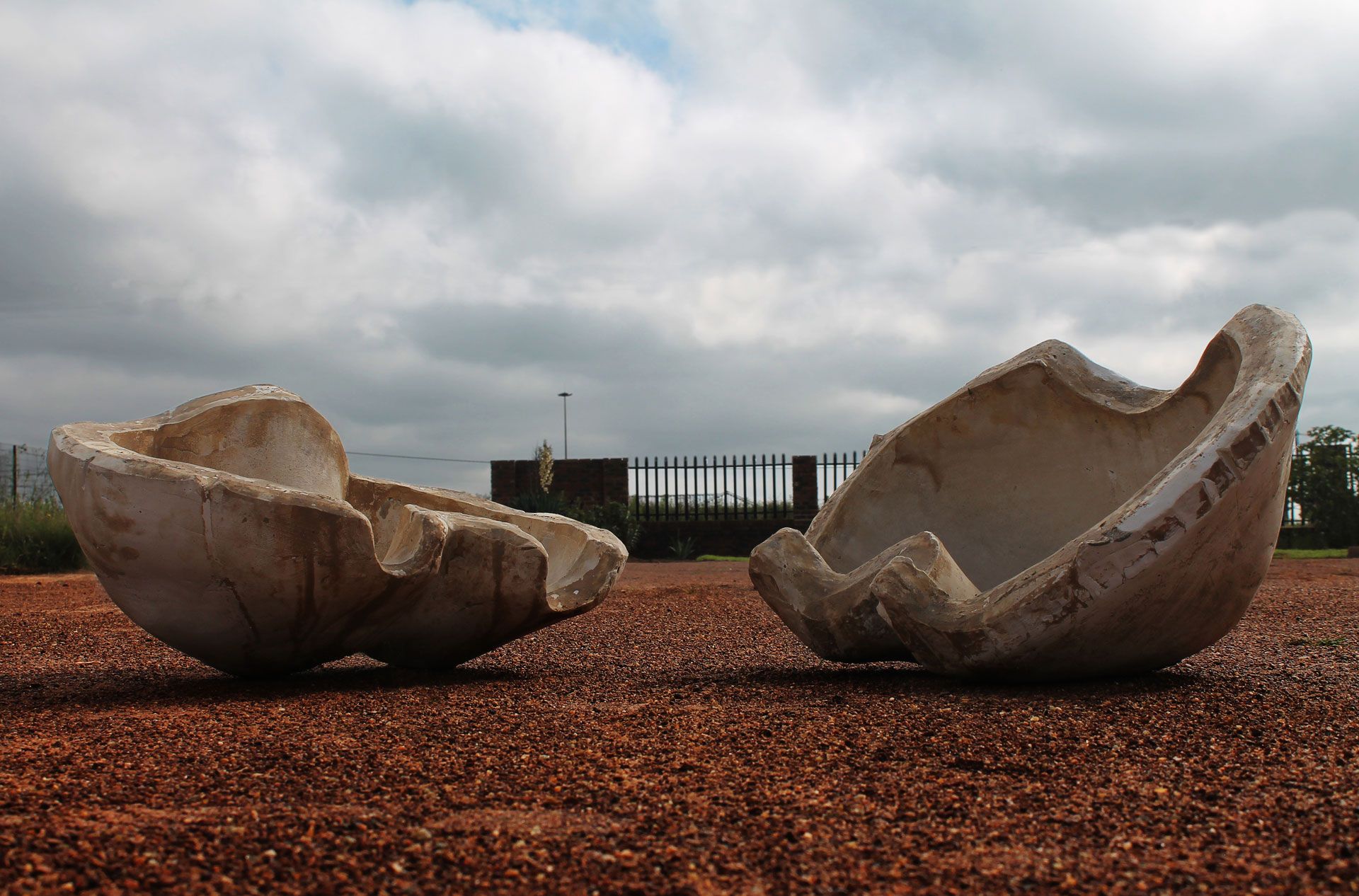
These concerns first emerged through Conversations with My Father (2021), an ongoing body of work structured around an intergenerational dialogue on ancestry, belonging, memory, and acts of self-writing. At the centre of these conversations was Meadowlands itself. Growing up there, I understood the township as both a site of mass dislocation and various modes of anti-apartheid resistance. In the 1980s and 1990s Meadowlands became a community that nurtured artists, musicians, activists and intellectuals whose contributions would significantly shape conversations about Black life in democratic South Africa. Yet my father often challenged this understanding. He would remind me that before Meadowlands became a symbol of resistance, it was first an instrument of apartheid’s spatial engineering.
Established in the 1950s to accommodate Black residents forcibly removed from places such as Sophiatown and the Western Native Townships, Meadowlands emerged through a system designed to regulate movement, belonging and identity (Modisane 1963). My father’s challenge was not to dismiss the histories of resistance associated with the township, but to ask what becomes obscured when we forget the conditions of its making. From this perspective, the social and cultural worlds I often treated as grounding my identity were themselves historical contingencies; they were conditions through which Black subjectivity had been produced and negotiated.
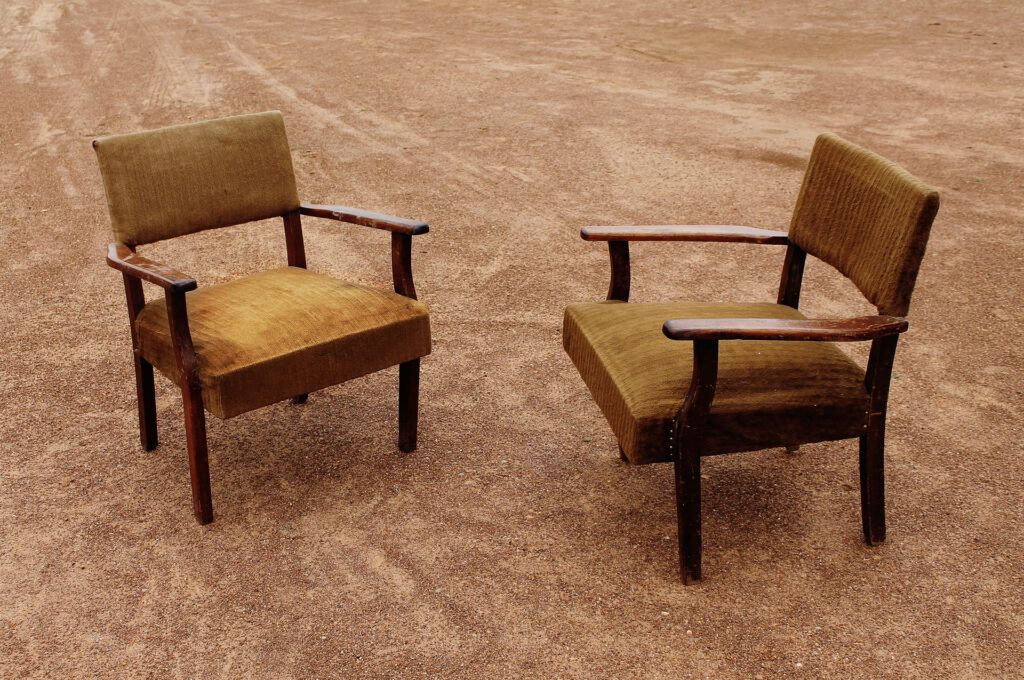
For him, acts of self-writing and self-conception could not be separated from these inherited structures. Instead, my attempts at narrating the self risks repeating the very logics they sought to describe. To look more closely at Meadowlands, he suggested, was to recognise how even personal memory is entangled in broader historical formations that stretch across generations. What appears as individual narrative is therefore already collective and already inherited. It is my story, but also his, and that of my grandparents before him.
Home truths
While Conversations with My Father (2021) positions the audience within an ongoing dialogue about ancestry, belonging and self-fashioning, it is ultimately concerned with a larger question: through which historical, cultural and political inheritances do we come to understand ourselves? If identity is never entirely self-made, then what are the moulds through which it is cast, and who determines their shape? Home Truths (2022) extends this enquiry by turning toward the domestic sphere, where such inheritances become most visible. Here, home is not approached as a stable point of origin but as a shifting field of negotiation shaped by migration, displacement, loss and remembrance. It is assembled through fragments: names, stories, photographs, heirlooms, rituals and everyday gestures accumulated across generations. Home, in this sense, is not simply where one comes from, but something continually made through acts of recall and relation.
At the centre of this enquiry is inheritance. Family histories, as they surface through my father, grandmother and those before them, rarely appear as complete narratives. They are marked instead by interruptions: by orphanhood, by labour migration, forced removals and apartheid’s social engineering. What remains are partial traces: a surname, isithakazelo, a family heirloom, and or stories retold in fragments. These become the materials through which continuity is sustained despite rupture.
The works gathered in Home Truths engage this condition through acts of preservation: of memory, of lineage and a fragile narrative. The project is oriented around the concept of ukuphahla[2]Ukuphahla (also spelled kuphahla in some dialects) is a traditional Nguni and Xitsonga spiritual ritual used in African spirituality to communicate with ancestors (amadlozi/abaphansi). It is practiced to seek guidance, request protection, offer gratitude, or report family matters directly to the spiritual realm. The ritual involves speaking directly to the ancestors. Practitioners will often introduce themselves, recite their izithakazelo to establish a family connection and then state their intentions or requests. Commonly understood as a practice of communicating with and honouring ancestors, ukuphahla opens a space of relation between the living and the departed. Through prayer, song, drumming, incense, trance or divination, this process enables forms of knowing that exceed ordinary language, allowing what is inherited, felt, or remembered to surface in non-linear ways.
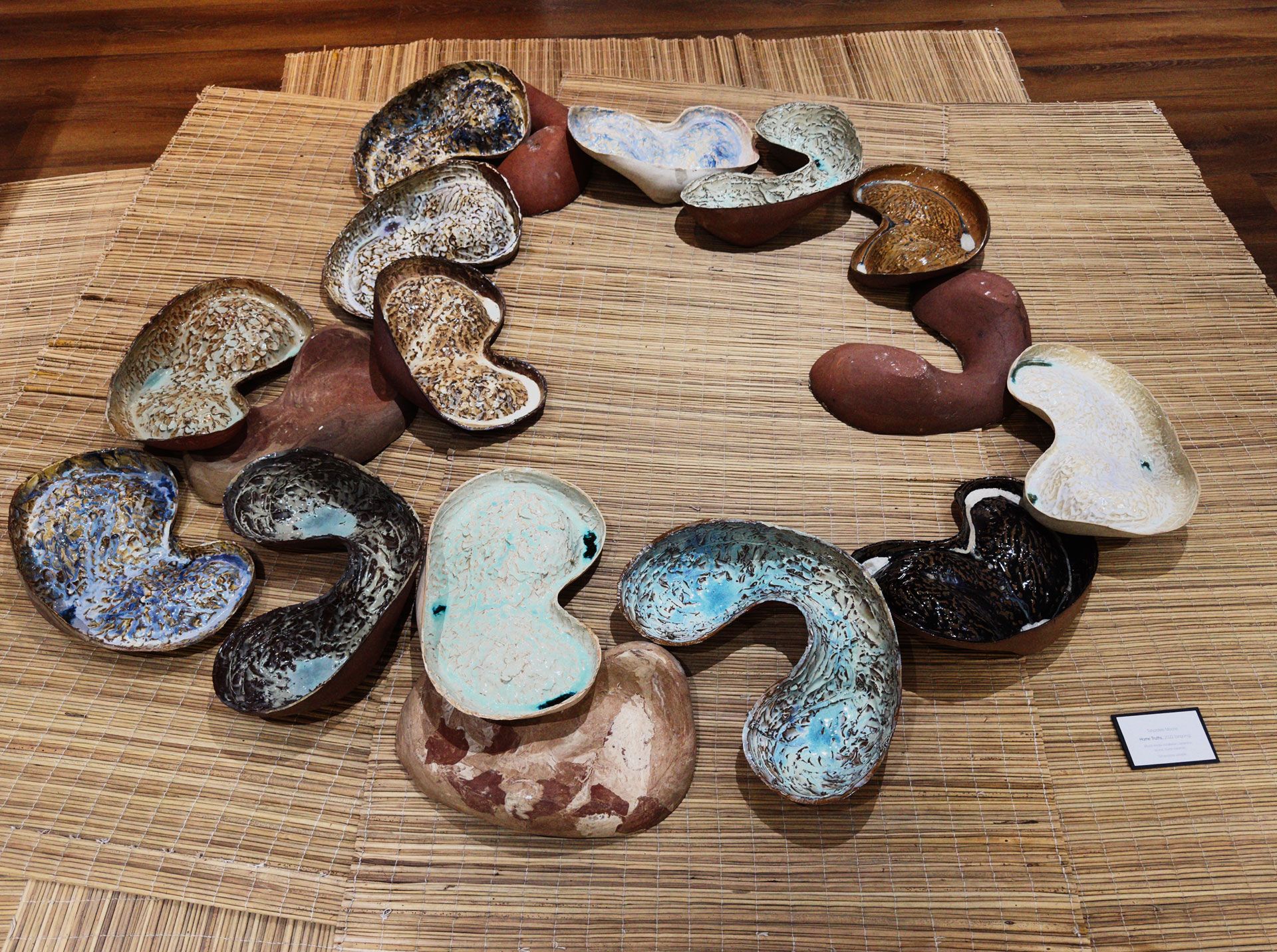
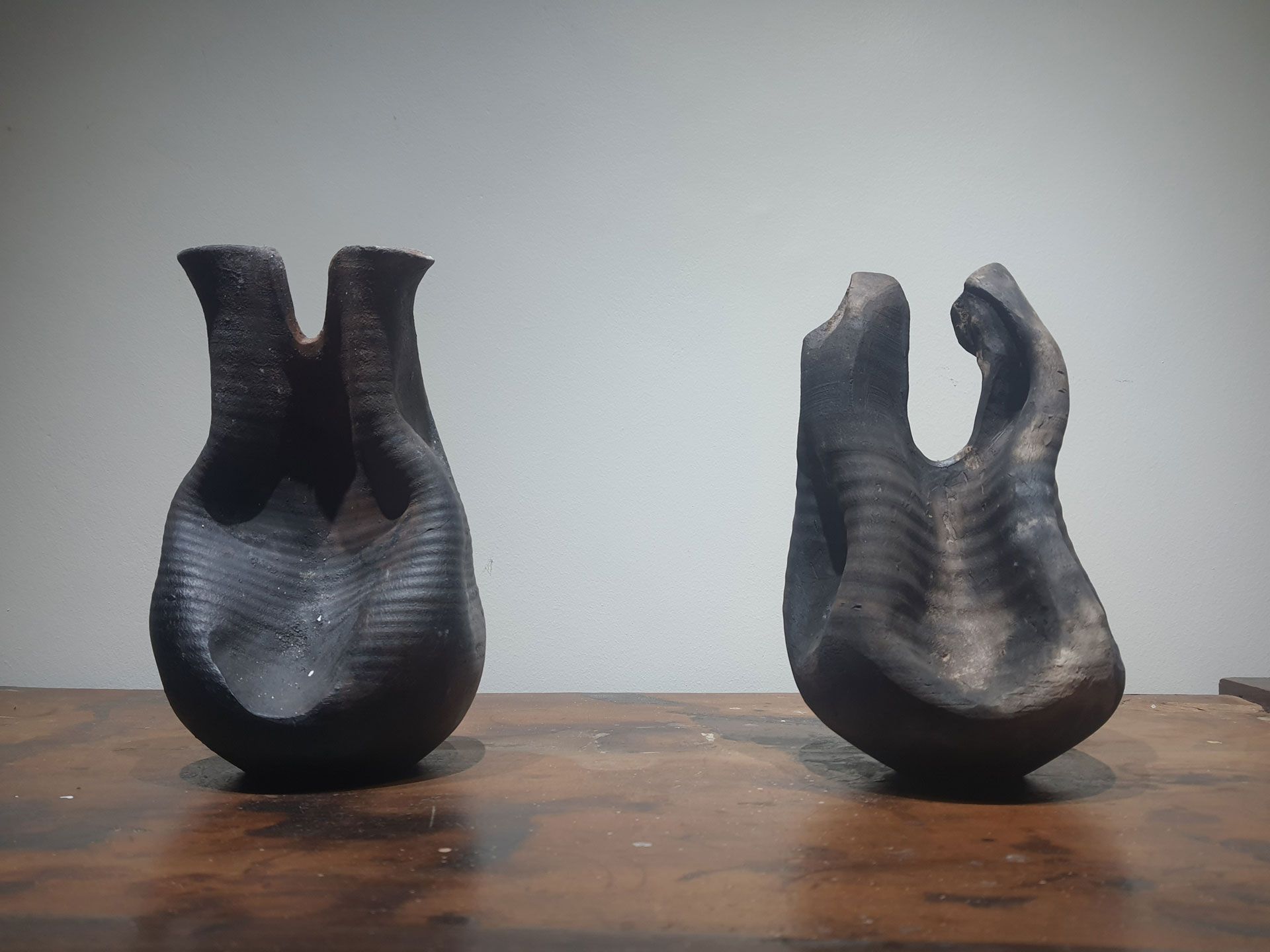
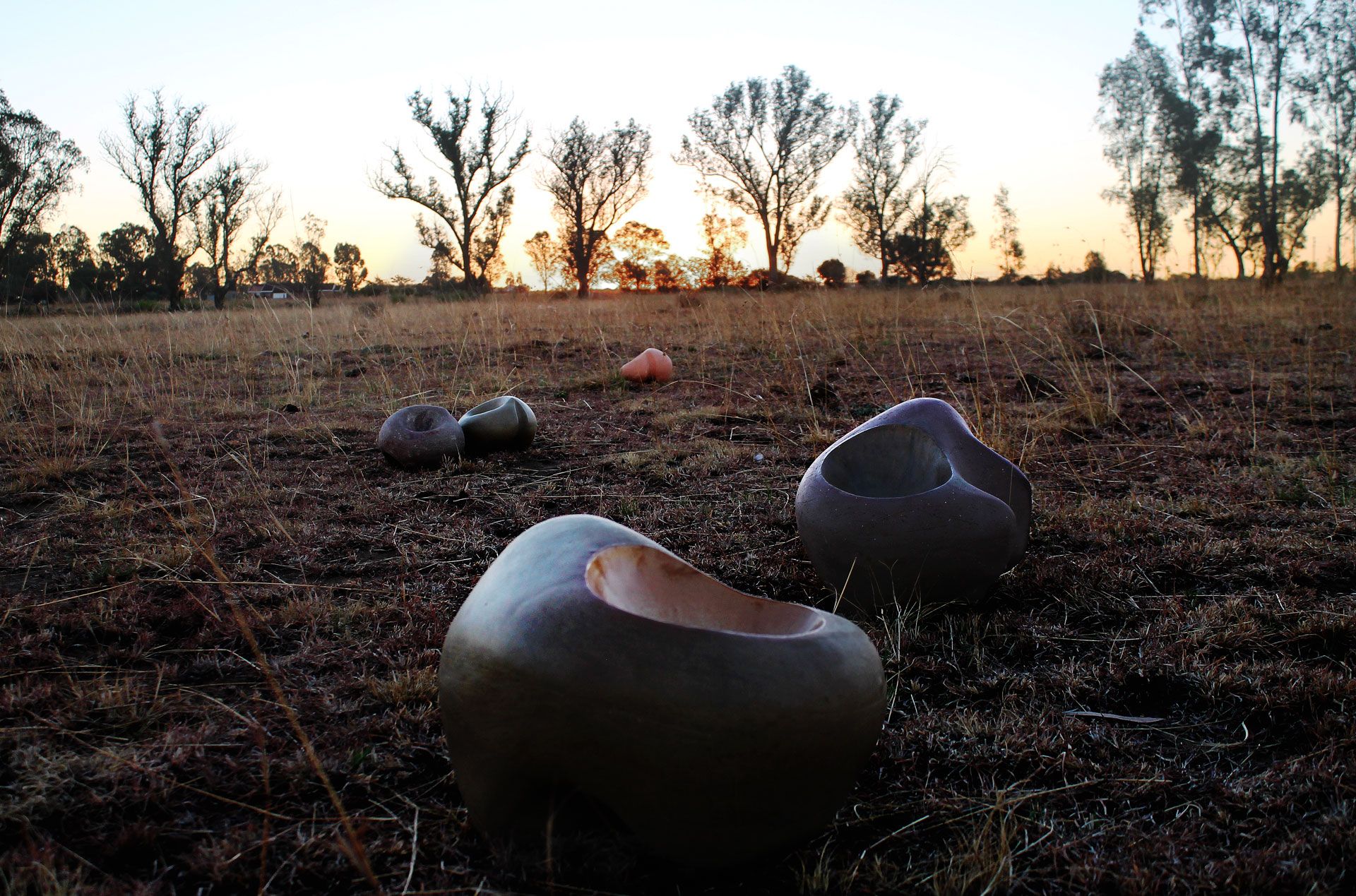
The floor installation, where sculptures are placed upon grass mats, recreates a shrine-like environment. This is a provisional sacred space within which ukuphahla can take place. The sculptures imagine and give form to those who enter the ancestral conversation, as well as the fragments that slowly begin to fill the absences of a fractured past.
The installation also proposes a way of returning to inherited names, partial memories and disrupted lineages without the expectation of full restoration. Some works are glazed and resolved, while others remain incomplete. Moulds are placed at the centre as both origin and trace. Broken pieces are mended yet visibly scarred. Certain forms remain unfinished, their missing sections held open rather than concealed. Together, these conditions foreground how identity emerges through an ongoing dialogue with ancestral presence.
The beaded necklaces, photographs, and sculptural forms are inspired by objects that form part of our family heirlooms. Their significance is inseparable from the conditions under which they survived. My grandparents were victims of multiple forced removals in what was then the Transvaal.[3]The Transvaal is a historical region and former province in the northeastern part of South Africa. The name literally translates to “across the Vaal” in Afrikaans, referring to its geographical positioning north of the Vaal River. Following the end of apartheid and the 1994 democratic elections, the original four provinces were restructured. The Transvaal province was completely dissolved and divided into four modern provinces: Gauteng: The economic core, including Johannesburg and Pretoria, Limpopo: The northernmost region (originally named Northern Transvaal), Mpumalanga: The eastern region (originally named Eastern Transvaal) and North West: Formed out of the western half of the Transvaal and parts of the old Cape Province. These displacements were not only spatial but also existential. Living under the constant threat of removal meant that belonging itself became unstable, fragmented and punctuated by interruptions.
Forced removals did more than relocate people from one place to another. They severed relationships between families and their land, disrupted systems of knowledge and fractured the everyday rituals through which communities understood themselves.
Homes were abandoned, possessions lost and histories scattered. Entire worlds of meaning were dismantled in the process.[4]When reflecting on the destructive effect of the native resettlement act on the lives of individual and communities in 1958, Drum Journalist and Author, Bloke Modisane eulogises Sophiatown when writing: “whatever Sophiatown was, it was home; we made the desert bloom; made alterations, converted half-varandas into kitchens, decorated the houses and filled them with music. We were house-proud. We took the ugliness of life in the slum and wove a kind of beauty; we established bonds of human relationship which set a pattern of communal living, far richer and more satisfying -materially and spiritually- than any model housing couls substitute. The dying of a slum is a community tragedy anywhere” (1963: 16). What remains today are remnants of objects that could be carried, hidden, salvaged or remembered. These material traces bear witness not only to survival, but also to the magnitude of what was lost.
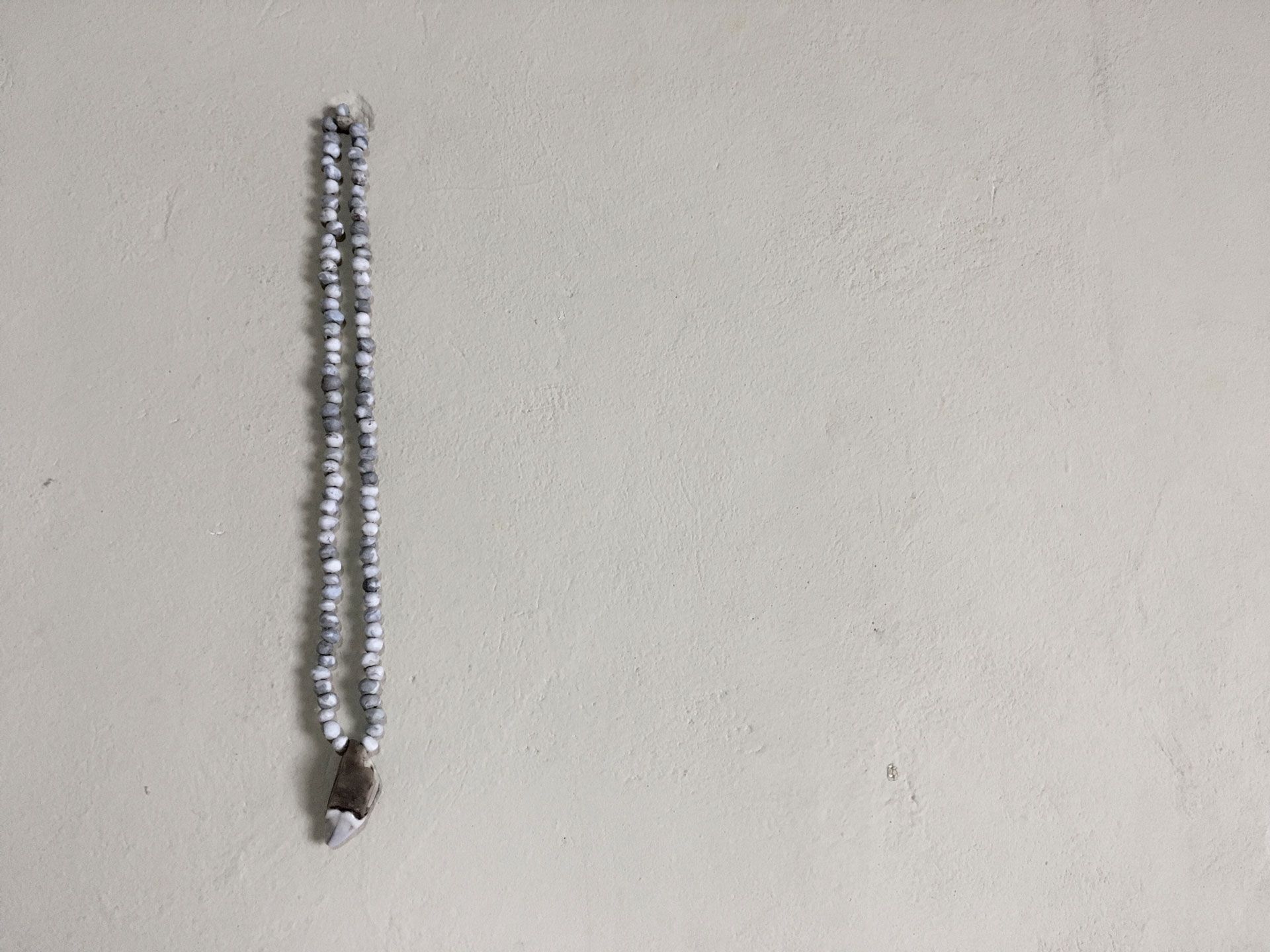
It is within this context that the enlarged beaded necklace hanging on the wall becomes an intervention. It functions as a form of memorialisation, not only of the necklaces that form part of our family inheritance, but also of those whose lives were similarly shaped by displacement and recovery. The scale of the bead becomes my way of translating this history into sculptural ensembles, transforming what was once intimate and wearable into something monumental and architectural, a cultural object that can be adorned by the building itself. In so doing, the work acknowledges how ordinary objects come to carry the weight of interrupted lives and ambitions to retrieve what was lost in the process.
The concern with naming is most explicitly reflected in the sound work Morabe oa Makholokoe[5]Morabe oa Makholokoe translates directly to “the Kholokoe tribe” or “the Kholokoe nation”. In Basotho culture, this phrase is used formally or historically to refer to the collective identity, ancestry, and heritage of the Kholokoe people. For instance, you will hear it used in cultural heritage events or discussions surrounding traditional leadership and land history (Nyaka, 2018). by Lefaso Macholo (2022), who reflects on naming practices within his own family history. His contribution underscores that names are never neutral descriptors. “To carry a name is to inherit a relational field”, he adds. “You become part of an ongoing chain of remembrance in which the past is neither absent nor fixed, but continually activated in the present” (personal conversation, 24 May 2026).
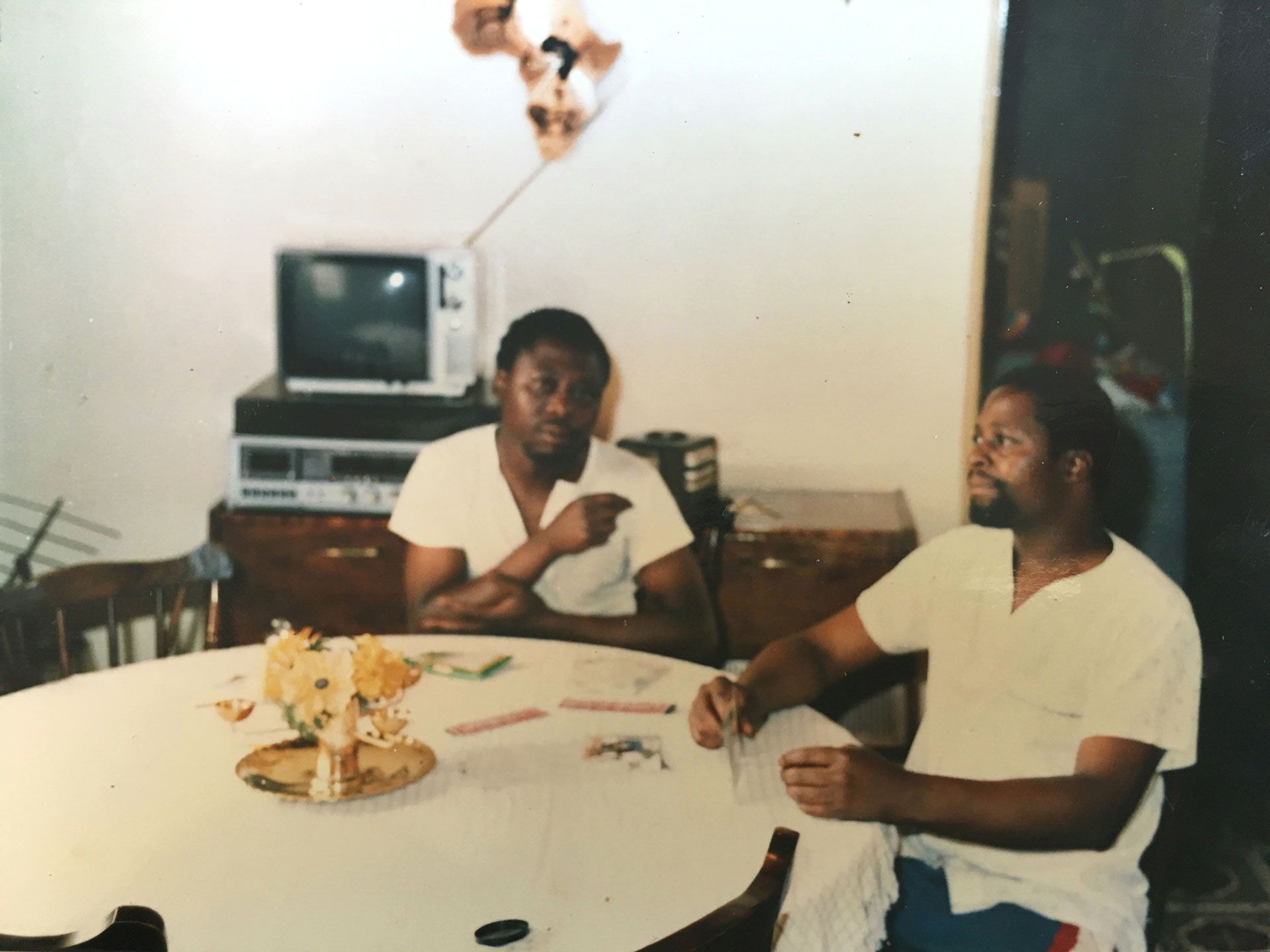
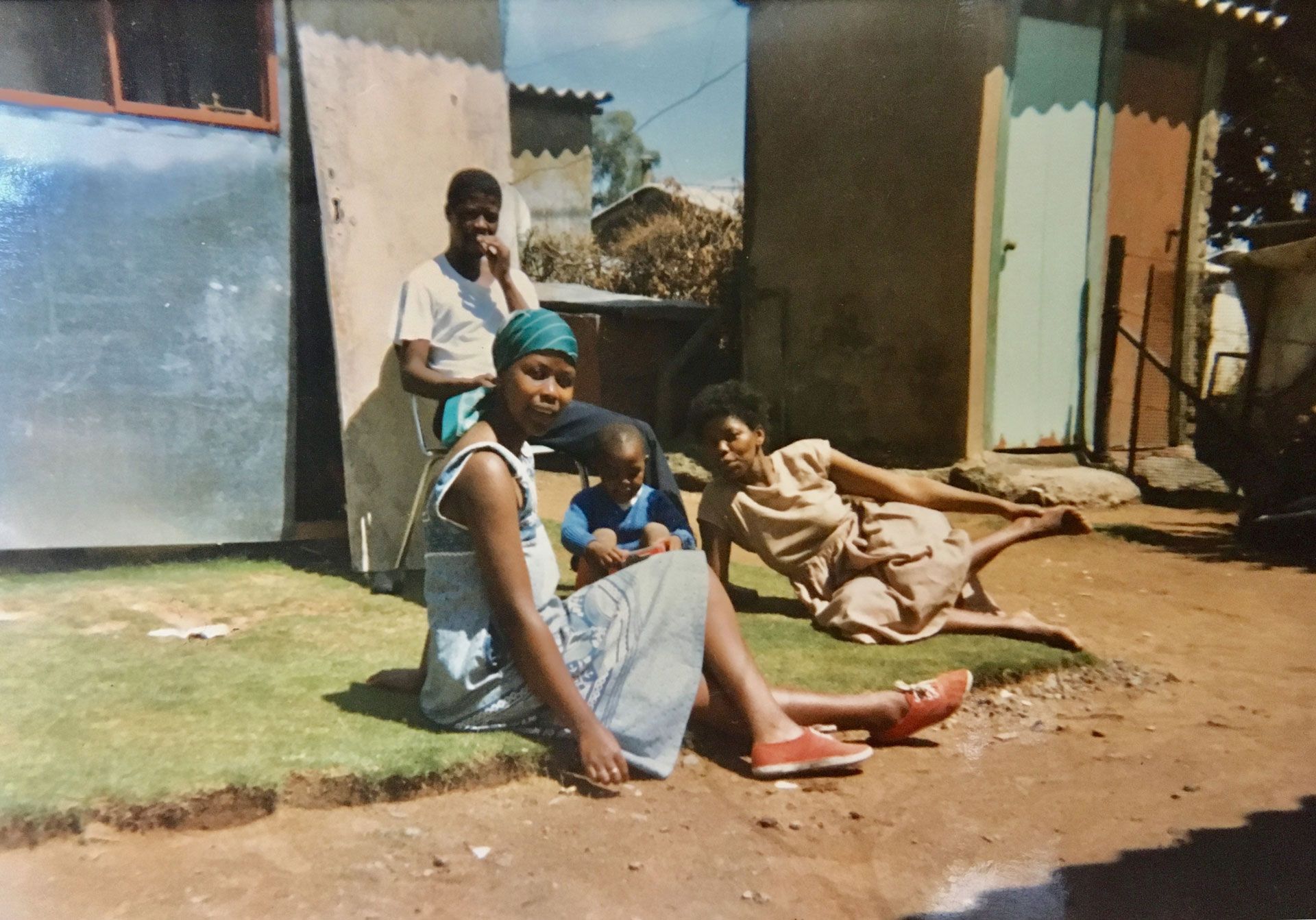
This sentiment is further expanded through a selection of photographs drawn from our family photo albums. Among them is an image of my father and his brother seated in a dining room, another depicting my mother, aunt, uncle and myself gathered in the backyard of our Meadowlands home (see Figure 1), and a photograph of my grandfather’s funeral programme upon which a set of beaded necklaces has been placed (see Figure 2).
While these photographs appear to capture ordinary moments, they function as more than records of family life. They are visual repositories of relationships, preserving encounters between people whose lives continue to shape the present long after the moment of the photograph has passed.
Placed alongside Morabe oa Makholokoe, the photographs invite a reading of family history through both image and sound. The sound work recalls individuals through the spoken resonance of names, while the photographs offer material traces of those lives as they unfolded in particular places and moments. Together, they create a narrative structure in which memory is neither exclusively visual nor oral, but emerges through their interaction. The names heard in the sound work begin to find faces, gestures, and environments in the photographs, while the photographs themselves become animated by stories and relationships that exceed what is immediately visible within the frame.
This relationship becomes particularly significant in the context of family histories marked by displacement, migration, and loss. Where official archives often fail to account for the complexities of Black familial experience, photographs and naming practices become important acts of preservation. They allow fragmented histories to remain in circulation, carrying traces of people, places, and relationships that might otherwise disappear from collective memory. In this regard, both the sound work and the photographs function as forms of ukuphahla: acts of calling upon those who came before, creating conditions through which the past may be encountered and brought into conversation with the present.
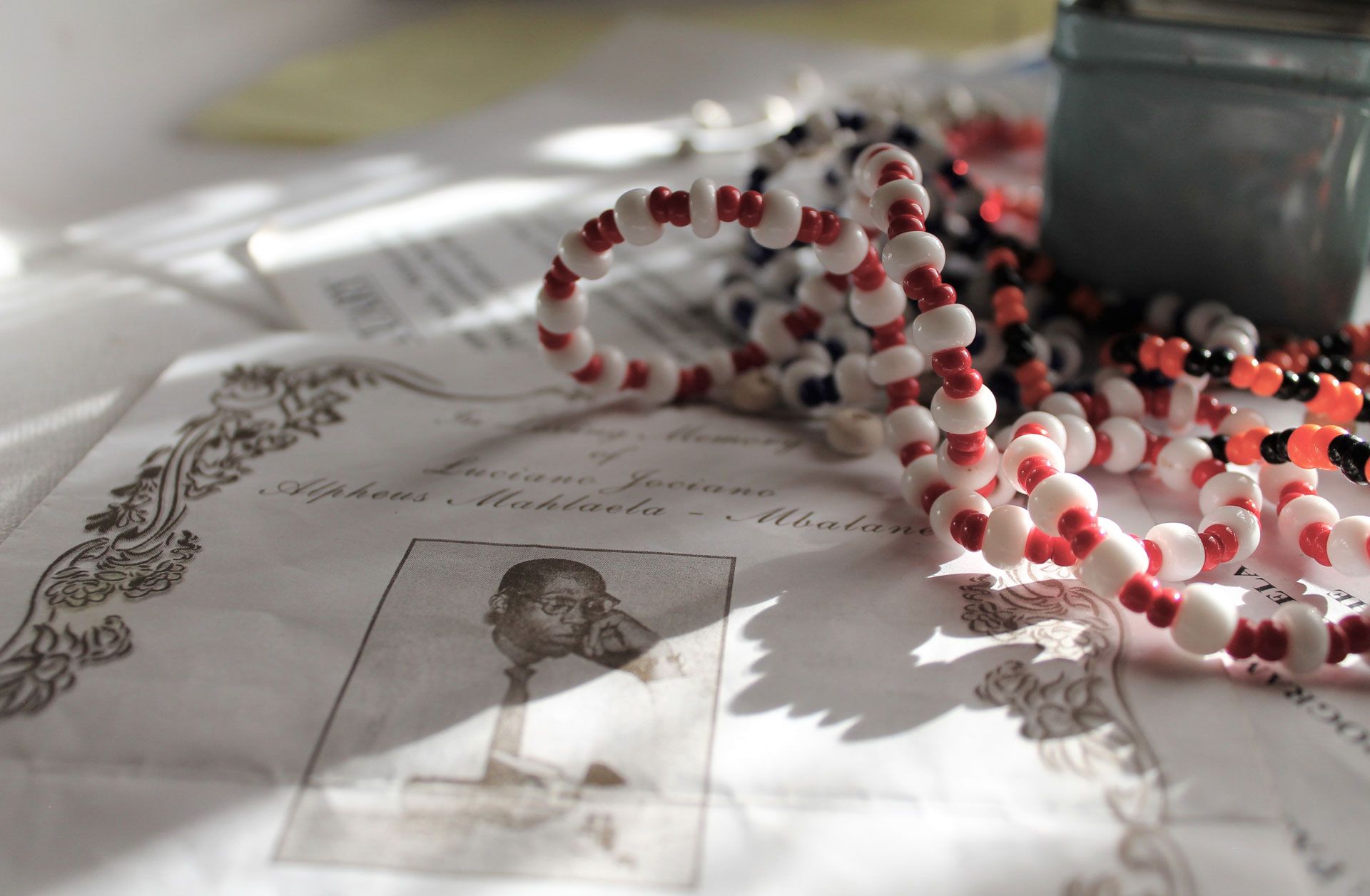
The photograph of my grandfather’s funeral programme, accompanied by the beaded necklaces, is particularly poignant in this regard. It collapses multiple temporalities into a single image: the life being commemorated, the rituals associated with mourning and remembrance, and the continued presence of inherited objects within contemporary family life. The beads become more than adornment; they operate as carriers of memory, linking personal histories to broader ancestral continuities.
In this sense, naming operates as a form of memorialisation. It ensures that lives and relationships extend beyond their immediate historical moment, persisting through language, repetition, image and address. If Home Truths is ultimately concerned with the afterlives of memory, then names remain among its most enduring materials: condensed vessels through which lineage is carried forward, linking those who came before with those who continue to speak them into presence. The photographs extend this work of remembrance by providing visual points of return, allowing names to be encountered not as abstract genealogical markers, but as traces of lived relationships, shared histories and everyday moments through which belonging is continually renewed.
Parting Observations
Several years after my father handed me that piece of paper, I find myself returning to it with different eyes. The names inscribed upon it no longer appear as a fixed account of who I am, but as traces of an ongoing conversation—one that extends across generations, places, objects, and memories. Home Truths does not seek to complete that conversation. Instead, it inhabits the space between what has been remembered and what has been lost, between inheritance and self-fashioning.
Like the fragments gathered throughout the exhibition, the names remain unfinished, asking not only where we come from, but how we might continue carrying one another into the future. In inviting viewers into these conversations, Home Truths asks them to consider their own inheritances: the stories, silences, objects, names, and histories that have shaped their understanding of self. The exhibition offers no singular truth about identity or belonging. Rather, it suggests that meaning is often found in the act of returning—to a photograph, a family story, a place, or a name—and in the willingness to listen to what those fragments continue to reveal. If there is something to take away from Home Truths, it is perhaps the recognition that we are all, in different ways, assembled from what remains.
Moche, T. (2021). Conversations with my father: On isithakazelo, Meadowlands and acts of self-writing (Master’s dissertation). University of the Witwatersrand.
Modisane, B. (1963). Blame me on history. Thames and Hudson.
Nyaka, L. (2018). Makholokoe tribe reflect on their history. The Guard. theguard
South African History Online. (2012, July 27). The Natives Resettlement Act, Act No. 19 of 1954 is passed. sahistory
| 1. | ↑ | Isithakazelo(plural: izithakazelo) is a traditional clan name or praise name used by the Nguni people of Southern Africa, most notably among the Zulu, Xhosa, Swati, and Ndebele cultures. It acts as an extension of a person’s surname and serves as a vital identifier of their ancestral lineage and family history. An isithakazelo is not just a single word; it is usually a poem or a list of historical names and phrases that tell the story of the clan’s historical achievements, traits, or migrations. |
| 2. | ↑ | Ukuphahla (also spelled kuphahla in some dialects) is a traditional Nguni and Xitsonga spiritual ritual used in African spirituality to communicate with ancestors (amadlozi/abaphansi). It is practiced to seek guidance, request protection, offer gratitude, or report family matters directly to the spiritual realm. The ritual involves speaking directly to the ancestors. Practitioners will often introduce themselves, recite their izithakazelo to establish a family connection and then state their intentions or requests. |
| 3. | ↑ | The Transvaal is a historical region and former province in the northeastern part of South Africa. The name literally translates to “across the Vaal” in Afrikaans, referring to its geographical positioning north of the Vaal River. Following the end of apartheid and the 1994 democratic elections, the original four provinces were restructured. The Transvaal province was completely dissolved and divided into four modern provinces: Gauteng: The economic core, including Johannesburg and Pretoria, Limpopo: The northernmost region (originally named Northern Transvaal), Mpumalanga: The eastern region (originally named Eastern Transvaal) and North West: Formed out of the western half of the Transvaal and parts of the old Cape Province. |
| 4. | ↑ | When reflecting on the destructive effect of the native resettlement act on the lives of individual and communities in 1958, Drum Journalist and Author, Bloke Modisane eulogises Sophiatown when writing: “whatever Sophiatown was, it was home; we made the desert bloom; made alterations, converted half-varandas into kitchens, decorated the houses and filled them with music. We were house-proud. We took the ugliness of life in the slum and wove a kind of beauty; we established bonds of human relationship which set a pattern of communal living, far richer and more satisfying -materially and spiritually- than any model housing couls substitute. The dying of a slum is a community tragedy anywhere” (1963: 16). |
| 5. | ↑ | Morabe oa Makholokoe translates directly to “the Kholokoe tribe” or “the Kholokoe nation”. In Basotho culture, this phrase is used formally or historically to refer to the collective identity, ancestry, and heritage of the Kholokoe people. For instance, you will hear it used in cultural heritage events or discussions surrounding traditional leadership and land history (Nyaka, 2018). |