EVE WONG
Missing People, Present Decay: Fabulous Matter, or the Decomposition of Colonial Ontology
Who Decays, What Decays? The Colonial Taxonomy of Matter and People
The April 2026 Decay Without Mourning conference challenged attendees by asking what possibilities arise when we approach decay as a method instead of mourning it as a failure. But it rests on an a priori worth closer examination: the assumption that decay is something scholars intentionally choose to engage with as a critical and creative gesture available to those who study heritage, or, put another way, a methodological stance to adopt or reject.
For the young “coloured” South Africans who stand at the centre of this paper, that choice was never a “choice.” They were born inside of and into “decay.” It is not a leftover; it is a “ruin.” Colonial administration, apartheid, and subsequent governments imposed the “coloured” label on South Africans.
Ann Laura Stoler (2013) distinguished between “ruins” and “ruination” in her book Imperial Debris. “Ruins” are the reified remnants of imperial histories, the evidence of what has ended. “Ruination,” however, is a continuous, corrosive process in which colonial systems persist in the present, leaving traces on the physical environment, bodies, and inherited systems of identity and belonging. To be “coloured” today in Cape Town does not mean to live in the shadow of a “ruin,” but to live in “ruination,” a process of decay begun by a colonial power that has never really ended.
Specifically, what is decaying is the possibility of a coherent identity, and, at a finer granularity, a coherent self-identity. “Coloured” classified those who fell between rigid colonial racial categories. Many years ago, I filled in paperwork for the University of KwaZulu-Natal and it confounded me. The available racial categories only included “black,” “white,” “Indian,” and “coloured” for me (and “decline to answer” or “other” were not options then). I asked my then-professor of South African literature (herself South African) for advice. She replied, “‘coloured,’ not because it’s accurate but because it’s still the government’s “here there be dragons” box of people they do not know what to do with.”
Times have changed since then, and so have the forms, but the logic embedded in them persists. When I later registered as an international student at another South African university, I was, for the institution’s fee and classification purposes, sorted alongside white South Africans. One of the administrative secretaries explained as much when she instructed me to skip the racial declaration on the form. I am not white, nor South African, but the system effectively classified me as equivalent to white South Africans through its logic, which views certain kinds of foreignness as similar to whiteness and others as different. Post-apartheid anxieties entwine with this complex system, which I cannot adequately explain here. But the dragon-box had not been retired. They only relocated it.
In his 2003 essay on necropolitics, Achille Mbembe describes this classificatory logic as “superfluous life”: populations rendered as an ersatz form of living matter without equivalence, people who exist in a state of “continually standing up to death,” whose price “is so meagre that it has no equivalence, whether market or – even less – human.” A resonant idea appears in Deleuze, who writes of “the missing people.”
“The missing people” of this paper are young, urban, working-class South Africans who identify as, have identified as, and perhaps will in the future identify as “coloured” “Khoisan.” The conjunction is missing on purpose. The connection between the people I interviewed and these two identities, and how they are perceived together or apart, is in flux. Their claims to indigeneity are contested and litigated in the courtrooms of tea gossip and social media as inauthentic.
“Coloured” remains sticky. In a very tangible sense, they embody the ongoing colonial decomposition of categorical, classificatory, ontological “identity.”
The Khoisan case exemplifies this brutal taxonomy. Colonial science placed them between humans and specimens. Nineteenth-century ethnology viewed them as “living fossils,” closest to the non-human world from which humanity supposedly emerged. Scholars have well-documented this history so rather than repeat it here, I point readers in two directions. The first is the foundational colonial-taxonomic literature itself, most notably Leonhard Schultze-Jena’s 1928 Zur Kenntnis des Körpers der Hottentotten und Buschmänner, the very work that coined the term “Khoisan.” The second is the scholarship that dismantles the falsities those ethnologies were built on: Andrew Bank’s Bushmen in a Victorian World, Nigel Penn’s essay “The British and the ‘Bushmen’” in the Journal of Genocide Research, Mohamed Adhikari’s Not White Enough, Not Black Enough, Andrew Smith’s First People: The Lost History of the Khoisan, and June Bam’s work on contemporary Khoisan heritage.
Experts in contemporary population genetics often describe Khoisan people as possessing the most “ancient” human DNA. The phrasing inverts the science. The research (specifically Stephan Schuster and colleagues’ genome work and Carina Schlebusch’s studies) actually describes that traces of the deepest genetic population divergence in Homo sapiens can exist in descendant populations known today as “coloured” and “Khoisan” in southwestern Africa. It should also be noted that, albeit at lower frequencies, all populations, including recent settler-descended populations, in southwestern Africa have also shown these traces since the twentieth century.
These DNA traces reflect the earliest-branching lineage, not the most “primitive” or “original” one.
A contemporary population is no more ancient than any other. But the misreading does real work, dressing an old primitive-versus-civilised hierarchy in molecular language. This is exactly the sleight of hand that Saul Dubow traces in Scientific Racism in Modern South Africa and that Kim TallBear anatomises in Native American DNA. Both analyse how settler science converts into a claim about who is, and is not, fully and presently human.
I want to emphasise something that “ruination” and necropolitics cannot fully encompass. The historical conceptualisation of Khoisan peoples as “superfluous” or somehow between fully human and less-than-human is not a separate move from classifying the non-human as passive, inert, and subject to colonial management. It is the same move. The colonial system demanded a taxonomy that rendered certain things without or with negligible agency. When considered as lacking the capacity for self-determination, colonisers could manage, extract, collect, or exploit them, or discard them at their discretion, having determined themselves unimpeachably on the human side of the boundary. They consistently applied this taxonomy across domains: land, plants, animals, enslaved people, colonised populations, and the bodies produced through colonial encounters. “Coloured” people were made “superfluous” through the taxonomic logic that positioned them closer to the non-agentive side of the human/non-human divide imposed by the colonial world.
This matters for what follows. The participants in this research claim identity, but do so in a way that dismantles the infrastructure that made ontological colonialism possible. This paradigm separated the human from the non-human and the social from the biological.
Here, I also suggest they separate the category of “heritage” from the category of “matter.” The conference asked what decay makes possible. This paper argues that “the missing people” here in Cape Town have been answering that question for decades, without waiting for the academy to catch up.
This paper draws on a decade of ethnographic fieldwork in Cape Town combining participant-observation at heritage sites, festivals, and commemorative events; archival and media research; and ethnographic interviews ranging from sustained relationships with a small core of participants to hundreds of informal conversations. The people at its centre are “born free,” working-class young adults from the Cape Flats in Cape Town who move between and around “coloured” and “Khoisan” identities. The names used here are pseudonyms; most participants were unwilling to be recorded or to sign consent forms, sceptical of what institutions might do with the documentation or how it might cause a social backlash in their communities. This is a wariness I took as data. I make no claim that these participants represent ‘coloured’ or Khoisan communities in general, nor that I speak for the wider community. This claim would reinstate the very logic of typological classification that this paper works against. Core participants could review and correct, revise, or retract their inclusion here. What they offer is not a representative sample but a set of practices, observed closely over time, that make a wider pattern legible. The relationships behind the pseudonyms are long.
Fabulation as Intentional Decay
How is a [missing] people created, through what terrible suffering? What a people creates is through its own resources, but in a way that links up with something in art … or links between art to what it lacked. Utopia isn’t the right concept: it’s more a question of “fabulation” in which a people and art both share.
Gilles Deleuze[1]Gilles Deleuze and Joughin, M. (1995) Negotiations, 1972–1990. New York: Columbia University Press, p.174. Although “[missing]” is my interpolation as Deleuze’s original reads “a people,” he further discusses these concepts in Time-Image (1989).
In my dissertation and elsewhere, I have developed “fabulation” as one dimension of a triadic analytical framework alongside sincerity and stickiness; but here I treat it specifically as a mode of intentional, categorical decay. Fabulation, in the Deleuzian sense, ain’t someone’s granddaddy (I’m a New Orleanian) spinnin’ a yarn about that one time on the river and catchin’ a big one–this big. It is not nostalgia, not oral history per se, not myth-making, nor the reconstruction of soothing stories about a lost past. Henri Bergson’s concept influenced Deleuze, but Deleuze reinterpreted it so dramatically that they are now connected only by name. Where Bergson saw fabulation as the psychosocial function through which societies conserve and stabilise themselves through collective myths, Deleuze removes this “conserving” aspect altogether.
Deleuzian fabulation operates through what he calls “the powers of the false”, which is not deception but the productive activation of possibilities that dominant frameworks have excluded. It operates through the absent, the missing, the unverifiable, to produce something truly innovative, beyond assembly or reassembly, that carries the force of truth…without factual credentials. It is how “the missing people” or le peuple manqué, the people who were, importantly, made missing, fabulate themselves into existence. They cannot recover what never existed. It was never preserved. It was never recorded. It lacked continuity in time, space, feeling, substance, or knowledge. But from this absence, they can create something new.
Moving beyond, or rather, building upon the way I have deployed “fabulation” elsewhere[2]See “Fabulous Khoisan,” PhD dissertation, University of Cape Town (2025) and “Fabulation, Erasure, and the Recursive Becoming of Identity” in Alternative Realities, Special Issue of Alma Mater – Journal of Interdisciplinary Cultural Studies (2025). is the recognition that “fabulation” is, structurally, a decomposition process. It is a framework I develop below as fabulative materialism, distinct from both new materialism and Haraway’s speculative fabulation in ways I specify in due course. Consider what fabulation accomplishes in practice. It takes a rigid classification, “coloured,” with all its accumulated injuries of misidentification, erasure, and imposed shame… and softens it. Not all at once, but through repeated efforts: performance, re/new-worlding, ritual, digital circulation, the quiet persistence of a great-grandmother’s recipe or a half-remembered, half-correct Khoekhoe word that has become an inside-family term. Each effort erodes the category like water on limestone. The category does not break; it is slowly dissolved, the bonds that hold its structure loosening, opening pores and fissures through which something else, something more, develops. The category does not disappear. It transfigures. Its component materials, like the histories, the affects, the genealogical fragments, and the colonial injuries, slowly allow us to access them again for alchemising and being alchemised, so they can emerge into something previously impossible.
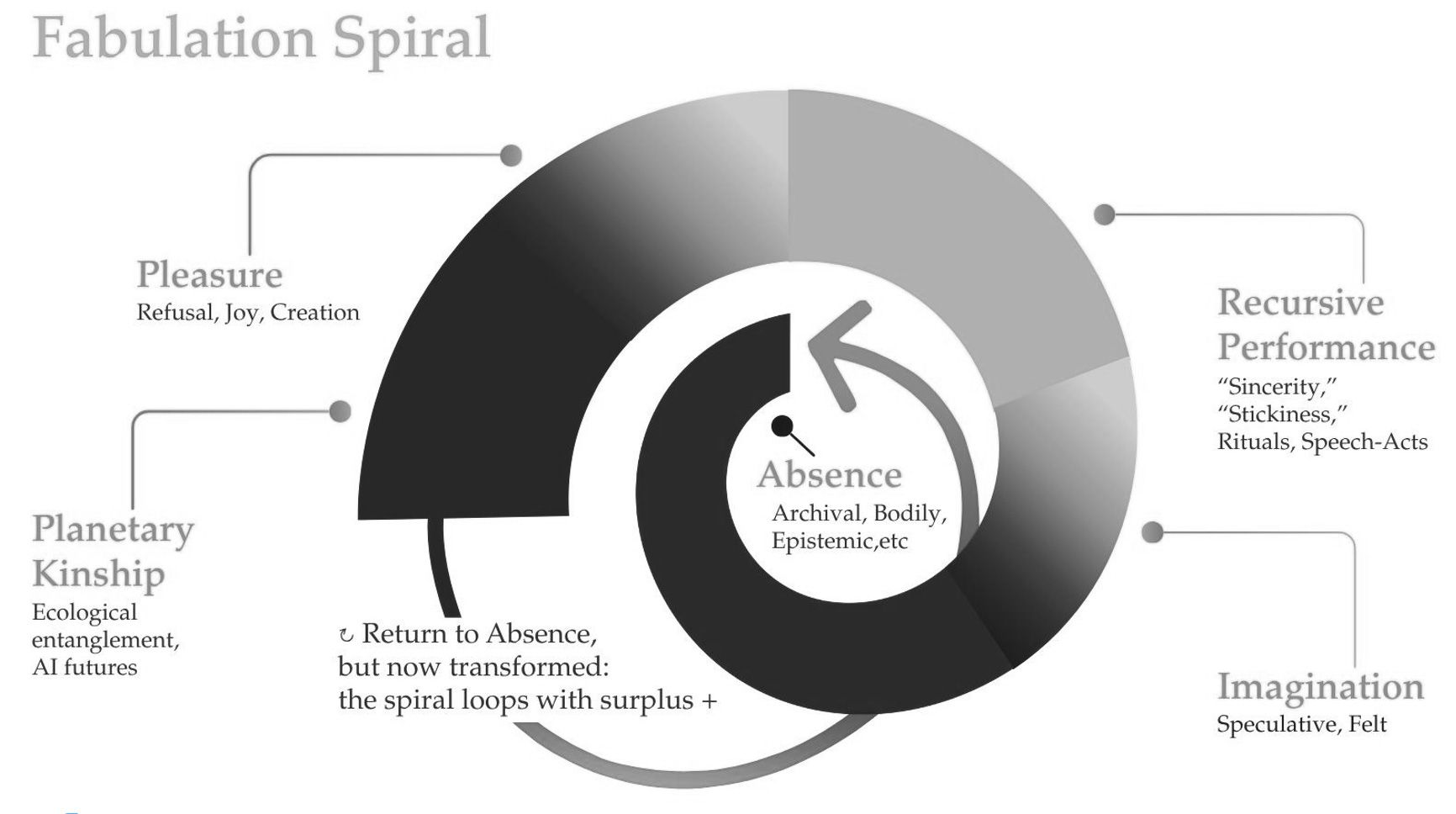
This is the logic of the fabulation spiral I propose, where performative recursions change the conditions of being. In other cycle- and spiral- form models put forward by other theorists like Hegel and, after him, Marx (the spiral), or Vanessa Watts’s place-thought and, before her, Ibn Khaldun (the cycle), the return to origin either sustains or grows the world. Here, I suggest a different outcome where the return rewrites the world. This is a model of how reality produces itself under conditions of erasure, as with “the missing people.”
Fabulation is not an identity or social process alone. It is a process applicable to numerous domains. Here, I want to frame it explicitly as a composting process.
The spiral treats identity-making as a recursive rather than a linear process. Passing through absence, information gaps, the missing document, the non-existent archive, or the unverifiable family oral history, it arrives, again, at the point of origin. But the process has completely changed the point of origin. If Heraclitus captured flux as “No man ever steps in the same river twice, for it’s not the same river and he’s not the same man,” the fabulation spiral argues that one cannot even step in the same absence or non-river twice. The core metaphor of the spiral can be, and for me is, both becoming and decomposition and reassembly. Each iteration is born through breakdown. The absence at the centre of the spiral is not a “nothing;” it is the fecund “no-thingness” that is the condition of the composting process, the space in which the old structure loses the integrity of its bonds before the new ones can form.
Biological decomposition is a team effort. Fungi, bacteria, and invertebrates break down the components of complex organic material so that new living systems can assimilate and reconfigure it. No single organism does the whole job. It is distributed, patient and fundamentally generative. What seems like rot is actually the active creation of conditions for future growth. The actions of “the missing people” here are structurally similar. The decomposition of “coloured” is spread across a movement with no single organisation or political structure, but an affective network of individuals, each disassembling different aspects of the colonial taxonomy. And what appears externally as an identity crisis, confusion, or signs of colonial trauma, from an internal perspective and within the analytic framework developed in this paper, represents the active creation of conditions for new imaginalities of being and belonging.
This is my paper’s contribution, and I wish to state it bluntly before the ethnographic material: the distinction between social metamorphosis and biological decomposition is not necessarily inherent. I suggest it may be yet another insidious colonial artefact. Colonial order demanded the categorical separation of social life and biological matter. It also demanded that people understand social transformations as purely human, cultural, and historical processes, while viewing organic matter transformations as purely biological, pre-human, and non-agentive. This separation supported the same taxonomic project that had originally rendered certain people as less-than-human. Fabulation, as practised by this paper’s participants, does not reflect that separation. It never did. The conference’s interest in decay as a critical method is, in this context, a realisation of what “the missing people” have been living inside for decades: the decomposition of inherited structures, whether social, biological or ontological, is a single process operating across registers, artificially divided by colonial thought.
Three Modes of Identity Composting
Genealogical Gaps as Compost Beds
Heritage discourse has taken on a “mourning” tone in relation to the archive: it grieves what it lacks. It presumes that important things endure despite breakdown, and that heritage work slows, reverses, or compensates for decay. Scholars reconstruct or rediscover the missing record as a loss. They formally and officially acknowledge the gap as a wound.
Responsible scholarship names the broken genealogical line as evidence of colonial violence and repairs it where possible. This is not an incorrect approach. But it is incomplete.
Imagine what it takes to trace Khoisan ancestry in South Africa. The colonial archive is fragmentary and, more than that, it is intentionally misleading. Successive regimes classified, reclassified, misclassified, and erased Khoisan peoples. Dutch colonial records reduced them to labour units or contended that they were obstacles to settlement. Christian missionaries recorded their conversions but erased their past. Then, the apartheid bureaucracy completed the erasure begun by colonialism by first subsuming them into “slave”, then into “coloured.”
Unless they happen to be related to well-known, and therefore better-documented, historical figures, individuals trying to find themselves in these archives are, in addition to needle-in-haystack searches through missing records, also searching through records designed to erase them. The documentary model of identity that underpins heritage governance, legal recognition frameworks, most genealogical practices and, in particular, authentication pathways for legitimising indigenous identity, cannot make space for the potentiality that this gap is generative. That the lack of a record is not the end of the genealogical story but a transformation of its foundation.
What the archive failed to preserve has not ceased to exist. It continues to exist, but in forms that the archive was never designed to detect.
One participant’s description of her relationship to her ancestry has stayed with me throughout more than a decade of fieldwork. When we worked through her family tree together, which had significant branches simply absent–colonial violence writ large as literal negative space–she looked at it and, after a long pause, said with one of those big sighs, “I don’t have the papers. But I have our poetry.” On the one hand, it is oral history where no written archival record exists. But it is also a claim about the relationship between decomposition and generation. The papers, if they ever existed, have decomposed. In their decomposition, something else became possible. It represents a form that the genealogical material took after being subjected to the composting and decay process of colonial violence. It emerged on the other side as poetry.
The poetry is not what survived the process. The poetry is what the process generated.
This distinguishes the compost bed from the wound. The wound metaphor, as discourse on colonial archival violence most commonly deploys it, imagines absence as an injury that requires addressing and acknowledgment. Then it must be repaired and restitution given for what was stolen. But the compost bed metaphor considers absence as a different kind of potency. I do not deny the violence. Compost rarely suggests that its constituents came to the heap through peaceful means. The process that takes place in the heap is still destructive, but it is also generative, and this generativity is born of decay, not in struggle against it or in spite of it. Instead of being a secondary or post-damage process, decomposition becomes the principal process through which the damage becomes productive material.
Among this paper’s participants, the relationship to genealogical absence remains consistent. Gaps are not always seen as problems to be fixed or as research problems requiring archival intervention, but as the unique texture of an inheritance that has passed through specific processes. The missing great-grandmother is not an absence to be resolved through DNA testing or archival recovery. She lives in the recipe her daughter’s daughter still makes without knowing its name, in the plant wisdom and knowledge that flows through the extended family as practice and in the somatic comportment of young men who tell me that when they are in the company of maternal figures, something in them settles, but they can’t explain why. They simply know that they feel safe and at ease. One could superficially read this as little more than a community that values relationships, but it also represents collective somatic memory that colonialism could not erase. As the actual forms genealogical material takes after the composting process. They are transformed, not lost. And now available in new configurations when no longer retrievable in the old ones.
The documentary model of heritage cannot interpret this. The model is designed for preservation, not for transformation. It recognises what remains despite decay. It cannot recognise decay itself as what persists, that it endures because it has broken down into forms that the archives could not and cannot record, and therefore could not and cannot destroy. The compost bed is, among other things, a place of asylum at great cost: the illegibility that renders these genealogical forms invisible to heritage institutions is what has enabled them to survive but perpetuates their “missingness.” The archive searches for papers, so the archives of “the missing people” became not-papers. The genealogical gap may not itself be a failure of heritage but a different type of heritage process, one that produces rather than conserves and that creates forms of connection and continuity that the documentary model will always interpret as absence. It is, in the specific sense here, compost.
Rematriation as Structural Decomposition
I was at the Castle of Good Hope on 25 November 2023 for the “Camissa Heritage Tour” which featured a performance choreographed by Luke de Kock as part of Infecting the City’s public arts programme. The dancers moved through the spaces of the Castle, using the body as a historical record, embodying colonial traumas in their writhing, rising and falling. The piece ended in an open courtyard where Lucelle Campbell, an elder, activist, historian and Khoisan cultural tour guide, sat. She did not perform. She waited. Then, she received the dancers. The dancers gathered around her, turning what had begun as a performance of rupture into a moment of arrival, return, and the acknowledgement of maternal, matrilineal authority. The choreography dismantled the colonial narrative of the Castle’s history. At the centre of this recomposed space remained a “mother,” kneeling with her hands on the earth, beside her a wreath of Cape plants, greenery, and branches as representing the living earth itself. This image, with the matriarchal figure at the centre, is central to the argument. This is a rematriation, a return through maternal lines to ancestry. In this case, a “return” to the original position of matrilineality and the mother does find the substrate completely transformed. Rematriation dismantles the colonial siting of property, naming, family, and authority in paternal and patrilineal lines. Instead, it reweaves the mother, grandmother, and “mother” earth as the genealogical and social foundations that colonial records rarely captured, and, whether by intent or neglect, destroyed.
Indigenous scholarship and activism widely use the term “rematriation,” but it is fairly new to the Khoisan context in South Africa. In her chapter “Rematriation: Reclaiming indigenous Matricentric Egalitarianism” in Rethinking Africa (2021), Bernedette Muthien provided a local definition. Used to distinguish a return that is led by maternal lineage, it distinguishes itself from the patriarchal connotations embedded in the more common term “repatriation.” Repatriation generally entails a return to a fixed origin through official and legal recognition, which animates indigenous authentication processes undertaken by states in order to bestow rights and protections; it is therefore the primary aim of much indigenous activism. But rematriation suggests a more transformative process, similar to the composting concept discussed here.
New growth arises from the composted tree, creating configurations the original tree could never have envisioned, instead of the tree returning to its source.
Among the men involved in this research, the rematriation argument mainly arises from conversations with men who inherit the colonial patriarchal model and work to deconstruct it; the language of return consistently refers to maternal figures and to the earth as maternal. In a survey of ninety-three participants drawn from a wider circle of contacts, fifty-seven named mothers, grandmothers, great-grandmothers, or maternal ancestors they had not met but knew as their primary ethical authorities. Not political leaders or formal Khoisan revival figures. These grandmothers, often products of illegible, undocumented knowledge transmission, had authority never ratified by colonial documentation and thus never fully revoked.
Kent, one of the main participants in my decade-long research, spoke most directly about the “decay” of gendered colonial authority, even though it is happening quietly, subtly, under the radar. At the Tweede Nuwe Jaar parade in 2017, I saw him make a cutting remark about a performer, using an insulting word in Kaaps. His grandmother, seated close by on a folding chair, corrected him. Not in private. In front of everyone. She did not raise her voice. She fixed him with a look and said, in Afrikaans, something that roughly translates as, “You don’t speak like that, you know better than that. Where do you think you come from?” Kent went quiet. He apologised. Later, talking to me about it, he said, with a mix of embarrassment and what I took to be genuine relief, that she always does that. “She doesn’t care who’s watching,” he said. More than a sentimental family anecdote, this is an example of structural decomposition. A woman who had no formal role or recognition challenged the colonial patriarchal authority (public, hierarchical, and official). Her correction held because her authority was of another kind, constructed through relationships, practices, and obligations based on knowing oneself and one’s origins,.
The sakmanne (men in hessian robes) walk worn paths across Table Mountain at dusk with herbs and homemade bread, offering their own evening vespers. They deliberately evade permits, audiences (compared with, for example, the overt visibility and intentional attraction of media attention of King Khoisan and his occupation, discussed below) and heritage frameworks that would impose cycles of (in) validation. Their lived devotional practices make the “Mother Earth” dimension of rematriation unmissable. Their actions are a return to the non-human world, but not a reconstruction of a precolonial past or a rejection of the colonial view of humans as above nature.
One sakman remarked that the sackcloth is the emblem of their devotion to nature. The mountain does not validate but receives its presence; the true authority is elemental. The sakmanne engage with the mountain as a system they are part of, processes that go beyond the human, already in motion before colonialism and persisting after whatever colonialism has done has itself broken down. Their return to the mountain signifies a return to the substrate: the breaking down of the colonial subject who stands apart from and above nature, and the recomposing of a different way of being in relation to the non-human world. This is rematriation in its fullest sense, a return to the earth from which the colonial project severed.
Rematriation unmakes colonial legacies like patriarchal authority, identity through property, anthropocentrism, and linear temporalities. Instead, it focuses on maternal authority, place-thought spatialism, relational ecology, and forms of continuity, which were obscured but never fully destroyed. You cannot return the compost to the tree. Yet the tree’s tree-ness, although altered, becomes a site to create new growth. Meanwhile, the “mother,” seated at the centre of the courtyard where the dancers have come to pay their respects, is very much alive.
Apolitical Politics as a Controlled Burn
Controlled burns are a form of intervention in fire ecology to remove accumulated material and prevent uncontrolled and damaging fires. To perform controlled burns, one needs knowledge of what survives fire, what needs protection or clearing, and what will grow afterward, especially in areas that once had dense undergrowth. It is ecosystem management in practice. Decay is intentional to create growth that can sustain aspirational future landscapes. This metaphor helps situate how framing addresses the political implications of my participants’ “cultural, not political” position. Participants who describe their Khoisan identity as “cultural, not political” are purposefully managing decay in a different way. They are neither passive nor confused, but actively learning from the pitfalls of political activism in current and previous generations in what I see as an apolitical politics. They deny having a political stance, but they inhabit one. They deliberately refuse the terms for political recognition that the state offers and activists seek.
Repetition of the lesson has occurred many times, at great cost. The first major post- apartheid Khoisan conference in 1997 brought to light internal factionalism and highlighted disputes in claims, most of which came into chiaroscuro because of the ANC’s call for state- sanctioned anthropologists to “authenticate” who was truly Khoisan, a dynamic the anthropologist Rafael Verbuyst documents in Khoisan Consciousness. This cycle of seeking recognition, subjection to state authentication processes, and (in)validation revealed itself. The state was to define identity; validations can be revoked, and there is no assurance that what is validated one day might not be refused the day after. This was confirmed by the 2019 Traditional and Khoisan Leadership Act. Legal scholars and activists alike criticised the Act for recognising five rather than all subgroups, for bypassing issues of land restitution, first-nation status, and formal language recognition. New hierarchies and divisions were formed under the broader “Khoisan” label. Instead of freedom, recognition acted as a form of confinement.
A recent clear example is King Khoisan SA. Born Rudwan Triegardt, he occupied the lawns of the Union Buildings to make Khoisan demands on the government. The strategy is maximal visibility intending to attract media coverage and spur public debate, highlight Khoisan grievances and exert sustained political pressure through the discomfort of occupation protest. The responses from my research participants show intriguing diversity. Lady, the most dismissive, criticises his visibility, fearing it links “Khoisan” mainly to spectacle rather than to demands or rights, describing him as “running around in animal skins demanding to own all of South Africa.”
The sarcasm Lady uses to mimic the historical spectacle discourse is uncomfortably self-aware, and it sharpens her critique. Deon is more succinct. “I didn’t vote for him.” These five words matter. They do not question King Khoisan’s politics or the Occupy Wall Street and Arab Spring tactics of occupation, but they challenge the usefulness of promoting Khoisan interests through a self-appointed representative. Lavender, with her nuanced view, understands the tactical intent, saying, “Protests are meant to be shocking and disruptive,” but adds that it is not her preference for how Khoisan activism should take place. In her view, King Khoisan’s demands have become a referendum on his “authenticity” and, in turn, cast a pejorative light on Khoisan people more generally. A news article titled “Could the Real King Please Stand Up?” discussed King Khoisan’s occupation, reinforcing her caution. She disagrees with the tactics and the optics, not the content per se.
What she, Lady, and Deon already grasp is what Deon calls “street cred politics.” To enter the “authenticity” system on its own terms seldom produces real recognition. It breeds competition. Groups, leaders, urban revivalists, and rural survivalists all vie to be recognised as the most authentic Khoisan and garner the prestige of the optics of having the most legitimate claim. This rivalry is not incidental but an inevitable consequence of the recognition system. It functions as a divide-and-conquer tool, perfected during apartheid and inherited in a more subtle form by post-apartheid governance. Both Deon and Lady are cognisant of this. Their “cultural, not political” stance is not oblivious to these dynamics, but a response to them.
The controlled burn is a strategy that risks exposing some things to validation or invalidation, while protecting others. Elements burnt or allowed to decay through non-engagement include colonial and nationalist frameworks that require visibility in order to be real. Instead, they allow those frameworks to become irrelevant to their core practices. By not confronting the frameworks, they minimise the risk of structural invalidation that exposure might bring. These things happen underground, away from the institutions, protected by illegibility at the cost of invisibility. The undergrowth is cleared, local practices carve paths, and people purposefully engage institutional structures when it is useful.
Because the maternal authority, embodied knowledge, and relational networks were already below, they remained relatively protected from the burn. In some cases, such as rematriation, it is invisible even to those embodying and enacting these collective somatics. Rematriation partially fills the gaps in the genealogical archives, and it works because it operates in a space that colonial systems cannot fully access. Systems concerned with patrilineality and patriarchy are blind to rematriation and this myopia safeguarded it from revocation. This is the link between the first two modes of identity composting I discussed. The burn does not create this protection; it preserves it by managing what remains unseen and what is revealed.
The metaphor of the controlled-burn refuses linear time. Lavender once misspoke, saying “tenseless” for “tenseness,” then chuckled and joked that she was indeed lost and that her soul needed a GPS to know where she was coming from and going to. This slip characterised her as being in a present that contains multiple pasts without sequence.
Eurocentric linear time is burnt away, replaced by a cyclical, non-hierarchical “composting” time in which the past remains active and transforming.
This is a refusal to let colonial temporal structures shape their becoming. Their apoliticality is not prepolitical or underpoliticised. They embody a strategic practice of selective, intentional decay, of managing what gets broken down, of what survives, of protecting a substrate from the destructive forces of authenticity and recognition politics. “Missing people” do not always fight for recognition or material gain. Sometimes they are fighting to simply exist on their own terms.
Fabulative Materialism: One Process, Multiple Instruments
The lives of participants demonstrate three interconnected modes appearing in various domains. The gap, grandmother, and refusal of legibility demonstrate the softening of colonial categories and their reconfiguration into unexpected configurations that elude colonial documentation. This section discusses the process and its theoretical implications. Rather than a blend, the suggested name “fabulative materialism” represents a realisation occurring as distinct academic areas observe an identical process, all emitting the same signal.
Gilles Deleuze’s notion of “fabulation” describes the destruction of dominant categorical structures through what he terms “the powers of the false” or the creative re-emergence of repressed possibilities excluded by official accounts. The people who fabulate themselves into becoming are generating new realities from the detritus of colonial violence, realities that colonial power could not permit and cannot contain. This is a categorical decomposition. Rigid structures become less bound, making their constituent elements available to create new configurations or assemblages as the old disintegrates.
Haraway’s speculative fabulation is a place of complex overlaps and differences in terminology and semantics with Deleuze, as well as points of convergence and divergence. Haraway’s usage sits closer to the Bergsonian sense that Deleuze abandons. In their separate yet related explorations, both thinkers describe phenomena at different scales but following similar logic. The Chthulucene signifies the breakdown of the nature/culture divide, emphasising how human and non-human realms intertwine in ongoing processes of mutual becoming. Haraway’s notion of compostism (“we are all compost, not post-”) is an ontological statement that materials of the world, human and non-human, are always in flux and change through collaborative breakdown and recombination. Her concept of communities of compost is not metaphorical but a serious proposition that recognises decomposition as the fundamental generative process, with human social life participating in it rather than existing apart from it.
Ann Laura Stoler’s concept of ruination offers a political and historical foundation that Deleuze and Haraway lack. Colonial ruination is an ongoing process, not a monument to the past, through which imperial structures persist, leaving traces in environments, bodies, and inherited structures. Ruination is political decomposition: the deliberate erosion of people’s selfhood, property, and genealogy. Stoler emphasises that this process is active and ongoing. The “coloured” category is not a ruin but ruination, and the practices here respond to this ongoing process, not to a historical injury. They represent active counter-decomposition, actively breaking down what is decomposing you.
In Vibrant Matter, Jane Bennett advances her theory with vital materialism. Her key claim that matter is active and has agency, influencing all events, is central to the fabulative materialism discussed here. If matter were passive, the proposed social and biological dissolutions would lack a real basis; instead, they would be mere metaphors for the same process. Bennett emphasises matter’s vibrancy and agency, challenging the view that human agency is separate from non-human objects, a mistake rooted in an anthropocentric category error. This renders the dissolution ontological (not a certainty), particularly as humans work with more-than-human intelligence, communication, and technological developments, learning to “listen” to these constellations.
Bennett’s vital materialism has a critical gap that this ethnographic material fills. Critics argue that new materialism’s focus on matter’s vitality can depoliticise, obscuring how power relations make some bodies more agentive, matter more valued, and people treated as things. The link between treating matter as inert and colonial dehumanisation is only a seed in Bennett’s work, but this paper hopes it has begun to grow this idea. Colonial logic deemed the Khoisan “superfluous” and placed them on the non-agentive side of the colonial divide. Bennett recognises matter’s vitality but not why colonial powers declared it inert or whose interests it served. The Khoisan case reveals that the same colonial authority declared this inertness and superfluousness at the same time, for the same purpose.
Similarly, Bruno Latour’s Actor-Network Theory rejects the human/non-human division. He reorients relations into symmetry but does not explain their historical stratification. This paper is precisely concerned with how that stratification came to be and whose interests it served. Karen Barad’s ideas on agential realism show that intra-action produces boundaries, including the human/non-human divide, rather than them being given in advance. This paper adds a discussion of how colonial power specifically produced certain boundaries and to what end. It shows how a colonial history of classification, rather than a physics of entanglement, created this divide. This argument aligns with Weheliye’s Habeas Viscus (2014), which shows how racialising assemblages differentially distribute humanity. Human “race,” itself a fabulation that is deeply saturated with social and historical significance despite being biologically meaningless, is one specific expression of the classificatory logic described here. And that logic has always exceeded race, organising hierarchies of agency and value across the very human/non-human boundary that race helped produce and police.
This is the paper’s core claim, now stated in its fullest form: the distinction between social transformation and biological decomposition is a colonial artefact, created by a taxonomic project that required certain people to be classifiable, manageable, preservable, or discardable at the discretion of institutions. The grandmother’s authority, the sakman and his sacred mountain, the poetry being seen as evidence rather than a plaster for the wound of absence… the fabulation of the missing people more than complicates the falsity of the colonial divide between the human and non-human; it ignores it by illustrating how their practices are entangled with and support social change and material processes, for this division was never theirs to start with.
Fabulative materialism recognises that different disciplines detect the same signal from distinct perspectives. Deleuzian fabulation focuses on identity and politics; Haraway’s speculative fabulation (Staying with the Trouble, 2016) explores multispecies entanglement; Stoler’s ruination examines the colonial afterlife; Bennett’s vital materialism considers matter’s agency. These perspectives alone are not enough. Triangulating and refracting all these theoretical offerings through ten years of ethnographic fieldwork with everyday people who perform this “decay” and “composting” work with their own ontology, but without labeling it, reveals that this is not an analogy between human practice and biological decay. It is the same process across multiple domains and registers, which colonial thought kept separate to shore up its artificial coherence. The people who were missing lived their way into this knowing long before the theorists theorised. The academy is only now catching up.
What Does Heritage Become?
To “spiral” back to the beginning: this conference asked what becomes possible when decay is engaged as a methodology rather than mourned as a failure. This paper suggests an even more unsettling possibility: that the category of “heritage,” which includes preservation, mourning, celebration, protection, exhibition, defence, recovery, curation, and governance, might be the wrong or incomplete unit of analysis. Not wrong in its details or intentions, but misaligned with the process it aims to describe. “Heritage” assumes a relationship with time in which valued objects must be preserved against decay. It presumes that important things endure despite breakdown, and that heritage work is to slow, reverse, or compensate for decay. Even progressive views of heritage as a living practice, a community connection, or a means of shaping the future tend to retain the core idea: something worth preserving, with decay as its enemy.
I propose no recommendations for heritage practice. The missing people are not waiting for a saviour to arrive on the scene. And the argument here is ontological before it is prescriptive. However, if we can accept heritage that decays without mourning, then learning to recognise growth where existing frameworks have trained us to see only loss will build it. Fabulative materialism suggests that social change and biological decay are the same process at different levels. For missing people(s), “heritage” is not the object resisting decay; it is what decay creates.
Moss
Moss is a symbol and a metaphor, and it also represents a literal process. Colonial monuments are crumbling. Moss takes hold when stone weathers, bronze tarnishes, or surfaces cease to be cared for. Moss begins to grow when the surface is no longer smooth and polished. Moss is not a failure. It is the making and unmaking of matter. Decomposition has begun, preparing matter for recomposition into unintended forms. It needs no institutional recognition or heritage status; it is not part of cultural frameworks. It simply grows. In the breakdown, during the breakdown, and out of the breakdown. It is regeneration. The people in this paper are like moss. They exist without monuments, generating new realities and life through breakdown, decomposing colonial structures and growing new things. Ancient in their off-the-record knowledge, plant practices, and cyclical time, they are like mosses, pioneer species preceding soil, embodying timeless, regenerative forces. Heritage that decays without mourning does not mourn because it recognises that decomposition is more than loss. It is the condition under which what was never allowed to flourish might now be nourished into a new life. The “missing people” know this. They have been becoming in the breakdown for a long time.
Cover image: Garth Erasmus | ARROW IN THE NIGHT | incised sand on canvas | 2026. Published in herri with kind permission of the artist.
| 1. | ↑ | Gilles Deleuze and Joughin, M. (1995) Negotiations, 1972–1990. New York: Columbia University Press, p.174. Although “[missing]” is my interpolation as Deleuze’s original reads “a people,” he further discusses these concepts in Time-Image (1989). |
| 2. | ↑ | See “Fabulous Khoisan,” PhD dissertation, University of Cape Town (2025) and “Fabulation, Erasure, and the Recursive Becoming of Identity” in Alternative Realities, Special Issue of Alma Mater – Journal of Interdisciplinary Cultural Studies (2025). |