ANDILE KHUMALO
The Invisible Life of Sound: Nachklang, Decay and Ancestral Temporality
Introduction
A sound does not instantly reveal all of its properties. While the initial portion of a sound may be the most intense and immediately perceptible, intensity does not equate to completeness. The onset introduces the sound, situating it within rhythm and providing cues for identifying the instrument. Research on timbre and instrument perception confirms the significance of the attack yet also demonstrates that the transient alone cannot account for all the features that render an instrument identifiable (Grey 1977; Siedenburg 2019). The attack imparts crucial information about a sound’s production, but it does not encompass the totality of what the sound is becoming.
Only as the initial energy dissipates do the internal relationships of the sound become perceptibly differentiated: partials emerge and fade at varying rates, sympathetic vibrations accumulate around directly excited frequencies, and the instrument’s body enters into audible dialogue with both the performer and the surrounding space. After its attack, a sound does not merely decrease in volume; its internal proportions are transformed.
Acoustically, this process is termed decay—a concept that conventionally implies reduction, whether as a loss of energy, identity, or physical integrity. If decay is construed solely as a change in amplitude, it appears to mark the transition of sound from presence to silence. However, my compositional approach is predicated on an alternative understanding: decay is not merely what follows the principal event of a sound. Rather, it constitutes a domain of spectral transformation, within which the sound discloses an internal life that cannot be fully revealed during its attack.
This proposition is central to spectral composition, especially in its treatment of acoustics and perception, its integration of harmony and timbre, and its conception of sound as an evolving phenomenon. Spectral thinking challenges the notion of the abstract note as the fundamental unit of composition, foregrounding the physical and perceptual dimensions of sound (Fineberg 2011). Consequently, spectral composition cannot be reduced to the mere conversion of acoustic analyses into pitch sets. Most importantly, it urges us to understand timbre as a temporal process and musical form as the internal transformation of sound over time.
My engagement with spectral thought extends beyond the European traditions commonly associated with Gérard Grisey, Tristan Murail, and L’Itinéraire. In examining Latozi Mphahleni’s Modokali, I have argued that amaXhosa bow music embodies a form of situated spectral knowledge, wherein the filtering and reinforcement of partials organize not only timbre, but also melody, texture, and form (Khumalo 2019). This is not to suggest that amaXhosa musicians should be classified as spectral composers in the European sense. Rather, it underscores the necessity of recognizing that a nuanced understanding of the internal structure of sound is informed by diverse histories, vocabularies, and embodied practices.
I apply this argument to my own compositional practice. Rather than limiting my focus to how a spectrum generates harmonic or melodic material, I consider how spectral transformation informs the perception of sonic presence. When the attack relinquishes its primacy, what becomes newly audible? How does sound persist when it can no longer be apprehended as a stable object? At what point does resonance become a trace, and in what ways might that trace shape the present through memory?
I look at these questions in terms of the German word Nachklang: that is to say, aftersound, resonance, reverberation, and also the impression which remains once an event is over. It is not simply the fading remnant of an action that has ended; Nachklang refers to the ability of sound to remain active even after the action that produced it has ceased. Although that action belongs to the past, its resonance still structures how the present is perceived and influences what comes next. The aftersound therefore exists in more than one time; it is both the remainder of what has taken place and a condition for what might still happen.
Acoustic and perceptual research demonstrates that sonic identity is shaped not only by the onset, but also by evolving spectral components, resonant bodies, acoustic space, and auditory memory (Grey 1977; Gleason and Khumalo 2018; Fineberg 2011).
Decay, therefore, extends sonic identity beyond the control of its originator.
As a sound recedes from its moment of inception, its identity is redistributed among shifting partials, sympathetic vibrations, instrumental bodies, architectural space, and the listener’s memory. A component that decreases in amplitude may simultaneously increase in relational complexity. What initially appears as an independent object ultimately becomes a dynamic field.
My understanding of continuing and transformed presence aligns with the Nguni ancestral beliefs that inform both my thinking and compositional practice. Within this worldview, the cessation of visible embodiment does not terminate relationship or agency; the deceased may remain active in the lives of the living as amadlozi—ancestral presences through whom histories, responsibilities, guidance, protection, and opportunities for renewal continue to be negotiated. Death, then, alters the conditions of presence rather than effecting a simple transition into non-existence.
I do not claim that acoustic decay explains ancestral existence, nor that ancestral presence can be simply equated with resonance; these are distinct phenomena situated in separate domains of knowledge and experience. Rather, Nachklang provides a conceptual bridge between these realms, allowing for comparative reflection without conflation. Both challenge the assumption that the withdrawal of an immediately perceptible body necessarily ends its agency, and both explore how something may remain active after its most visible or audible aspect has vanished.
This essay centres on my piece ISO[R], which is written for flute, cello and piano. It creates the impression of altering the usual way in which the piano begins its sound by means of tremolos that are played very gently and directly on the piano strings using a bass-drum mallet. Gradual variations in the use of the pedal affect the resulting resonance, and the flute and cello reinforce, maintain and modify parts of the piano’s frequency spectrum. Instead of acting as three separate sources, the three instruments come together to form a single resonating body from which fragments of melodic identity slowly appear.
The usual relationship between attack and decay in ISO[R] is reversed.
The piece begins by placing the listener in a state of resonance, delaying the strong attacks until they appear near the end. Once these attacks do appear, their Nachklang sends them back in a modified form, as if resonance were acting like a mirror, producing another image of the source that seems to be causing them. The aftersound thus becomes consequence, expectation and reinterpretation all at the same time.
Another concern is mentioned in Tracing Hollow Traces for solo clarinet. In a previous study I conducted with Scott Gleason, listening was understood as the conceptual and structural basis of the piece: an action that assigns space to the sound and, through continuous attention, imparts it with a voice (Gleason and Khumalo 2018). I refer only briefly to that composition here, not as a second case study, but to extend the argument beyond simply continuing vibration. Resonance becomes a trace; the trace enters memory; and memory allows for transformed presence. The sound no longer occupies the foreground, yet it does not stop acting.
To listen to decay without feeling sorrow does not mean that one is denying the fact of loss, grief, or the eventual dissipation of acoustic energy. On the contrary, it means not seeing every withdrawal as extinction. Decay can also stand for a transition: it is the moment when sound gives up the apparent unity of its initial attack and begins to exist in a less obvious network of resonance, space, memory, and relationship. The invisible life of sound begins where its most forceful action ends.
After the Attack: Decay and Nachklang
A sound event is usually shown in the form of an envelope, which shows how the amplitude varies with time. Although the attack-decay-sustain-release model is helpful, it might also lead us to see sound as consisting of clearly distinct stages. The attack is seen as the definite starting point, and decay is regarded as the following decrease in energy. While this kind of representation does capture a key feature of the physical behaviour of sound, it is not able to fully explain how the identity of a sound changes over time.
Not all sounds conform to a uniform envelope. The sounds generated by striking a string, bowing a note, sustaining a vocal tone, or breathing, each exhibit distinct relationships between onset, continuation, and termination. Even within a single instrument, variations in register, articulation, dynamic level, resonance, and technique all influence the development of energy. My primary interest lies less in the envelope as a fixed pattern than in the perceptual hierarchy it produces: the tendency to privilege the attack as the central musical event, relegating subsequent phases to the status of mere consequence or residue.
There are practical reasons for this perceptual hierarchy: the attack typically delivers energy in a concentrated burst, rendering the sound immediately perceptible. It facilitates our ability to discern event timing and aids in identifying the instrument or material that has been activated. The attack marks the sound’s entry into perception, while the decay reveals that this entry is only one moment within a more extended process.
This perceptual privileging of the attack parallels what Duncan Watts terms “the retrospective authority of common sense”: once an outcome is known, its explanation appears clearer and more complete than it did beforehand. Complex processes are retrospectively reorganized into persuasive narratives of cause and effect (Watts 2011). In listening, the visible gesture and the sound’s onset similarly provide a convincing account of causation—one sees the string struck, a body vibrates, and sound emerges.
However, this explanation remains incomplete. While it identifies the initial action, it neglects the broader network implicated in the development of the sound. After a piano string is set in motion, subsequent events are determined by the string’s physical properties, the resonances of the instrument’s body, the behavior of other strings, the position of the dampers, the acoustic environment, and the listener’s unique perceptual sensitivities.
The attack appears obvious because it supplies a clear cause, yet decay complicates this apparent clarity by revealing the network of relationships through which the sound evolves.
Even as the force of the attack fades, the various components of the sound do not necessarily decrease at the same rate; some of the partials stay noticeable for a longer time than others. Resonances inside the instrument either strengthen or weaken certain frequencies, and sympathetic vibration causes materials which were not directly struck to vibrate. The surrounding space takes in, reflects and alters the sound. What initially appeared to be a single event turns out on closer examination to be a constantly changing arrangement of energies and relations.
That is what I have in mind when I talk about the anatomy of sound. It is not a fixed structure concealed within a sound and waiting to be discovered. Rather, its anatomy develops over time; the internal proportions of the sound alter as its various components appear, disappear and interact with their surroundings. Timbre is therefore not simply a colour associated with a constant pitch. It is a continuous reorganisation of the relationships between partials, noise, resonance, gesture and space.
In this sense, decay is a kind of spectral disclosure. A higher partial can for a short time become more noticeable as the other components fade away. A sympathetic string may continue vibrating after the directly triggered frequency has diminished. The reverberation of a room becomes noticeable only after the immediate sound produced by the instrument has disappeared.
Decay does not reveal a single true identity hidden beneath the attack; rather, it reveals that the sonic identity was never single or fixed.
Fineberg identifies one of the basic changes within spectral composition as a shift from the abstract note to sound that can be experienced physically and perceptually (2011). Since a note can be regarded as a stable symbolic unit, sound cannot be separated in the same way from its duration, spectrum, material source or acoustic environment. There is a tendency to classify the note, but attention must be paid to the sound’s transformation.
If we consider the attack to be the main source of musical information, then composition can be seen as a series of successive events: one pitch, chord or gesture after another. However, my music often reverses this situation. The attack is not always eliminated, but its influence can be reduced, hidden or delayed. It then serves to set off a field of vibration rather than remain the main thing the listener focuses on. The compositional event takes place within the developing sound.
The way in which musical time is experienced is now altered. When listening with an attack-centred approach, time is divided into clear starting points; but with attenuation, attention is drawn to continuation, overlap and slow transformation. Every new event takes place in a field which has already been formed by residual vibration and perceptual memory. As a result, musical time becomes layered due to the ongoing activity of what has already happened.
I call this ongoing area Nachklang. The word may denote resonance or aftersound, as well as an effect or impression which remains after an event has taken place. It thus combines the idea of physical continuity with that of perceptual memory. The aftersound is part of the original event as well as of the bodies and spaces which carry on from it. It is neither the authentic sound kept exactly as it was nor something completely separate from it. It is a transformed continuation.
The person listening is involved in this redistribution process. If physical resonance decreases, the event can still remain active through people’s expectations and memories. A subsequent pitch might reawaken the spectral quality of an earlier sonority; a silence might keep the pressure of a gesture which has withdrawn.
Memory does not store the event exactly as it was. Instead, it reconstructs the event in the perspective of a new present. Decay is therefore the redistribution of sonic life beyond the original gesture.
This account of sound in terms of spectrum also raises the question of where spectral knowledge is located. Should the spectrum be seen merely as information obtained through technological analysis and then transformed into compositional material, spectral thinking will still be bound to a single scientific and historical account. The amaXhosa bow practices provide an alternative kind of knowledge of sound: in this understanding, the partials are developed through the physical interactions between the string, the resonator, the gesture, the voice and the body.
The Bow, the Body and Spectral Knowledge
In my analysis of Latozi Mphahleni’s Modokali, I advanced an interpretation grounded in the concept of “African spectralism”—a response to the prevailing emphasis on rhythm in much scholarship on African music (Khumalo 2019). Focusing on Mphahleni’s performance with the umrhubhe, voice, vocal ensemble, and bass drum, I contended that timbral transformation is not a supplementary feature appended to otherwise stable structures; rather, the filtering and reinforcement of partials are integral to the formation of melody, texture, and large-scale form.
The umrhubhe and uhadi utilize distinct methods of resonance. For the umrhubhe—a mouth bow—the performer’s oral cavity acts as a variable resonator, with changes in mouth shape selectively amplifying specific components of the bow’s spectrum. When playing the uhadi, the calabash resonator is alternately placed against and away from the performer’s body, thereby modulating resonance and the relative prominence of overtones (Dargie 1988). In both cases, spectrum modification is accomplished through embodied technique.
The performer’s body is thus inseparable from the instrument, actively participating in the production of musical material. The string, bow, resonating cavity, voice, and body collectively constitute an interconnected system, such that a change in any component alters the character of the entire system. Timbre, therefore, does not reside solely in the vibrating string; it emerges from the interplay among multiple material bodies.
This principle is particularly evident in the relationship between bow and voice. At first, the voice may seem to dominate the foreground—carrying text and the most immediately recognizable melodic material—while the bow appears to merely provide accompaniment. However, attentive listening disrupts this hierarchy: the vocal line emerges from harmonic and tonal relations already present within the bow’s sound. Voice and bow are not simply arranged as melody and accompaniment; even prior to the entrance of the voice, an instrumental introduction may foreshadow the melody. By selectively amplifying specific partials, the performer creates the impression that a melodic identity already resides within the resonance, even before it is explicitly sung. The complete melody may not yet exist as a series of fixed pitches, but its spectral outline is detectable. The resonating body thus holds the melody in potential before the voice renders it explicit.
When the voice enters, it consolidates and gives form to relationships that the bow and resonating body have already prepared; what emerges in the foreground was already latent within the spectral field. This challenges the assumption that the background is merely passive, suggesting instead that less immediately discernible elements may be structurally generative for what subsequently occupies the foreground.
Even though it does not use the vocabulary of Western acoustics, this kind of practice demonstrates a deep grasp of spectral organisation. To call it an early or intuitive form of European spectralism would imply that one history is subordinate to another. The term “African spectralism” refers to the way I listen analytically and when composing: it is a method of paying attention to how timbre, resonance, and embodied filtering organise musical relations in this practice (Khumalo 2019).
European spectral composition provides one way to understand the spectrum through acoustics, psychoacoustics, technological analysis, and instrumental synthesis. In contrast, AmaXhosa bow technique involves a form of embodied knowledge in which spectrum, gesture, melodic formation and social performance are inseparable. There is no need to incorporate these different histories into a single universal theory; instead, they can each modify the questions that are raised by the other.
The connection between bow and voice provides my approach to composition with a principle of musical organisation according to which one sound can contain the possibility of another. A theme can arise from timbre; a foreground may be created by its apparent background; and a resonant body may anticipate a voice which has not yet come in. This principle is at the heart of ISO[R].
Inside the Decay: ISO[R]
ISO[R], composed for flute, cello, and piano, intentionally disrupts conventional perceptions of piano sound over time. In standard piano performance, the hammer strike marks a clearly defined onset, after which the sound undergoes irreversible decay. The attack is typically understood to determine the sound’s identity, with resonance conceived merely as its dissipation. However, in ISO[R], I invert this sequence, inviting the listener to encounter resonance first, only subsequently revealing the full force of the attack.
In the piano part, tremolos are executed gently and directly on the strings using a bass-drum mallet. This approach does not eliminate attack in an absolute sense—every vibration still requires an initial expenditure of energy—but it suppresses the familiar mechanical identity associated with the piano’s hammer action. The strings are activated rather than forcefully struck, redirecting the listener’s attention away from the precise moment of onset and toward ongoing sonic transformation. The piano is thus reconceived: no longer primarily a keyboard instrument producing discrete pitches, it becomes a resonating body. Within this partially obscured sound source, pitch, noise, vibration, and sympathetic resonance coexist, and what is typically considered the afterlife of the piano note becomes the principal locus of musical activity.
The sustaining pedal is essential to this effect. Varying degrees of pedal usage yield different resonant conditions. Through partial pedalling, damping, and the controlled release of sympathetic vibrations, particular elements of the piano’s spectrum are accentuated or subdued. In this way, the pedal operates as a spectral filter, altering not just the duration of sound, but also the internal balance by which it is perceived.
These differing pedal levels also produce a layered temporality: resonance from a prior action persists beneath newly generated sounds, while select partials establish anticipatory expectations. Past, present, and potential future sounds thus coexist within a single acoustic field. The pedal does not merely preserve the past; it actively shapes the present and conditions the perceptual future.
This complexity disrupts linear notions of causality. Resonance may appear to foreshadow a theme that has not yet materialized; a subsequent note may clarify a partial that was previously present but unrecognized. The listener is thus encouraged to reinterpret earlier sounds in light of subsequent developments. Musical time becomes multidirectional: the past continues to inform the present, while the future is already latent within it.
From an initially unstable field of noise and resonance, traces of melodic identity begin to emerge. Specific partials accumulate into fragments, contours, or anticipated lines. Melody is not presented as an autonomous structure imposed upon the resonance; rather, it is gradually revealed from within the spectral field itself.
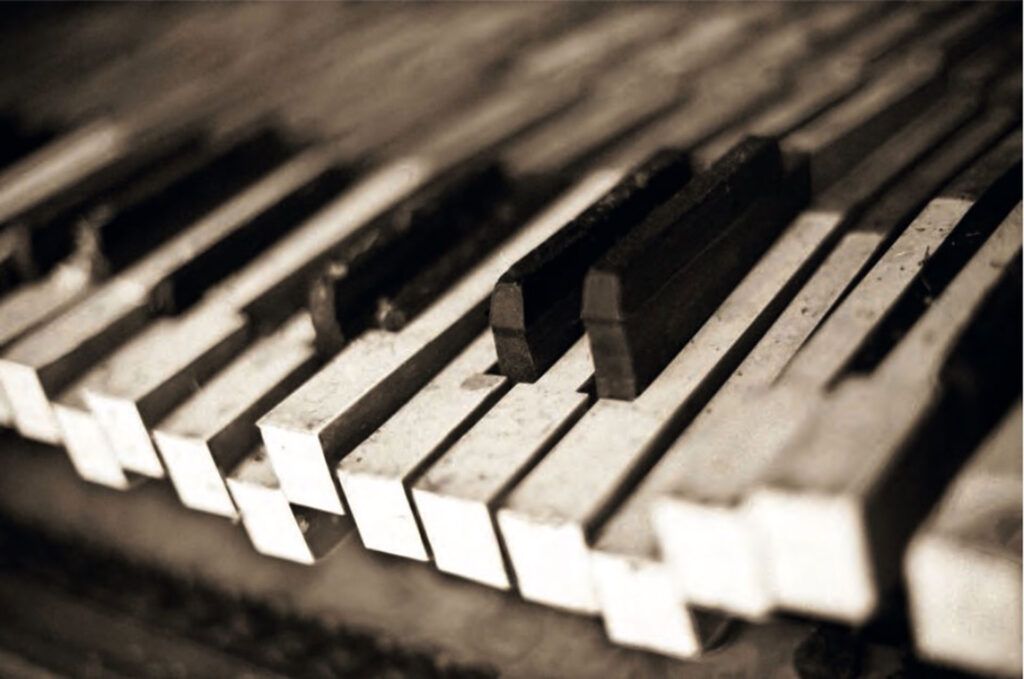
What first appears as sonic debris—even as ruins—contains the potential for a more articulated musical identity.
These ruins are far from inert; their seeming disorder harbours latent vitality. The flute and cello animate this potential life by entering the piano’s spectral field, reinforcing select partials and sustaining components that the piano alone cannot extend. Through modified instrumental techniques, the sounds of these instruments blend seamlessly with the piano’s evolving spectrum. While initially the three instruments may function as distinct sources, they gradually become elements of a unified resonating system.
Fineberg’s explanation of instrumental synthesis clarifies this process. The result does not clearly reproduce the spectral model when each instrument expresses parts taken from it, since each instrument has its own complicated spectrum (Fineberg 2011). Although the overall sound remains connected to its origin, it becomes not only more substantial in material terms but also less capable of being reduced to that origin.
In ISO[R], the flute and cello do more than just extend the frequencies already present in the piano; they give those frequencies different physical characteristics. A partial coming from the piano takes on the physical quality of breath when it is sustained by the flute and the friction together with the sound of a bowed string when the cello plays it. It stays linked to the piano as it enters into another kind of sonic existence.
The group together make up a resonant circuit. A sound can become noticeable on one instrument, gain clarity or duration on another, and then reappear in the ensemble as part of a single, combined acoustic image. As a result, the individual identity of the instruments becomes movable. The listener is able to hear the flute in the resonance of the piano, the piano in the resonance of the cello, or a mixed sound whose origin cannot be firmly attributed to any one player.
Fineberg (2011) describes this situation as existing on a continuum from harmony to timbre: harmony is perceived when simultaneous elements remain distinct, whereas timbre emerges when perception fuses these elements into a singular acoustic image. In ISO[R], the music traverses this boundary. The flute, cello, and piano alternate between functioning as individual voices and as components of a unified spectral body—the temporal extension of the piano’s resonance. As a piano tone recedes, the flute and cello enter the field of decay, prolonging and transforming aspects of the sound beyond what the piano can sustain alone. Rather than halting decay, they redirect its trajectory: energy is redistributed among instrumental bodies, and the piano’s withdrawal becomes the precondition for the ensemble’s continued activity.
There are social consequences involved. In most of ISO[R], the individual characteristics of the instruments are partly hidden in their combined spectrum. This hiding does not mean that the differences are completely eliminated. The flute, cello and piano remain materially separate, but their identities become noticeable as a result of the specific ways in which they enter, maintain and transform the common musical field. Individuality does not demand singularity or isolation.
An instrumental voice achieves its own character through its relations.
The way George E. Lewis describes créolité is useful in this context. Rather than viewing musical identity in terms of purity or within a form of limited pluralism in which differences exist alongside one another without affecting one another, his approach stresses mobility, complexity, and the development of composite identities as a result of encounter (Lewis 2017). I do not refer to ISO[R] as Creole music, nor do I equate Caribbean créolité with the cultural systems that inform this composition. What is helpful in this case is Lewis’s rejection of the notion that identities remain pure, autonomous and unchanged as a result of contact.
In ISO[R] the three identities are not displayed side by side; rather it is the flute and the cello which modify the way the piano is heard, just as the piano’s resonance in turn changes the way we perceive the flute and the cello. The relationship between the instruments is not additive, since each instrumental element comes into being differently in light of the others. At certain times the instrumental identities break away from the unified field and aim at a higher degree of acoustic independence. The resulting sounds tend to become drier and more hollow. Although there is an increase in immediate definability, there is at the same time a loss of resonance. The instruments become easier to recognise as separate sources and yet sound less connected to the overall body from which they came.
This should not be understood as a rejection of individuality or a claim that collective fusion is inherently virtuous. The composition distinguishes individuality from isolation. A voice may retain its particularity while participating in relation. Hollowness happens when the individual sound attempts to deny the network that made it audible.
Listening is the basic counterpart to this process of relating. If an instrument’s identity is conceived of as acoustically self-sufficient, then it will not be able to respond to a shared resonance. Similarly, a listener cannot understand the combined sound by focusing merely on its most prominent voice. According to Kasriel, deep listening is an active practice based on curiosity, sympathy, and respect, through which understanding might be achieved without requiring agreement or sameness (Kasriel 2025). In ISO[R], difference becomes productive since it is heard in relation.
The course of ISO[R] leads the argument back to the attack. The piece starts by hiding the usual onset of the piano and instead draws attention to vibration, fusion and resonance; at nearly the end, the strong attacks are finally shown, but they cannot be perceived as simple origins since the composition has already taught the listener to hear from the point of view of the aftersound.
Normally, the attack occurs first, with the Nachklang following. In ISO[R] the experience of resonance in terms of composition happens before the complete manifestation of the attack. The listener comes upon a world of spectral consequences before having to face the gestures which seem to cause them. Cause and consequence are mixed.
At first sight, the arrival of the vigorous attacks appears to provide a retrospective explanation since the source has now been made known and the earlier resonance can seem obvious. However, the work does not accept this kind of explanation. The Nachklang of the attacks does not reproduce them unchanged; it is like a mirror, maintaining a connection with the primary action while producing a different image, one shifted and altered by the conditions of reflection. The attack and the aftersound then become mutually interpretive. The attack sheds light on the energy hidden at the beginning of the piece, but the previous resonance has already altered how that energy can be heard. The conclusion forms a temporal mirror, in that the apparent starting point is understood in light of what comes after. At the same time, the early resonance seems, in retrospect, to contain an image of an attack that has not yet been revealed. The aftersound thus functions both as a consequence and as an anticipation. For ISO[R], decay is not the final stage of sound; rather, it is the generative centre—the field in which the individual characteristics of the instruments blend, partials become melodic possibilities, past and future overlap, and the relationship between origin and consequence is reorganised. The piece starts from the invisible life of sound and ends by showing that the attack was in fact only one possible expression of that life.
From Resonance into Trace
The temporal reorganization exemplified in ISO[R] extends beyond the audible duration of its resonances. Even after vibration has diminished below the threshold of audibility, sound persists through the effects it leaves in memory and expectation; the altered aftersound continues to shape perception. Resonance becomes a trace, memory absorbs that trace, and memory in turn enables a transformed mode of presence.
A similar principle underpins Tracing Hollow Traces. In that composition, we argued that listening constitutes both the conceptual and structural foundation: sound is not limited to pitch, rhythm, and timbre, but also encompasses gesture, shape, resonance, sonority, and spatiality (Gleason and Khumalo 2018). The harmonic and melodic material derives from a spectral analysis of a steam train. The original sound is not replicated verbatim; rather, its organization is transposed into clarinet multiphonics, sustained tones, and evolving gestures. The mechanical body of the train vanishes, yet elements of its sonic identity persist through the clarinettist’s breath and embodiment.
The title encapsulates the perceptual condition at the core of this transformation. A trace does not preserve its origin intact, but instead connects the present to something no longer fully accessible.
To trace a hollow trace is to attend to the ways in which absence continues to shape perception.
This idea reinforces the argument advanced in ISO[R]: sonic identity endures by migrating into new material or perceptual forms. A trace is not merely the final vestige of a fading sound; it signals a relationship that remains operative even after the initial conditions have changed. It is at this juncture—where acoustic resonance becomes memory and assumes the character of relational presence—that Nachklang intersects with ancestral temporality.
Ancestral Temporality and Transformed Presence
The relationship between resonance and ancestral temporality requires careful articulation. An ancestor is not merely an echo, and spiritual agency cannot be reduced to the lingering physical presence of acoustic energy. In this context, Nachklang is significant not as proof or representation of ancestral existence, but as a conceptual framework through which the notion of transformed presence may be contemplated.
Within the ancestral traditions of the Nguni people, from whose perspective I write, the death of the physical body does not mark the end of a person’s engagement with the living world. The deceased may assume a new role within an intergenerational community as amadlozi, guiding, protecting, warning, or disciplining the living, and sustaining relationships among the dead, the living, and future generations. South African scholarship similarly interprets death as a transition, framing ancestral existence as an ongoing capacity to influence the living (Bogopa 2010; Baloyi and Makobe-Rabothata 2014).
Not all who die automatically attain the same form of ancestral authority, nor can the relationship be reduced to a simple transactional exchange of obedience for prosperity. Ancestral status is embedded within an ethical and relational framework. Showing respect for ancestors entails recognizing inherited responsibilities, family histories, and obligations that connect an individual’s life to a community extending beyond the immediate present. A fulfilled life within this order does not result solely from individual agency, but from the ongoing maintenance of relationships. Life’s conditions are shaped not only by visible actors, but also by ancestral guidance, communal responsibility, the material environment, and the consequences of actions for the future.
Death, therefore, may be understood not only as loss but also as a transition into a different condition of authority. To describe this shift as a privilege is not to romanticize death or ignore the grief that accompanies the loss of embodied presence. Rather, it acknowledges that the departed may transcend certain limitations and hierarchies of visible life, assuming a position from which their influence continues. In this respect, Nachklang acquires philosophical significance: though the aftersound is linked to its original source, it is not a simple continuation; it is transformed as it passes through new materials and contexts. Similarly, in ancestral temporality, bodily life does not persist unchanged after death, but presence endures in an altered state. The analogy between acoustic resonance and ancestral presence should not be taken beyond this structural similarity. While acoustic energy ultimately dissipates, ancestral agency continues as a spiritual, cultural, and ethical force. Both phenomena challenge the presumption that only the immediately perceptible is real—reminding us that the invisible is not necessarily absent, nor the inaudible inactive.
ISO[R] articulates this proposition musically. The piano’s initial vibration is not confined to the instrument itself; its harmonic components migrate into the flute and cello, acquiring breath, friction, duration, and other timbral qualities. Although the apparent source recedes, its relationships persist within a unified ensemble. The nuanced use of the pedal blurs the boundaries between past, present, and future: earlier vibrations continue to influence current events, and latent partials foreshadow sounds yet to come. The past is not sealed off by the present, nor does the future remain external to it; rather, all temporalities are interwoven.
Ancestral temporality is just as much not a straightforward sequence in which life on earth ends and an entirely separate afterlife begins. The living dwell in a present that has been formed by those who came before them, and the actions of the living produce conditions which are inherited by future generations. The dead are not restricted to the past, nor do they get transferred into a far future; rather, their presence brings together various temporal orders.
Memory is not merely a private image of an irretrievable past; it serves as a conduit through which inherited relationships are reactivated in the present. Remembering may reawaken responsibilities, restore neglected connections, or reframe the interpretation of current actions. While memory enables the past to exert influence, it does not claim that the past remains unchanged.
It is precisely the final attacks in ISO[R] that render this temporal entanglement audible; their arrival appears to reveal the origin of the previously heard resonant world. Yet, Nachklang returns these attacks as altered reflections. The apparent point of origin does not exert absolute control over subsequent events; its effects extend beyond itself, and the memory of earlier resonance reframes the perception of initial actions.
Presence does not survive by remaining unchanged; it continues by acquiring another mode of existence. This proposition connects acoustic decay, musical transformation and ancestral temporality without collapsing their differences. In each case, the withdrawal of the foreground creates conditions through which less immediately perceptible relations may become active.
To listen within this time-based framework means to oppose the idea that only what is immediately present can have agency; it entails paying attention to traces, inheritances, and consequences, and it also questions the isolated individual’s assertion of self-sufficiency. Just as no sound in ISO[R] can be entirely the property of one instrument, so no life can be formed entirely within the limits of the visible self.
Decay and Future Sonic Thinking
What might decay contribute to future sonic thought? Its significance lies not in the introduction of new technique or style, but in inspiring a particular mode of attention—a willingness to remain with a sound beyond its moment of greatest prominence, and to recognize that diminished audibility does not equate to diminished significance.
Such listening also carries an ethical dimension. Attending beyond the attack resists the impulse to reduce sound to its most immediately apparent gesture, instead foregrounding the relationships, histories, and transformations that extend beyond the source. Analogously, to listen to others is to recognize that a person exceeds what is immediately visible, familiar, or easily categorized.
As Kasriel (2025) asserts, deep listening is a practice through which understanding can emerge without requiring agreement or similarity. It is not passive reception, but rather the creation of relational conditions that allow another voice to become perceptible. As Gleason and I argued in Tracing Hollow Traces, listening grants the perceived phenomenon sufficient space to exist and to be encountered on terms not wholly predetermined (Gleason and Khumalo 2018).
Listening is intimately linked to human dignity. It is perilous to mistake a partial view for completeness: the eye perceives the visible body, the ear registers the attack, and common sense constructs an apparent cause. Yet, such immediate explanations may obscure the complex relationships that constitute events or identities (Watts 2011). Deep listening—marked by curiosity, empathy, and respect, as advocated by Kasriel—enables recognition of these relationships and allows others to be encountered beyond initial classifications.
In ISO[R], no single instrument embodies the totality; rather, the piano, flute, and cello achieve meaning through participation in a shared resonant body. This does not require erasure of difference.
Lewis’s concept of créolité envisions identity as extending beyond both purity and a static pluralism in which differences coexist without transformation (Lewis 2017). This principle also informs the interaction between European spectral composition and amaXhosa bow technique discussed in this paper. These traditions need not be subsumed into a universal theory, nor regarded as merely parallel; European spectralism provides terminology for acoustics, perception, temporality, and synthesis, while amaXhosa practice embodies a knowledge of the spectrum integrating instrument, resonator, voice, and body in melodic formation (Khumalo 2019). Future sonic thinking, then, requires a multiplicity of perspectives—not only embracing new sounds, but also the bodies, histories, and epistemologies that confer meaning. The future is not created solely through ever more forceful attacks or novel objects, but also by attending to what has been treated as background, residue, or ruin.
The notion of decay without mourning does not entail denial of loss.
Mourning acknowledges the end of a particular form of presence and its significance, but it need not equate every withdrawal with extinction. Decay may also signify transition, redistribution, and revelation. In ISO[R], resonance does more than just follow the attack; it filters, extends and transforms it. It travels among the various instruments, giving rise to potential melodic forms and reorganising the relationship between the past and the future. When the strong attacks finally occur, their Nachklang reflects them differently. The apparent origin then reappears as another image of itself.
The sound may recede from the foreground, yet its influence persists. Resonance becomes a trace; this trace is preserved in memory, enabling the possibility of transformed presence. Presence continues not by remaining unchanged, but by acquiring a new mode of existence.
The invisible life of sound begins where its most assertive gesture ends.
Baloyi, Lesiba, and Molebogeng Makobe-Rabothata. 2014. “The African Conception of Death: A Cultural Implication.” In Toward Sustainable Development through Nurturing Diversity: Proceedings from the 21st International Congress of the International Association for Cross-Cultural Psychology, edited by Leon T. B. Jackson, Deon Meiring, Fons J. R. van de Vijver, Elias S. Idemoudia, and William K. Gabrenya Jr., 231–243. https://doi.org/10.4087/FRDW2511.
Bogopa, David. 2010. “Health and Ancestors: The Case of South Africa and Beyond.” Indo-Pacific Journal of Phenomenology 10 (1): 1–9. https://doi.org/10.2989/IPJP.2010.10.1.3.1063.
Dargie, David. 1988. Xhosa Music: Its Techniques and Instruments, with a Collection of Songs. Cape Town: David Philip.
Fineberg, Joshua. 2011. “Spectral Music: Gérard Grisey, Tristan Murail and the Creation of a New Paradigm for Musical Composition.” In Leadership in Science and Technology: A Reference Handbook, edited by William Sims Bainbridge, 573–581. Thousand Oaks, CA: SAGE.
Gleason, Scott, and Andile Khumalo. 2018. “The Act of Listening Is the Art of Giving Voice: On Andile Khumalo’s Tracing Hollow Traces for Solo Clarinet.” Journal of the Musical Arts in Africa 15 (1–2): 111–117. https://doi.org/10.2989/18121004.2018.1560561.
Grey, John M. 1977. “Multidimensional Perceptual Scaling of Musical Timbres.” Journal of the Acoustical Society of America 61 (5): 1270–1277. https://doi.org/10.1121/1.381428.
Kasriel, Emily. 2025. Deep Listening: Change Your Relationships with Family, Friends, and Foes. New York: William Morrow.
Khumalo, Andile. 2019. “Reading for ‘African Spectralism’ in Latozi Mphahleni’s ‘Modokali.’” SAMUS: South African Music Studies 38 (1): 137–158. https://hdl.handle.net/10520/EJC-16b44c0e2f.
Lewis, George E. 2017. “The Situation of a Creole.” In Defining Twentieth- and Twenty-First-Century Music, edited by David Clarke, Twentieth-Century Music 14 (3): 442–446. https://doi.org/10.1017/S1478572217000342.
Siedenburg, Kai. 2019. “Specifying the Perceptual Relevance of Onset Transients for Musical Instrument Identification.” Journal of the Acoustical Society of America 145 (2): 1078–1087. https://doi.org/10.1121/1.5091778.
Watts, Duncan J. 2011. Everything Is Obvious: Once You Know the Answer. New York: Crown Business.