FERNANDA MENDONÇA PITTA
Against the Rhetoric of Loss: can Decay be reframed as Transmission and Transformation?
Abstract
Discussions of Indigenous heritage are frequently organized by a rhetoric of loss: the presumed disappearance of an authentic culture and the survival of only fragments, substitutes, or belated imitations of an original whole. This article argues that such language does not neutrally describe cultural change. It reproduces an allochronic logic[1]Allochronism is a concept from anthropology and cultural studies—coined by Johannes Fabian—in his book Time and The Other How Anthropology Makes Its Object that describes the practice of placing the people or culture being studied in a different, usually backward time than the observer. It denies that the observer and the observed share the same living present. Watch here. that locates Indigenous peoples in a time other than the present and makes historical transformation appear as evidence of cultural inauthenticity. The opposition between authentic and false has accompanied the colonial interpretation and collection of Indigenous material culture since the sixteenth century. Reading this history alongside projects led by Francy Baniwa, Irineu Terena, and Glicéria Tupinambá, the article proposes a shift in the terms of heritage theory. Preservation should be understood through transmission, and transmission necessarily entails practice, selection, translation, and change. The three projects considered here do not ask museums to rescue disappearing cultures. They show that knowledge remains alive, may become dormant, and can be reactivated through artistic and community practice. Museums that retain Indigenous belongings consequently face an obligation: to care for them responsibly, to learn from those who hold the relevant knowledge, and to redistribute the authority through which collections are studied and interpreted.
Keywords: Indigenous heritage; decay; allochronism; authenticity; transmission; museums; Indigenous art; Brazil
The Discomfort: Indigenous Heritage under the Sign of Loss
I want to begin with a recurring discomfort. Discussions of Indigenous heritage, including those conducted with the stated intention of protecting it, are frequently permeated by a rhetoric of loss. Cultures are described as disappearing; practices as surviving only in fragments; objects as the last witnesses to worlds that no longer exist. The present is measured against an imagined moment of plenitude, before contact, colonization, Christianity, the market, the museum, or modernity. What remains is then treated as residue: an attenuated version, a reconstruction, or an imitation of an allegedly original culture.
This rhetoric appears compassionate because it speaks the language of concern. Yet its historical and political effects require scrutiny. Lamentation can preserve the colonial premise that Indigenous culture is most authentic when located in the past. It allows museums and scholars to mourn a disappearance that they have already presupposed, while overlooking the people who continue to make, teach, transform, interpret, and contest the meanings of their material and intellectual practices. The discourse of inevitable loss converts Indigenous historical agency into decline. Change becomes evidence against authenticity.
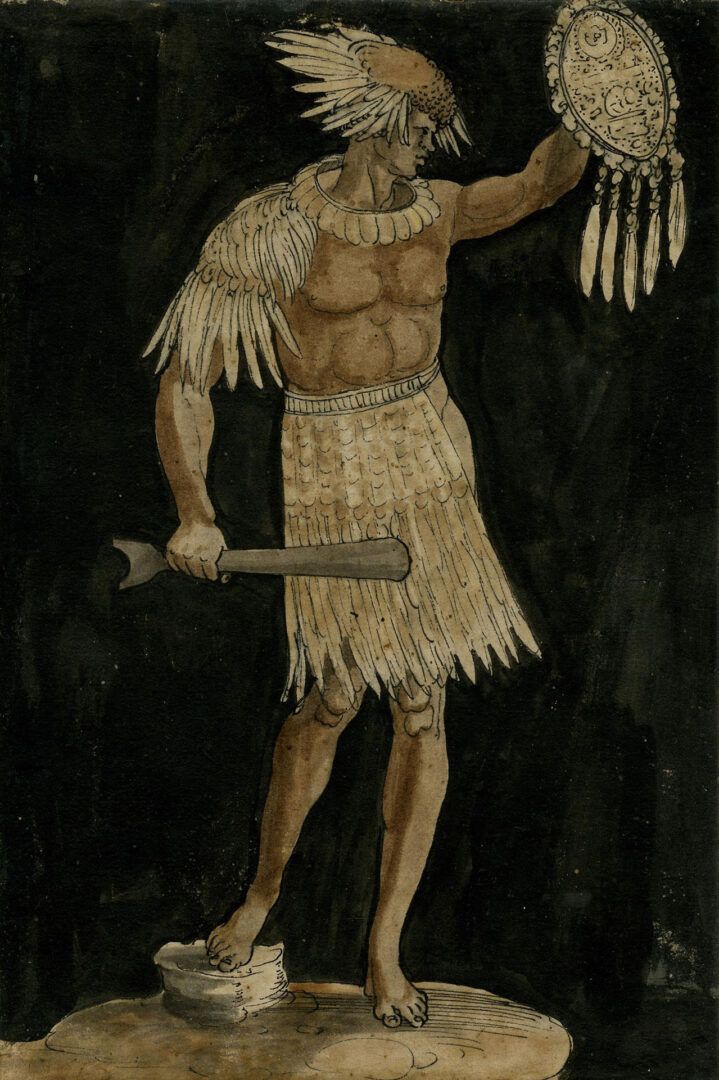
The spectre of the “authentic” and the “false” hovering over Indigenous production is not a recent effect of the heritage industry or the tourist market. It belongs to the formation of the colonial gaze itself. In her study of Tupi featherwork and intercultural exchange in early modern Brazil, Amy J. Buono examines a revealing sixteenth-century episode. Pero de Magalhães de Gândavo described the alteration of feather colour through the procedure now generally called tapirage and then claimed that Indigenous sellers deceived buyers by passing altered feathers off as those of a more valued species. The Portuguese term “contrafeitos” (counterfeited or imitated), translated a sophisticated Indigenous technology of material transformation into a European anxiety about fraud, substitution, and access to the “real” product (Buono 2009, 351–353).
Buono identifies the colonial marketplace as the framework through which Gândavo interpreted the practice. Within that framework, modified feathers appeared as fake exotica offered to credulous Europeans. The episode exposes a deeper epistemic problem. The colonial observer recognized the physical efficacy of the technique and simultaneously denied the Indigenous terms under which its value could be understood. A technology that transformed the colour, social efficacy, and perhaps ritual value of feathers was judged according to the presumed stability of species, substance, and price. Indigenous technical mastery became suspicious precisely because it unsettled the categories through which Europeans sought to authenticate and possess Indigenous things.
The Jesuit sources discussed by Buono add another dimension. Missionaries mediated the circulation of featherwork, shipped mantles to Europe, incorporated feather adornments into Christian performances, and interpreted their sale or relinquishment as evidence that Indigenous converts were abandoning a pagan past. These objects could function simultaneously within Tupi and Christian rituals, colonial markets, missionary narratives, and European collections. Their mobility and semantic transformation did not diminish their importance. Nevertheless, colonial accounts repeatedly tried to arrange this complexity along a temporal axis: Indigenous featherwork belonged to a past that conversion would overcome, while the objects sent to Europe became material evidence of missionary success. Authenticity, conversion, and collection were therefore linked to a politics of time.
This politics of time is central to what Johannes Fabian termed the “denial of coevalness”: the persistent placement of the people studied by anthropology in a time other than that of the observer (Fabian 1983). Allochronism does not simply claim that different societies have distinct histories. It establishes an unequal temporal relation. The colonized subject is made contemporary in physical presence and noncontemporary in conceptual status. Indigenous people may inhabit the same present as researchers, missionaries, collectors, and museum professionals, while their cultural legitimacy is referred to an earlier time. When they change, adopt materials, develop new forms, circulate through markets, or intervene in institutions, their contemporaneity is used to question their authenticity.
The rhetoric of loss is one of allochronism’s most durable heritage forms. It recognizes Indigenous culture most readily at the moment of its presumed disappearance.
It grants historical depth while withholding the right to history. Within this structure, continuity must look like repetition, and transformation is interpreted as corruption. A culture imagined as timeless can only remain authentic by remaining unchanged; any evidence of history becomes evidence of decay.
This temporal structure contradicts the very operation that gives preservation social meaning: transmission. Materials may be stabilized, objects may be sheltered from light and humidity, and records may be stored with great technical precision. Yet heritage does not persist socially through physical endurance alone. It persists because knowledge, skills, narratives, obligations, and modes of attention pass among people, places, and generations. Transmission involves acts of learning and teaching. It requires interpretation in changed circumstances. It brings inherited knowledge into contact with new materials, problems, media, languages, and political demands.
Transmission consequently produces difference. This does not mean that every alteration is equivalent, that historical violence can be redescribed as benign change, or that material destruction ceases to matter. It means that continuity cannot be evaluated through identity with an originary form. What is transmitted is enacted again, and each enactment takes place under conditions that differ from those of previous ones. Selection, adjustment, invention, and translation are internal to the process. Change is therefore not preservation’s opposite. It is one of the conditions through which preservation occurs.
This distinction clarifies why in our approach we sustain that “decay” should be treated as an inherent category of heritage theory if understood as a transformative process, both generative and degenerative, profoundly propositional and inherently linked to power (Lambrechts et al., 2024). Decay is never a self-evident description of what has happened to a practice or a body of knowledge. It names a judgment about change, value, and time. A museum may classify a material alteration as deterioration, a discontinued practice as disappearance, or an object detached from documented use as a remnant. Regarding Indigenous heritage, from within a community, the same situation may be understood through other temporal forms: latency, dormancy, memory, reactivation, adaptation, or return. These terms do not deny rupture. They refuse to make rupture the total explanation of Indigenous cultural life.
The issue is therefore larger than the acceptance of entropy within conservation. Critical work on curated decay has productively challenged the ambition to preserve every material thing indefinitely and in an unchanging state (DeSilvey 2017). The projects discussed below raise a different question. They ask who has the authority to diagnose loss and to determine whether a practice has ended, transformed, or entered a period of dormancy. They also ask what museums preserve when they stabilize objects while allowing the relationships, languages, techniques, and interpretive authority attached to them to be severed.
The answer does not lie in extending institutional care until the museum claims responsibility for the survival of Indigenous culture itself.
Indigenous communities do not require museums in order for their knowledge to be alive.
The direction of dependence must be stated clearly: museums that wish to retain Indigenous belongings require the knowledge held in communities if they are to understand and care for those belongings responsibly. Their task is not to rescue communities from cultural disappearance. It is to become accountable for what they hold, to respect living systems of knowledge, and to learn from the people entitled and able to teach them.
The work developed together with Francy Baniwa, Irineu Terena, and Glicéria Tupinambá makes this argument concrete. Their projects emerged within Decay Without Mourning: Future-Thinking Heritage Practices, developed at the Museum of Contemporary Art of the University of São Paulo between 2022 and 2026. Each addresses a distinct relation among Indigenous communities, artistic practices, and museum collections. Taken together, they displace the vocabulary of disappearance through three related propositions: knowledge lives in communities; knowledge may remain dormant without ceasing to exist; and objects held by museums can carry technologies that artistic and collective practice may awaken and reconnect to those present in the territory.
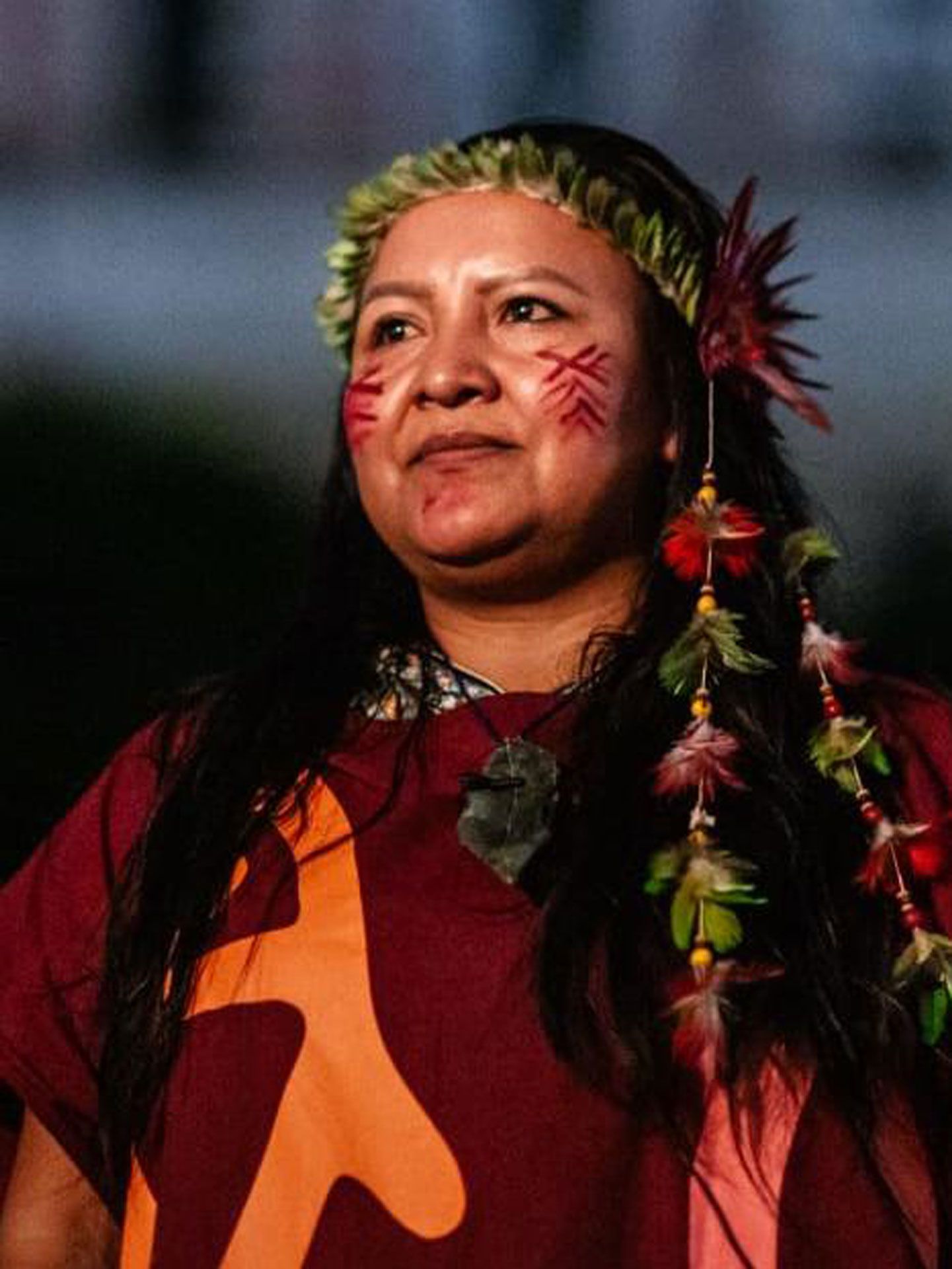
Francy Baniwa: The territory as a living museum
Francy Baniwa’s ongoing research on living museums and Indigenous curatorship begins with a concrete documentary problem regarding the material culture of her people, the Baniwa. The Baniwa, who also identify collectively as Medzeniakonai and through the names of their respective clans, are an Arawakan-speaking people whose territory extends across the Içana basin and its tributaries, including the Aiari and Cuiari, in the border region connecting Brazil, Colombia, and Venezuela. According to Francy:
The community of Assunção do Içana, where I was born, forms part of the vast cultural and ecological complex of the Upper Rio Negro. Located on the lower Içana River, Assunção was established on terra firme (non-flooded upland) where, according to Baniwa oral history, there have always been gardens, hunting, and fishing. The settlement was formerly known as Pitsiromai, the Baniwa name for a sacred and dangerous bird, and as Bitiru Ponta in Nheengatu. It is still also known as Wanaliina, or Catrara-Poço. With the establishment of the Salesian mission in 1951, the settlement came to be called Nossa Senhora da Assunção. Compared with traditional settlement patterns, the mission brought about a substantial concentration of the population and transformed the settlement into a district. Although this facilitated the missionaries’ work, it disrupted Indigenous forms of social organization and led to the loss of knowledge, traditions, and cultural values. (Baniwa, 2023, p.12)
The community’s present configuration developed long after a very important ethnographic expedition took place in the area, in the beginning of the 20th Century, the Koch-Grünberg’s expedition. The German ethnologist and museum collector travelled for the Royal Museum of Ethnology in Berlin between 1903 and 1905, documenting languages, ceremonies, social life, and material culture while assembling collections. According to his own itinerary (Koch-Grunberg 2005), he entered the Içana on 28 September 1903, encountered the peoples he grouped under the broad designation “Baniwa”—including Karutana, Katapolitani, Huhuteni, and Siusi—along the lower and middle Içana, reached Tunuhy on 6 October, departed toward the Aiari on 12 October, and travelled upriver from Cururu-cuara on 2 November, reaching the Yurupary waterfall, called Iyäipana in his account, on 6 November. His journey on the upper Cuduiari occurred separately, from 25 November to 2 December 1904, among predominantly Kobeua-speaking communities and a Hölöua group that he also classified as “Baniwa.” At the time of his visit, Baniwa communities were already experiencing forced recruitment, debt relations, and labor exploitation connected to the rubber economy. Assunção subsequently grew around the Salesian mission and boarding school established in the early 1950s. Missionary education, Christianization, interethnic marriages, and the predominance of Nheengatu reshaped language, settlement, ritual life, and the transmission of shamanic knowledge. Francy also explains that:
Today, all the families in the community maintain good relations with one another. They organize and plan activities, discuss matters of common interest, and hold traditional and religious celebrations. Approximately seventy families live in the community, including Baniwa, Koripako, Baré, Tukano, Wanano, Werekena, Kubeo, Tatiano, and Puinave families, who seek to maintain their cultural identities both in everyday life and during cultural events. Their principal economic and subsistence activities are hunting, fishing, and gathering wild fruits. They also collect vines, tucum, tururi, arumã, and other plant fibers and resins. In addition, the families engage in traditional agriculture, cultivating manioc in their gardens and near their homes, and raising small numbers of poultry for their own consumption. The community is organized into seven villages: Vila Mazarello, Dom Bosco, Nossa Senhora da Assunção, Catrara-Poço, Santa Cruz, Sagrado Coração de Jesus, and São Francisco. The houses have wooden walls and roofs made of corrugated aluminum sheets or caraná palm thatch. (Baniwa, 2023, p.13)
More recent Indigenous organizing, differentiated schooling, and the community-led Escola Viva Baniwa have created new conditions for teaching the Baniwa language, rebuilding a ceremonial maloca, and strengthening knowledge and practices long stigmatized by Catholic and evangelical missions. Assunção’s history is therefore one of successive transformations, in which coercive labor regimes and missionary intervention coexist with Indigenous strategies of alliance, institutional appropriation, cultural reactivation, and renewed self-determination.
Artistic production has become another important dimension of the Living Schools movement. Its first collective exhibition, Viva Viva Escola Viva, was held at Casa França-Brasil in Rio de Janeiro from 2 December 2023 to 28 January 2024. This first edition preceded the Baniwa Living School’s formal incorporation into the movement in 2024. The second edition, presented at Instituto Tomie Ohtake in São Paulo from 10 June to 9 August 2026, included the Baniwa Living School alongside the other participating schools and brought together paintings, drawings, collective works, and installations produced through workshops, artistic residencies, and activities in the territories. The Baniwa section featured paintings by Frank Baniwa, Larissa Baniwa, and Francy Baniwa, as well as Umbigo do mundo [Navel of the World], an installation collectively created by members of the Baniwa Living School in Assunção do Içana. The exhibition demonstrates that the school’s work is not confined to the transmission of knowledge within the territory. Artistic practice also allows this knowledge to enter public circulation without being reduced to ethnographic documentation: paintings and installations become modes of research, collective narration, and the activation of relations among memory, territory, and contemporary Indigenous life.
Together with Francy, we gathered a list of Baniwa objects associated with his collecting expeditions. Research intern Lucas Abner has brought together the dispersed catalogue records for the objects collected by Koch-Grünberg and now held in Berlin, Leipzig, and Hamburg. Across these four institutions, we have located more than a thousand Baniwa items. Together compiled the available entries, obtained images whenever they existed, and translated the documentation into Portuguese. In September 2026, this material will be taken to the community for collective examination by the Escola Viva members. The research is therefore still in development, and its central interpretive stage will take place in the territory.[2]Previous projects connected the peoples of the Upper Rio Negro with their belongings in German collections. See Scholz, 2017, and Oliveira and Scholz, 2024.
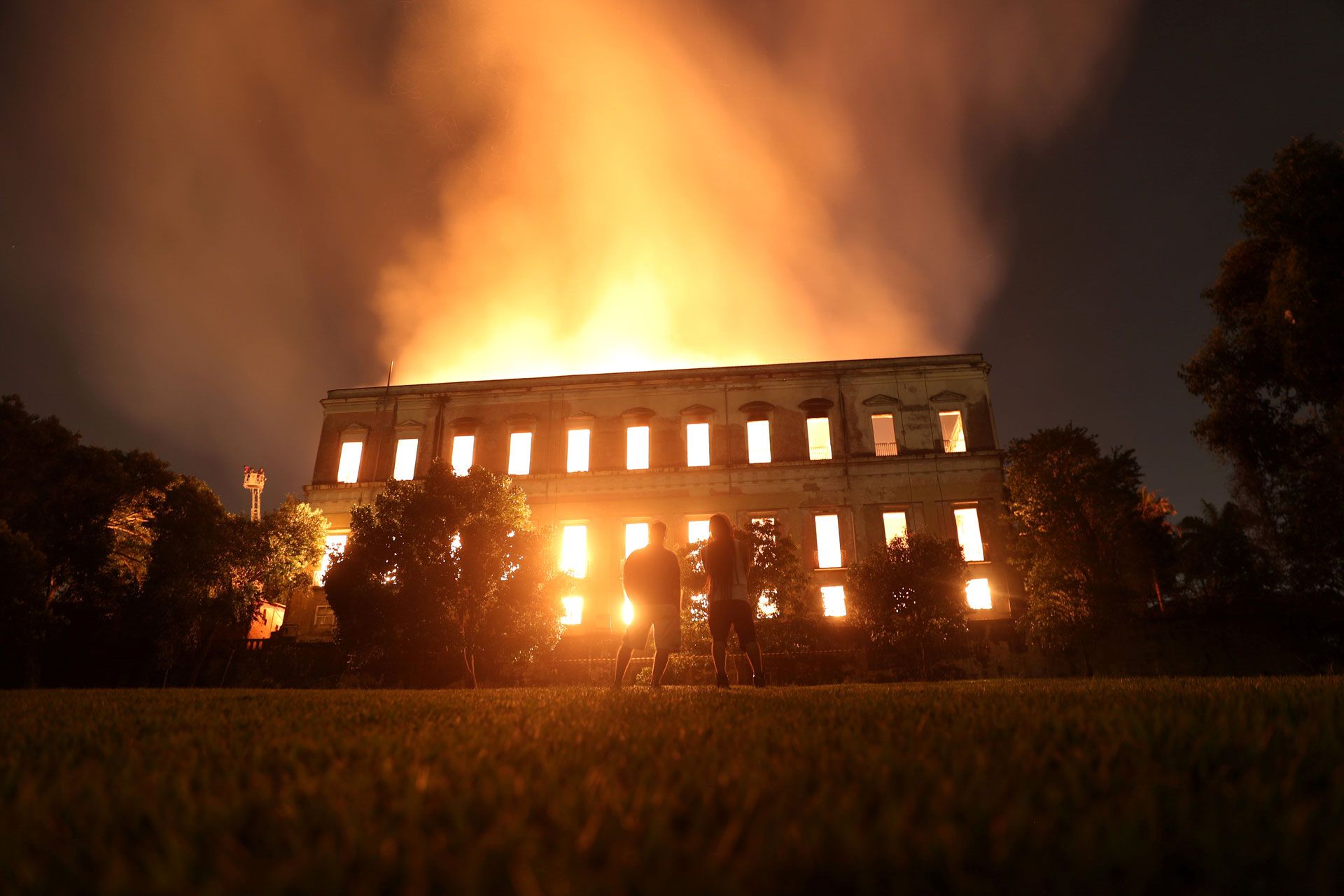
The scale of the German holdings has particular historical weight. Following the 2018 fire at the Museu Nacional in Rio de Janeiro, Germany became the principal repository of Baniwa material heritage in museum collections worldwide. This fact could easily reinforce a familiar institutional narrative: the idea that the museum preserves the material remains of knowledge that has disappeared from community life. The preliminary results of the research demonstrate the opposite. Most of the objects identified in the German collections are known within the community (Francy already began sharing images with her family and friends through WhatsApp asking for information). There are no objects whose materials, fabrication, or uses are entirely unknown to them. Some have not been made for a long time because they belong to rituals that are no longer practiced, like masks. Most, however, remain part of everyday life.
This distinction is decisive. What is scarce in this case is not Baniwa knowledge. It is reliable museum documentation. The catalogue records are frequently incomplete or inaccurate, although the knowledge required to correct them continues to exist in the community. The museum may possess the object while lacking even basic information about what it is, how it was made, which materials it incorporates, and how it was used.
Physical custody has thus produced no epistemic superiority.
The apparent opacity of the collection results from the historical separation between the objects and the people who know them, compounded by institutional records that have preserved and repeated misunderstandings.
For Francy and her Baniwa relatives, these inaccuracies are not minor technical deficiencies. As Francy explained in her talk in the workshop Beyond Restitution (Baniwa, 2025), erroneous information causes damage to memory and heritage. A catalogue entry participates in the public life of an object: it determines how museum professionals handle and classify it, how researchers find and interpret it, and what non-Indigenous visitors are told about Baniwa history and knowledge. An error retained in a museum database can acquire the authority of an institutional fact and circulate through exhibitions, publications, and subsequent research. Correcting it is consequently an act of respect toward Baniwa knowledge and a form of reparation within the field of documentation.
The intended audience of this correction is also significant. The Baniwa do not need museum records in order to learn what these objects are. They want the records corrected so that non-Indigenous people receive accurate information and so that the knowledge of Baniwa experts is treated with the respect it deserves (Baniwa 2025). The research thus reverses the presumed direction of museological instruction. The museum does not return lost meanings to the community. The community enables the museum to understand the objects under its custody and to stop reproducing erroneous or impoverished accounts of them.
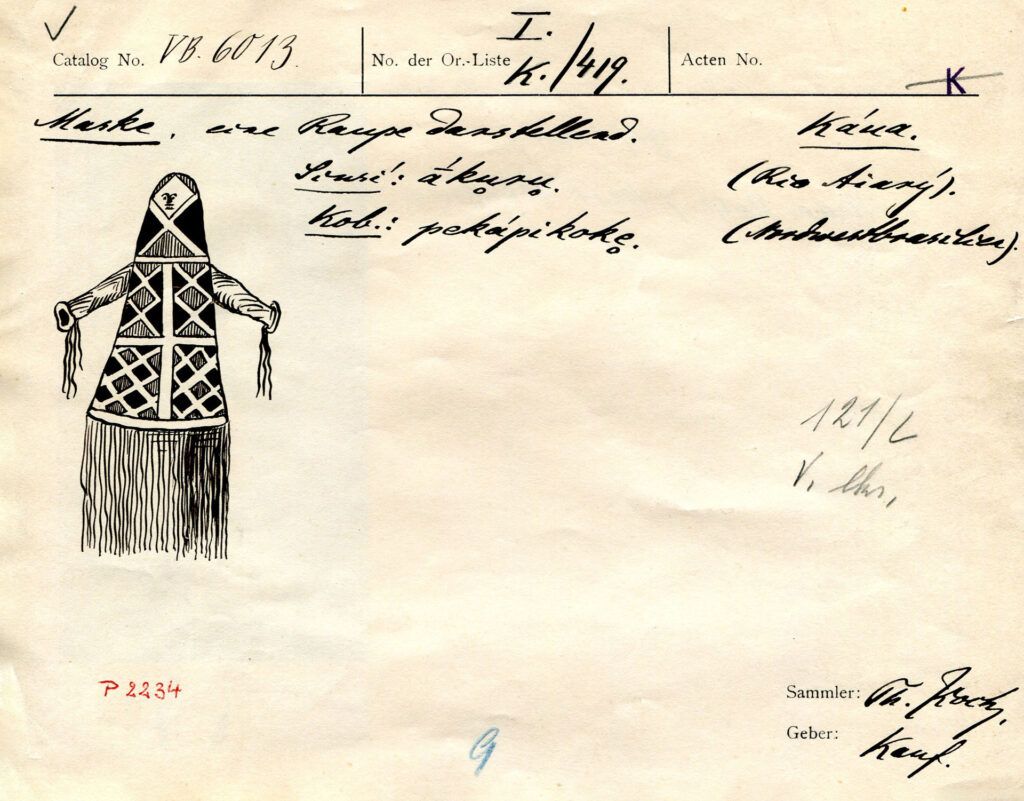
The return of the compiled lists, translations, and available images to the community has a second objective. Objects associated with rituals no longer practiced may preserve details that can contribute to renewed processes of making at the Escola. Here, museum collections can serve as resources for the reactivation of practices that have become dormant. This potential does not imply that the museums contain a complete culture awaiting recovery. The collections hold material and visual evidence that can be interpreted through knowledge present among Baniwa people. The possibility of remaking an object emerges from the encounter between this evidence and community expertise, memory, experimentation, and decisions about what should be made again.
Francy’s research therefore identifies two distinct directions in which knowledge can move. In the first, Baniwa knowledge enters the museum in order to correct records intended largely for non-Indigenous publics and professionals. In the second, documentation and images assembled from dispersed German collections return to the community as resources for studying and potentially remaking objects that have not been produced for many years. The two movements are related, yet they answer different needs. One transforms the museum’s responsibility toward the objects it holds; the other expands the materials available for community-led reactivation.
The proposition can be stated directly.
Communities do not need museums to certify the continuity of their culture.
If museums wish to retain belongings originating in those communities, they might care for them properly, treat them with respect, and learn about them from those who possess the relevant knowledge. Care includes physical conservation and accurate documentation. It also includes access for Indigenous researchers, the recognition of restrictions, appropriate modes of handling and display, the use of relevant languages, and, perhaps, the incorporation of community knowledge into institutional procedures.
Oliveira and Scholz identify a persistent gap between museums’s declared recognition of Indigenous epistemologies and their capacity to incorporate them into institutional practice. In the Amazonian exhibition at the Humboldt Forum, only a small part of the knowledge produced through collaboration with Indigenous partners entered the final displays, while cosmological, ecological, and technical complexity was reduced to conform to concise exhibition formats. Similar limits shaped the storage and documentation of Upper Rio Negro feather ornaments: museum taxonomies separated them according to material, size, and object type, while Kotiria and Desana visitors understood them as interconnected parts of ancestral bodies that should be kept together. Broad ethnic labels such as “Tukano” or “Baniwa” also omitted the clan affiliations required to establish an object’s biography, ownership, and powers. These cases show that institutional resistance does not necessarily take the form of openly denying Indigenous knowledge. It operates through classificatory systems, conservation protocols, and exhibition formats that acknowledge such knowledge as contextual information while preventing it from reorganizing museum practice (Costa Oliveira and Scholz 2024, 50–55, 61–68).
The notion of the living museum is therefore more than a metaphor for participation. It names a redistribution of the location and authority of knowledge. Knowledge does not become alive when it enters a museum program; it enters the museum from living relations in the territory. Francy Baniwa’s research replaces the image of the museum as guardian of the last trace with a more demanding model. The institution becomes the custodian of objects that it cannot adequately understand on its own. Its legitimacy depends on whether it can acknowledge this dependence, correct the damage produced by erroneous records, and sustain reciprocal relations with the people whose belongings it retains.
None of these movements guarantees continuity. Corrected records may again become outdated, institutional commitments may weaken, and objects made anew may not develop into sustained practices. Francy’s research offers no definitive formula for cultural preservation. Its theoretical force lies in changing what preservation is understood to entail. Once incomplete documentation and interrupted circulation are approached as conditions that can be acted upon, the signs previously read as cultural decline become points from which knowledge may be retransmitted and transformed, turned into artworks or not. Heritage emerges here as an ongoing relation of accountability, revision, and return, whose continuity depends on renewed commitments among communities, collections, and institutions.
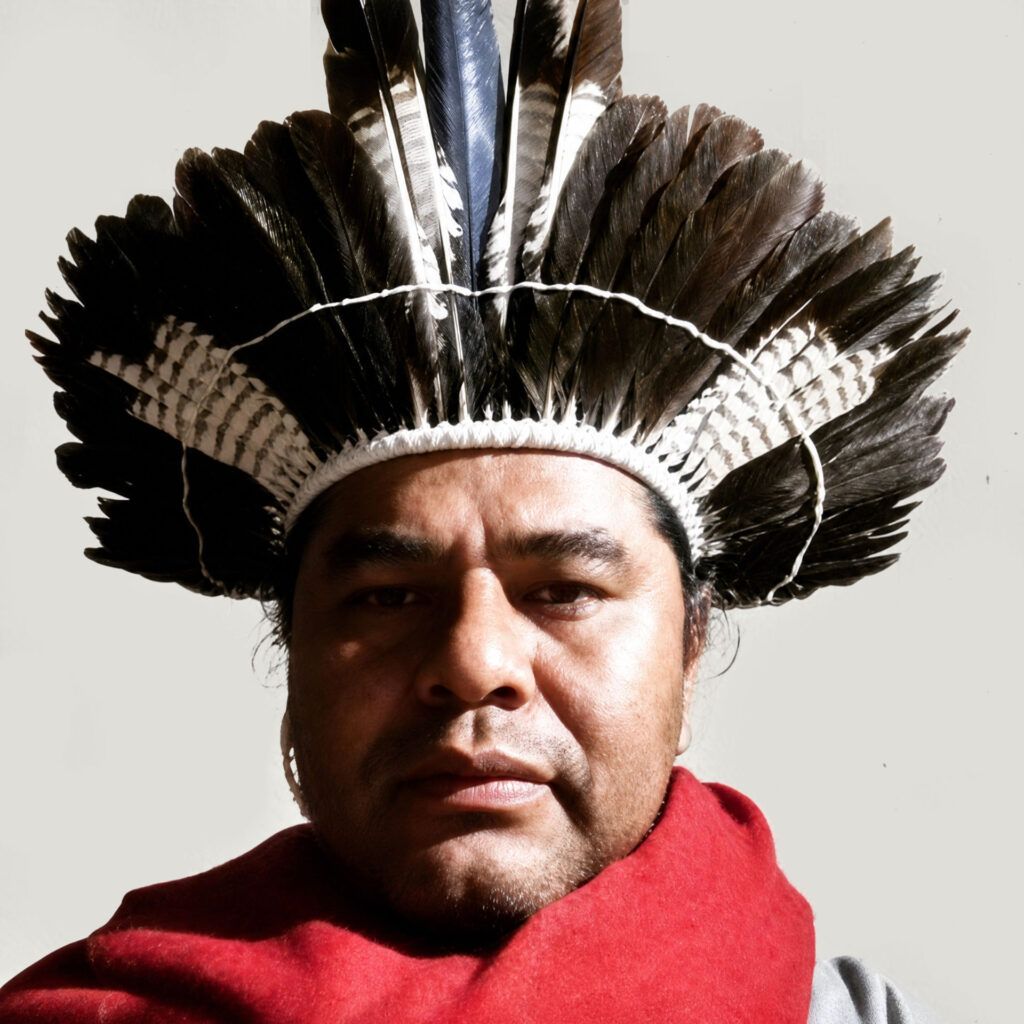
Irineu Terena: Dormant Knowledge and Artistic Reactivation
Irineu Terena’s work on Terena ceramics introduces another temporal concept: dormancy. His project, Technologies of Terena Memory, has involved travel among villages, an artistic residency, learning with women potters, exchanges between communities, workshops, and exhibitions. These activities address the effects of historical violence on the transmission of ceramic knowledge and on relations among Terena communities.
Kopenoti is located in the Araribá Indigenous Territory, in the municipality of Avaí, in the state of São Paulo. Terena families began moving from Mato Grosso do Sul to Araribá in the early 1930s, following a longer history of warfare, territorial displacement, and transformations in their ways of life. Irineu’s research suggests that pottery had already ceased to be practiced within some of these families before their arrival in São Paulo. Cassiano Sebastião, who moved from Mato Grosso do Sul to Kopenoti in 1954, recalled that neither his mother nor his grandmother made pottery. Osnita Machado, who arrived in Araribá decades later, likewise knew that ceramics belonged to Terena tradition, although she had never learned to make it in her family. The dormancy of pottery in Kopenoti thus cannot be attributed to a single moment of abandonment. It emerged through successive displacements and through the weakening of the material and social conditions that had enabled women to learn and work together (Sebastião 2024).
The difficulty continued in the new territory. Women lacked regular access to clay, suitable firing structures, experienced potters, and time devoted specifically to the practice. Occasional activities took place, yet they did not establish sustained transmission. A workshop in the village of Ekeruá, for example, produced an unsuccessful firing and was not continued. In Kopenoti, the project Clay in the Hands, Living Terena Memory, organized by Irineu for women participants, created another opening. Osnita gained experience through the project and continued producing ceramics using a small kiln built in the village. Her trajectory shows that the knowledge was neither simply present as an uninterrupted practice nor entirely absent. It could acquire renewed force when conditions for learning, experimentation, and continuity were deliberately created (Sebastião 2024).
Reactivation in Kopenoti therefore entails restitching relationships with women potters in Mato Grosso do Sul, where Terena ceramic practice is strong. Women from these communities already meet with the women from Kopenoti at celebrations such as the Feast of Saint Sebastian, the Indigenous Games, and other festivities. These occasions sustain kinship and community relations, yet they rarely provide the time, support, materials, and resources necessary for an encounter centered on ceramics. Making pottery requires another temporality: time to locate and prepare clay, to observe gestures, to exchange memories, to form vessels, to dry and fire them, and to remain together while knowledge passes among women.
The project’s importance lies precisely in creating this dedicated time. The opportunity to Bring potters from Mato Grosso do Sul together with women in Kopenoti in the beginning of 2026 did more than transfer a technique from one village to another. It strengthened relations that historical displacement stretched across territories and allowed pottery to become a medium through which those relations are renewed. The encounter gave women the opportunity to compare procedures, recall family knowledge, solve material problems, and decide collectively how ceramic practice can continue under present conditions (Sebastião 2026).
The language of disappearance would frame the interruption of pottery in Kopenoti as evidence that a tradition had been lost. Dormancy provides a more exact account. Knowledge remained dispersed across memories, kinship relations, other Terena villages, Irineu’s artistic practice, and the desire of women such as Osnita to learn. Reactivation brings these elements together. It does not recover an intact form stored outside history. It creates the social and material conditions in which knowledge can circulate again.
Artistic practice is central to this process because it does not treat memory as information awaiting extraction. Clay must be located and prepared; forms must be made; techniques must be observed, attempted, adjusted, and taught. Workshops and residencies are therefore the means by which the research occurs and by which weakened connections acquire renewed force. The relevant continuity lies in relations among potters, learners, clay, territory, memory, and collective life.
The project was also presented in the collective exhibition Antagonistas: Resistências Algorítmicas, held at the Museum of Contemporary Art of the University of São Paulo from 29 November 2025 to 22 February 2026.[3]acervo › acervo › Detail › exhibitions Within the exhibition, Technologies of Terena Memory was not framed as ethnographic documentation of an endangered craft. Instead, it positioned pottery itself as technology and contemporary art as a field in which hegemonic definitions of technology could be contested. Against an understanding of technology centered on digital innovation, industrial development, and systems controlled by corporations and institutions, Irineu’s work locates technology in the preparation of clay, embodied gestures, firing processes, collective memory, kinship relations, and intergenerational transmission. The exhibition thus showed that
Indigenous artists do not merely appropriate or gain access to supposedly universal technologies: they redefine what technology is, where it resides, and which forms of life and relation it should sustain.
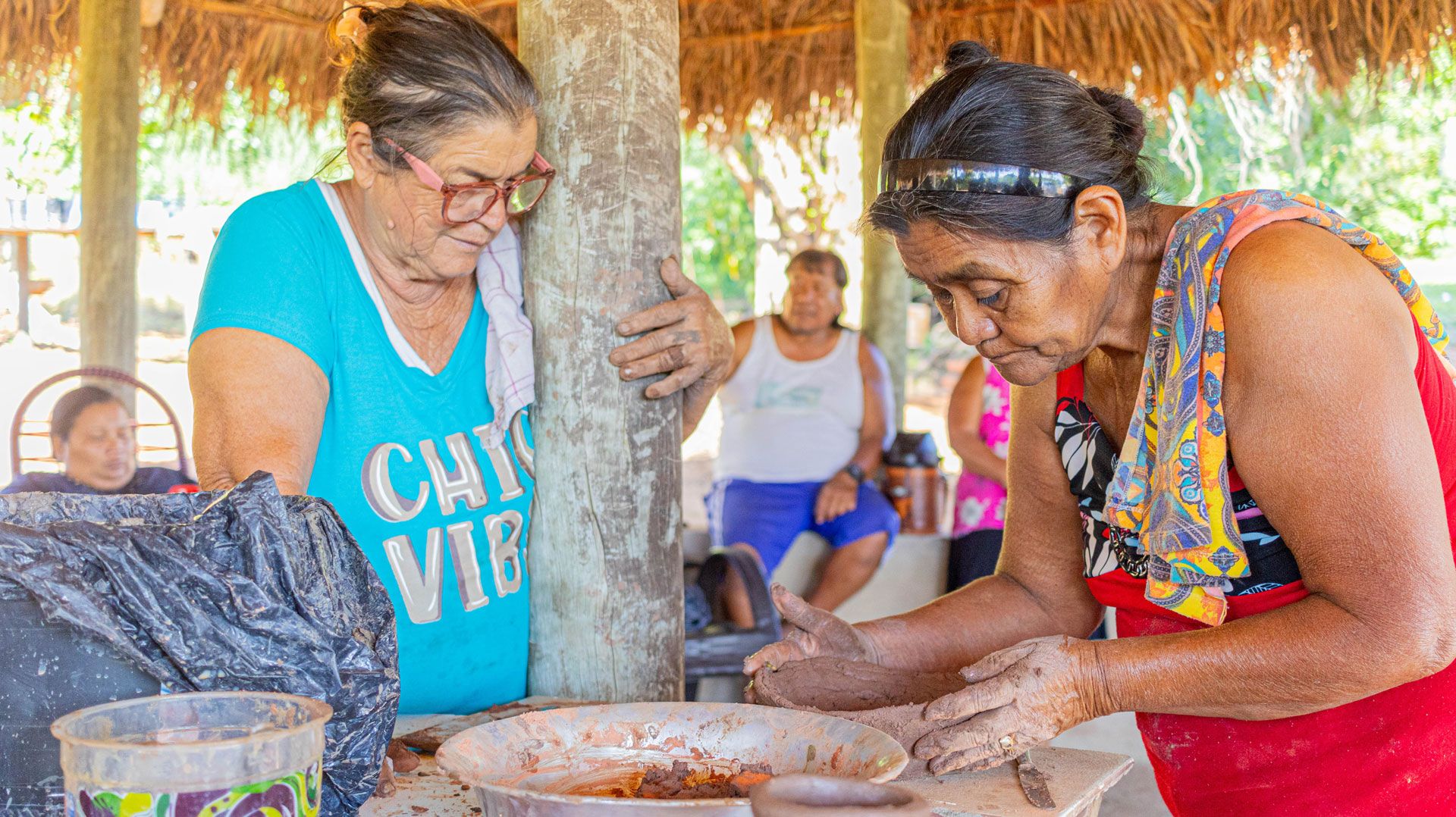
Irineu’s project thus offers a temporal alternative to the terminal vocabulary of heritage loss. Dormancy acknowledges interruption without turning it into extinction. Reactivation recognizes artistic and collective agency without claiming a seamless return. Transmission becomes an event in the present: inherited knowledge is practiced, shared, and transformed, while relations among Terena women and communities are carefully restitched through the time of making ceramics together.
The creation of this shared time does not mean that pottery will continue forever in Kopenoti. Access to clay and firing structures may remain difficult, resources for further encounters may disappear, and women may choose different forms and degrees of involvement. Irineu’s project does not claim to have resolved the preservation of Terena ceramics. Its contribution is to redefine the terms through which continuity can be perceived and supported. What a narrative of loss would describe as disappearance of tradition becomes legible as dormancy, uneven transmission, and the possibility of transformation through practice. Preservation consequently appears as the contingent work of creating conditions in which people can meet, learn, decide, and make together.
Glicéria Tupinambá: Awakening Objects, Reconnecting Technologies
Glicéria Tupinambá’s research brings this argument into direct contact with European museum collections. Her work on Tupinambá mantles (Tupinambá 2026) and, more recently, on wooden clubs has combined the study of colonial images and texts, visits to collections, technical examination, artistic production, dreams, community knowledge, and workshops with young people and elders in the Serra do Padeiro territory.
The Tupinambá are an Indigenous people whose contemporary communities in southern Bahia sustain historical, political, and cosmological relations with the Tupi-speaking peoples who occupied extensive parts of the Brazilian coast at the onset of the European invasion. Their history includes war, epidemics, enslavement, Jesuit missionization, the formation of the Olivença mission settlement, successive invasions of their territory, and official practices that sought to absorb them into the category of caboclos[4]A caboclo (or caboco) is a term used in Brazil to describe people of mixed Indigenous Brazilian and European ancestry, or traditional rural inhabitants of the Amazon region. The word originates from the Tupi language, likely meaning “one who comes from the forest. and to deny their Indigenous identity. From the late 1990s onward, renewed political organization and land “retomadas”[5]Retomada—literally “taking back” or “recovery”—is the term used by Indigenous peoples in Brazil for collective actions through which they reoccupy parts of their traditional territories held by non-Indigenous landowners or other occupants. A retomada is simultaneously a territorial action and a process of rebuilding community life: families return, cultivate gardens, construct houses and schools, restore relations with the land, and strengthen political organization. Among the Tupinambá of Serra do Padeiro, retomadas have been central to recovering areas affected by a long history of dispossession and to pressing the Brazilian state to complete the legal recognition of the Tupinambá de Olivença Indigenous Territory (Alarcon 2013). made this continuing presence publicly visible and recovered areas appropriated by farms. Glicéria belongs to Serra do Padeiro, an inland community within the Tupinambá de Olivença Indigenous Territory, which extends through the municipalities of Ilhéus, Buerarema, and Una in southern Bahia (Alarcon 2013).
The workshops Decay without mourning developed there in july 2024 and july 2026 were organized as intergenerational periods of collective research: elders and other knowledge holders worked with young people to identify suitable trees and woods, discuss the uses and forms of clubs, make new pieces, and experiment with decorative procedures examined in colonial images and descriptions, including those published by Hans Staden.[6]The film Bordunas, shows aspects of the 2024 workshop. Historical sources, territorial knowledge, and artistic practice were thus brought into the same process. Their purpose was to create the time, materials, and conditions through which technologies dispersed across archives, museum collections, memories, and the living landscape could again be tested, taught, and transformed, with the making of new objects understood as research and transmission rather than the exact replication of a sixteenth-century model (Pitta, Tupinambá et al., 2026).
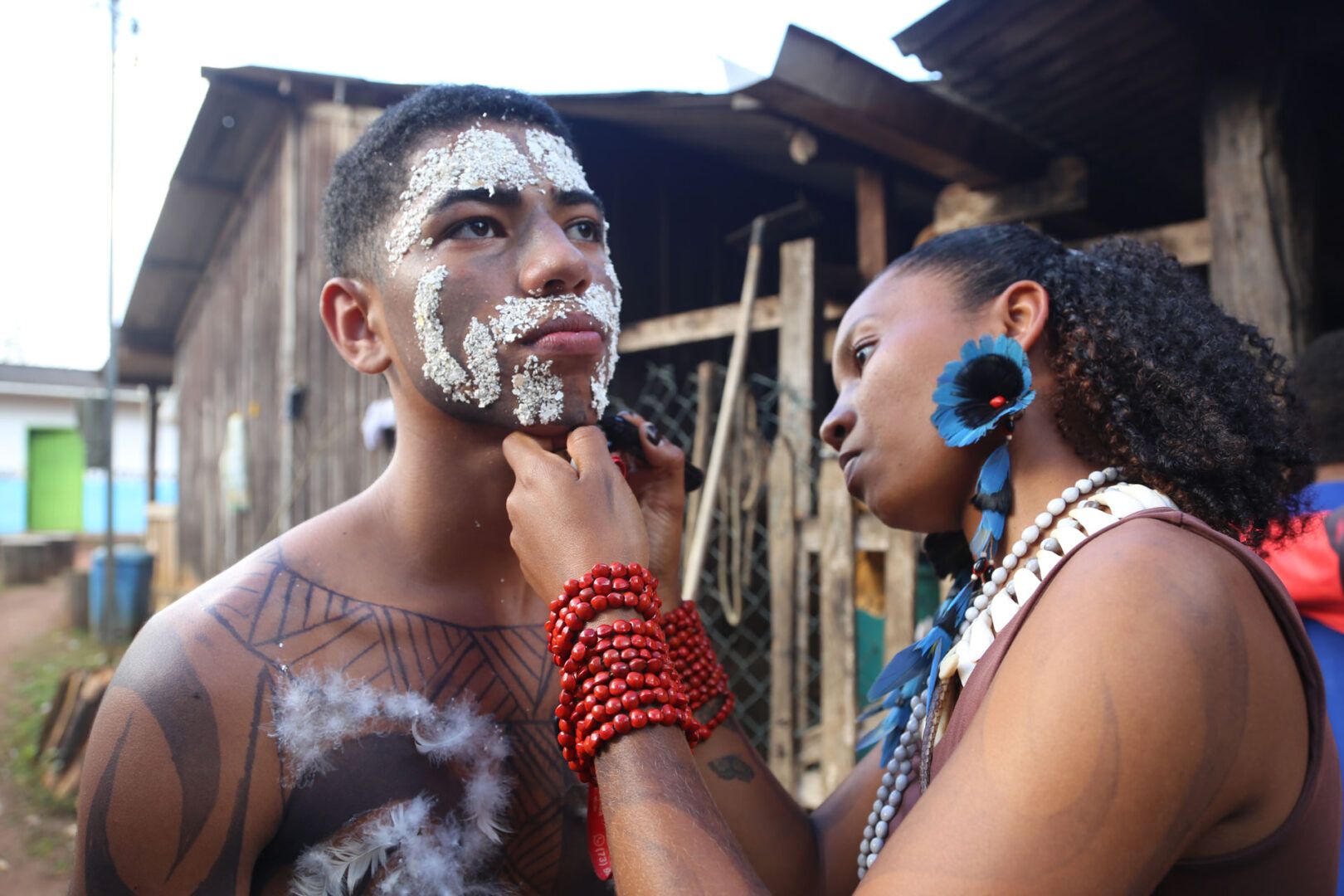
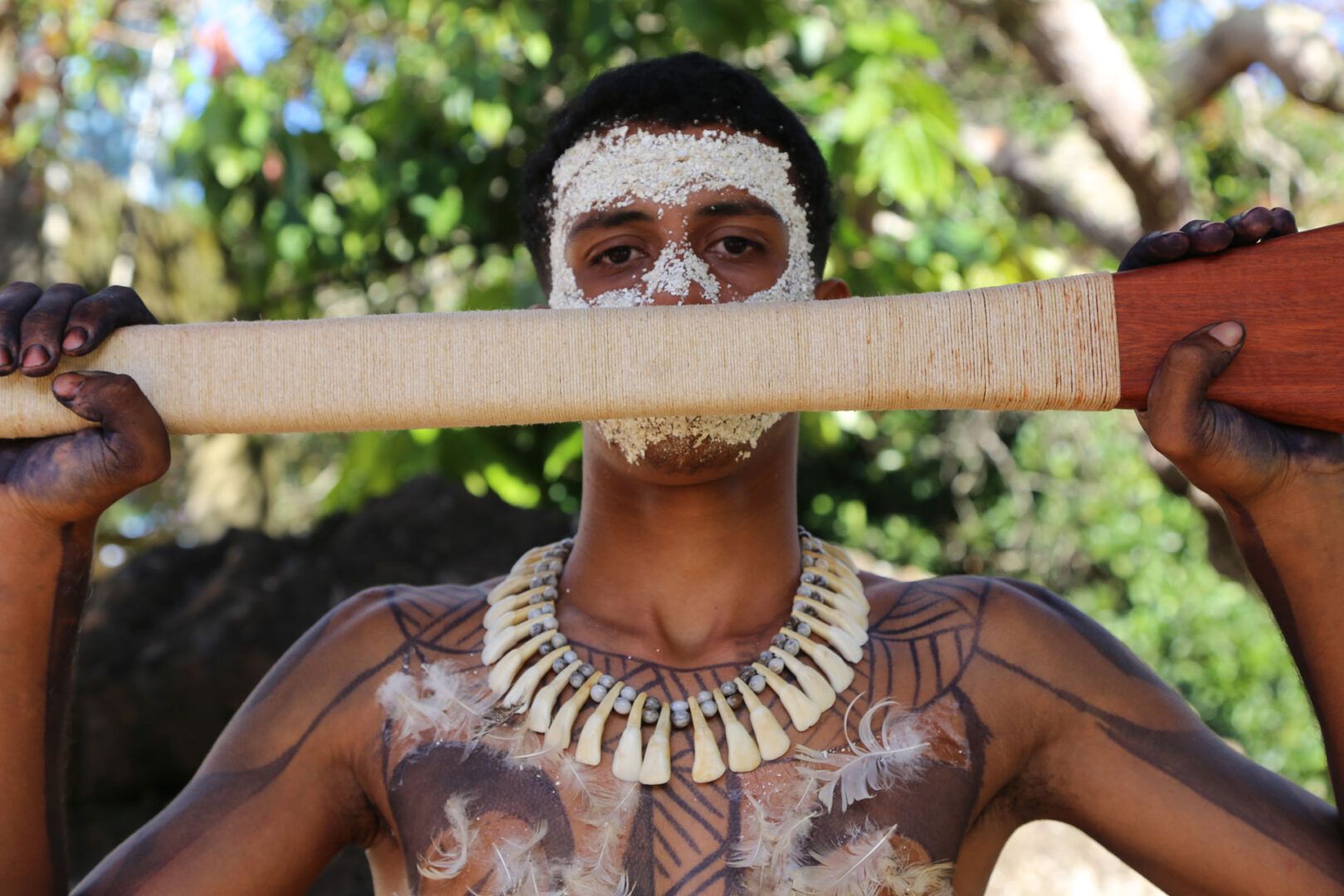
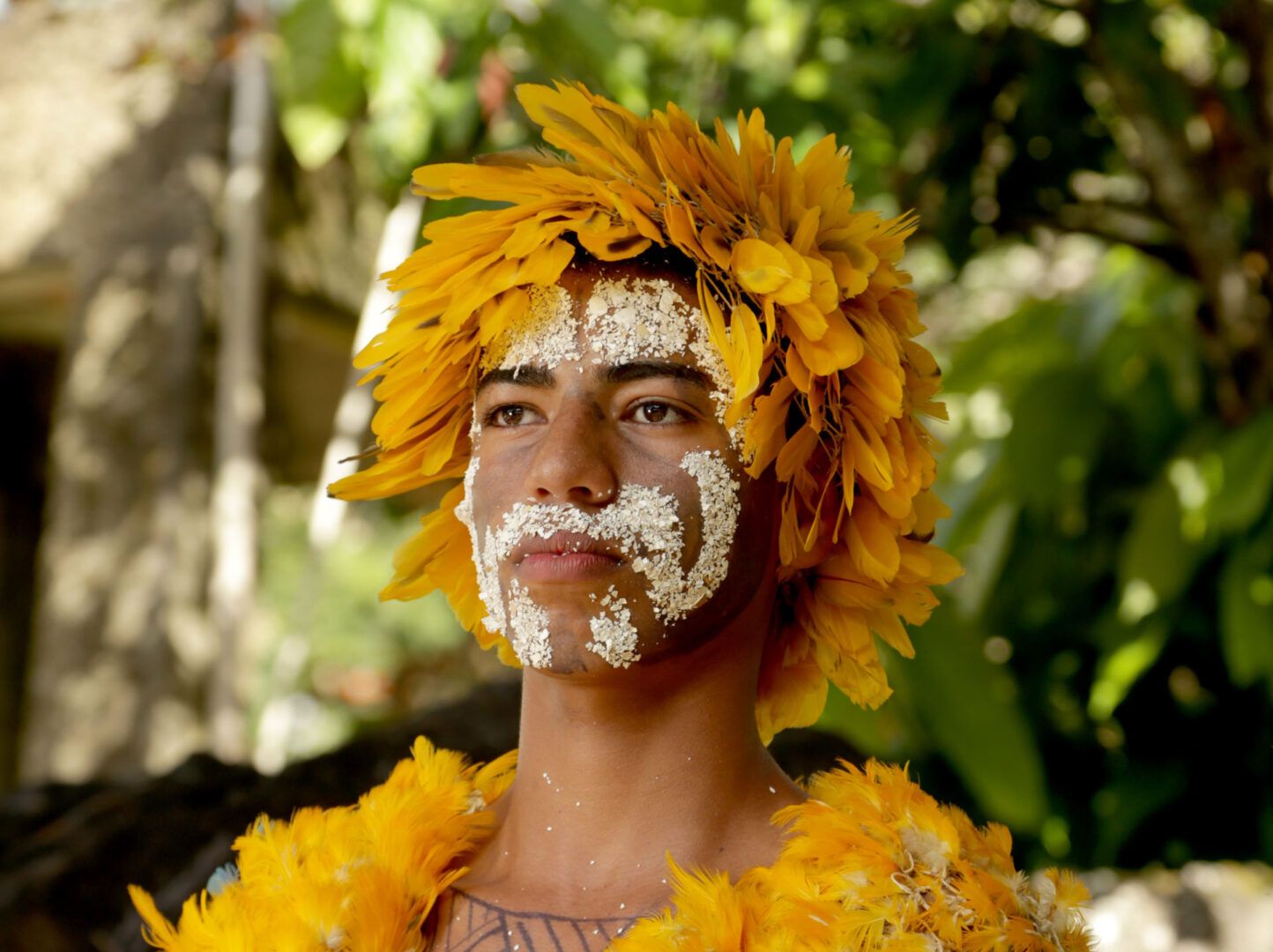
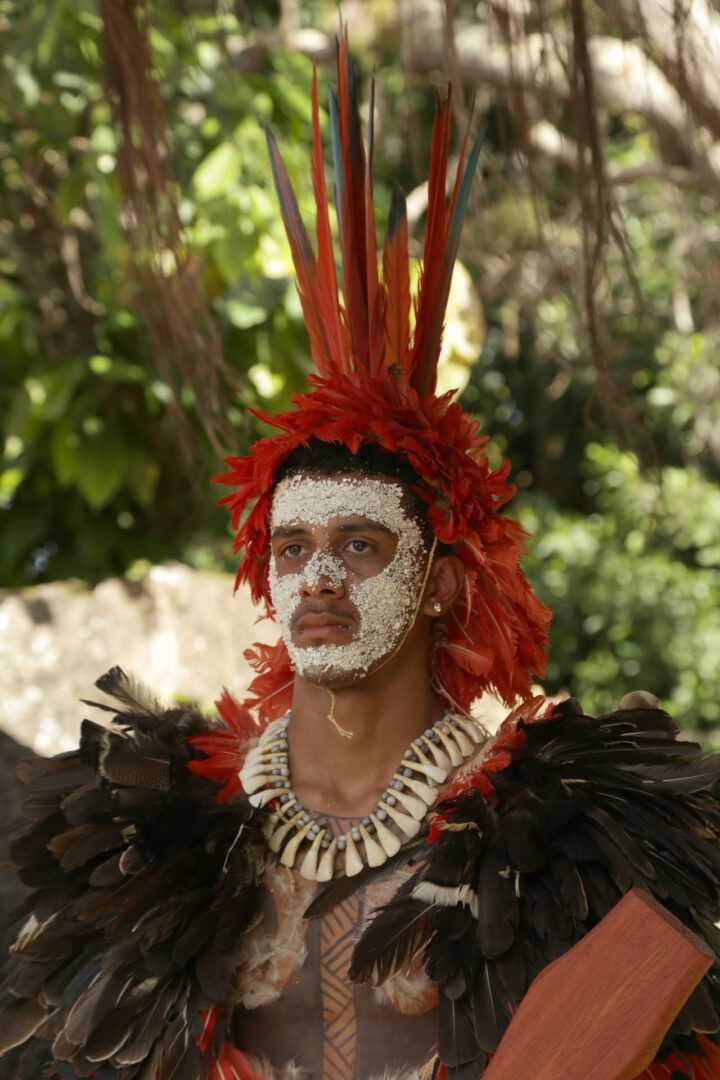
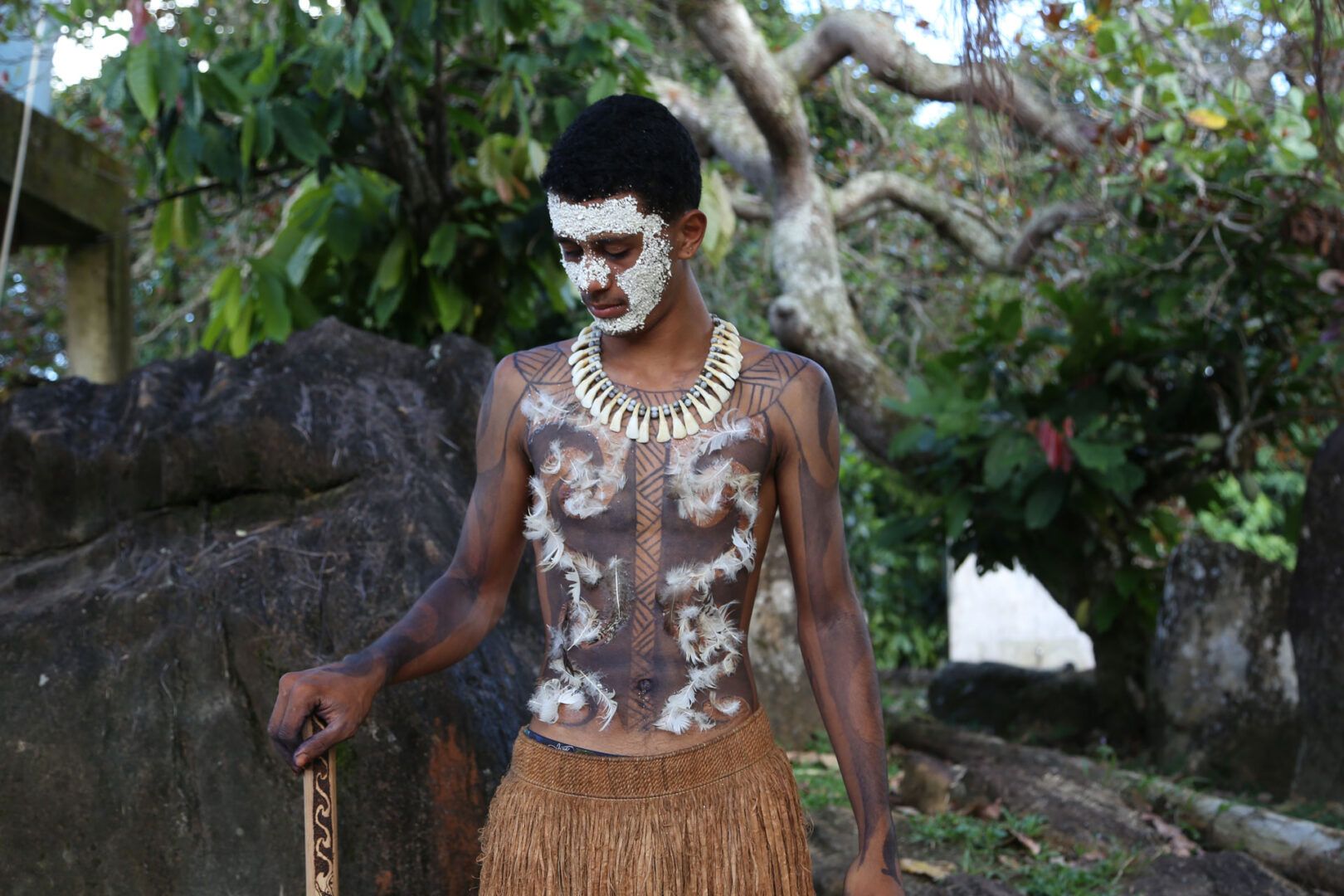
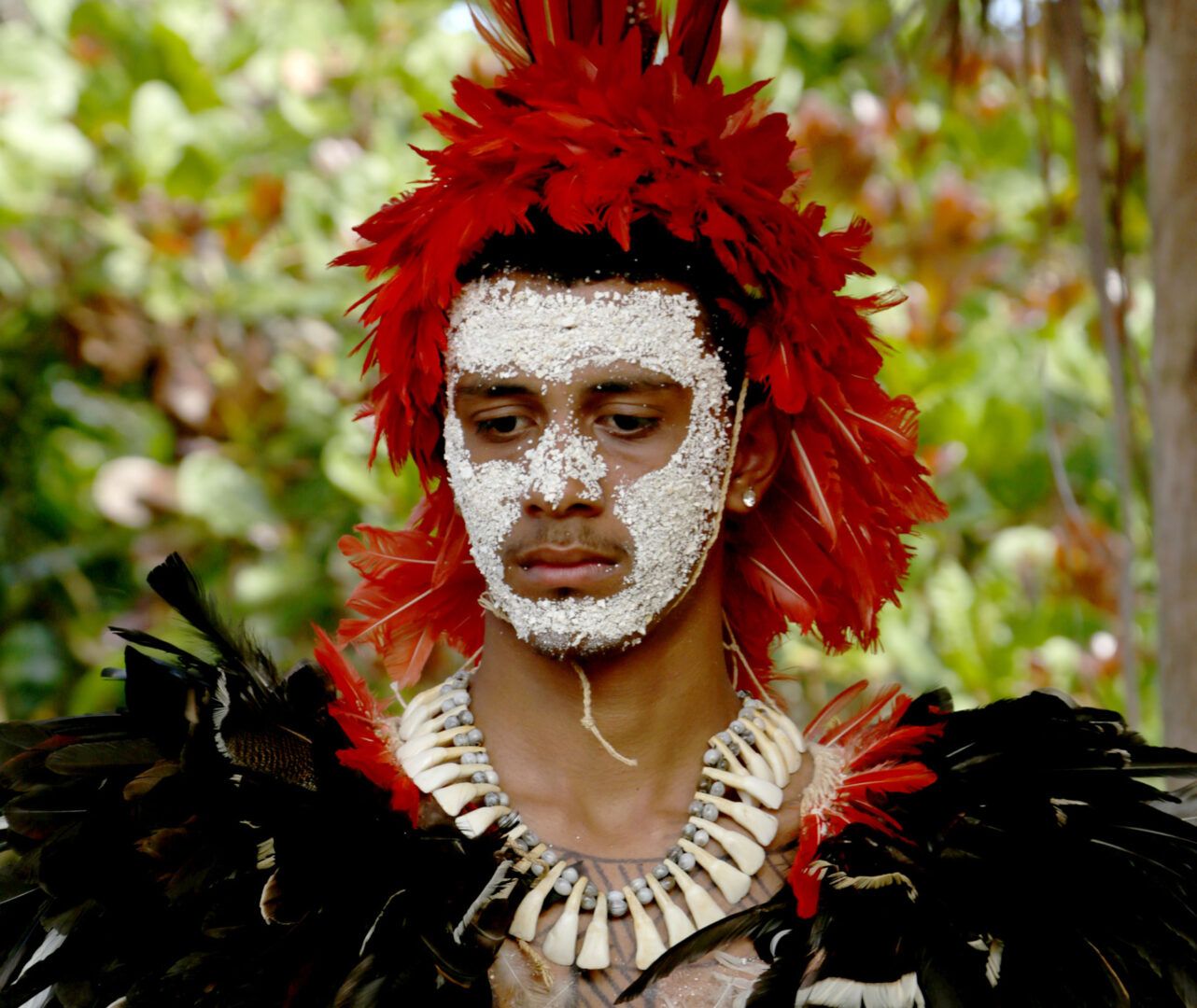
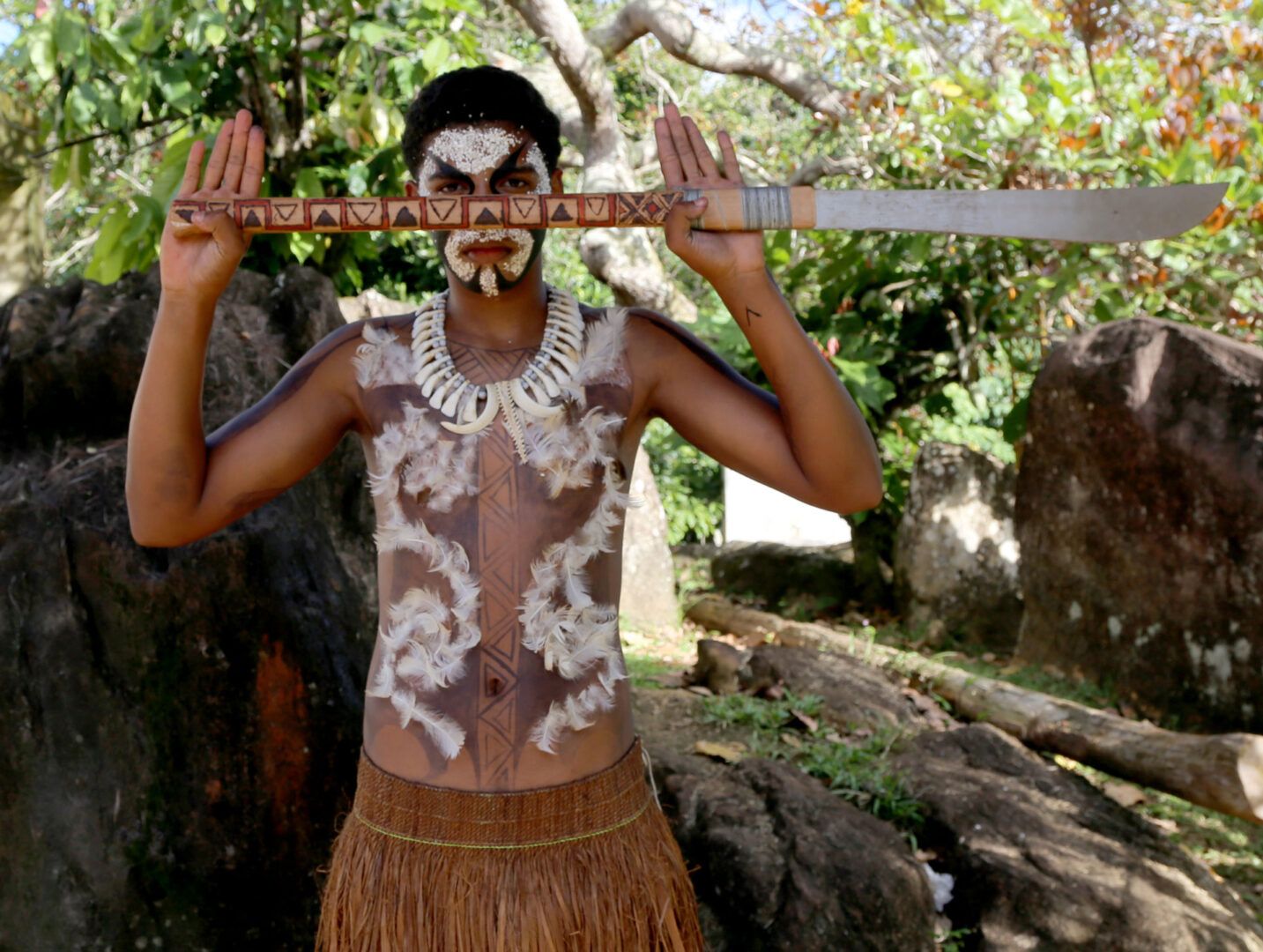
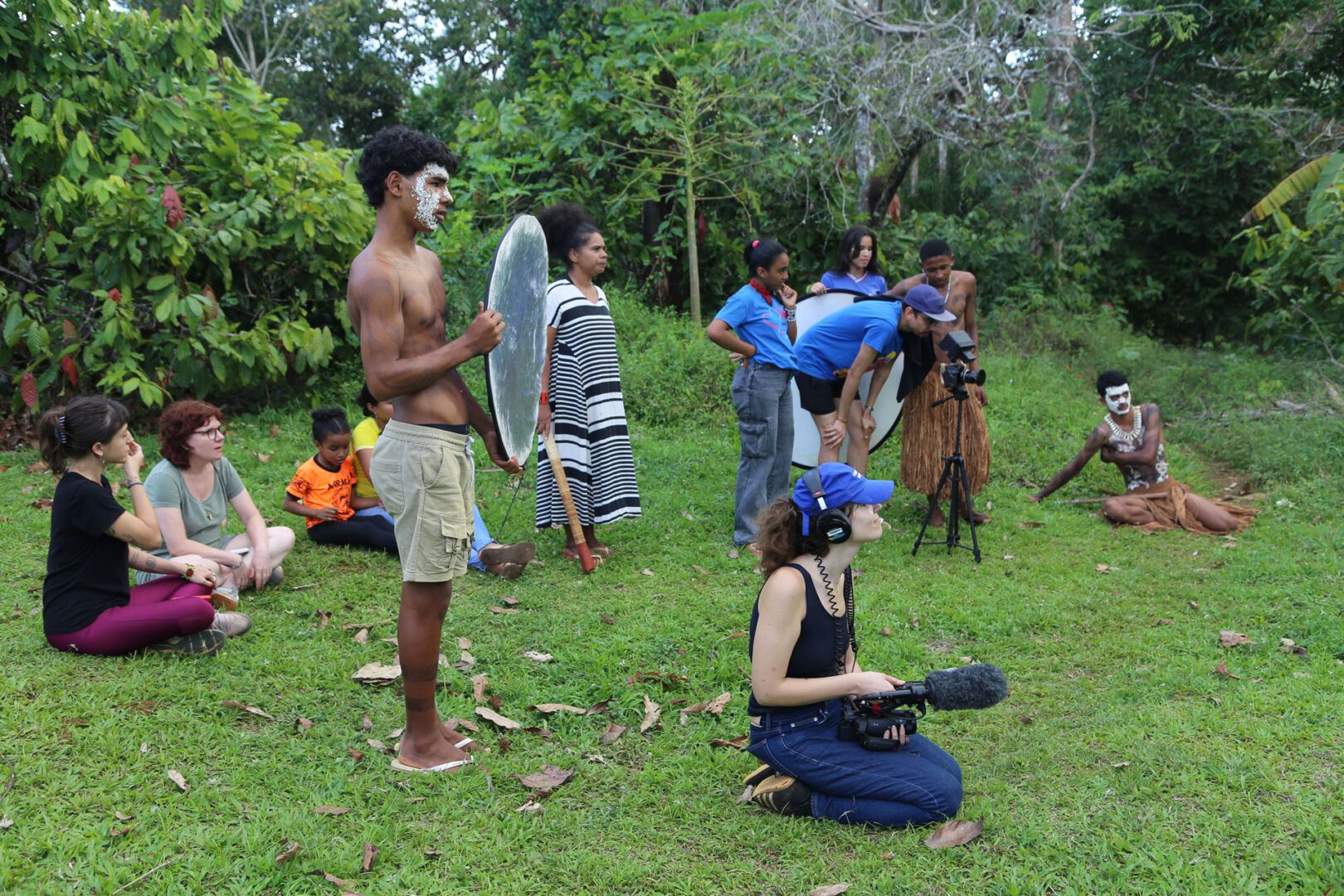
The objective of Glicéria’s research with Tupinambá objects is neither the reconstruction of a vanished culture nor the reproduction of a museum object as an immutable model. It is to awaken the objects and to bring home the technologies they carry, reconnecting them with technologies and relations that remain active in the territory.
The verb “to awaken” is conceptually exact. It refuses the assumption that an object’s entry into a museum marks the survival of matter after the death of culture.
The objects are not mute remnants to which scholarship alone can restore meaning. They hold technical possibilities, histories, and relations that institutional classification has frequently obscured. Their apparent silence is partly an effect of the conditions in which museums have stored, described, and interpreted them.
Awakening is consequently relational. It occurs when questions generated from the territory reorganize the study of objects. Technical imaging, material analysis, iconographic research, and archival documents become useful through the questions Glicéria formulates as an artist and Tupinambá researcher: how were these objects made; which woods, fibers, adhesives, pigments, or feathers were involved; who possessed the relevant knowledge; what do colonial representations reveal and conceal; and how can the technologies encountered in museum objects be tested, taught, and transformed in collective practice?
This method changes the direction of research. Scientific and art-historical expertise does not culminate in a fuller institutional description of an isolated artifact. It participates in a return of technical knowledge to the territory. The museum object becomes one component within a larger field that includes existing practices, environmental knowledge, oral histories, artistic experimentation, political struggle, and the education of younger generations.
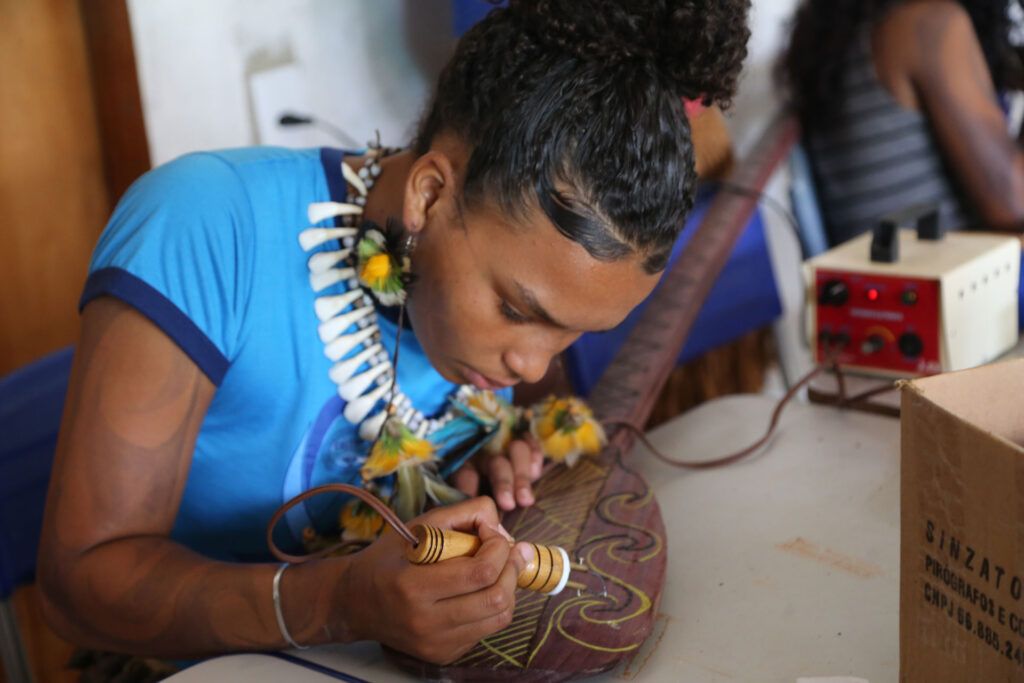
Glicéria’s work with young people is especially important. In workshops, participants learn with elders about woods and clubs, make new objects, and study decorative procedures in relation to colonial descriptions and images. This work neither treats the archive as transparent evidence nor rejects it as irredeemably colonial. It reads the archive from Tupinambá questions and tests its propositions through embodied practice. The result is a form of historical inquiry in which making can expose the limits of written and visual sources.
Glicéria’s research has also circulated through contemporary art as an expanding field of experimentation. In addition to also participating, like Irineu, in Antagonistas: Resistências Algorítmicas with an installation based on the project Ibirapema: Cosmotechnics of the Tupinambá Clubs, the research on the clubs generated a collaboration with the Jardim Miriam Arte Clube (JAMAC). Forms and graphic elements identified through the study of historical clubs were transformed into patterns, stencils, and screen-printed fabrics. These patterns appeared in works developed for the exhibition Assojaba Tupinambá Umbeumbesàwa: O manto Tupinambá conta e canta a história [The Tupinambá Mantle Tells and Sings the Story], at Sesc São José do Rio Preto in 2025. The stencils were also used to print T-shirts for young people in Serra do Padeiro, while one of the fabrics was made into a dress in collaboration with JAMAC, which Glicéria wore in Cannes when the documentary Eu Ouvi o Chamado: O Retorno dos Mantos Tupinambá received a Cannes Docs award in 2025.
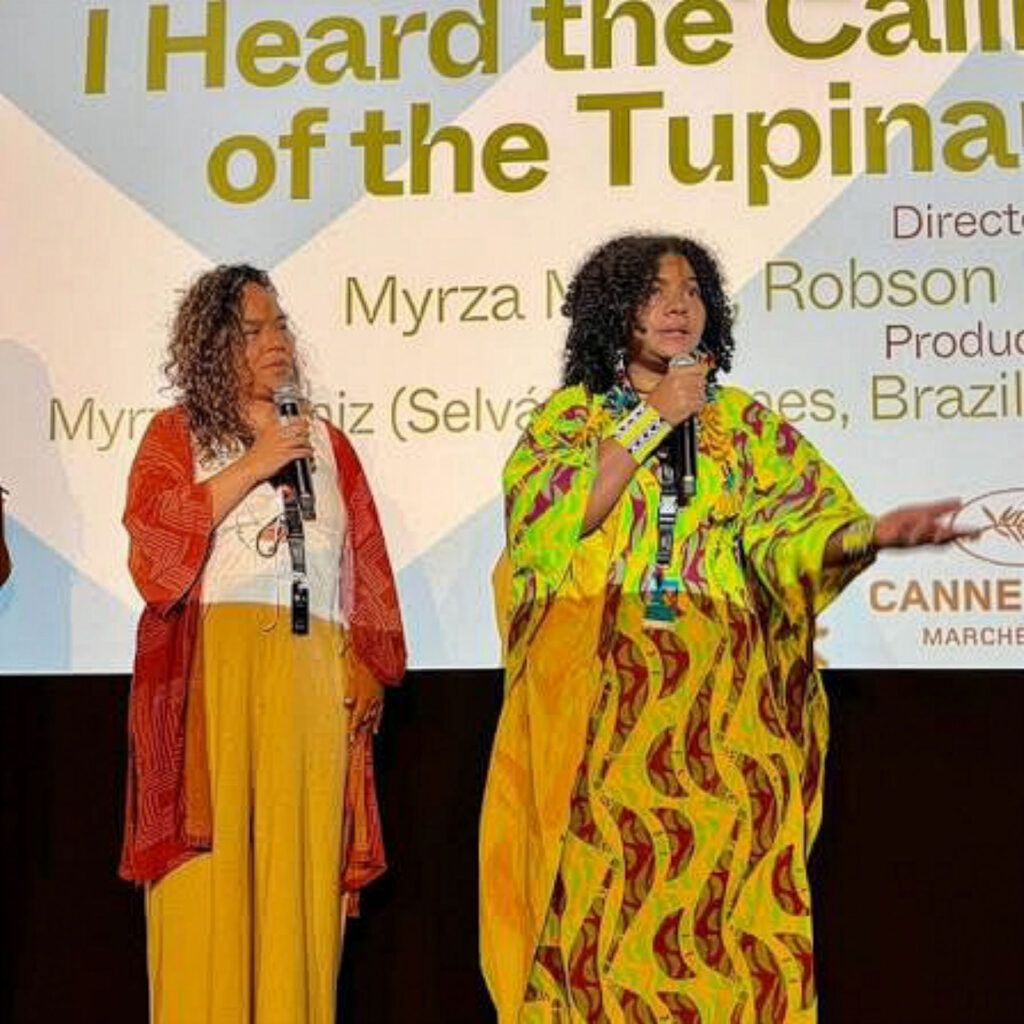
This visual repertoire will probably continue to stimulate new creations among young people in Serra do Padeiro. The research is thus not completed when an object is examined, a workshop ends, or an exhibition opens. It proliferates across materials, bodies, images, and generations.
For Glicéria, this circulation also exposes a revealing institutional asymmetry. Contemporary art has enabled her to enter museums, access collections, and formulate research directly through objects in ways that academic credentials alone have not. Although she holds a master’s degree and is currently a doctoral candidate in Social Anthropology at the Museu Nacional of the Federal University of Rio de Janeiro, she observes that no ethnographic museum has invited her to study its collections in that capacity or simply because she is Tupinambá. The doors opened when she was recognized as a contemporary artist.
Glicéria’s experience should not be taken as evidence of the art world’s exceptional openness. Rather, it reveals the unequal regimes through which institutions authorize Indigenous people to enter, examine, and reinterpret the material heritage of their own peoples.
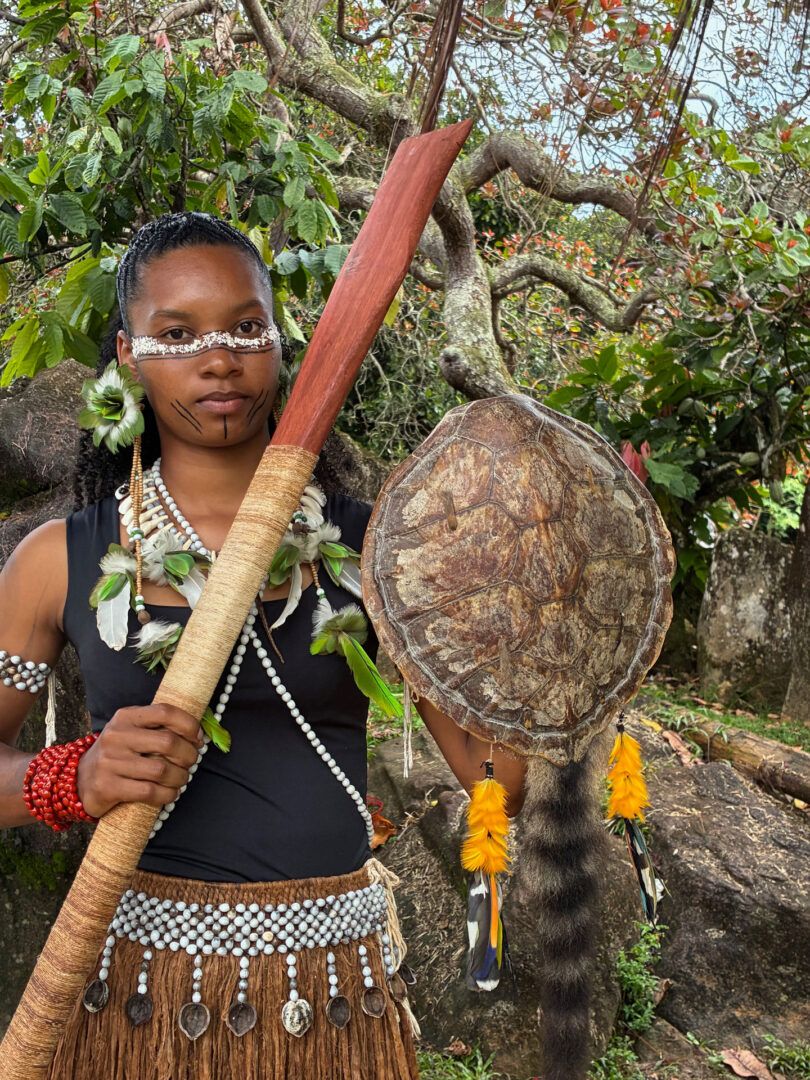
The proliferation of these forms across clubs, stencils, fabrics, clothing, installations, and community workshops brings the earlier colonial anxiety surrounding transformed feathers into renewed focus. Where Gândavo interpreted the alteration of feather colors through tapirage as potential counterfeiting, Glicéria’s practice makes transformation legible as technical knowledge, artistic experimentation, and historical agency. Each new material translation carries inherited technologies into different relations and circumstances rather than reproducing an immutable model. The creation of new forms therefore does not distance contemporary Tupinambá production from an allegedly authentic past. It enacts the continuity of an intellectual and technical sovereignty exercised through transformation under changed historical conditions. This exercise of intellectual and technical sovereignty places corresponding responsibilities on scholars and museums. Contemporary Tupinambá practices should not be required to authenticate themselves through resemblance to objects preserved in institutional collections. Instead, museums and researchers must make collections, documentation, technical resources, and research infrastructures available to processes guided by Tupinambá questions and priorities. Their responsibility is not to control the meanings or outcomes of reactivation, but to support the circulation of knowledge while recognizing that awakened objects may enter relationships, generate new forms, and produce effects that exceed both institutional categories and scholarly authority.
From the Diagnosis of Decay to the Politics of Transmission
These three projects allow us to identify the limits of loss as an organizing concept. In much heritage discourse, loss appears to describe a natural trajectory: matter deteriorates, practices disappear, and institutions intervene to delay the inevitable. Applied to Indigenous heritage, this narrative readily converges with allochronism and paternalism.
Cultures already imagined as survivors from the past are expected to vanish in the present, leaving the museum as the natural destination of their remaining objects.
The scholar, meanwhile, conveniently emerges as the custodian of knowledge, and the specialist as the benevolent figure summoned to help Indigenous communities recover what they have supposedly lost; as though the knowledge had vanished from the territory only to reappear, miraculously, in the museum catalogue, or the expert’s notes.
Francy Baniwa, Irineu Terena, and Glicéria Tupinambá make another temporal and institutional arrangement visible. Francy begins with knowledge living in communities and asks museums to become responsible students and custodians, not “decay stoppers”. Irineu approaches what is perceived as decay as knowledge capable of dormancy and reactivation through artistic and collective practice. Glicéria awakens objects considered in decay so that the technologies they carry may return to the territory and connect with technologies still present there. None of these positions denies colonial violence, interrupted transmission, or material vulnerability. Each specifies where continuity resides and who has the authority to recognize it.
Their work also prevents a romantic celebration of transformation. Change takes place within unequal histories. Some transformations are desired, some imposed; some extend knowledge, some result from dispossession; many contain both constraint and invention. An emphasis on transmission does not dissolve these distinctions. It makes them available for historical analysis because it asks how knowledge moved, where it was blocked, who maintained it, what it became, and what conditions now enable it to act.
Preservation can therefore be reformulated as support for transmission. This includes material conservation, especially when objects remain in institutions far from the communities that made and cared for them. They also embrace forms of preservation that conventional conservation protocols have long excluded, or even classified as threats to objects, such as touching, playing, handling, and “activating” them. Indigenous interventions may also disrupt established cataloguing systems and reorganize collections according to more appropriate Indigenous categories and relational logics. Yet the most consequential transformation concerns the direction of care: from things to people, and from isolated objects to the relationships that sustain their lives and meanings. This marks a shift from preserving to caring, grounded in the recognition that maintaining heritage means caring for the relations through which it continues to exist. It also includes access, language, research funding, community-led documentation, technical exchange, intergenerational learning, appropriate restrictions, and the redistribution of curatorial authority. The value of conservation is measured by the relations it sustains, not solely by the duration it adds to materials.
This reformulation changes the place of museums. A museum need not present itself as the institution that guarantees the survival of Indigenous culture. It can acknowledge that the knowledge required to understand its collections lives elsewhere and that institutional practice must be reorganized accordingly. Such acknowledgment is not an abdication of responsibility. It is the beginning of a more exacting responsibility: to care for belongings without claiming ownership over the worlds that give them meaning; to receive instruction from Indigenous experts; to return knowledge and resources to territories; and to allow community priorities to alter research, conservation, documentation, and display.
Contemporary art can contribute to this process by creating spaces in which research, making, activation, and transmission overlap. Yet its role remains ambivalent. Exhibitions may also aestheticize restitution, translate collective knowledge into individual authorship, or offer temporary visibility without altering institutional authority. The significance of these projects therefore cannot be measured simply by the objects conserved, remade, or exhibited, but by the conditions they establish: who gains access, who defines the questions, where knowledge and resources circulate, which relations are renewed. Whether the museum or artworld itself become permanently transformed is not the decisive measure; and, ultimately, their limited capacity for change is their own problem. The relevant question is whether the community could carry out the work it considered necessary. The effects must therefore be evaluated in the territory: whether people were able to meet, make, teach, remember, reactivate knowledge, create new forms, and strengthen relations on their own terms. A politics of transmission begins with this displacement of purpose and authority: institutions or cultural environments are not the destination of heritage work but, at most, one of the resources that communities can mobilize in sustaining and transforming their own worlds.
Conclusion: The Right to History
The opposition between the authentic and the false has long functioned as a temporal discipline imposed on Indigenous production. It makes repetition the condition of recognition and historical change the evidence of cultural loss. The sixteenth-century suspicion directed toward transformed feathers and the contemporary demand that Indigenous art resemble an imagined precolonial form belong to the same broad structure. Both deny Indigenous people the right to be recognized as coeval subjects who inherit, invent, select, contest, and transform.
The rhetoric of loss should therefore be treated as an object of critique, not as heritage theory’s neutral starting point. Its persistence can conceal living knowledge, naturalize institutional authority, and turn collections into monuments to a disappearance that Indigenous people themselves refuse. Moving away from this rhetoric does not require forgetting what colonialism destroyed. It requires describing destruction without allowing it to monopolize Indigenous time.
Transmission offers a more productive framework because it joins continuity to transformation. Francy Baniwa shows that knowledge alive in communities must guide institutions that retain Indigenous belongings. Irineu Terena shows that knowledge can become dormant and can acquire renewed efficacy through artistic practice and collective learning. Glicéria Tupinambá shows that objects confined in collections can be awakened and that the technologies they carry can return to the territory, where they meet knowledge, materials, and political projects already present.
These practices do more than broaden the field’s definition of preservation. They relocate authority over what continuity means. They insist that Indigenous people have a right to history: a right to change without being declared inauthentic, to reactivate knowledge without being treated as reconstructing a dead past, and to transform inherited technologies without having their transformations named “decay”. The decisive question is consequently not whether institutions can preserve Indigenous cultures against time. It is whether institutions, not only museums, but the academy itself, can learn to inhabit historical time with Indigenous communities—and whether they can accept the obligations that follow from holding and thinking about things whose knowledge, life, and future do not belong to them.
Alarcon, Daniela Fernandes. O retorno da terra: as retomadas na aldeia Tupinambá da Serra do Padeiro, sul da Bahia. Master’s thesis, Programa de Pós-Graduação em Ciências Sociais—Estudos Comparados sobre as Américas, Universidade de Brasília, 2013.
Baniwa, Francy Fontes, and Francisco Luiz Fontes Baniwa. Umbigo do mundo: mitologia, ritual e memória Baniwa Waliperedakeenai. Pinturas de Frank Fontes Baniwa. Rio de Janeiro: Dantes Editora, 2023.
Baniwa, Francy. “Presentation.” Paper presented at Beyond Restitution: Indigenous Practices, Museums, and Heritage, Leuphana Institute for Advanced Studies in Culture and Society, Leuphana University Lüneburg, Lüneburg, February 7, 2025. Moderated by Fernanda Pitta. Video recording, YouTube.
Buono, Amy J. “Tupi Featherwork and the Dynamics of Intercultural Exchange in Early Modern Brazil.” In Crossing Cultures: Conflict, Migration, Convergence: The Proceedings of the 32nd International Congress in the History of Art, edited by Jaynie Anderson, 349–355. Melbourne: Melbourne University Press, 2009.
Costa Oliveira, Thiago da, and Andrea Scholz. “Curating and Creating Relations between Lived Worlds: A Practice-Oriented Methodology for Museum Engagements with Indigenous Communities from Amazonia.” In Collections as Relations: Contestations of Belonging, Cultural Heritage, and Knowledge Infrastructures, edited by Hansjörg Dilger, Barbara Göbel, Lars-Christian Koch, Stephanie Schütze, and Alexis Th. von Poser, 50–75. London: Routledge, 2024.
DeSilvey, Caitlin. Curated Decay: Heritage Beyond Saving. Minneapolis: University of Minnesota Press, 2017.
Fabian, Johannes. Time and the Other: How Anthropology Makes Its Object. New York: Columbia University Press, 1983.
Koch-Grünberg, Theodor. Dois anos entre os indígenas: viagens no noroeste do Brasil (1903–1905). Tradução de Casimiro Beksta. Manaus: Editora da Universidade Federal do Amazonas (EDUA); Faculdade Salesiana Dom Bosco (FSDB), 2005.
PITTA, Fernanda; SILVA, Glicéria de Jesus (Glicéria Tupinambá); FRANÇOZO, Mariana; VALENTE, Renata; THIERION, Brigitte; DE ROBERT, Pascale. Ibirapema cosmotechnics. In: FLYNN, Alex Ungprateeb; CLAVO, María Iñigo; LEMOS, Beatriz; PORTOCARRERO, Florencia (org.). Unmaking to Make: art as decolonising practice in Latin America’s future, past and present. London: UCL Press, 2026. p. 391–424. DOI: doi
Scholz, Andrea. “Sharing Knowledge as a Step toward an Epistemological Pluralization of the Museum.” Museum Worlds: Advances in Research 5, no. 1 (2017): 133–148.
Sebastião, Irineu. Mito de origem do povo Terena: história ilustrada da cultura Terena. Bauru: Canal 6, 2016.
Sebastião, Irineu (Irineu Nje’a Terena). “Relatório viagem ao Mato Grosso do Sul: cerâmica conexão viva.” Unpublished field report, March 2024.
Sebastião, Irineu (Irineu Nje’a Terena). “Oficina de cerâmica ancestral — Aldeia Kopenoti.” Unpublished field report, January 2026.
Terena, Irineu Nje’a. “O despertar da cerâmica: memória, arte e espiritualidade.” Interview by Célia Barros and Gabriela Leirias. Revista Latente, December 12, 2024. Updated December 13, 2024. revista.
Tupinambá, Glicéria. O feitiço do fio: a busca pelo Manto Tupinambá. Rio de Janeiro: Zahar, 2026.
| 1. | ↑ | Allochronism is a concept from anthropology and cultural studies—coined by Johannes Fabian—in his book Time and The Other How Anthropology Makes Its Object that describes the practice of placing the people or culture being studied in a different, usually backward time than the observer. It denies that the observer and the observed share the same living present. Watch here. |
| 2. | ↑ | Previous projects connected the peoples of the Upper Rio Negro with their belongings in German collections. See Scholz, 2017, and Oliveira and Scholz, 2024. |
| 3. | ↑ | acervo › acervo › Detail › exhibitions |
| 4. | ↑ | A caboclo (or caboco) is a term used in Brazil to describe people of mixed Indigenous Brazilian and European ancestry, or traditional rural inhabitants of the Amazon region. The word originates from the Tupi language, likely meaning “one who comes from the forest. |
| 5. | ↑ | Retomada—literally “taking back” or “recovery”—is the term used by Indigenous peoples in Brazil for collective actions through which they reoccupy parts of their traditional territories held by non-Indigenous landowners or other occupants. A retomada is simultaneously a territorial action and a process of rebuilding community life: families return, cultivate gardens, construct houses and schools, restore relations with the land, and strengthen political organization. Among the Tupinambá of Serra do Padeiro, retomadas have been central to recovering areas affected by a long history of dispossession and to pressing the Brazilian state to complete the legal recognition of the Tupinambá de Olivença Indigenous Territory (Alarcon 2013). |
| 6. | ↑ | The film Bordunas, shows aspects of the 2024 workshop. |