• Issue #01
  • Issue #02
  • Issue #03
  • Issue #04
  • Issue #05
  • Issue #06
  • Issue #07
  • Issue #08
  • Issue #09
  • Issue #10
  • Issue #11
  • Issue #12
12
Contents
editorial
LUCAS LEDWABA
Festival in forgotten community seeks to amplify rural voices through art
RATO MID FREQUENCY
Social Death Beyond Blackness
HUGO KA CANHAM
Exchanging black excellence for failure
LOUIS CHUDE-SOKEI WITH IR INDIGENOUS RESISTANCE
Sharp as a Blade: Decolonizing Decolonization
Theme Timbila Library
MALAIKA WA AZANIA
The Timbila Library - 120 books to read by age 28
MING DI
“Through Multiculturalism We Become Better Humans”: A Conversation with Vonani Bila
MZWANDILE MATIWANA
The surviving poet
NOSIPHO KOTA
Seven Poems
MPHUTLANE WA BOFELO
Language is Land
MXOLISI NYEZWA
Seven Notes To A Black friend, The Dance of the Ancestors and Two Other Songs That Happened
VONANI BILA
Ancestral Wealth
PHILLIPPA YAA DE VILLIERS
Voices of the Land: Poets of Connection
MASERAME JUNE MADINGWANE
Three Poems
SANDILE NGIDI
Three Poems
VONANI BILA
Probing ‘Place’ as a Catalyst for Poetry
DAVID WA MAAHLAMELA
Four Poems
MAKHOSAZANA XABA
Poems from These Hands
TINYIKO MALULEKE
An Ode to Xilamulelamhangu: English-Xitsonga Dictionary
KGAFELA OA MAGOGODI
Five Outspoken Poems
MZI MAHOLA
Three Poems
VUYISILE MSILA
People’s English in the Poetry of Mzi Mahola and Vonani Bila
VONANI BILA
The Pig and four other poems
MPUMI CILIBE
American Toilet Graffiti: JFK Airport 1995
KELWYN SOLE
Craft Wars and ’74 – did it happen? (unpublished paper)
MAROPODI HLABIRWA MAPALAKANYE
Troublemaker’s Prison Letter
AYANDA BILLIE
Four Poems
VONANI BILA
Moses, we shall sing your Redemption Song
MM MARHANELE
Three Poems
VUYISILE MSILA
Four Poems
RAPHAEL D’ABDON
Resistance Poetry in Post-apartheid South Africa: An Analysis of the Poetic Works and Cultural Activism of Vonani Bila
THEMBA KA MATHE
Three Poems
ROBERT BEROLD
Five Poems
VONANI BILA
The Magician
galleri
KHEHLA CHEPAPE MAKGATO
TŠHIPA E TAGA MOHLABENG WA GAYO
THAIO ABRAHAM LEKHANYA
Mary Sibande: Reimagining the Figure of the Domestic Worker
TSHEPO SIZWE PHOKOJOE
The Gods Must Be Crazy
DATHINI MZAYIYA
Early Works
KEMANG WA LEHULERE & LEFIFI TLADI
In Correspondence
TENDAI RINOS MWANAKA
Mwanaka Media: all sorts of haunts, hallucinations and motivations
ROFHIWA MUDAU
Colour Bars
OBINNA OBIOMA
Anyi N’Aga (We Are Going )
THULILE GAMEDZE
No end, no fairytale: On the farce of a revolutionary ‘hey day’ in contemporary South African art
SAM MATHE
On Comic Books
VONANI BILA
Caversham Centre: A Catalyst for Creative Writing and Engagement with Writers and Artists
KEITH ADAMS
Vakalisa Arts Associates, 1982–1992: Reflections
borborygmus
LYNTHIA JULIUS
Om ’n wildeperd te tem
EUGENE SKEEF
THEN AND NOW
BONGANI MADONDO
Out of Africa: Hip Hop’s half-a-century impact on modernity - a memoir of sound and youth, from the culture’s African sources, Caribbean “techno-bush” to its disco-infernal flourish.
KOPANO RATELE
You May Have Heard of the Black Spirit: Or Why Voice Matters
KWANELE SOSIBO
Innervisions: The Politricks of Dub
NDUDUZO MAKHATHINI
uNomkhubulwane and songs
RICHARD PITHOUSE
The radical preservation of Matsuli Music
CARSTEN RASCH
Searching for the Branyo
BONGANI TAU
Ukuqophisa umlandu: Using fashion to re-locate Black Psyche in a Township
VONANI BILA
Dahl Street, Pietersburg
FORTUNATE JWARA
Thinking Eroticism and the Practice of Writing: An Interview with Stacy Hardy
NOMPUMELELO MOTLAFI
The Fucking
frictions
IGNATIA MADALANE
Not on the List
SITHEMBELE ISAAC XHEGWANA
IMAGINED: (excerpt)
SHANICE NDLOVU
When I Think Of My Death
MPHUTLANE WA BOFELO
Biko, Jazz and Liberation Psychology
FORTUNATE JWARA
Three Delusions
ALEXANDRA KALLOS
A Kite That Bears My Name
NIEVILLE DUBE
Three Joburg Stories
M. AYODELE HEATH
Three Poems
ZAMOKUHLE MADINANA
Three Poems
VERNIE FEBRUARY
Of snakes and mice — iinyoka neempuku
KNEO MOKGOPA
Woundedness
VONANI BILA
The day I killed the mamba
JESÚS SEPÚLVEDA
Love Song for Renée Nicole Good
ALLAN KOLSKI HORWITZ
Three New Poems
claque
MAKHOSAZANA XABA
“Unmapped roads in us”: A Review of Siphokazi Jonas's Weeping Becomes a River
LINDA NDLOVU
Uhuru Portia Phalafala’s Mine Mine Mine
VONANI BILA
Kwanobuhle Overcast: Ayanda Billie's poetry of social obliteration and intimacy
WAMUWI MBAO
We Who Are Not Dead Yet: A Necessary Shudder
ENOCK SHISHENGE
Sam Mathe’s When You Are Gone
SIHLE NTULI
Channels of Discovery
MAKGATLA THEPA-LEPHALE
Lefatshe ke la Badimo by Sabata-mpho Mokae
PHILANI A. NYONI
The Mad
SEAN JACOBS
Mr. Entertainment
NELSON RATAU
On Culture and Liberation Struggle in South Africa — From Colonialism to Post-Apartheid, Lebogang Lance Nawa [Editor]
DIMAKATSO SEDITE
Morafe
MENZI MASEKO
Acknowledging Spiritual Power Beyond Belief - A Review of Restoring Africa’s Spiritual Identity by African Hidden Voices (AHV)
DOMINIC DAULA
Kassandra by Duo Nystrøm / Venter: Artistry inspired by Janus
RIAAN OPPELT
Get Jits or Die Tryin’
MZOXOLO VIMBA
The weight of the sack: Hessian, history and new meaning in Tshepo Sizwe Phokojoe’s “The Gods Must be Crazy” exhibition.
RICK DE VILLIERS
Review: Ons wag vir Godot – translated by Naòmi Morgan
GOODENOUGH MASHEGO
We Who Are Not Dead Yet by Aryan Kaganof
MAKGATLA THEPA-LEPHALE
SACRED HILLS, A Novel by Lucas Ledwaba
ekaya
MALIKA NDLOVU
Beloved sister Diana
VONANI BILA
The Timbila Poetry Project
MARK WALLER
It’s time to make arts and culture serve the people
LUCAS LEDWABA
'I have nothing left' – flood victims count the costs
KOPANO RATELE & THE NHU SPACE POSSE
On The ‘NHU’ Space
LWAZI LUSHABA
A Video Call with Kopano Ratele on Politics and the Black Psyche, 22 July 2024
CHARLA SMITH & KOPANO RATELE
“Men cannot love if they are not taught the art of loving”: Blueprints for caring boys and men
LAING DE VILLIERS
A visit to the Mighty Men’s Conference and Uncle Angus: A perspective on masculinity
THOMAS HYLLAND ERIKSEN & RIAAN OPPELT
Post-apartheid diversification through Afrikaaps: language, power and superdiversity in the Western Cape
MARTIN JANSEN
Where is the Better Lyf You Promised Us?
THADDEUS METZ
Academic Publishing is a Criminal Operation
off the record
MIRIAM MAKEBA
Sonke Mdluli
ALON SKUY
Marikana 2012/2022
ZAKES MDA
Biko's Children (12 September 2001)
VONANI BILA
Ku Hluvukile eka ‘Zete’: Recovering history and heritage through the influence of Xitsonga disco maestro, Obed Ngobeni
IAN OSRIN
Recording Obed Ngobeni with Peter Moticoe
MATSULI MUSIC
The Back Covers
THEODORE LOUW
Reminiscing
GAVIN STEINGO
Historicizing Kwaito
LEHLOHONOLO PHAFOLI
The Evolution of Sotho Accordion Music in Lesotho: 1980-2005
DOUGIE OAKES
On Arthur Nortje, The Poet Who Wouldn’t Look Away
PULE LECHESA
Sophonia Machabe Mofokeng: Distinguished Essayist and Dramatist in the pantheon of Sesotho Literature
NOKUTHULA MAZIBUKO
Spring Offensive
feedback
OSCAR HEMER
16 October 2025
PALESA MOKWENA
9 October 2024
MATTHEW PATEMAN
11 August 2024
RAFIEKA WILLIAMS
12 August 2023
ARYAN KAGANOF
26 October 2021 – A letter to Masixole Mlandu
FACEBOOK FEEDBACK
Facebook
herri_gram FEEDBACK
Instagram
PhD
ALICE PATRICIA MEYER
Timbila Poetry: Vonani Bila’s Poetic Project
the selektah
VONANI BILA
Vonani's Choice
ARYAN KAGANOF
herri films
hotlynx
hotlynx
hotlynx are sizzling
shopping
SHOPPING
Order Online | Pay Online |
contributors
CONTRIBUTORS
From Alice to Zama
the back page
WALTER MIGNOLO
Presentación El cine en el quehacer (descolonial) del *hombre*
MENZI APEDEMAK MASEKO
The Meaning of ‘Bantu’
ACHILLE MBEMBE
Decolonizing Knowledge and the Question of the Archive
ROLANDO VÁZQUEZ
Translation as Erasure: Thoughts on Modernity’s Epistemic Violence
SABELO J NDLOVU-GATSHENI
The Dynamics of Epistemological Decolonisation in the 21st Century: Towards Epistemic Freedom
MARGARET E. WALKER
Towards a Decolonized Music History Curriculum
© 2026
Archive About Contact
    • Issue #01
    • Issue #02
    • Issue #03
    • Issue #04
    • Issue #05
    • Issue #06
    • Issue #07
    • Issue #08
    • Issue #09
    • Issue #10
    • Issue #11
    • Issue #12
    #12
  • frictions

VERNIE FEBRUARY

Of snakes and mice — iinyoka neempuku

In the dusty old veld, where the sun shone mercilessly sometimes, there lived mother mouse with her two children. And, in that same old veld, some 1000 yards further on, in a hole, there lived mother snake with her two little snakes.

And, during the day, when mother mouse was busy, the veld mice played around, explored the veld, first timidly, then boldly. Until at last, they wandered off so far from their hole that they came upon a pool of clear crystal water, some five-hundred yards away. And when the sun shone it conjured up myriads of little diamonds on the water.

And, the snakes also explored their world, first timidly, then boldly, until they too came upon the pool of crystal clear water. The mice saw the snakes first. They turned and were about to run away. The snakes spoke to them.

They stopped and listened:
“And you, what are you?
Such funny bodies.
Such funny heads
Such funny tails
Such funny noises
Peep, peep. peep
What are you?”
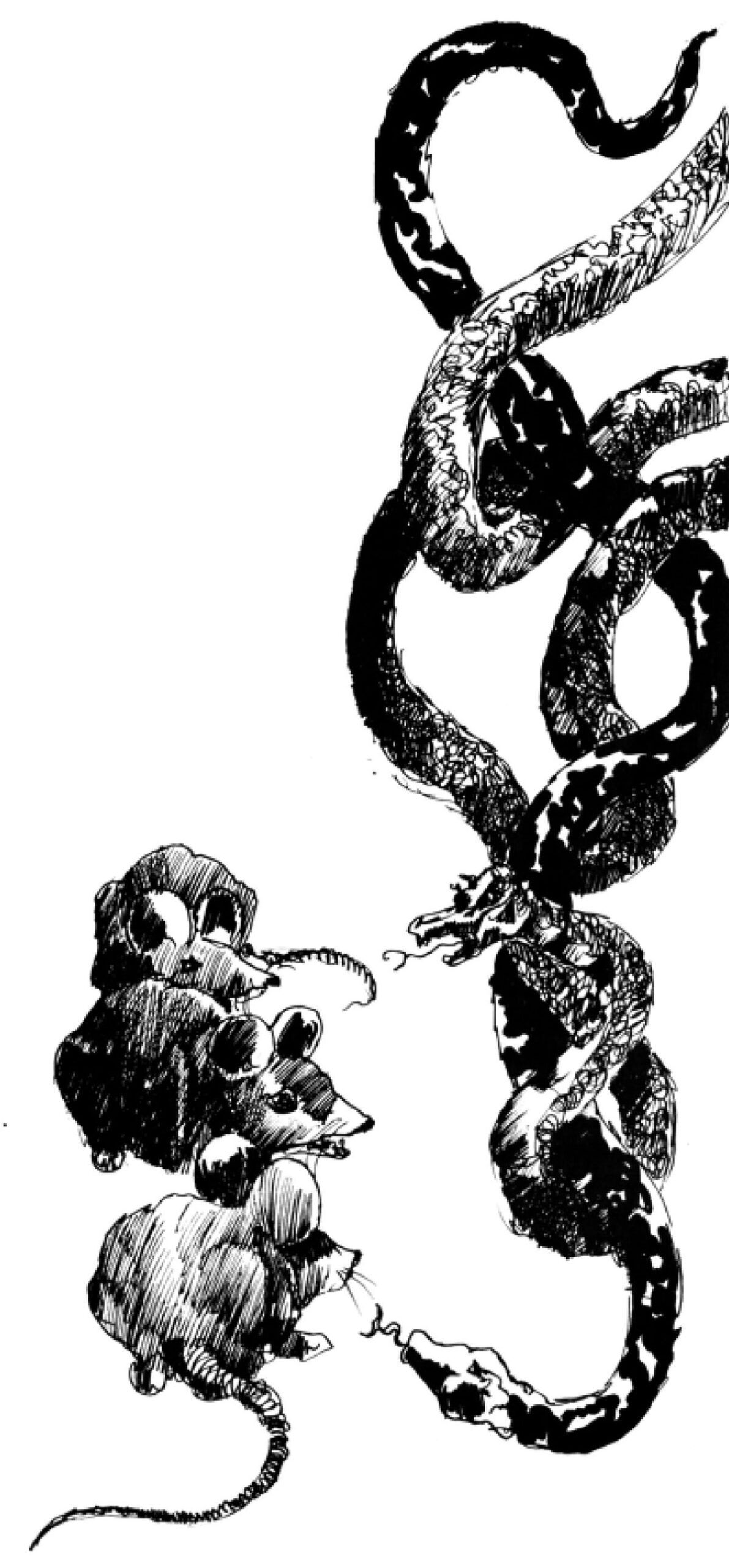
And the little mice answered: “We are veld mice.’
Then, the mice asked the snakes:
“And you, what are you?
Such tunny bodies
Just one long tail
No head
No body
No feet
Just one long tail
With everything on it
What are you?”

And the snakes answered: “We are called snakes.”

And the mice answered: “We like you.”

The veld mice and the snakes played together for the first time in the African veld. And they were happy. And the sun of Africa, as if it wanted to lend extra lustre to this wonderful moment, the sun shone so beautifully, that myrlads and myriads of little diamonds were conjured up in the water. And the snakes danced with the mice and the mice with the snakes. They pirouetted, swooshed their tails, squeaked and hissed with glee, while myriads of diamonds glittered on the water.

When night fell so dramatically in one swoop, enveloping everything, the mice scuttled off in a hurry, peep, peeping their way to their hole. And the snakes slithered their way through the veld.

Mother mouse asked her little ones:
“Where have you been? What have you done?”

The veld mice replied:
“We met these funny creatures
No body
Just one long tail
No feet
Just one long tail
And, they called themselves snakes.”
Then mother mouse shouted with fear:
“‘Snakes!
You played with them
Don’t you know we’re enemies
They eat us up
We’re enemies.”

The veld mice trembled with fear for they did not know.
When the snakes came home their mother asked them:
“Where have you been? What did you do?”

The snakes answered their mother:
“We met these funny creatures
With funny bodies
And funny eyes
And funny tails
And funny sounds
They called themselves Veld Mice.”

Then mother snake shouted:
“Did you eat them up?’

The little snakes said:
‘No, why should we eat them up?

Then mother snake answered:
“Don’t you know we live on mice,
We feed on them.”

The next day at the pool, the mice were there, the snakes
were there. But whenever the snakes came closer, the veld
mice ran away. At long last the snakes asked their friends:
“Why do vou run away?
Are you afraid of us?
Yesterday, we had such fun
Yesterday, we were such friends.”

The veld mice — at a safe distance now, shouted back to
the snakes:
“Yesterday, we did not know
that snakes were our enemies
Yesterday, our mother had not yet informed us.
We are Iimpuku
and you are Iinvoka.
Yesterday we did not know
that SNAKES are our ENEMIES.”

So saying the veld mice ran off into the African veld, peep,
peep, peeping their way to their mother and to safety …
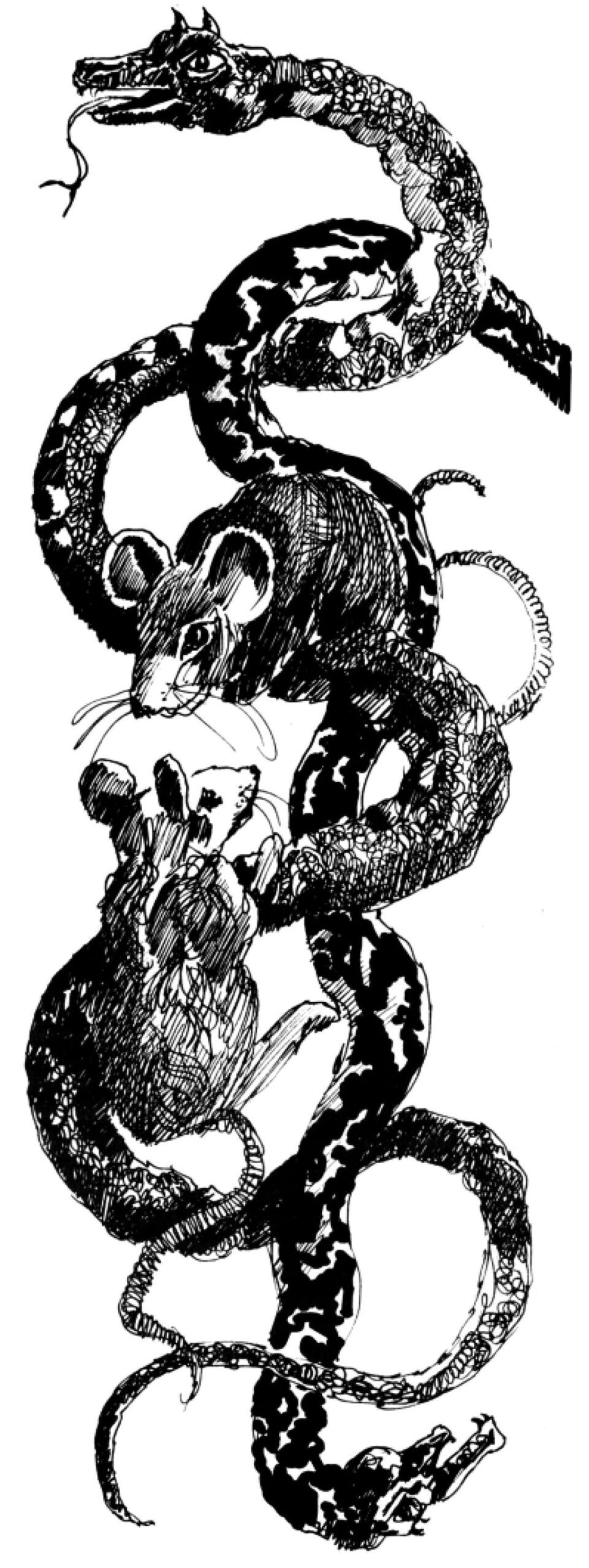
Illustration by Jason Askew. First published in rixaka, issue 1, 1990.

Share
Print PDF
ZAMOKUHLE MADINANA
KNEO MOKGOPA
© 2026
Archive About Contact