RICK DE VILLIERS
Review: Ons wag vir Godot – translated by Naòmi Morgan
On 29 June, 1937, an Irishman applied for an Italian lectureship at a South African university. If this sounds like the setup to a flou grap, the punchline fizzles accordingly. The applicant was Samuel Beckett, and he would not get the job.
The hiring committee at the University of Cape Town could not have known they were turning down a future Nobel laureate. What they had to go on were five glowing testimonials and a grudging curriculum vitae. The former elaborated on the applicant’s command of European languages, praised his slim book on Proust, and remarked on his knowledge of Dante.[1]See Samuel Beckett, The Letters of Samuel Beckett, Volume 1: 1929-1940, ed. Martha Dow Fehsenfeld et al. (Cambridge University Press, 2009), 523-8. (They were kind enough not to mention that one of his poems jabs at the ‘loutishness of learning’, or that he had been known to present conference papers on non-existent authors).[2]Samuel Beckett, ‘Gnome’, in The Collected Poems of Samuel Beckett: A Critical Edition, ed. Seán Lawlor and John Pilling (Faber and Faber, 2012), 55. The CV, by contrast, shrunk the vital details to half a page and made no attempt at self-promotion. ‘If I got the job,’ Beckett confessed in a letter, ‘I don’t think I’d hold it for a fortnight.’[3]Beckett, Letters 1,535.
Beckett’s tepidity had more to do with his feelings about academia than about South Africa, though this would change in the coming decades. In the early fifties, at work on the English translation of his novel Molloy, he collaborated closely with a young South African, Patrick Bowles, who would have given him insight into the political rupture of 1948 when the National Party came to power. During the same period, the Irish writer Aidan Higgins was sending Beckett regular dispatches from Johannesburg. In one of his replies, Beckett records having seen Come Back, Africa, Lionel Rogosin’s documentary about township life and racial segregation.[4]Samuel Beckett, The Letters of Samuel Beckett, Volume 3: 1957–1965, ed. George Craig et al. (Cambridge University Press, 2014), 297. If this letter fails to reveal Beckett’s thoughts on South African politics, they would soon be made clear in the ‘Playwrights Against Apartheid’ declaration of 1963. Besides Beckett, signatories included Graham Greene, Arthur Miller, Spike Milligan, Iris Murdoch, Harold Pinter, Muriel Spark, Angus Wilson, and other dramatists. They expressed their ‘personal repugnance to the policies of apartheid and their sympathy with those writers and others in the Republic of South Africa now suffering under evil legislation’.[5]‘Playwrights against Apartheid,’ accessed March 5, 2026, aamarchives They also refused to allow their plays to be performed in the country.
Despite a general queasiness about political causes, Beckett would continue to show commitment to the anti-apartheid struggle.[6]For the fullest account of Beckett’s engagement with South African politics, see Emilie Morin, Beckett’s Political Imagination (Cambridge University Press, 2017), 21-2 & 83-4. In 1967 he gave instructions that one of his manuscripts be auctioned off and that the proceeds be donated to the ANC. Twenty years later he contributed to books meant to hasten Nelson Mandela’s release from prison. The enigmatic poem, ‘Brief Dream’, was included in Jaques Derrida and Mustapha Tlili’s 1987 collection, For Nelson Mandela. A year later – the year before his death – Beckett lent his support to the Irish Anti-Apartheid movement by allowing his translation of the essay, ‘Murderous Humanitarianism’, to be republished in the book, In the Prison of His Days: For Nelson Mandela.
Throughout this time Beckett maintained the embargo on his plays. But when approached in 1976 with a request that Waiting for Godot be staged before integrated audiences at Johannesburg’s newly founded Market Theatre, he was open to persuasion. The request came from Mannie Manim, artistic director for a theatre group called The Company. The production would have a black director at the helm in Benjy Francis and feature an all-black cast. Beckett’s biographer records that the licence was issued with the proviso that ‘tickets of admission are sold on a multiracial, non-discriminatory basis’.[7]James Knowlson, Damned to Fame: The Life of Samuel Beckett (Simon and Schuster, 1996), 637. The licence was granted one month before the Soweto Uprising.
Four years later, Beckett made a similar concession that would herald his long-overdue arrival in Cape Town. The Baxter Theatre production of Waiting for Godot also played to mixed audiences with a mixed cast. Directed by Donald Howarth, it featured John Kani and Winston Ntshona as Vladimir and Estragon, with Pieter Dirk-Uys and Peter Piccolo in the roles of Pozzo and Lucky. When the production toured to London a few months later, it brought the SA context along. According to Matthew McFrederick, the programme paired photographs of the Baxter Theatre run with choice snippets from the play.[8]For the most comprehensive overview of Godot in South Africa, see Matthew McFrederick, ‘“The Air Is Full of Our Cries”: Staging Godot During Apartheid South Africa,’ in Beckett and Politics, ed. William Davies and Helen Bailey (Palgrave Macmillan, 2021). The suggestion was that Beckett’s play had special relevance for a country where the master/slave dynamic was no metaphor.
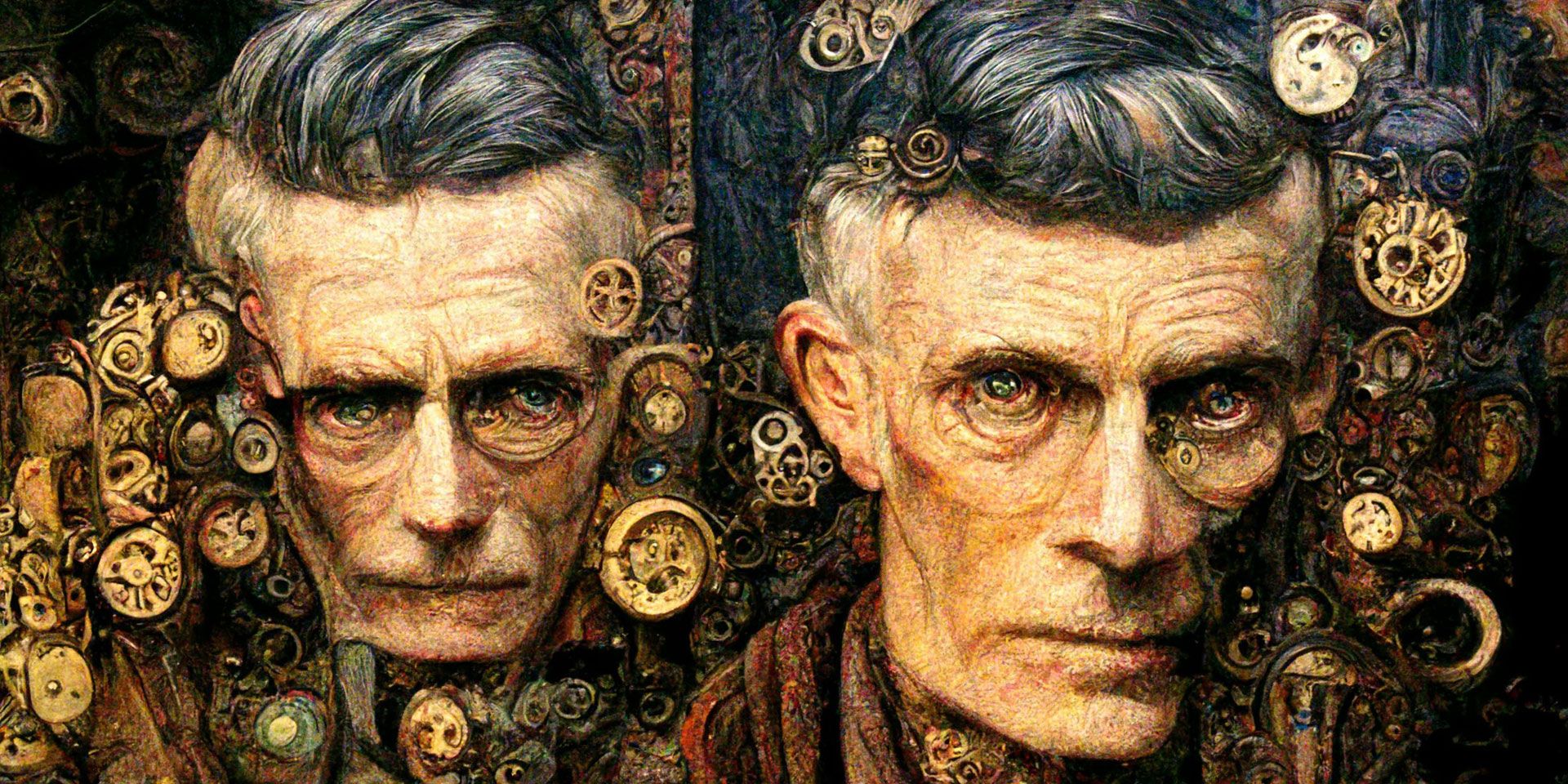
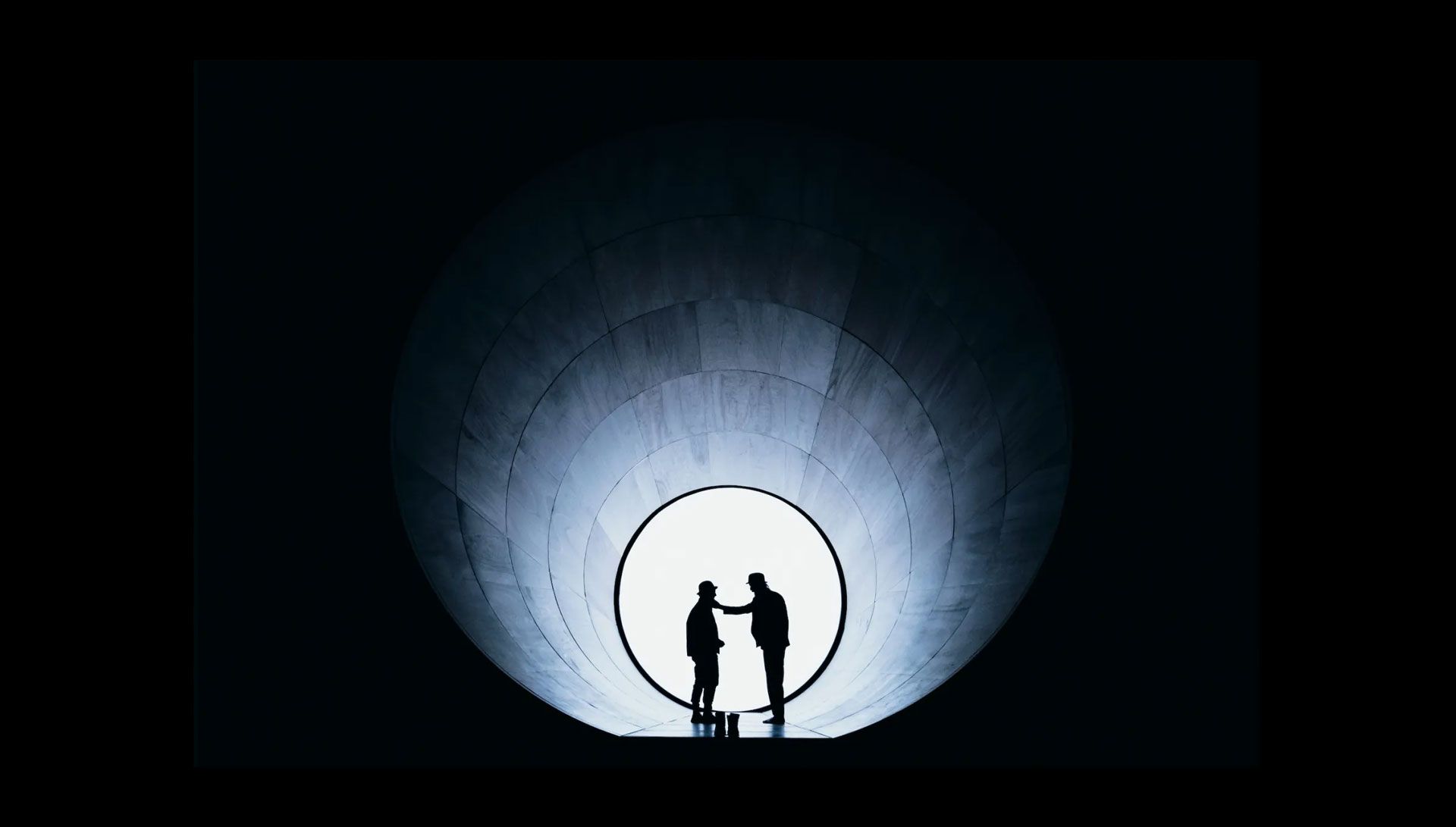
Ons wag vir Godot – the first official Afrikaans-language translation of Beckett’s most famous play – arrives at a very different moment. The date of publication, 2024, marked thirty years of South African democracy, while the debut performance in 2025 coincided with the ‘official’ centenary of Afrikaans. That any Beckett play should be linked to a moment of celebration is not without irony. Nevertheless, the troubled history of Godot in South Africa perhaps justifies seeing this translation as a measure of progress, however small.
Consider that in 1970 an unauthorised translation, Afspraak met Godot, played to an audience of invited, and presumably white, guests. Fifty-five years later and with the full endorsement of the Beckett estate, Ons wag vir Godot opened its doors to all, ‘sonder toegang voorbehou’.[9]Naòmi Morgan, ‘Voorwoord,’ in Samuel Beckett, Ons wag vir Godot, vert. Naòmi Morgan (Naledi, 2024), 7. Naòmi Morgan is right to mention this in the preface to her excellent translation. She is also right to not make too much of it.
The collective achievement of a basic human right buys you little room for self-congratulation.
What Morgan foregrounds instead is the responsibility of the translator: remaining faithful to the spirit of the original while invigorating it through the resources of the target language. This is not a simple task when you have competing ‘originals’. Beckett first wrote the play in French, in France, in 1948 – a time when the country had barely recovered from the devastations of the war. (For South Africans there will be compelling symmetry in the fact that France faced the ‘threat of electricity rationing’ as Beckett began drafting the play).[10]See Mary Bryden, ‘Preface,’ in Samuel Beckett, Waiting for Godot (Faber and Faber, 2010), p. viii. En attendant Godot was published in 1953 and premiered at the Théâtre de Babylone in Paris. Beckett’s own English translation would appear a year later in America, with the British edition to follow in 1956. To complicate matters, the latter was subject to excisions and changes demanded by the Lord Chamberlain’s Office. It would be nearly a decade before an unexpurgated Waiting for Godot appeared in Britain.
Whether for these or other reasons, Morgan’s translation favours the French. We can tell by the inclusion, for instance, of Vladimir’s vain hopes about Godot’s arrival: ‘Dalk slaap ons vannag warm en droog by hom, op strooi, met ‘n vol maag. Dis most die wag werd, of hoe?’[11]Beckett, Ons wag, 31. The English text scraps this counterfactual for Estragon’s hard truth: ‘I’m hungry.’[12]Beckett, Waiting, 16. Such austerity sometimes shades into crudity, as when Vladimir mentions the Gozzo family. Again, the Afrikaans follows the French in revealing that mother Gozzo did ‘borduurwerk, met ‘n hoepel’ (‘brodait au tambour’).[13]Beckett, Ons wag, 36; Samuel Beckett, En attendant Godot (Les Éditions de Minuit, 1952), 30. The English text, by contrast, gives the poor woman ‘the clap’ and no hobbies.[14]Beckett, Waiting, 19.
Morgan’s preference for the French is also disclosed by omission. One of the most celebrated moments in Waiting for Godot is Gogo and Didi’s exchange of insults, which Ons wag does not reproduce.
Vladimir: Moron!
Estragon: Vermin!
Vladimir: Abortion!
Estragon: Morpion!
Vladimir: Sewer-rat!
Estragon: Curate!
Vladimir: Cretin!
Estragon: [With finality.] Crritic![15]Beckett, Waiting, 71.
It is possible that the translator (a formidable critic herself) took umbrage with Estragon’s clincher, though a more likely reason is that it’s not in En attendant.
Francophone fidelity aside, Ons Wag is set in a distinctly South African landscape. Vladimir and Estragon entertain the thought of leaping from Van Stadensbrug, not the Eiffel Tower. Pozzo loses his Kapp and Peterson pipe only to find an ‘Ebenharts’ sourced from Calitzdorp. And, in better days, Lucky could put himself through the paces of the riel, pantsula, and horrelpyp.[16] Beckett, Ons wag, 15, 58, 67. These cultural shifts are managed without losing the play’s general sense of displacement. Whatever new beacons emerge, they only to point to the fact that Didi and Gogo have been everywhere and nowhere, both in the Boland but also in the ‘Gatkantland’.[17]Ons wag, 100. Duly domesticated, the play still retains its quintessentialunhomeliness.
The true gauge of this balance is how a translator handles the play’s intertextuality.
Morgan has a wonderfully Beckettian ear, which is to say she mishears allusions with aplomb.
A good example is the moment when Vladimir and Estragon attend to the silence around them. ‘Godot!’, thinks Vladimir, but not Estragon: ‘Dis net die wind in die rietpensele.’[18]Ons wag, 31. The French and English, mirroring each other, give us a slightly less specific image: ‘Le vent dans les roseaux’ / ‘The wind in the reeds.’[19]En attendant, 25; Waiting, 16. At a stretch, the latter could evoke the wistfulness of W.B. Yeats’s collection The Wind among the Reeds, though not a particular poem within it. Morgan’s borrowing is more pointed and more menacing. The unusual ‘rietpansele’ arrives via Eugène Marais’s eerie poem, ‘Mabalêl, in which the eponymous innocent fails to sense the dark presence of the crocodile-creature, Lalele:
Nooit onheilige gedaante uit die diepte van die hel
Half so dringend , half so fel
As dié skadu, Mabalêl,
As dié skadu wat benee jou
Uit die diepte opwaarts wel.[20]Eugène Marais, ‘Mabalêl,’ in Versamelde gedigte (J.L. Van Schaik, 1976), 21.
Marais’s rough beast slouches towards but not onto the scene.
Elsewhere, Ons Wag draws on the comedic stores of Afrikaans literature. A.G. Visser’s poem, ‘Vet’, sneaks in as Pozzo lowers himself onto his folding stool: ‘So ja, en toe sit ek al.’[21]Beckett, Ons wag, 46. In ‘Vet’, the corpulent sedant is ‘ou Tant Siena’ who miraculously weds intention and execution: ‘Sy wou gaan sit, toe sit sy al!’[22]A. G. Visser, ‘Vet,’ in Rose van herinnering en ander gedigte (J.L. Van Schaik, 1934), 85. Apart from serving the immediate action, the allusion also anticipates the irony of future inaction. Later, when Pozzo wants to sit again, he will be prevented by a lack of motive: ‘But how am I to sit down now, without affectation, now that I have risen? Without appearing to – how shall I say – without appearing to falter.’[23]Beckett, Waiting, 25. Hy wou gaan sit, maar kon toe nie.
One of Morgan’s finest transpositions is the swapping of a line by Shelley for a line by C. Louis Leipoldt.[24] I’ve mentioned this elsewhere: theconversation In the English text, Estragon looks up at the moon and quotes in a woeful key: ‘Pale for weariness…Of climbing heaven and staring on the likes of us.’[25]Beckett, Waiting, 49-50. In the Afrikaans, he produces a fragment from the wistful plaas-poem, ‘Die Moormansgat’: ‘ek kyk na die lig van die volle silwermaan’.[26]Beckett, Ons wag, 88. At a glance this lacks the detached quality of Shelley’s line. But read in the context of Leipoldt’s poem, it brings home the desolation of the scene:
En hy wat langs die wapad gaan
Kan as die volle silwermaan
Sy bleek verligting oor die wrak
Van windeverweerde rietgrasdak
En oor die stukkende gewels sprei,
Sy hart ontlas van meely.[27]C. Louis Leipoldt, ‘Die Moormansgat,’ in Die Moormansgat en ander verhalende, en natuurverse (Afrikaanse Pers Boekhandel, 1948), 34. ‘And he who travels along the road / Can (when the full silver moon / spreads its bleak solace over the wreckage / of wind-torn thatches / and broken gables) / rid his heart of sorrow.’ (My translation).
These subtle acts of domestication are made more visible by a page of endnotes. If this strikes us as rather academic, it may be defended on the grounds that Beckett had done the same with his poem, ‘Whoroscope’, which extended his mockery of loutish learning. This is not quite Morgan’s intention. Instead, she wants to our draw our attention to the resources of Afrikaans literature in accommodating a play as challenging as Beckett’s. The endnotes also undercut any notion that the history of the language could be confined to the period of its official status.
Of course, a few references to works composed in the 19th Century can only begin to gesture at a long and varied history that stretches back much further. And looking beyond the peaks of a high canon, it’s not hard to recognise how apt it is that this tale of debasement should be told in a platvloerse kombuistaal. Afrikaans is a language of many centuries in the making, a language of many peoples made. It is up to future producers of Morgan’s fine translation to make this clear: to render it in ways that do justice to the diversity of the language and its speakers, and to the diversity of Godots that speak back to our world. It’s also up to them to tell the tragic-comic joke of an Irish play walking onto a South African stage and addressing us in Afrikaans.
| 1. | ↑ | See Samuel Beckett, The Letters of Samuel Beckett, Volume 1: 1929-1940, ed. Martha Dow Fehsenfeld et al. (Cambridge University Press, 2009), 523-8. |
| 2. | ↑ | Samuel Beckett, ‘Gnome’, in The Collected Poems of Samuel Beckett: A Critical Edition, ed. Seán Lawlor and John Pilling (Faber and Faber, 2012), 55. |
| 3. | ↑ | Beckett, Letters 1,535. |
| 4. | ↑ | Samuel Beckett, The Letters of Samuel Beckett, Volume 3: 1957–1965, ed. George Craig et al. (Cambridge University Press, 2014), 297. |
| 5. | ↑ | ‘Playwrights against Apartheid,’ accessed March 5, 2026, aamarchives |
| 6. | ↑ | For the fullest account of Beckett’s engagement with South African politics, see Emilie Morin, Beckett’s Political Imagination (Cambridge University Press, 2017), 21-2 & 83-4. |
| 7. | ↑ | James Knowlson, Damned to Fame: The Life of Samuel Beckett (Simon and Schuster, 1996), 637. |
| 8. | ↑ | For the most comprehensive overview of Godot in South Africa, see Matthew McFrederick, ‘“The Air Is Full of Our Cries”: Staging Godot During Apartheid South Africa,’ in Beckett and Politics, ed. William Davies and Helen Bailey (Palgrave Macmillan, 2021). |
| 9. | ↑ | Naòmi Morgan, ‘Voorwoord,’ in Samuel Beckett, Ons wag vir Godot, vert. Naòmi Morgan (Naledi, 2024), 7. |
| 10. | ↑ | See Mary Bryden, ‘Preface,’ in Samuel Beckett, Waiting for Godot (Faber and Faber, 2010), p. viii. |
| 11. | ↑ | Beckett, Ons wag, 31. |
| 12. | ↑ | Beckett, Waiting, 16. |
| 13. | ↑ | Beckett, Ons wag, 36; Samuel Beckett, En attendant Godot (Les Éditions de Minuit, 1952), 30. |
| 14. | ↑ | Beckett, Waiting, 19. |
| 15. | ↑ | Beckett, Waiting, 71. |
| 16. | ↑ | Beckett, Ons wag, 15, 58, 67. |
| 17. | ↑ | Ons wag, 100. |
| 18. | ↑ | Ons wag, 31. |
| 19. | ↑ | En attendant, 25; Waiting, 16. |
| 20. | ↑ | Eugène Marais, ‘Mabalêl,’ in Versamelde gedigte (J.L. Van Schaik, 1976), 21. |
| 21. | ↑ | Beckett, Ons wag, 46. |
| 22. | ↑ | A. G. Visser, ‘Vet,’ in Rose van herinnering en ander gedigte (J.L. Van Schaik, 1934), 85. |
| 23. | ↑ | Beckett, Waiting, 25. |
| 24. | ↑ | I’ve mentioned this elsewhere: theconversation |
| 25. | ↑ | Beckett, Waiting, 49-50. |
| 26. | ↑ | Beckett, Ons wag, 88. |
| 27. | ↑ | C. Louis Leipoldt, ‘Die Moormansgat,’ in Die Moormansgat en ander verhalende, en natuurverse (Afrikaanse Pers Boekhandel, 1948), 34. ‘And he who travels along the road / Can (when the full silver moon / spreads its bleak solace over the wreckage / of wind-torn thatches / and broken gables) / rid his heart of sorrow.’ (My translation). |