“The wind knows nothing about keeping secrets under cover
Emman Usman Shehu from “The Wind Knows Nothing”
…it blows in any direction it chooses”
The 2025 edition of Mwanaka Publishing’s Best New African Poets Anthology marks a significant milestone for this African publisher, arriving as the series celebrates a decade of amplifying voices across the continent since its inception in 2015. African poetry enthusiasts will be treated to a massive 72 poets writing from across the continent and the African Diaspora. In his editorial, English-edition editor Tendai Mwanaka alludes to a healthy and functioning literary ecosystem; he contextualizes this ten-year milestone through highlighting the commendable groundwork already laid to introduce emerging voices to readers both at home and abroad. This multilingual anthology not only has contributions in English; there are also poems in French, and Portuguese edited by Arnold Kobi Mondo and Lorna Zita respectively. The anthology features over 185 poems, with themes ranging across a variety of stimulating and intriguing points of discussion.
While at first the wealth of work contained within these pages seemed to me to be a bit overwhelming, I found myself appreciating the grounding principle of anthologies: their purpose being to bring different poets together. The beauty of poetry compilations is that they tend to reveal many, if not all, the possibilities of the genre. While this is not to say that poetry anthologies do not have their shortcomings, their strength lies precisely in the excitement that comes with the potential of discovery. To stay with this idea of discovery, there is a trio of dub poems by Aryan Kaganof that sets the tone. The second of these reminded me of the unflinching and raw nature of truth. The hesitant confrontation of truth is something society tends to shy away from; this is confronted in the concluding lines where Kaganof writes:
Finally they urged their mirrors to stop reflecting
Aryan Kaganof, “untitled dub poem II,” p. 3
They were tired of seeing
How empty they were
In considering the established premises of poetry—some of which include it being a highly subjective genre with symbolism that can be interpreted differently—one can think of this anthology holistically as doing much the same. The poems are indeed sourced from one place, but the beauty of the compilation is that there are multiple themes and streams with which the reader can engage with. For instance, in the poem “Rock bottom” by the Botswanan poet Athalia Pule, there is a poignant despair contained within the powerful opening:
Rock bottom is not a fall it is a landing
Athalia Pule, “Rock bottom,” p. 30
As I read through the book, I found many inward and outer grapplings with the human condition throughout this body of work. Half of the work of this compilation is to gather experiences; the other is the gift of sharing them. A poem such as the one by Athalia Pule illustrates the courage it often takes for humans to be vulnerable.
This is not an instance of African poetry becoming too attached to pain, but rather a much darker revelation that pain is universal. The fact that the majority of the poems are meditative should not be viewed negatively; on the contrary, it happens all too often that there is a tendency to over-analyse and institutionalise the craft. We tend to miss the fact that this is essentially a literary art form.
There will be others, footprints on paths we’ve walked, voices weaving prayers to God. There will be love, gentle as rain-soaked petals, and hope, a flame that never fades, lighting the way through dark nights.
William Khalipwina Mpina, “Even After We’re Gone,” p. 44
There are engaging poems such as “Even After We’re Gone” by William Khalipwina Mpina. It is always intriguing to me to learn about the ways in which poets of different generations deal with time. The words that end up on the page represent poets at different stages, not only of their craft but also of living. Through the interrogation of past, present, and future, I believe the comfort we often find in poetry is the release—an intentional willingness to engage with the uncomfortable and also the inevitable.
While a majority of the poems tend to deal with the personal, there is also enough room left for them to coexist with those that dissect matters affecting the public. I am reminded of poems like “PEACE” by Ibadin Kingsley and “BULLETIN BUGS” by Ekundayo Asafit, which provide an African perspective on a more generalized sense of strife that is currently smothering the world in proverbial smog. Alongside this, there is also the interrogation of the impact of past and present wars on the continent.
Beneath a layered plenitude of poems, I do appreciate the ecological component being present. I would have welcomed a few more works in this realm, but those presented here really delivered. The poems of Janet Patricia Chikoja are written in rich dialogue with nature. I most enjoyed the poem titled “Zomba Mountain,” which is itself a masterful centering of nature:
Bamboos, mahoganies and creepers
Janet Patricia Chikoja, “Zomba Mountain,” p. 137
Weave together in bonded relationships.
Your swift-running Mulunguzi stream
Whispers swift, sweet melodies to the spirit
Fuelling the soul’s mayhem to flutter and dance in the stream’s breeze
As it flows down to Zomba city
Golden yields of joy welcome us with pelting falls. Passion (fruits) climb on twining vines as Cherries redden their fruits dangling on frayed boughs. Chiuta sprinkles petrichor on earth’s sheet, soothing our lost memories. Showers of quietude rinse our stained teeth as Healing pours down mercifully — Washing our ills in earth’s bosom.
Ewurama Tawiah Welbeck, “The Sound of Rain,” p. 153
In her poem “The Sound of Rain,” Ewurama Tawiah Welbeck masterfully creates a moment where the significance of rain is made apparent. The notion of rain as a cleanser or replenisher is a powerful way to assert the need for a more intentional engagement with nature. In the politics of First World and Third World countries, some developed countries owe their powerful positions to the destruction of the earth; it thus becomes a necessity for those who were colonized to remind them of this fact.
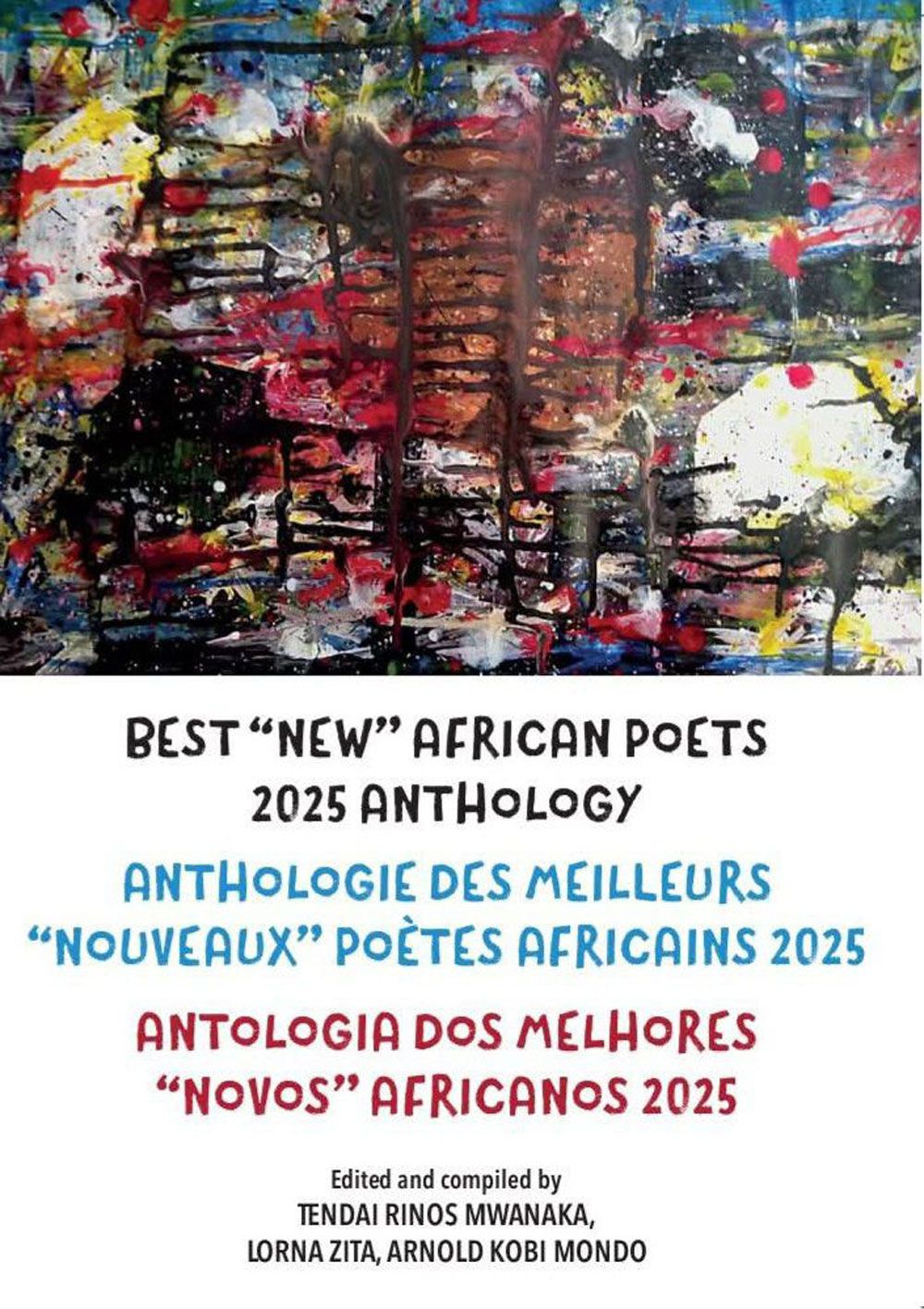
To properly appreciate the 2025 Best New African Poets Anthology is to remember that all of these works, and many more, are from the same source; they have all found a home in the same place. The curation of anthologies such as these and the strength of each individual work is entirely subjective; however, there is something much more essential at play here. When it comes to reading a poetry collection, not everyone will read it from cover to cover; some choose to look through the contents page and select individual poems. So this is to say, with this anthology it is the reader that is empowered. The true work of editors is to facilitate discovery for the reader; the good ones are able to help craft stimulating work with integrity without sacrificing accessibility.
In closing, if we can venture away from the notion of discovery as the unearthing of the new, and move toward the re-entry of what we already know from new vantage points—this would be closer to what I am getting at. Not only are we presented with poets who are learning about their poetic voices in real time; alongside them we are shown those who may be further along but also making more discoveries about their newer iterations. I ended up viewing this anthology as a celebration of African poetry and its diversity. The power of the reader is reaffirmed precisely because of the possibility of choice. The poets are themselves readers first, and as such, our work is to take our place as witnesses to African poetry in its finest element.
Editors: Tendai Rinos Mwanaka, Lorna Telma Zita and Arnold Mondo Kobi | Title: BEST “NEW” AFRICAN POETS 2025 ANTHOLOGY | Pages: 340 | Publisher: Mwanaka Media and Publishing Pvt Ltd, Zimbabwe (2025) \ ISBN: 978-1-77928-531-7