RIAAN OPPELT
Get Jits or Die Tryin’
The saga continues.
Saga? Which one? The current state of the world? The folly of the Marvel Comics Universe and its endless failed apocalypses? Timmy Chalamet’s quest to be the next DiCaprio?
No. The controlled, authored saga of the stellar Jitsonovas. They’re like Champagne Supernovas but with cosmic, spumante wordplays that actually mean things.
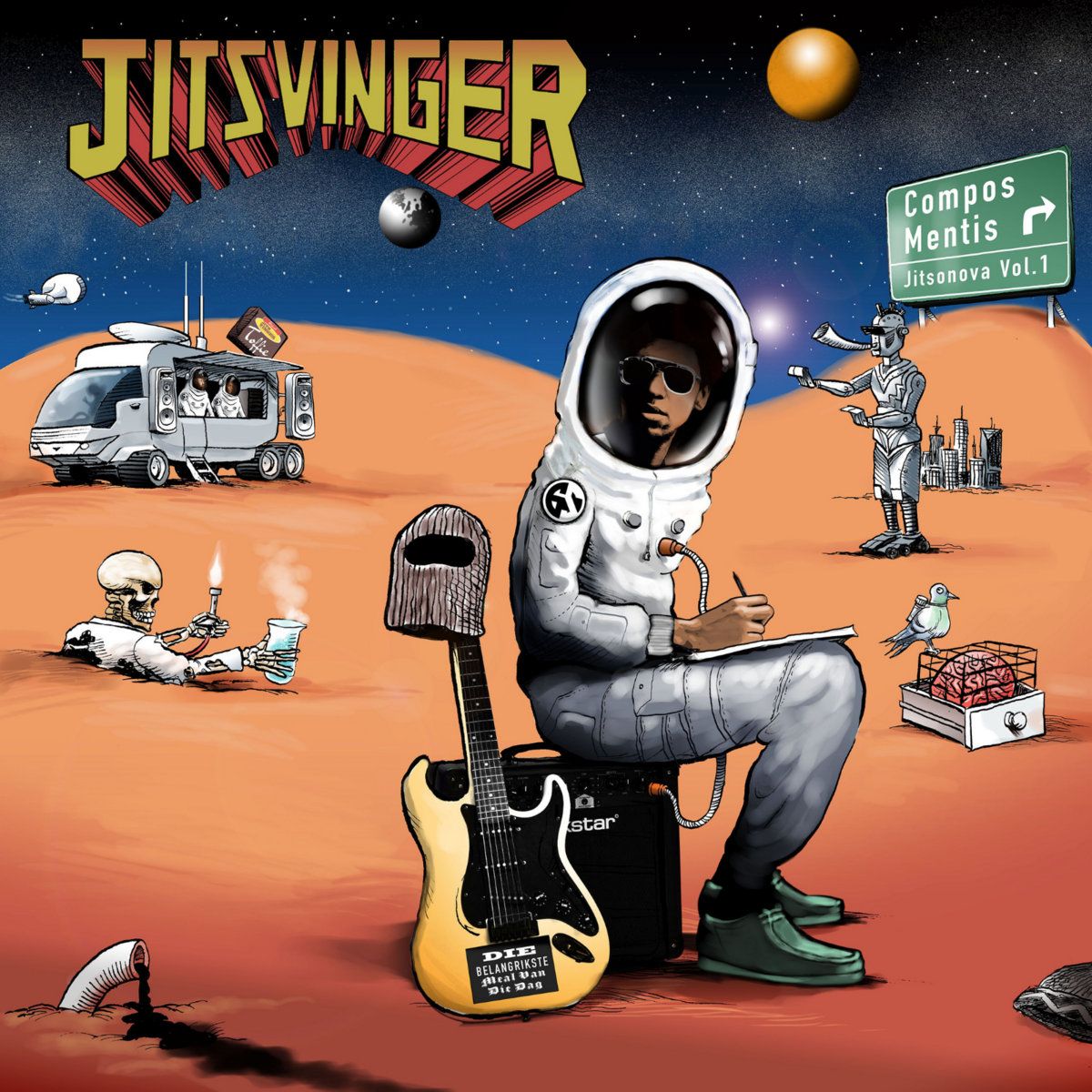
The Master that is Jitsvinger kicked off 2026 by releasing his latest, Jitsonova Vol. 2: Djas EFX in late January, mere weeks before the world changed. Before I discuss this most recent work, I must draw your attention to the ‘Volume 2’ of the title indicating a sequel or follow-up to something—and that something is the standout collection Jitsonova Vol. 1: Compos Mentis from 2021. To name your work ‘Volume 1’ presages a ‘Volume 2’ somewhere down the line; it is authorial intent, the mapping of a saga. This new release was always coming.

While this review will discuss Volume 2 it must, by necessity, return to Volume 1, the same way you’d discuss The Godfather Part II in the same conversation as The Godfather (whether Part II was planned or would have happened without the success of the first film is anyone’s guess). Both those films are, to enough movie buffs, all-time masterpieces and, for the longest time, before the inferior third movie that came much later, the first two were known as The Godfather saga. The same goes for the Jitsonova releases: they constitute a saga and they’re both masterpieces, albeit for very different reasons.
But first, a step back… herri readers, most of them, know who Jitsvinger is but for new readers, or those unfamiliar with the artist, here is a catch-up.
Jitsification, or motivating for knowledge of the fast finger
Jitsvinger is the Godfather of Afrikaaps rap and Cape poetry, the man who named Afrikaaps, the poet who curates the storyscapes of the Cape Flats and the spirit warrior always recognising and honouring the ancestors.
He is Cape Flats born and bred, an MC, poet and creator, a philanthropist and community icon, a language activist and decolonist reminding many in the communities he moves in to be proud of their heritage and identity. There’s also the small matter of his being an incredibly skilled guitarist with lightning-fast fingers meriting the name Jitsvinger.
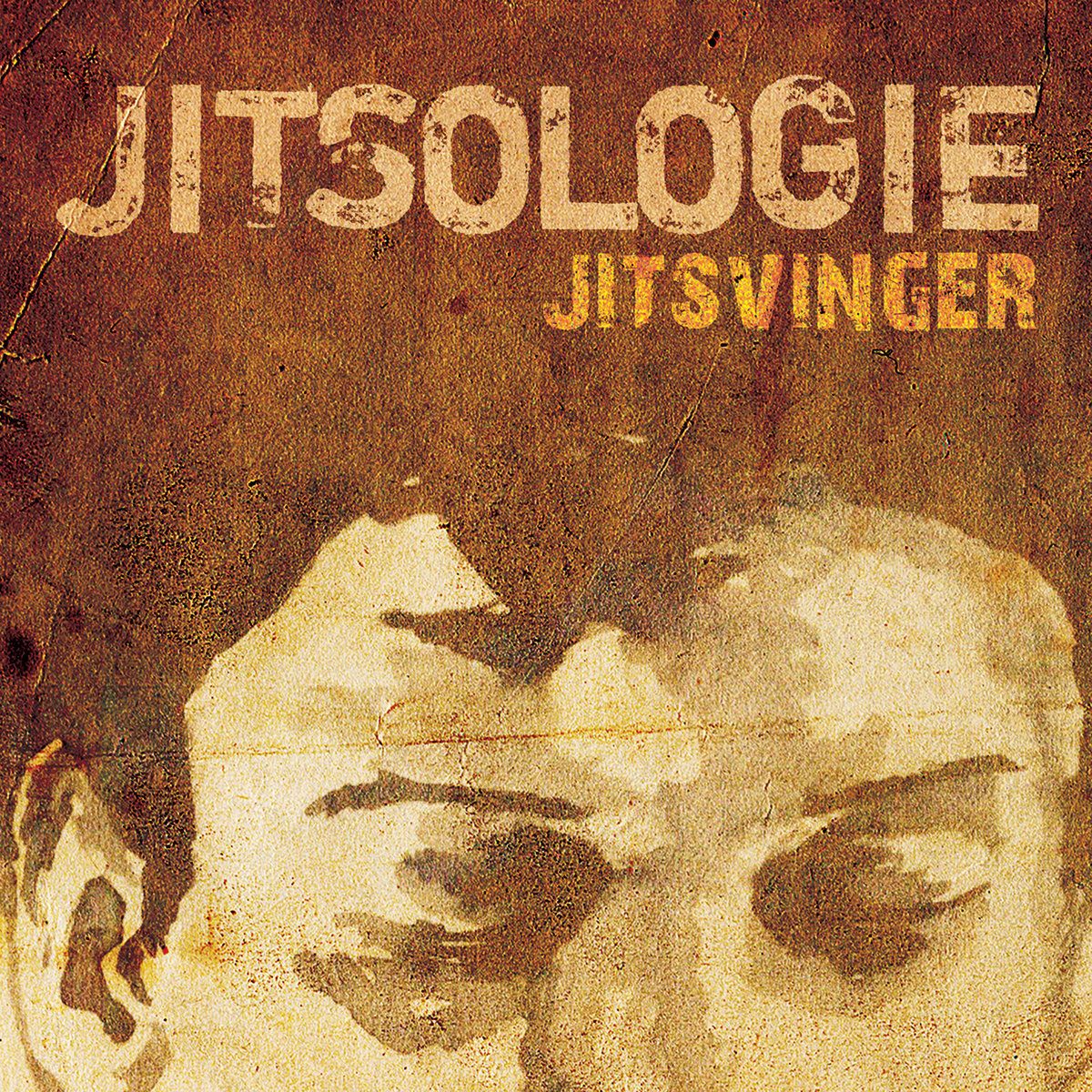
He is the author and producer of the acclaimed albums and EPs Skeletsleutel, Jitsologie, Knapgat, and Jitsonova Vol. 1, collaborating with prominent classical and jazz musicians and featuring many breathtaking artists on his tracks like someone who keeps the doors to his home open to his community. Make no mistake, Jits’ home is the location of hip hop excellence that stands back for no-one; his artistry synthesises the learned knowledge of the crews that came before him, recognises the shared space with his peers and plays balletic tennis with the exuberance of the younger talents of Now while teaching them how to host at the highest levels of hip hop performance. He is an MC, a master, and he is one of a kind. We may never see something quite like him again.
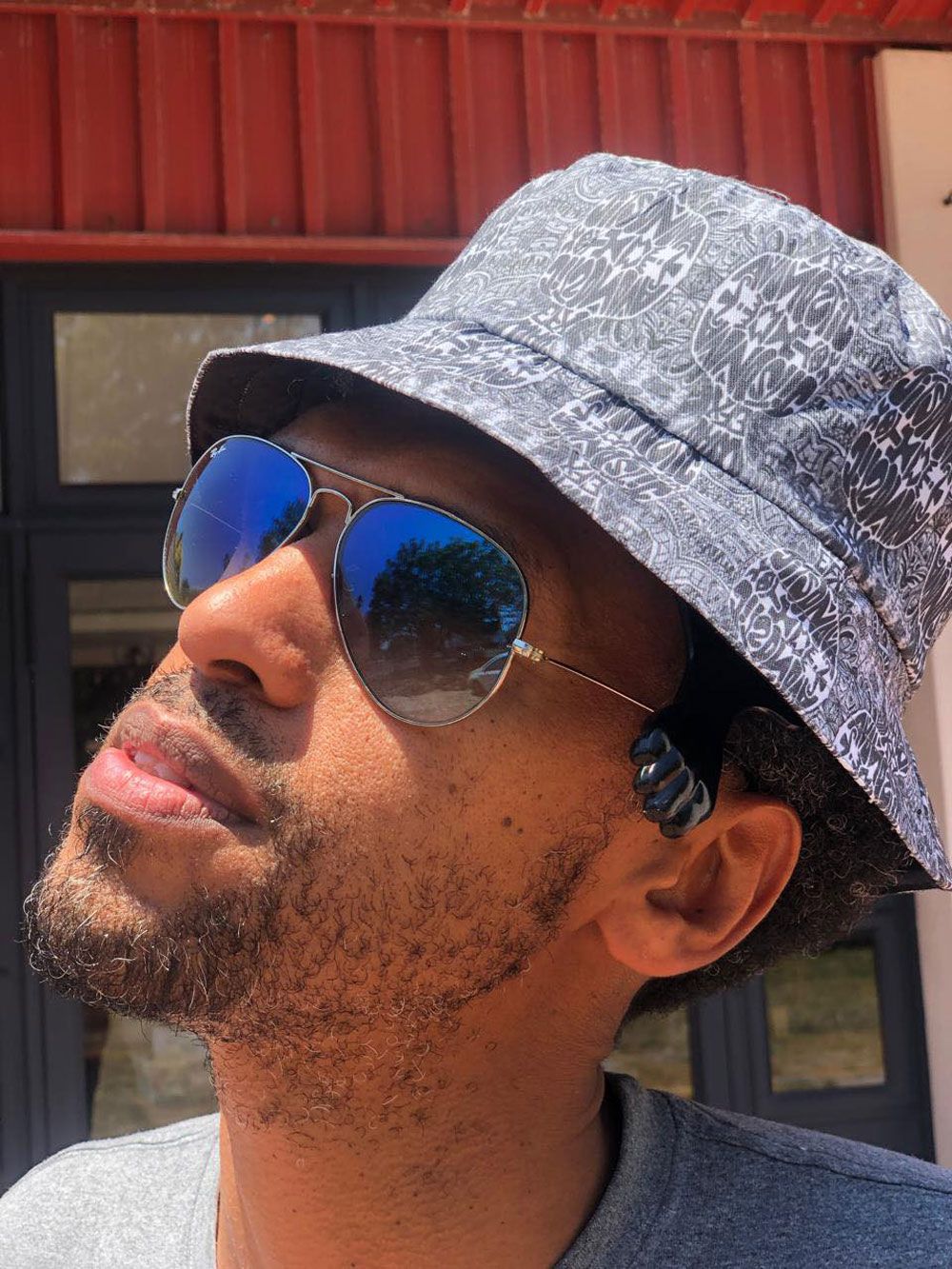
If your first time encountering Jitsvinger was at a live performance, you may count yourself very lucky because he remains one of the most compelling performers on any South African stage this century. And not just SA. As I write this, he has just returned from New Zealand and is already en route to The Netherlands. His own hard endeavour, his connection with New Zealand documentarian Rachael Lowe and crowdfunding got him to Aotearoa of the Land of the Long White Cloud. His excellence and gargantuan knowledge production got him to Groningen at The European Hip Hop Studies Conference where he is co-presenting a paper with Dr. Jody Metcalfe (aka Breinsuiker), and where that other major iconoclast, Emile YX? is also presenting. Fuck me, I haven’t even talked about the EP yet, but we go on. He has hit major local and international stages throughout South Africa, Europe, Asia, and South America. Jits is international and if you don’t know, now you know.
Film and theatre have been Jitsified, too. The groundbreaking theatrical production Afrikaaps (2009)and its equally vital filmed diary (2010) of the same title, both international award winners, gave a massive assist to opening the floodgates for the Afrikaaps language movement of the last decade-and-a-half. Guess who renamed the Kaaps language as Afrikaaps, thereby giving those revolutionary productions their moniker and providing many of us with a new name for the language we speak? Jits did. He is magnetic alongside other giants on those Afrikaaps stages but don’t believe me, watch the damn thing on youtube. Shit is free. Each watch and rewatch of Afrikaaps teaches something new, still.
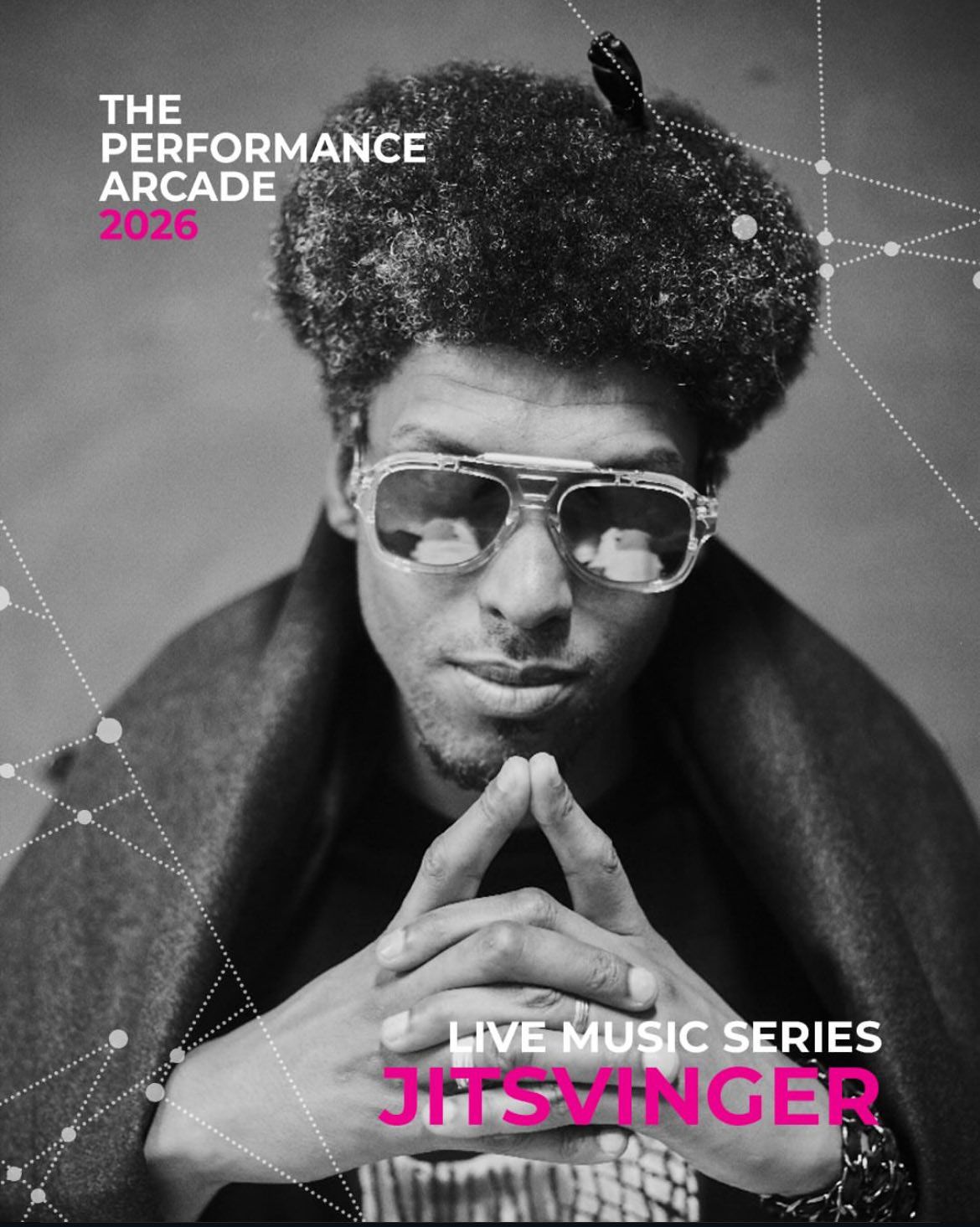
Jitsvinger is deeply dedicated to education, having hosted the Heritage and Harmony cultural production for three consecutive years and conducted creative writing workshops at Kylemore High School. He spearheads mentorship programs in schools, universities, prisons, and community organizations, including initiatives with the Zero Drop Out Campaign and Students for a Better Future. He is a trailblazer in cultural exchange tours between South Africa and Aotearoa New Zealand, in partnership with Performance Arcade 2026.
Through his work in poetry, theatre, and music, Jitsvinger persistently advocates for vernacular expression as a means of cultural restoration and unity. In collaboration with his colleague Rachael Lowe, he is developing a relationship-driven South-to-South cultural corridor that connects South Africa, Aotearoa New Zealand, and Australia. This endeavour is intentionally relational and dynamic, shaped through dialogue with festivals, educators, Indigenous artists, and cultural institutions regarding shared histories of language, land, and cultural memory. With a resume like that, imagine the pressure on the albums and EPs to live up to.

Jitsonova Volume 2: Djas EFX
The key’s in the title on this one: djas efx, or awesome sounds. The sound of collaborators, of features, of a community guided by the Master. There are the sounds of a great time, in studio, in narrative, in the club and on the Flats. For much of the EP, the featured artists lead the tracks, leading to entrances made by Jits—and what entrances they are. He stage-manages, coming in deftly and with purpose but never even thinks of upstaging the featureds, because he is not that kind of host, no matter the obvious scale and dimension of his power. He does not come in hot and bombastic because he does not need to; he knows Jitsonova Volume 1 is out there for you to hear exactly how untouchably he rolls.
This might be the first practice on Jitsonova Volume 2 to strike you: Jits acknowledges and honours community and he is inviting the featured artists to give it their best go and have a djas time. Jits’ style here has a little bit of peak Snoop to it, when you knew Snoop’s laidback shape could still easily dominate any track he enters, but such is the mastery that it never needs to announce itself. You’re in Jits’ house and you know it. Like I said, it’s a different story on Compos Mentis but we’ll get to that because we’re going to need to; as we go on, you’ll see how Djas EFX compels you to return to Compos Mentis. It’s a saga, remember, with two components doing different things within the same moral universe.
Benjamen YTTG, featured twice on Djas EFX, gets things going on the opener, ‘Te Diep’. The youthful pitch of his voice belies a steady sense of purpose already evident on his own tracks like 2024’s ‘Doen Net Jou Ding’ and the urgent lyrics he sirens on last year’s ‘Laaste’. He assumes the lead with secure timing and the odd melodic turn of phrase in the ‘Te Diep’ verses when he punctuates his line endings unremittingly to immediately bridge your ears and brain to a personal landscape of inner belief and external pressure:
Ek is te diep ini ding/Hoe kan ek op wil gie/Doenit beter op my eie/J wiet ek het baie van vrinne gecrop vir di/Hulle wil my opi grond sien/It is harde werk om opi top te wies
(I’m too deep in it now/How can I give up/Do it better on my own/You know I cropped many friends for this/They wanna see me on the ground/It’s hard work being on top)
And like that, YTTG locks the track in and flows on his lyrical river, just being a pro about it. The rapids on this river are provided by Jits with his signature announcement, “kwaai”, acknowledging the featured artist’s work and getting you ready for his altering bridge. After a relaxed meditation on depth comparisons from Kilimanjaro to the Pyramids of a Pharoah, and promising that Jits and YTTG will go spittin’ bars long into the night (‘tot laat toe’) Jits sets off and immediately throws out:
Kô dip in my sauce/My moccasin sool glip… wat is die met die hele geraas, ek hoo niksie/sit affie volume, ek het vi niks annes voo lussie
Dip into my sauce/ My moccasin sole slips… what’s with all the noise, I hear nothing/ turn down the volume, I don’t feel for anything else
He is all pace and wisdom, uncorked energy that makes no mess because this is an old hand far from cold. His presence asserted, Jits brings his machine-like precision to the party, not upstaging YTTG but clicking into his rhythm and then switching up his note values at will like a jazz drummer entering their happy place. He is almost playfully running with the metaphors of depth before consummately winding his delivery neatly back to YTTG’s waiting final verses. It’s a great album opener, the responsibility ably handled by YTTG and the track dynamic instantly morphed by Jits without taking it away from the younger artist. YTTG has earned himself another go-round here, which occurs later.
Stand-out track ‘Viva La Cape Flats’ featuring Lady G and K-NiNE DIE HOND is a radio-rouser that I must introduce by quoting its bullseye chorus:
Viva la Cape Flats!/ Dies’ie number one destination, van die dak tot die pavement/ Viva la Cape Flats!/ Almal is buite, soe luister! Waars al’ie huiskinnes??!!/ Viva la Cape Flats!/ Original soe lyk hulle! Sienit in my grill soe kyk hulle!/ Viva la Cape Flats!/ Die universe is Cape Town, met Jits, Lady G en K-Nine
Viva la Cape Flats/ This is the number one destination, from the roof to the pavement/ Viva la Cape Flats/ Everyone is outside, so listen! Where are all the housekids??!!/ Viva la Cape Flats/ Original, this is how they look/ See it in my grill, see them watching!/ Viva la Cape Flats/ The universe is Cape Town, with Jits, Lady G and K-NiNe
It is a big chorus that is more bold than beautiful, which, in context, is a fearless move of authenticity: these aren’t paid cheerleaders belting out an easy set of lines; instead, we have Jits’ directness, the aggression in KNiNe’s voice and the urgency in Lady G’s chorus complements, her responses to the rappers’ calls. The bells and whistles of a conventional big chorus with all the pretty casings is eschewed here for a chorus that works hard to reflect how hard Cape Flats families work for togetherness when every force imaginable tries to wrench them apart. The nylon string lead guitar, and a secondary rhythm guitar with steel strings and moody chords all along channels Latin American music that knows a thing or two about dark forces of history and still finds a way to get you dancing. This comes full circle (and through one or two moves of Latin American styles and countries) when Lady G’s last chorus accompaniment finds a suddenly shifting instrumental backing that goes full Son Cubano, the enduring salsa sound with Africa in its layers.
Two tracks in and it’s clear as day: this EP is about community, and a big chant-along chorus like that is crafted for many voices, which Jits celebrates by underlining the power trio of himself, Lady G and K-NiNe in the final line, three people pointing to three million (well, actually six million). We’re stronger together is the message for the Cape Flats and for the rest of the world around it. Too much either ignored or depicted as a war zone filled with stereotypes and reductives, the Cape Flats deserves an anthem and that is exactly what Djas EFX serves up: the Cape Flats has a sound, and it is not the sound of gunshots or someone shouting ‘MSP’. It is the sound of closeness and strength in unity; it is the sound of a djas effect. Compos Mentis had similar exultations but despite the features Jits easily proclaimed them himself; here, he is rallying the people with love for the Flats, and the result is unbridled pride—no ifs or buts about it.
On top of a beautifully sinister nylon string guitar loop, another Jits signature here with dark jazz inflections, harmonic twists and diminished (re)turns, Jits sizzles on his opening verse, one that ends with his invitation to Lady G and K-NiNe:
Viva la Cape Flats vanuit die Mitchell’s Plain/ Elke dag is ‘n film bra, hier skiet hulle jy!/ Ons dra die spirit vannie Struggle musiek oppie tape/ Die give en take is in balans jy moet dieper kyk/ Die skaal word gelig virrie straat/ Ek bring’it op demand/ Die plate sizzle oppie yard, Spinnit jy!!/ Ek briek gevangene yt ‘n geskiedenis chained/ met ‘n inferior mindset ek sien hulle pyn/ En dies ‘n feit: die Kaap is unique/ Die charm is innie culture die vibe: mystique/ Die spice is innie beat, die guitar is my vice/ Met KNiNe en Lady G wat ek invite oppie mic
Viva la Cape Flats from Mitchell’s Plain/ Each day is a film, here they shoot!/ We carry the spirit of the Struggle music on tape/ The give and take is in balance, you need to look deeper/ The scale is lifted for the street/ I bring it on demand/ The records sizzle on the yard, spin it!!/ I break prisoners out from a chained history/ With an inferior mindset I see their pain/ And this is a fact: the Cape is unique/ The charm is in the culture, the vibe: mystique/ The spice is in the beat, the guitar is my vice/ With KNiNe and Lady G whom I invite on the mic
This is simply exciting and heartwarming stuff, Jits setting up Lady G and K-NiNe with intricate weaving, taking listeners through the rumble, the gunshots, the ‘give’ that is always taken from the Flats by an uncaring, engorged and criminally culpable system, the intergenerational trauma, neglect and hurt pressed upon those on the Flats. Jits’ verse recognises that pain and shows a way out by cleaning the mirror and uncovering reflections that need to stand back for nothing.
KNiNe follows this, after menacingly growling some support lines throughout the Jits verse. He is a fearsome presence, suitably akin to a guard dog trained to have a bark and a bite that could only fuck you up. Ordinarily, on most tracks, his ‘dog’ would normally be all attack but, cleverly, he reins that in to avoid cliché, choosing instead to focus his lines on individuals who break the sanctity of community for betrayal. Again, there’s something evocatively Latin American about this, a la familia es todo invoking that is underlined when KNiNe describes “ôs eie Mexico innie Plain” (our own Mexico in the Plain). It’s a long game of mixed psychological warfare KNiNe’s character plays here and the warnings, you feel, are more like exhortations to do the right thing and honour the community. If you don’t, then he warns you all over again that the Cape Flats could be a jungle and a dog could become a lion:
“Die ghetto is ‘n jungle en ek is Mufasa!”
“The ghetto is a jungle and I’m Mufasa!”
Against the passion of Jits and the scowling of KNiNe, Lady G pulls off a masterclass in restraint. This is not merely because she is given a supporting role, the melodic woman backing the versifying men. She has a voice that can soar and take the track to spectacular heights, but she keeps herself back, something few singers, sensing a chance to shine, would do. She keeps her register between dispassionate and diva, a tricky balance when your voice is this strong, bringing to the fore the hard-earned and often painful wisdom of women on the Cape Flats, the voice of experience that does not draw attention to itself but never ceases to be there, present and protective.
Jits’ last verse gives so much, he might as well be a spiritual guide as well as historian (and in some ways he is):
Die plek waar my moedertaal se basis is/ Die plek waar ons vir mekaar sê:/ “My Masekind”/ Waar die mix masala vir jou nader bring/ Waar die gene van elke nasie op aarde woon/ Waar die goema en’ie jive met mekaar verbind/ Kom vang ‘n trim of ‘n massage virrie laafnis/ Vat ‘n dip innie Atlantic lang’s die kus/ As jy verdwaal kyk waar die mountain is!
The place that is the basis of my mothertongue/ The place where we say to one another:/ “My mother’s child”/ Where the masala mix draws you in/Where the genes of each nation live/ Where the goema and the jive bind/ Come catch a trim or massage to refresh/ Take a dip along the Atlantic coast/If you get lost, look to the mountain!
The next track, ‘Goema 3000’ furthers the local heritage claiming Jits practices across his oeuvre but especially on Compos Mentis. That this track means plenty to the Godfather of 21st century Afrikaaps music is clear just from the liner notes. ‘Goema 3000’ honors the lively traditional sounds of the Klopse and Malay choir ensembles that are rooted in the histories of slavery and colonisation. The Klopse and Malay choirs showcase this aural legacy of endurance in vivid detail during annual Tweede Nuwejaar (Second New year) parades in Cape Town. The creolised word ‘goema’ refers to the hand drum used in these performances that dates to the colonial era. On the track, to paraphrase Jits, producer Reuben Crowie and beat providers Bangla, Siljeur, Mbanda and Beukes fuse this distinctive sound with contemporary influences, creating a fresh flavour for Cape Town’s diasporic community around the world. As with two guitars serving the same story in different ways on ‘Viva La Cape Flats’, Crowie’s synths go from futuristic iterations of Locrian scales to introspective layers. All the while the addictive beat kicks up happily frenzied life underneath another performance of intense wordplay, alliteration and sheer command-at-speed from Jits, “woelig oppie grill” with lines that snake around that relentless rhythm. My favourite verse is one in which he brings his poetic stamina together with a uniquely Cape metaphor of community, namely the fish and chips folded parcel:
Kom op!/ Laat die voete jik/ Doenit virrie culture/… Toe maak gou/ Smyt die goema oppie tafel/Ek maak jou hoekal lus/ Met snoek en chips by die parcel/ Sout en asyn, ma vou ‘it ma plain/Jy ka ma kyk tot jy blou is/Girl, ek hou van jou frame/Koppel ‘n prescription/Ốs sny dieper as die surface…
Step up!/ Let the feet itch/ Do it for the culture/… Come on, hurry up/Throw the goema on the table/ I’m giving you appetite/ Snoek and chips with the parcel/ Salt and vinegar, but fold it plain/ You can stare ‘til you’re blue/ Girl, I like your frame/ Hook up a prescription/We cut deeper than the surface…
Singer Boskasie, whose powerful song ‘Goema’ (2024) would have been fresh in Jits’ ears during the production of Djas EFX, evokes the spirit of a people and their voice. More dynamically, Boskasie’s lyrics personify the essence of the Cape as a woman, an entity alive in the natural movement and flow of a place and her people. In Boskasie’s refrain, there is a story of both reverence and neglect, a celebration and a sadness:
“She is the mountain in the early light/ She is the ocean holding stories tight/ She is the wind that the Cape calls home/But nobody sees her when she walks alone”
Again, as in ‘Viva La Cape Flats’, the featured artist here does not merely ‘support’; if anything, she intensifies the already-multifaceted themes Jits presents on this EP. Nobody here is overly merry or ignorantly talking up the Cape or only calling for a party—it’s not that simple, and it never is. If you follow Jits’ socials, you know he’s not out there telling you things you want to hear (Welcome to Cape Town/Let’s have a party!) but things as he sees them. His collaborators here share these visions with him.
Jitsonova Volume 2: Djas EFX is not merely a cheerleading follow-up to Jitsonova Volume 1: Compos Mentis, which is an all-time great, or GOAT collection (yes, it is; more on that in a bit). It takes the thematic concerns (heritage, decolonisation, community, family, friendships, violence, difference, overcoming) of the first collection and puts them to a round table of voices that must, of necessity, reveal further complexities. This is not only bold but should be a priority, one that petty politicians and their ilk, spouting happy-clappy messages of out-of-touchness each year and overtures to urgency closer to voting periods should have learned about decades ago.
All that said, everything on this EP doesn’t have to be intense, which brings me to ‘Soema Netso’ featuring Clarence Stanley, who was also on Compos Mentis with ‘Toffie’. Ah, ‘Soema Netso’… my feeling about this one is almost implicit in the title: ‘just like that’, a mood shift. This is a Jitsified version of a sweet song, an R&B chaser with rap verses to carry the story of courting moves, although nothing as passionate as what he did on Compos Mentis, in which he channelled his inner Prince on the sexytime ‘Winterkoebes’. In ‘Soema Netso’, a guy and a girl meet in a club and their courting takes shape through dancing that brings their respective crews into it. It’s worked for millions of years; it will work now.
Clarence Stanley’s voice goes with piano, specifically early 90s-sounding pianos such as on ‘Toffie’ and here, on ‘Soema Netso’, on nice, thick keys with cascading organ, eventually rounding off into Fender Rhodes-style electric piano. The track, however, kicks off with a hand drum, Clarence’s voice and acoustic guitar on a choppy rhythm exactly how neighbourhood cats have always played it, lending a familiar intimacy to the kind of romantic pursuit narrative at play. It reminds me of how guys used to talk on street corners and pavements about girls they were gonna bowl or were bowling. Clarence is more the main character here and Jits is the feature, but it still works in a different way to the other tracks, a playful step out into the personal.
Clarence leads us in with his recounting of a first meeting at a club:
Op ‘n lekke soemer aand/ Het ons mekaar ontmoet/ In die middel van ‘n crowd/ Ja, ek onthou nog goed/ Sy was die beste ene vir my/ En ek kon nie my mind/Van haa af kry nie
On a great summer night/We met one another/ In the middle of a crowd/ Yes, I remember it well/ She was the best one for me/ And I couldn’t get my mind/ Off of her
He moves swiftly through a pre-chorus to land these hooky lines in the chorus:
Oppie dansvloer/ Met jou crew/Wys jou muis/Laat ôs breek los/Met jou beste move/Maak’it lekke/ Dala soe/ Vat my hand as jy wil/As jy kan/Dan wys jy my hoe
On the dancefloor/With your crew/Show your stuff/Let’s break loose/With your best move/Make it good/Do it so/Take my hand if you want/If you can/Then show me how
It’s one of those choruses where you don’t love it as much as you just sing along to it because it sticks with you. I catch myself singing it and then stopping myself with “Yay, hou op!” but the chorus continues and takes me with it.
Jits and the electric piano enter after the first chorus, and he quickly shapes his delivery as a natural, straightforward balance to Clarence’s chorus. It’s simple and effective, allowing him to hit the ground running with his share of the courtship narrative:
Sy flikker soes ‘n kers innie donker/En maak ripples deurie plek: Gorgeous/ Ek flip deur my stack van approaches/Soes ‘n deck wat ek prepare virrie moment/ Spontaan en op datum/ “Groetnis madame, hoe lyk ‘n dance-off teen jou span?/Die aand is jonk laat ons vibe
Sy flickers like a candle in the dark/ And causes ripples through the place: Gorgeous/ I flip through my stack of approaches/ Like a deck I’m preparing for the moment/ Spontaneous and on time/ “Greetings, madame, how about a dance-off against your team?/ The night is young let us vibe
After Clarence brings in the chorus once more, Jits leans into this silky refrain to wind the track down:
Voel’ie nommer, larrit heel aand speel/Sy’s aan’ie oorkant, ek wil haar steel/ Soema Netsoe!/ Die beat klop en sy dip aaneen/ Ek is gelok met elke liggamsdeel/ Soema Netsoe!
Feel the tune, let it play all night/She’s on the other side, I wanna steal her/ Just like that!/ The beat kicks and she dips and dips/ I’m locked in with every body part/ Just like that!
Just like that, a sweet song is snuck into the EP.
Final track, ‘Wanne Dan’ featuring Benjamen YTTG and Capital L is a banger, a great way to finish the EP. Over an ominous synth hook, coupled with a mid-90s, gangster rap, Southern California-reminiscent beat, YTTG shows why he earned two appearances on the EP with an infectious, even tricky flow:
Waa’ isi prove vani goed j prat ommi tafel/ Sê vir my wanne dan?/ J het gese ôs kan music mak dah by ju uncle/ Sê vr my wanne dan?/ Het my gese j gan gym toe ek need oek muscle/ Sê vr my wanne dan?/ Het gesê voo j ha ring koep gan j ha humble/ Sê vIr my wanne dan?
Where’s the proof of things we discussed at the table/ Tell me when then?/ You said we could make music at your uncle’s/ Tell me when then?/ Said you’re going to gym, I need muscle too/ Tell me when then?/ Said before you buy her a ring you’ll humble her/ Tell me when then?
YTTG is up for it, he can hang with the experienced cats, and he takes you directly through that portentous beat with confidence, knowing when to sidestep the synth and how to time his doubles of ‘wanne dan’. I really enjoy his work on the EP but, it turns out, he is the opener not for Jits but for Capital L who takes the baton from YTTG and goes postal with it:
Assit tie nou issie, Wanne dan?!/ Gaan hulle my due gie/ As Ekkie Taal Kap/ is Ek op duty/ amper nes eene wat span innie Taalbagh/ ennie werk loep net, na Ek betaal was/ … Al wat ek wil wiet is wanne dan?!/ assit tie nou is/ hoe lank kan it aan vat om te notice/ Dit is n Leeu die kan nie wil n goat is
If it’s not now, when then?/ Are they going to give me my due/If I sling the language/I’m on duty/ Just like one gets down in Taalbagh/ And the work keeps coming, after I get paid/ … All I want to know is when then?!/ If it’s not now/ How long will it take to notice/ This is a Lion, this can’t be a goat
How Capital L spits these bars is stupefying and you wouldn’t be wrong for thinking he is the main event on this track. The repetitive interrogation of “when”, of when someone is going to come through, show up, keep their word, is edgy and controlled with YTTG but once Capital L begins his iteration of the “when” interrogation, the edge turns to menace that takes his wordplay (“Taalbagh” and the lion/goat contrast) daringly away from the track, as if the verses are pointing straight to a Capital L joint. In fact, he even drops that very hint himself:
Kyk om saam My te werk/Kos ‘n Arm en ‘n Leg/ Om n feature op My album te het
Look, to work with me/ Costs an arm and a leg/ To have a feature on my album
Seriously, there is a serrated edge to his sense of rhythm as he tears through his lines as if he is merging genres, about the closest I’ve heard a performer’s voice mimic an electric guitar amped up to intrude on an R&B party. He speeds up and slows down at will without ever losing his footing and, temporarily, you may be forgiven if you thought Jits was sitting this one out.
But the host with the most would never dream of that. He shows up, all right, once Capital L completes his evisceration and YTTG re-emerges to reset the dial that Capital L all but blew up. YTTG and Capital L weren’t battling it out but if they did or not, Jits arrives as a mediator—but a mediator you don’t fuck with.
With one last signature “kwaai”, Jits enters proceedings, following up not one but two rhyme renegades. He does exactly what he did on the EP’s opening track, ‘Te Diep’: he doesn’t show off, doesn’t go bombastic or feel the need to minimize the sizeable work done by YTTG and Capital L. He rides that Southern California beat as steady as a Tokyo train and as his verse progresses his tone becomes more assertive, an authority figure who does not need to do much to remind you that he is an authority.
Hie kô die nuwe standaad vir jou receivers/ Vi julle innie wagkamer by die speakers/ Jitsvinger, skangaaka, dai’s’ie move/ YTTG, Capital L oppie feature/ Kom op!/ Jy lees twee duisend jaar aanieselfde skrifte/ Nes ‘n gevangene van ‘n ma se woorde/ Hemel en hel sit in jou mind/ Slim skud issie vibe/ Soe jy biete vi jouself begin dink
Here comes a new standard for your receivers/ For you in the waiting room at the speakers/ Jitsvinger, skangaaka, that’s the move/ YTTG, Capital L on the feature/ Come up!/ For two thousand years you read the same scripts/ Just like a prisoner of a mother’s word/ Heaven and hell sit in your mind/ Clever play is the vibe/ So you better start thinking for yourself
The sense of authority grows and becomes assertive without needing to go past third gear:
Ek’s oppie blok se patrol vênne/Level op met die programme/ Full force het ek jou attention/ Bra, ek het laat loep met die Ancients/ Afrikaaps Genesis… hoelykit?/ Park met jou bek as jy pull aan my patience/ Slaap oppie werk/ Dan wil jy nog kô change stoot/ Hie staan ek op dit wat jy my skuld/ Nou praat jy van vis as’it vleis is/ Jy raak te gerus/ Tot jy dans in jou pis/ Tot jy slaap in ‘n kus
I’m on the block patrol vans/ Level up with the programme. Full force I have your attention/ Bra, I walked with the Ancients/ Afrikaaps Genesis, how do you like it?/ Park your mouth if you pull at my patience/ Sleep on the job/ Then you still want to push change/ Here I stand on that which you owe me/ Now you talk about fish like it’s meat/ You’re too comfortable/ Until you dance in your piss/ Until you sleep in a coffin
Jits closes the EP in this mood, like a movie character looking in the distance and spotting a sequel and saving their energy for the next go round. He allows YTTG to take the track to the end, giving him the honour of opening and closing a Jitsvinger joint. In five tracks, Jits and his community have given us plenty to absorb, plenty to take home even if we’re already at home. The community has different voices on this EP, but they’re switched on to the same ideas. Jits chose like-minded artists and he did not have to tell them what to say—they knew, as great artists do. Even Clarence Stanley knew what the brief was.

To follow Jits’ socials is to know how hard he works, and he shared some inside views to the making of Djas EFX. It took the time it needed and demanded laser focus and commitment. That much can be heard, as it ought to be. Jits, like Emile YX? and so many others is a tireless community leader, someone who wants everyone to be better positioned. Across all his initiatives, he is in service of betterment for all. At times, as someone who makes music but does not depend on it for a living, I see how all that hard work someone like Jits does is not always well-rewarded for a variety of reasons.
Artists in the digital age work harder than ever before for less reward and it becomes harder to be original in an artistic scene increasingly beset by play-it-safe, neoliberal formations of entertainment content, not art.
Streaming platforms fuck the artist over, selling their music for a pittance and working the music and its makers to the bone in a thankless battle against bots pushing up kak music while platform overlords support weapons industries and probably have oligarch aspirations. Jits has been vocal about these battles between artistic integrity and corporate sterility, and he tries more than most to help younger acts avoid these traps.
I don’t know if we appreciate Jitsvinger as much as we should, given all this, given how artists in South Africa across mediums must toil. Our artists give us their all and it’s not about their catharsis or their ego; it is about their ubuntu. We hear, see and feel ourselves in what they do, be it Denise Newman reminding us of our aunties or Bheki Khoza’s guitar taking us the outer limits of our imagination, leaving us happily spent and, in a word, proud of our artists. And they are ours; as proudly South African rings like hollow corporate sloganeering at a time of war on the Cape Flats, the Madlanga Commission, housing crises and our inability to curb gender-based violence, we’ve never needed so badly to feel proud about people and things.
To conclude, I go back once more to Jitsonova Volume 1: Compos Mentis, which translates as being in complete control of one’s mental faculties. On another day, I will write a retro-review of that album. I will need to because of the following claim I am going to make:
Compos Mentis is the single strongest collection of hip hop by an MC this century in South Africa.
That’s a bold claim and, to be sure, it’s my claim only. But that’s how I hear it, as a GOAT collection. It is Jits at a phase-peak, a distillation of plenty that came before him and a setting out of new ground few individual rappers could explore. Jits’ versatility and his many roles, mentioned earlier in this review, come to the fore: the historian, the Ancient, the sly romantic, the godfather, the educator, the role model and the poet. Oh, and the face-melting guitarist. He has powerful featured artists on Compos Mentis and they’re exemplary at what they do, but they do not operate at his level on that collection, a level he sustains across 14 floors of rap callisthenics. That is Jits’ Illmatic, his Citizen Kane and we should celebrate what he did there—and I surely will in a future piece.
Djas EFX is Jits doing the impossible: following up a GOAT collection with an EP that easily holds the level up. And my guess as to why this EP works is a simple one: Jits already mapped his hip hop, even before we call it Afrikaaps hip hop out immaculately with Compos Mentis. He knew it, and so did the artists he invited to feature on Djas EFX. The pressure was off, but the artistry was high because the featured artists certainly knew who they were working with and what he had achieved. The unity of purpose across the 5 tracks of Djas EFX speaks to a hero being joined by other heroes, not in a cash-grabbing Avengers way but as a throwback to some of the crews who changed the world, like Public Enemy and NWA, like Black Noise, Prophets of Da City and Godessa. The community on Djas EFX works because the different members lift each other up across the tracks even if they weren’t in studio together.
Jitsvinger is their common denominator and his vision and purpose were unflappable. There will be a Jitsonova Volume 3, you just know it. We’ll go Jits for it.