NDUDUZO MAKHATHINI
uNomkhubulwane and songs
There has been a huge insurgence in the postcolonial zones, and beyond, to consider indigenous knowledge systems (IKS) as sites for meaning making and theorisations. This movement is confronted by, among other problems, the peculiarities of memory and the “archive” in post-slavery, postcoloniality and post-apartheid—what is left when all these historical moments have hit and produced varied forms of erasure projects?
Also given that, at the tail “end” of these catastrophes, comes this “abstract nromativity” of reading black aesthetics, fundamentally, from this place of lack and broken-ness.
A consideration of my album uNomkhubulwane moves us in a different direction and opens an invitation for rethinking these normative positionalities in black worlds.
I come to this work as part of an ongoing study that seeks to restore affinities between sound practices and being. I am exploring these connections under what I have termed as “an ongoing rehearsal in ntu sonicities” (also the working title of a book that I am writing).
The general concept is that of understanding sounds within their cosmologiacal significance and using improvisation as an ongoing ritual of restoring the ancient Bantu syncretism between the physicality and meta-physicality of being.
Improvisation, in this context, departs from spirit (as inspiration) to the body (as practice) and returns to spirit (as sound-text). This process si what I regard as an ongoing rehearsal, addressing the sonic as a result of being in the world.
What this rehearsal state allows is not to seek completion but ongoingness. As a standpoint, it reduces what may be regarded as “failure” to an inherent part of being in the process.
In this sense, study is the very motion that propels the everyday mobility (what I have called “walking as knowing”)—it is not study in a conventional sense that confines knowledge into a kind of stagnantion. Essentially, I am thinking about “be-ing” as an active practice of listening-sensing-hearing.
I then ask the question: “What does it mean to only produce sounds, or improvise, as a resutl of hearing” [given that such an exercise may also result in silence]?
We must then consider improvisation as an art that connects musical practices to metaphysical worlds as mentioned earlier. But again, this raises the age-old question of language as it relates to spirit. The study then may be understood to depart from the very failure to “language” the unspeakable (and ineffable) but doing it anyway as a form of protest and a broader rehearsal of being.
Let us begin by briefly contemplating some Bantu cosmologies and then locating the sonic within the mythical institution of uNomkhubulwane. For this text, I turn to the Zulu creation myth as a point of departure.
In this story we are told all creation broke of the reeds “sadabuka ohlangeni”. This brings together two aspects that work intimately as a collective: ukudabuka, that refers to emerging or breaking which signifies the process of birth, and uhlanga which symbolises a place of birth.
I am particularly interested in this moment of the break in that it suggested all creation has a common pre-existence energy from which it emerges. This means all things are a result of a kind of vital force, what is known to us as ntu (an eternal spirit).
Various scholarly debates have grappled with this idea and how it relates to the formulation of philosophical thought in Africa. The idea of vital force is the language of this omnipotence (ophezukwakwakhokonke), it lives before, now and after.
The greater part of African cosmology is based on this trinagular concept of time (and being) which underpins an eternal dance between the spirits of those who are not yet born (soul), the living (in the body) and the living dead (spirit ancestors).
To return to the creation sotry, uMvelinqangi (the creator, the one who appeared first) had only one daughter and her name became uNomkhubulwane. Some have suggested that her name comes from her ability to shape shift between various animal states. I want to focus on her as the daughter of the heavens (iNkosazana yeZulu).
I argue that the introduction of uNomkhubulwane in the creation story marks our first encounter with the concept of gender. By extension, this suggests that the creator was a genderless force.
If we were to then proceed with this claim, uNomkhubulwane is the mother of creation and a mythical rain goddess; all is born through her. She regulates fertility and balance through the language of water.
Water as a language is significant in my work whether we are thinking about water in the states of rain, tears or even the womb. These varied manifestations of water allow us to think about the characteristics of uNomkhubulwane.
For instance, the rain allows us to contemplate land and its ability to produce food in abundance, tears signify the laments of loss, and the womb signifies creation and protection. Perhaps I can also add the rainbow as a resulting manifestation of uNomkhubulwane’s presence that signifies hope and balance.
Collectively, these are some characteristics and symbolisms of uNomkhubulwane set against the abstract entanglements of “lack” and “broken-nesses” as a propensity in black biographies, and by extension, black aesthetics.
The above locates uNomkhubulwane within a mythical realm. Myth is understood as a form of text that is passed on through generationsl knowledge which then becomes part of a discourse whose existence relies on the living.
This means that the responsibility for safeguarding myths lies with thge current generations. But the violences of the past have disrupted these knowledge systems and this is perhaps one reason why attempts such as this article are important.
This intervention then is to make myths once again palatable to society by “transposing” them to some kind of relevance and relating them to current practice and discourses.
Here I am thinking about improvisation and how it relates to the bandstand as a space of collective memory. This is one of the ways in which were are utilising ntu as a relational philo-praxis that opens up beyond “traditional” limits of indigenousness.
To bring all of this into focus, here are some subthemes that underpinned some of my recent concerts (and rituals of uNomkhubulwane) in various venues: izibigelelo zikaNomkhubulwane (the greetings of uNomkhubulwane), izinyembezi zikaNomkhubulwane (the tears of uNomkhubulwane), isililo uNomkhubulwane (the lament of uNomkhubulwane), amalokotho kaNomkhubulwane (the regards of uNomkhubulwane), and umgidi kaNomkhubulwane (the celebration of uNomkhubulwane).
These themes produce a kind of itinerary, a way of walking-dancing with and through uNomkhubulwane. I also bring in these themes as portals for study and intentions that provides each of the conerts with a form of vibrational depth.
For instance in Izibingelelo ZikaNomkhubulwane, which took place in Cape Town at Young Blood Gallery, I focused on the incantations and libations of uNomkhubulwane in an attempt to formulate a lexicon for speaking to divinities in spirit realms. Here is one of the prophetic texts that emerged by way of improvisation (as ritual): Bathi wena oweza ngephupho, siyakhuleka, wena oweza ngomoya, siyakhuleka, bathi wena oweza ngemililo, siyakhuleka. maKos’amakhulu, makube inala esibelethweni sikaNomkhubulwane.
[Translation: They say we came to the world through a dream, we pray, they say we came through water, we pray, they say we came through spirit, we pray and they say we came through fire, we pray. The great kings, let there be abundance in Nomkhubulwane’s womb.]
The chorus above locates the various streams of uNomkhubulwane in which she gives birth by way of dreams, water, spirit, and fire. Collectively, these streams animate uNomkhubulwane’s language of abundance.
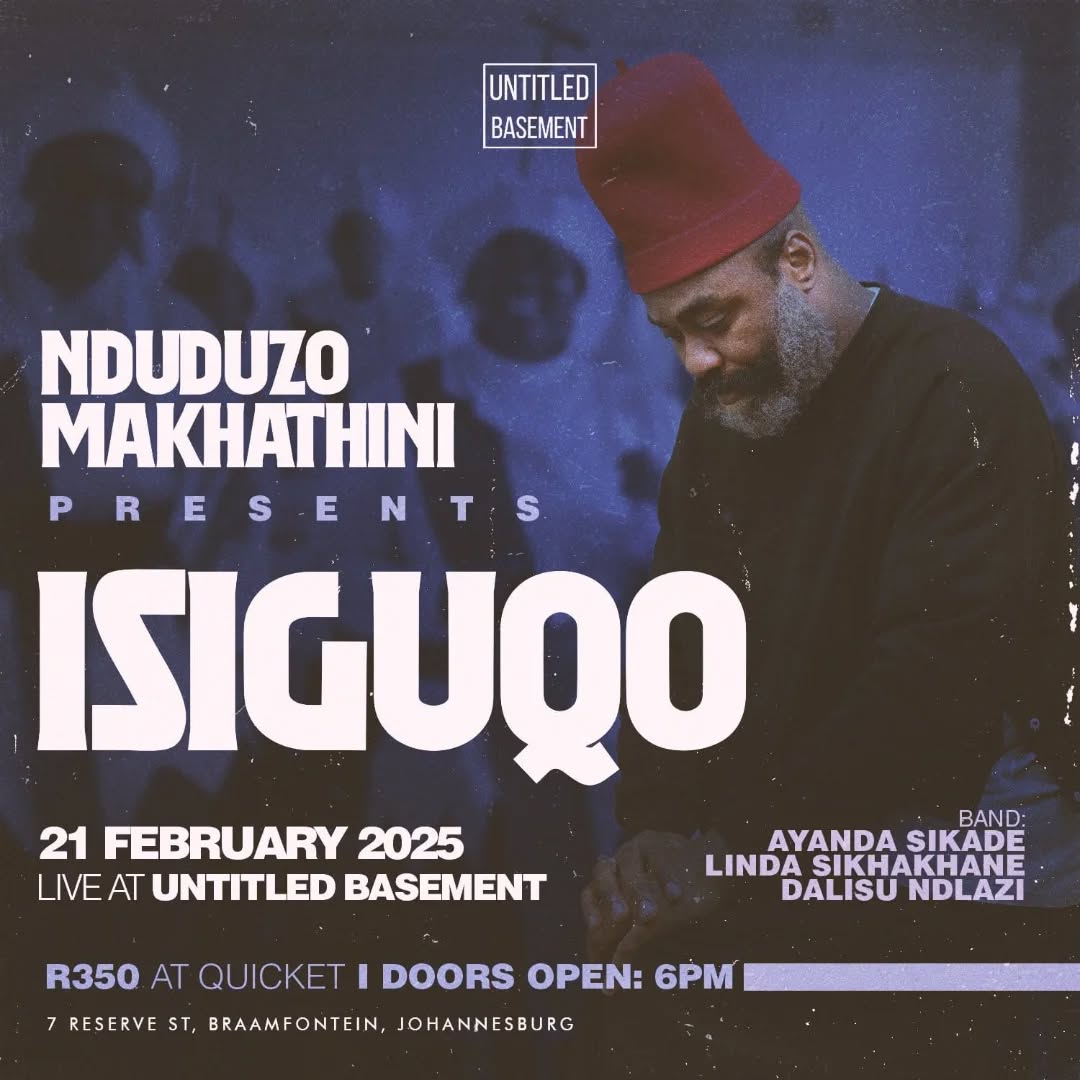
Both Isililo SikaNomkhubulwane, which took place in New York at Le Poisson Rouge, and Amolokotho KaNomkhubulwane, which took place in Johannesburg at Untitled Basement, were meditating on loss.
In the US, we thought about loss in the context of the violence of the Trans-Atlantic slave trade which happeded by way of water (as transportation into slavery) and the various moments of refusal along the way; the refusal to leave one’s land, culture, and language.
We looked at the ways in which jazz becomes a form of protest, a space that locates “black codes” and collective memory between Africa and all its diasporas. In this discourse uNokhubulwane is signified by what I refer to as the “Atlantic Bridge” which represents “choices” and ways of healing through returning to our collective black essence.
In Johannesburg, we engaged the laments of uNomkhubulwane which was located around the time of the rlease of the album. In this period (the season of Auset in Kemetic knowledge), uNomkhubulwane laments the departure of the sun (God) from the Southern Hemisphere to the Northern Hemisphere, resulting in winter.
In both instances, uNomkhubulwane is manifested in water, whether as tears or the ocean—or should we say oceans of tears?
In Umgidi KaNomkhubulwane, in Johannesburg at Nirox (at the Cradle of Humankind) and Amalokotho KaNomkhubulwane, at Untitled Basement, we returned to the language of gratitutde. At Nirox, the event conicided with both June 16 (the Soweto Uprising), and Father’s Day, which made the idea of celebration really complex.
On the one hand, most of us are still mourning this day and there is a fear that its significance stands a risk of being erased by turning it into a celebration of fathers. There is also the danger, in a general sense, in the ways we are socialised around such calendar events, the urgency to “move on” as we are constantly told.
On the other hand, there is the difficulty of language around how fatherhood is celebrated against the many societal issues that implicate men in society. In this complex dichotomy, I suggested a return to uNomkhubulwane by way of cleansing and rebirth.
Now that we have laid out some of the ways in which creation myths, the sonic and the everyday converge, I want to suggest that this ensemble of ideas is my unique effort to invite us to a place of study that transcends the “classroom” but is a way of studying what happends “outside” in the “peripheries”.
I find this approach to be useful against a world that has implicated our modalities of knowing into a kind of “death” and even more, a world that expects us to attend the funerals, where motion and life are taken away from study.
Study in this sense is a refusal to allow our indigenous knowledge to become extinct, both by way of erasure and that of “abstract inclusion” that often exerts its own violence on what is being studied. One is then advocating for a form of study that brings to the fore our cosmology as part of our everyday technology left behind by our great fore-mothers/fathers.
A deeper engagement with such a practice would help us transcend the effort of creating and “composing” the music, and focus, rather, on composing a being who understands the language of uNomkhubulwane.
That is to say, our metaphysical world is a realm of onging music, and if we are tuned into it, music becomes a citation practice from a library of abundance. Our sounds will follow the language of water and begin to flow with freedom and elasticity.
Consequently, the record uNomkhubulwane (2024) departs from text and the explications outlined above. At this stage, one should not be perceived to be trying to make albums but involved in a ritual of producing materials and a pathway for study.
I want to leave you with my new mantra:
Sithi makwande, kube inala esibelethweni sika
Nomkhubulwane. We proclaim plenty, let there be abundance in Nomkhubulwane’s womb.