MAKGATLA THEPA-LEPHALE
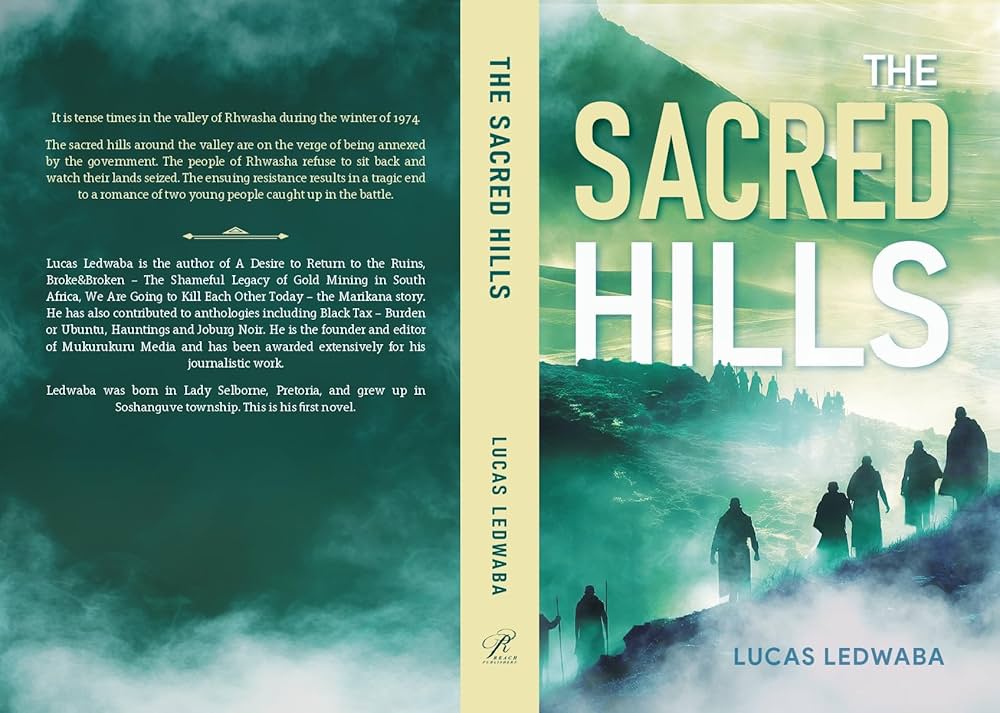
SACRED HILLS, A Novel by Lucas Ledwaba
A common trait in Lucas Ledwaba’s writing oeuvre is his ability to tackle complex issues that affect ordinary South Africans in their daily lives, from writing about land reform to putting human faces on the mining sector’s struggle in South Africa.
When Sacred Hills hit the shelves, it was expected to add to his body of work in voicing social justice issues in South Africa. Sacred Hills, is his debut novel and adds a twist to his known storytelling, bringing to the attention of South Africans the issues affecting the forgotten Black masses. Sacred Hills adds a new dimension to his thematic corpus by introducing a love story amid the struggle against forced removals.
At first, I was skeptical of the narrative, because it’s slightly different to his other offerings in the literary space. However, the book proves to be worthwhile since it is a novel packed with diverse emotions and lively characters. Sacred Hills traces the Ndebele people of Rhwasha and narrates a story of love, calamity, land resistance and cultural norms and values among Africans. Growing up in the villages, I have always known kgoro as the highest court in traditional communities. Ledwaba’s historical novel also emphasizes the importance of Nkrundla as the highest court for the people of Rhwasha.
Even though the book is fiction, it puts the Ndebele people—who are among the most marginalized communities in South Africa—and their language at the centre of the storytelling. 32 years after democracy, IsiNdebele remains one of the country’s marginalized languages. It’s very rare to come across a book written in IsiNdebele or one that speaks to the Ndebele people and their struggle. Sacred Hills provides a breath of fresh air in closing that gap. The book tells the story of a community fighting and defending its sacred land against the brutal system of apartheid that wanted to annex the ancestral land to build on it a resort. It’s the story of a community defending their heritage, honour and the land where their ancestors are buried.
At the heart of the novel is the people of Rhwasha, whose lives were tormented and marred by the atrocities of the evil system of land dispossession. The tragic interruption of their lives began first in 1854 and again in 1974, as their land was targeted for forced removal. When Jacobus Potgieter entered the Valley of Rhwasha, his mission was to disrupt and disrespect the lives of the people. He acted with so much impunity and pomposity that he even slept with women of the Valley. He acted as if he owned the people of Rhwasha, just as his forefathers did in 1854, which is why they suffered the same fate.
During the struggle period, every community would have young people rising to protect their communities against injustices inflicted by those who wanted to disturb their peace. Ledwaba traces the history of resistance to these injustices, focusing on Lebone’s courage as he fights to protect his ancestral land. Land dispossession refuses to be settled, even long after the country has gained its questionable ‘freedom.’’
What is freedom without land? What is freedom when the majority of Black South Africans remain landless?
The book also delves into the story of young love that was interrupted by the very same system that sought to annex the sacred land of Rhwasha. As the people of Rhwasha grew defiant and struggled to hold on to the land of their ancestors, a blossoming love story was to be disrupted by the system before it could unfold. Lebone fell in love with Morongwa. Their love was constant amidst the uncertainty of the people of Rhwasha. But their relationship was tested when was detained in Pretoria with his life hanging in the balance. Morongwa was left devastated after losing the love of her life to prison.
The book also delves into the importance of communality over individuality, as is demonstrated during the prayer session held at Lebone’s home. How village mothers carried Lebone’s mother during the difficult time of praying for the safe return of his son from Prison walls. It was not only women who showed moral support for Lebone’s family, but also the community, which gathered at Nkrundla to get updates on Lebone’s trial.
Lebone’s mother did not have to carry the pain of losing his son to prison alone; instead, it became a pain that was collectively shared by the community of Rwasha. The gathering of men, women and youth of Rhwasha to support Lebone whenever he was summoned to appear in court was a true definition of solidarity and the spirit of community. This is also evident in the community’s reaction when it heard that Lebone had been found guilty. The book says some women wept, while others threw themselves down in pain, which is a clear indication of a strong community, bound by a shared love and a spiritual unity.
One of the things that colonialism thrived on was the divide-and-rule strategy. It always targeted those it deemed weak and vulnerable. The people of Rhwasha were not immune to such a divide-and-rule strategy. The annexation issue nearly tore the community apart. Potgieter stood leaning against the truck, watching the Black men fight each other to protect him. There was a satisfied smile on his face as he stood watching them. The division was even among the women, as during one of their walks to the river to fetch water, some were flirting with the idea of moving to the “location” because it promised a comfortable life without collecting wood or drawing water from the river.
Some women lamented that the only homes and life they knew, was the one in Rhwasha, with others vowing to rather die than move. Ultimately the divide and rule strategy did not win because the people of Rhwasha stood firm in their defiance. The consistency with which they fought for their land was a testament to their traditional value system. Despite facing adversity and brutality, the people of Rhwasha did not lose their essence or their values.
In every community, there is always a wise elder, whose wisdom always prevails at uncertain times. The people of Rhwasha were fortunate to have such an elder in Nkhulu. The counsel of Elder Nkhulu is a true reflection of what an African community that prides itself on its values is characterized by. Nkhulu was a senior member of Nkrundla and a trusted advisor to Nkrosi Gegana. At the age of 74, Elder Nkhulu still had the courage to fight for what is right even in the face of death. His political statement in the courtroom reflected bravery, consistency in fighting for what is right, and honour for his ancestors and their land.
Ledwaba’s novel resonates with countless stories of land dispossession throughout South Africa.
The fact that, for every village matter, the people of Rhwasha rely on Nkrundla to provide solutions and counsel for their issues is a clear indication of how Africans pride themselves on their value system. Nkrundla, was, and in some villages still is, the highest arbitrator in resolving communal issues. The people of Rhwasha believed in the leadership of their chief and his traditional council.
Although the story of the people of Rhwasha is filled with tragedy and uncertainty, Ledwaba’s storytelling compels readers to engage deeply with the characters and their circumstances. Sacred Hills argues for the recognition and reflection on the painful legacies of colonialism and apartheid, particularly around the land question and its impact on the people.
The book is not short of humour amid tragedy, especially when women are having conversations about removals during their walk to the river. Books provide readers with questions, answers, or even clarity, regardless of genre. Ledwaba’s book has left me with burning questions that I am not sure where I will get the answers from. Do we still have brave young men such as Lebone amongst our communities? Old men who possess the wisdom of Nkhulu with their values intact? Is kgoro or Nkrundla still relevant in our modern democracy? What becomes the role of traditional councils under the democratic dispensation? Sacred Hills is a great book written in simple terms that the ordinary masses can comprehend. An important addition to the literary landscape.