KEMANG WA LEHULERE & LEFIFI TLADI
In Correspondence
This letter exchange which is continuous began as a result of having spent three months in Stocholm, a large part of which was spent producing collaborative drawings with myself and Lefifi Tladi. During the course of three months we made well over 30 collaborative charcoal drawings including ink drawings which are yet to be exhibited. This letter exchange comes on the back of many conversations and interviews with Lefifi in Stockholm in the later quarter of 2022. The works discussed are a body of paintings I produced as an extension of works I began making in my studio in Sweden. Kemang wa Lehulere, Cape Town, Wednesday 1 April 2026.
Dear Lefifi,
I hope these alphabets find you well, I am writing to you about a recent body of work that I have up at the Rupert Museum in Stellenbosch. By now I hope you have had some time to go through the document I sent you images of the works and titles. AS you will see there is a work titled, Petals of a visionary (for Oupa Lehulere) (2023-2025), that is the same title that you offered for our collaborative charcoal drawing we made in my temporary studio Stockholm, Sweden. As you may know he was the coordinator of the Jozi book fair that I helped co conceptualize, almost some 2 decades ago now. This is an important title to me as he was also very much in to jazz, just like you. In fact, he had also started a jazz program, as part of the fair with high school students.
I miss your humour sometimes and not so much your foul language and I will try not be contaminated by you in that latter matter. I am though reminded of a story, as I write; that you told me about someone who was buying music at a music store you were at some many years ago. You told me that he said he was only buying the music for the album cover, or rather in your words, “I’m buying the cover, fuck the music!” In a way, I feel that way about my paintings, they are silent songs or songs that are silent. Maybe they are mute. I’m not sure how I feel about this but let me elasticize and see how far I can stretch this.
Mute, a word I first familiarized myself with the use of a television remote control, refers to temporary speechless and or renouncing speech. I wonder what these paintings would say if they had human speech. But again, they are paintings because they have no human speech. In fact, there is a painting that is titled, Parable of the vanished vocals of the orator (2023-2025) oil on Canvas. Canvas. 60 x 45
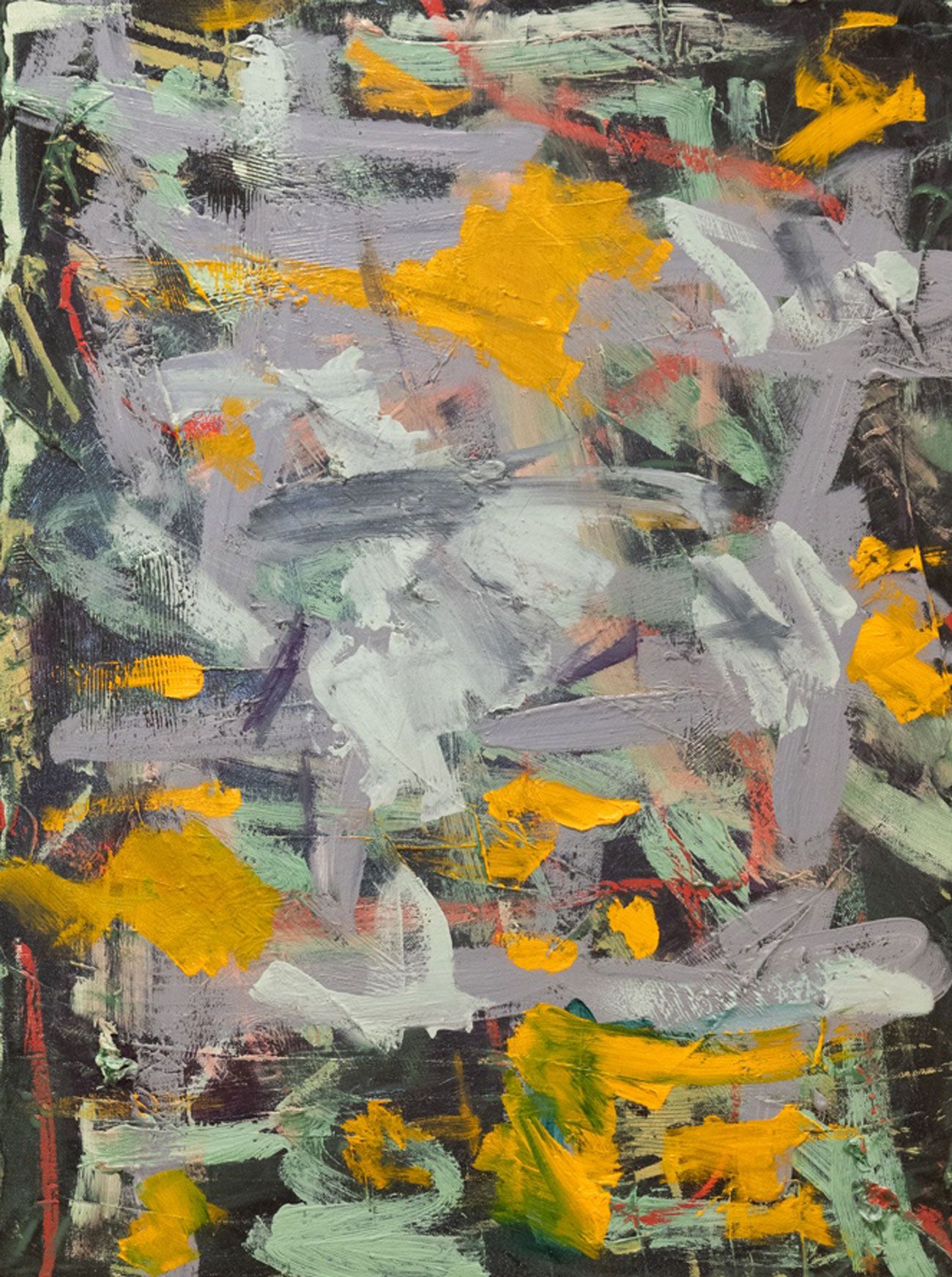
I often think of you as an orator of sorts, maybe because you have read many of your poems to me and was even more struck by how you are able to recite other writers works from memory. Regarding the works though, I would like to think of them as unmute. That is to say while they do not speak our vocabulary they have their own internal logic. White studying at Wits a professor once denounced the idea that artworks can have a vocabulary based on the fact that there is no established protocol of a syntax. Or something along those lines.
Would you say that the work is Mute? I am not sure I like where I am going with this. Even though it seems an interesting exercise nonetheless to think through with you. Mute also reminds me of the muting of animals. I cannot find the proper dictionary meaning of it, but I understand it as the castration of male both man and animal alike. The oxford dictionary offers an extension of meaning to the term beyond male genitals to mean deprivation of power, vitality, or vigour. To silence in a way. In my humble opinion, the said work, does not lack vigour at all. Muted colours is a term one often hears in the art world. I suppose elsewhere too. When I was in high school and learnt and got obsessed with the work on Andreas Bocelli, I was also told that he is a castrate. Apparently, these are young men who are castrated while young so that their voices never break and hence the possibility of singing at such high pitches. I am not sure whether this is actually true of Bocelli but I know that he also lost his sight by the way and I find that quite curious that he would come up in thinking and writing about paintings. Sometimes I touch the oil paintings I have here at home but this is not advisable of course.
I think this is what has drawn me to oil painting from an early age. Even though I couldn’t afford the material at university, something that led me more towards performance and ephemeral works, I do have a handful of oil paintings from around 2004/5 that mostly some of my family members purchased to support what was, at the time, seemingly a hobby. I have always been fascinated by texture. As a teenager I was always in awe of the paintings by Vincent Van Gogh, so much so that I stole a copy of his book at the high school library. I must add though, that it was also Van Gogh who made me reluctant to become a professional artist, as I thought all artists had mental health issues. After all, who cuts off their ear lobe and sends it off to their favourite sex worker. Another artists I was fascinated by in my teens was the Alberto Giacometti. The later figurative works even after he lost his sight was something more than fascination to me. To a point where I drew copies of his figurines. In the same vain, I am always intrigued by how much work you make on a daily basis and I hope I could maintain that like you should I ever live to be your age.
The work you titled for Oupa and I also used for the work below, Petals for a Visionary has much to be said for vision that is not in front us. Or rather speaks to that we have yet to see by way of proposal and vision. You often speak a lot about the relationship between abstraction and jazz music and sound as portraiture or songs as portraits. I would like to hear more about this.
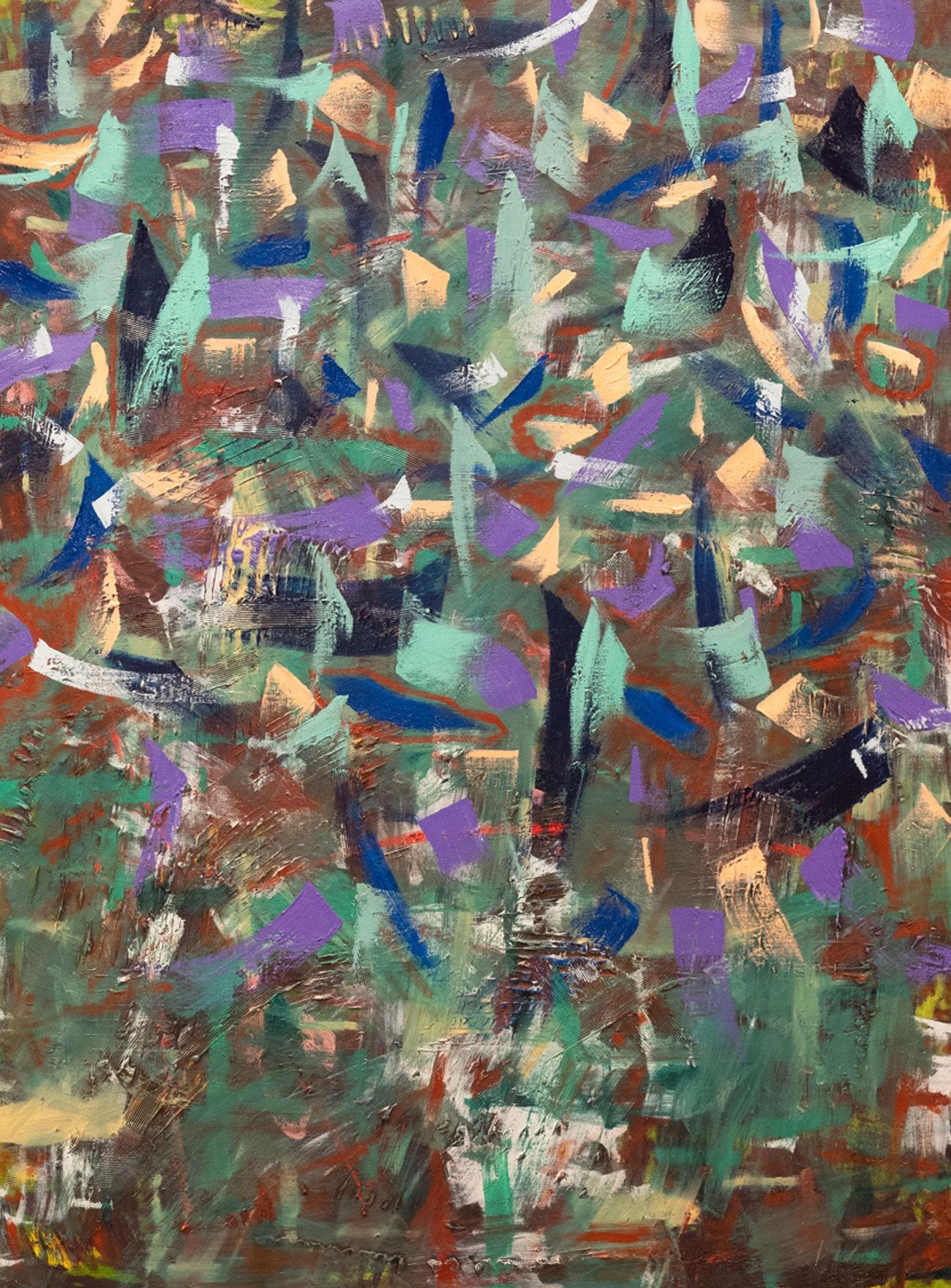
Especially portraiture, so the work for me, is a portrait of Oupa via petal like strokes, delicate colours of purple yet vigorous with warm browns reminiscent of the soil in Johannesburg. Oupa was very much into the piano instrument in jazz and horns too, he often would ask me to play home some Keith Jarett’s Koln Live Concert or Moses Molelekwa. I am reminded of how often he used to whistle while listening to music. He was a very sentimental person in his private life but the political climate is something that I feel made him think he had no luxury for such emotions.
I have some works on the show that are shaped in a square format. I have enjoyed working in this format quite a lot is it reminds me of the shape of a vinyl or CD cover, instead of the standard rectangular shape, which of course one could relate to the shape of a cassette tape. Now it makes sense why one would buy music just for the cover, there is something pleasing about the square. Or maybe it was a cassette they were buying the cover for, you never mentioned. I include another work below, The curse of ignorance of the property, possessed by an object of producing different sensations, on the eye as a result of the way it reflects (2023-2025) Oil on canvas. 100 x 100. While in Stockholm, you unrolled some of your very long works which you referred to as scrolls many of them more then 10 meters long and some more than 20 meters. Telling me about your desire to have a composer or jazz musician write music based on these drawings and paintings.
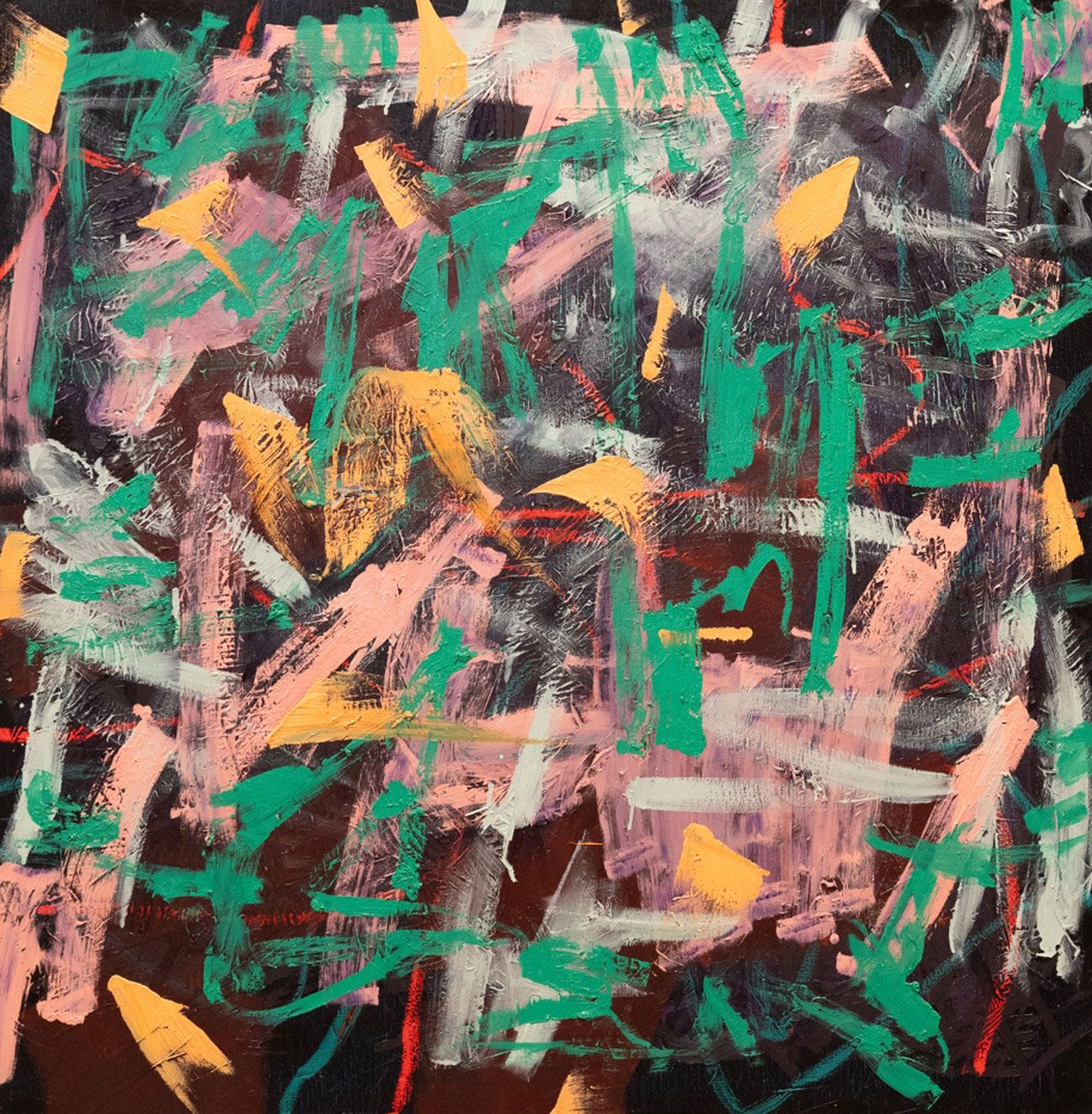
I am often curious as to what music they would write based on these and who would be up to this challenge? Many of the scrolls reminded me of Russian Constructivism something readily visible in the sculptural works of our fellow South African artist William Kentridge. I didn’t say this to you because I am often torn about contextualising artists’ works in relation to other artists. I find it as a way of gatekeeping at times, or a lazy way of reading artists’ works by placing them in certain pigeon holes, even though I must add that it is hard to look and see works in a vacuum without referring them to other artists. I guess it’s how we have been trained but also how we learn to see, by relating things to other things. Your scrolls are loud and bold, always as if begging to be heard. But who hears them? Do you know the phrase, often said in isiXhosa, that the eyes do not dish for each other? Which basically means we cannot see the same way as another person. And so I wonder, what if you were to give the same single scroll to different composers and musicians and see what they come up with? Kemang.
1
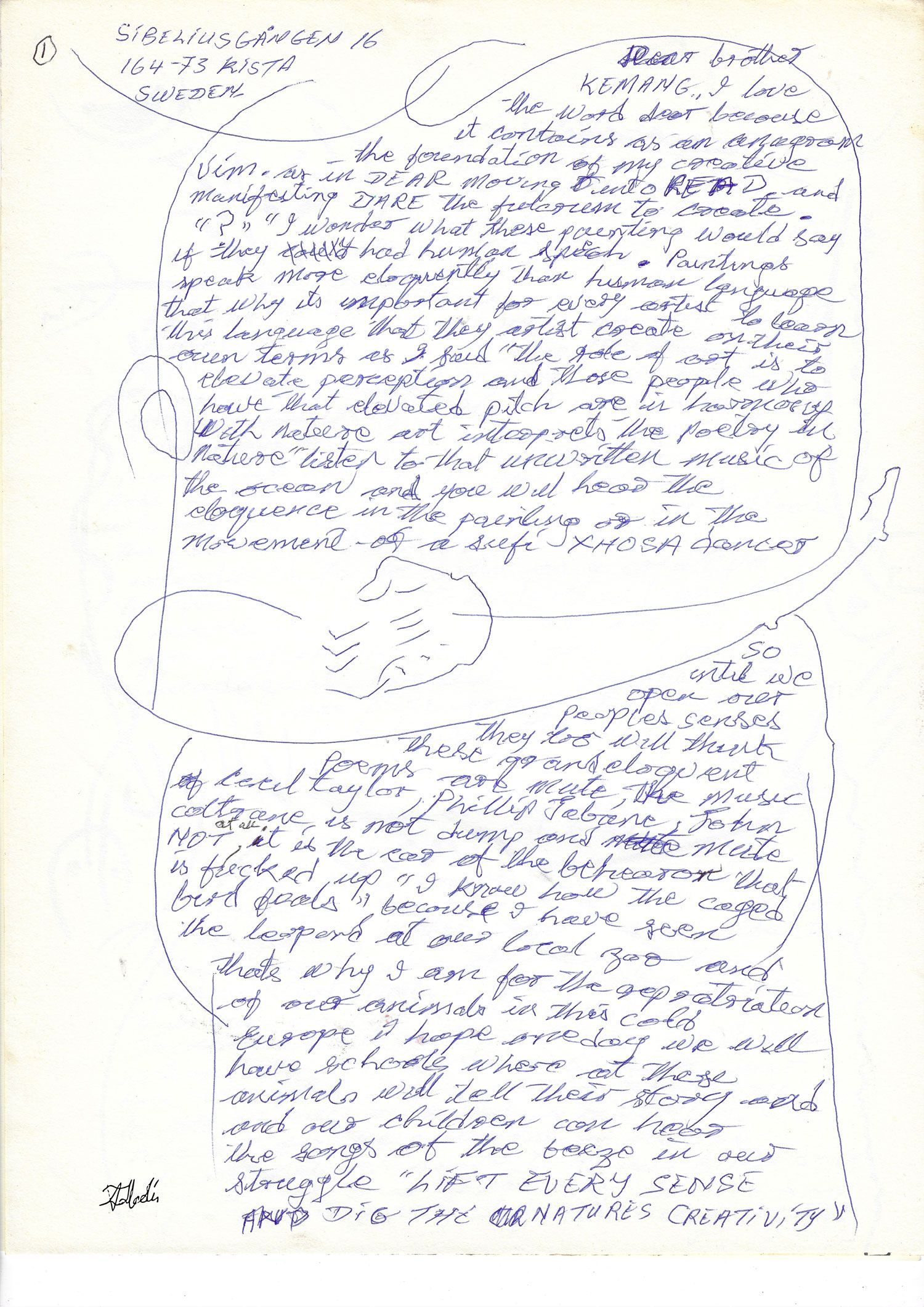
Dear brother KEMANG, I love the word dear because it contains as an anagram the foundation of my creative vim. As in DEAR moving into READ and manifesting DARE the fulcrum to create. “?” I wonder what these paintings would say if they had human speech. Paintings peak more eloquently than human language that’s why its important for every artist to learn this language that they artist create on their own terms as I feel the role of art is to elevate perception and those people who have that elevated pitch are in harmony with nature art interprets the poetry in nature listen to that unwritten music of the ocean and you will hear the eloquence in the painting or in the movement of a sufi XHOSA dancer.
So until we open our peoples senses they too will think grand eloquent poems are mute, the music of Cecil Taylor, Phillip Tabane, John Coltrane is not jump and mute not at all, it is the ear of the behearer that is fucked up. “I know how the caged bird feels” because I have seen the leopard at our local zoo and that’s why I am for the repatriation of our animals in this cold Europe I hope one day we will have schools where all these animals will tell their story and our children can hear the songs of the bees in our struggle “LIFT EVERY SENSE AND DIG THE NATURE’S CREATIVITY”
2
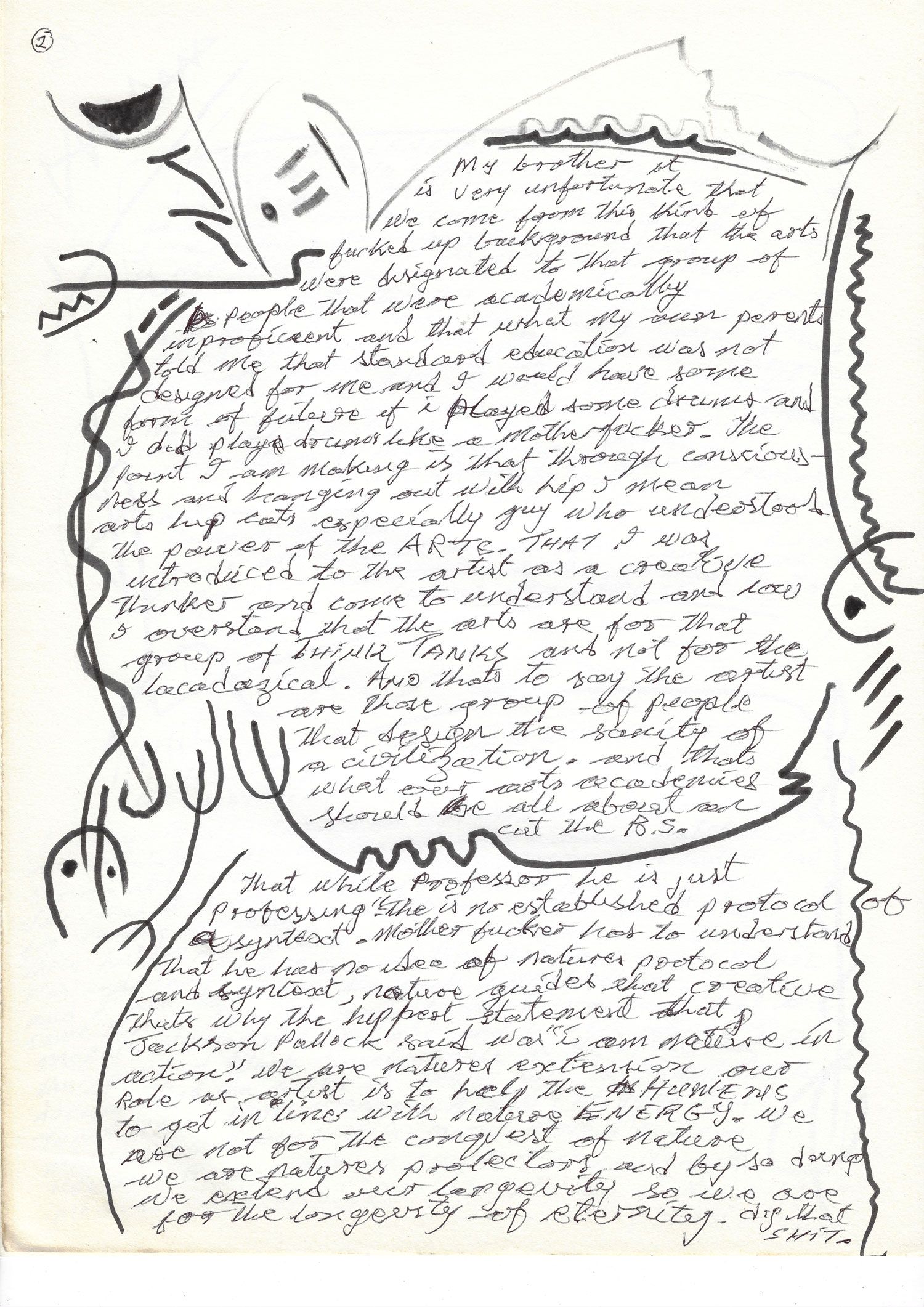
My brother it is very unfortunate that we come from this kind of fucked up background that the arts were designated to that group of people that were academically inproficient and that what my own parents told me that standard education was not designed for me and I would have some form of future if I played some drums and I did play drums like a motherfucker. The point I am making is that through consciousness and hanging out with hip I mean arts hip cats especially guys who understood the power of the ARTS, that I was introduced to the artist as a creative thinker and came to understand and how I overstood that the arts are for that group of THINK TANKS and not for the lackadaizical. And that to say the artists are those group of people that design the sanity of a civilization, and that’s what our arts academics should be all about and cut the B.S.
That white professor he is just professing there is no established protocol syntext not to understand that he has no sense of nature’s protocol and syntext, nature guides that creative, that’s why the hippest statement that Jackson Pollock said was “I am nature in action”. We are nature’s extension our role as artists is to help the HUMANS to get in line with nature’s ENERGY. We are not for the conquest of nature we are nature’s protector’s, and by so doing we extend our longevity so we are for longevity of eternity. Dig that SHIT.
3
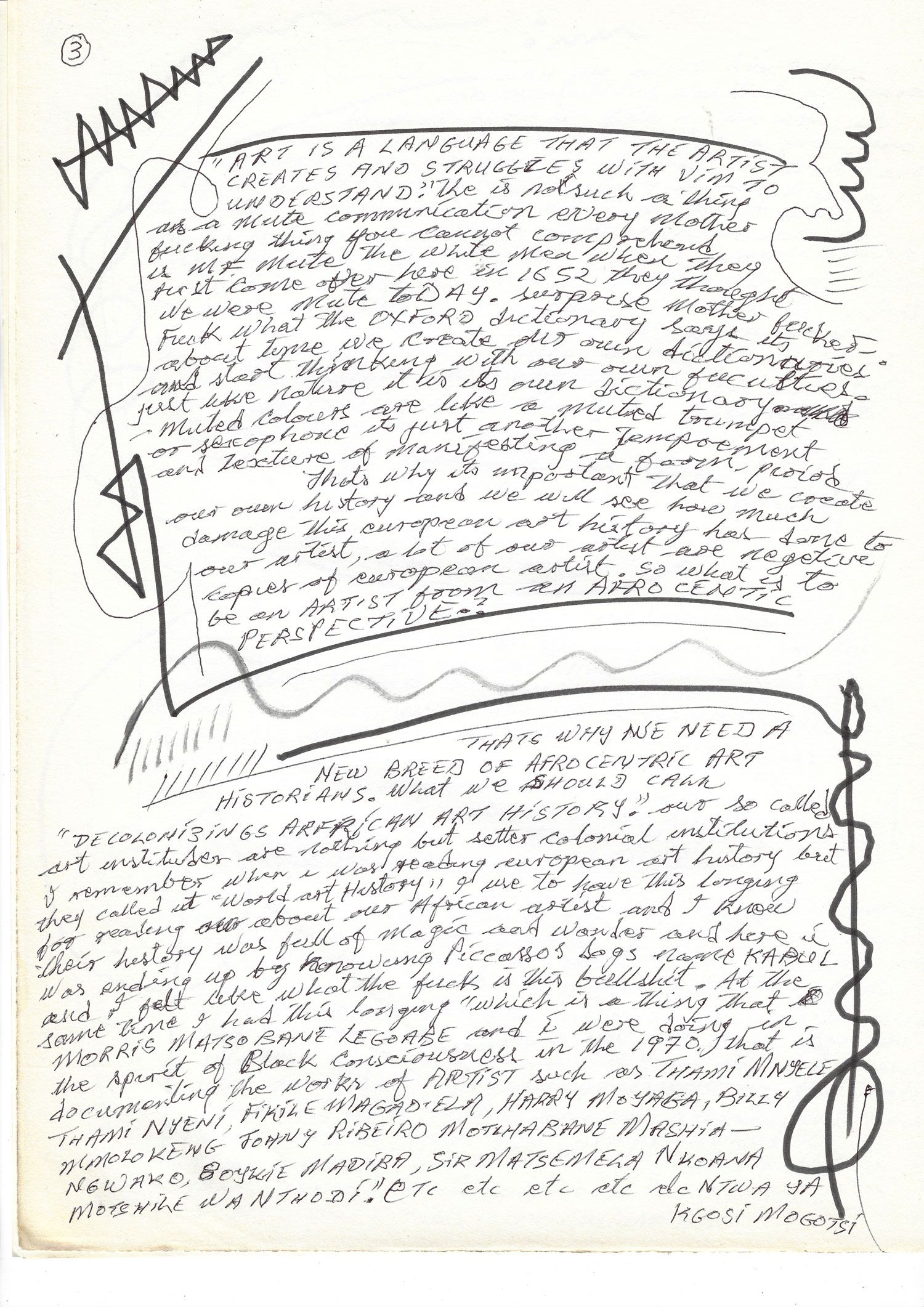
“ART IS A LANGUAGE THAT THE ARTIST CREATES AND STRUGGLES WITH VIM TO UNDERSTAND”: There is not such a thing as a mute communication every mother fucking thing you cannot comprehend is M.F. mute the white men when they first came over here in 1652 they thought we were mute to DAY. surprise mother fucker Fuck what the OXFORD dictionary says it’s about time we create our own dictionaries and start thinking with our own faculties just like nature it is its own dictionary. Muted colours are like a muted trumpet or saxophone it’s just another temperament and texture of manifesting a form, period.
That’s why its important that we create our own history and we will see how much damage this European art history has done to our artists, a lot of our artists are negative copies of European artists. So what is it to be an artist from an AFROCENTRIC PERSPECTIVE?
THAT’S WHY WE NEED A NEW BREED OF AFROCENTRIC ART HISTORIANS. What we should call “DECOLONISING AFRICAN ART HISTORY”. Our so-called art institutions are nothing but settler colonial institutions. I remember when I was reading European art history but they called it “World art History” I used to have this longing for reading about our African artists and I know their history was full of magic and wonder and here it was ending up by knowing Picasso’s dog name KABUL and I felt like what the fuck is this bullshit? At the same time I had this longing which is a thing that MORRIS MATSOBANE LEGOABE and I were doing in the spirit of Black Consciousness in the 1970s and that is documenting the works of ARTISTS such as THAMI MNYELE, THAMI NYENI, FIKILE MAGADLELA, HARRY MOYABA, BILLY MMOLOKENG, JOHNNY RIBEIRO, MOTLHABANE MASHIANGWAKO, MOYKIE MADIBA, SIR MATSEMELA NKOANA, MOTSHILE WANTODI. Etc. etc. etc etc de NTWA YA KGOSI MOGOTSI
4
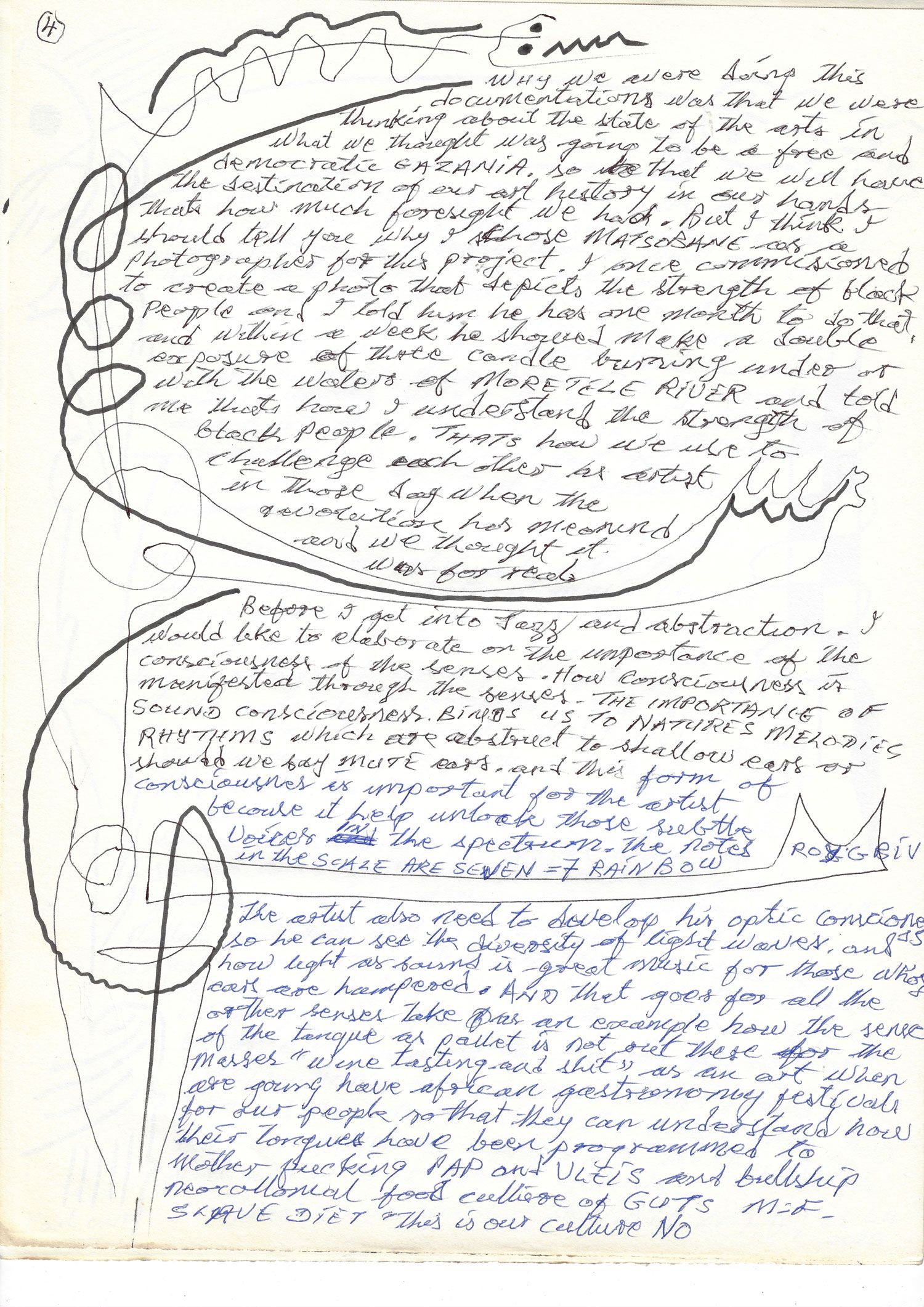
Why we were doing this documentations was that we were thinking about the state of the arts in what we thought was going to be a free and democratic AZANIA. So that we did have the destination of our art history in our hands, that’s how much foresight we had. But I think I should tell you why I chose MATSOBANE as a photographer for this project. I once commissioned to create a photo that depicts the strength of black people and I told him he has one month to do that, and within a week he should make a double exposure of three candles burning under or with the waters of MORETELE RIVER and told me that’s how I understand the strength of black people. That’s how we used to challenge each other as artists in those days when the revolution had meaning and we thought it was for real.
Before I get into jazz and abstraction. I would like to elaborate on the importance of the consciousness of the senses. How consciousness is manifested through the senses. THE IMPORTANCE OF SOUND CONSCIOUSNESS BINDS US TO NATURE’S MELODIES RHYTHMS which are abstract to shallow ears or should we say mute ears, and this form of consciousness is important for the artist because it helps unlock those subtle voices in the spectrum. The notes in the scale are seven = 7 RAINBOW ROYGBIV
The artist also needs to develop his optic consciousness so he can see the diversity of light waves and how light as sound is great music for those whose ears are hampered. AND that goes for all the other senses take an example how the sense of the tongue as pallet is not out there for the masses “wine tasting and shit” as an art when are going have African gastronomy festivals for our people so that they can understand how their tongues have been programmed to mother fucking PAP and VLEIS and bullshit neo-colonial food culture of GUTS. M.F. SLAVE DIET. This is our culture NO.
5
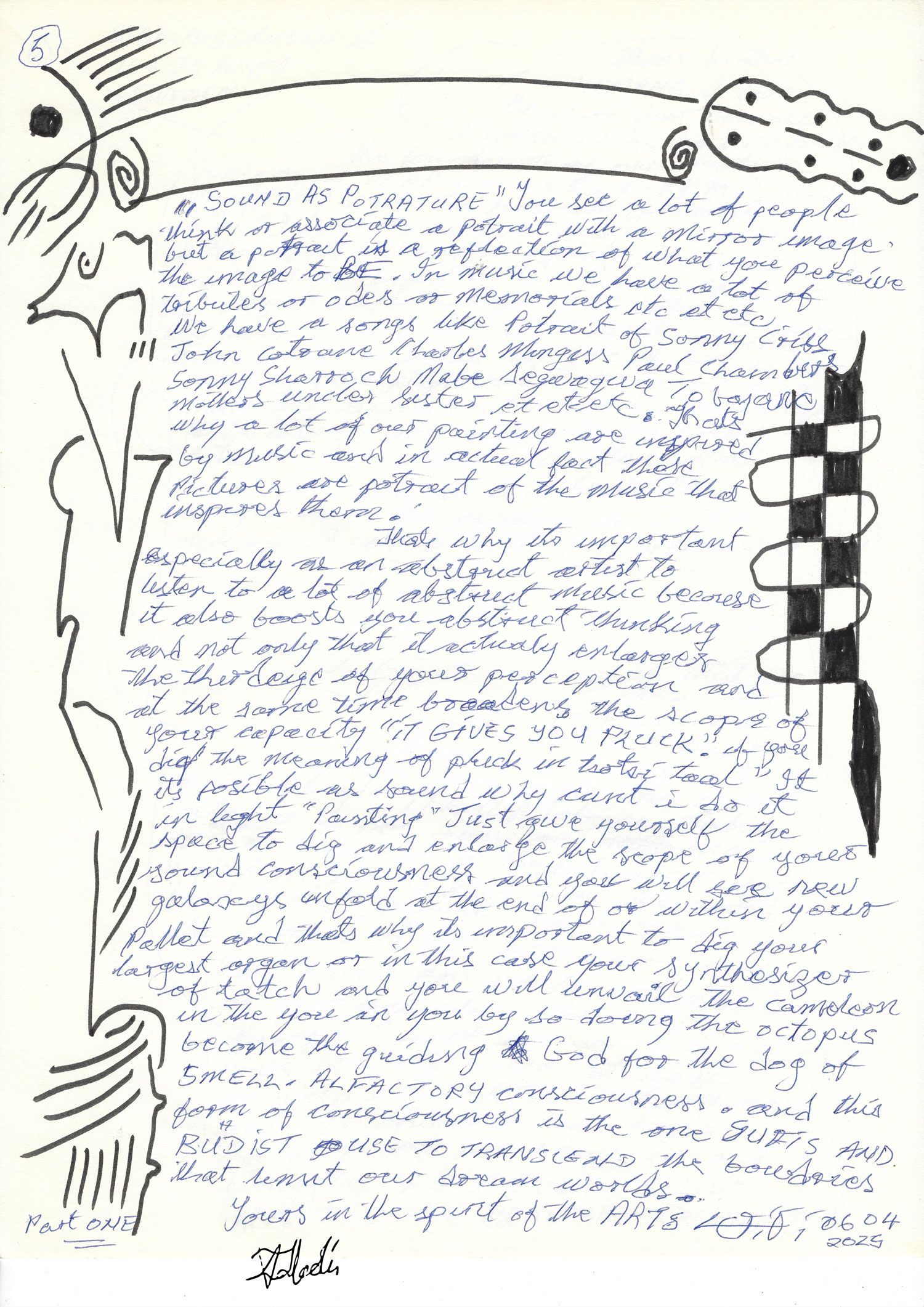
SOUND AS PORTRAITURE. You see a lot of people think or associate a portrait with a mirror image but a portrait is a reflection of what you perceive the image to BE. In music we have a lot of tributes or odes or memorials etc etc etc. We have a songs like Portrait of Sonny Criss John Coltrane Charles Mingus Paul Chambers Sonny Sharrock Mabe Segwagwa Tobejane mothers under sister etc etc etc. That’s why a lot of our paintings are inspired by music and in actual fact those pictures are portraits of the music that inspires them.
That’s why it is important especially as an abstract artist to listen to a lot of abstract music because it also boosts your abstract thinking and not only that, it actually enlarges the third eye of your perception and at the same time broadens the scope of your capacity “IT GIVES YOU PLUCK” if you dig the meaning of pluck in tsotsi taal. It is possible as sound, why can’t I do it in light “Painting”? Just give yourself the space to dig and enlarge the scope of your sound consciousness and you will see new galaxies unfold at the end or within your pallet and that’s why it’s important to dig your largest organ or in this case your synthesizer of touch and you will unveil the chameleon in the you in you by so doing the octopus become the guiding God for the dog of SMELL. OLFACTORY consciousness, and this form of consciousness is the one SUFIs and BUDDHISTs USE TO TRANSCEND the boundaries that limit our dream worlds.
Yours in the spirit of the ARTS. LEFIFI 06042025
1
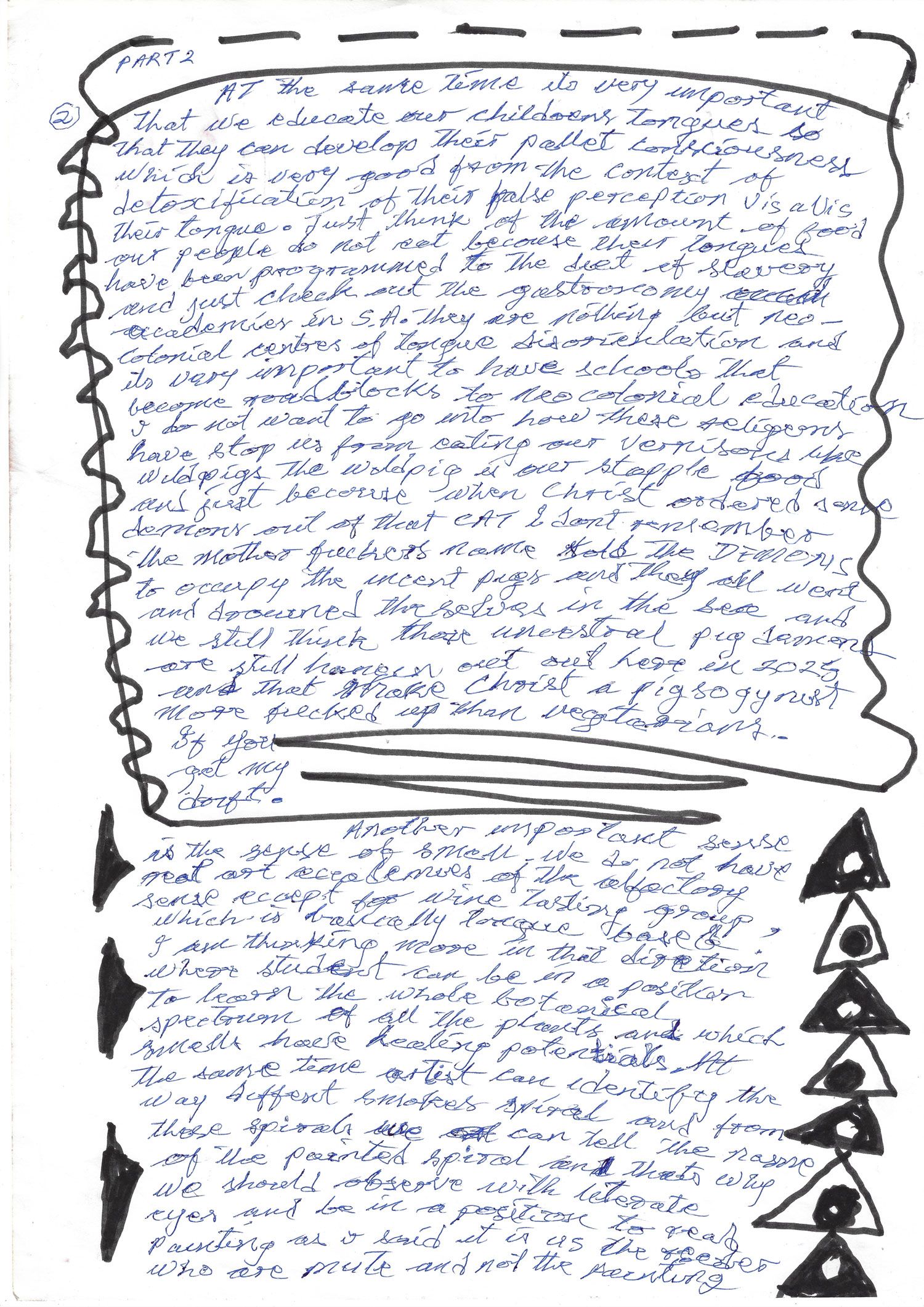
At the same time it’s very important that we educate our children’s tongues so that they can develop their pallet consciousness which is very good from the context of detoxification of their false perception vis a vis their tongue. Just think of the amount of food our people do not eat because their tongues have been rpgrammed to the diet of slavery and just check out the gastronomy academies in S.A. They are nothing but neo-colonial centres of tongue disorientation and its very important to have schools that become roadblocks to neocolonial education. I do not want to go into how these religions have stopped us from eating our vernison like wildpigs, the wild pig is our staple food and just because when Christ ordered some demon out of that cat I don’t remember the motherfucker’s name told the demons to occupy the innocent pigs and they all went and drowned themselves in the sea and we still think those ancestral pig jamsen (?????) are still hanging out here in 2025 and that makes Christ a pigsogynist more fucked up than vegetarians if you get my drift.
Another important sense is the sense of smell. We do not have real art receptors of the olfactory sense except for wine tasting group which is basically tongue based. I am thinking more in that direction where student can be in a position to learn the whole botanical spectrum of all the plants and which smells have healing potentials. At the same time artists can identify the way different smokes spiral and from these spirals we can tell the name of the painted spiral and that’s why we should observe with literate eyes and be in a position to read painting as I said it is us the reader who are mute and not the painting.
2
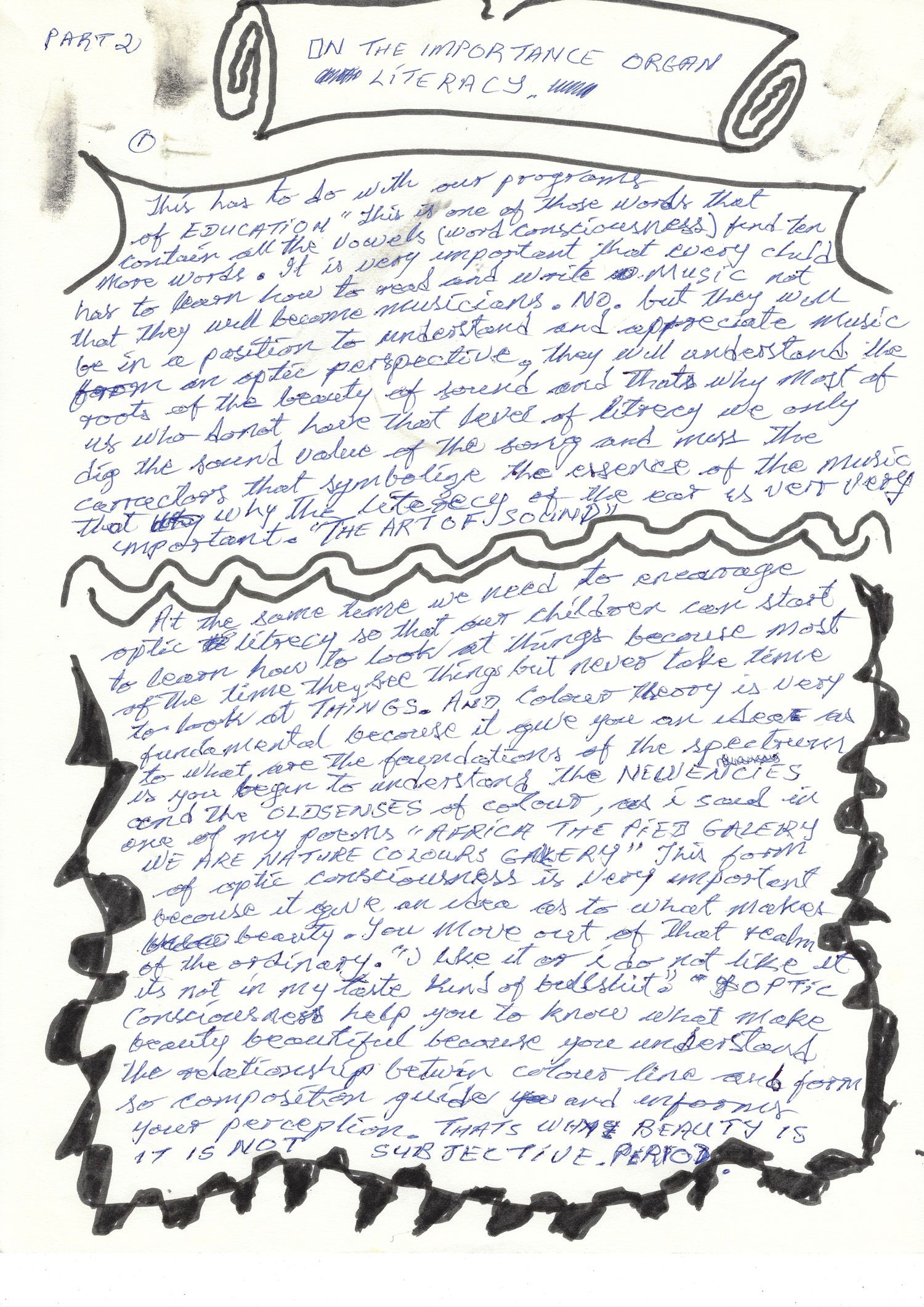
ON THE IMPORTANCE ORGAN LITERACY
This has to do with our programs of EDUCATION. This is one of those words that contain all the vowels (word consciousness) find ten more words. It is very important that every child has to learn how to read and write music, not that they will become musicians. No. but they will be in a position to understand and appreciate music from an optic perspective, they will understand the roots of the beauty of sound and that’s why most of us who don’t have that level of literacy we only dig the sound value of the song and miss the characters that symbolize the essence of the music that’s why the literacy of the ear is very very important. THE ART OF SOUND.
At the same time we need to encourage optic literacy so that our children can start to learn how to look at things because most of the time they see things but never take time to look at THINGS. And colour theory is very fundamental because it gives you an insight as to what are the foundations of the spectrum. As you begin to understand the NEW SENSES and the OLD SENSES of colour, as I said in one of my poems “AFRICA THE PIED GALLERY WE ARE NATURE COLOURS GALLERY” This form of optic consciousness is very important because it gives you an idea as to what makes beauty. You move out of that realm of the ordinary. “I like it or I do not like it it’s not in my taste” kind of bullshit. OPTIC consciousness helps you to know what makes beauty beautiful because you understand the relationship between colour, line and form so composition guides you and informs your perception. THAT’S WHY BEAUTY IS NOT SUBJECTIVE. PERIOD. Lefifi Tladi.