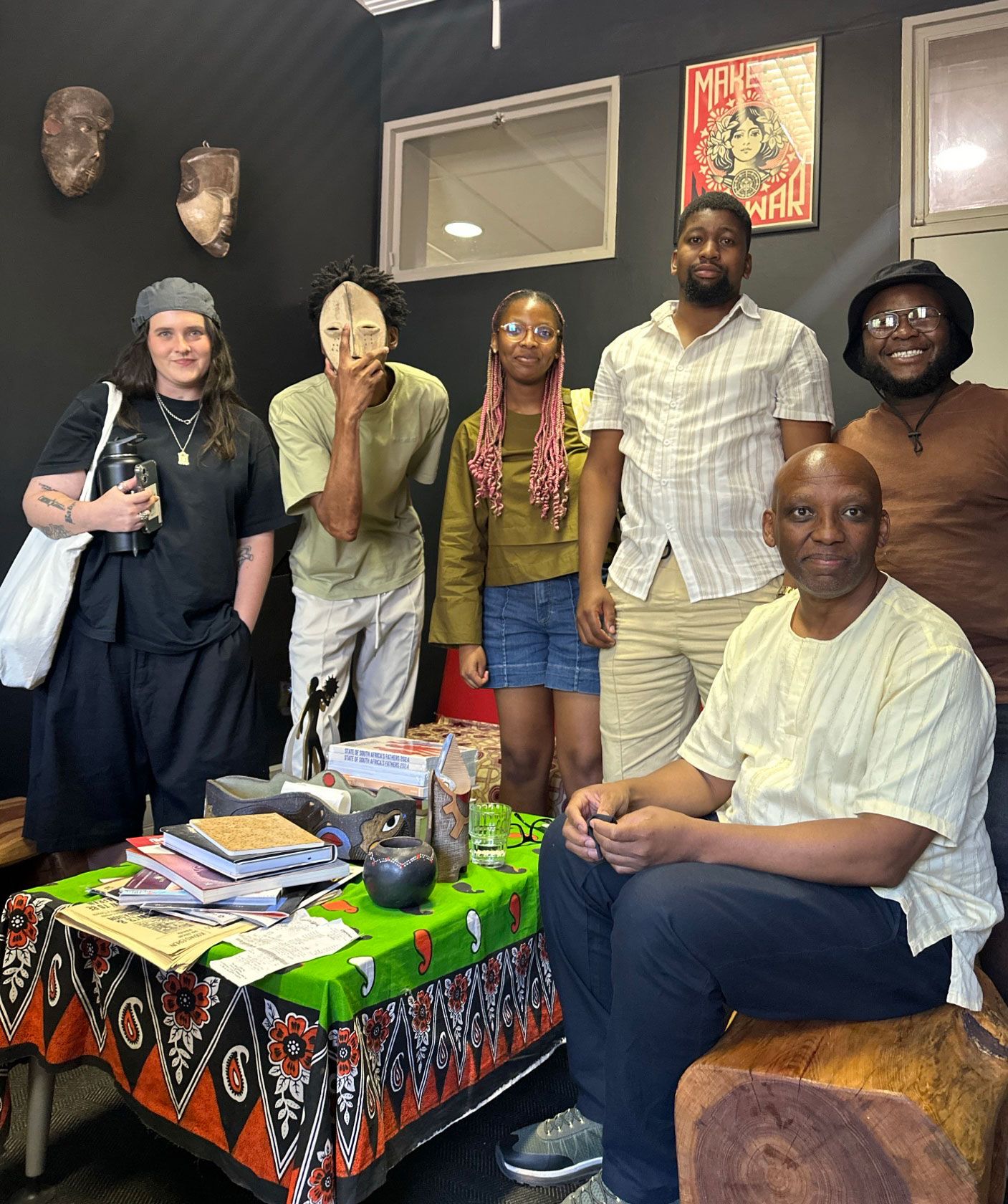
KOPANO RATELE & THE NHU SPACE POSSE
On The ‘NHU’ Space
What is the Nhu Space?
It is a space of Being. A space of Becoming.
Being what? Becoming what?
Above all, being and becoming human.
Since there is no university course on being and becoming motho, and I work at a university, I have found that making space for myself and others to think about the human animal is eminently satisfying. This is what the Nhu Space does.
More prosaically, it is a space for thinking about being and becoming umuntu. And one way to approach this thinking is to become, and to be, a reader.
It is never too early to be a reader; for that matter, it is never too late. Reading is the beginning of the life of the mind.[1]True Stuff: Socrates Vs The Written Word I think the mind, which is to say the brain[2]Understanding the Mind, is a significant feature of human animals. Important does not mean the only thing or even the essential thing. All the same, as a teacher, I see my main role as nurturing in my students and younger scholars the love of close, deep, slow reading. I want them to believe that reading, in a world at war with itself, when humanity may be hurtling at great speed towards the end, may be one of the worthwhile things left worth doing. Beside the ability to differentiate beauty with ugliness, a world of reading in one’s voice, enjoying the quiet in one’s mind, may become one distinction left between humans and agentic humanoid robots.
To say that the Nhu Space is a space for readers and readers-to-be is not to disparage those who prefer the life of feelings or who work with their hands. We need healers of the spirit and plumbers, farmers and tailors. We each have talents to nurture and contributions to make. And who says you cannot be a reading tailor? All the same, besides nurturing thinking about batho and botho, the Nhu Space rests on the awareness that as doing, sensing, feeling, and intuiting beings, humans are always in process, imperfect till the end.
Reading well is inseparable from learning to think well. Reading never stops at words. One learns to read in order to see clearly, which is to say, to think critically and creatively. It means thinking beyond, beneath, or through the words you read or hear. Careful, unhurried, absorbed reading is a luxury I am prepared to own. What else is slow reading when app developers promise you the ability to read 100 books in 100 days, or a 500‑page book in one day, but an indulgence?
But is it? Could slow reading be, in a world of short attention spans and reels, one of the fading defining features of our species?
Even though it cultivates the mind, reading alone can isolate when there is no one with whom to discuss one’s thoughts. At the Nhu Space, a place is made for readers and would-be readers to engage each other—ask questions, dialogue, be wrong—carrying with us the realisation that a person is always becoming.
There are so many books to read, let alone academic papers. One must delimit one’s interests. The Nhu Space is anchored in two thematic areas:
- Decolonising, decolonial, indigenous, Africa(n)-centring psychological studies, and
- Boys, men, and masculinities.
With regard to the first, we encourage each other—students, fellows, and associates—to think differently about the usual psychological topics, but also to examine those that receive little attention in mainstream psychology: land, Black love, activism, housing, corruption, queering decoloniality, art, decolonising queer theory, dancing, white supremacy, home, and voice.
The same applies to studies on boys, men, and masculinities: thinking differently is encouraged. We push each other to develop creative and critical approaches, and to consider masculinities in relation to economic, technological, political, social, and cultural structures and processes.
But what does Nhu mean?
The nhu in Nhu Space is derived from munhu, vanhu, and hunhu.
To say munhu ane hunhu literally means “a person with personhood.” At the core of munhu, vanhu, and hunhu is the stem nhu, which can be understood as being, people, or life force.
When referring to an individual human being, nhu gestures toward qualities sought in a fully actualised person: ethical conduct, fairness, belief in justice, respect for others, empathy, sharing, community‑mindedness, interdependence, forgiveness, and generosity.
The question is: do humans ever become fully actualised, or are they always becoming? Do they reach god‑like perfection, do they become gods, or must they learn to live with imperfection until the end? Can anyone perfect the qualities that make humans human? Or are we inescapably “a not‑yet”: unfinished, imperfect, developing?
In the spirit of the Nhu Space, we use this to reflect on nhu, not‑yetness, becoming, and incompleteness and some of the work we do. Here are some contributions.
‘not-yet’
Nicola Hartell. [Nicola Hartell is working on her Master’s on the question of how South African lesbians of different races experience love and intimacy from a queer theory and decolonial perspective.]
Queer, ontological incompletion
An ethic of unfinishedness
A rejection of the normative endpoint: ’ready’, ‘perfect’ or ‘done’
A resistance of colonial and heteronormative closure
A commitment to perpetual becoming
What are African psychologists to learn from and teach about mbaqanga?
Kopano Ratele
It is almost unbelievable, given where I come from, to be in the company of the young as their teacher, able to facilitate their learning about people who think of struggle as rhythm; to be a study supervisor, mentor, or older colleague in a position to help these young people appreciate how they are following in the footsteps of people who dance for God’s glory. Given what I have experienced and witnessed, this journey seems complete in itself when one becomes a professor, but I think it is also a journey from which one can teach or write something worthwhile.
Townships and shantytowns are not designed for people to thrive. It is that basic. Yet it is precisely in these places, some with muddy lanes running with sewage, where every weekend morning a murdered body lies, where people invented a whole fertile world where there should be barrenness. They dance even when they suffer. This is what the blues, mbaqanga, coladeira, is’cathamiya, jazz, and highlife are; what jùjú and soul, kwaito and hip‑hop, soukous and Afro‑soul seek to communicate: that we are here. Struggling, but alive. Creative through pain. On Sundays, even beautiful.
What does this have to do with African psychology? What are African psychologists to teach about this world? We might also ask: how can American psychology teach young people from such worlds from the point of view of their grounded experience; teach about the glory carved from grime?
I want to propose that African psychology must nurture the Black will to life, the drive to create. African psychologists still have the chance, given their knowledge of places where children still die of hunger, to teach how to invent life itself, and to help design places (interior and material) where the sick and hungry express their creativity for the world. That might mean the African psychologist will have to be more like the creatives, at least also an artist, even if they are something else too. They will have to develop their own voice.
Perhaps that is too great a stretch. “African psychologists are not artists,” one might say.
“African psychology is psychology; psychology is a science; psychologists are more like scientists,” one might insist.
The claim that psychology is a science, to be treated like physics or biology, should be met with scepticism by African psychology students and new kind of scholar, the decolonising scholar.
The assertion appears in nearly every first‑year textbook. Many students take months, sometimes years, to come to see what this claim is intended to do. And to rightly doubt it. Unfortunately, many never do get see clearly.
I have no need to shout. Psychology belongs more with the liberal arts than the hard sciences. At best, it is kin to the human sciences rather than the natural sciences. If that is so, what might be gained by considering African psychology as (also) a creative discipline, one taught alongside African music, African philosophy, African history, African religion; in the same building as design, dance, painting, drama, and photography?
Is this not what many universities already do? Certainly. Yet others choose differently.
Choices have ramifications: for how psychology is positioned in a department and university; for the kind of education students receive; and for the professional, scientific, and humanistic ecosystems of a country.
I will not spend too much time on debates about what is or is not science. These debates can be esoteric and endless. But I do want to propose that African psychology students and teachers and researchers cultivate a desire to connect their work to the arts and to African and Black music; where music is deliberately made as an artistic expression.
Do not get me wrong. I do not subscribe to the view that making art to become rich is “selling out.” There are songs with catchy beats and two‑line lyrics that become the December anthem and keep the producer and DJ comfortably paid. There is room for that. Nothing wrong with it. The DJ has a “voice” too. A signature.
Sometimes we want to lose ourselves in the beat; sometimes we do not want to listen, we want to dance.
Yet there is a line – it is blurry, subjective – between the artistic and commercial sensibilities you can hear between a track by Distruction Boyz and one by Boyz II Men. They make music for different feeling states, and that is fine.
Still, in relation to African psychology, I am inclined to think of it, teach it, and have it be considered as part of the arts. Connecting African psychology to the arts connects it to the impulse to create. What I do not want lost is the simple but profound idea of conveying to young people that they must learn to experience themselves as not leftovers, not unnecessary. (A forty‑year‑old may also struggle with self‑doubt and benefit from unlearning feelings of inadequacy, but here I am concerned with the young.) This is the key idea, then: African psychology would do well to teach young people that each of them is not surplus, that they have something to contribute, and even more importantly, that they are unique. They have a voice.
And what a powerful thing voice is. Too many young people on a continent beset by immense challenges feel they have nothing to offer, that they are unnecessary, that the world can go on without them.
Yes, the world will go on without any single individual. But I propose that in African psychology classes we should teach each student to appreciate their singularity, resilience, possibilities, talents, and voice. It may sound like pop positive psychology, yet I struggle to understand why, in training people in psychology, we do not train them to understand their own psyches – their strengths, struggles, and histories. African psychology would do well, then, to help young people appreciate that their identities emerge from the history of people who were astonishing precisely because they were not supposed to survive, not supposed to be resolute, connected, inventive. Almost improbable.
This does not mean closing young minds to despair, venality, violence, helplessness, disease, wars, misgovernance, or death. Many young people who enter Psychology 101 have grown up hard. Given the odds set by slavery, colonialism, exploitative capitalism, racism, corrupt leadership, and apartheid, few would have bet on them. But here she is. Here they are. Here we are.
For this reason, having struggled to come this far, it becomes important to write about and teach a psychology rooted in knowledge of this world. This, I propose, is what at least one class on African psychology should want young people to know on the surface of their skin, in their veins, in the recesses of their psyche, in the way they breathe, walk, write, listen, or simply are. That whether it is mbalax, gospel, kwela, Afrobeat, or qgom, each form ultimately seeks to offer them a model of a Black subject who understands what their world is—and who struggles to create even when the world insists she is below average, disposable, less than nothing, less than human.
African psychology must learn from this struggle.
‘not yet’
Iphendule Filtane [Iphendule Filtane has just graduated with a Master’s degree. The title of his thesis is: “Cultural adaptation and mental health among male internal migrants”. He is embarking on a PhD on the topic “Psychological impact of immigration policies and discourses on international migrants.”]
I would say,in Xhosa, the idea of ‘not-yetness’ could be interpreted as “hayi okwangoku, linda umzuzwana nje,” (“not yet, give it a chance because good things take time”)
Shifting perspectives on men and masculinity: A postdoctoral research journey
Laing de Villiers
My name is Laing. I’m of white Afrikaans, Scottish and French descent. Laing actually is a Scottish clan name and the French side of my family have been in the Overberg region of South Africa for more than 200 years. With this lineage comes both the privilege of the last century as well as the guilt and shame of what my ancestral legacy is. As a man I carry the typical stoic strength and passive aggressive distanced (in)ability to verbalise my inner world. Like most people, I’ve been grappling with my identity for a large part of my life. In particular, it has been tricky to navigate who I am as a man, in and amongst of all the assumed or imposed parts of my masculinity and it has been feeling more and more complex the last few years.
In 2022 I attended a rites of passage experience led by the Mankind Project South Africa. For what seemed like the first time in my life I saw men who were not just asking important questions of themselves but men who showed up unapologetically and deeply vulnerably. It’s called mythopoetic men’s work and it uses a variety of approaches: Jungian inspired understandings of individuation within the collective consciousness, use of archetypes, and concrete emotional expression and tools. Most impressive to me was the model of peer-led self-help groups and rites of passage experiences that organisations like these offer.
When a group or organisation starts with the question, “what type of man do you want to be in this world?”, suddenly I’m intrigued and interested.
After 5 years of being involved in this type of mythopoetic men’s work, I can see the difference in myself not just from my own perspective, but also in the way others in my life have reflected it back to me. So I’ve been interested in what works well in these groups and also what are some of the challenges or shortcomings? Moreso, what different forms of rites of passage experiences for men exist in South Africa? What other programmes, research or organisations exist in the local South African landscape that are focussed on some form of gender transformational experience for men? These are some of the questions I bring to my current work and research as a postdoctoral researcher.
My background has been mainly in public health as a socio-behavioural researcher, exploring liminal identities or hard-to-reach groups of people and their access to vital health services from an intersectional and positive psychological lens. I believe hegemonic masculinity creates a sense of deep liminality, where men do not receive support from other men, struggle to express their emotions authentically and isolate their experiences as influenced by deep held fears and past traumas.
I see that in myself first of all. My research experience is in running ethnographic style cohorts using longitudinal qualitative interviews as well as creative processes to narratively explore people’s lived experiences. And so, I applied and have been accepted to this post-doctoral research within the Nhu Space in the Psychology Department of the University of Stellenbosch. One of two thematic areas of work in which the Nhu Space is anchored is Boys, Men and Masculinities. Clearly, my work falls under this theme and I aim to understand transformational masculinity in praxis.
There’s no perfect way to do this I realise, but it feels important to have a clear intention. So what’s my intention with this work? It is to really get a deep-seated understanding of what some of the interventions available for men look like, understanding some experiences and ideas from men involved in men’s work organisations, programmes and interventions, and seeing what rites of passage experiences are available out there in the local South African landscape. I am interested in practical ways to intervene in and on ideas of masculinity and masculine gendered stereotypical roles. Where do you begin? Where does it end? Is there something inherently wrong with masculinity or is there a perpetuation on the negated aspects and destructive qualities of masculinities?
I do not find myself having answers to these questions and I am less able to think myself through the theoretical conundrum as a way to figure out masculinity. But I’m excited to know more, especially in times when debates and conversations are becoming more polarised.
So, this is me embarking on this explorative study, to have the conversation with men involved in mythopoetic men’s work, men involved in academia, research, programmes and organisations that support men to look at their masculinity in a healthy way and to critically reframe their masculinity. David Whyte has a beautiful poem called Close In that speaks about the ability to start slowly, by taking the first step, not the second or the third, but to start with the first thing, the step you are scared to embark on. With that same exciting hesitance, I hope to find out more about what are some of the beautiful groups of people and organisations that support men on their journey in discovering themselves.
‘not-yetness’
Still questioning the idea of what is being or the state of being? I’d like to have this conversation. — Siyamthandaomuhle Muyanga [Siya Muyanga is a 2nd year student in the humanities at Stellenbosch University.]
I would say ‘not-yetness’ of being could be interpreted ngesiZulu as “okusamila buthule” (what is yet to sprout from the seed – seed of not-yetness), softly and quietly whilst no one is watching or as systems or constructs take a new form.
Queerness as horizon
Nicola Hartell
José Esteban Muñoz, in his 2009 work Cruising utopia: The then and there of queer futurity, conceptualises queerness as a mode of futurity that is not yet fully realised, positioning it as a horizon rather than a stable or completed identity. Drawing on Ernst Bloch’s notion of the Noch-Nicht (“not-yet”), he argues that queerness exists in the realm of potentiality, as an orientation toward alternative ways of being that exceed the constraints of the present. In this sense, queer existence is anchored in what could be, resisting the closure imposed by normative social forms.
While Muñoz situates ‘not-yetness’ primarily at the level of collective social transformation, the idea can be extended inward to the level of subjectivity. The self, like queerness, is never fully realised in the present, but is instead constituted through an ongoing process of becoming that refuses finality. To exist queerly is to inhabit this horizon; to remain open to emergence, to possibility, to variation and to revolution. Such an orientation unsettles linear understandings of time and development, foregrounding instead a mode of being that resists arrival and coherence.
In In a Queer Time and Place, Jack Halberstam (2005) argues that queer life resists the heteronormative expectation of arriving at stable identities and prescribed life stages, such as birth, maturation, marriage, reproduction and death. Queer being is instead marked by non-linear temporalities that refuse the demand to become complete, legible and valuable on schedule.
In The Queer Art of Failure, Halberstam (2011) develops the argument by reframing failure as politically and ethically generative. Within neoliberal and heteronormative frameworks, success is tied to coherence, mastery and socially sanctioned milestones, and failure appears as deficiency. Halberstam destabilises this binary by showing how not arriving, not mastering, and not finalising the self, rejecting the aforementioned logics of normativity, produces coherence, mastery and value in unfinishedness.
‘Not-yetness’ is therefore not merely a condition of futurity or a sign of lack, but a lived temporal practice and a queer refusal of normative success narratives. The self in perpetual becoming is not a flaw to overcome, but a deliberate rejection of the compulsion to arrive, thereby foregrounding the ontological implications of incompletion.
Being is a process of becoming
In the terrain of ontology, in Gender trouble: Feminism and the subversion of identity, Judith Butler (1990) challenges the assumption that identity is a stable or pre-existing essence, arguing instead that it is performatively constituted through repeated acts. There is no true self that precedes these performances. Rather, the effect of a coherent identity emerges through their ongoing reiteration. In this sense, being is not a fixed state but a continuous process of becoming, one that is never fully secured or complete. The subject is therefore always marked by a degree of incompletion. This destabilisation renders ‘not-yetness’ constitutive of subjectivity itself, rather than an interim phase on the way to a final way of being. To be is always to be in iteration, in process, and in excess of any singular definition. Such an understanding disrupts essentialist accounts of identity, and reframes a journey of becoming as the very matter of subjectivity. This raises questions about the limits of self-knowledge, and whether the subject can ever be fully known or articulated.
If Butler locates the instability of the subject at the level of ontology, Eve Kosofsky Sedgwick (1990) extends this indeterminacy into the domain of knowledge, in Epistemology of the Closet. Demonstrating how sexual identity is structured by contradiction and opacity, she interrogates the binary logics that organise modern understandings of sexuality, showing how these categories are both pervasive and inherently unstable. Knowledge about the self, in this framework, is thus never complete, it is partial and subject to revision. This produces a dynamic in which what is known and what is unknown are constantly in tension. ‘Not-yetness’ can be understood as an epistemic condition as such that the subject is never knowable, even to itself, and any claim to coherence or completion is provisional. Thus, indeterminacy is not a deficit of knowledge, but a constitutive feature of being. Such an insight complicates any straightforward orientation toward futurity, raising a question: must ‘not-yetness’ imply a future at all?
In No Future: Queer theory and the death drive, Lee Edelman (2004) challenges futurity, rejecting the idea that a queer way of being is oriented toward a utopian future. Central to his argument is a critique of what he terms “reproductive futurism,” in which the figure of the Child functions as the organising principle of politics and social life, and secures a normative investment in continuity, inheritance and in the future. Queerness is positioned as that which disrupts or negates these teleological narratives. This position stands in productive tension with Muñoz’s (2009) utopian horizon, complicating any straightforward celebration of the ‘not-yet’ as a future-oriented ideal. Instead, ‘not-yetness’ can be reconceptualised as a deferral of completion without the necessity of an endpoint. Not anchored in a promised future nor resolved in the present. An ongoing suspension. This tension opens onto the question of how such incompletion might be lived in relation to contemporary demands for self-realisation. A queer ethical stance of a refusal of mastery against neoliberal self-optimisation, an oppenness to transformation, a commitment to becoming in perpetuity.
‘Not quite yet’
Laing de Villiers
‘Not-yetness’, to me, feels like… to be in the mystery of not knowing or not needing to know.
Queer ethic of unfinishedness.
The question of how incompletion might be lived as an ethical stance can be approached through the distinction between neoliberal self-optimisation and a queer ethic of unfinishedness. In Technologies of the self, Michel Foucault’s (1988) notion of the “care of the self” conceptualises subjectivity as an ongoing project of formation. However, under neoliberal conditions, this is recast as an imperative to endlessly improve and maximise oneself. As Wendy Brown (2015) in Undoing the Demos and Byung-Chul Han (2015) in The Burnout Society argue, the contemporary subject is compelled to become an entrepreneur of the self, for whom incompletion signifies deficiency or something to be corrected through constant labour, discipline and self-surveillance. Thus, the ‘not-yet’ is experienced as lack in the pejorative sense. It is an index of failure to meet normative ideals. By contrast, a queer orientation to ‘not-yetness’ refuses the demand for optimisation, reclaiming incompletion as a condition of possibility rather than a problem to be solved. Here, in Écrits, Jacques Lacan’s (2006) notion of the subject as structurally lacking becomes instructive. Incompletion is not a problem to be solved, but a way of being. To inhabit this lack without seeking closure is to adopt an ethical stance that resists never being good enough, or never being ready.
The imposition of fixity onto the subject is particularly stark within colonial contexts, where, as Frantz Fanon (1952, 1961) argues in both Black Skin, White Masks and The Wretched of the Earth, the colonised subject is overdetermined through racialised and hierarchical schemas that foreclose the possibility of becoming otherwise. Colonialism does dominate materially, and operates at the level of ontology, producing subjects who are forced into rigid, externally imposed identities that deny complexity and multiplicity. In Black Skin, White Masks, Fanon (1952) illustrates how the Black subject is fixed within a white colonial gaze, rendered an object rather than a becoming subject, while The Wretched of the Earth (1961) calls for the emergence of a new way of being that is not bound by colonial categories, but constituted through a process of ongoing transformation. ‘Not-yetness’ is thus a rejection of colonial closure, an insistence that the subject is not reducible to imposed identities, and that it remains in excess of them. To claim incompletion contests coloniality. This foregrounds the necessity of rethinking subjectivity beyond imposed universal ways of being, creating space for expansive, historically responsive ways of being.
In On the Postcolony and Critique of Black Reason, Mbembe (2001, 2017) extends this critique by rethinking power, subjectivity, Blackness, and the human in ways that disrupt fixed and universalised conceptions of identity. His work attends to entanglement, plurality, and historically layered forms of temporality, complicating linear narratives of progress and singular developmental trajectories. Subjectivity, in this framing, is less a fixed essence than an ongoing negotiation shaped by political, historical and affective forces. ‘Not-yetness’ can be read as an affirmation of subjectivity as open-ended and in motion. Being is constituted through relations and transformations that cannot be fully stabilised or finalised. This shifts the emphasis from resisting imposed fixity to inhabiting multiplicity and incompletion as conditions of existence, thereby calling into question the universality of “the human” and the forms of subjectivity it privileges.
Sylvia Wynter (2003, 1995) deepens this interrogation by critiquing the overrepresentation of a particular way of being or type of person, what she terms “Man”, as if it were universal. This figure, produced through colonial and Enlightenment epistemologies, is positioned as a completed and self-contained subject, against which all other forms of being are measured and subordinated. Wynter argues that this overrepresentation forecloses alternative ways of being human, rendering them illegible or deficient within dominant frameworks. In this sense, the problem is that subjects are fixed, and that the very ideal of a coherent, finished human subject is itself a colonial construction. A ‘not-yetness’ of being, then, becomes a critical intervention into this paradigm as a refusal to aspire to the completion embodied by “Man,” and an insistence on the plurality and ongoing emergence of other ways of being. Rather than seeking inclusion within an already constituted category, Wynter calls for the invention of new ways of being that remain unfinished and generative. This reframing situates incompletion as the condition for reimagining ways of being altogether, inviting ever-shifting and open-minded forms of identity.
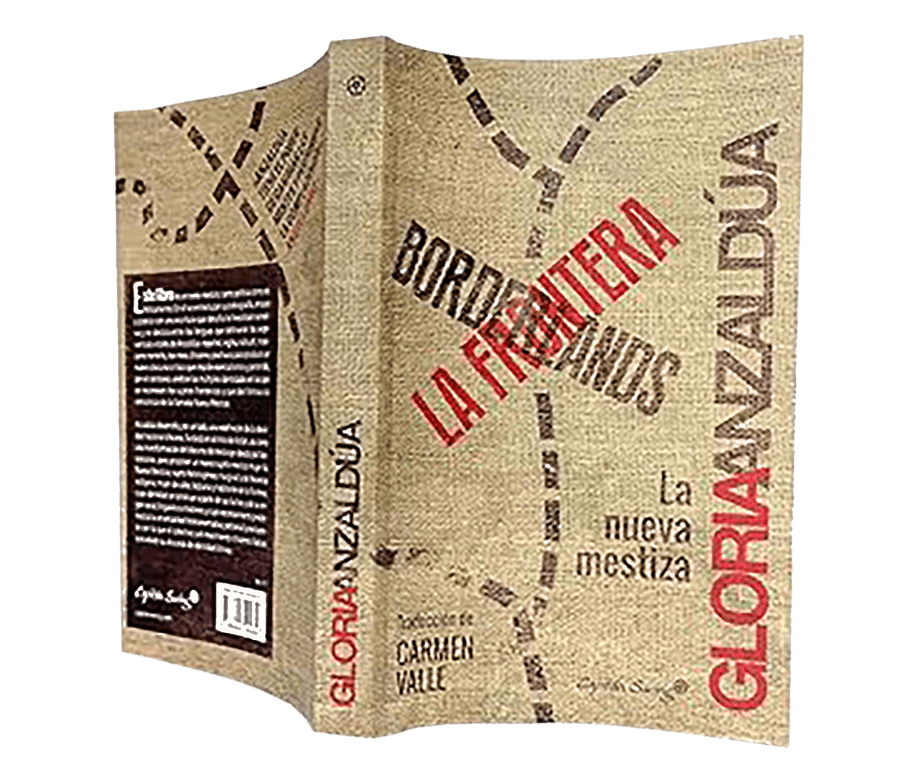
In Borderlands/La Frontera: The new mestiza, Gloria Anzaldúa (1987) offers a complementary account of subjectivity as fundamentally in flux through her conceptualisation of the “new mestiza,” a figure who inhabits the borderlands as a site of constant negotiation, contradiction, revision and transformation. Rather than resolving these tensions into a coherent identity, the mestiza consciousness sustains multiplicity and ambiguity as enduring conditions of being. Identity, in this framework, is not a destination but an ongoing process shaped by intersecting cultural, linguistic, and historical forces. The borderlands thus become a space in which fixed categories are unsettled and reworked, allowing for the emergence of subjectivities that are neither singular nor stable. Thus, ‘not-yetness’ is lived as a continuous becoming that resists resolution, embracing instead the productive tensions of in-betweenness. Anzaldúa’s account foregrounds the affective and embodied dimensions of this process, where transformation is lived through negotiation and contradiction. In doing so, she extends the critique of fixed identity into a praxis of inhabiting duality, where the refusal of closure becomes a way of sustaining openness. This emphasis on lived, situated transformation resonates strongly with contemporary African queer scholarship
‘not-yet’
Kopano Ratele
Embracing that you will get wrong sometimes, maybe often.
Open to learning.
You don’t have all the answers.
The goal of life is to learn how to live.
Ho ba motho ke ho ithuta ka botho.
Ukuba umuntu ukuzifundisa ngobuntu
Is it not strange that other mammals, and fish, and birds, and reptiles, and trees, do not spend as much time, if they spend any time at all, on learning how to be themselves? Human animals, though, spend an inordinate amount of time learning how to be human do they not? That might be the essence of ‘not-yetness’ of being human?
African queer thought
Within African queer scholarship, where identity is approached as contextually embedded, relational and continually in formation, the ‘not-yetness’ of being finds further footing. Zethu Matebeni (2011, 2014) foregrounds the ways in which queer subjectivities in South Africa are negotiated through embodied, spatial and affective practices that resist reduction to fixed identity categories, particularly those imported from Euro-American frameworks. Similarly, Kopano Ratele (2013, 2016) emphasises the fluidity and plurality of masculinities, demonstrating how subjectivities are shaped through ongoing interaction with sociopolitical and historical conditions rather than stabilised into singular forms. Across these works, being emerges not as a completed state but as an evolving process, one that is attentive to the complexities of lived experience and the constraints of context. As such, ‘not-yetness’ is a necessary condition for articulating forms of being that exceed imposed categories and remain responsive to shifting realities. This situates incompletion as both a descriptive and ethical stance within postcolonial contexts, where the refusal of fixed identity becomes integral to resisting epistemic and ontological imposition. In this sense, a ‘not-yetness’ of being can be understood as both queer and decolonial, grounding subjectivity in perpetual becoming.
Thus, a ‘not-yetness’ of being is a commitment to the journey, but a refusal to arrive. It is a deviation from Western, heteronormative, colonial expectations, resisting the demand to become something that is ready or finished, and instead, remaining in motion and continual process. To “be kind to your becoming,” (to quote one of our members, Tema), or to commit to becoming as a state of being, and to recognise it as a strength, not a failure.

Anzaldúa, G. (1987). Borderlands/La Frontera: The new mestiza. Aunt Lute Books.
Butler, J. (1990). Gender trouble: Feminism and the subversion of identity. Routledge.
Brown, W. (2015). Undoing the demos: Neoliberalism’s stealth revolution. Zone Books.
Edelman, L. (2004). No future: Queer theory and the death drive. Duke University Press.
Fanon, F. (2008). Black skin, white masks (R. Philcox, Trans.). Grove Press. (Original work published 1952)
Fanon, F. (2004). The wretched of the earth (R. Philcox, Trans.). Grove Press. (Original work published 1961)
Foucault, M. (1988). Technologies of the self. In L. H. Martin, H. Gutman, & P. H. Hutton (Eds.), Technologies of the self: A seminar with Michel Foucault (pp. 16–49). University of Massachusetts Press.
Halberstam, J. (2005). In a queer time and place: Transgender bodies, subcultural lives. NYU Press.
Halberstam, J. (2011). The queer art of failure. Duke University Press.
Han, B.-C. (2015). The burnout society. Stanford University Press.
Lacan, J. (2006). Écrits: The first complete edition in English (B. Fink, Trans.). W. W. Norton. (Original work published 1966)
Matebeni, Z. (Ed.). (2014). Reclaiming Afrikan: Queer perspectives on sexuality and gender. Modjaji Books.
Matebeni, Z. (2011). Exploring Black Lesbian Sexualities and Identities in Johannesburg. (Doctoral dissertation, University of the Witwatersrand).
Mbembe, A. (2001). On the postcolony. University of California Press.
Mbembe, A. (2017). Critique of Black reason (L. Dubois, Trans.). Duke University Press.
Muñoz, J. E. (2009). Cruising utopia: The then and there of queer futurity. New York University Press.
Ratele, K. (2016). Liberating masculinities. HSRC Press.
Ratele, K. (2013). Subordinate Black South African men without fear. African and Asian Studies, 12(1–2), 34–58.
Sedgwick, E. K. (1990). Epistemology of the closet. University of California Press.
Wynter, S. (2003). Unsettling the coloniality of being/power/truth/freedom: Towards the human, after Man, its overrepresentation—An argument. CR: The New Centennial Review, 3(3), 257–337.
Wynter, S. (1995). 1492: A new world view. In V. L. Hyatt & R. Nettleford (Eds.), Race, discourse, and the origin of the Americas: A new world view (pp. 5–57). Smithsonian Institution Press.