ENOCK SHISHENGE
Sam Mathe’s When You Are Gone
This review places the work of Sam Mathe’s When You Are Gone and Other Poems within the South African literary traditions while exploring the universal themes of absence, memory and resilience. It is Mathe’s debut poetry collection, comprising 38 poems that speak with a voice at once intimate, reflective and universal. It is a voice deeply rooted in South African cultural and political consciousness but expands to the broader human faculties. These post-modern poems are not just lyrical expressions of grief or longing but also surreal meditations on impermanence, on the fragile threads of memory, and the resilience of the human species. Mathe bridges, blends and bends literary criticism, journalism and biography. His engagement with South African cultural life informs his poetry, which is intended to synergise personal and collective history. Mathe’s praxis is defined by a commitment to poetry that is accessible, and which resonates with experiences of largely the working-class poor, and of course without isolating all types of readers, including the suburbanites. His voice is amenable while inviting readers into his reflections without alienating them with verbiage and jargon.

Mathe is not a poet who isolates himself in purely artistic experimentation; rather, he locates his work within lived experience, cultural memory and philosophical inquiry. In the poem “The Taxi driver’s Lament” (p. 27), he writes about the daily routine of a working life in the city, “I wake up at the break of dawn/and before sunrise I am gone/to begin a new day behind the wheel.” These lines mirror the daily toil of ordinary South Africans, thus grounding the poem in lived reality.
“Queues,” also captures the lived hardships of the discarded masses in the following lines: “Snaking queues the length and shape of the river Nile/Miles and miles of masked faces that can’t smile” (p. 15). Similarly, cultural memory is excavated in “Tribute to Don Mattera” (p. 20), in which the speaker declares melodically, “I have heard your sweet voice/ Singing Azanian love song” invoking a collective memory of resistance and affirming cultural pride.
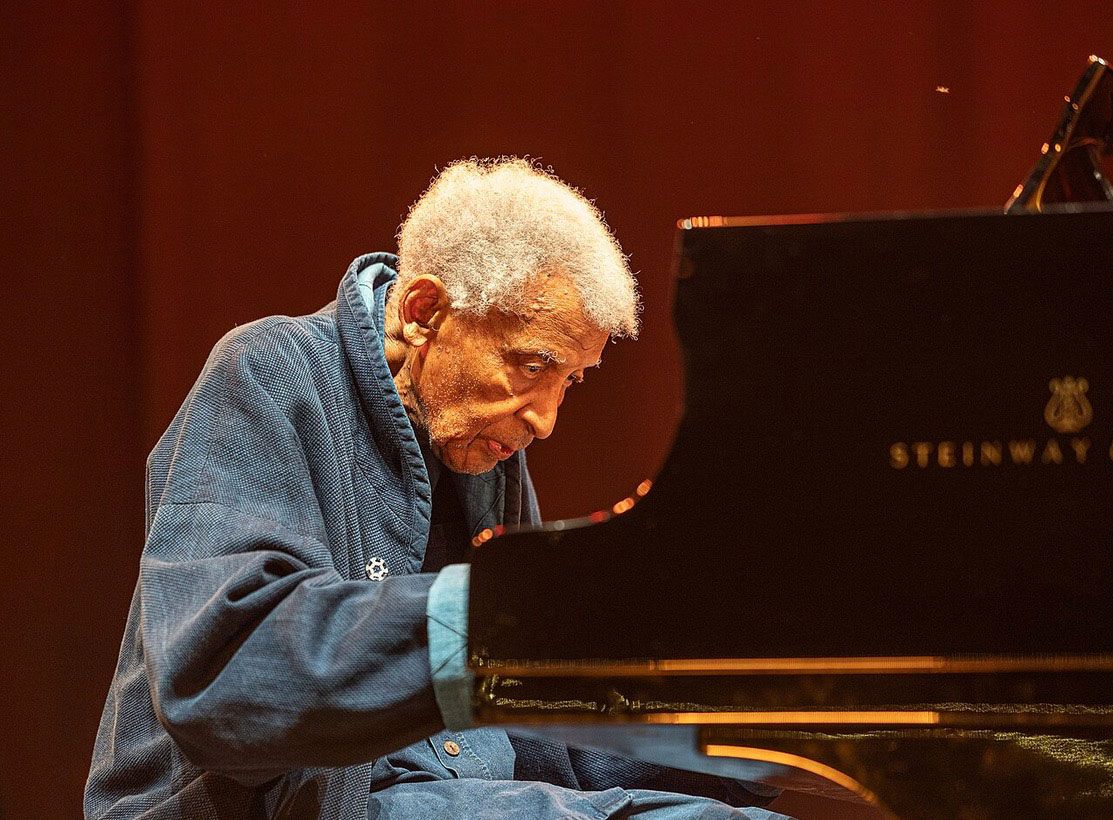
“Blues for a piano king”, celebrates the huge impact of Abdullah Ibrahim’s weaving jazz and poetic vibes.
Some cats still call you dollar brand
the soul brother with perfect timing (p. 45).
“A song for Steve Biko”, (p.42) positions Biko’s martyrdom as part of national consciousness, admiring how the father of Black Consciousness in Azania, “… walked among us, your people/but you were always steps ahead.”
The collection’s central concern is absence, whether through death, separation, or the erosion of memory and political critique.
“A song for Steve Biko”, attests to this when he writes:
They punctured and fractured your skull
but like the majestic seagull
your undaunted and defiant spirit soared” (p. 42).
Similarly, ‘Ode to Can Themba’ shows the theme of absence through mortality and the persistence of memory echoes in these lines:
Though you have been gone for half a century,
and have returned essentially as a memory” (p. 26).
The erosion of memory comes out clearly in “Blues for Piano King (Abdullah Ibrahim)”, as the speaker sings, “Let me drink from your ancient fountain/ of sacred knowledge and sage hood.” The poet shows the need to preserve cultural wisdom before it fades. In “Marikana,” the poet shows the absence of democracy, justice consumed by political betrayal and greed.
Marikana is platinum mountain of greed
in an ocean of suffering, exploitation and need (p. 40).
Absence is not treated as a void but as a space in which meaning is negotiated. In the titular poem “When you are gone”(p. 10), rhythm mirrors the ebb and flow of grief, moving between the sharp pains of loss and quieter moments of reflection. The fading light conveys the gradual acceptance of absence while repetition through the lines underscores the persistence of memory. The effect is not a technical showcase but an emotional implication that allows the reader to feel the weight of loss as lived experience. Poetic techniques are entrenched seamlessly within the broader thematic concerns while serving the vision rather than drawing attention to themselves.
Memory emerges as both burden and gift in several poems. Mathe captures its dual nature with tonal shifts that move from longing to the celebratory. At times, memory is painful, a reminder of what is irretrievably gone; at other times, it is affirming, a testament to the endurance of love and connection. Poems that exemplify this ethos include “When you are gone”, “Tribute to Health Workers”, “Tribute to Don Mattera” and “A song for Biko.” In “Blues for a piano king,” the speaker laments, “Let me sit on the stoep of your wisdom/and listen to your stories of District Six” (p. 45). This connection through music, memory and mentorship shows the strong love for cultural continuity. This dynamic treatment situates memory as a force that injures and heals concurrently, reflecting the complexity of human resilience and spirit. The philosophy underlying these reflections is one of impermanence and a sober acknowledgment that life’s beauty is heightened precisely because it is brief and unpredictable.
Mathe’s doctrine is not despair but acceptance of the spiritual and material world – an existential perspective that finds meaning in transience. This philosophical coherence gives the collection unity, binding individual poems into a larger meditation on the fragility and endurance of human experience.
Although many poems reflect the personal, Mathe’s voice expands at times to encompass broader social consciousness. He positions individual grief within collective histories, suggesting that absence is not personal but cultural. This perspective is sharply articulated in “A song for Steve Biko”, whereby the writer shows that Biko’s death is not only mourned as a personal loss but a collective wound in the South African struggle. The speaker laments, “We wept at the sight of your broken splendour/ but they failed to destroy your beautiful mind.”
Mathe’s poems engage with questions of identity, history and resilience, grounding them in African contexts while reaching for universal resonance. This cultural grounding is one of the collection’s strengths allowing it to speak to both local and global audiences. Mathe’s ability to weave personal grief into collective consciousness makes the work deeply relatable while affirming the interconnectedness of individual and communal memory. This brings to mind Gerry Magwaza – a poet and journalist from Giyani who died in December last year. Magwaza does not linger only in my recollection of mentorship, but in the shared memory of a generation of writers he guided into the world of journalism and literature, his absence echoing as both private grief and cultural loss.

Mathe’s restraint allows grief and longing to resonate organically, thus avoiding mawkishness while still evoking profound emotion. His language is clear, making his work more approachable, authentic and inviting a wide audience or readers into his reflections without alienating them with excessive abstraction. The example of such is very clear in “Queues” – where he uses everyday imagery that readers can immediately grasp, as in, “Snaking queues the lengths and shape of the river Nile/Miles and miles of masked faces that can’t smile.” Its simplicity lies in the use of concrete and familiar visual of comparison like ‘river Nile’, ‘masked faces’, and ‘smile.’ These are everyday words. The diction is straight forward.
The thematic coherence of the collection consistently returns to the doctrine of impermanence and gives it a sense of unity and purpose. The connection between past and present jazz and liberation history further strengthens the book. Music was used for resistance and by weaving jazz into his poetry he continues to remind the readers that liberation is not historical but an ongoing people’s project. Jazz like poetry is the anthem of resistance, a cultural weapon that challenges oppression and unending corruption.
One limitation of this collection is thematic redundancy. The poems lean heavily on absence and longing and while these are central concerns, their repetition across multiple pieces sometimes creates a sense of sameness rather than expansion and invention. A broader thematic range – incorporating joy, renewal or sharper social critique – could have added greater dynamism and prevented the collection from feeling overly weighted toward grief. Another limitation is the lack of formal experimentation. Mathe’s style, while clear and effective, is often conventional, relying on straightforward lyricism that risks predictability. In “The Staffriders of Yesteryears”, (p. 30) – the visual and tactile imagery transports the consequences of reckless youth, but the plainness reduces the poem’s emotional punch, “Now some of them wheeled around/while others hobble on rickety clutches.”
Readers who are familiar with contemporary poetry may find the absence of formal innovation limiting as the collection does not push boundaries of form and structure. In the end, there are moments of overstatement where the emotional tone turns toward the obvious spelling out of feelings rather than allowing imagery or subtle suggestion to carry the weight. In “Queues”, “A proud people reduced to hunger and starvation/Even your celebrities now beneficiaries of charity.” This line sends a plain conclusion without leaving space for readers to infer the indignity through imagery alone. For some readers who prefer implication over declaration, these moments can dilute the impact.
These weaknesses do not diminish the collection’s value but highlight areas where Mathe’s poetic voice could evolve further. The thematic redundancy suggests a need for greater variety, the limited formal experimentation points to opportunities for innovation and the occasional overstatement underscores the importance of subtleness. Addressing these areas could enhance the richness and complexity of Mathe’s work, thus allowing it to resonate even more powerfully with diverse audiences.
Taken as a whole, this collection is a moving and thoughtful work that situates Mathe as a poet of both personal and social consciousness. His style is deliberate and the philosophy undergirding it is clear. The themes resonate with readers attuned to the fragility and beauty of human existence. It is a work that stands as a testament to the enduring capacity of literature to articulate the complexities of human experience.
Mathe’s collection is a valuable contribution to South African poetry. It demonstrates the capacity of poetry to engage with both personal grief and collective memory, to affirm resilience in the face of impermanence, and to speak with a voice that is accessible yet so profound. While the collection would benefit from greater thematic variety, more experimentation with form, and subtler handling of emotion, its strengths far outweigh its limitations. Mathe’s collection offers readers not only an exploration of absence and memory but equally, an affirmation of the enduring power of human connection. It is a book that reminds us that poetry’s first duty is to resist and protest against forgetting.
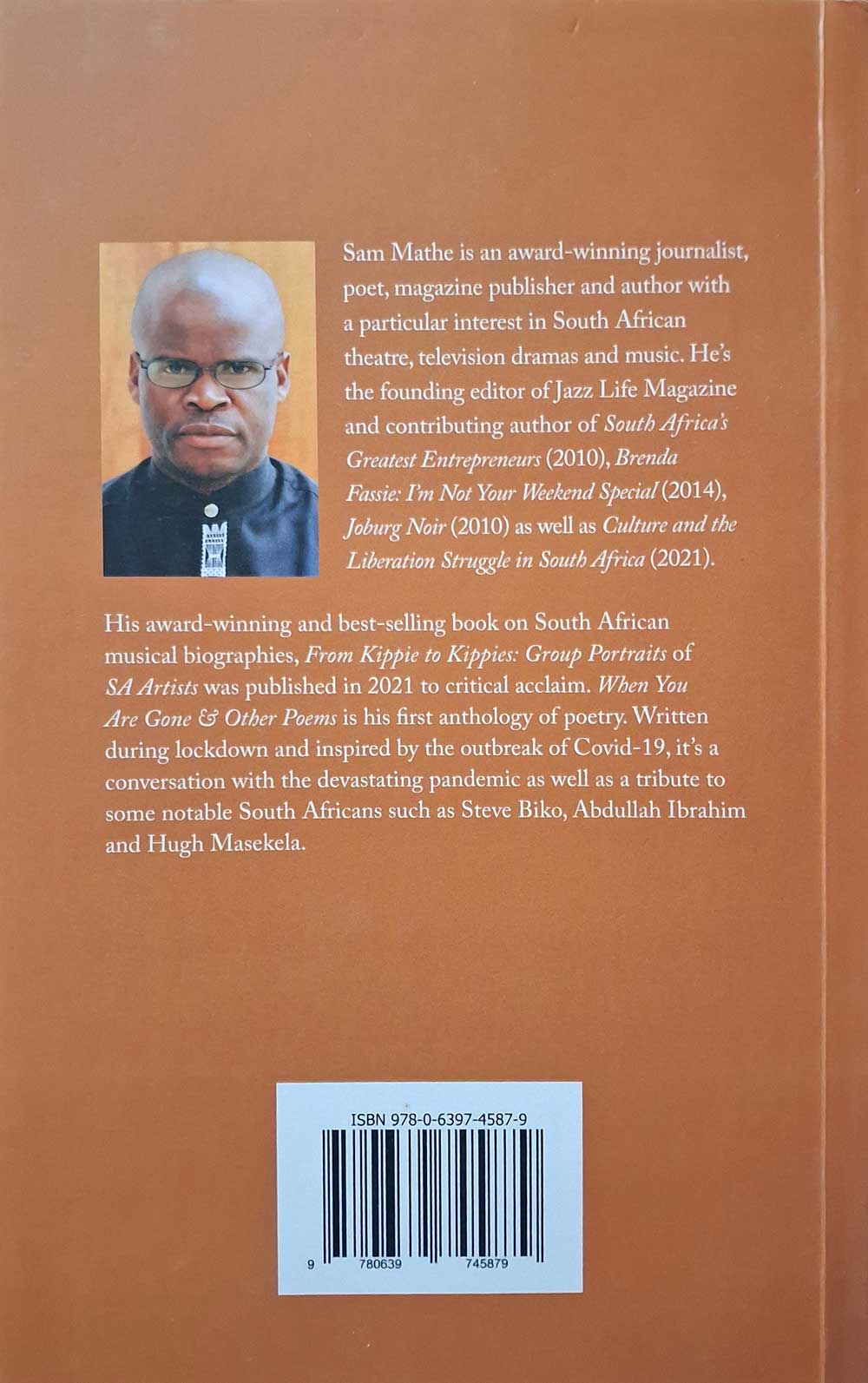
When You Are Gone, Sam Mathe | Black Roots Books, South Africa | ISBN: 978-0-637-4587-9