ARYAN KAGANOF
On Power and Powerlessness: Genocide in Gaza Through the Lens of Afropessimism and Decay Studies
The genocide in Gaza, witnessed in real-time through live feeds, fragmented testimonies, and algorithmically suppressed grief, unfolds as a catastrophe of both visibility and abandonment. Power is enacted here not only through bombs and sealed borders, but through the architecture of epistemic annihilation.
In this essay, I propose to approach the unfolding violence in Gaza through two critical frameworks: Afropessimism, with its foundational claim that Blackness constitutes a position of social death; and decay studies, which interrogates the processes of deterioration, disintegration, and the afterlives of matter. When held together, these frames allow us to consider how power functions not merely as domination, but as the slow, recursive wearing away of the world itself; and how powerlessness, in turn, might be misrecognized, weaponized, or even refracted into forms of radical endurance.
The Ground Zero of Powerlessness
To speak of Gaza is to speak of a geography of entrapment; a space rendered both hyper-visible and structurally abandoned. Palestinians under military occupation in Gaza exist within what Achille Mbembe has called a regime of “necropolitics”, where sovereignty is exercised through the capacity of the occupation forces to dictate who may live and who must die. But the genocide currently underway exceeds even the logic of death, it enters the register of annihilation, of total erasure. It is beyond the matter of bodies slain in war; it is the attempted deletion of a people’s past, future, language, earth, air.
Afropessimism offers a resonant lens here. Frank Wilderson’s concept of social death, drawn from Orlando Patterson, posits that Blackness in the modern capitalist world is structured by an ontological exclusion from the category of the Human. This exclusion is not contingent; it is foundational. What this means, provocatively, is that suffering does not signal a deviation from normative structures: it is the structure.
Gaza, in this light, becomes more than a crisis to be solved but rather a site where a certain modality of the world system is laid bare: the expendability of lives deemed ungrievable. Palestinians, like so-called “Black” people under racial capitalism, are positioned as structurally antagonistic to the very logics that produce and protect Western liberal subjecthood and not simply as victims of some pre-supposed but failed ethics. Their fungibility and disposability a sign of democracy faililng, but a condition of its coherence.
Ruination as Method: Insights from Decay Studies
If Afropessimism provides a structural analysis of powerlessness as inescapable positionality, decay studies allows us to think about what happens after abandonment: how things fall apart, and what remains. Decay is a process of rot but it is also a field of temporal and material complexity. Scholars like Anna Tsing and Kristina Lyons have shown how decay marks the breakdown of systems, but also how life continues within and through ruination.
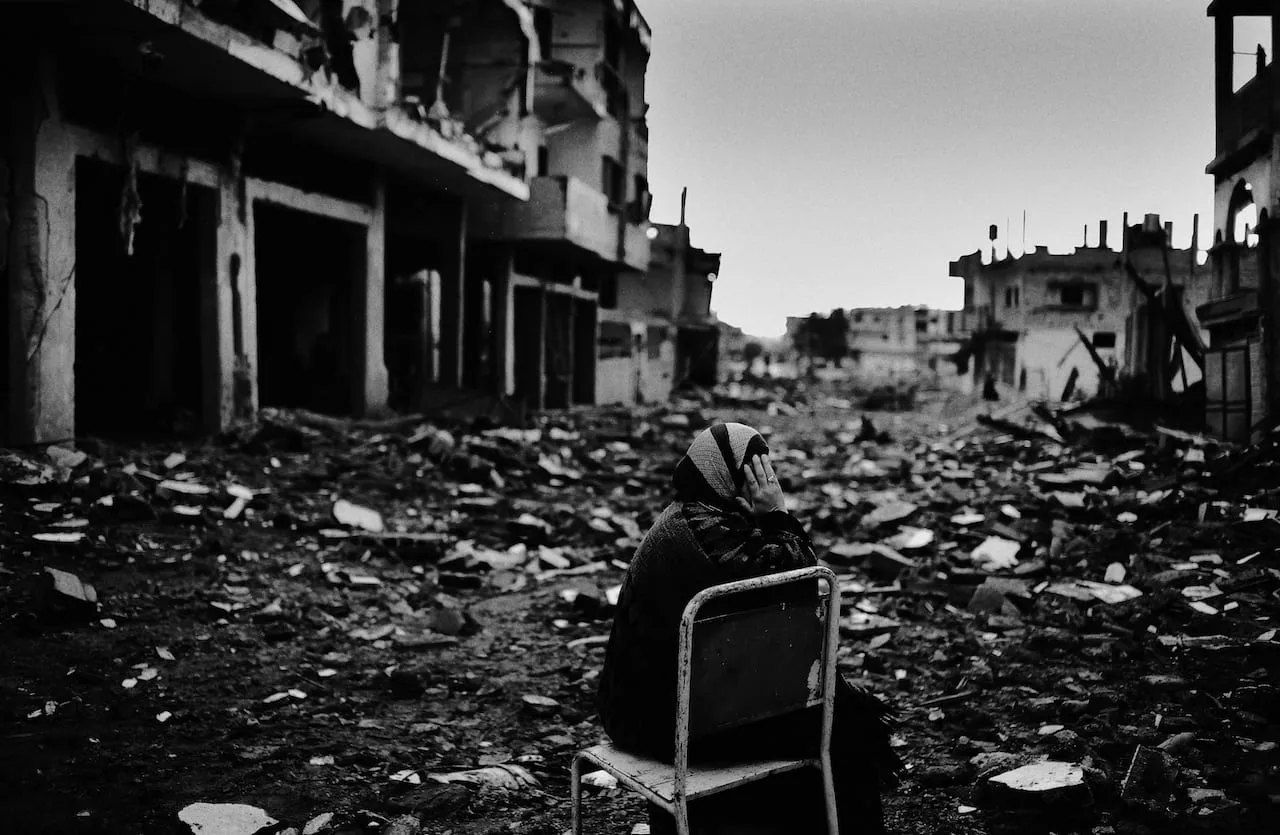
In Gaza, the deployment of ‘decay’ goes beyond metaphor. It is infrastructural, literal. Water filtration systems have collapsed. Hospitals reek of blood and antifungal despair. Bodies cannot be buried fast enough. Yet decay here is not a natural entropic process, it is engineered decomposition: a deliberate targeting by the Israeli government and the IDF of life and all the systems that sustain life. In the words of Decay Studies, “natural death” has been replaced by “compounded ruin.”
The people of Gaza are not simply starving, they are being starved.
This famine is being clinically engineered by Netanyahu and his genocidal cohort. This is their “power”.
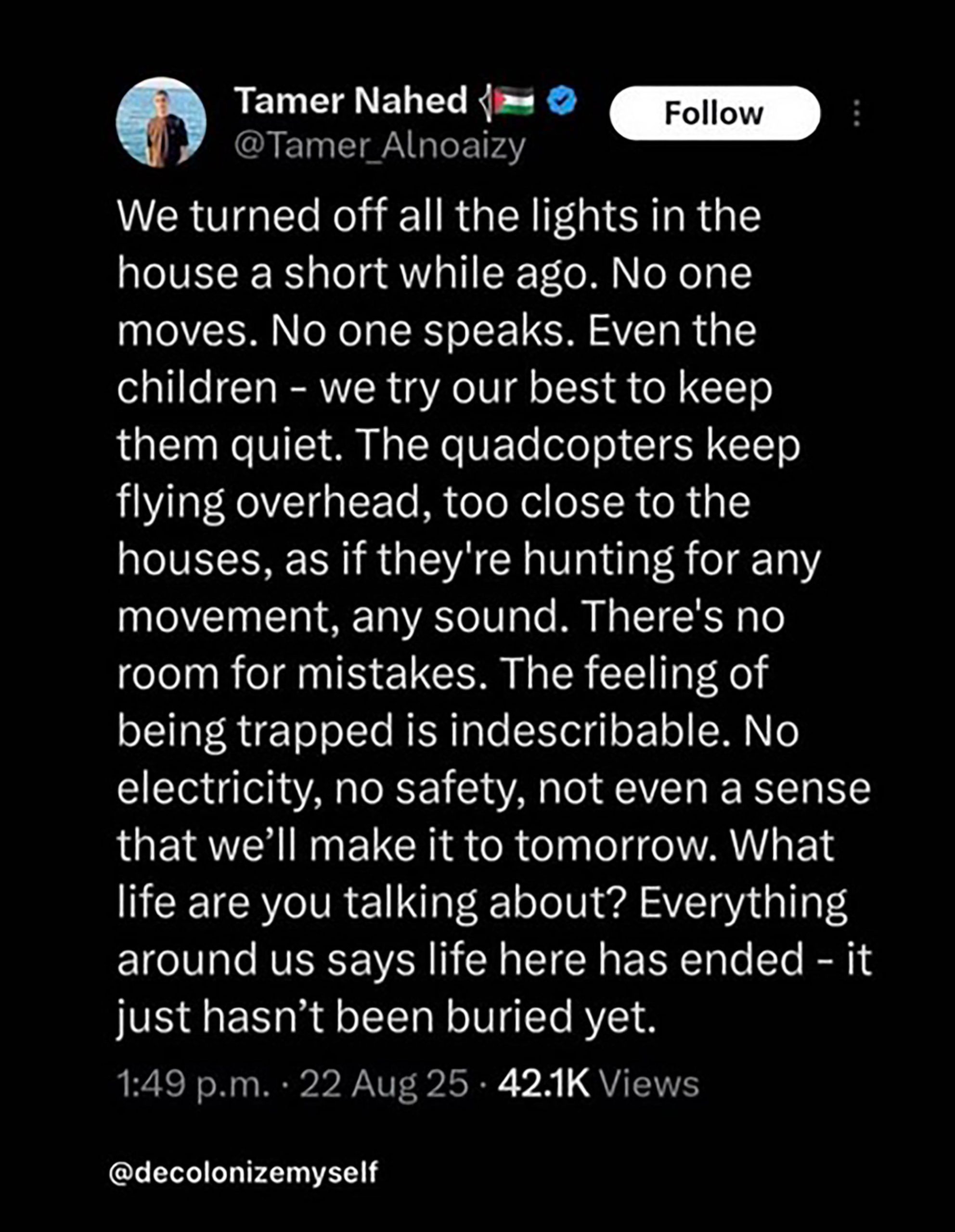
But paradoxically, it is within this landscape of collapse that the persistence of Palestinian life asserts itself most fiercely. Children continue to draw. Songs continue to be sung. The internet flickers with fragments of love, memory, rage. In Afropessimist terms, this is not “resistance” in the liberal sense, it is not a path out of social death, but it is a kind of endurance that troubles the neat boundary between powerlessness and power.
Power, Not As Capacity, But As Ontology
We often imagine power as something one can hold, exert, or lose. But Afropessimism demands a more radical understanding: power as ontological relation. To be Black under slavery (and its afterlife) is to be positioned as the anti-human: the object against which the human is measured and maintained. Palestinians in Gaza experience a structurally analogous position: rendered outside the scope of protection, of recognition, of value.
The genocide thus becomes a scene of ontological policing. A denial of the capacity to even have rights rather than the loss of rights. Humanitarian appeals fail, not because they are ignored, but because they are addressed to a system in which Palestinians were never included. A system where some deaths matter as tragedy and others merely as statistics.
Power, in this reading, is not signigfied by the tank or the drone. It is the grammar of the world. And powerlessness is not represented by the absence of military force, but the condition of being untranslatable within that grammar.
Toward a Poetics of Residual Power
Yet we must tread carefully. To speak of powerlessness risks romanticizing despair, or reducing the lived horror of genocide to a theoretical abstraction. This is where decay studies reorients us. If Afropessimism reveals the totalizing logic of exclusion, decay studies opens space to think about what lingers, what resists disappearance, even when not recognized as resistance.
Decay is slow. It smells. It transforms. And within it, new ecologies form. To say that Palestinians survive does not offer hope in the traditional sense, but insists on the obstinacy of life enduring even when stripped of futurity.
The power of Gaza, if it can be called that, lies in its refusal to vanish. In a world that thrives on disappearance, to remain, even in fragments, is a kind of counter-spell. A refusal to be unspoken.
Echoes in the Rubble
Power and powerlessness are not opposites. They are intertwined, recursive, layered. The genocide in Gaza exposes this knot, as both spectacle and absence. Through Afropessimism, we understand that certain populations are structured outside of humanity itself. Through decay studies, we witness how life decomposes, but also how it decomposes into something else: a grammar of pain, a mouldy lullaby, an echoing scream that persists beneath the rubble.
Perhaps the question is not who holds power, but whether genocidal erasure will become fertilizer for the next regime of forgetting? We live in the ruins of a world that has already decided who matters. But sometimes, ruins whisper. This is their power.